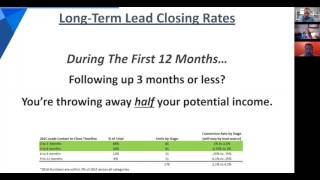
Most real-estate agents stop following up after 30 days, but buyers take about two years to close. Nearly half of sales happen in the first three months, yet a simple rule shows conversion rates climb to 3% by month three and beyond. Zillow data shows the average buyer-to-close is 4.2 months, making long-term drip campaigns essential.
Questions this video answers
About 80–85% (speaker's estimate).
About two years.
48%.
4.2 months.
Approximately 1% (≤30 days), 2% (2 months), 3% (3 months).
Systems and processes as we know can be applied to really every part of your guys business. My experience has really given me the opportunity to see what type of impact it has on agents, conversion rates, ultimately making money and a lot. Well, I'd say probably 80, 85% of the agents really have less than a 30 day follow up on leads. The ones that do, they do very well. And why it's important to follow up with these things is obviously to establish a relationship. And we know through historical data that these from the time that a buyer starts shopping to the end point is really about a two year period. So this was a snapshot of a case study that I came across. Basically this guy compared short term, long term conversions and why it was important. Basically during the first 12 months, if you're not following up within at least three months you're going to be losing out on about half of the income. And on the contrary, on the long term, these are the slow down on that. Go back one slide. I want to make sure everyone understands what you just said. Percent of total 0 to 3 months. So 48% of income is on a 3 month follow up? Yeah, it's not even follow up. That's the percentage of closings during that first three months. And really like if we want to kind of average it out, think about it, 1%. So if I go through my typical process of digging deep on a client's business and they tell me one out actually without telling me how many times they follow up, I can kind of reverse engine, reverse engineer the numbers and know what their conversion rate is going to be within about a half percent. And so you can get a feel for less than 30 days is obviously going to be around that 1% or even less. Two months, you know, 2%, three months, 3%. And sometimes you can get better than that. But if we just want to kind of simplify it, that's a pretty good equation to make sense out of it. Okay, awesome. But one thing that I didn't include in this recap slideshow is the data from Zillow that we know that our audience is there for 4.2 months now. And that is, it's actually pretty accurate information. From the time that they're on Zillow to the time that they are closing with clients. It's about 4.2 months. Obviously that's going to be different in different markets, but that's the average. Okay, great. So it does fall in line with these numbers. Okay, cool. So the other thing that in honesty, Zillow does not cover on this at all, which is really where you guys have to kind of step up your game, which will be obviously in line with what we're talking about today is the long term conversion. You know, I would be, I'd be feeling like I was doing very well if my clients were, you know, even following up, you know, past that three month mark. Reality is they just don't do it. But when you look at this guy who essentially has a campaign that goes indefinitely and you compare that to the amount of business that he did from his leads that came in from that same year, it's almost the exact same amount for all the previous years. If you stack it and combine it together, it's not like it's that much more labor intensive. It is a drip. It is having a scheduled call. Check in. Anything past 12 months is called. Check in is basically every two months. So it's not like it's real time consuming.