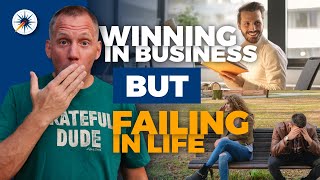
A first-person motivational talk by a real-estate agent reflecting on having professional success while failing at home. The speaker recounts working excessively (seven days a week, 10–12 hour days), reaching top-producer status ("top 1% of the 1%"; sold 44 homes in 2008), but harming family relationships and health. He traces roots to his father’s salon business and addiction as motivation to do better, describes concrete failures (working during vacation, broken promises to his wife Julie), and prescribes remedies: create a written vision (3-year, 1-year, 90-day), maintain open communication with loved ones, and set non-negotiable boundaries. He cites outcomes—later working one day a week at ~$2,300/hour—and promotes his book Scale or Die (Scaleordiebook.com) and a coaching program (Real Estate B School).
Questions this video answers
44 homes
Working seven days a week, 10–12 hours per day
"Top 1% of the 1%"; Instant Top Producer
$2,300 per hour
Scaleordiebook.com
What's the point? Selling thousands of homes in your real estate career and losing a marriage or not taking care of your physical body or messing up as a parent or, you know, just failing in your spiritual journey or being depressed and overworked and stressed out all the time. You know, my journey in the early days, there was nothing easy about it. I was headed down the path of a traditionally successful real estate agent, was working seven days a week, 10 to 12 hours a day, yet I was the top 1% of the 1%. No, Instant Top Producer. Sold 44 homes in 2008, and it was not sustainable. I was losing at home and technically I was winning at work, yet I didn't have the money to show for it and I was super stressed out. So was. Was it even really a win? You know, when I look back on the journey and what I've done right and what I've done wrong and that the mistakes that I've made, it hurts me to say how I hurt, you know, my spouse in those early days, how I made promises, you know, about not working this evening or not working, you know, on this weekend day, or, you know, just promises that I failed to keep. And, you know, I still think about, you know, the hurt I caused to my wife, Julie. And I can think of just a bunch of instances and I'll go into them to kind of nail this point home. Here's the thing though, if you're thinking that there's a different way to do real estate, please stick around to the end of this video. I'm going to let you know how to get a copy of my book, Scale or Die. Where. Where I lay out the exact frameworks, the exact path, the tools and systems that I used to go from overworked 44 homes a year, like top agent in my market and super miserable, to just a few years later working one day a week making $2,300 an hour in my real estate business. And how you can do the same thing. If you like the video, hit the like button. Subscribe to the channel, turn on your notifications and leave comments. I would love to hear from you. You know, where do you think I'm on track? Where are you challenged by what I'm providing and the approach I took in my real estate business. I'm happy to have a dialogue with you about it. So the approach I took in my real estate business, I did it because I didn't want to do what I saw as a kid. So my dad and my mom actually were in business together. You Know, when I was born, they owned a hair salon. My dad moved here from Sweden to be. He was a hairdresser there. He was known for as a colorist. He was actually on stage. You know, this is hard to believe that there even is such a thing. You know, he was really good at hair color. And so Wella is a hair color company. And he was like their premier stylist, like, on stage. Like, this is the, I guess, like the super bowl of hairdressers. And so he came to America to pursue the American dream. And in the process, he went from, like, the man that did the highest pay activity in, you know, being a hairstylist to owning his own business. Straight up. E. Myth, entrepreneurial myth. He wanted to own his own business, yet he went from doing the top thing to sweeping the floors, emptying the trash, ordering supplies, counting money, making sure that bills were paid, you know, doing all the things that a business owner does, and very few of those things actually get you paid. And so my motivation, you know, was looking at him as an example, not only in business, but he also failed us as a dad. He, you know, when I think about my parents divorced when I was 4 and was because of his addiction, you know, And I have a feeling that the pressure in the business and the things he had to do in the business really pushed him to lean into his addiction even more. He drank until I was 15. So I really didn't have a dad growing up. And so I knew for me to show up as the dad I wanted to be, to show up as the dad I wanted to be, and the husband that I wanted to be had to do it differently. So there's still pain, obviously, around having a father figure missing in those early days. And still it provided a fuel and an example of what I didn't want to have happen to me. So here I am in 2007. Anders is born in November. This is my first year in real estate, and I am that guy. I'm working more than I'm home. So if you break up your waking hours into, you know, hours that you're spending not working, there wasn't a lot of those hours. Many, many nights I would or days I would work from 7 in the morning to 7 at night. That was my day job. That was the job of a real estate agent. I would spend an hour with Julian Anders, and I would go upstairs and I would do anything I needed to do to get the business on track. Building systems, marketing systems, client care systems, you know, lead generation systems. The things that I knew had to happen so that I wouldn't end up like my dad. I wasn't willing to win at work and fail at home. It just was not an option for me. And, man, there was a vacation. It was probably like my. I think Kendall was born. So it might have been 2010. This was when I had started the team. I was still heavy in production. The systems really were not coming together the way they were coming together in my mind. And it was our first vacation when I got into real estate. So I was probably just over three years into the business. And I remember, of course, I had to work a deal while I was on vacation. And I promised Julie that this was going to be an. I was going to be off the grid. I was not going to work on vacation. And I worked every day of vacation. And not only did I do that, so I breached, you know, that promise. I broke the promise. The deal never went through. And so we were in the mountains. I had to drive down to the base of the mountain to get reception. You know, she even has a picture of me working on this deal while on vacation. And just a complete failure at that point. And so again, just another point of motivation for me to do things differently so that I could actually win at home, you know, use the business to fuel me winning at home as a husband and as a father. And so there's a few things I want to go through with you so you can. Maybe you're in a similar situation, maybe your stories are a little different than mine, maybe you're in a similar situation and you can use these tips to get you on the right track. So the first thing is to be really clear on where you want to end up, you know, Know, I feel like this is not even just true of real estate agents. People in general. No one really has a written plan for where they want to be in the future, you know, in their business or in their personal lives. And so we have a process. We take every one of our members through. It's not all that complicated and it's super powerful. If you've watched the videos I've been putting out, you've seen me talk about it before. It's a three year vision, a one year plan, 90 day world, you know, that's 13 weeks and a quarter. There's seven days in a week, there are hours in a day. How can we attach the thing we're doing right now to the vision that we see for our future? And that is the first thing you need to get super clear on is that you have to have a vision for where this business is headed, and you have to be able to communicate that vision, not just so you know where you're going, to future team members, and also to anyone who that is important in your life. For me, and that brings us to the second point is to be really intentional and really have an open line of communication with. In my case, it was my wife, Julie. And even though I hurt her in those early days, I can't even begin to tell you how many times I was like, this is going somewhere. Like, you know, it might not look like the best business right now, but I promise you, you know, when I'm going upstairs late at night, this is like, I feel like we can be friends now. Later, like years after the business was established, I was down to one day a week. I had launched the coaching business she shared with me. She's like, I honestly, I just wanted to respect you and, you know, the choices you made during that time. And I didn't know if you were, like, addicted to porn and you were like, spending time upstairs, like, doing things on the computer. And I'm like, like, really? I was like, licking envelopes and sending out mailers and I was like, in the, you know, data management systems. And it's funny, you know, she just trusted that I was doing the right thing, even if she had some concerns that I might not be. And so just really be on the same page with your spouse, someone who's important, you know, to the other areas of her life that matter and what that looks like. The last thing I'll say is be really clear on what the non negotiables are. You know, there has to be some sort of standards that you set for yourself that you're not willing to go outside of those standards. You know, just because one of your clients think that Sunday during church is when they need to hear from you, it doesn't mean that that is important, that that should be the most important thing. Or ruining a family night or stepping out of a restaurant when you should be on date night with your spouse, right? Or being late for dinner. Like, honey, I just have to take this call. Just this call. Like, that's never a worthy trade. And you just have to be clear about what you're willing to sacrifice and not sacrifice and what's negotiable and what's not negotiable. If you don't have boundaries around what, you know, you're willing to do and not willing to do, the hours you're willing to work and not willing to work, it becomes really fuzzy, really fast. And so the journey isn't necessarily an easy journey. And at the same time, doing real estate the traditional way is really challenging. Like there is no freedom, there is no path to wealth. As a traditional real estate agent, right, we are heavily marketed to. We're going to chase the next squirrel, we're going to get distracted by the next shiny object, and we're never going to build something that has a life outside of our individual efforts. And our ability to make money as a solo agent versus build this thing out the right way becomes really, really hard. So I don't care where you are in your journey. You could be a solo agent, have a small team, or even a large team. You know, we have resources to help you no matter where you are in your journey. I'll share one last quick story with you. It is a client that came in. He was one of the first 10 clients to real Estate B school. And the first time we got together for our first intensive workshop, we've done 15 or 16. Now, our first intensive workshop, he shared a story of his daughter. He had purchased a kite for his daughter and it had been three years since he had flown this kite. He hadn't flown it. He bought her a kite. She probably asked him a dozen times, like, daddy, can we fly the kite today? And tears flowing from his face telling us this story. And he still hadn't, you know, flown the kite with his daughter. And, you know, what areas of your life are you missing out on because you're focused too much on your business? You know, there's a more direct path to do this. I wrote a whole book on it. It's called Scale or Die. So go to Scaleordiebook.com that's Scaleordiebook.com or click on the link below. I lay out not only my journey, I tell the stories of our most successful members. You know, where they came from and the things they did to achieve freedom in their business and how you can do the same thing your business. If you like the video, hit the like button. Make sure you subscribe to the channel, turn your notifications on, and leave me comments. So I'm motivated to put out more content to serve you. And I love doing this. I love serving you and challenging you. And I look forward to our next video together.