Creator Interviews: Tony & Alisa DiLorenzo; You have to have an offer from the start
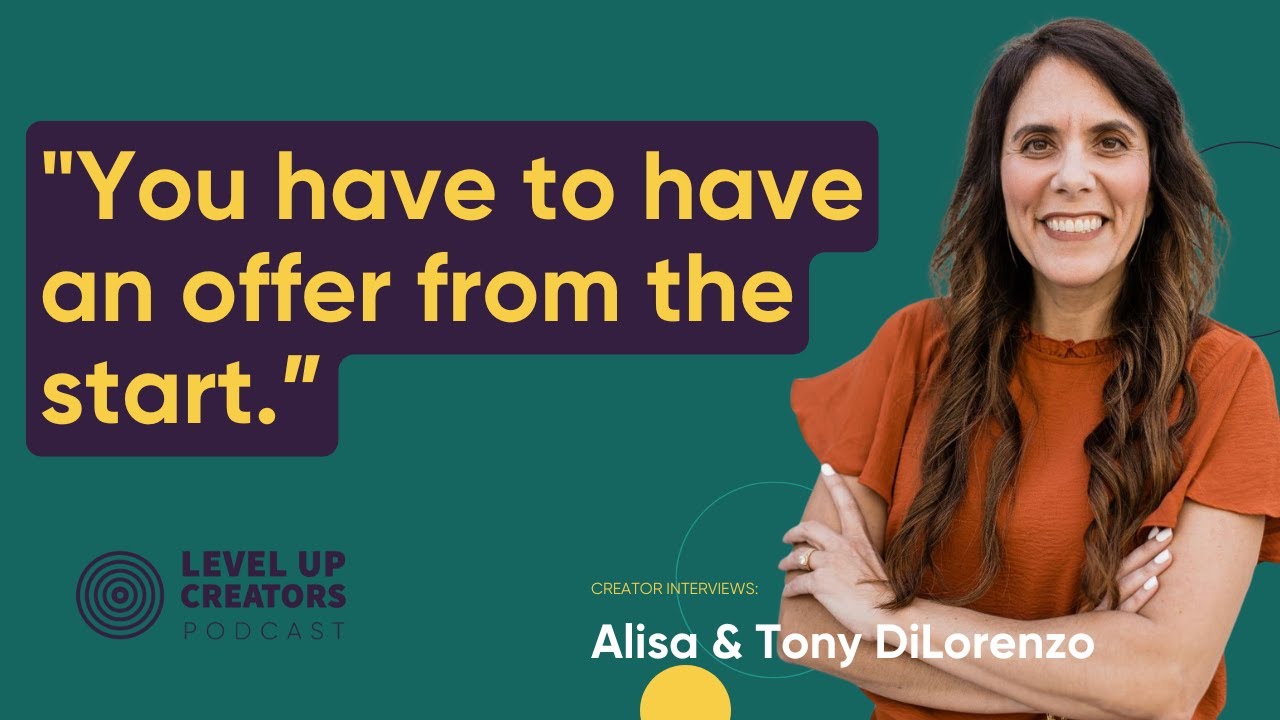
In this Level Up Creators Podcast episode, host Amanda Northcutt interviews marriage experts Tony and Elisa DiLorenzo about the evolution of their creator business over 15 years. They recount how a 2009 coaching suggestion led them to podcasting in 2010, the launch of their first book, and the gradual growth of a community they call "One Family." Key milestones include reaching 20‑25k monthly podcast downloads, self‑publishing the bestseller The Six Pillars of Intimacy, iterating product‑market fit by selling before creating, and expanding into live events, courses, and niche programs like Bold Wives Club and Menopause Shouldn’t Suck. They discuss their team‑building process (virtual assistant, tech lead, content director, event director), the importance of asking audience questions to shape offerings, and their evolving tech stack for email marketing (AWeber → Ontraport → ClickFunnels/SendGrid → ConvertKit → ActiveCampaign). Social‑media strategy emphasizes consistency, niche relevance over follower count, and repurposing content. Throughout they share creator advice: have an offer from day one, develop thick skin, be intentional and take action, and leverage community‑driven feedback. The conversation ends with a concise mantra – be intentional, buck up, and act – for creators seeking sustainable, impact‑driven businesses.
Chapters
Hey, hey, you're listening to the Level Up Creators Podcast. Amanda Northcutt here, founder and CEO. We help creators and digital thought leaders like you turn your knowledge and experience into rock solid recurring revenue. And we're so glad you're here. Welcome. Today I'm doing a deep dive with a pair of veteran creators who have a bestselling book, the top marriage podcast on Apple, over 125,000 social media followers, and almost 15 years of creator business experience under their belts. Our guests today are marriage influencers and experts, Elisa and Tony DiLorenzo. The couple speaks to worldwide audiences about sex, love, and commitment and challenge every listener to make their relationship a priority. Elisa is also the One Extraordinary Marriage coach, founder of the Bold Wives Club, and she's the author of 9 books, including the bestseller, The Six Pillars of Intimacy, The Secret to an Extraordinary Marriage, which I'm reading right now, and it is super good. Highly recommend. I have so much more to say to round this intro out, uh, but let's wrap it up there. Elisa and Tony, welcome to the show.
Thank you for having us. We're so honored to be here.
Yeah, thank you, Amanda.
Awesome. Glad to have you. So, all right, you two are veteran creators at the top of your game. You have so much wisdom and experience and insights to share with our audience of creators, many of whom hope to grow a business that's been anywhere close to as successful and sustainable as the one that you two have built. So all that to say, I know you normally get interviewed about marriage and we're like totally turning the table on you today, but, um, we're going to talk about how you've built your business and I'm pumped. So let's get into it.
Absolutely.
All right. So One Extraordinary Marriage, y'all have been around for 15 years. You've done very well to say the least. And again, top marriage podcast, bestselling book, large-scale in-person events, and you have successfully sold dozens of different online programs. Over said 15 years. But let's rewind the clock a little bit. Take us back. Hit the highlights on how in the world you got to where you are now.
Wow.
Yeah. Well, it all started when we decided to step into this space, right? And back in the day, it was all about blogging. And that was the big thing. And I know you remember those days and it was like all the comments and all this. And in the marriage world, it was really difficult because everybody liked to read in between the lines. And it was really frustrating. Elisa and I would write articles and we would actually get in more fights trying to write an article. It
was not good for us.
It wasn't good.
Good for the marriage.
And we had a business coach and he said, hey, have you guys heard of this thing called podcasting? And this was late 2009. And we were like, nope, we haven't. And he shared what podcasting was. And that really was the start of it because we stepped in. I hired another coach to help us set it all up. And then January 13th, 2010, we released our first episode.
60 Days of Sex.
That was the first episode. And so we did that and we just started getting going and then we wrote our first book called Strip Down: 13 Keys to Unlocking Intimacy in Your Marriage. And we began to see some people like gathering. We started building a community, not an audience, but we started building a community then and we were like, oh, this is really cool. And then about 3 years into podcasting, we finally added stats because back in the day we didn't have what we have now. I mean, it was a wild, wild west and it's still a little wild, wild west with podcasting, I feel like. But back then it really was. And so I forget, I think we got, we moved our hosting to Libsyn because we kept crashing our server. We had a shared hosting and it would just crash every time we released a new episode. Every week. It would just crash. And I didn't know why. I'm not a techie guy. But 3 years in, we were like, all right, let's get stats. And at the time, I remember seeing it like the first full month, we had something like 20,000, 25,000 downloads. I was like, holy cow.
People are listening. People are listening.
I don't even know where they're listening because it's podcasting and I don't even know where to listen personally.
This was before the podcast app. This was before like, like it was really hard to find podcasts 15 years ago. 14 years ago.
Yep. So that was about 3 years in. And then we had a chunk of time in there where I was running another business. Alisa was a stay-at-home mom raising our, our wonderful children. And so we really weren't doing much. We did release a couple of other books. Um, you began coaching.
Yes. And let's see, about 5 years in, I began coaching. And that was also a lot of iteration in that over the years because You know, what do you do when people are coming to you with their problems and how do you handle it? And what, how do you, you know, set yourself up to understand what your value is and what are the iterations until you're like, oh, okay, now I'm actually getting paid what my value is. Cause I don't have this tension of, oh my gosh, just show up for your appointments, people. It's not that hard. Right. And so coaching was, it's been about 10 years.
Yep. And then in November of '21, We did start doing some events. Our first event was not a highlight, but I do want to share it.
We have to share our first event.
We have to share it because we thought we were this and that much more.
Well, can we just talk about the whole Field of Dreams mentality, right? If you build it, they will come.
Yes, right? They will come.
And I think that there are a lot of creators that think if you build it, they will come. Like, you don't need to market it. You don't need to— you're like, you're so amazing and your product's going to be so amazing. So we Decided we were going to do this live event in San Diego.
He zig, she zags.
He zig, she zags.
Get your communication on the same path.
And so we've got this space reserved, we've got all the goodies, we had been passing out little postcards to everybody, and the morning of the event comes and 2 couples show up. 2 couples. And, and I want everybody listening to know, we still did the event. Still did it. There had been 150, 200 people in there.
Yep.
But it taught us a lot. That was a very humbling moment. They got the most one-on-one dedicated attention they could possibly get. We forgot to hit record for the first half of the morning. Like, all of these— but we look back and it was a highlight because it reminds us now, like, you have to have that part of your journey in order to go, okay, where have we come from? So now fast forward to November of '21.
Yeah. And even prior to November of '21, we started putting on events. We'd have 150 couples showing up. And then November of '21 is when our bestselling book, The 6 Pillars of Intimacy: The Secret to an Extraordinary Marriage, showed up and was published. And that has really transformed One Extraordinary Marriage, the One Family, us. It's— we've sold, I think, 50,000 to 60,000 copies of that book, self-published, have over 600 reviews on it now. And everything we do and look at for One Extraordinary Marriage and other programs is all based on that framework. Mm-hmm.
Mm-hmm. I also, I just want to call out real quick how several minutes ago you were like, oh, we weren't really doing too much. We put out a couple of books and stuff and we kept doing our podcast, but come on. I wrote a couple of books in my spare time and we put those out. And that was just like a footnote. I understand on the arc of like 15-year business so far that now that is a footnote, but
I
just want to call out that that is quite significant.
So yeah. It is. We've learned a lot about publishing and self-publishing. And it's something I think we should have done and doubled down on many, many years ago. And we didn't. I look back and I'm like, we probably should have written another 2 or 3 books, but we took a little hiatus and just—
We were also, I mean, we worked together. We were in the throes of parenting. We, you know, our kids have grown up. In One Extraordinary Marriage. I mean, they are 18 and 21 now. When we started the podcast, they were 4 and 7. Um, so that we had those parenting years. And when you work with your spouse, there, there gets to be those times when you're like, okay, we just have to focus on what we're doing in order to be able to like expand later on down the road.
Yeah. I want to come back to y'all are married and you work together and you're teaching other people how to be married because that's so meta. But first, how many podcast episodes have you all published?
We have published 821 and we recorded 8. Yeah. And we recorded 822 this morning.
Holy moly. That is so impressive. That's so impressive. Um, wow. Okay. So at what point from '09 to, we're recording this in August of 2024, when did y'all know like, we are really onto something. We've struck a chord. What was that moment? Was it the 25,000 a month downloads on the podcast? Okay.
I think there have been 2 key moments. One was the podcast starting to see those numbers. And we'd gotten early messages from folks from around the world. You know, we'd get a message from South Africa, we'd get a message from Australia. Oh, we love your podcast. I'm like, how are you finding this? Right? And then seeing the numbers. And so that was, that was an early, something's going on here. And then when we were in COVID, so 2020 and 2021, when we started to get the idea for the 6 Pillars of Intimacy, And we started using that language with our audience, teaching them before we even released the book. And then to see how quickly people understood and adapted to the framework and started to incorporate it into their marriage. And when that happened, that was the big, you know, fireworks, light bulb moment, whatever you want to call it, angels singing in the background of going, this is going to actually change a generation.
Yeah. It gives me goosebumps even thinking about it because now Um, so many of, so many folks in the marriage world use that language and they never used it before. And now I'm seeing it more and more and people are using it and they don't have to attribute it to us. I mean, that's fine. I, we, we registered trademarked Six Pillars of Intimacy. So we have that, like that's our framework, but it's really cool to see and be a part of. Yeah. our community, our industry, and have had an impact where others are like, oh, we're going to start using this language too. So yeah, that's been really cool.
Yeah,
that is so cool. And I mean, well-deserved and hard-earned. Obviously that did not happen overnight and almost nothing does.
No, we actually started it in our first book. We talked about them.
Really?
We really didn't understand what we were talking about then. But then you look so many years later and you're like, oh.
You can see the dots.
Yeah.
You really got to connect the dots.
Yeah. Okay. Well, let's talk about what it's like working with your spouse where the expectation is that you two are the model of a truly extraordinary marriage. And then the second part of that question is, what are maybe top 3 points of advice you would give others who are working with their partner or their spouse?
So working with your spouse is an interesting daily experiment.
It
has, it has a lot of highs.
It does.
But if you're irritated with your coworker, you're still going to bed with them at night. So, so that, that creates, you know, a unique opportunity for conversations and for having to work through things.
Many of arguments.
Oh yeah.
I mean, this isn't like, oh yay, everything's just great. I mean, we've had many of heart-to-heart sit-downs. And even when Elisa began coaching, I had another business where, um, I had to do sales every day. And so I remember just being on the phone with her and like, hey, you did this consult, how'd it go? You know, it's supposed to be like 15 minutes. Oh, I spent an hour. I'm like, you did what? Like, Impressing her like
you can't do that.
They're not going to sign up. They're not going to become a client. You just gave them everything they need. Why are they going to pay you now? And and so tears. So it's been
some of our most epic, epic highs and epic lows with that too. You know, you asked the question about us being the model for an extraordinary marriage, and one of the things that we tell our audience all the time is we're not a perfect marriage, right? We still have fights. We still don't see eye to eye on certain things, and and extraordinary isn't perfect. It's How do the two of you navigate those things? And so we're so transparent with our audience. They know when we've been on fights. They can hear the emotion. We talk through our challenges on purpose so that they understand real in order to be able to level up, level up their own marriages.
Yeah. And like you're relatable because you don't have a perfect marriage and that doesn't exist. I'm sure you all can attest to that. That's, That's absurd. I've been married, I've been married long enough to know that for sure. And I've worked with my husband on and off on multiple businesses.
So, okay.
Top 3. I do, I do understand we haven't worked together for 15 years, but— Wow. Um, have, have not. No, no, no, no. We have not been working together.
Have not worked with each other. Yes.
Yeah. Yeah. Yeah. So, um, okay. Top 3 pieces of advice for people who do work with their spouse or partner though.
Find your strengths.
Yes.
Number 1, what are your strengths? And I know it's tough because you're like, well, this is what I do best. But sometimes you start to find what you really do best by being at it day in and day out. But let your spouse lead in their strength because if not, then you're competing and it gets really hard. So Elisa and I had to go through this iteration and where we found what sat well with us is she's a content creator, the coach, and I tend to take more of that backend role. I'll do the technical stuff. I'll do a lot of the marketing. I'm working with our team. Um, and so we just had to lean into our strengths. That's number one.
Number one. Um, if you are working with your spouse, make time to be a married couple.
Yep.
Like have times when you aren't talking about the business and our business is marriage, so it can get even, even more meta,
meta, like,
but, but be a couple.
Yeah.
Right. Everything is not about your business. Make time to be a couple. Yeah. What would you say for number 3?
Number 3, I think you got to have fun. Yeah, you do. I think you got to have fun in the business and outside the business and laugh, learn, be willing to stretch. And sometimes you got to go in that fun. Sometimes you got to go along for the ride when your spouse sees something that you don't and they're making it fun for both of you. But that can be that you just got to sometimes just smile and wave and just be like, let's go. Like, we're doing something. Let's go have fun.
Yes. Yeah. I like that. I mean, numbers 1 and 3, that's great marriage advice anyway, right? Like communicate well, lean into the one and the other strengths. Like traditional marital roles don't necessarily work. Like my husband and I do not have traditional marriage roles at all, like zero amount. Um, and we love it and it's great, but it took a really long time based on how we were raised and what was modeled for us to like figure that out. That would have been cool to know. Yeah. If I'd known about you in 2009, that would have been helpful. And then
also,
I know you now. Yes. Which is great. Again, reading through your book, it really is awesome. So, and then also, yeah, just having fun. I like the boundary also. Like if we're out to dinner or on a date, we're not talking shop. Like you just exercise self-control.
And the best way to do that, Amanda, just to share with folks. If you're doing a business meeting or a lunch or a dinner, be across from one another. When you're on a date as a couple, make the point to sit next to each other.
Oh, interesting.
Change the environment. Because work, we tend to be across from each other talking, doing something. But if we're on marriage time, Tony and Lisa time, sit next to each other shoulder to shoulder and let's change the environment. And with that, we are sort of reminded like, This isn't time to bring up business. This is time to bring up us and what we're doing. So it's tough, but it can work.
Yeah, obviously. Yes, definitely. Okay. So let's, I want you to walk us through sort of your timeline of offerings over the years and how those have evolved. You talked about, you know, podcasts, got a pretty consistent rollout of books, your in-person, your first in-person attempt was Not awesome, except for the 2 people.
Yeah, that's who showed up. Yeah,
2 couples. Yeah. Okay, so what happened after that?
So in that in-between, we obviously more books, we started trying courses and doing different things. So we've done, you know, courses for couples, we've done workshops. And, you know, we, we did put a long pause on the in-person events. That was like year 3. And then we didn't do it again until, oh gosh, it was probably like 10 years, 8 years.
Yeah.
It was 2018 was the next like live in-person event. We were just like, we waited until people started asking for them to do in-person events, but we kept trying different courses and trying to figure out like, how do we find what our audience wants? And one of the things that we have, I think in the last few years, very specifically really leaned into is asking a lot of questions of our audience. Anybody that follows us on Instagram knows that we will ask— as part of the One Family, they know that we will ask questions that will lead to podcast episodes, questions that will lead to programming. We are constantly asking questions so that when we deliver, it sounds like them and it's what they want. And that's been a real catalyst, I think, in our program offerings, like getting into me founding Bold Wives Club and starting my most recent Menopause Shouldn't And getting into these types of things because that's what people are talking about.
Yeah.
And if we, I think as creators, if we would just ask more questions instead of assuming we know the answers, we'd get into a place of having a lot more success because it's not about us, it's about them.
Yeah. And one of the things we started leaning into as well was stop creating and stop thinking we need to create this 8-hour course and then try to Offer it and sell it. Instead, it's like, we're gonna put on a masterclass. It's a 2-hour masterclass. It's gonna, uh, registration is gonna cost this much. If you're interested, please sign up. And then what we would do is we would hold those. Sometimes it was Elisa and I. We even did day-long events that were just Elisa and I, like our 6 Pillars of Intimacy virtual seminar. We've done them with other experts. And then we, we hold those events and then we package them up. And we changed that landing page to now be instead of a live event, it's a digital product and you can buy it. And so I would say one of the big changes though for us was try to create everything and then sell, where now it's more like let's sell and see if there's an interest and then create.
Yes, I love that. Working iterations is such, such sage advice and that's such a great way to do it. I mean, we're looking for the overlap between Easy for me to provide as a creator. There's a lot on a creator's plate, especially if you're a solopreneur doing it all yourself. You gotta do all the social media and the technology and on and on and on. So easiest for you that also overlaps with highest value for your customer, right? And a lot of time those like live events are amazing and I love that content motion, right? Hold the live event. It's very low risk for you. It's simple for you to put on because you're an expert, just like the people who are listening are experts in their field. Record it, sell the recording. You can chop it up using a tool like Opus.pro to have infinite number of social media clips. You can take the transcript and plug that into ChatGPT with the right prompts and refine it to get, and again, infinite content, newsletters, and so on and so forth. And so that is so smart. That is such a good way to do product sales. So,
yep. And repurpose, right? Like, I love what you're saying. Repurpose, repurpose, repurpose, find stuff. And we are doing a better job of that now. Like, just even looking back at some of our old stuff, and I'm like, this is good stuff.
But it's been sitting.
But it gets, it gets lost. You know, I call it digital clutter. It just gets dust on it. And you're like, where is it? And all of a sudden you start diving in, you're looking, you're like, this is really good. Like, we're younger, obviously, but it's still quality. Like, what we provide is really good. So finding that is good.
That is. Yeah. Recycling content is completely valuable and legitimate, especially for people who have been at it at any length of time, especially like, geez, you know, 15 years. Okay. Shifting gears a little bit. Obviously, I'm very much enjoying working with you. My team is as well in Level Up Creator School over the past several months. And I can see this like insatiable curiosity and growth mindset, these 2 qualities in Both of you. And yet, you know, the digital landscape obviously has changed a lot. We've been talking about sort of the evolution of your business over the last decade and a half. You've obviously hired some coaches, you've got some people on your team at this point, but what role has continuing to push yourself and educate yourself and hire coaches and hire people played in your ability to stay relevant, stay ahead of the curve, not go crazy, not burn out? Like, how are you doing this?
Wow. Um, bringing people around us, I think, as entrepreneurs of a small business has been helpful in many ways for me because I'm typically the one doing more of that. Elisa does as well. I tend to be more the driver of that because I do believe in that growth mindset and being around people who are doing things that I want us to be doing or learning from. Mm-hmm. And so Over the years, it's just like, and I'm very relational and I'm extroverted, so I like meeting people. I like getting into forums and groups and in different ways and learning to be stretched and also to have strategy.
Mm-hmm.
Because we're good at what we do. And I think as I am getting older and the business is growing, I'm learning more and more for myself. These are people that I need in my corner. Because they have an expertise I don't. I'm an expert in marriage. I'm an expert in encouraging and bringing hope to the One Family, our community. That's what I'm good at. I can, I can be a little good on the back end in tech and marketing. I'm good at it, but I'm not great at it. So bringing people around who know their stuff is really important. And when we found Level Up Creator School, just so you know, I was like, all right, these people know their stuff. I mean, we've been burned before with coaching programs. Like everybody else has most likely. And you're just like, that was icky. And it really wasn't anywhere near what they said. When I got on your guys' landing page, I remember reading it multiple times and going, I don't know. I don't know. But I was like, you know what? Let's just do it. I mean, it's monthly. Let's go for it. Mm-hmm. And I have been so, so impressed with the knowledge that you bring, And everybody on the team brings. Now, on the other side of that is still me as the entrepreneur and us as business owners. We have to do the work.
We have to implement. But I think, you know, you highlight a really good point. It's having that growth mindset, but going out and like having good discernment about the types of programs.
Yes.
Right. That you're getting involved in because, you know, programs are a dime a dozen out there. And so, you know, I think for us, what we've learned over the years is we have to do a little more research. We have to see, okay, who Who are these people? What are we getting ourselves into? What's the commitment? And then making wise choices because like for all of us in business, you know, money is a finite resource and we wanna be able to— Yeah. Money and time, right? And so are we aligning ourselves with folks and with programs that are actually going to, you know, expand what we're doing? And I think that was, you know, I know when Tony first showed me Level Up Creator School and, you know, I started poking around 'cause I am like the scavenger. I'm like, let me see what they've got going on. Yeah. Who are these people? What are they doing? I totally, you know, stalked you on LinkedIn and I'm like, okay, she goes all the way back to Texas A&M.
Yeah.
Right. I'm looking, I'm looking at your websites and like where you've been and things like that because I want to know.
Right.
And when I started seeing that, I'm like, okay, this is somebody. And I will say your level of authenticity, you know, a lot of people talk about our authenticity, the level of authenticity that you and the team at Level Up Creators School bring to the community. Is what made it easy to say yes to stretching and going into this new season working within, within the program, because we want people that are going to be real. I don't need slick. I don't need hype. Can we get it done?
We are building a business here, man, and we want a business that is going to be around for many decades to come. And can we be around those amazing people?
So, yeah, do that.
Yep. And so it is discernment. I do agree with you on that one.
Cool. Thank you. I mean, thank you for saying all those things. And my gosh, I love my team. I mean, you know, like all the research you did on me in LinkedIn and like past executive positions, I just cherry-picked all my favorite people and put us all in one place. So that's how our team came to be.
That's awesome.
It shows. And I think this is another thing too that I would encourage folks as they're looking at programs, like what is the camaraderie amongst the team that you're going to be working
with?
Because if everybody's just kind of in their own silos and there isn't this cross-collaboration and there is like, maybe in certain situations that works, but for what we're looking to accomplish and for the growth that we're looking to, we need people that are talking to other people. And that very much comes across within the program.
Yeah.
Cool. Well, thanks. I was going to ask you about like decision-making criteria when choosing a coach and a program, but I mean, y'all just like went into all that in spades. So thank you. I think that's super, super helpful that you've got to find The right match for you and like where you're at, the stages you're at in business and finding that connection there. So cool. Okay, so I mean, I have a question around how you decided what each of you would do. We kind of covered that based on your own strengths, and then you know, but those two of your strengths together combined with a 24-hour day that we all have still doesn't make the whole business. So you you went to outsource. You know, different tasks, different people. So just real quickly, could you touch on sort of the process of who you hired first, what you hired them for, and kind of how that your team has evolved?
First one was a virtual assistant. Went to the— went offshore first and realized quickly that that wasn't the way to do it. So we put a posting to The One Family, our community, and we hired somebody from there. And she's been with us 9 years now. So she has become our executive assistant and our customer support. So she handles—
She's worn a lot of different hats.
She's worn a lot of different hats, but those are her— excuse me— her 2 main. So we have her. We have our tech guy, Tony, and he just does like your normal maintenance stuff. And if we're building a new site or we're dealing with stuff, you know, I'll be like, hey, Tony, all right, let's do this build. That's Tony. Natalie, we brought on and she's our content director.
Thanks.
And she is by far the best hire we've made in the last couple of years. She took a lot of weight off of my shoulders in having to deal with the daily content with episode notes, articles, newsletter, social media. You name it, she's in it in some way, shape, or form. Scripts for reels and like whatever. So Natalie's taken a huge load off of me and she does a ton. And so that's, that's her position. And then we brought on Rachel and she's our event director because we're holding more events.
Yeah.
And we just needed somebody to just sort of be in there. She doesn't have a massive role. from month to month, but she's in there and she's just making things move. Um, so I'm not having to be like, oh, this needs to get to a printer or we need to order this. She just takes care of it. Um, and then for the event itself, she and her husband come out, um, and they run the back of the room stuff and just make sure everything is just moving smoothly so Elise and I can be front of the room doing what we do best, which is loving on the one family.
Yeah. Wow. What an amazing team.
Yes.
I love that. Oh my gosh. And that makes all the difference in the world when you can really focus on what you do best. So yeah, I'm, I'm big on like maximizing your strengths and leaning into that. Uh, so I, I love your approach for sure. Thank you for sharing that. I think I get a lot of questions about who do I hire first? How do I do that? And so I think that's a helpful framework that you're not necessarily gonna get it right the first time. I know you two are extremely resilient and now you sell, you sell so Sold out in-person events to hundreds of couples, and I mean just that you didn't throw throw in the towel after that first event. I think speaks a lot to your character, resilience, persistence, and the level of intention you have. I mean, this business really means the world to y'all. Like you're making a huge difference. I love your mission also. It's like it's help one couple a day, like help one marriage a day.
Exactly. Yeah. Impact one marriage. And that's our mission. Yeah. That's what we tell our team. Don't worry about everything else. Just how are you impacting one marriage today? That's it. That's all we got to do. And everything else will work itself out some way, somehow.
That is so powerful and such a good, short, concise thing that yourselves and very importantly, your team can remember and point to like, that's the North Star. That's where the business is heading. Is what you're doing today tied to that? results. So I think that's cool. All right, let's talk about social media. Y'all have a massive Instagram account. So when did you start in social media? What was sort of like the growth arc of the Instagram account? And how's that working for you at this point in terms of like lead generation?
Yeah, social media started probably from the beginning. I think we had a business page on Facebook back in the day. So that was probably the first thing, Twitter back in the day. And then about 8 years ago, we jumped into Instagram. And again, consistency is something that Elise and I are very well known for because you have to be consistent when nobody's looking because they want to know you're there. Yes. And Instagram's the same thing. If you post once and then you don't post again for a month, People don't know if you're really into this or not. And, and so we just got really— I did, uh, I just—
That was one of those strengths conversations. Yes, like that. So when he says that, it's because we had
a
very intense heart-to-heart about Instagram at one point in time.
And this is well before there were schedulers. I used to have to post every day,
every
day, come up with the content every day. create the image. And we just stayed consistent. So it grew. It just, I don't remember where the hockey stick happened. I can't recall because I remember just posting and just posting and just, we kept doing it. It's probably within the last 3 years maybe.
For sure.
Where all of a sudden it went from like, oh, we got 10,000. Oh, we're at 50,000. Oh, we're at 75,000.
Yeah.
And then we sat for a long time trying to hit 100,000. Come to find out they had put some restrictions on us for a couple of posts that we put up that had, you know, the word sex in it, which I didn't understand because we'd been using that for so long before. Natalie had found that. And once we took that off, then it shot up past 100,000. Yeah, we're about to close in on 110,000, I think, there. So with that though, hired a couple to help us build out some ManyChat flows, tested on that, been working and trying to figure out what's the best way to take somebody who's on social media, Instagram, Facebook, wherever you may be, and get you to engage with us and get your email and your name and add you to our email list.
Mm-hmm.
And so I'm still working on that, still trying to figure it out. And we we do we do we're doing sometimes it's great like we hit it and other times it's like ah we're I'm not sure what's going on and and you're dealing with their algorithms and their changes and so you're trying to stay on top of it but overall our goal with social media as a whole is you're a follower and what we really wanted to make you is part of the community so we need to get that email we need to get you onto our email list. And that's the way I use it. We do sell sometimes.
For sure.
But that's not my main goal on social media. I'll sell on the podcast, newsletter, and other ways.
Cool. Yeah, I love that you all are continuing to experiment. I mean, that's kind of the name of the game. You have a very established business, but like you're not complacent at all. You just push, push, push, push, push your business forward. And again, just the consistency, persistence. You have a vision. And you are working toward that every single day. And that's the like hidden work that people don't see and they expect the overnight success. And it's like, nope, no, no.
Can I say one thing about following though? Because too much of our society and creators put such a value on it. I would say when we had a smaller account, it was much more niched to who we are and who we serve. And as it's grown, it's gotten a little diluted. And I have noticed that. And so the number itself, it may look good and it may look pretty and it's something I can pat our— we can pat ourselves on the back and go, look at us. Wow. But at the end of the day, it gets a little diluted and I'd rather have a more niche audience that I could really speak to and they understand us and we understand them.
Yeah. Yeah. I love that. I mean, and a lot of what we teach in Creator School and our consulting firm is You don't have to have the massive following. I mean, in our we we do LinkedIn quite a lot. We're on there quite a lot. But like our email list is many times more people than all of our social media following combined. And so it's like if you can skip the whole social media thing or at least de-emphasize it, it's like getting people to the email list. They're so much closer to making a purchase from you if they haven't already, if they're on the list. But I can't wait to talk to you more about ManyChat and and. DM flows and stuff. I'm excited about that. And I wanna circle back real quick. You're so smart to put a job requisition in your own community. We tell people to do that all the time and I always get pushback and then someone will come back to me and be like, yeah, that worked. That was awesome.
You know, you know how we got Natalie? We put stuff up on Indeed or something.
Well, we had mentioned it. We did. We mentioned it on a podcast. Right. We had actually put the posting up on Indeed, but Natalie's mom had been listening to the And so when she heard us say that, her— Natalie was only, what, 6 months married?
Yeah.
At the time.
Yep.
And Natalie's mom reached out to Natalie and said, you need to apply for this.
Wow.
And,
and we, we were, we were interviewing somebody else, um, through Indeed or whatever the platform was, I can't remember. And we were like, oh, this is— she's gonna be it. She's been married 20 years, this, that, and the other. And we always give A task, so we know what what we can expect, and we'll pay you for it because we know it's your time. Natalie blew her out of the water. I was like, oh yeah, you're kidding me. But Nick, that came from somebody in the one family
who made a recommendation,
who recommended her daughter. So it's it's awesome.
That's really cool. That's a great story. I love that. Let's talk a little bit more about email list. When did you start an email list, and then how do you all utilize the email list now to sell? Live event tickets, online programs, subscriptions.
So email lists started early on. I can't remember the year to tell you the truth, Amanda, but it was an old AWeber account. Whoa. Yeah, you know it. It was kind of a dating gesture. There are a lot of people who don't even know what AWeber is, but we were on AWeber. Really tough. I don't know what we were really even doing there. So that was one of those lackluster things where it's like, okay, we got AWeber and we're trying to build. And I knew that was something important. And so I just started doing it. And then from there, we turned our entire platform into— onto Ontraport, which was all integrated. And then at that point, and I want to say that had to have been 10 years ago now, 11, 12 years ago now. Mm-hmm. And Ontraport was still pretty new, newer anyways. And, but that's when it really started amplifying and I started understanding and I could see the workflow and what was going on and why it's important in setting up these opt-in pages. And that's when we started getting some momentum going. Moved over to ClickFunnels with SendGrid. That was a very bad decision. SendGrid, you can't see anything. And I was lost and it was very frustrating. ClickFunnels overall is not my favorite platform. I like their landing pages and that is about all I'll say about ClickFunnels. And then we moved into ConvertKit and ConvertKit really helped me to amplify because now I could really see what was going on. I could see the subscribers, I could see the unsubscribes, I could get the forms going. Mm-hmm. And then that really started blowing it up. And now we're gonna move into ActiveCampaign on your guys' suggestion. But I'll still keep ConvertKit and then I'll keep ActiveCampaign to build out Bold Wives Club, Menopause Shouldn't Suck, and everything on that side of things. So I'll use both for a bit and then go from there. The way we use it is For everything. We have a content calendar. We send out 2 newsletters every week, Tuesdays and Thursdays. Tuesday is because a new podcast comes out, Thursday because an article comes out. And we don't just highlight those 2 things. We do fun things in them in such of we got quotes, we'll have—
Survey questions.
Survey questions in there. We'll have promos for different things that are going on. And so those are those 2. And then typically on Sundays, we'll do more of a promo email and that's to the entire broadcast. And then within that, we're using link triggers to know who's clicking on things to send them specific stuff between resends. You know, if I'm looking at a broadcast email and it's, you know, 40% open rate, but I'm seeing that it's moving people, I'll set up another subject line, I'll change some things in it, or Natalie will, and we'll do a resend and we'll get a 60-plus percent open rate. So
yeah,
we're always trying to just keep people in there and engaging with them, but also knowing that with every email people are going to unsubscribe, and that's okay.
Yeah.
Like, I had to overcome that myself. Elisa didn't— doesn't really deal much in this world.
Yeah.
Um, but I had to realize that if I'm not emailing Then we're unable to impact one marriage. And so I shouldn't be fearful of emailing because somebody might unsubscribe. It's okay. I unsubscribe from stuff all the time. It's just because it's a different season of life, or I don't like what you're saying anymore. It's okay. Move on.
Don't take it personally.
Find ways to get more— find ways to get more people to opt in.
There you go. There you go. Okay, well, I want to point something out real quick. So Elisa earlier was talking about the importance of talking to customers, using customer Language. And I was reminded of a podcast interview that will have been released a few weeks before this episode with Katherine McGarvey, who is a customer interview expert. And we talked all about the importance of interviewing your customers in a formal way, but, you know, doing this informally as well and just talking to people and all the coaching that you do, Elisa. Okay. So that's like the qualitative dataset, right? And then Tony's over here looking at the hard numbers, like absolute numbers and percentages, the quantitative dataset. And then you two are merging those. So beautifully and, you know, like doing the resend to unopened. And then, you know, Elisa, we've all talked a lot about revising language to be more incisive with your target market for different offerings. And so it's in the marriage of the two where the success really comes from. You can't really have one without the other because they both play such an important role. So I think that's cool that you're doing that, I guess, whether you've thought about it in that way or not, but super important.
We haven't thought about it.
But thank you for bringing that up.
It is interesting that you even bringing that up. Because I just had the— well, by the time this comes out, it will have completed, but the, the launch of The Menopause Shouldn't Suck. And, you know, that, that has been that group coaching program, and a lot of what's happened there has been a marrying of— yeah, me, all about the feeling, all about the qualitative, like, let's, let's use this language. And he's like, okay, here's the structure, here's what's going to go down, here's where your numbers are, here's what your conversion rates are. And so I hadn't thought about it, but as you're talking about it right now, it is very much that marrying of those two sides. Thank you.
Yeah,
yeah, yeah, for sure. Well done. Nice. All right, uh, let's pass on some knowledge to people who are not quite at the level that you are, which the vast majority of creators are not. So knowing what you know now, what do you wish someone a couple years ahead of you on their creator journey had shared back in 2009 with y'all?
Sell from the start.
Sell from the start.
You, you have to have an offering if you are building a business. You have to have an offer. And this is a place that Elisa and I got to, and I remember us having this tough argument because I had another business in the service world, and I was like, Elisa, I didn't start the business with this, oh, I'm gonna, I'm gonna grow a community and then I'm gonna sell them something. No, I'm gonna get people to call me I'm gonna offer them my services. I'm gonna tell them a price, and then I'm gonna go do the work.
Yeah.
And so back in the day, everybody's like, just, just build your, your community, build your audience. And then when you tried to sell, when we tried to sell in the beginning, oh, people were mad. People were seething. Yeah. So do it from the beginning. And people know now we're in a different world. We're 15 years later.
Yeah.
But you have to have an offer. And it can be as simple as doing a 1-hour workshop for whatever price point you feel comfortable at, but offer it to them and do it. Do not be like, I'm gonna give you a free workshop and then I'm gonna upsell you into something else. Just sell 'em the workshop right now. Sell 'em something because they need to know that what you are providing Has absolute value,
and
they can't just come in for free and then maybe think about it, you know, for a week afterwards and not do anything. Learn from us. We we did that many many a time.
Establish your value early. Yes, I think is really what that translates to. And and then secondly, you're gonna need a thick skin.
Yeah.
If we go all the way back to episode three of the podcast, right after that episode, January of two thousand. 2010, um, got an email, Facebook message from a gal I went to high school with, and she just laid into like, who do you think you are and what makes you an expert? And I mean, if you look at our iTunes reviews, uh, and they're, they're so— the old Apple Podcasts, yeah, where it was like, I don't like their voices and I've listened to them for a year and I don't like— they don't talk. People are gonna say—
I love the 1-star reviews.
Yeah, we have a lot of fun with the 1-star reviews, but in the beginning, the 1-star reviews Or that, that message from somebody that's like, what the heck are you talking about? Those
hurt.
And so recognizing that if you're going to be in business for the long haul, people are going to say all kinds of stuff about you or about your product or about your business. And develop that thick skin and develop it early. Just be like, somebody is having a really bad day. Yep.
Right. Yeah. It's a them thing, not a you thing.
100%. But when you do that, then it's a lot easier to look at the 1-star reviews. And laugh those off, or you take feedback and go, is this somebody that has the privilege to speak into my life, or is this just somebody that just needs to shoot their mouth off today? And being able to even discern the difference there.
Yep.
That's great life advice. I love that. Yeah, it's like doing an audit, a content audit. I'm like, what do you actually let into your mind? What are you scrolling through? Who are your best friends? Who's your inner circle? I mean, I'm sure y'all know that statistic Harvard published Close to 10 years ago now. It's like 95% of your success is determined by the people, like your top 5 people in your life. That's crazy. So yeah, if you're letting all that trash in, that's great. Okay, I love Tony what you said. Um, I think that's extremely helpful. I like this like yin and yang kind of situation we have going on here too. Um, man, the, the thick skin thing, that cannot be understated. Um, I gotta tell a quick funny story because it's really on point, and I'm gonna send it to my Boss when I was 16 years old. Hi, Bill and Patty Reynolds. Okay, I was selling shoes at a New Balance shoe store in Prestonwood Village in Dallas, Texas, very ritzy neighborhood. And I was pretty shy and introverted until that job really, that just totally broke me out of my shell. And I started breaking sales records and it was super fun, super great. But one day somebody came in And they like wouldn't put socks on to try their shoes on, which is gross. Hello. You know, like they thought that they did not need to follow those rules, right? She was really, really rude to me to the point where we had to like ask them to leave the store. And so I'm in the back, uh, almost in tears. And Patty sat me down in the back. She— I was like sitting in a chair. She put her hands on my knees, looked at my face and said, buck up.
I like her.
I'm a big fan of Patty.
Oh, I love her so much. And the funniest thing is her daughter was one of my closest friends growing up, Julia. And Julia's husband is now our company's lawyer. So it's so cute.
Oh, wow.
Yeah. That's
awesome. I love Patty though. Sometimes you do. You got to just go. You gotta, yeah, you just gotta move on and just be like, it's a you problem, not a me problem. We're gonna just keep on moving. And
yes. Yeah. And that was what, like, I needed to hear that at that point. I was like, oh, oh, okay. I don't have to take this like personally. I can just move on with my day and be like, wow, they really think something of themselves that is maybe not true to others. And that's fine.
Yes.
Yeah. Okay. This has been so fun. We got to have y'all on the show again. Because I think, I mean, we didn't, we barely scratched the surface here, like the tip of the iceberg of the knowledge and wisdom and experience y'all have to share. But if there's only one thing that our listeners remember from this episode, what should it be?
That's the 2 things we always tell the ONE family, be intentional and take action. And if you, if you are a creator, And you want to grow your business and you believe what you are saying is going to impact a segment of the population, you're going to have to be intentional and you're going to have to take action. And that's the only way you're going to grow. And whoever you're around, you're going to just have to be like, I got to put aside an hour today. I got to be intentional.
Hmm.
And I got to do this and I got to take action to see it grow. Um, to what I believe it can be.
Nice. Elisa, anything else?
Ditto. Although I'm actually now pretty partial to Patty and buck up.
That
was like some Southern tough love, man.
I'm kind of thinking she's stealing the show today. So
let's give it to Patty
because I do think, you know, it is, it's just getting into that place and saying, and it doesn't matter if it's comments coming towards you or criticism or whatever that is. Where do you need to buck up? Yes.
Be intentional. Where do you need to buck up? Yeah, I like that. Nice. Yeah, I think that's a great problem-solving framework as well. Like, be intentional and take action. There's not a lot you can't do by following that advice. So amazing. Well, thank you again for joining me today, Elisa and Tony. This was so, so, so fun. I really appreciate it.
Thank you. Thank you.
And thank you, listeners. We know that time is precious. We appreciate you sharing yours with us. We help creators like you at levelupcreatorschool.com, where our team becomes your full-stack team of fractional advisors, and also includes cool things like no-fluff creator courses, a vibrant creator community, and one-on-one coaching and helping in a small group setting, all in a subscription. See the show notes for more information and a high-value suite of free resources. We'll put all the contact information and everything you need to get in touch with Elisa and Tony down there as well. And we'll see you next time on the Level Up Creators Podcast. Okay.
More from Amanda




Audit Your Calendar, Audit Your Life — Dr. Lani Jones on Hidden Guilt & Boundaries



Built a Successful Business & Still Feel Empty? Here’s What to Do with Dr. Lani Jones