Creator Stories: Inside the MRR Accelerator with Training & Coaching Expert Therese Miclot
In this Level Up Creators Podcast episode, host Amanda Northcutt interviews leadership development veteran Therese McClellan, a participant in the MRR Accelerator. Therese shares universal leadership truths—clarity, accountability, and trust—drawn from work with startups to Fortune‑500 firms, and explains how her early life watching her mother endure bad management shaped her mission to eradicate poor leadership. She outlines her practical, listening‑first methodology, the tools she uses to diagnose leader pain points, and her new focus on group coaching and the book The Facilitation Advantage, which reframes everyday meetings as facilitation opportunities. The conversation moves into the benefits of the MRR Accelerator’s cohort model, the shift from one‑off consulting to a recurring‑revenue business, decision‑making frameworks (telescope vs. microscope), and the importance of decoupling time from income. Therese offers her top three leadership tips—self‑awareness, active listening, and adaptable communication—and reflects on how the accelerator has already changed her mindset, confidence, and approach to scaling her practice. The episode ends with practical calls to action for listeners interested in leadership development, group coaching, and building a sustainable, high‑impact business.
Chapters
Hello and welcome to the Level Up Creators Podcast. I'm Amanda Northcutt, founder and CEO, and we help digital thought leaders like you turn their knowledge and experience into rock-solid recurring revenue. Today's episode is part of our special series featuring our MRR Accelerator participants, giving you an inside look at who they are, what they bring to the table, and how we're teaming up to transform their businesses. I am thrilled to welcome today's guest, Therese McClellan. Therese uses her decades of experience as a leadership development consultant in order to create strong, effective leaders. From working at a multibillion-dollar industrial automation company to consulting for Fortune 500 global organizations in tech, banking, retail, and media, she's seen firsthand what great leadership development looks like and what happens when it's missing. Through our work together in the MRR Accelerator, Therese is building a scalable, recurring revenue-based leadership development offering, bringing her expertise to even more organizations that need it the most. Welcome, Therese.
Thank you. I'm so happy to be here.
I'm so happy to get to spend this time with you out in the open. We've had lots of conversations in the past month or so, and it has been such an absolute pleasure so far. We're only 3 weeks into the accelerator, but we're already having a lot of fun, and I'm so grateful and appreciative of your time today. So, thank you for being here.
Of course.
So, you have worked with organizations, I mean, ranging from high-growth startups to global Fortune 500 enterprises, like I just said. So, I am curious to hear from your side of the table, what leadership lessons have remained constant across that, you know, that span industries, company sizes, geography? What's true across the board?
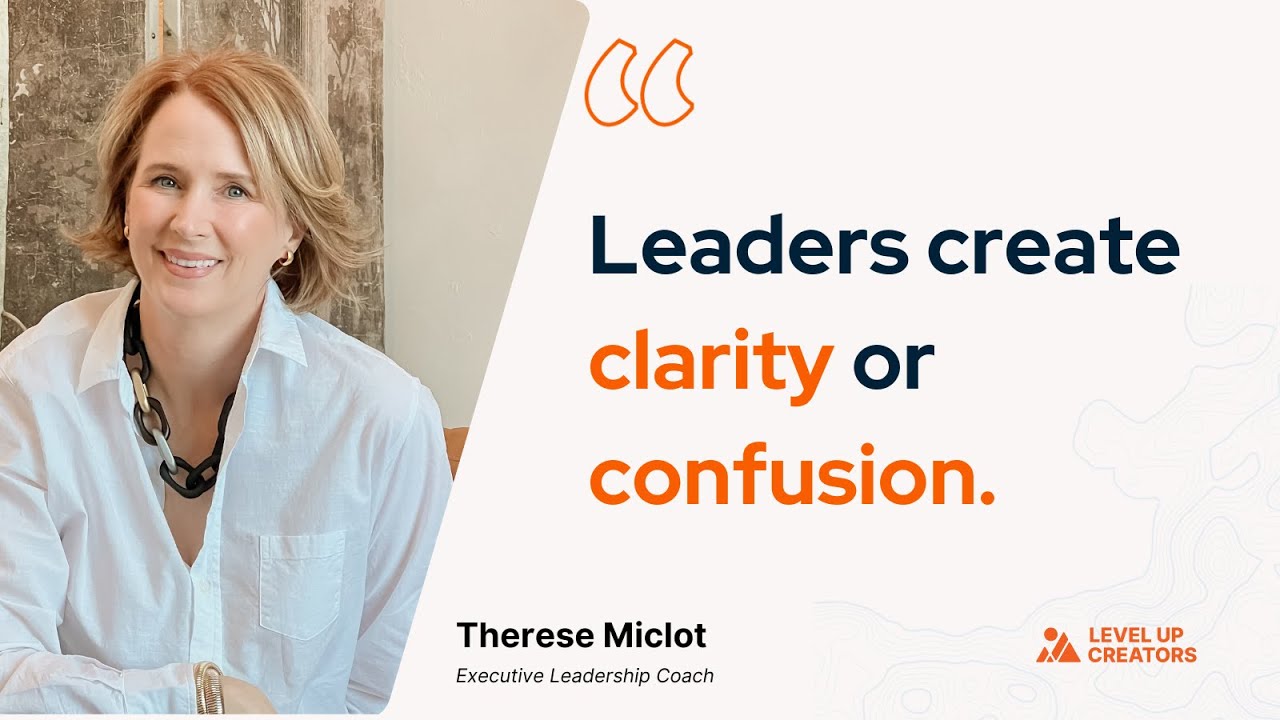
Yeah, there are some things that are just universal. And it really doesn't matter if you're a scrappy startup or you're a 100-year-old company. And, you know, I keep coming back to, I think the common denominator is that Either leaders are creating clarity or they're creating confusion.
Hmm. You
know, I've been a part of startups or seen startups that, you know, make decisions right on the spot. And I've seen large companies get caught up in the bureaucracy and layers of approval. But one thing that really makes the difference is when, first of all, leaders can really set clear expectations. And I see it all the time where they think they do, but they don't. So, people have different interpretations of what needs to be done and it creates confusion. And so, that's been a universal truth that the more leaders create clear expectations, the more they're going to help the business thrive regardless of size. Another thing is that, you know, watch out is when you normalize or tolerate behaviors that are not holding people accountable.
Hmm.
By that, I mean, a lot of times, I'll see in organizations where they'll let certain things slip. They'll like give someone a pass. They might be hitting their sales goals, but they're really difficult to work with. And it's like, we just got to live with that person. And so, when you tolerate that, whether again, you're a 5-person organization or a 5,000-person organization, It's a problem. And then, the third, I think, universal truth is that trust is built in small but meaningful ways. And they're built over time. You know, that you can't count just on, you know, a big splash of, you know, a culture reboot or launch or, you know, a big town hall meeting to think that employees are going to feel that they belong, that they're motivated, that they're engaged. And so, That, you know, leaders, no matter where you're coming from, you've got to build trust in consistent ways. And it happens in the everyday moments, not in the big splashes.
That's a great answer. It brings a lot to mind. I've definitely worked for a couple bosses who, you know, think that we can reach inside their heads and extract what they're thinking, right? But in fact, we have no clue. You've not communicated context clearly. That externalization process, you know, writing is like the great clarifier as well. And so, I love documentation of priorities and accountability frameworks and things like that. So I can imagine you've seen dozens of manifestations of, I mean, in huge organizations like you're working with, we're talking about really significant cascading effects. Yeah. Do you have a story you can share about any of those that's anonymous?
Sure. Well, one that just happened, I was just talking to a client from a big company and like most Companies these days are going through pretty big change. And she was lamenting like, you know, we've done all these, you know, town halls and messages and all this stuff and people just aren't, you know, aren't shifting. And the reality is, this is back to trust is built in small moments.
Hmm.
It's because they haven't had one-on-ones. They haven't prepared their leaders to go beyond, well, you know, just forward this email. And so, they're not seeing people adapt quickly enough. And that's, again, that problem, big company, small company, when you don't get people aligned very quickly. And so, I see that all the time. And especially because when you're the founder of the company or you're, you know, a senior leader in a big company, you've had time. You know, you've worked out the change you have to go through. But Other people haven't, and then that that's a problem when you haven't thought down chain. How am I going to get people to understand it in a way that's meaningful to them?
Hmm. Yeah, definitely. It's got to land on that individual level. Okay. Well, that's fresh. Let's talk about why you do what you do because it is deeply, deeply personal. I mean, you've shared with me that you watched your mother work. tirelessly under terrible managers, and that's probably a generous term, after you lost your father when you were just 13. And so, how did those really early formative experiences shape what you do now and your approach? And if you would share sort of what your mission and why is in the work that you do, that would be great as well.
Yeah. I think, of course, maybe this is relatable to everybody. You have these like major moments in life that set the trajectory. of your future. And certainly, that was a moment that really set me up for what I do today. And like you said, I watched my mom, who wasn't degreed, so didn't have a career, need to enter the workforce with very little skill and found herself working for really bad bosses and not giving feedback, not building trust over time, all these things. And so, as a 13-year-old, I'm watching my mom come home every day just deflated, right? Just not having any choice because she had 3 teenagers to feed and not much money to go around. And so I had to get a job, as did my brother and sister. And I eventually found my way into my major, which was industrial organizational psychology. And the reason I fell into that career, that degree, was because I was really kind of hell-bent, honestly, on like, I want to eradicate bad bosses from the world. I know that's pretty lofty because there's a lot of them.
Yeah.
But I think that even when I work with senior leaders, in the back of my mind, I'm thinking to myself, of course, I want to help you succeed. But I'm actually thinking about the people 3, 4, 5 layers down from you that you probably don't even know.
Yeah.
But people that do not have a lot of choice and don't have a lot of power and have to work for those that work for you. And you create a shadow. You model behaviors. And so, that has driven me for the past 25 years is that because you don't leave this stuff at work, you bring it home to your family. And I just felt like I had a calling to really address it at the top level, but always in the back of my mind thinking of those that have less control, less power.
So, you have been Quite emotionally intelligent for a long time. I mean, to be a 13-year-old, I can imagine myself at 13. I have a 13-year-old boy. I don't see him necessarily doing this. Um, and he's, he's quite an empathetic person, but really to like realize that that was happening with your mom at that age while you, I can imagine, were grieving enormously yourself and your siblings. So obviously that's a theme that you have carried through and through in every step of your career. Mm-hmm. So, tell us a little bit more about your methodology and approach with your clients as it relates to all of your past experience.
Yeah. I think that I come in, one, I want to be as practical as possible. So, I don't come in with a bunch of theories that I pontificate on when I'm ever working with a leader. Actually, my starting point is to be a really good listener because I think the starting point always is to understand the pain points and the pressures that a leader is experiencing. And they're experiencing them in their unique way. And so, when I can really listen and uncover like what's the root of the issue, sometimes it's, you know, they're not a great boss because they don't know how to delegate. I was just on a call with a leader who's stuck because she's constantly in the super-doer mentality, right? She's really good at her job. And so, everybody, there's a line literally out her door. every day because she's a problem solver. Well, the problem is she was promoted to a pretty senior role and she hasn't created capacity to start working on the more senior things.
Yeah.
And so, my approach is always, okay, so what's underlying it all? Is it, again, is it a delegation skill? Is it that they're not capable of giving feedback? Is it that they don't have emotional intelligence? They're just kind of operating as like one-size-fits-all approach to leading people, which we know never works. And so, I feel like I have a bag of tricks that I've developed over 25 years and also being a leader of teams in my past. And then, I can pick out the right tool to fix the right ailment, if you will.
Yeah. And you have a lot of tools in that toolkit. We've been through a number of them and there's surprises at every corner. I feel like you've got a bottomless toolkit, I think, which, I mean, what an incredible gift and talent to bring forward into the world, especially to these massive organizations who do have layer upon layer upon layer upon layer. So your potential for impact in those cascading interactions is enormous. So that's a very interesting niche. And you have recently also written a book. You're working in group formats now. And so tell us a little bit about your book, The Facilitation Advantage, and your group programs.
Yeah. Yeah. So the book is called Facilit— titled Facilitation Advantage. And For most people, they're like, well, that's not for me. I'm not a facilitator. I'm not a trainer, right? I just lead other people. But the reality is we are all facilitating every single day because what you're doing is leading a staff meeting. You're presenting to your senior leaders. You're having one-on-ones. One-on-ones. And that is facilitation because at the heart of it, it basically is how you make things easier for people. To understand, to buy in, to overcome obstacles. We're all facilitating all the time. And I really believe there's a set of skills that underlie that. And this book is really meant to be a way for people to come at it from a— not like, I got to be good at everything, but like, what are the one or two things that are skill-based facilitation contributions or components that would really raise my game? For example, maybe it's your mindset. Maybe the chatter in your head doesn't support you in high-stakes moments. So, you've got to get that straight. Maybe it's listening that you get stuck in meetings where you want to engage people, but all you get is crickets. And so, it's like, what's up with that? Or you're the 8th meeting of the day. Everyone is exhausted. You have a lot to convey. And maybe you make a choice instead of just flat out giving information, you tell a story. And so it's meant to be a really helpful resource for someone to kind of assess themselves on those contributions and then just go where you feel like it's going to add the most value for you.
Yeah. So would it be fair to say anywhere where you want to have influence, the facilitation advantage would be a helpful starting point or framework?
Exactly. And especially think of like, a lot of us are stuck in places where you have to influence without authority. Right? Like, you know, like whether that's even your, you know, you've got a board of directors that you have to influence or you're in the middle layer of the organization and you're stuck kind of between people. So yeah, it really is about how to unlock your capability to collaborate, to get things done through others, to influence, communicate more effectively. And I think we've distilled it really nicely in a very practical way for people.
Yeah, absolutely. And you've done one-on-one executive coaching for many, many years. You do lots of group trainings, you do speaking engagements. But tell us about these new group programs. Yeah.
Okay. This is my real passion that I think I've really found, um, you know, particularly in the last couple of years. Um, and that is, uh, group coaching. And I, I really believe it's kind of the way people want to learn these days. For a couple reasons. One, executive coaching is a very, very expensive proposition for most, and it's kind of out of reach, and it's one-on-one. And then training sits out there, and you might be one of 25, or maybe it's self-directed, and, you know, you're doing LinkedIn Learning, which is all good, but it— there's a— there— it's not maybe fulfilling everything you need. And I think group coaching fits in a sweet spot.
Hmm.
Because what I've designed with my, uh, collaborator is Group coaching plus elements of individual coaching. So, you get the best of both worlds. And I just think that leaders want to learn from others, not just from theory or models, which we bring, but the magic happens when you're with others that you respect and regard. And I'm personally experiencing that in the cohort that you created. So, it's been very reinforcing. I'm sure we can touch on that too.
Yeah, definitely. So walk us through your group training methodology or group coaching methodology a little bit. What does that look like inside of a company? You said there's a mix of one-on-one with the group elements. And so talk more about sort of that process and the magic and some of the key differences and then outcomes and transformations of the program.
Sure. So we start back with listening, like really understanding where's the business headed, And so, what do leaders need to be equipped with in order to be ready as the business grows?
Hmm.
And so, we have— we pull on kind of best practices, curated content that we know makes a difference. And we design that usually with the CEO or senior leaders. And so, we create the program around those burning needs. And again, they might be, how do I manage time and energy, which seems to be a big one for mid-level leaders these days. Yeah. How do I develop my emotional intelligence? How do I think in a more strategic way? How do I give feedback? So, we build it around what the business needs and people need. So, we meet them where they're at. And then, we have interspersed throughout those group meetings one-on-one coaching. So, you can go a little deeper in the place where I need more on this but maybe the group doesn't. So, you get to have, you know, several conversations with me or another one of my colleagues to really get to what you need beyond just the, you know, the group dynamics.
That's really cool that you have so many tools in your toolbox that you can come in and create with surgical precision a bespoke program for an organization based on their unique stage, where they're trying to go, what's keeping them from getting there. I think that's really special. And I also love that you just completely like light up when you're talking about that and that you have really found an area of emphasis and passion, um, at this stage in your career. I think that's phenomenal and very excited to be a part of this journey with you. Um, okay. One more question. This is maybe for my own curiosity as much as anything else, but I think we can probably both agree that some companies succeed despite themselves, even if everything is duct taped together and the wheels are falling off, at least from the outside. Yeah. It appears as though things are going okay. So, what separates businesses from ones that intentionally cultivate strong leadership and bring people like you in? What is the difference under the hood between the places with the duct tape and the wheels falling off and those that are truly humming along? And what it looks like on the outside is actually a reflection of what's on the inside.
Yeah. I think, you know, there's some companies that they have something else special that's working for them. And it might be that's really operating in their favor. Maybe it's a product. hitting the market at exactly the right time. Maybe it is market conditions that have just exploded for them. Maybe it's because they have a very unique founder who is this genius that can never be photocopied. But I think that it works until it doesn't work. I think it operates a little bit on luck that way because the conditions were perfect. Whereas, I think if you're going to build a solid foundation as an organization, you can't rely on those unique special variables that just kind of came together in this kind of perfect synchronicity. Because I think the companies and the founders that are thinking more strategically are recognizing that I've got to build a stronger foundation. And it's going to be something that's more sustainable than a good couple of quarters or just hitting the market just right. And it's going to come down to your leaders because if you're running an organization that in some part depends on the capability of other humans, then it's going to have to be about how do you create a culture and an environment where people know they are going to be held accountable in a fair way, that they're going to have an opportunity for growth. That they're going to have an opportunity to contribute, that's going to make a longer-standing successful company over years versus those that, you know, maybe have success for a few.
For a hot minute.
Yeah. Yeah.
And I can also imagine, I mean, back to your first point, these are organizations who are successful long-term, really have the foundation for success and are not playing the quarter-by-quarter game. Um, I can imagine they communicate well, they don't tolerate bad behavior, and they do build trust in small meaningful ways, right? Like, those have all probably have to exist.
Yeah. And, you know, so, you know, one quick story is a founder that, um, we're working with right now. And it was, I mean, you know, through sweat, equity, hard work, built this amazing company. And it's thriving. And but now he's at the place where he Recognizes that his leaders are the bottleneck. And it's like hitting him smack dab in the face. And now, the good thing for him is he's spotting it and he wants to do a pretty hard pivot and kind of reset what does good leadership look like? What are we expecting of leaders? And we're really helping him build that foundation at the same time that this business is like— dramatically growing. And so, I guess I'd say it's never too late until it is too late. But it's the wise leader that's kind of recognizing and spotting the signs earlier where there's a leadership gap.
So, would you say that it's the self-awareness and emotional intelligence and things like that, that plays a key role when someone's ready to bring you in? They've got to have those things probably. Well,
I wish. I don't know if they always do, but they certainly feel the pain point. Okay. It's back to like they can't throw as the business is scaling. They want to throw to their next line of leaders. And when they pivot and look at, okay, is that person capable of now leading this strategy or taking on this new venture or helping us acquire this new company? And they're like, I don't have the skill. I have a skill gap.
Yeah.
So, sometimes, it's the cold water of reality that like I don't have anybody to throw to. And if your only answer is, I'm going to hire from the outside, one, it's a very expensive proposition. Now, your culture is getting diluted with new people. And that comes with a whole host of other problems if you're not growing from within.
Yep. Yeah, no kidding. Those HR metrics around engagement and retention are there for a reason.
Yeah. And even if you go down to like, what is the cost to replace a professional position? You know, it could be hundreds of thousands of dollars depending on the level of the role. And so, I think when you can make it really tangible, you've got the CFO and the CHRO, you know, like being able to spotlight. Do you know, you know, there's one company I work with that they quantified it to millions of dollars to the bottom line because they had this attrition problem.
Yeah.
And when we dug deeper, it was because of how leaders were leading.
Yeah. Well, that's why people like you exist, and thank goodness for it, right?
I, I hope so. Yeah.
Well, speaking of, you know, laying the foundation for your business, I mean, you already have a successful consulting and coaching practice. Hands down, you are successful. So what ultimately led you to explore building a monthly recurring revenue-driven business, uh, instead of, you know, continuing on more of a traditional one-time revenue model path? What was appealing about that?
Yeah, I'll tell you, it was a pretty easy choice to make when I really understood what, what you're offering. And one was that, um, I, I want to be much better at standardizing things. And, you know, when everything is a unique situation and requires kind of unique you know, support that, that, that's hard to scale for sure. Um, and I also, back to like that foundation, like I, I, you know, I grew my business and my accounts and clients over time, but I also know that where I spend my time isn't necessarily on the structuring of, of the business that would be able to scale, that would be able to manage more revenue, more, more, more income. So I, I really felt like this was the time. And I think like a lot of creators maybe listening to this are at a pivot point where working harder is just not sustainable. Yeah. And so you have a choice to make. Like, I can keep grinding it out, but I don't know if that's, you know, it certainly wasn't a good answer for me. Um, and so I felt like it was a pretty easy decision to join up with you.
Cool. Great. I'm glad to hear that. Thank you. Um, tell me how, if, uh, how your experience in the accelerator so far— again, we're 3 weeks in— um, has that shifted your vision for what's possible with your business?
For sure. For sure. I, I think it's really, especially if you're a solo entrepreneur, It's really easy to have limiting beliefs, and you need you need other advisors, others around you that can help you, you know, see it through a different lens and ask you really smart questions that you haven't asked yourself yet. And I think that's awfully hard to do on your own. And already in the three weeks. I'm thinking differently, which I think drives a different set of behaviors, which is the first thing that I'm seeing, right? Like, I'm approaching work with a different mindset, and it's already steering me to spend my day in better places. And honestly, you guys are great at holding me accountable, which can be easy, right? Like, there's a million things I could do every single day. And there's, uh, there's value in the structure that you're providing because it keeps, it keeps things front and center on really being able to accelerate this plan. And it, and, and, you know, we're equal partners here. I have to be able to be able to respond quickly and, um, you know, meet, meet the requests.
Cool. Okay. That's great. Thank you for sharing that. And You are a very skilled decision maker and you help other people make big, high-stakes decisions all the time, really, really high-stakes stuff in big Fortune 500 companies. And so, I would love for you to share how you approach making big decisions, how you help other people make big decisions, and, you know, did you sort of overlay that framework when you were thinking through, you know, should I join this Six Figure Accelerator program?
You know, I speak a lot to clients about the value of, as an entrepreneur, you need to have a telescope and you need to have a microscope. You need to know when to use both, right? Like, there's sometimes you got to get really close into what's happening or problem solving, right? And I think that decision-making requires you to have both, right? Yeah. That you have to be able to really kind of look closely and objectively at the problem or if Or the challenge. Sometimes it's not a problem per se, but like, what are we trying to solve for? And that requires the telescope, right? To then look at, okay, instead of just doing my day-to-day, which, you know, your days get just filled, I have to be able to pause at some point and say, okay, so what am I trying to solve for? Mm-hmm. And what do I want my future to be? Because If you don't, then, you know, it's kind of like, you know, going anywhere without a map or, you know, any kind of navigating device. And so I think that decision-making starts with your ability to, you know, be able to think strategically about what are you trying to do with intention as opposed to, and what's really easy to do is just be kind of a short-order cook with the work that comes in. Because you can have the mentality of like, I'm going to grab everything that comes my way. And you're helping me already think differently about that, that not all the requests that come my way are going to match the direction I want to go. And being okay to make some of those tough decisions in the long run is going to help me get to my North Star.
Hmm. I love that question, like, to what end, or what am I trying to accomplish here? I mean, that will get me, that got me unstuck the other night thinking about a very specific business problem. And I just pulled out, you know, 35,000 feet, right? I got, I got the telescope out and was like, what am I actually trying to do here? And then as soon as I answered that question, everything else flowed out of me. Um, I love that you shared that. There's lots of good. tidbits I feel like we're going to be able to extract from this. So thank you. Yeah. So the MRR Accelerator, as you obviously know and mentioned earlier, it runs on a cohort model. So we have a Slack, you know, collaboration channel for the team. We do weekly group coaching sessions. So I'm curious about how the group dynamic and community is resonating with you so far. And then how do you feel about sort of that group coaching vibe, what this versus what this program might have looked like if my team and I were working with you one-on-one, which is what we have traditionally done in our consulting firm.
I'll tell you, I was probably a little more than a little skeptical because you never know. Like, I, you know, I didn't know these people.
Yeah.
And, uh, I, in fact, even I think when I signed up, I still didn't know, you know, until you did the introductions. Um, and I cannot tell you how valuable it is in this process. And I think you are, you know, maybe there's some sort of magic, but you curated a group of people who are very complementary but not redundant. And I think I was a little worried, right? Mm-hmm. Like, if it's just a group of people that are just like me in the same space, I'm sure I'll learn. But what I've really, really valued is that it's these really, really wonderful people that are approaching their business in a unique way. But we're all striving in a way for the same thing around growing our businesses in a sustainable way. And already, like, we're reaching out to each other beyond the sessions you facilitate. And I think also, we all kind of all started to suffer from a little imposter syndrome. Like, oh my God, I'm with these people. These are amazing, talented people. And, uh, and so, uh, you know, I— it's, it's great because of course I'm a— I facilitate, uh, group cohorts, and to be a part of one that just feels so supportive and I'm learning so much from, it's— again, I, I, I didn't expect it to be as good as it is.
Great. I'm glad to hear it. And I completely echo the sentiment that this group is amazing. I mean, brilliant, brilliant, amazing humans who are all actually really helping their customers. Like, there's real value outcomes and transformation that are being provided. And moreover, these are people who are emotionally intelligent and have empathy and actually want to help make a difference. And so that's very rewarding. It's so fun to be a part of.
And like, also interested in helping each other, you know. So even on our last call, there was, you know, of the cohort members that offered a tip. And I mean, you probably don't know this, I like scribbled it down right away. I'm like, oh my gosh, that is gold. And it wouldn't have come up if, if you were just working with me one-on-one. And, um, so it, it's just exponential.
Great. That was the idea. Um, yeah, that was definitely an imperative for this group and will be for all the cohorts moving forward. But I feel like this first one has come together in a really, really special and cool way. So I'm glad that You're feeling already the exponential effects. And the idea is that this will be a long-term, you know, uh, differentiator for you all is that you have each other. So I think that's really, that's really cool.
I think you need to also have a retreat for us. I think, I think in the future you need to have a retreat in a really cool, warm place.
Where I just came back from.
Yeah. Um, you can just go with you. If you're going to go every year, why don't you bring us with you? I don't get it.
Oh, that's so funny that you say that, Therese, because I've been thinking about in-person retreats and have not even shared that with my team. So this will be news to them. So that's funny. Um, yeah, I mean, and you're absolutely right. We, we, we do need to figure out a way to do that. That would be incredibly fun. Okay. So what ultimately gave you the certainty and security to join this experimental, if you will. I mean, this is again our first cohort. How did you know that was the right chess move for you at this time?
Yeah, I mean, certainly the fact that you have a guarantee is, you know, I've never ever seen anything like that, that someone that would stand so firmly behind their work that they'll guarantee it. So that, I mean, was just so unique and just drew my attention months before we even talked. The other thing I think is that I have always found this to be true for myself is that I know I'm doing the right thing when I'm a little bit scared and equal parts excited.
Yeah.
And that's where I'm at. And, you know, because you're pushing me in ways I hadn't thought of, you know, you're asking me questions that are making me really think deeply. And I think you have to be at that place. I think you have to be willing to be a little bit scared and a little bit excited. And I felt that. And if I didn't feel that, then I don't think this would have been the right thing for me. And so, I reside there in these first, you know, 3 weeks. I'll probably still stay there for the whole length of things. But I think you really have to be ready to take a risk, take a leap. And you made it so safe to make the leap that even as I tell other people, they're like, are you serious? Is this real? Like, I know, I can't believe it either. So
cool. Yeah, it's like we're jumping off this cliff together, but I've got a really big parachute for us. It's all good. And I love that you're saying that, you know, there's a little fear involved because what got you here won't get you there.
Right, right. And I think that's always the kind of the gut check you have to do as an entrepreneur. If things are just starting to feel so comfortable, that might be fine if that's, that's, you know, that's what your dream is, is to not really, you know, maybe it'd be on autopilot. And I think there's nothing wrong with that at all. But I think if you're, if you really see a runway for your business and you more than anything, and I think this is true of every cohort member, like we feel like a desire to help the world in our own unique way. Like, right, we have these gifts that, that like are boiling out of us that we have to give. And, and, and how do we amplify that? And you have a big parachute, but you also have, you know, a pretty big, you know, microphone and amplifier. And, and I think that's a signal that this could be right for you.
Hmm, that's good advice. So other than hitting your multi-five-figure MRR guarantee, Which is, I know, a huge draw to the program. But outside of that, you know, what are your biggest goals for our time together?
You know, some of it is like new thinking, is the expertise that you bring. I really do feel like I have, you know, I have a fractional CEO, I have a fractional CMO, I have, you know, a fractional IT person on all the aspects of the business that are, you know, like gears in a machine that, one, some I didn't even know that I needed. And two, that I haven't ever greased. I haven't ever really thought about. And particularly at this time and stage where AI is exploding, and I could go spend all my time trying to figure that out, but that's not the best use of my time.
Right.
And what I'm looking forward to getting out of that is this huge leap In terms of expertise that I don't have, nor will I ever have, to set me up on a, on a new, you know, level that then I can, I can, you know, keep building the business from.
Nice. Yeah, because you don't need this level of help forever. That's the coolest thing about this accelerator program. It's like, you don't need my $100,000 payroll. Um, you need a fraction of it. That's what you get, right?
Exactly. Exactly. Yeah.
Um, and, and so, I mean, that is certainly the goal to build, build the machine, demonstrate the machine works exceptionally well, and then set you on a path to take your business really as far as you want to go for as long as you want to do it. And then make sure that you have optionality retention at the end of the line if you want to sell your business or whatever the heck you wanna do. So that is, that's definitely the goal.
Yeah. And I really appreciate, I think that, you know, one of the first conversations we had, you're like, look, We're not creating dependency here. You know, like, this isn't some deal where now you're going to need us every time, you know, there's a brand update or a new piece of collateral or content. Like, it's, it's to help make you independent, but, you know, to kind of, you know, give you a slingshot in the direction you want to go. And so I really appreciated that.
Awesome. So at the end of our 7-month accelerator, which will be at the end of August of 2025, What do you believe you will be able to do that you couldn't do before? And why does that matter to you? Obviously, you know, it's not just about the money piece. Again, like what foundational skills do you hope to gain that you will carry forward and that will be meaningful?
I think one is to know and feel very confident in what I'm saying no to.
Oh,
if I could really like, this is not, you know, one of our cohort members, I want to find my people and In addition to that, I want to stand firm in knowing where, you know, where I'm a good match for a problem or pain point and where I'm not.
Hmm.
And if I can walk away with a lot more confidence and clarity so that I'm not spinning my wheels and I'm adding more value in the places that need it, that's going to feel like success to me. The other byproduct of that is that I create more time for other things.
Yeah.
You know, that you've talked a lot about. This is also about helping you live the lifestyle you want. And I'm at a place in my life where I want to kind of transition from working, you know, every weekend, you know, endlessly, never, never kind of turning it off to being able to have some standardization where I can turn it off. I can free up myself to, you know, keep thinking and dreaming and creating and not be beholden to the next email, you know, the next call that, um, you know, I feel like I am today.
Yeah. And decoupling money and time,
I
think that's really, really key is, you know, we're not building packages based on hourly inputs, but we're building packages based on value outcomes and transformation. And your 25 years plus really experience. Um, brings to the table. And so I think that's like a key mindset shift for all of our clients, the accelerator participants, everybody listening, is that if you can decouple your time from your income directly, you will create extraordinary leverage for your business and for your life. And so thinking about how you deliver solutions in a very different way, um, and people aren't paying for your time. I mean, when you, uh, get brain surgery, you're not paying the surgeon by the hour. You're paying hundreds of thousands of dollars because of this skill.
Yeah.
And so, you know, in a consulting environment and a coaching environment, it's the same thing. But those worlds typically don't collide very much. Like we don't, we don't think that way enough, especially as individuals when, you know, if we're coming from a corporate environment where we're paid on a salary and we break that down to an hourly rate and maybe base our first consulting based on the hourly rate we used to make at our corporate job.
Yes.
Um, so that's kind of a funny switch, but it's a very important switch to flip to be able to move forward in a completely different way, taking into account lifestyle considerations.
Yeah. And I think that's why it makes a lot of sense that it's the length that it is, because that's not a— that's, that's a very different mindset shift.
Yeah.
That, you know, I'm continuing to work through. And you need the time and you need the structure to be able to shift to that way of running a business.
Yeah. And that's like what these weekly group coaching sessions are really about. So the way that I've been noodling on the MRR method and this program and how it all works together and what are the exact prerequisites for each step and just had kind of this very tangled ball of yarn of ideas in my head. And so how this sort of came to be is I went to hang out with Natalie at the end of October. Like, we spent a couple days together and put our heads together. Within 4 hours of my, like, arrival, we had the entire program hammered out. And it went from, you know, there's a ton of, like, deliverables and hands-on work. It's quite bespoke. It's different for every person, still on the MRR method. But just like you were talking about with your group program, it's like we've got all these tools in our toolkit. And we know how to arrange and bring those into the fold for each individual based on their, where they are now, where they want to be, and what's keeping them from getting there. Right. That's kind of what this is all about. Uh, to the end of your MRR guarantee and your lifestyle considerations and building a business that can scale if you want it to scale.
Yeah.
And so there's lots and lots of deliverables and work, but we came up with all of our group coaching topics because we were like, these don't fit anywhere else. And so there's so much that, there's so much knowledge transfer that needs to happen that is not necessarily on paper or part of your strategy document or your product ladder or product development tables or, you know, ideal customer profile and things like that. And so, we do hope that this is reflective of a quite holistic program from mindset to practical information, accounting and finance and decision-making and how to think about the documents that we deliver for you. And like you said, We're trying to not create dependencies. We're trying to, you know, push you out of the nest at the end of the 7 months, if you will. Um,
because you're ready to go, but you know, we'll
be here if
you need us. For sure.
Yes. But you will be equipped to do that. And so that's, that's kind of like how the, that was the sausage making of the program. It was, it was a big, hot mess, but only for literally 4 hours. I just needed my, my partner in crime, Natalie, to, to get that sorted out. But— Well,
I hope you took a picture. I hope you, you know, you were able to commemorate that moment because you're gonna look back on it and be like, that's where it all happened.
Yes, our massive kitchen island. We had hundreds of Post-it notes, um, out on there. So yes, that'll be a fun thing to look back on, um, in future years. But okay, I have to ask you, One more question. It's not on our prep doc, but for the leaders, managers, aspiring leaders and managers and entrepreneurs and solopreneurs and solo CEOs and creators who are listening, what's your top 3 pieces of advice, leadership advice for
them? I think it all starts internally. The first one would be you've got to be really able to be self-aware. You really have to be able to understand clearly how you're showing up. And face what you're doing extraordinarily well, but also not shy away from the areas where, like all of us, you're not perfect. And so, I think you have to be ready to be willing to not be the best person in the room at all times and be willing to focus on how do I build the other people to be the best. I think that's one. I think 2 would be the skill I always come back to that is just universally true is listening. That if you're going to double down on one skill, it's got to be how well you actively listen. And here's the truth, Amanda. Like, as humans, we are not designed to be very good listeners. And, you know, especially as leaders, if you've like, you know, you've been in your job, you're great at your craft, it's so easy to think, you know, I already know what you're going to say. I already— if you stop talking, I will give you the answer. And I just think that it is the hidden skill that will propel your career in ways you don't even realize. And so that would be my second. So self-awareness, listening. And I think my third would be how well you're able to adapt your message to your audience. So I think it's this, you know, and this is— we talk about this in The Facilitation Advantage, this idea, you have to be really able and willing to shift how you communicate to your audience. So, whether that's announcing a change to your whole staff, you're going to have to be thinking about if I step in their shoes, they're going to want to know what does this mean for me? Not just what does it mean to my customers? What does it mean to the bottom line? What does it mean to me? And so, then if you're with the board of directors, You're going to have to shift dramatically to how you communicate to that audience. And the more you have this versatility, this flexibility, the more people want to work for you, the more customers want to hire you. And so, that would be my third one. It's versatility. It's how you're able to shift your behaviors to those around you.
Oh, that's a good one. Thank you for sharing that. I could just sit here and talk business with you all day.
I have so many questions.
Um, it is really fun and we will have you back at the end of the accelerator. And so I will come up with a fresh list of ridiculous business questions that will be somewhat self-indulgent. Uh, I love business. I'm a total nerd about it and fascinated, uh, by you and your experience and your expertise. I mean, it is just, wow, it is such an honor to work with you. Um, do you have a parting shot? Anything else you'd like to add? And where can people connect with you and learn more about your work?
Yeah, well, I would love to connect with more people. So I'm quite active on LinkedIn. And so that'd be the first thing, find me on LinkedIn. I post a lot about the pain points of leaders and I try to really add the value of the years that I worked with leaders. So that would be the great thing. I think the other thing is like, if this idea of like facilitation is Is it for me or not? Go to the Facilitation Advantage website and there's a free self-assessment. And I really loved it. We worked a lot on it because leaders don't have a lot of time. And so, you know, it's fruitless to try to work on 1,000 things at once. You pick one thing, pick one thing and try to really focus on that. And that might be my parting message when it comes to leadership. Like, no one's expecting perfection. And if anything, I think when you can show up with a little bit of vulnerability, you actually come across as more credible because you're more relatable. Like, who of us is perfect? So, um, and a way you can, you know, kind of channel that energy is to kind of work on, you know, one or two facilitation skills.
Nice. Just mic drop right there.
And
we'll make sure all of those links are, of course, in the show notes in the YouTube description. And thank you, listeners. We know that time is extremely valuable. Thank you for sharing yours with us. If you are a subject matter expert looking to build a scalable, high-impact business with recurring revenue, visit mrraccelerator.com to learn more. Follow me, Amanda Northcutt, on LinkedIn for daily consulting insights. We'll see you next time on the Level Up Creators Podcast.
More from Amanda




Audit Your Calendar, Audit Your Life — Dr. Lani Jones on Hidden Guilt & Boundaries



Built a Successful Business & Still Feel Empty? Here’s What to Do with Dr. Lani Jones