Creators Interview; Maura McInerney Rowley; I want to see more living funerals
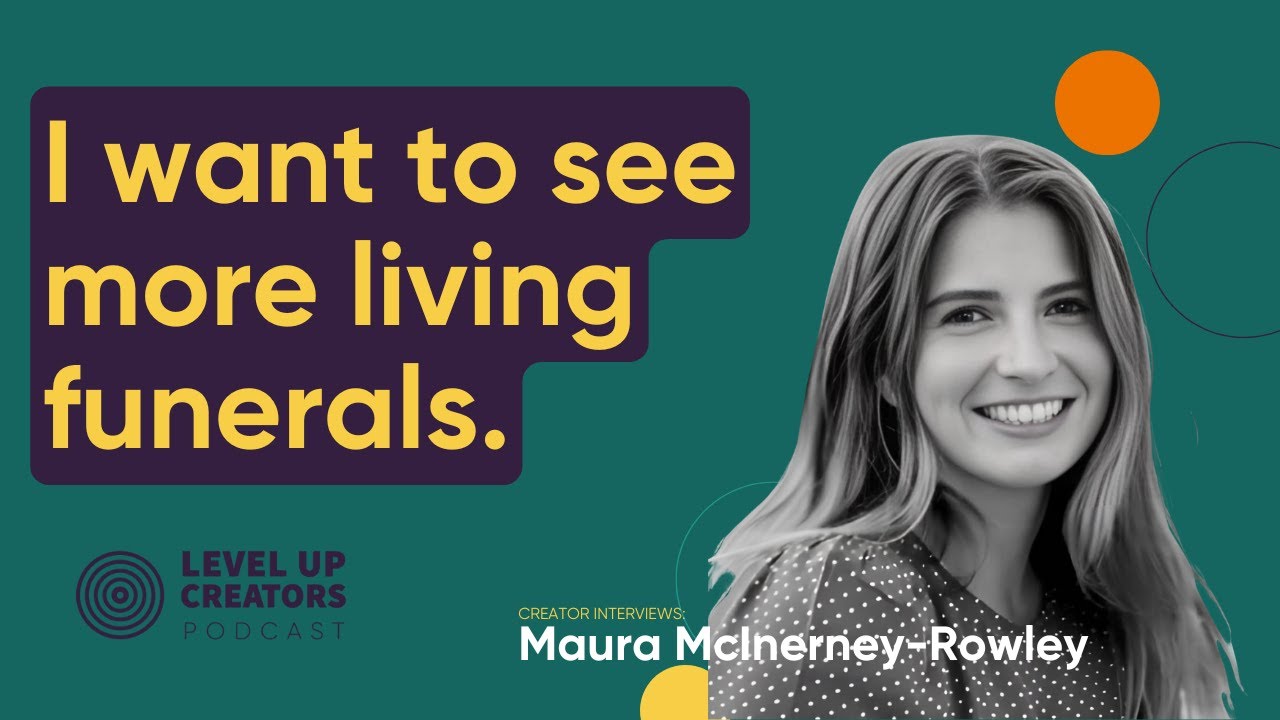
In this Level Up Creators Podcast episode, host Amanda Northcutt interviews Maura McInerney Rowley, founder of Hello Mortal and former hospice operations director. Maura recounts the personal tragedies that sparked her interest in death care – the loss of her mother during college and a sudden death at a friend’s wedding – and how those experiences led her to pursue death‑doula training, open a social‑model hospice on Cape Cod, and eventually launch Hello Mortal in 2024. She explains the platform’s core offerings: a free Death Archetypes personality test, weekly Substack newsletters, workshops, intimate dinner salons, doula services, and a digital end‑of‑life planning MVP. Maura outlines her long‑term vision of making basic end‑of‑life planning (medical power of attorney and disposition choice) as universal as a driver’s license, establishing a national bereavement policy, and popularizing living funerals. She describes her target market (the “4‑5 Ds”: terminal diagnosis, early‑onset dementia, recent divorce, recent death, and death doulas, plus the sandwich generation), her low‑budget organic marketing tactics (social media, street interviews in a Grim Reaper costume), and her small, freelance‑based team. Current projects include a clinical study on Death Archetypes, grant‑seeking for grief work, collaborations with human‑composting pioneer Recompose, and expanding dinner events to new cities. Throughout, Maura emphasizes confronting death anxiety, using mortality as a tool for intentional living, and the need for broader death‑doula education.
Chapters
Hello, you're listening to the Level Up Creators Podcast. Amanda Northcutt here, founder and CEO. We help creators and digital thought leaders like you turn your knowledge and experience into rock-solid recurring revenue, and we are so glad you're here today. My unique guest is Mara McInerney Rowley. Mara is the founder of Hello Mortal, a platform dedicated to helping people contemplate, prepare for, and manage life's inevitable end. Her journey into death care began after her mother, Maureen, Died during Mara's junior year of college, a profound loss that reshaped her world and set her on an unexpected path. And then a few years later, a death at a friend's wedding became a turning point, redirecting her toward a calling she hadn't anticipated. In 2023, after contemplating death doula training, Mara joined the Lily House, a social model hospice on Cape Cod, as director of operations. These personal and professional experiences continue to fuel her mission to transform how we approach and plan for the end of life. Mara holds a degree in global studies and anthropology from the University of Vermont and an MBA from the University of Michigan. Welcome, Mara.
Hello. Glad to be here.
Thank you. So, Mara, I speak with subject matter experts day in and day out— professionals with expertise in sales, self-improvement, career coaching, high school football recruiting of all things, relationships— the types of experts that, you know, they really span the gamut. But you're the only certified expert I know whose expertise lies in death and dying. And as we said before, you know, your path to becoming an expert in the subject started with losing your mom just before your 21st birthday, which is, I mean, of course, my God, an unfathomable tragedy that I'm sure continues to shape your life every single day. And unfortunately, that's not the only unconscionable tragic death you've experienced. And so I'd be grateful if you would share, you know, whatever part of your story you feel comfortable sharing, and then we can discuss your career trajectory and the exploratory path you took professionally between your mother's passing and And early 2024 when you launched Hello Mortal. Does that sound okay?
Yeah, that sounds great. Awesome. I always love stealing a line from Andrew Garfield whenever I talk about my mom and her death. You might have heard it or seen it, but his famous line, you know, he talks about grief is love with nowhere to go. But he says, if I cry, it's not out of sadness, it's because I love to talking about her, his mom, so much. And same for me. And obviously, there's a tinge of sadness there, right? Because you miss the person and you want them back. But it's really just love being expressed. And I find it interesting because sometimes when I share this story, I'm sort of stone cold and emotionless. And other times I just breakdown. So I never know what I'm going to give or someone's going to get. But yeah, my first experience with loss, I think with many people, was around pets. But my first real significant loss was my grandmother and then my own mother. And that occurred when I was a junior in college. My mom had been Diagnosed with breast cancer when I was five years old, so she was in and out of remission my entire childhood, and her doctor often referred to her as Miracle Maureen. And so I naively thought you know my mom would never die, and intellectually I knew she would die eventually, but just not from cancer, right? And in our society, we also just avoid talking about death. So I think to some. In some instances too, I just, I thought she was immortal. She's my mom. Like, she'll never, she'll never leave. So her death really hit me hard. And I had about 2 weeks to spend with her, or less than 2 weeks actually. But from the time I got the call to the time we had her funeral, it was 2 weeks that had gone by. So I came home from college, spent a few days with my mom while she was briefly on hospice at home, and was able to be there by her side when she died, which I'm incredibly grateful for. And it comes with its own set of challenges, but I often wonder where I would be had I not gotten that experience. And at the social model hospice I helped open on the Cape, we help people give— we help give people a similar experience where they can be at the bedside of the person they love as they're transitioning.
Wow. I so hate that you had to experience that, one, at all to this point in your life. But I mean, at such a young age, I can't even imagine. My mom is still living, thankfully. And like, I am not ready to imagine a world without her. And, um, you know, you've had to go through your entire adulthood without your mom, and that's just tough. Yeah. You know, that wasn't the only like major hit. So tell us about kind of the what happened between your mother's passing and then we've got to talk about some, you know, wedding planning in Colorado and, and then a death at a friend's wedding. So how did that all happen?
Yeah, it's definitely dark times after my mom died, as you can imagine. And I felt very isolated being in college. There weren't that many people I knew who had lost a parent or anyone really close to them. And after that, yeah, I had an experience where I was snowboarding and I experienced my first powder day ever. And it was in Vermont of all places. Yes, they still get powder days on the East Coast. Since we're both in Colorado, I can— No. say that. And I felt euphoria or what I thought was euphoria or whatever. I joy again for the first time in over a year since my mom had died. So I decided I was going to chase that feeling. Life was too short. I couldn't imagine being anywhere where I couldn't snowboard. And I know that sounds ridiculous, but at the time it was something I clung to. And that's how I ended up in Aspen. And snowboarding and working, and that's how I ended up. I ended up in the wedding industry as well because that was my my first job right out of college, and it was a really wonderful and challenging time in my life. But I I ultimately left the wedding industry because it was making me so sad just going to all these weddings over and over again, and being with the bride and watching them walk down the aisle, knowing my mom. And it was just, it became too much for me to bear. And so it's fascinating to me to see how I've come full circle because we think of weddings and funerals at the opposite ends of the spectrum when it comes to events, but they're really so similar because they're all about bringing people together and celebrating love and life and tradition and rituals and community. And so, yeah, I'm really excited to be here. I had this kind of like smack in the face profound experience the summer between my first and second year of business school where I was at a wedding for a friend I had met in Aspen. And we had bonded over the fact that we lost parents at the same young age. And she had asked me to read a poem about lost loved ones in the wedding. And then on the morning of, and this is the Beautiful poem. I cry every time I read it. So if anyone listening needs a poem about lost loved ones in their in their wedding, happy to share it. I've been given permission to share it. So at the wedding that morning, the bride had to inform some of us who who were in the wedding that one of her friends had died the night before. So we were all with this guy. We were out at the rehearsal dinner Friday, and then later on he continued. To go out and just tragically died. And I won't get into the details here, but it was that shock and that juxtaposition of the death at the wedding that really sent me into deep introspection of how similar these events are, but how we plan over a year for our weddings and funerals are planned in 2 weeks, often leaving the grieving family in crisis mode. And then I quickly went off. Wedding was Saturday. Sunday morning, I was on a plane to Alaska to go backpacking with a bunch of people from business school. And I spent a week in the wilderness of Alaska, no phone, no internet, just with my thoughts, reflecting on what had just happened, reflecting on how my mother had died and her circumstances. And then had my own really scary moment where I, because it was pouring rain. Alaska in August, you either get rain or mosquitoes. And we got rain. Yeah. Pouring rain, freezing cold, fell down the mountain, like thought I was going to have to get helicoptered out of there or something. Was so, so scared. Had a friend behind me, one of my dear friends from school, Vivian. Gave her such a fright that she said, I was afraid that you were going to die. And it feels like so awful because she had just months later or earlier lost a friend to a freak, uh, accident in, um, uh, Moab or Zion or somewhere with flash floods. Uh, I think— is that— is it Zion Park? I forget.
Yeah, Zion National Park's in—
Zion. Yeah, I've never been. Um, But so she had literally just lost a friend to a tragic, like, outdoor accident. And then here I was right in front of her, like, tumbling off of a cliff. And so it was, it was that moment too that was on our second to last day. So then the next day I had to hike 7 miles out on this, what turned out to be only just a horribly sprained ankle, thank goodness. And yeah, it was just, it was these back-to-back experiences. And then I was in business school again, less than 24 hours, because that's how things work in business school. It's a jam-packed schedule. And I had to pitch a business idea. And so I pitched this concept of wilderness hospice because I was combining, you know, being in the wilderness, thinking about my mom, how wonderful it would be to have your last moments there in nature, you know, returning to earth in such a natural way. And that's where things sort of really kicked off for me. I just had that whole semester to research the funeral industry, the hospice industry, recognizing and learning how outdated and overwhelming and fragmented these spaces are, and that we can do so much better for people. And that's really where that whole journey, I think, came to a head and I started to intentionally be like, okay, this, this is something I am interested in. I want to focus on. I want to learn more about.
Whoa. How far down did you fall?
Pretty far. I was lucky that I got stopped by a tree, but I, I'm a small person, like 5'1, and so my back 60-pound backpack Oh my gosh! Is was almost the size of me, and I as I slipped, I tried to stop myself, and the weight of my backpack threw me over. And yeah, it was it was quite a harrowing experience for sure.
Wow. Okay. Okay. So what's next after you know you spent you finished business school, I assume, and then. What happened?
So what's next is really, I mean, interesting time. I was in business school during the pandemic, part of it. So my first year was virtual except second year was in person. And I was having interviews for, you know, because typically people go to business school and then they go into consulting, investment banking, maybe tech. Small percentage of people try and start their own companies. And all the interviews I was having, I was recognizing that I was dreading them. I was dreading preparing for them. I was dreading having the interviews or even ones that I thought I was excited about. I'd walk away being like, ugh, you know, okay. And I really just wanted to work on my idea I had at the time, which by the end of business school, I had pitched in a few competitions and won some funding. So I was walking away from business school with about, I don't know, maybe $20,000 in funding from pitches. And again, at the time, we had a pause on student loans, on repaying student loans. Mm-hmm.
So
it was sort of this combination of like, okay, I've got some validation from these pitch competitions. I'm going to have a period of time where I don't have to worry about paying my student loans back right away. It sort of feels like it's now or never. You know, there's never a perfect time to get started or do anything, but it really felt like, you know, the universe was setting itself up for me to kind of follow this through. And so, I did. But I had, I don't know if it was imposter syndrome or if it's also, you know, part of the business mindset. I had personal experience in death and grief. I did not have professional experience. And that was really important to me to go out and seek, one, to understand the industry better, two, to understand if I wanted to be in this industry and in what capacity, because I could have opened a funeral home, I could have become a death doula, I could have You know, gone into hospice, gone back to school to become a nurse. You know, there's like a million things and ways to get involved. So I ended up getting my death doula training. I was fascinated by the concept when I heard about it and found out about it. And through that is how I got connected to opening the hospice on Cape Cod. And again, it was one of those things where it was like, It just kind of fell into my lap. Basically, I got the training, and then I was living in this rural town on Cape Cod, mostly retired folks. And someone was like, oh, you're, you're a death doula, you have to meet the one other death doula in town who's opening a hospice. And so we connected. And yeah, the rest is history.
Okay, so is this 2022? At this point, was this happening?
I got the training in 2022, and then in 2023, opened the hospice.
Okay. All right. And then you went from that in 2023 to launching Hello Mortal earlier this year. We're recording in November of 2024. So what was that kind of little transition like? And then how did you end up back here in Colorado?
Yeah. So. Working, opening and working at the hospice was eye-opening. I was worried after I got my death doula training, you know, how am I going to find clients? You know, how am I just even going to utilize this? Because it's, it's, it's an interesting field. And that is a whole other topic too. But The hospice gave me a crash course experience in being a doula, and I'm so grateful for it. It completely changed my life. And at the time, I still had the ideas from business school. And so I was trying to manage doing both, but I was also still exploring, you know, what's the right space to be in? And what do I really want to do and spend my time on? And so I became obsessed with this idea of contemplating mortality because of all the great benefits it has and the fact that it's so taboo in our country to talk about death. Yet it's something that's going to happen to all of us and to all of our loved ones. And the better prepared we are, the less of a crisis it is and the more opportunity we have to lean into our grief and start that grieving and healing journey. And so I really became obsessed with, okay, how do we make talking about death less uncomfortable, more approachable, and in sort of the mainstream? And that's where the idea for a newsletter came from. And that's also where the idea for Death Archetypes came from. And it was— had the idea for Death Archetypes before I even started the hospice, but it was really the experience in the hospice that brought a lot of it to light. And for those who aren't familiar with Death Archetypes, it's a free contemplative personality test to help you explore your mortality. So there's a set of 27 questions that you're meant to answer. Just instinctively. And some of them are challenging. But that's because contemplating mortality is challenging. And at the end of it, you get your results. You're one of 8 different archetypes. And these archetypes go through a description of the way that you see and approach death and dying. It's kind of like if Myers-Briggs met Enneagram, a horoscope, and human design just focused on mortality. But the whole thing is about living a fuller life right now. So what I love about talking about death is that you inevitably end up back in the present. And that's what it's all about is how do we ground ourselves? Because all we have is right now. Future is not promised. And so let's live more intentionally and meaningfully. And so the experience at the hospice brought up the top regrets and the potential biggest fears for each archetype because there's a pretty well-known book called The Top 5 Regrets of the Dying. And that was a huge inspiration as well. So I'll stop there because I'm like, I don't even know what I'm talking about anymore.
I'm tracking with you. Okay. My next question was going to be, what's a death archetype? So thank you for preemptively answering that. And yeah, Makes more sense. Okay. All right. So what's your long-term? Oh wait, wait. How did you end up back in Denver? That was one we missed.
That's more of a personal thing. I mean, I loved living in Aspen. It's a bubble. It's a snow globe. It's beautiful. It has its own particular set of difficulties though. And I was long distance with my boyfriend at the time, now fiancé. And so congrats. Thank you. I moved to Denver to be with him, but also it just so happened that my technical partner who helped me build Death Archetypes also moved to Denver, and that Colorado is just super progressive and innovative when it comes to death care practices. So it ended up working out really well. It's one of the few states that allows human composting and medical aid and assisted dying. So, and on the forefront of green burials and all of that.
How serendipitous, right? I mean, that's kind of
a truly
perfect trifecta. Okay, cool. Thanks for sharing that. So I want to hear about your long-term vision for Hello Mortal. And when I say vision, I mean something very specific. I mean, what unique possibility do you see in the future that you will work to bring to bear through the activities of your business over the next 10 years or so? Does that make sense?
Yes. Yes, that makes sense. That's such a big question. I love it. Long-term vision. And I'll make the distinction between long-term and 10 years because I think it's going to take longer than 10 years. But long-term is I want every single person To have a basic bare bones end of life plan. And to me, that means you've named a medical power of attorney. So someone who's going to make decisions for you in the event that you cannot make them for yourself. And you're not only going to have decided who that person is, you're going to have had a conversation with them and you're going to have discussed what it is that your values are. And And you know what it is that you envision yourself, and so you have a trusting relationship with them. So many people do not do this, and it causes a lot of turmoil for families. And I've seen not only one person actually die, but there be several deaths metaphorically in in the family of people not speaking to each other because they fought over how mom. Should have been treated when it came to her medical care. So that's one part of the plan. The second part of the plan is your disposition method. So are you going to be cremated? Are you going to have a green burial? And there are many options. Again, human composting, people don't even know what that is. So those are the 2 very basic things that I think everyone needs to have Decided on, discussed, and written down that save your loved ones so much anxiety, guilt. No one is questioning what you wanted and what they did. And it's so simple. So that is like long-term vision. I want every single person to have that. And I want that to be as commonplace as it is to have a driver's license. Because it's something that is going to happen to all of us and we need it. The second thing is a national bereavement policy. We do not have one in this country, which is horrifying to me. And I really want to partner with anyone I can to help push that through and make that an option. that all Americans have to exercise and have the time off. It's never going to be enough time, but at the very minimum, you'll have 2 weeks as opposed to 2 days. I think that is going to be huge, like positive, have huge positive impact on our society as a whole. Mm-hmm. The other, I think, long-term vision for Hello Mortal is I really want to see us helping people. You talked about like unique aspects. I really want to see us lean into what so far, what has resonated with people and what we're good at, which is new and interesting ways to discuss death and to bring it into the mainstream. And something I'm really excited about is the opportunity and the shift that we're seeing of people embracing living funerals. Sort of calling back to my former experience as a wedding planner, I really want to see more and to help people celebrate their life and to do it before they die. So they actually get to be there to hear the eulogy, to hear the speeches, to hear how they've impacted people's lives.
I love that concept. And I think I first read about the concept of a living funeral in like an Anne Lamott Book or something like that, and I was just like, that's fascinating, and that's so much better.
Like yeah,
how amazing! Um, yeah, and celebratory instead of yeah, how funerals feel. Okay, that's a big vision. I respect that.
Yeah, yeah.
You're you're in it to win it. You are here to change the world.
Okay. Yes,
I believe you.
Absolutely. Hi, thank you. I I appreciate your confidence. I mean, I think it's just. It has to be done. And it hurts me to see people, you know, go through this and experience things. Death will always be challenging. It will always be sad. But there are things that we can do to improve the experience. Hands down.
Yeah. Yeah. And I mean, hate that you are in the perfect position to do this because of what you've had to live through. Um, but what a gift to be able to give other people. Uh, and I can see why going through the interview process as you were, you know, approaching the completion of your MBA, uh, being really like, you feel like maybe you didn't fit. Like it just wasn't, didn't have meaning or the jobs that you were applying for, what you would be doing did not have the meaning and purpose and impact that you knew that you were going to have on the world. And you knew that that was not the, you know, modality for you to. Bring forth your full potential. So, my next question is: Who is your target audience slash customer for Hello Mortal? I hear that it is first like all Americans, but as you know, because you have an MBA, that you have to start with you know a customer persona. And so, is there a particular pocket of the internet that you are targeting as your beachhead, if you will?
Yes, yes. Well, I should say before I give you that answer, our Aspirations are global. Like, I want every single person in the world to have these 2 things. And, you know, that is not a 10-year plan. That's my lifetime plan. But, you know, because there are so many different variations among cultures that are so unique and so interesting. Mm-hmm. Our target customer right now, I mean, I think it depends on what part of the business we're talking about. But everyone dies, so everyone is a potential customer. And so, it's been really challenging for me to narrow it down. And I know my business hat, my marketer hat is like, if you're talking to everyone, you're talking to no one. You have to have an ICP. What's it going to be? So I'd say actually right now we're testing that out. There's something called the 4 Ds. So it's folks who have recently been diagnosed with a terminal illness, diagnosed with early onset dementia, have gone through a divorce, or have recently experienced a death. And we have identified these different areas of people who are most informed and motivated to make a plan. And so really just sort of experimenting right now, which one is going to land for us. And I would say another D, actually 5 Ds, adding one to that, are death doulas themselves. Yeah. They're a really interesting market. And then my gut also is telling me that We're looking at the sandwich generation. So those are people who are taking care of young kids and aging parents, and they're incredibly overwhelmed with all of the responsibilities they have of just caring for loved ones. But then throw on work, throw on friends, throw on— dare you try and have a hobby, a life of your own.
Yeah.
And so really what we're trying to offer them is an an efficient way to just get started. Because I like to look at end-of-life planning as a book, and your book can be 1,000 pages or it can be 10 pages, and it's truly customizable to what matters to you. But at the very, as I mentioned before, at a very basic level, everyone just needs Mm-hmm. The one page. You know, this book belongs to Maura and her medical power of attorney is her sister Kate and her body disposition method preference is human composting. And it can be as simple as that. But there are many other things that you can do that will improve your loved ones' lives and help set them up for success after you're gone.
Okay. All right. So what services do you currently provide?
So currently, we provide a few different types of services. As I mentioned before, we started because I was so obsessed with this idea of changing culture and making talking about death more approachable and accessible with contemplation. And on the contemplation side, we offer the free Death Archetypes tool. As an extension of that, we also offer a workshop, a Death Archetypes workshop, which is great for company retreats, conferences, festivals. Like, it's all about how contemplating mortality can unleash your creativity. So, it really lends itself to a whole host of different types of groups. And then, we also offer intimate experiences through Death Archetypes dinners, and these are my favorite thing to host. Um, uh, on top of that, we have our, uh, weekly Substack. So that is a free and paid version, um, and every week we're dropping new contemplations about mortality to help you live well, um, in face of impermanence. And in those, um, Uh, in that Substack community as well, if you're a paid member, a benefit is that you get to come to our monthly Death Over Coffee salons, which again are more intimate gatherings where we contemplate and talk about death and dying and life and everything in between. Um, and those are also one of my favorites because people share stories and there's so much resource and insight sharing.
Mm-hmm.
And then there's Maura, me as the doula. So those services I can offer people, which range from sitting vigil to end-of-life planning, which again can cover so much stuff, just like simple logistics to legacy planning, ethical wills, to companionship. And then right now we're currently building the MVP for our digital end-of-life planning tool. So essentially, I'm taking all of my knowledge and experience, personal and professional, of helping people prepare for the end of life and turning it into a digital platform so that it's convenient for people to fill out. And with that service, we offer 3 levels of a DIY self- self-paced group cohort and then one-on-one touchpoints with, with me.
Okay. Very interesting approach. Cool. Yes.
Yes. Yeah.
And I can imagine that marketing is potentially difficult. So what has your approach to marketing been? What resonates with people? What has flopped?
Yeah. This is like, I love marketing because it feels like a, it's like a puzzle you have to put together, or almost. It's like you're a detective trying to figure out, you know, the person you're trying to reach and how to best reach them. Since, you know, small early stage, we don't have a marketing budget. So I have been doing everything organic, unpaid right now. But the caveat is that you're always paying for something somehow, whether it's like a Twitter subscription or a scheduling platform, whatever. So it's like, I think for whatever reason I have beef with that term. We're trying to just do it all organic. So we haven't done paid ads. And that's been through my LinkedIn, my Twitter, TikTok, Instagram. Again, I've been testing different platforms, seeing what works. Also through Substack, also through the dinners we do, like that's brand awareness. All of that adds up. And so, yeah, I mean, there's so much we can do on that front that I'm eager to raise the funds to do it so we can. One interesting thing I tried was I dressed up as a Grim Reaper and I interviewed people on the streets of New York City. So like, I'm willing to try all of those things because you got to get creative when you're talking about something no one wants to talk about.
Okay. How did the Grim Reaper video content go over?
It went well, honestly. I was Surprised people wanted to talk to me, but at the time it was also like the height of street interviews on TikTok. So people were, you know, they knew what was happening when you were walking up to them with a microphone and a weird-looking costume. Now there's this trend of people sitting with a sign being like, come ask for advice or come sit with me or something. And I would love to just sit in a park and have a sign that's like, Come contemplate mortality with me or something, or like tell me about who you lost or something like that. But yeah, I mean, the the the Grim Reaper one was super fun. I definitely would would pull that out again at some point.
Yeah. Okay. And you've mentioned we several times. Do you have a small team? Is this you? And is your fiancé involved in all at all or? Who all is
involved? He's not, no, he's not officially involved, although he hears all of it. Sure. Yes, I don't have a full-time team. I say we because I don't feel like it's just myself. You know, I work with people on a freelance basis. I have so many friends and family supporting me. And I have a technical partner too. So that's sort of who I mean by we, but definitely, it's, you know, when I got into this, there was no way I could do it alone. And this, you don't change culture, you don't change behavior alone. Like, it's planting seeds and having people join the movement is the only way that we're gonna— succeed in, in making this a better experience for everyone. Yeah. Yeah. But that's, that's the we.
Awesome. Yeah. That's a we with an exclamation point. That's great.
Yeah.
Okay. I have to ask. So when you go to say like a dinner party or something like that, not one you're hosting where people are there to contemplate mortality, but you know, one where you're a guest where you don't know people, how do you describe your work to strangers and what's the reaction that you generally get?
I'm still trying to figure out how I should describe my work. Every time I can feel the anticipation when we go around the room and I'm like, what am I going to say?
Yeah.
And I definitely read the room trying to figure out what will resonate the most with people. But I typically say I lead with that I'm a death doula because right off the bat people are like, whoa, what is that? I don't even know what that is for the most part. And then I share that, you know, I am the founder of Hello Mortal, and we're a platform to help you contemplate, prepare for, and manage life's inevitable end. I'm also the co-creator of Death Archetypes, a contemplative personality test to help you explore mortality. The other day, actually, I was playing around with ChatGPT, which told me that I was a mortality motivator. And I thought that was an interesting take on what I do. And then I share, you know, the experience with opening the hospice and my mom, and it starts to paint a fuller picture. But I think, you know, I should probably be doing some better analysis with this. But what I've noticed is that, you know, people who have experienced the death of a loved one, I think, tend to catch on quicker, right? Because they've likely had experience with hospice or a funeral home or any of that than others. Mm-hmm. So it's, it's something I'm still trying to nail down.
Fair enough. That's a hard nut to crack for sure. Yeah. And you've, I think, generally covered this, but I'm looking for a summary here. What knowledge do you wish the general public had about death that we currently are just largely ignorant about?
Hmm. I wish that Every single human took a death doula training, took the training I took, because truly everyone has the capability to be a death doula. And at some point, sort of will quasi be one in their own life. And it's something we've been doing forever. It just hasn't necessarily had a name. And over the course of humanity, death was right in our face and we would bury our own dead in our own backyard with a coffin we made from our own hands. And then funeral industry came in and we got very distanced from death itself. So just like, I think people, when you're going through high school, I think, stuff and you graduate and you go to college and you're— and some people know how to do this. So I might just be embarrassing myself here. But you're like, I never learned to change a tire. What are taxes? So that's how I feel about death. Like, we need to be educated on this. Like, it's gonna happen to every single person. It happens every 3 seconds. Someone dies. So it's like, we need— we— that's what I want people to know. I want them to know that they need to educate themselves on this.
Yeah. Okay. Yeah. What an unbelievably empathetic and compassionate society we would have if everyone went through death doula training. Wow. That's a paradigm shifter for sure.
Yeah.
Oh, all right. Well, it sounds like my next question is, what are you working on right now that excites you? I think it's probably the digital services that you and your team are building out. Is that accurate or is there more?
Yeah, it's definitely that. It's definitely the weekly Substack. Like, I am just loving writing right now and putting that out into the world. It's not something I'm used to doing. That has been really exciting. And people's reactions have been really exciting to it as well. Just today, got an email from Um, one of the bigger players in this space saying how much they love my content and that they took the test and they'd love to collaborate. And so things are, are slowly like the doors are starting to open. So that's exciting because
I
think there's so many people who have experienced the death of a loved one. There's, there's so many people working on ideas in this space and that ultimately we need to just collaborate. Yeah. for the greater good and push the mission forward. So I'm really excited about things that will come through that collaboration. I'm interviewing Katrina Spade, the founder of Recompose, which is the first ever human composting company in the world. I'm interviewing her on my birthday, which is in December, and I'm wildly excited about that. Nice. I just think she's the coolest human. Yeah. And then, yeah, I mean, we want to host more of these dinners. So I want to try and do one in New York. I've only hosted them in Denver so far. And then 2 other things, I'm trying to link up with, and I've been in talks with some folks who have a PhD in psychology, other palliative care doctors at hospitals to conduct a study, a clinical study about death archetypes. To see if we can show that it actually alleviates death anxiety and fear around death and dying, because anecdotally, people have been telling us that it does and sharing it with their therapists and things like that. So if we can get a clinical study through, that would be just major for all of our future efforts. And then lastly, I have a project in the grief space I really want to work on. This is the whole shiny object syndrome. There's so much I want to do, so much I'm excited about. But yeah, I would just— a plug in case anyone is listening, we're looking for grant funding for a grief-related project that I think would also have a huge positive impact on society as a whole. So there's a lot, lot cooking that I'm excited about.
Amazing.
Yeah.
Uh, Mara, if people could remember only one thing from this episode, what should it be?
Uh, gosh, one thing from this episode, I would say Oh, it's so hard to choose just one. I mean, there's such simplicity in death that, you know, like, you could die tomorrow. Mm-hmm. But I think I'd want you to know not to be afraid of death because I think a fear of death Completely natural, completely natural and understandable. And, you know, maybe you can get to like 1% afraid and never truly zero. But to start thinking about how you can alleviate that fear of death, and that you might, if you think you don't have one, you might subconsciously have one because Ernest Becker, very famous anthropologist, wrote the book The Denial of Death. And in it, he talks about how at the root of all anxiety is a fear of death. And that was really powerful to me when I read that. And some people, you know, they do not agree with that at all. But in my experience, I actually see how that it comes to life and that, you know, we have a fear of being seen, of failing, of all these things that stop us from truly living to a life that we desire, that fulfills us, that brings meaning. And so, you know, I'd like people to remember that they don't I try not to be preachy. I want people to remember that there's an opportunity and magic and benefits to be had when you start embracing death as a tool to use at your disposal, contemplating death as a tool at your disposal.
Well said. Thank you. This has been such an incredibly unique and I think special conversation. So I appreciate your vulnerability and just willingness to really put yourself out there and that you took the time to find meaningful work and that you're going to change the world through your business. And I think that is so inspiring. Thank you. Phenomenal, and of course I can't let you go without telling us more about where we can find you online.
Where you can find me, Maura Ball, M-A-U-R-A-B-A-L-L, all over the place, Twitter and Instagram, and then Hello Mortal, H-E-L-L-O-M-O-R-T-A-L. is where you can find the newsletter, Death Archetypes, the doula services, everything. We just launched— oh gosh, I can't believe I didn't mention it— our book recommendations. So yeah, yeah, for contemplation, spirituality, death, grief, children, you name it. If you are going through a time of transition, there's no better— gift or act of love for yourself or someone else than, than a book, I think, can be, um, super powerful for people.
Great. Thank you so much for being here, Mara. I really appreciate it.
Thank you.
And yeah, and thank you, listeners. We know that time is precious. We appreciate you sharing yours with us. We help creators like you at levelupcreatorschool.com, where our team becomes your full-stack team of advisors and also includes no-fluff creator courses, a vibrant global creator community, and more, all on a subscription basis. See the show notes for more information and a suite of high-value free resources. We'll see you next time on the Level Up Creators Podcast.
More from Amanda




Audit Your Calendar, Audit Your Life — Dr. Lani Jones on Hidden Guilt & Boundaries



Built a Successful Business & Still Feel Empty? Here’s What to Do with Dr. Lani Jones