Creators Interview; Roslyn McLarty; Get clear on what your vision is for your dream life and career
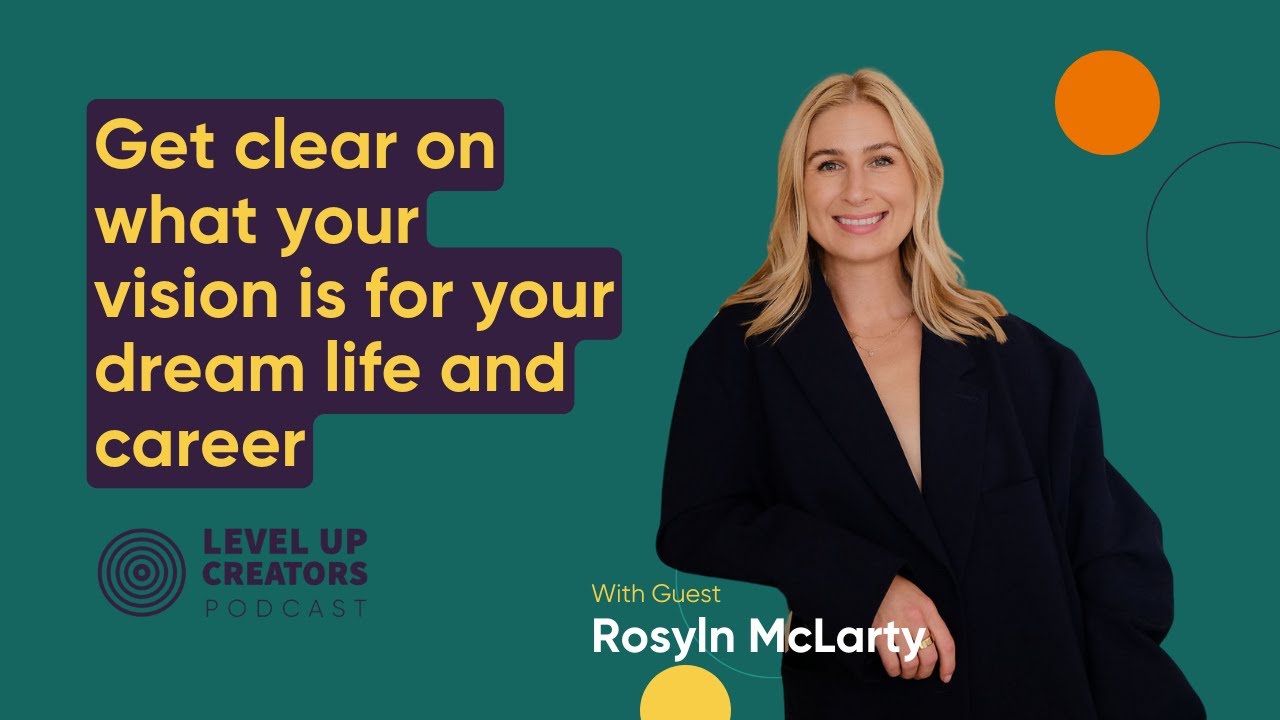
In this Level Up Creators Podcast episode, host Amanda Northcutt interviews Rosalind McClarty, co‑founder of The Gist and founder of Within, a coaching, content, and community platform for purpose‑led founders. The conversation traces Rosalind’s early exposure to entrepreneurship through her parents’ accounting firm, her decision to work at PwC, and the organic birth of The Gist—a women‑focused digital sports media brand that grew to over a million newsletter subscribers and multi‑million‑dollar revenue. Rosalind describes how relentless drive, perfectionism, people‑pleasing, and an expanding scope of responsibilities led to a severe burnout in mid‑2023, detailing physical (neck/shoulder pain, eye twitch, insomnia), emotional (anxiety, dread, guilt), and psychological symptoms. She recounts the painful decision to step away from The Gist in early 2024, the grief of losing her identity tied to the company, and the supportive role of her inner circle. Recovery involved intentional rest, somatic experiencing, yoga, coaching, inner‑child work, meditation, journaling, and re‑connecting with creative pursuits like graphic design. These practices informed the creation of Within, which aims to integrate entrepreneurship, personal development, and spirituality for founders. Rosalind shares a five‑point anti‑burnout framework: nervous‑system regulation, basic self‑care, interoception, self‑compassion, purpose alignment, and community. The episode closes with a concise golden nugget: burnout signals misalignment with one’s authentic self, and clarifying a vision for a dream life prevents it.
Chapters
Hey, hey, you're listening to the Level Up Creators Podcast. Amanda Northcutt here, founder and CEO. We help creators and digital thought leaders like you turn your knowledge and experience into rock-solid recurring revenue. And we're so glad you're here. Welcome. Today, my distinguished guest is Rosalind McClarty, an executive coach and the founder of Within, a personal development platform for purpose-led founders. Prior to starting Within, Rosalind co-founded The Gist, a women-run digital sports media brand, making sports more inclusive, accessible, and fun for over a million underserved sports fans. And while at The Gist, Rosalind was recognized as Forbes 30 Under 30 recipient in 2020. One more time. And while at The Gist, Rosalind was recognized as one of Forbes 30 Under 30 recipients in 2020, which is a massive honor. Congratulations again, a few years later. Rosalind's experience of building and burning out from a startup made her acutely aware of the role of personal development in entrepreneurship. This inspired her to Found Within to support founders and startup leaders through coaching, content, and community at the intersection of entrepreneurship, personal development, and spirituality. Rosalyn is joining us today from Brooklyn, New York. Welcome, Rosalyn.
Thanks for having me. I'm excited to chat today.
Me too. And you and I are basically strangers introduced by Amanda Goetz. Thank you, Amanda. And after doing like all manner of non-creepy internet stalking on you and your background, I am so excited to have this conversation. And, um, my degree is actually in sport management. I worked in sports for 10 years Outside of school, and so I am super interested to hear more about the gist. And I have like missed the boat on that. I am maybe half a generation older than you, and so like I kind of get maybe why that is. But I did start following the gist after I learned about you. I'm super, super excited to learn about that. But we have a lot to unpack that included. I want to make sure we have time to really dig into your story. Purpose-led companies burnout such a prevalent theme among the creator economy, and of course your newest project within again that's a personal development platform offering coaching. Content and community to purpose-led founders. And I cannot wait to hear about the launch, the, the vibe, what you're going for, the vision and everything. But first, we're gonna like go way back to your childhood, if you don't mind.
Um,
I'm always so curious when I look at a LinkedIn profile like yours, you know, it's university, you put in your time at PwC, and then like entrepreneur. I mean, in your, you know, early to mid-20s. So do you have entrepreneurial blood? Did you always know you wanted to start a company or something else?
Yeah, actually, I do have parents that are entrepreneurs. They ran an accounting firm together when I was growing up. Um, and I think, yeah, that was very expansive for me in that it showed me the impact that entrepreneurship can have in your life, from the flexibility to the meaning to the, the growth and evolution you experience as someone that is growing a company. the personal satisfaction that comes with creating and building something and bringing it into the world and solving problems for people. So, Mm-hmm. I don't think I was one of those kids that was like, yeah, I'm like, I'm gonna be an entrepreneur for sure. But I think it subconsciously influenced a lot of the ways that I went about my life. And when I found myself in a somewhat unfulfilling role, at a Big 4 accounting firm, like you mentioned, um, and the opportunity for entrepreneurship came up, I think I didn't hesitate, probably because of that expansion that I had early on.
Hmm. I'm curious what your parents thought about your move into going to work for one of the Big 4 right out of school. Were they supportive of that or like, this is maybe not going to be what you think it is?
So it's funny because that was following in their footsteps too. They are both CPAs. They both did Since after the Big 4. It's so funny how influenced we can be by our parents. So, I think they knew that it wasn't probably not going to be the most fulfilling, but they supported it because they thought that having that foundation of business and finance can be really valuable for any company. And that certainly proved to be true for me. Bringing kind of that financial background to startups was helpful.
Oh my gosh. Yes. such a huge skill set to bring to the table in a group of co-founders. Okay, well, tell us about how you went from PwC to the startup world, co-founder of The Gist. You have co-founders, so how did that all come to be? And then tell us more about The Gist.
Yeah, for sure. It honestly came about really organically and kind of born out of a personal need that myself and my co-founders felt. We were friends from university, all studied business, and we were all working in different areas of finance in Toronto and just were gotten together for dinner one evening and sports came up. And, you know, one of my co-founders is a super avid sports fan and really identified— that's a big part of her identity. And the other 2 of us, like, grew up playing sports and Could really appreciate the community that sports brings, but just didn't really feel like there was anything out there that felt inclusive and accessible and fun and like it was for women. Everything else felt pretty exclusive, like it was really made for the white male sports fan in mind. And so, um, I think we really just saw the opportunity to create something that had inclusivity at its core and just like thought it was a really massive business opportunity because there are so many women and other underserved sports fans that, you know, felt the same way. So once we had the idea, we were pretty fired up about it. So we—
Yeah.
Just got started initially as a side hustle for about a year, started as a weekly email newsletter, expanded to social media. Eventually, we got into an incubator program that offered some funding, and we had just made a promise to ourselves of, if we get into this, we're all going to quit our jobs and go full-time on The Gist. Felt like a lot of money back then. It wasn't really for all of us quitting and getting going, but it was enough, I think, to get us over the edge. So, from there, you know, over 5 or 6 years that I was active in the company, we grew to serve millions in audience, over a million in newsletter subscribers, working with hundreds of different brand partners, making multi-millions in revenue and growing our team to about 20 full-time people when I, when I left. And yeah, I'm really proud of the impact that we had and that The Just continues to have on the sports industry and our society more broadly, making a male-dominated industry, um, more inclusive.
Yeah, it's so incredible. And I mean, you're absolutely right, ESPN was built for the, like, white male sports fan for sure. And turns out half the planet is made of women. We have slightly different tastes, right? Um, so I think this is a super interesting concept, and I love that you built something that is continuing on. You've built something that is here to last, and that is such an incredible testament to your business acumen, your foresight, your vision, and risk tolerance. I'm kind of curious how you feel if you're, if you feel that your parents being entrepreneurs themselves helped you have like a very different perspective going in terms of like, it's okay if I fail at this. How do you, what's your purview on failure and has that changed since you started The Gist?
Yeah, that's a good question. You know, I feel like I went in with almost this, like, naivete of, like, we just can't fail. Like, it's just too good of an idea, and we're just, like, so— have so much determination to bring this into the world, um, that we can't possibly fail. Um, and that really kept us going, I think, in the early days when it is, like, more likely that maybe you'll run out of cash or you don't get traction or—
Mm-hmm.
And whatnot. Um, but then I think like once you get over that hump, the pressure really builds. Um, this pressure to not fail. And in some ways that can be healthy. And I think for me, it, it probably is one of the things that did end up leading to my burnout, this pressure that I put, put on myself of like, we need to make this work and I need to contribute and. Mm-hmm. Setting those really high expectations for myself and for the company as an entrepreneur.
Gotcha. Let's start to fill in those gaps a little bit because I mean obviously you have you helped start the gist. You have exited as a full-time employee. You're still in an advisory capacity. Is that correct?
Mm-hmm.
Cool. And now you have launched your newest venture within, but a lot has happened between now and then. So it sounds like you guys were you and your co-founders. How many? Other people were involved at the beginning.
Three of us co-founders.
Amazing. Okay, so the three of you are like nose to the grindstone. We're gonna do whatever it takes to make this work. Failure is not an option, and you freaking did it. So that's incredible. You know, ninety-nine people out of a hundred who have this story have failed already. So that's really cool. But then it sounds like the fear of failure, or maybe wasn't necessarily just like fear of failure, but the pressure, like you said, built as you found more and more success. You weren't able to sort of like relax. into that success, but felt probably more responsibility, more pressure. You've got employees now, you're responsible for their livelihood. So tell your side of that story.
Yeah, I mean, there is a— are a lot of factors that went into my burnout, um, which for context I experienced in June of last year, was when I kind of woke up one morning and felt like something is very off. Like I really don't feel Okay. At all. Which I can get into what that looked like. But I think some of the factors that contributed, there were some that are a little bit more surface level and observable, and then there are some that went a lot deeper. Mm-hmm. On the surface, there was the compounding effect of being on, like we talked about, just building for 5 years, trying to make something successful through sheer determination and hard work. without really taking more than a couple of weeks off for, you know, 5 or 6 years is a lot. I think too, as the company grew, my scope started to feel like it was bursting at the seams. I was the head of operations, finance, and growth, which is, yeah, a lot of balls to have in the air, a lot of different things to juggle. But not only that, but Also, I realized after the fact it wasn't really conducive to, I think, what I fully have to bring to the table. I think I always thought that I needed to be this finance operations, logical numbers person because that's how I thought I would be successful as a business person. And I have a lot more creativity. I love working with people one-on-one. There just were lots of parts of me that weren't being fully expressed. And honored in my work in that scope. And so, that was a big contributor for me. There's just, like, the constant personal and professional growth that's required of you when you're going from a 3-person company to a 20-person full-time company. That's pretty intense. But then, I think under the surface, there was a lot to do with me that I was contributing to my own burnout. I was Major perfectionist. I've set really high expectations for myself and the company and felt like I was failing to come anywhere underneath that. And that was really in all aspects of my life. I felt like I needed to be this really strong, capable operator, but also this really kind and caring manager and a great friend and great girlfriend and like all the different areas of life, like holding myself to this perfection. And then on top of that, I was a really big people pleaser and, you know, wasn't good at setting boundaries and asking for help. I felt like the value that I was contributing was being able to come in and fix everything for everyone and keep everybody happy. And those behaviors don't scale with a company. If you're trying to be perfect in every area and you're growing your team and you have investors and partners and customers, it's just not possible to be perfect in everything and keep everybody happy. And so, yeah, I had a lot of healing work to do around those areas that I learned kind of after the fact, but those were some of the— Some of the factors that led to my burnout in the company.
I mean, that sounds like the absolute perfect storm of, you know, competencies, core competencies, things that normally can be leveraged for good. But when you pile and layer on that pressure to yourself, I mean, yeah, it sounds like a pressure cooker, honestly. Wow. So, You you said that the burnout you you woke up and realized like oh no this is June of twenty-three.
Mm-hmm.
Right okay we're recording this in November of twenty-four and so looking back are you able to see parts that of your life earlier on before the gist where like the perfectionism and other behaviors you mentioned like affected— how do I want to say this? Can you sort of go back and do a retrospective and see how you got to that place where, you know, I don't know if you grew up in a very performance-driven household. You said you were in athletics. Where did that pressure sort of originate? And do you see a logical path to how things went from here to here, you know, from a healthy startup place to unhealthy, the walls are falling down?
Yeah, that's a good question. And that's been a really big piece of the work that I've been doing since I burnt out is figuring out those answers. But yeah, I think there was something I felt from a really young age of having to be a really high achiever, you know, be smart, get good grades, achieve in athletics, um, to be a very, like, good girl, I guess you could call it. Keep everybody happy, never misbehave. Um, that's what felt safe for me, or that's kind of how I learned to approach the world as a kid and as I got older. And I think that that continued to manifest for me through university and my career and into my startup too, was this notion that I'm not inherently valuable just for being me. I need to prove my value and worth through performing in my career, in my startup, in my relationships, keeping everybody around me happy. It, yeah, I think it, that was at the core of so much of the burnout of just not accepting that I was inherently worthy at the end of the day.
That's a very mature perspective to take. And I can, I get that is evident that you have done a lot of work. Um, again, like this is actually the first conversation you and I have ever had, just full disclosure. I think that's the first time I've, I've interviewed somebody on a podcast where this is literally our first conversation. So. Um, I don't know if you know this about me. I do speak pretty openly about it, but I had like the bottom fell out of my health in my mid-20s. I mean, like, it is surprising to everyone that I'm still here. And I was a total workaholic, perfectionist, did grow up in a performance-driven household. I was the number one, um, applier of pressure though.
Mm-hmm. Yeah.
Uh, parents definitely had high expectations, but like, it was like I was born with it. I mean, it just, I don't know how, I don't understand how that comes to be. And one's genetic code, but it ultimately came down to the same thing for me that I did not feel like an inherently worthy human being unless I was a human doing and a human achieving and visible signs of my, you know, success as the world defines it, even if again, the walls are crumbling down everywhere else. Uh, so that's big that you've already like come to that. And, um, that is a hard realization to have. And what did you find when you left The Gist and you were like, I have to step away? How did your inner circle respond to that?
Yeah, it was really hard, the process of stepping away from the company, and one that quite honestly I resisted. Initially, because I identified so much with the company and it was everything to me. I had put so much time and effort and felt like I'd sacrificed so, so much, um, and had gotten a little bit lost in the company. And so the idea of stepping away really brought up a lot of this really scary uncertainty of who Who will I be without the company? What will I do? And it brought up a big sense of loss and grief, like, around not only not being involved with the company, but around almost going through like a co-founder breakup.
Mm-hmm.
Because, you know, you're building with these 2 super important people in your life that Nobody understands you like they do because you're the only ones that are going through everything that you're going through for 5 years. And I don't think people fully acknowledge how sad that can be. Like, that was the longest relationship I had, longer than I've been with my fiancé even.
Mm-hmm.
So there's loss, there's grief, there's heartbreak. Um, and My inner circle was incredibly supportive. I think it was, you know, one of the first times that I've— or first time in a long time where I've fully fallen apart. Like, I, I felt like I really hit a rock bottom and was like so lost and everything felt so under control, which— so out of control, which is very scary for someone who likes to be in control of everything that's happening and where I'm going and all that, all these things. Mm-hmm.
So I really.
Had to allow myself to be held by, for the first time, by my partner, by close friends, family. Um, and that was as like horrible as what I was going through was, that was really a beautiful moment for me and one where I felt very supported and I guess, you know, worthy of that love and support, even though clearly I was not achieving, clearly I was not contributing, all those things. Um, and it was also a moment where I think I have felt so much more aligned to my intuition than I had in a really long time. I had really disconnected from my body in building the company and really disconnected from my intuition. And so— Mm-hmm. This time of grief and uncertainty was also a period where I started to have hope again and to see a possibility to have my life be a different way and to build companies potentially in a different way, in a way that felt a lot more in integrity for me and was more embodied and more expressive of who I am. Um, so as terrible as burning out was, I'm so grateful that I did and for the inner work that I did after, for the support that I got from the people around me after. It was a life-changing experience in a really good way, ultimately.
Yes, I hear that. That's coming through strong. And looking back, When did the signs of burnout start and how did that manifest from you from a physical, emotional, psychological standpoint, if you don't mind sharing?
Yeah, absolutely. Um, yeah, it took, it kind of took me having that initial kind of breakdown for me to fully admit to myself that something was wrong. I think I had blocked it out for so long and was so disconnected from my body, but, um, Looking back, you know, I, I was physically and emotionally exhausted. Um, like I was so emotionally reactive. I was just completely at the end of my rope that the smallest triggers, just like an email, would set me off in tears. It just felt like I couldn't handle anything emotionally. I was feeling anxious and overwhelmed. I felt like This reaction to opening my laptop, like a feeling of dread, um, because I didn't want to go in there and deal with whatever there was to deal with. Um, I felt this pervasive dullness, like almost this apathy towards my company and my life, which I then felt guilt and shame on that because I was like, why am I feeling this way? I love this company. I love being an entrepreneur. Like, what? What? What's going on? Why don't I care? What's wrong with me?
Mm-hmm.
Um, physically, I experienced this intense pain in my neck and shoulders that actually took about a year after my burnout to finally be rid of. Um, what else? I was drinking 3 cups of coffee a day just to try and keep myself going, and then lying awake at night ruminating and starting to question, like, What is the point of this company? What's the point of anything? Um, yeah, so it was a pretty dark time in terms of my physical and emotional, spiritual wellbeing.
Yeah, no kidding. And then if you can pinpoint a timeframe, so, you know, official burnout marker, like, oh my God, I'm done, June of 2023. When did those
Oh, that's a good question. Like, I would probably say in the months leading up, like, more intensely, but probably some, some of them had been going on for a long time. When I think of the physical side, the pain in the neck and shoulders, and actually I had an eye twitch too. That was another physical manifestation that had been going on for a while. There probably for like a year back. So it was slowly building.
Wow. And so what was it like for you once you made the decision? I mean, you said earlier, obviously it was very difficult, especially with your, your 2 business partners to kind of like actually roll this decision out and make it your new reality. Um, so apart from that, I mean, what was it like for you to, you know, let go of the reins or at least Loosen them significantly and put your business baby in the hands of the team that you built and your two co-founders. Was it relieving or was it more stressful?
That's a good question. It was a mix of emotions. I think initially it was more stressful because being a perfectionist, I wanted to make sure I transitioned out as well as possible. So I probably like burned myself out again just trying to get everything together. And pass it along to the team. But yeah, it was also a huge relief. I think deep down I knew that continuing to work in the company without making any big changes was just going to burn me out again. And it was going to be hard to make changes that would work. It would kind of be like fitting a square into a circle.
Mm-hmm.
Um, and so it was stressful. It was a stressful time to transition, like, you know, between recognizing the burnout to all the way through making the announcement that I was stepping away from the company in February of this past year, of this year, 2024. Um, but yeah, I think at a certain point, There became this undercurrent of, of hope that really kind of carried me through.
Good. Okay. So how have you recovered? I mean, to the point where you've launched a new thing already. What were the steps?
Yeah. Um, it's funny being like a type A person, I jumped into my burnout recovery like, I'm gonna do great at this healing. I'm gonna crush this burnout. I'm gonna crush this burnout. Yeah, exactly. Which is not actually the energy. That you really need when you're burnt out and recovering from burnout. Um, so the, the very beginning of it really was just like resting and allowing my body and my nervous system to regulate and heal. And so that was a lot of sitting on the couch and reading and watching TV, going for long walks outside. Um, Yin and restorative yoga was really good for that. Just like doing activities that felt restorative and recharging and restful, which felt really strange, by the way, after 5 years of just being in go mode and, you know, always feeling like there was something to be done and never allowing myself to fully rest. So there's that. And then— Once my body was able to hold all of the inner work that would come, I think I was feeling really determined to start to get to the bottom of where did this perfection and people pleasing come from? Like, how did I get to a place where I was feeling so misaligned from what I actually think I want to do? So there was a lot of soul searching and it came in lots of different forms. I did work with a burnout coach in the months after I decided to go on leave, and that was super supportive. We did a lot of work around limiting beliefs and self-compassion and identifying values and starting to see what, you know, could be next for me. Um, I also dove into a manifestation course called To Be Magnetic. Which is really about manifesting from this place of you need to be worthy enough of what you desire. And so there's a lot of work around going back to your limiting beliefs and core wounds and understanding where those came from and, and healing them. Um, lots of inner child work and shadow work.
Yeah.
So that was amazing. Um, somatic experiencing was a really big step in my recovery because I'm someone who was so disconnected from my body. And so just the work of like, where are emotions showing up in my body and moving through them and starting to trust my body's intuition and allowing my body to start to trust me back has been absolutely transformational work. Yeah. Um, what else? Like lots of different types of journaling, meditation, reading, just to expand myself and see what are like the new ways of, of being and seeing the world. And then the last thing was just taking some time to rediscover who I am and what I love. And so I took a graphic design course, for instance, because I always felt super in flow working on like, how does our brand show up at at the gist. I loved that. So I was like, I'm gonna dive into that further. I started writing online and sharing my story and just like having an avenue to express myself, which was really powerful for me as someone who has had trouble like having their voice feel heard and feeling expressed.
Mm-hmm.
And I signed up for a coaching certification because I knew I was always like very much obsessed with personal development and spirituality and that whole side of everything. And so that has been also like hugely transformative in and of itself. And all of them have kind of— all the things that I have explored and loved have all come together into what I'm doing now, which, yeah, is so cool.
Yeah. I wanna ask you one more question, then we're gonna get all about All on within. For creators who are listening to this interview right now and going, "Oh no, that's me! I've got the tense shoulders and the twitching eye, and you know no appetite, or my stomach hurts all the time, or I'm lying awake having anxiety and worrying about what's unfinished at work." What advice do you have for creators who have that awareness? Entrepreneurs, business owners, anyone, they're, you know, are sensing that happening in themselves, but, you know, don't want to get to the point where they have to shut their business down, basically. Like, if they can walk back off the ledge a little bit, like, how would they do that based on where they are now?
Yeah, great question. And hard, hard to say it all in one, in one answer. It's something I've written about at length and that I coach people on. Now in kind of a more personalized way. But if I had to give my top 5 recommendations, they would be one, regulating and healing your nervous system, because burnout can come about from chronic stress, which means your nervous system is getting stuck up in that fight, flight, or freeze and not being able to healthily come back down into rest or digest. And many of us, like, throughout our days can get stuck up there. in this day and age because we have stressors that might be longstanding and we might have nervous systems that are prone to getting stuck up in there, which can, can be affected by our childhoods and genes and things like that. And so having practices to regulate your nervous system throughout the day, whether that be breathwork or yoga nidra, Getting outside, movement, laughter, all these things can help bring your nervous system back down into rest or digest so it doesn't get chronically stuck up there and, and lead to burnout. Um, a second one I would say is just prioritize the basics: good sleep, nutrition, exercise, movement. All of those things can actually resource your nervous system better so that it doesn't get stuck again, like I said, up in that fight, flight, or freeze.
Yeah.
Um, and practicing interoception, which is being able to listen to the cues from your body. So not the things like sight and hearing, but actually things like hunger and temperature and emotions. So just starting to develop that understanding of signs for your body so that you notice like, oh, I'm feeling really tense. My neck is hurting. Why is my eye twitching? Why am I— why does my stomach hurt? Um, so that you get tipped off. The third one, which was a really big one for me, is to practice self-compassion. Um, I think for my burnout, at least because I was so hard on myself that just made everything worse. It made me work harder. It made me doubt my worth, which made me push more and continue to be stressed out about everything. Self-compassion is a practice. It's not an on-off button, otherwise we would all do it. So the practice that helped me the most in building self-compassion was to write down every day 3 things that I did well yesterday or today and what that says about me. Mm-hmm. So kind of like a gratitude practice, but more like a self-gratitude practice.
Yeah.
The 4th thing I would say is to try and find purpose and enjoy what you do. Like I mentioned before, finding myself in a role that really ran contradictory to, or ran contrary to what I think my unique purpose is and my unique strengths and what I love to do. Um, that was like a big thing that caused my burnout. So to the extent you can take some time to reflect and get clear on what is it that I love and what am I doing in my day that maybe, or maybe I could move things around to do more of what is naturally energizing to me and minimize the things that are energy draining for me.
Mm-hmm. It
doesn't have, you don't have to like change everything, but just bringing a little bit more reflection and intentionality can go a long way.
Yeah.
And then the last one I would say is to find community and expansion of people, from people that are building companies and careers in a way that is more sustainable and in integrity and kinder to self and embodied and All these things that I just mentioned, because if you surround yourself with people that are like, go, go, go, and pushing themselves and hustling and grinding to try and get things done, it can feel easy. It's easy to feel like you're falling behind. But if you surround yourself with people that are doing it in a way that is inspiring you to build your company or career in a way that is, yeah, just kinder to yourself, that can go a really long way.
Yeah, I love that. I love how much you're talking about self-compassion. I'm sure you're a Brené Brown fan.
Yes.
What about Kristin Neff? Have you read her book? Oh yeah.
Yeah. Mm-hmm.
Those are like, and Esther Perel, like those 3 women are just so high up on my, my list. And so I love that you're bringing in all of those practices, uh, into kind of, I mean, I assume kind of a unified curriculum almost. So I want to hear all about Within, how you are building sustainably in a way that is authentic and within your value set and is giving you purpose. Um, to borrow a Silicon Valley phrase, like, how are you eating your own dog food in that regard and like practicing what you preach? So how is that going? And also we need to hear all about Within also. This is a great opportunity just to go for it.
Yeah, for sure. So Within is a platform for founders. Um, offering coaching content and community really at the intersection of entrepreneurship, personal development, and spirituality. Um, and it was really born out of a personal need. Like, this is what I wish existed when I was a leader at The Gist. I think that there's a lot out there that supports founders in the tactical side of building companies, fundraising, growth tactics, all that good stuff. And then— Yeah. There's kind of a separate lane for spirituality and personal development. But I think that they're super interconnected in that in order to level yourself up as a creator, as a founder, you know, in your life, it does take a certain amount of inner work. I think that the entrepreneurship journey is a spiritual journey and that, you know, it's a— all the challenges and difficult people that come up in your journey are opportunities to heal. They're mirrors for you. And so, yeah, that's, um, that's really what it's all about. I'm still very much in kind of the early stages of it. So, um, but yeah, to answer your question around like, how are you eating your own dog food?
Sorry.
It hasn't been super easy. Well, first thing, I guess, the fact that it is coming from a place that I feel like I am working on my unique purpose that's come from my experience of building a company and burning out and doing all this healing work. Just like, like I'm the right person to be doing this and helping other founders with it. And the work feels very energizing for the most part. So I think that's really helping with not burning out again. Um, I think, you know, to be completely honest, like it has been a little bit of a struggle because I have experiencing some chronic fatigue over the last few months, which maybe could be related to the burnout or something else. And so that's forced me to really learn this lesson of integrating rest, um, which has forced me to get really clear on my goals and prioritize ruthlessly, which is something that I definitely would recommend. I think when you're unfocused, you can get really reactive. You can be trying to do too many goals. And as a result, you become less effective. And so for me, getting really clear on the goals and what it's going to take to achieve those goals and managing my time so that those are priority and everything else is nice to have. And if I have to take an afternoon off to rest, then that's okay. Like I'm still moving my business forward.
Mm-hmm.
And then the other couple of things I would say, like I've continued to do my healing work. It's not like I did this healing journey and now I'm building my business. They really do go hand in hand. So. I'm working with a coach. I'm continuing to journal and meditate. And as things come up in the business, ask like, how can I learn from this? You know, how am I getting in my own way? Um, and the very last thing I'll say that I think is helping me build this business in a way that feels more joyful and easeful and in alignment and in integrity is To continue to expand my, my spirituality and to build from more of a place of trusting that because, you know, I'm listening to my intuition and my true self and moving in a direction that feels really in integrity for me, trusting that it's going to unfold. Yeah. Instead of building from a place of pushing and hustling and trying to control how everything shakes out, which has been my method before. And I think that contributed to my burnout. So yeah, I've just been reading a lot of books and trying to get expanded in that way. So that's, that's how I've been approaching it.
Awesome. And so What role does accountability play in your community platform here? I mean, like, it is so hard to build an organization, as you know, and keep up with all of these health and wellness practices, like full spectrum stuff. And so how does accountability work?
Like keeping myself accountability?
Or like, um, How are you holding— yeah, well, sure, yourself accountable for sure. And then also, you know, the people who are part of within, you know, are you matching like accountability partners or do you have some sort of system or something like that to make sure that people are actually following through and acting in their integrity and alignment with their visions?
Yeah. So as of right now, I haven't rolled out the community yet. I'm starting with one-on-one coaching. Okay. So that I can really understand like the problems and pain points of the people that I'm gonna be working with before I roll that out. But I absolutely would love for that to be a big part of it and to really get focused on the most important things. I think most founders and most people are just trying to deal with everything that's coming their way, all of the information and everything.
Yeah.
Yeah. I, I envision it as like there being a different focus for every month that, you know, you build that skill or build that practice and then,
yeah,
it is integrated into your life. But as far as the one-on-one coaching goes, that's definitely a piece of it too. Like,
yeah, I mean, that's the ultimate accountability is having one-on-ones, right? Like, did you do what you say you're gonna do and all that kind of stuff. So,
yeah.
And that's great. I love that you're starting one-on-one. I think a lot of people starting businesses, especially those who identify within the creator economy, like all the marketing out there is build and launch a course, build and launch a course, build and launch a course, or build and launch a community. And if you are just starting out and you don't truly understand your customer and their core problems, what role you have in solving them, the methodology that you're going to use to take someone from point A to point B and how you're going to help You know, understand the nuance in that journey for different sort of archetypes of clients or customers. And so I love that approach. I think it's the absolute right approach because you're going to establish product-market fit and then you're going to get enough experience within different client archetypes that you can build a one-to-few or one-to-many, you know, program that is actually going to be really effective because you're not guessing. And so I think that's The absolute correct approach. And, um, it's also working iteratively, like you are learning new information with, I'm sure, every single client session and you're able to iterate and bring those learnings forward to the next client, the next client, and the next client. So it's this virtuous cycle, um, of iterating on your, your methodology and your practice. And so that's great.
Yeah, absolutely. Thank you. And it also is just what felt the most energizing for me to start with. So that was part of it too. Yeah.
Yeah. Yeah. I mean, you definitely seem extroverted. Is that correct? Or—
I actually don't really identify as extroverted.
Oh, interesting.
More of like an ambivert.
Okay. All right. Fair enough. Um, I mean, I get like extremely energized with one-on-one conversations with our clients. I mean, these kinds, this kind of platform is very energizing for me as well. I'm definitely. Extroverted. Um, but there's just, it feels like so much more you can help someone if you're, you're doing something that's specifically tailored to them. There's something like very human component and connection and relationship is very, very special and is difficult to imitate in, uh, a small or large group setting.
Yeah. Yeah. It's such a privilege to get to hold space for people and support them on their on their journey and work through whatever is going on for them and, and see the transformation, you know, as they make the changes session after session. Super, super rewarding.
Yeah, that's great. And how can people find out about you and getting coaching from you?
Yeah, so, um, can find me on Instagram at Rosalind McClarty. And that's where I post everything about Within and have my links and everything. I also have a biweekly newsletter, which is at within.beehive.com. And that's where I write about lots of different actionable insights for building companies, living a meaningful life, and reaching unstoppable progress without burning out.
I love that. Unstoppable progress, not perfection, but progress. Nice. Okay. I love that. That's great. And of course we'll link all of that up in the show notes as well. But, um, one more question. If people can only remember one thing from this episode, what's the like absolute number one golden nugget they should walk away with?
Hmm. Yeah, I would say it's that burnout Ultimately, I think, is a manifestation of you being out of integrity or out of alignment with your authentic self and the life that's meant for you. And so taking the time to really get clear on what your vision is for your dream life and career and starting to take steps towards that will allow you to prevent burning out and ultimately bring you, I think, the most joy, abundance, growth, success, peace, all the things that you want.
Wow, that was really great. Um, thank you so much for joining me today, Rosalind. This was such a down-to-earth, relatable conversation for everyone listening. I so appreciate you showing up here and being vulnerable. Like, that is so incredibly important for people to actually Um, feel like they can relate to you, that you are a real human. You have achieved a lot of success in your career so far, and the sky is the limit for you. And you're doing it in a way that is authentic and sustainable, and you're showing others, you're shining a light on how others can do this as well. And that is not the typical, you know, Western world model. So, um, I think you are going to make a massive difference for all the people that you impact and just So appreciate you coming in and showing up here today as a human.
Yeah. Thank you so much. I really enjoyed this conversation too, and appreciate the opportunity to get to know you better and chat to your audience. Um, appreciate it so much.
Thank you. And thank you, listeners. Time is precious. Thank you for sharing yours with us. We help creators like you at levelupcreatorschool.com, where our team becomes your full-stack team of advisors and also includes no-fluff creator courses, a vibrant creator community, and more. All on a subscription basis. See the show notes for more information and a suite of high-value resources from us and Roslyn as well. We'll see you next time on the Level Up Creators Podcast.
More from Amanda




Audit Your Calendar, Audit Your Life — Dr. Lani Jones on Hidden Guilt & Boundaries



Built a Successful Business & Still Feel Empty? Here’s What to Do with Dr. Lani Jones