Let's Talk Mental Models
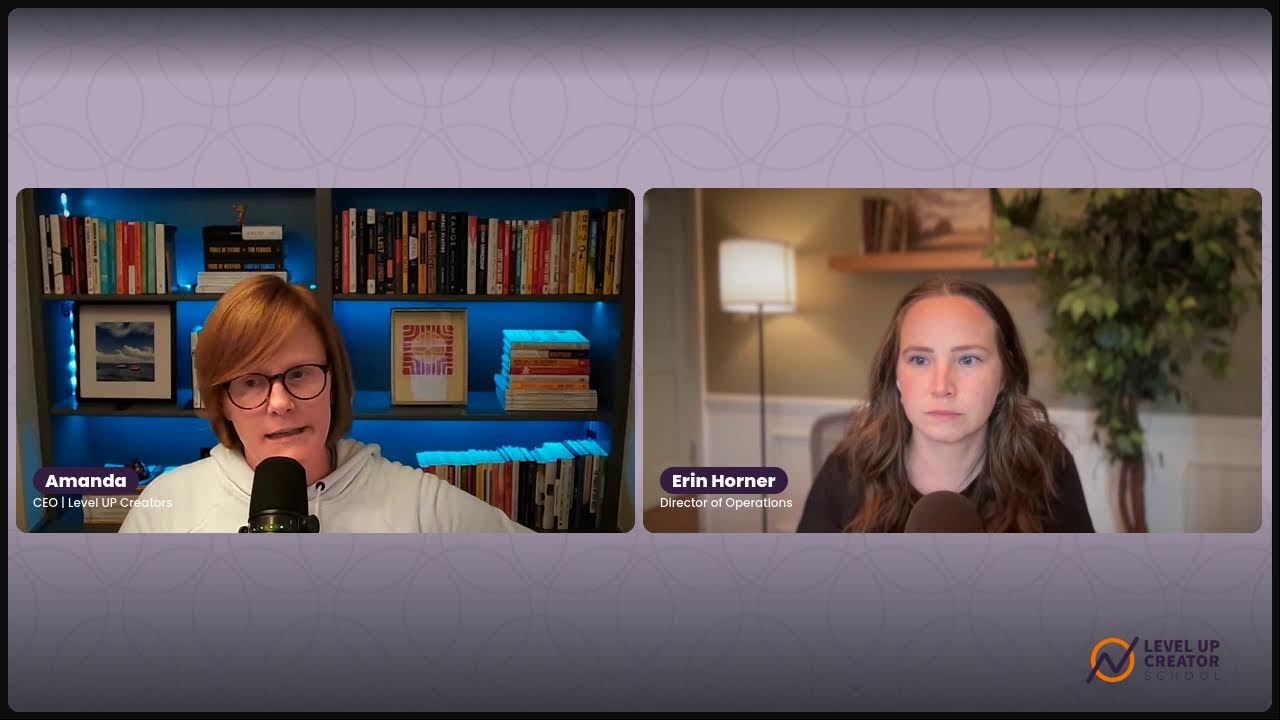
In this Level Up Creators livestream, host SPEAKER A introduces Amanda Northcutt, who shares her obsession with mental models as tools for better decision‑making, especially for creators and small‑business CEOs. She explains mental models using a glasses metaphor and walks through several key frameworks: Jeff Bezos’s Regret Minimization Framework, the distinction between one‑way and two‑way door decisions, second‑ and third‑order thinking, and Hanlon’s Razor. Amanda emphasizes the importance of iterative, low‑risk experimentation backed by metrics dashboards, and ties these concepts to a growth‑mindset approach for building recurring‑revenue businesses. Throughout the conversation she references resources such as the Farnam Street blog and her own Creator‑to‑CEO course, and promotes Level Up Creators’ consulting services, the Creator School, and a new exclusive 7‑month MRR accelerator program that guarantees scaling from $10‑$20 K revenue to $40‑$60 K MRR. The session closes with a practical call‑to‑action: apply second‑order thinking to today’s decisions.
Chapters
Models, and we're so glad that we could spend a few minutes of your day with you. If you have any questions for me or Amanda, please drop them in the chat at any time, and we are happy to pause what we're talking about and answer your questions. If you haven't met us yet, there are 2 ways that we help thought leaders. And creators like you build rock-solid recurring revenue. First, we have Level Up Creators, which is our done-for-you white glove consulting firm. Second is Level Up Creator School, where we have a global group of thought leaders, um, and we help them build businesses through our done-with-you model. Creator School includes access to our consulting team and our consulting methodology in a way that we used to reserve for our clients exclusively. So hello and welcome. OK, let's dive right in. Amanda, just give us a quick synopsis on mental models overall.
Yeah, so I'm relatively obsessed with mental models because I'm obsessed with good decision-making, honestly. And I think it's really hard to make really good decisions. I mean, literally, like, this is what we get paid to help people make really, really big decisions, many times their livelihood. depends on it. And we take that very, very, very seriously. And so we don't just take like an intuition-based approach, though your gut feeling is important. But I think of mental models are just different ways of thinking about the same situation, or you could look at it that way. So for instance, it's like, you know, I've got, I don't know how many pairs of glasses, but I have a lot of different pairs of glasses. OK, like I'm a full-time glasses wearer; they're a face ornament. So like, I like to change them out. But if you think of, if mental model as a pair of glasses. You can put that pair of glasses on and see a situation through a specific lens. And then you can trade out your pair of glasses, and you can see that same situation through a different lens. And some examples of mental models— important, like, start to put a little context and color around this— but the regret minimization framework, that's one of like Jeff Bezos's favorite frameworks. There's one-way door versus two-way doors. And so— Yeah. Would it be helpful if I explained these as I went along? Maybe? Perhaps?
Maybe.
OK. So Regret Minimization Framework. So the way that Jeff Bezos describes this is he's on his deathbed. He's making a very consequential decision today, right now, at age 50 or whatever. How will he view this decision on his deathbed? And so that kind of like helps it put a current situation into perspective. And like, what's the long-term view? And that also, taking that regret minimization framework, long-term view requires you to use another mental model called second-order thinking. And then there's third-order thinking. And so it's like, what is the cascading effect of this decision going to have? Who else will it impact? Who are key stakeholders? How is it likely to impact them? And then what is the result, right? So that's a really good one. One-way door versus two-way door. A one-way door decision— so think about like restaurant doors, you know, in the kitchen coming in and out. It's very important that you go the correct direction so people aren't bumping into each other. But some doors only open one way. There's no going back, or it's very, very, very hard to walk back through it without a, you know, catastrophic, cataclysmic, you know, hitting everybody else coming the other way, whatever. Two-way doors 2-way door decisions are less consequential, right? So they're easier to walk back. So they require less arduous, a less arduous decision-making process, perhaps like, you know, when Jeff was the CEO of Amazon, he was pushing decisions down to maybe middle management for 2-way door decisions, whereas one-way door decisions have to have a much higher degree of scrutiny because the consequences of those decisions, whether positive or negative, are much, much, much Greater. That makes sense?
Yeah.
Cool. And then second-order thinking and third-order thinking. This is something I really try hard and instill in my son. And his prefrontal cortex is not yet fully developed, right? He's 13 and a half. But it's— I've used this phrase with him since as long as I can remember. If I do this, what might happen? So I'm trying to help like bridge these synapse gaps in his brain a little earlier than they might have otherwise. by encouraging him to think about the consequences of his actions. Again, either positive or negative. Who is this going to impact? How is this going to impact them? What is the trickle-down effect of this decision? So that's very, very important in business. If I do this, it's going to cause this domino effect, and we need to know if we want that domino effect or not. So, I mean, I could go on. I know lots and lots of these. Oh, I will share one of my favorites. Maybe this would be better to share the week before Thanksgiving, as we're preparing to celebrate with our families, for those of us in the United States. But one of my very favorites is called Hanlon's Razor. I assume that's just the person that it's named after, and razor is like a type of cognitive model situation. So Hanlon's Razor is if you're trying to figure out why somebody did something that seemed like overtly stupid or obtuse, just unbelievable. Like, why did that happen? And, you know, I think our brains tend to go toward like, that person was trying to be malicious, they were trying to be mean or wrong me or wrong another person. And, uh, Hanlon's Razor says something to the effect of, do not attribute to malice what could be attributable to stupidity. And so sometimes people do stupid things because of any number of reasons, but it's, it's not necessarily— sometimes, yeah, not necessarily because they intended to harm, but literally, maybe, perhaps do not have the cognitive capabilities, wisdom, experience, ability to use mental models to make better decisions. So I think that's an important one as we head into the holiday season with families and— I obviously don't want to be tone-deaf. Today is the day after the presidential election also in the United States. So that is a way of thinking about things that is sometimes helpful.
Yeah, I know. I'm like, whenever I look back at my life, I'm like, why did I make that decision? And it's like, I'm not stupid. I just didn't have the full picture that I have on the other side. And most of the time, that's true for everyone else that's also living this crazy journey of life with us. So yeah, that is a great mental model. Which mental model do you find yourself using the most frequently?
We are really big on working in iterations at Level Up Creators, both internally and with our clients. We want to run low-risk experiments that have the opportunity to yield medium to high rewards. And so if you're, you know, the old saying, like, how do you eat an elephant? One bite at a time. And so that's how you approach business, right? And that's why we have— take a quantitative approach and have a metrics dashboard. We're tweaking things and seeing what happens. And then we're learning new information and then tweaking the next thing. So I think working in iterations is really important. And then when you learn new information, you do something different, or you change your mind about something. And so— I think those are really, really important sort of like growth mindset related mental models, but your ability to have a successful business, I think, and especially a small business, a creator business, is directly and causally, and instead of like, you know, causal versus correlation. So— Mm-hmm. There's a causal impact in your business based on your ability as the business owner, the creator CEO, To make good decisions, and in order to make good decisions, you have to think well. You have to elevate your thinking, literally. And and that is how you know top CEOs use mental models all the time. I've used you know cited Jeff Bezos a few times here. Obviously, that's just one very small example. But to level up your business, you have to level up your your thinking, your cognition, your growth mindset, and put situations through different lenses. Get other people's opinions, learn how to think better and how to make better decisions so that you will be more successful.
Yeah. If somebody is brand new to the thought of a mental model, where should they start?
Yeah. Oh, that's a good question. I have like a whole module actually on this in the, our Creator to CEO course, which is actually, we just started, we haven't even really promoted it very much. But that course is now available As a one-off, you can purchase it for like $129, something like that. So if you want to level up your thinking and learn how to do this, like, I literally spelled it out in this course. And as with all of our content, it is definitely like GTFP, no fluff, nothing extra. It's exactly what you need. It's meaty, for sure. But we are here to help you level up, not to dumb down any of our content, because we know that you are wildly intelligent and a very capable human. And we want to treat you and respect you as such and not take everything, strip, strip out the, the good nuggets, because I don't know, I don't like it when marketers and people do that. Because I think it's disrespectful to human intelligence, to be honest with you.
I don't know, sometimes I need that click here button. Just kidding. Oh my gosh. Yeah. Okay. So that's a great place to start. I'm trying to think, are there any books or any resources that have really helped you along in learning mental models?
There is a blog post that I refer to frequently on the Farnam Street blog. I'm going to try and find the link. Ooh, there it is. So I can't find the direct link, but we can drop it in here afterwards. Maybe this is it. Nope, I got it. I will drop it to you in Slack, Erin, and then you can put it in the chat. How about that?
Yeah, that works.
So that's a good place to start. I mean, also our Creator to CEO is sort of like a— we have the course, we have the full course, and then we also have a shorter guide. And it does explain some mental models. But I mean, really, I've spent 20 years dedicating myself to learning. I feel like my education really started after I graduated from university, which is sort of funny. But that's when really something like clicked in my brain where I found my extraordinary extreme area of interest is business. Like I'm just obsessed with business and optimizing businesses. And so I have acquired mental models and sort of adjusted them to my needs and all sorts of things over many years. So it is hard to sort of just like dive into that. But, you know, if one of these resonated with you that I talked about today, then try that out. But it is kind of meta to think about thinking. And so I know that is an abstract concept for many. And it's kind of unusual. But again, I do believe that that is foundational to success is Working hard to be smart and make good decisions. I believe everyone is capable of doing so. If you have the cognitive ability to listen to this conversation and comprehend what we're discussing, then I believe you have the cognitive ability to elevate your thinking. And I would love to help you do that because we're all about like equipping and empowering creators, right? It's kind of like our whole job.
It's kind of why we're here.
It's kind of why we're here. Yeah.
And you are also talking about mental models in the newsletter coming up.
Yep.
That's right. Okay, cool. Yeah, yeah, the whole month of November. The link there. Sweet. Yeah, we need that. Mental models, getting ready for family, getting ready for holiday season.
Holiday season for sure. And the new year, we're all getting ready for the new year at this point. And Oh, this would be a good opportunity. We are, we don't have any information publicly available about this. And so this is just a little tidbit if anyone's interested. We are going to take 7 creators through a 7-month program, January through July next year. And we're going to guarantee, like a personal MRR guarantee, we're going to take you from $10K in revenue to $40K in MRR, or $20,000 in, you know, revenue or roller coaster revenue, revenue to $60,000 in MRR. So this is an MRR accelerator program. It is very exclusive, very small. It is all of our done-for-you services. We are building or optimizing your existing business in this program. You get group coaching from myself, our amazing team, and some really heavy-hitting guests, which is super cool. And it's also a mastermind. So this is a highly curated group of, again, a small group of creators in a similar stage, putting you all together. And we are drastically elevating each and every one of your businesses. And we are equipping you, again, through coaching resources and everything, to be, to think and act like a top CEO and take your business as far as you want it to go. We are building all of the infrastructure, all of the tech stacks. It's insane. I mean, Natalie, I was in Missoula, Montana with Natalie, our Head of Revenue, last week, and we were putting the kind of structure around this program that we've been thinking about for months. And I mean, it just blew my mind, like what we're going to be able to transfer in terms of knowledge, and then send these 7 creators away, away with a well-oiled machine, hyper-functioning business, and then the capability to take that business forward. It's freaking nuts. So anybody's welcome to reach out to me through DMs or amanda@welevelupcreators.com if you're interested in that program. I mean, we're going to change the lives. Like, it's taking what we've done for Amanda Goetz and turning it into a very, very small group, intimate, exclusive program. But everybody who talks to me, everybody who talks to Amanda Goetz is like, I want that! I'm like, well, yeah, of course you want that! Who doesn't want that? But y'all, y'all ask, we're, we're answering, and we're getting ready for the new year in that regard. So I am going to teach all of these things in that program at a very, very specific and targeted level. So would invite y'all to start a conversation with us if you're interested in that program. And again, we are literally putting our asses on the line and guaranteeing your results. It is going to be in black and white in the contract that we sign. So I think you'd be crazy not to, like, be thinking about this. Imagine yourself next year making 3, 4, or 5 times as much as you're making now and turning revenue into MRR, right? Monthly recurring revenue, where you're selling as much as it makes sense ethically to the same customers.
Yeah.
It's a hell of a business model. It works like gangbusters. Just ask Amanda Goetz.
Yeah. OK, parting shot on mental models. Anything else?
Today, if you're making any sort of decision today about anything, use 2nd-order thinking. What are the— 2nd and 3rd-order thinking. If I do this, if I choose this way, this is going to happen, then this is going to happen, then this is going to happen. And if I choose the other way, this is going to happen, then this is going to happen, and this is going to happen. That's it. Just try that one time today.
Okay, sweet. Thanks for joining our livestream. Be sure to follow us for more tips and insights on how to build a successful recurring revenue business. Bye.
Thanks.
We did it.
Nice job.
Honestly, that might be one of our best.
You think so?
More from Amanda




Audit Your Calendar, Audit Your Life — Dr. Lani Jones on Hidden Guilt & Boundaries



Built a Successful Business & Still Feel Empty? Here’s What to Do with Dr. Lani Jones