Want to build a scalable community? Start doing this first with Bri Leever
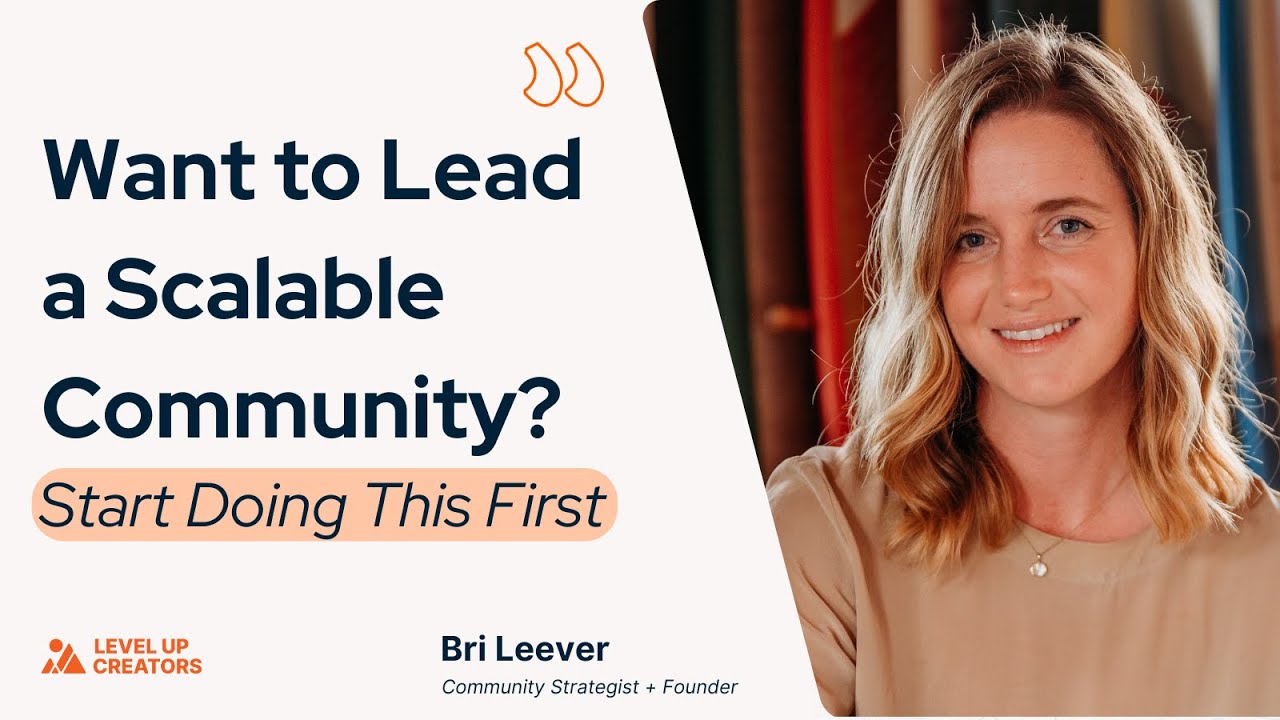
In this episode of the Level Up Creators Podcast, host Amanda Northcutt (founder & CEO of Level Up Creator School) interviews community strategist Bri Leever. The conversation traces Bri’s accidental entry into community work while working for a Portland‑based fashion brand, her pivot during the 2020 pandemic, and her evolution into a paid‑community consultant. They explore the two primary community architectures—education‑centric versus connection‑centric— and how founders should choose one to start with. The dialogue covers membership pricing tiers (low, mid, high ticket), the shift from cohort‑based education models to membership‑first models, and the role of in‑person events as a post‑COVID accelerator. Platform preferences are discussed, with Bri favoring Circle and Heartbeat over Mighty Networks, and emphasizing the need to match platform affordances to community goals. Common operational pitfalls are highlighted, especially unclear expectations, onboarding neglect, and lack of leader development. Retention strategies focus on the 80/20 Pareto principle, robust onboarding, and systematic leadership cultivation (the “Woo Funnel”). The conversation then turns to AI: cautious adoption for seasoned creators, using AI to index community knowledge, facilitate member matching, and eventually deliver hyper‑personalized experiences, while warning against premature AI for nascent voices. Finally, Bri shares personal anecdotes about scuba diving and surfing in Hawaii, and provides her contact points (emberconsulting.co, LinkedIn, Dear Bri podcast).
Chapters
Hello and welcome to the Level Up Creators Podcast. Amanda Northcutt here, founder and CEO. We help coaches, consultants, and thought leaders like you turn your knowledge and expertise into rock-solid recurring revenue businesses. And we're so glad you're here. Welcome. Today, my special guest is Bri Lever. Bri got her start building a community and growing it to a multimillion-dollar revenue stream for a brand in Portland, Oregon. Now she helps coaches, consultants, and creators build thriving online communities for their businesses. She's a community strategist by day and a camper van host by night. the Big Island of Hawaii, and you'll usually find her on, in, or under the water. Welcome, Bri. We're so glad to have you.
Yeah, thank you. I'm delighted to be here.
Well, let's start by kind of unpacking your story a little bit for my listeners who don't know you yet. Let's talk about how you got your start in your community. Let's unpack this multimillion-dollar cash cow that you built out and kind of walk us through some steps and how you got from there to where you are today.
Yeah, absolutely. The TL;DR is by accident. And I think most community people, that's, it's like how you know they're telling the truth is because they're like, it happened by accident. And you're like, yeah, you are a community person. So I walked into this role fresh out of college working for a social enterprise fashion brand in Portland, Oregon. And they were looking to shift their model from working with wholesalers to a direct sales model where they partnered with like basically ambassadors who would represent the brand in their community. And I didn't even really have the language for the 6 years that I worked there. I wouldn't have really called myself a community person. It wasn't until I left and I really was reflecting on what I had done, which to me was a lot of sales and marketing. Like, I was creating this community of people who were selling the brand and representing it. But once I really sat down and reflected, I was like, whoa, make no mistake, I have been doing community building every day for the last 6 years. And in some ways, like, kind of the hardest type of community to form where it's also like really tied to your sales goals and you're keeping like the vibe feeling vibrant and something that everybody wants to be a part of, but also really making some pretty big moves for the business. So it was really tricky. I'm so grateful for the experience. I had a great team. I got my teeth cut in the community space. And then February of 2020 rolled around and I was burnt to a crisp. So I left my job. And like 3 weeks later, the pandemic hit. And 2020 was a, I mean, I think a lot of listeners will resonate with this, but like a year of tremendous change in my life. I quit the job I'd had. I got out of a serious relationship. I started my business doing consulting and I moved from Portland to Hawaii in that year. So why not do it all at once? Right?
Oh my gosh. That's making me feel stressed just hearing about it.
It was, it was a total It was a total change in every bucket of my life, and I'm so, so grateful for it. I would not be the person that I am today without that pivotal year. And so that's really where I got my start in the community spaces. And then once I started consulting for brands, building communities for them, I just slowly started evolving into the paid community spaces. So over the years, I've really gotten the full spectrum, the full buffet of different types of communities. And I've wandered and traveled through all the different types. And I've found that my skillset is best suited coming alongside of communities that are supporting a business as the community as an offer. It's as like, it's a paid product itself. And those can take a lot of different shapes and sizes and colors. But that's definitely my sweet spot.
Okay. Interesting. I have about 400 questions and I was telling you before I hit record that we, uh, I had an interview earlier today that we recorded and made it through 3 of my questions. So we went on so many different tangents and everything, uh, and it ended up great. So I have a feeling today, um, our, our time today together today is going to be very similar. So, okay. Um, I also cut my teeth in memberships a really, really long time ago. I started back in 2005, uh, working for this membership website that's now this gigantic collegiate media property. Called Texags for Texas A&M University sports fans. And I've got to tell you that way back in 2005, when I started doing that work, and I did it until 2012, '13, something like that, I don't think there were very many people on the planet who would've predicted that communities would've taken the trajectory that they have. I think maybe the person who like put all their chips on the table at that time was like Gina Bianchini, the co-founder and CEO of Mighty Networks. Like, she saw the future and she has like also brought it to bear. But there's no way that I could have envisioned communities being as big as they are. It's been such a fascinating industry to watch and to be a part of. And, you know, speaking of COVID I mean, that was a really interesting time for online communities when people couldn't gather in person and were looking for connection, community, relationship, and to combat loneliness. And I think that that actually ended up being like a massive accelerant for communities. And so tell us about, let's kind of go back to 2020. You started your own company at that time. I mean, what did you see happen in communities during COVID and has the trends that were established then, have those been sustained or have we gone back to like reversion to the mean before COVID
Yeah, it's a really good question. So at that time when I was launching, I was partnering with brands who were leveraging community as a way to nurture and support their customers in, in their product ecosystem. So. In that, in 2020, digital businesses were doing great. They were thriving. It was like all of these businesses had who people were not able to go into stores. And so if the business wasn't primarily serving their customers through wholesale and in stores, they were now doing a lot better in sales. So in some ways that was a huge bump. In other ways it inflated the perception. And I think a lot of businesses were like, oh my God, we're growing. We're expanding, this is incredible. And then that really messed up their production, their projections in the following years when those same circumstances were not the case. So I think it's like, it's 2 different things because like online e-commerce was like in such a weird bubble during that year. So from the community perspective and building communities for their customers, there was like never a better time. We have not seen that sustained as like the world went back to normal. On the membership side, I have really seen as COVID has settled, the foundation that was built in the online spaces during the COVID era, I've only seen become more enhanced through in-person, as in-person experiences have been baked back into our life. So, communities that like had a really strong foundation for this online membership that like met people where they were at when we were in COVID and we couldn't connect, but then we found this like really intimate space for belonging online. And now they're like, now let's do the in-person experience in tandem with our online membership. So for those communities, I think it's continued to get better. I think for other communities, they've really failed to move into the in-person spaces that people are now craving. And they're probably seeing a pretty significant drop-off from where we were in 2020. So there were a couple big communities that like hit it, hit it really big right in that like 2020 to 2022 era. And I do think that most of them have experienced a slowdown since then unless they've leveraged that in-person experience as well.
Yes, that is so interesting. That's a really, really good point that is completely aligned with what I'm seeing and also just aligns with like you fail in business when you fail to adapt and you try and hold on to an old model, even if you adapted really quickly in 2020 and 2021. Um, I think it's, it's very interesting that the world has largely gone back to the way that it was and that, you know, some things stuck, but the vast majority of them did not. Um, yeah. So that's fascinating. We could go down a whole like rabbit hole on, on that one. But tell— okay, I gotta ask you, um, tell me, since you live in Hawaii, I want to hear about all of the outdoor activities that you do and the water sports that you do.
Oh my gosh, what a fun question. Well, I'm so excited to tell you that, um, I am a scuba diver. Well, primarily a surfer, but I also love to scuba dive and I went on a dive on Memorial Day and I saw for the first time 2 tiger sharks like came up to us while we were scuba diving and like adolescent tiger sharks, which are like kind of the dangerous ones because they're like adolescent and unpredictable and kind of crazy. But so that was wild. I have not had an encounter like that before. But that's like my dream world is just like scuba diving, being under the water with some sharks and dolphins and Or surfing. And my partner is a surfboard shaper, so we're big in the water. If I'm not injured, I'm on a longboard somewhere trying to catch like tiny waves that won't kill me. Fair enough.
Okay, well, my next question was gonna be, tell me a terrifying story from when you've been scuba diving.
Oh my God, seriously? I beat you to it.
On Monday, a few days ago. Wow.
That was a few days ago. I've had one other like kind of scary shark encounter where I was free diving. I wasn't scuba diving, but I dove into like a tunnel. It's like an underwater tunnel and I was feeling like super good and super confident and I made it like 70% of the way through. And then it wasn't like a big shark, but it was like a 6-foot little like reef shark went in the tunnel on the opposite end and started swimming towards me. I about shit myself, but then I just kept swimming towards the shark and eventually he turned around.
Whoa. That is, um, brave. Um, how long can you hold your breath for?
Um, I've, you know what, I don't actually formally know. I know I've like hit at least like 2 minutes, like just laying in my bed. I don't know when I'm under, like how, how long it actually is, but I was like, oh yeah, I'm feeling good. Like I can, I can make it all the way through this tunnel. So.
Oh my gosh, that's incredible. Are you like a former secret Navy SEAL or something like that?
Not even close. There's no way. No, just, just, you know, it over time you're just like, oh, I really want to get to that shell. And you just end up like pushing yourself a little bit more.
Yeah.
Yeah.
Okay. So, um, is your scariest story also like the coolest thing you've ever seen underwater or do you have like a cool—
That's a really good question. I mean, yeah, the sharks are definitely up there, but probably some of my favorite ocean experiences have been— I mean, honestly, like, there's been a couple times where I've been on my paddleboard and there's a super pod of dolphins here that, like, they'll— like, a couple times, like, I was just on my paddleboard and the, the super pod, like, came up around me and we were just, like, all cruising together. And, like, yeah, swimming with the dolphins is Like a magic that I, previous to living here, just had no idea how, how magical that experience is. That's probably up there.
Wow. Um, yeah, that does sound really surreal and incredible. Okay, cool. Thank you for indulging me. Those are completely indulgent questions.
Happy to. Happy to.
Yeah, you have an interesting life, you know, that completes the picture for everybody. All right. So let's go back to communities. I'm going to ask you about what you're seeing that's working really well with communities. So we're going to yes and what you said earlier about like bringing what's online to IRL, in real life, in-person events. What else is working really, really well for the most successful community owners you work with?
Yeah, that's a great question. So I work with a lot of people who— there's kind of 2 different types of communities, and I differentiate them between education-centric communities and connection-centric communities. And What works for one doesn't always work for the other. And a lot of communities try to have like a combination of both. And the reason— so let me just back up and explain a little bit more. So education-centric communities are usually designed around a specific transformation journey for their member. And the member is joining because they want to be guided through this experience. The person leading the community is often like, um, a teacher, they're guiding people through that experience, and the value comes from the transformation of that educational journey. Connection-centric communities, on the other hand, the value and the reason people are showing up is because of the value exchange happening with other members. So it's just a different container, it's a different design. It's a little bit tricky because connection in and of itself is not an outcome, It's a vessel for another outcome. So connection-centric communities have to get really, they have to do a lot of due diligence around what the transformation like is actually happening because connection in and of itself is not the outcome. So what I really actually see right now is like there's always this play between the two because there's certain strengths that come with the education-centric and there's certain strengths that come with the connection-centric and people are always trying to figure out like, how do I get Both in my community container. And for those people who are just starting out, my advice is always to just start with one. Start with the one that you feel most confident in, that's going to align with your business model, that's going to support your business in the way that you need it to. And then you can always expand and test. This is a really long intro to say one of the interesting things that I see happening in the community spaces is that A lot of people start with those education-centric experiences and they'll do more like cohorts. There's like a start time and an end time to like join the community experience. And then they want people to move into a membership as their recurring revenue. That's like what I've seen most commonly. And I'm actually starting to see it flipped a lot more commonly where there's a membership, which is the core. It's like a connection-centric membership experience. That's the core offer. And then there are educational accelerators or like mini programs that are often offered on top of or inside of the membership. So that like flip-flop of the models is interesting to me. You can do it both ways, but I've definitely seen a pretty significant shift to people wanting to make the recurring revenue of the membership the foundation of their community model. Rather than being, um, kind of dependent on like these seasonal launches for their educational experiences.
Hmm. Interesting. Okay. So then how do the in-person events fit in for the educational type communities or do they?
Yeah, they can. So sometimes like the educational experience is an in-person like retreat or a summit or like the actual like communal program is just like entirely in person. Um, Sometimes it might be that like you have a creator who runs seasonal programs and that are online and one of the programs in that lineup is an in-person experience. So for the people who are in that, in the flow of creating those educational containers, the in-person experience is like a great addition to it, but I think it also can in some ways cannibalize the other online experiences that you have available. So it's I think the in-person container also works really well with the memberships is like kind of the sweet spot.
Yeah. Interesting. I mean, it seems like if you're having, uh, in-person educational experience that you could then, I mean, you're accelerating the depth of relationships significantly by doing an in-person intensive. You could parlay that into, you know, community element where community is the number one thing. And then as you're talking about, you have this whole product ladder where people can bump up and down based on, you know, episodic needs, uh, in order, in service of maximizing LTV, customer lifetime value.
Yes, exactly. I've had several clients recently where we're combining their, they actually started with the retreat or with the in-person experience, and now we're coupling it with the online community, or they're starting the online community because they want to build up to the in-person experience. Like both, both work really well.
Let's talk about high ticket, mid ticket, low ticket memberships. So, um, memberships can be, the membership model can be applied in any number of ways. Like, or you can have a super high-end mastermind. Mind that sits in kind of in a membership model and you can have the super low ticket, $19, $29, $39 a month model where you're going for a scale play, right? Like it's, it's a one-to-many low touch, high volume model. So tell us about kind of the trends you're seeing around high versus low versus mid ticket. And if you can give any, I don't know if you can give any specific examples of people who are being successful in any of those models, but that would be great.
Yeah, absolutely. This is a whole podcast episode. So, um, something that I'm observing with the low-ticket community offers, member membership offers, when they're low-ticket, it becomes— I've, I've noticed that for these communities, it's a really blurry line around like, what's the actual value of the experience that we're providing here? Low-ticket communities that are going for volume, they tend to be more content-centric and they tend to be like, even though they're a membership, they tend to be education-centric because it's all about like this person, this thought leader, like who is sharing their insights, their tips, their frameworks, their tools. Like those lower price point communities tend to be designed more like massive content libraries and they seem to be less about Prompting members to participate and interact in ways that are valuable to each other. So I don't, those aren't my favorite, not because like, I actually am not, I'm not like the type of person who's like, oh, I only like high-ticket communities because like, you know, it's a really valuable experience. Like it's not, it's not a money thing for me. It's not like a price point difference, but I think it's just you get content creators who are familiar with being content creators. And that's all they know is that they have to create all of the value and they create a community, but it still just really feels more like a gathering place for their audience. It doesn't feel like it's transitioned into a proper community. So I think that's not by anybody's fault, just like the way that we've been conditioned as a society is to consume. And if you're going to charge somebody, it's because you have to be like feeding them more value. And what's so liberating about the community model is that's no longer the case. You are no longer the sole derivative of value in your communal experience because now instead you've created an environment where other people are prompted to share and participate in a way that's valuable to other members. So, I noticed that for our low-ticket communities, they don't always act like a community and I wish more of them knew how much more value is waiting for them. High-ticket communities, on the other hand, tend to be really attuned to that and they are really focused on providing a container where their members are connecting with each other and getting value from that experience, especially because when they're a high-ticket offer, you're normally gathering a group of people that has hit a certain standard or a certain caliber or certain expertise. So the promise of there being value in those exchanges is much more easy to guarantee, or maybe not guarantee is the way I want to frame it, but it's easier to promise to your other members. And then we've got like our mid-ticket. Like, where would you, what would you say the price point for like mid-range communities? I want to make sure we're talking about the same thing.
Yeah. I mean, I would think that like our community Level Up Creator School is $300 a month. I would consider that a mid-ticket.
Yeah. Yep. Yep. So these communities are like honestly a sweet spot where you can like still access scale and you're charging enough where you're asking for a commitment from people, asking them to show up as a participant is expected and it's anticipated from your members. When you're charging $20 a month or even $30 a month, that's like the same as their Netflix. They're like, oh, this is like a Netflix subscription. Like, okay, I'm gonna be consuming content. But when there's like, once you've crossed the $100, now we're like into the participant identity, which is what I love about them because you actually get to do so much more. It's kind of, it's not like a direct correlation, but it is a little bit like the more you charge for your members, the more weird stuff you can like force them to do. And I truly think that's like where actual transformation lies. So in some ways I like—
Hold on, hold on, hold on. Hold on, we need to put a little context and color around the phrase weird stuff you can get your members to do. So pause, give me some examples.
Yeah, we will, we will breeze past that. So one of my favorite examples is, um, from my, like, one of my first online community experiences, which was doing the Alt MBA program with Seth Godin and the team at Akimbo. And, um, in AltMBA, it's like, I think it's like 3 months, maybe 2 months, 1, 1 to 3 months. It is an insane time commitment. Like you are, I think I, I totaled it up and it was like I was spending 15 to 20 hours a week just on Zoom calls with people from this program, let alone like the time that I was spending reading prompts and like creating my own work and shipping my own work. So what I mean by like, we can ask them to do a lot of weird things. Like, this is the perfect example. I would hop on a 5-hour-long Zoom call with complete strangers and we would like, the instructions were to break open the prompt. Like that was like all the instruction you got. And so we're just kind of sitting there like figuring it out. Like, who are you? What do you do? Well, it's like not connected to what I do at all. Okay. Now we have to like work through this prompt and break it open. Like really like challenging, like not a lot of direction. And it worked. Like, I became like really good friends with these strangers in this weird container where we spent like 3 hours going over how to give feedback to each other. You know, like it was just like, like these are the weird things. I'm not, I'm not getting like super, super weird, but it's like you can just require a lot more of people in terms of the energy that they show up with, with how they, that how they posture themselves to participate. And it makes everyone else better.
Interesting. Uh, okay. I also did the Alt MBA, but I was in like the second cohort, like ever. So what year did you do this? Because it was not that high of a commitment. I did not do that.
Oh wow, really? They must— it must have evolved. It was in 2016 or '17.
I feel like that's around when I had to do it. Maybe 2015 if it was around then. But anyways, that's super interesting. I don't know very many people have done that program. That's cool. I also didn't really think of that as like like a membership in my mind. But yeah, of course that makes sense.
And that's where I wouldn't like— I wouldn't categorize it as membership, but I would categorize it as a community, but an education-centric one. So you come in for this communal experience, and even though it's not a recurring revenue like membership model, it's still under the community umbrella for me, and in my vernacular.
That makes sense. Okay, cool. Um, okay. Sorry. So thank you for that, uh, little interlude so we can go back to like mid, high, and low ticket. Um, I would love to hear the most successful, like high ticket community model you've seen. Like, is it positioned as a mastermind or what works?
Yeah, that's a really good question. So, um, a couple examples come to mind for me and they're, I'm not terribly familiar with the ins and outs of both of their models, but there's 2 circle communities that stand out to me. They also like target me. I'm like their ideal member. So. Of course I pay attention to them. One is The Upside, which is a community for corporate consultants. And they have like, they're very much like the core membership is like the foundation. And then there's accelerators and like even more high-ticket like programs and offers, like in addition to the membership. Then there's Dreamers and Doers, which is actually like The Upside would probably be like mid-tier in terms of their pricing. Dreamers and Doers, I would position as like a high-ticket offer. And most of the high-ticket offers that I come across are more intimate mastermind experiences, or they are like guiding you through a very intentional journey with like a specific outcome. Like we're gonna, you know, I'm thinking of my friend. Oh, oh yeah. I'm thinking of my friend Sveta, who has a program for getting you your first 100 happy paying customers. I don't actually know her price point, but I would put that in this like really intensive group of people, small group of people where you're guided through a process to get a specific outcome. There's also a lot of movement for thought leaders who are again familiar with positioning themselves in front of an audience who are migrating into this space of community and excited about the prospect, but I'm like curious to see how these thought leader communities evolve.
Yeah.
Because the thought leader is usually like, like they are the magnet. They are the person who is attracting the people joining this community. But good community building, if everybody in the community is like kind of facing this thought leader, like they're coming in because they're magnetized to them, Good community goes beyond that and starts to turn your members towards each other where the value is not just the thought leader. The value from the thought leader is actually like the environment they've created, not just the constant feeding of content. So I've seen these high-ticket communities because they are behind big names come up And I'm, I'm curious to see how they evolve because I don't think these thought leaders always have the skills and mechanics. Like they don't, they don't think about community containers that way because they, they've positioned themselves as the thought leader. They've created, they've generated the audience. They've like sold their ideas in bestselling books. So I'm curious to see if they can make that transition.
Let's talk about that because that's our whole audience, right? Thought leaders. And, um, Experts, like subject matter experts who are coming from the corporate world, or they already have exited and have kind of like a fledgling consulting or coaching firm. And some of them consider membership type or community models, and some of them won't touch them with a 10-foot pole. But you're exactly right. When everybody comes into a thought leader community, they're essentially paying for access, or at least they think that they're paying for access to this thought leader community host. And that places an insane burden on the thought leader who, um, like no matter how many boundaries you try and set, like you could disable DMs depending on what platform you're on, but just all questions are directed toward the host, all DMs like left, right, and center, like completely unmanageable number of DMs. So how does a thought leader successfully have people from being like tunnel vision toward them to opening that aperture so that they're turning to one another? Like what's the magic trick to do?
Yeah. Yeah. It's a really good Good. So, uh, one, we have to start by being really honest about like why people are coming. And so if it is for you, we can't, we can't just like bait and switch them right away, right? We can't be like, come to get access and then like, psych, like we're out of here. You gotta talk to each other. And they're like, what? So you have to be really subtle and it has to be really intentional. And where I like to start is thinking about what is the ratio of education to connection? Education being like from this thought leader, they are educating you. This is like content that they are producing and providing in the community. Connection being the goal is to turn these members towards each other. So you might start with like, it's 90/10 and okay, that's a totally fine place to start, but we need to ask, how do we bake that 10% into every experience? And if the goal a year from now is that we're 80/20%, We need to now start to like incrementally turn up that 10% each time. So I'll give you a specific example. If your audience is used to seeing you host workshops in your community, to start making this change, you might leave 10% of that call for breakout rooms where you're putting your members together in a breakout room. You're prompting them with questions. It's really simple, but you might start to like expand the amount of time that you put people in breakout rooms. You might start to prompt other members to share. When somebody asks you a question on the call, you might first ask, has anybody else experienced this or overcome this issue? And then you might shut your mouth and awkwardly wait and embrace, because people will be like, The first time you do it, people will be like, oh my God, what? How could we come on and talk? We are not worthy. But if you just embrace the pause, embrace the tension, and hold that space, you will be shocked with how your members start to pop up. But it also requires your ego to take a little bit of a backseat. And that's what I think most thought leaders are actually not ready for. They love the idea of the community and they love the idea of other people providing value, but at the end of the day, they kind of like being the star. They kind of like being the one that everyone needs. So if you're not honest with yourself, what you will find happen is you will self-sabotage your community in one way, shape, or form because you don't actually want other people to provide the value. You want to be the savior. So you gotta be honest with yourself.
Boom. Just drop the mic and walk away right there. Um, That's great. That's great. Having the self-awareness there is really important. Let's talk about AI and the future of communities with AI. So, I was on a coaching call with some clients of ours who have a very, very successful community for women who invest in real estate. And I was talking to them about like their communities in Mighty Networks. I was talking about like Mighty's integration with Delphi.ai and the ability to make like Host bot effectively, like y'all could put all your knowledge and into the back end of this bot, pipe it directly in, and thereby like potentially reduce the amount of like interaction replies. Like host replies, you know, can can like take your take over your life if you let it. So I'm curious to know your thoughts on not just like host bots, but I mean there's all manner of use cases for AI at this point. Obviously, we're trying. like really push the boundaries of that within our own organization and within our client organizations. So, where do you see the best implementations of AI in any current communities you're consulting for or involved in? And then what do you think the future is?
Yeah, it's a really good question. I see for people who have spent the last 5 to 10 years like creating their own content and becoming like their own, like developing their expertise and their voice and their brand, for people who are in that position, I think you stand to win and gain so much from AI because you already have this massive library of content. You can train AI in a way that is like actually meaningful and specific and like not just so general. Like I think there's kind of two camps of like people facing AI right now and it's content creators and community creators who are just starting out. And honestly for them, I'm like, you gotta cut your teeth, you gotta earn your stripes, you've gotta like create your own con— like honestly, I'm like, don't, don't jump to AI. It's just gonna like water down your voice. Yeah. It's gonna keep you you from developing your own style, like I'm kind of like proceed with immense caution for folks who have not been developing their own voice and their own style and their own writing and their own content. For folks who have been doing that now, like you have an amazing opportunity to leverage AI to simply organize the information and help your members find the answers that they need in a way that's meaningful. So I'm thinking about this in my own community. My community is built in Heartbeat, which doesn't have AI agents. Circle and Mighty Networks have AI agents right now, which is a great, like It's a great feature to have. For me, I'm building out like my own bot somewhere else where we can like bring in all of the content. What's what's tricky about the AI bots inside of your community is that they're going to like aggregate all the information, but all the information has to be inside of your community. So for some of us, like that information is split across audience and community. In in my case, that's true. So I need to like. Combine all of the information in a little bit more creative way to get the outcome that I want for my members. But for communities with like loads of data and loads of like information and great reflection from your members, using it to not only find the content that you need, but I think, I think that's the first step. I think the second step we're going to start to see is AI leverage to help our members match in one-on-one connections. So making it easier for you to find the person who is just like, there's that je ne sais quoi. You get on the phone, on the call, and you're like, where have you been my whole life? Like, AI is the bridge and it's going to be amazing. I don't think it's quite there yet, but I think that's where we're headed.
Yeah. Yeah. That's a great idea. I think that's super doable. And I love the idea of like peer accountability also in like small cohorts that are like highly curated in that mid to high ticket model, community model. Yeah. Okay. That's, that's a very interesting take. And I wholeheartedly agree that if you do not have a body, of work, and if you have not defined a process and established a process and proven a process, like, you putting it into AI is, is like a shit in, shit out kind of situation. Whereas if you have truly dialed in and perfected a process, AI can enhance and elevate your ability to deliver at an exponential scale and with consistent excellence if you have, if you're doing it the right way.
Yeah.
So, that's, yeah, that's great. I love the approach with caution, but the potential is Infinite, basically. And I think we will see more and more and more AI agents facilitating relationship building for sure, but then your education-based communities enhanced abilities for hyper-personalized experiences. So we're doing tons of testing right now with our own, in our own business and with our client businesses, specifically in our accelerator. I think like, for instance, lead magnets as we know them as PDFs and guides and top 10 lists and things like that, they're going to die within like 18 months. We're recording this at the end of May in 2025, so I'm calling my shot here. And they will die for the vast majority of tech, more tech savvy audiences in favor of hyper-personalized experiences through custom AI agents. And so I don't really want your top 10 list. It's generic AF and like for everybody, like basic, right? No, I want a list that is custom tailored to me. I want to interact with your AI agent 24/7, 365, on my schedule, on my terms. I want to tell you what my information is, and I want hyper-personalized output, and I want it right now. And I think that's the way that like everything is going to go. And so, you can translate that into any sort of like learning module, hyper-personalized quizzes, and things like that within communities, and to create like deliverables, you know, within learning communities as well. So, where do you see AI going in that regard?
Yeah, I mean, I already see it for like, for myself, it's a little less, it's, it's not as sleek as what you described, but for me, like I have a discovery challenge resource and with, it's like a very low ticket offer, like Google Doc that you purchase, but it comes with my AI bot and it comes with prompts. And it comes with like directions to record all of your calls on AI, download all the transcripts. So, you know, it is like kind of that medley of guiding somebody through the process where they can leverage AI to enhance their learning and insights really quickly. I could totally see in the future, you know, I'd say the one exception to the future that you painted is folks who are so, they're so narrowed in on their niche. That even they're like templated or like guides or frameworks, because they're so targeted on this type of person, that their resources are still going to hit the mark in a way that feels customized, even though it's not, just by the nature of being so intimately aware of that niche and their problems. So I could, I could maybe see that being the one exception. And I think the big obstacle we have to overcome is like, do we trust the AI tool and do we trust the AI bot? And I think that's a big question mark right now. When you offer somebody a bot or you offer somebody like any type of AI mechanic or tool, there's a little bit of hesitancy and like not sure if we can trust the outcome of what's being shared. So that will improve over time, but I definitely see that. Being something we need to overcome.
Interesting. It'll be really, really fun to see how this plays out. And obviously, like, I, yeah, I'm a major fan of going like narrow and deep within a specific niche. If you're talking to everybody, you're talking to nobody. And, um, the AI adoption curve, and if you look at like different, all the generations that are alive right now, right? And you can see younger generations are going to adopt much faster and then some on the back end are not ever going to adopt it. And then I sit kind of in that transitional list of generations. And so it's very interesting. There's tremendous opportunity also just for AI and coming into a low-tech audience and showing them what you can do with AI, whether I guess your customers know you're using AI or not. There's just like a very interesting intersection. Like I'm trying to get my kid to start a business. Like he's 14 and he's already started 4 different businesses. And I'm like, man, you have such an incredible opportunity to build tools For boomers who have no idea what AI is or how to use it. And, um, anyway, that's like a complete and total aside, but I'm just like fascinated with where all this is going and the different intersections of generations and tech savvy versus not people. And we'll see. It's anybody's guess, right?
Mm-hmm. Mm-hmm. It's, it's an exciting time for sure. I can see it going a lot of different ways. Yeah.
Okay. Well, let's talk a little bit more about tech and tech platforms and, um, the tech platforms that you are recommending the most and why for different types of communities.
Yeah. Okay. So love talking about tech. Um, I'm a certified partner, certified expert with a couple different platforms, but I'm technically like positioned as platform agnostic. So I will build wherever my clients or my members will be best served. Sometimes that's in more of what I call like a social network, like Slack or a Discord or places where like, quote, everyone already is. Mm-hmm. And you're sometimes in social networks, you're benefiting from discoverability, but other times you're just benefiting from the habituated behaviors and people like know how to interact on that tool and they're, they already have a login. So depending on, depending on the type of community you're building, like there's so many variables we need to line up to find the place that fits best for you. But most of my clients come to me because they are fed up with the clustered ecosystem of like Zoom links here and content libraries there. And recordings here and the Slack channel there. And then there's a Facebook group that God knows who's on there. So they come to me because they're like, we want events, conversation, and content all in one centralized home. And there's been in the last— so Mighty Networks was like, had a huge head start on all of the other platforms. They got started really early.
Mm-hmm.
And in the last 5 years, we've really seen a resurgence of these new all-in-one platforms. So I partner most consistently with Circle and Heartbeat. Those are the 2 that I prefer to build in the most. I also have some use cases for other platforms like Honeycomb. Disco is on my radar and even Skool, which I have like a video where I like totally ripped them a new one. But then I— But then I was like, okay, actually I do a little bit more deeper diving and I was like, I could see a use case where this, it makes sense to build here. The one platform that I have had clients building there and then I've had clients trying to migrate from it, we've talked about Mighty Networks. I'm not a fan of their UX. I've found it confusing. And even with the changes that they've made to like adapt it to be a little bit more like Circle, I think Mighty Networks can unfortunately lead you to design a space that's not super well optimized for great engagement. So that's not usually— one that's on my recommendation list, but I have had clients build there and have, have good experiences. So we do what's going to serve them best ultimately.
Nice. We can talk about this offline, but you'll be so pleased with what's coming down the pike in Q3 for Mighty.
Oh, oh, tell me more. Wait.
I can't right now, but I can tell you after we stop recording, but I think you'll be Super happy. Okay. But yeah, I totally, uh, I hear you on all of that stuff and it is hard to choose a platform and it's very overwhelming. And that's why having, you know, someone like you or me and my company really cutting through the noise and saying, I have a deep, deep understanding of your business and what you're trying to accomplish. And that's what we're going to define first. We're not going to pick a platform first, but we're going to define the business use case, the value outcomes and transformation, who your customers are. What their heuristics are for community? Are they on Discord? Are they on Slack? Or should we build kind of like a out-of-the-box thing on Circle or Mighty or MemberUp or whatever? So, okay, great. Tell me common pitfalls that make hosts hate running their communities but are like most easily avoidable. Tell us about rookie mistakes that just kill communities.
Yeah, absolutely. Well, on the management side, boundaries tends to be one that doesn't get you right away, but gets you in the long run for community managers and not being super clear on the expectations on what they're promising to their members and out of fear. And I see this for a lot of like founders who are community creators, like they are building their own community. When they launch their community out of fear, they feel like they have to be constantly constantly available to their community because that's what people are paying for. When really, like, the launch of your community is this amazing reset of expectation that, like, you get to define. And especially when it's in an all-in-one platform or, like, what might be perceived by your members as a new space, the obstacle with that is that you have to train your members how to interact there with you and with each other. That's like you to rehabilituate them to the new technology. So that's a, that's like a fair challenge and obstacle. But the benefit of that is that you get to set the expectation. Like it is a blank slate. We are not talking about like, you're not building in a Facebook group where you feel like you have to constantly be on and available and your members aren't expecting that, frankly, unless you tell them to expect it, and then they will. So setting the expectation early, setting the expectation, especially if it is, if any part of your community is connection-centric and you want members to be providing value to each other, posturing them. I call this like the posturing part of your onboarding. So teaching them how to posture themselves in the community in a way that is valuable to other people. This can be as simple as like guiding them through how we provide good feedback here. It can be as in-depth as to onboarding them to like some of the mantras and like traditions of the space. And I've seen everything from like, you know, your wins are called Bragasaurus and like, you're like, we can get as crazy and fun and world-building as we want. But that's all a part of your onboarding is like teaching them the mechanics of the container, how it works, what are the rituals. Goals, rules, and rhythms here. Onboarding is like huge. It's not to be underestimated. And it's never something that is static. Like the second that it's, it's so tempting to like get your onboarding set up and then you're like, all done. I can just like dust my hands off. I never have to touch it again. And I'm like, man, your onboarding, you need to revisit that like every 3 months because your community is evolving. And if you are evolving with the needs of your members, your onboarding has to too. So, I think people, that's like a common pitfall people fall into. If, if they do have onboarding, they definitely don't touch it after 3 months. And I'm guilty of that too. Yeah.
Yeah. That baking that into like the quarterly planning rhythms is really, really important because you want, I mean, we are really big on using like ActiveCampaign conditional blocks or ConvertKit snippets so that you can like pipe in using branching logic, like upcoming events. And that's just perpetually in your onboarding email. And so there's like some really sophisticated ways to reduce complexity and just have kind of a quick SOP that you go through once a month or once a quarter to update that information. You don't have to like go and reinvent the wheel. There's all sorts of technical shortcuts that are available to you if you are listening to podcasts like this and learning new things. Okay, we need to wrap up. And as I predicted, we barely made it through any of my questions. So, I'm just going to go ahead and like call this a part 1, and then we'll have you back later this year for a part 2. Let's talk about real quickly, and the last question, could you give us maybe like top 3 for membership model recurring revenue communities retention tactics or strategies where, you know, you're really, you got this recurring value machine in exchange for recurring revenue happening here. It's a mutual exchange of value. How do you do that?
I look at 3 things. Number one, what's already working? In your community, we want to do it more. If you really had to just distill down all of my strategy, it comes down to this. So the 20% that is generating 80%, the Pareto principle, if you're familiar with it, we want to hone in on, okay, so what exactly is that 20% that is working and generating 80% of the good stuff happening in your community? When you can cut through the noise and be willing to prune the 80% that is Functionally, you're doing it in the community, but it's not actually adding significant value. If you can bravely cut and prune and focus in on the 20% that is adding 80% of the value, that is your pathway to scale. That's number one. The other 2 places that I look anytime we're talking about retention or just the general health and growth of your community, I look at onboarding, which we've talked about a tiny bit, but I can go on a whole spiel about it. But the third My third point is leadership development in your community. So, we need to be asking, how are you identifying leaders in your community? How are you nurturing and developing those leaders in your community? And that can look really different depending on the community that you're in, but every community has leaders whether you acknowledge them or not. And by acknowledging them and identifying them and rewarding them appropriately, And even if we were to get crazy, having like a formal incentive journey, I called it our woo funnel. So, we identify a leader and then we're wooing them closer in to us and our team. Whether it's your leadership development journey or your woo funnel, you've got to have that in place because it'll probably start happening by accident if you're doing something remarkable. But when you like actually formalize it and put some intentionality behind it, It can take you completely to the next level.
I like that third one a lot. So many questions. I will have to save them for next time, but I think you should probably trademark Woo Funnel. That's a new one that feels very proprietary, very much your intellectual property. Lock it up. That's good.
That's good. I got to get my lawyers on that.
That's right. That's right. This was so much fun. Thank you so much for joining me for this part one, Bree. And do you have a quick parting shot? And where can our listeners find you online?
Yeah, no, thank you so much for having me. I'm over at emberconsulting.co. I'm most active on LinkedIn and I also have a podcast called Dear Bri. It's an advice column for community conundrums, fiascos, and drama. So I like to say it's like juicy community strategy, deep fried, and good storytelling. It's a, it's a, it's a good time. So go check that out. It's the best place to learn about community stuff if you're just getting started. Um, but yeah, look Happy, be happy to connect with people.
Awesome. Thank you. And we'll of course include all those links in the show notes. And to our listeners, we know that your time is precious and we're grateful you spent some of yours with us today. If you're a subject matter expert looking to build a fully customized business in a box with a 5-figure MRR guarantee, head over to mrraccelerator.com to learn more and jump on our waitlist. And follow me, Amanda Northcutt, on LinkedIn for daily consulting insights. Thank you again, and we'll see you next time on the Level Up Creators Podcast.
More from Amanda




Audit Your Calendar, Audit Your Life — Dr. Lani Jones on Hidden Guilt & Boundaries



Built a Successful Business & Still Feel Empty? Here’s What to Do with Dr. Lani Jones