What can you do to experience financial peace of mind?
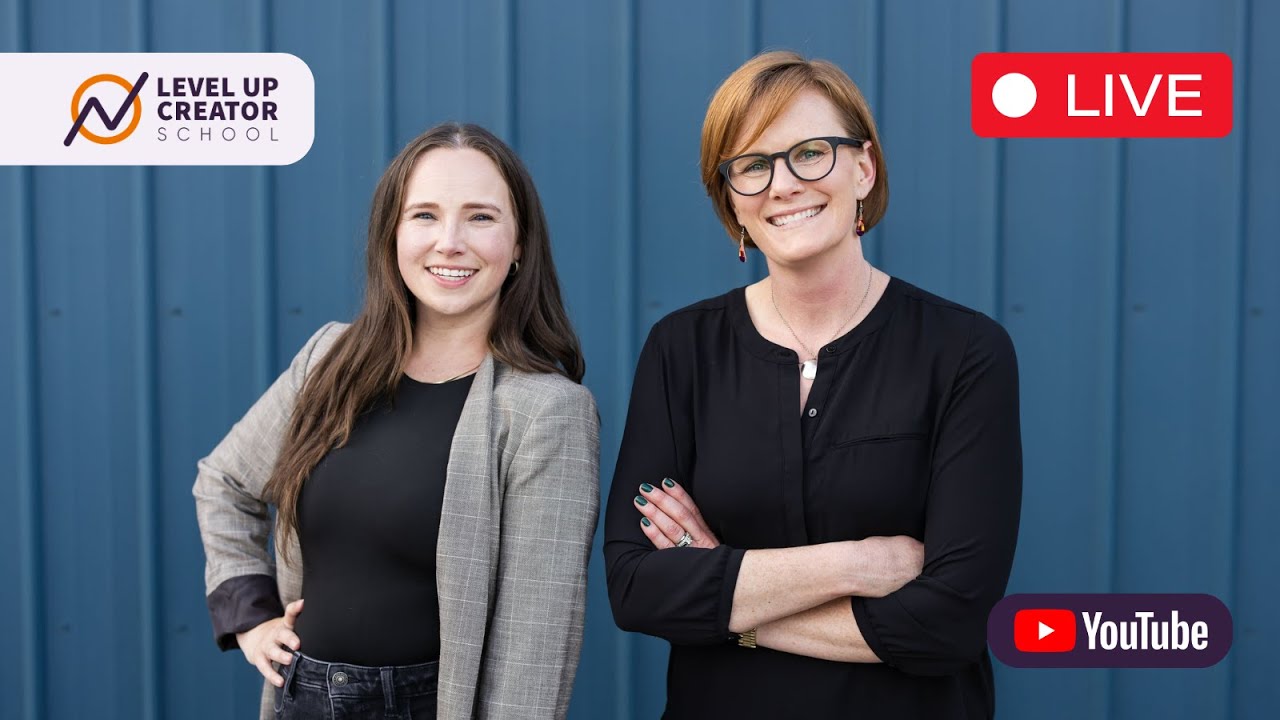
In this livestream, Erin (Director of Operations) and Amanda Northcutt (CEO of Level Up Creators) guide creators and thought leaders through building sustainable recurring‑revenue businesses. They introduce a three‑circle Venn framework (expertise, passion, what people will pay for) to pinpoint a sellable value proposition, and define "consumable value" as the core of any subscription model—comprising evergreen content, community interaction, and live events. Practical tactics such as lead magnets, waitlists, pre‑sales, and market‑testing are explained, followed by a product‑ladder approach that maps desired customer transformations to specific offerings (courses, challenges, memberships, masterminds, coaching). The conversation then outlines a full sales funnel (TOFU, MOFU, BOFU), communication strategies for low‑touch versus high‑touch sales, and the importance of empathy‑driven customer understanding, which they identify as the top mistake creators make. The session concludes with a call to action to join their newsletter and upcoming content on common creator questions.
Chapters
Yes, today and spending a few minutes of your day with us. I am Erin. This is Amanda, and we are part of the Level Up Creators team. I'm the Director of Operations, and Amanda Northcutt is our CEO. Today we are going to be talking about recurring revenue, and I know that that is just the bread and butter of what we do. So we're very excited Um, thank you again for spending a couple of days with us. If you have any questions throughout this live, drop them in the chat and Amanda is happy to answer them. Okay. So if we have never met before, there are 2 ways that we help thought leaders and creators like you build rock-solid recurring revenue businesses. First, we have Level Up Creators, which is our done-for-you white glove consulting firm. And second, we have Level Up Creator School, which is where we help a global group of thought leaders build businesses through a done-with-you model. Creator School includes access to our consulting team and our methodology in a way that used to be reserved exclusively for consulting clients. So we are excited to have you. Let's jump right in. Amanda, how do you help creators and thought leaders identify a value proposition that can be turned into a recurring revenue stream?
That's a great question. That's actually one I got this morning from a very prominent LinkedIn influencer. It's like, there's infinite things that I could do, but what should I do? What's actually going to— what's something I want to do for the next, like, 5, 6, 7, 8, 10 years? What's something that's really going to drive me and feed my soul and get me up in the morning and also provide tremendous ongoing consumable— keyword there— value to the people that I serve? And so that we have a framework for, for how we handle this, both in the— or how— when I say how we handle this, I mean like how we help a creator go from I'm not sure, uh-oh, to I have a clear plan of action, strong value proposition. I'm solving painful, painful pervasive problems for my unique community of followers, and the value that I'm providing is consumable and can be provided on an ongoing basis, therefore justifying people's ongoing monthly, quarterly, or annual payments to whatever your recurring revenue product or service is, right? So first of all, first of all, I'm willing to bet everybody listening here has started sharing content, whether it be on social media, a newsletter, podcast, whatever your top of funnel source is. And you're sharing information in between the overlap of your expertise and your area of passion. And so we want to think about like this 2-circle Venn diagram and we want to find the middle. I bet you're already talking about that stuff. So the next piece of the puzzle that we have to find is not only the middle of the overlap between your expertise and your passion, but the third circle is what people will pay for. And we've got to find the bullseye right in the middle of the overlap of that 3-circle Venn diagram. And that really informs what your business is about, right? Like, what are you uniquely positioned to offer to a— not to like the world, not to everyone, because if you're talking to everyone, you're talking to no one. Your marketing message has It has to be so incisive and resonate with one specific audience. So find the middle of that 3-circle Venn diagram. Literally, this is actually an exercise. Sit out and like sketch, sketch out the 3 circles and fill them in with words. And we do some market testing and things like that. Obviously, we want to make sure that like that bullseye we landed on resonates with the particular group of people that we want to help, or at least that there is a group of people ready to have that problem solved. And ultimately it's, it's finding the middle of those 3 circles and combining that with what you can offer again, that is consumable. And if you really take recurring revenue down to its essence, that's what it is. It's consumable value. And there's a lot of ways that you can package consumable value. Access to you is consumable. Relationships are consumable. Information, content, knowledge. All consumable. This is not like a one-and-done kind of a thing. This is something that, you know, within a recurring revenue product, a membership community in particular, or even a small group coaching program, you've got like 3 core pieces of that. You have foundational or core content like courses, resources, recommendation, things like that. They're always there. They're available 24/7, 365 to those who pay you. And then we've got community where you are facilitating relationships, not just between yourself and the people who are part of your community, but also people within your community with other people within the community, right? You want to kind of be the bridge between building real relationships between real humans. That's a huge part of a recurring revenue product. And then the third is typically like live events, group events, Q&As, workshops, teachings, coworking sessions, challenges, You know, gamification elements and things like that that really aid with retention. So yeah, what do you have to offer that is consumable, that solves a painful pervasive problem for a specific group of folks who are hopefully already listening to you on the internet in some way, shape, or form?
Yeah, that's really good. What practical steps have you seen creators take to build that loyalty and generate recurring revenue, and how do you advise them to go through that process of Getting started.
Yeah. So with— if you're a content creator and people are following you online, we've talked extensively about like the research that's come up in the last 2 years and it shows this incredible affinity that individuals have for their favorite 3 to 5 creators. And so you already have like such a huge jump on this know, trust, like factor that is so important, this affinity piece that makes the the gap to bridge so much smaller between they know, trust, and like you, they're listening to you, have their attention, to they've purchased something from you. So you're already well on your way. But if you're providing valuable, good content to this specific group, you're speaking specifically to them. Again, you're not casting this like humongous net, but you're being specific. You've already got a jump. And then providing free resources, maybe it's training, maybe it's a PDF guide, maybe it's a mini course or something like that to further demonstrate your expertise. It's called the lead magnet. That's a great way to further demonstrate trust. And then like, oh, this is kind of going somewhere. Actually, this is not just someone that I'm listening to on the internet, but now they're being taken kind of on this well-crafted customer journey toward things that you're going to try and sell them. And you don't actually even have to make products before you offer them for sale. You can start a waiting list. You can require a down payment. You can require a prepayment for something that you're going to offer, you know, Today's August 23rd or something. 22nd? 1st? I don't know.
21st.
21st. Um, I'm ahead of myself. August is such a long month. Oh my gosh, I feel like so much has happened this month. Uh, okay, so maybe you're gonna have something available September 15th, and you're gonna, you know, close your cart at the end of August or something. And then if you had enough interest and enough people actually paid you for what you said you were going to build, you actually do build it. And then if you don't, you've got to go email those people individually and refund them all of their money and be totally on the up and up and say, sorry, I didn't get enough interest to actually do this. Here's what I can offer you instead. Don't just be like, sorry, too bad, so sad.
Yeah.
So that's kind of an interesting way to do market testing. Also testing your social media content and newsletter content. Like people that are reading and consuming don't really understand that you're doing market testing, but like I have these ideas for things. And so I'm going to start talking about them more intentionally online and see what people's reaction to those things are. But ultimately, you need a plan. You need to come up with what's called a product ladder. And it's well-defined products and services where you have a definition of the value outcomes transformation that you are offering. Like, before you use my product or service, you feel like this. And these are these really undesirable things going on. But when you buy and consume or use or participate, in my product or service, we're going to have this transformation from this place that's undesired to this place that's highly desired. Clarity, confidence, financial peace, things like that. And then you can package that up, those solutions up in any number of different ways. We've already talked about a handful of them, but courses, challenges, membership communities, masterminds, small group, high-ticket coaching, one-to-one coaching, consulting. And we want to communicate effectively what the value outcomes and transformation of those products and services are, what the packaging is, what the guarantee is. We want to offer social proof and help people understand that we are legitimate. We're going to do what we say we're going to do. We're going to bring the value to the table. And then you need technology to support that process, basically. But make a plan, work backwards to like, here are the exact steps I need to take to get to the cart is open. I can actually sell the product. I can collect the money. I can give the value. So it's not super, super, super, super easy. It's simple, but you've got to know the steps, right? I had another person, Erin, yesterday. I was on a sales call yesterday. I had somebody else use the analogy like, I know I have all the pieces to the puzzle, but I just don't know how to put them all together. Like, this is so confusing. I know I need like a course or funnels or people telling me about email marketing. I just like, what is all of that stuff? How do you do that? Like, I know what I want to sell, but I have no idea how to get from here to there. And I was like, we got you. This is— you're in the right place. Yeah,
yeah. You're in the right place for sure. That was funny because my next question was, how important is continuous communication? And then how do you recommend the strategies behind maintaining that connection throughout the process?
Like of sales or retention?
I think in sales.
Okay. So depending on what you're selling, who you're selling to, how much you're selling it for, all those things, that's going to dictate a lot of the amount of communication, like direct communication you might need to have. If you have a fully automated funnel, you're probably selling a PDF, maybe a low ticket challenge or a course, or maybe a lower ticket, lower to mid ticket membership where don't have to have like sales calls, for instance, like a one-to-one sales call. Maybe you're doing a webinar with a sales pitch at the end or something, something that's more fully automated to low touch in a one-to-many environment. So if that's the case, we're doing most of the work through marketing, whatever, you know, we've gone through this whole series of TOFU, MOFU, BOFU, top of funnel, middle of funnel, bottom of funnel. And that's like, you've got your, you know, social media platform, LinkedIn, X, YouTube, whatever the case may be. Maybe a podcast. Maybe you're doing appearances on other people's podcasts. Hopefully you're writing a newsletter. You have lead magnets. And so there's all these ways people can find you. And then, you know, our specific methodology helps you nurture those people and take them on a very linear journey of value recognition, helping them understand that you have the solution to the painful pervasive problems they're experiencing. And then, you know, we're ultimately leading people to a landing page where, again, depending on the complexity, cost, how you're delivering your solution. The call to action on a landing page could be buy. It could be come to this webinar or Q&A to get all your questions answered about what the group program is, or book a call with me if it's something much higher ticket. Obviously, a one-on-one engagement, there's going to be some, you know, in-person sales process, which I know a ton of people have an extraordinary degree of discomfort with. We have this really fun course in Creator School. It's called Sales for Creators, uh, Who Hate Sales, and it's short, quick, and to the point. But it's like, I've been in sales since I was 16 years old, which was a really long time ago, and my philosophy is you are here to serve people and provide solutions to problems, not try and sell people things that they don't want or have a need for. Like, you're not trying to pull one over on anybody. You're just— there's a very specific way to lay out and demonstrate that I have a solution, I have a demonstrable track record of success to deliver this solution to you. Here's the social proof, the testimonials, the statistics, and here's my guarantee. And you're there to answer their questions during the sales process. So that happens either in a one-to-one small group or an FAQ section on a landing page, right? And you're just trying to think of all the reasons that someone might not buy from you and then addressing those in your automated sales process or in preparation for a sales call with someone, making sure that you're giving them enough information. So they know coming into the call, what are their like very last questions they need to ask in order to make a decision or the information that they're, they're lacking. So you've got to put yourself in the customer's shoes, have extraordinary empathy for them, understand where they're at, where they want to go, what's keeping them from getting there. And then your job as a good marketer who's on the up and up, we don't do any icky marketing or sales around here. is to just demonstrate through, again, a specific methodology and tactics and strategies that you're the right person for them. You're going to help them go from X to Y. It's going to be great. So that's, I mean, that's the sales process in a nutshell.
Yeah. In this process, what's the top, I'll just say one top mistake that you see creators and thought leaders make as they're building out recurring revenue and how should they avoid it?
As they're building out recurring revenue, I think most problems in business can come down to not understanding your customer. Not really, really, really, really, really understanding your customer because if you can understand them, hopefully you have the emotional capacity to be fully empathetic to them, to think like them, to really walk a day in the life in their shoes, and then you're designing an experience for those customers no matter what you're selling, who you're selling to. You're designing. A fun, engaging, value-laden experience for someone else. Um, and you can hit it out of the park if you really know what they need and want and you can communicate effectively to them. So yeah, if you don't know your customer though, you're going to be like throwing spaghetti at the wall all day long and nothing's going to stick ever. It's going to be incredibly frustrating if you don't really, really know the painful, pervasive problem your audience needs solved and how to communicate in their words, in their language with empathy that you have a solution.
Yeah, that's so good. Okay, well, that's a wrap for today. If you guys are interested in more information about the sales process, customer journey, you can always, of course, let us know, but you can also sign up for our newsletter because we are always giving away this advice for free. So thanks so much for joining our livestream. Be sure to follow us for more tips and insights on building a successful recurring revenue business. Next week, we are actually going to be covering the top 5 questions we get in Level Up Creator School. So give us a follow and we will see you next week. Thanks. Bye. Jeez. Okay.
More from Amanda




Audit Your Calendar, Audit Your Life — Dr. Lani Jones on Hidden Guilt & Boundaries



Built a Successful Business & Still Feel Empty? Here’s What to Do with Dr. Lani Jones