Why Are Consultants Still Selling One Off Trainings? Turn workshops into recurring revenue wit
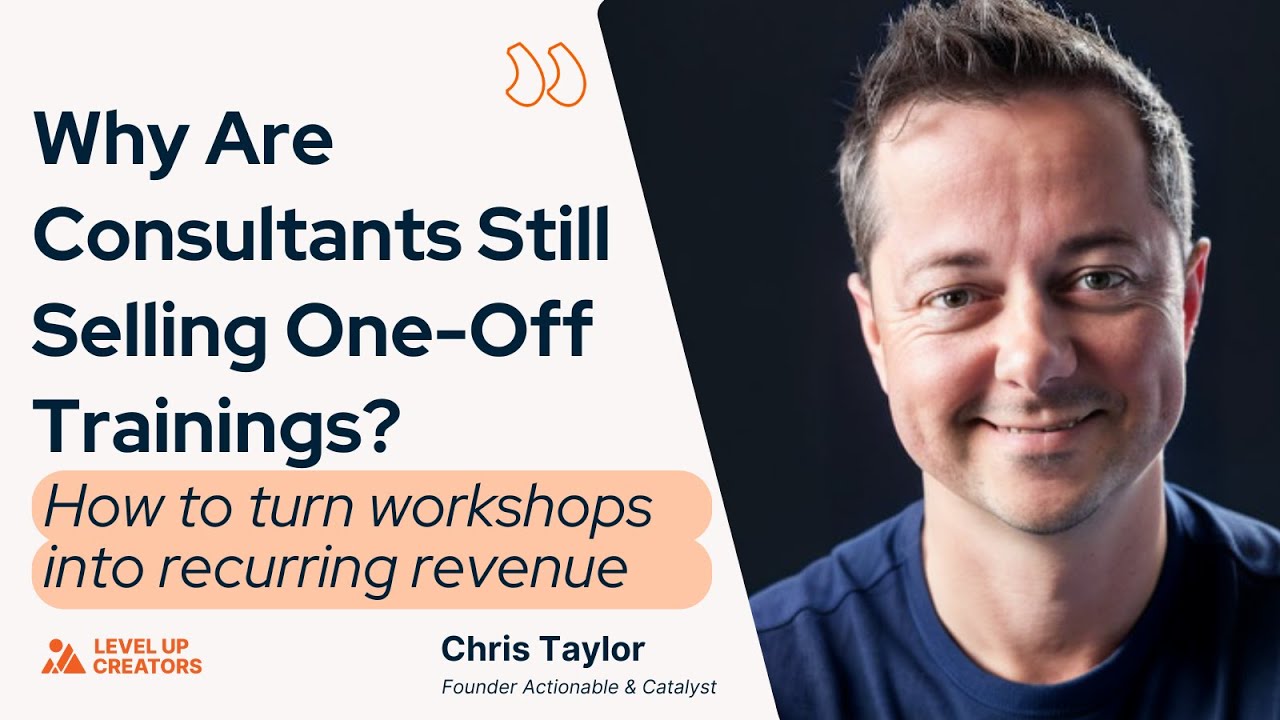
In this episode of the Level Up Creators Podcast, host Amanda Northcutt interviews Chris Taylor, founder of Actionable and Catalyst. The conversation traces Chris’s entrepreneurial path—from a teenage venture selling devil sticks, through a failed franchise, to a 19‑year‑old blog that turned business‑book insights into actionable summaries. Realizing that consultants were using his content for one‑off workshops, Chris built a technology platform, the Habit Builder, to help them drive measurable behavior change and turn single engagements into recurring revenue. He explains Actionable’s three‑phase service model—Amplify (adding habit‑building to existing programs), Sustain (decoupling time from revenue via ongoing support), and Cascade (licensing the platform for enterprise‑wide use). The discussion delves into the behavioral science behind the methodology (BJ Fogg, Charles Duhigg, accountability, participant agency), key data findings (92 % correlation between self‑reported and observed change, 9.6 % lift when impact value chain is mapped, double‑likelihood with week‑2 facilitator check‑ins), and how AI is used to reduce friction without removing human oversight. Chris shares practical advice for consultants: ask clients explicitly if they want impact, focus on must‑have outcomes, use a simple impact‑flywheel framework, and align habit commitments with organizational priorities. The episode ends with a call‑to‑action directing listeners to a free toolkit and Chris’s LinkedIn profile.
Chapters
Hello, you're listening to the Level Up Creators Podcast. Amanda Northcutt here, founder and CEO. We help creators, SMEs, and thought leaders like you turn your knowledge and experience into rock-solid recurring revenue, and we're so glad you're here. Welcome. Today, our guest is founder and CEO Chris Taylor, who has dedicated his entire career to helping consultants evolve from corporate trainers and entertainers to strategic, high-leverage transformation partners with measurable impact. Chris is the founder of Actionable and Catalyst, 2 organizations laser-focused on helping consultants drive behavior change, earn more recurring revenue, and build businesses with real enterprise value. Beyond his strategic mind and psychological approach to product development, Chris is also an avid bookworm. He's read hundreds of business books and actually built his first company on summarizing them. Chris, welcome to the show.
Thank you so much. That was a fabulous intro. I'm taking that and sharing it with future podcasts.
Awesome. Please do rip it right off. My team did a great job on that. Um, and it, it doesn't even sort of begin to scratch the surface of what you've accomplished in your career. And you've had a very interesting journey. And as with most guests that I have on this show, it took kind of like a winding road in order to get there. So let's just back up a couple of steps for folks who don't quite know you. Um, take us back to the beginning of your entrepreneurial journey or even further back if you want to, um, and bring us up to speed.
Sure. I love it. My entrepreneurial journey probably started when I was 13. Um, so we won't go back maybe all that way, But I found that I loved, you know, I didn't have this language for it as a 13-year-old, but I loved identifying problems, building a solution for the problem, figuring out how to create that solution in a way that actually made money, and then putting it in front of the right people. So I did that with Devil Sticks. Do you remember those back in the '90s? That was my first company. No, there's like a, it's like a party. Some listeners do.
Is it a Canadian thing? What is that?
It might be called something else. It's like 2 pieces of doweling with a rubber stick in between and you bounce it back and forth.
Yes. Okay. I have no idea what that's called, but I got the visual. Okay.
I, well, we weren't allowed to call them devil sticks when I sold them because that sounded, you know, not like a 13-year-old. Sinister. I know. Anyway, fast forward in time. I ran a franchise after university. It went really well for about 2 years. That success went straight to my head. I became an arrogant, whatever word you want to put in there. And then shockingly, Amanda, the business fell apart after that because nobody wants to work for a 22-year-old that thinks he's God. So I was curled up in my parents' basement at, I don't know, 23, 24. That's like the epitome of failure when you're 24, right? It's back in my parents' basement licking my wounds. And my dad had a bookshelf in his home den, as he called it, in the basement. And there was, you know, like Lee Iacocca's biography and books by Jack Welch and other, you know, white dudes in their 50s and 60s. But I was kind of bored, honestly, and started flipping through these books and became really fascinated by the stories behind business and business leaders. And I started reflecting back on the business that I had had, realized that maybe it wasn't the world's fault, it was maybe my fault, or at least some culpability here. And so I went on this sort of crusade for a year where I was going to read one book each week for a year, and I would put an idea from that book into practice. The whole idea being that if I could make 52 small behavior attitude changes over the course of the year, I could reinvent how I showed up in the world. I knew that I would never actually follow through on this unless I had some external accountability. And so I started a blog and a newsletter where I would take the idea from the book and I would share it. And I called them actionable book summaries, which is a bit of a misnomer because they weren't summaries. They're, you know, most summaries are sucking all the life out of the book and leaving you with the skeleton. This was one idea gone deep around how you could apply it. And so because of that, authors were very cool with this. They didn't mind me doing this at all because I wasn't taking anything away from their book. I was adding to it. And so I had this simultaneous growth where I had people subscribing to the newsletter at a fairly good clip at the time. It was never enough back then, but a fairly good clip. And the authors were very open to this Canadian kid who was doing these book summaries. And so I got to simultaneously build relationships with some of my heroes and build a following through Actionable Books. So that was the beginning. That was 19 years ago, I guess.
19 years ago. You were really, really on the forefront of blogging. You were an early adopter on that bell curve.
Bleeding edge. That's right.
Incredible. Okay. Well, how did we get from book summary, actionable summaries that aren't summaries to a technology company?
Yeah, in about 3 leaps and a pivot. So I was doing these book summaries. I had people subscribing. There was really 2 big camps of people that were subscribing aside from my mom. Number one was consultants, coaches, facilitators, people that are also avid readers. And the second were team leaders or business leaders, depending. And both these camps started reaching out to me. The business leaders said, I like the summaries. I want this for my team, but there's not enough meat on the bone. Could you come and teach this concept to my people? And I said, well, you should probably call Jim Collins if you want the stuff from Good to Great. And they're like, yeah, we can't afford him. That's why we're calling you. I'm like, all right, right, okay. Now I get it. And so I started an accidental training company where I would do mashups of these ideas from different books and I'd bring it in and share it with full attribution. And I kind of fell in love with training. There was what I came to call the facilitator high, that moment in the room where people are just like, they're just getting you, right? Like you're in sync, they seem inspired, they're all lit up. I get great smile sheets, feedback forms, people would leave. And then that facilitator high would be followed by the facilitator crash of now what? Like I'm back on the treadmill of going out and finding the next gig. And I really had no idea, like I'd spent hours or days building relationships with these people and now I had no connection to them. So that became an itch. At the same time, consultants, facilitators, coaches, typically those that were really early in their career had fallen in love with these summaries as content, right, that they could riff on and build off and turn into their own workshop, similar to what I was doing direct with clients. And so they started asking for the basically meetings in a box, like, give me the workshop based on the book that you're delivering for your clients. And that was my very first foray. I hired a guy off Twitter to build me a WordPress page with a paywall. It was like $100 a month. And you could have unlimited, all you could eat of these workshops that I was building. And then Toronto is a big small town. I found myself competing against myself for bids with clients where Chris Taylor, the facilitator, would be pitching and consultants with my content would be pitching. And I took it and it was like, we were still very small. And I took a look at this and went, no, I don't like this. And honestly, I'm kind of falling in love with supporting the consultants. I love these people and the work that they're doing and the passion they have for it. And so I shut down the training firm, started working with the consultants, realized very quickly that the itch that I had around not being able to see or support the behavior change following a session was one that they had en masse as well. And so I thought, hey, Twitter guy, come back over here. And we built the very, very rudimentary version of what's now the Habit Builder, which was designed to support learners in applying what they had learned after the session. And I added that to the license to consultants and I charged a little bit more and went down this path. So that, now that's still 12 years ago. And Amanda, we probably would've gone outta business in 2020, 2021 if COVID hadn't happened. Mm-hmm. Because COVID happened and suddenly 2 things happened. One, the whole learning industry, like most industries, got flipped on its head. And L&D buyers that had historically been, I'll say, resistant to, it's probably the kind language, to new, were now actively pursuing new because they needed new approaches to things. And they weren't actively looking for what we were doing, but they were open to new. And so when we showed them something that worked in a virtual environment, they became really interested in that. Simultaneously, they're getting pressure from the executive team to improve an ROI on the investments that they're making. And that's really what Actionable had grown to do. So it's sort of grown since then.
So interesting. You know, you and I have had many conversations to this point offline, right? We were introduced by Therese McCloskey. So shout out to Therese. I know Therese and Eduardo Bresinho both work with you. And so I'm so grateful for the introduction, but I've never heard that full story. And so I'm so glad we're having this conversation in this environment, which I think is just so fun and kind of extra special and great. What an interesting evolution of your career. And, you know, I'm hearing lots of you keeping your ear to the ground and understanding market demand and working iteratively and deciding also like what the lifestyle architecture piece is for you personally and knowing, okay, I'd rather support these consultants than compete with them. And so, going all in on that. And I think it sounds like you found a lot of alignment in that. And then, have you always been into technology? I mean, you have basically a managed service supported by like a SaaS product. Is that a fair description?
Yeah, someone described it as an advisory, tech-enabled advisory service. I'm like, yeah, it sounds grandiose, but sure, I'll go with that.
Yeah, no, I like that for sure. So, uh, did you code? Did you learn how to code or?
No, I couldn't code to save my life. I'm kind of loving the tools that exist right now, um, with, you know, sort of AI-powered and cursor stuff. Um, but no, I'm not a coder.
Interesting. All right. So you assembled an amazing team with complementary skill sets and then have just built layer upon layer. COVID, uh, I'm glad to hear, you know, always glad to hear when something good comes out of COVID uh, as bad as that was. So that's positive. And then what's going on in the business right now? Talk to us about, uh, both Catalyst and Actionable. And I mean, you have really planted your flag on, hey, consultants, you can't just come in and do a keynote and facilitate a workshop and then leave. Like, if you want what you're sharing to be sticky, we have to— the science tells us that we have to establish habits in order to operationalize or habitualize or whatever corporate jargon word you want to apply to it. Yeah. So walk us through a little bit more of your offerings and why you do what you do.
Sure. Yeah, I think so. You know, again, it started this 18 years ago. So the through line has always been, I believe that good training— I'm gonna call it training, but coaching, consulting, facilitation, training— anytime that we're exposing a group of humans to new ideas, there is a responsibility, if not a sense of purpose behind helping those people put those ideas into practice. Said more succinctly, the purpose of training is to drive change. Not everyone agrees with that. That's fine. But that's, that's who we support are the people that believe their purpose is to drive change, not just deliver content really well. What we found is that there's really 2 camps of facilitators. And I've been saying this for years. That there's the folks that are edutainers. Their job is to go in and light people up and inspire and then leave. And then there's the group that believes their purpose is to drive change. And I've, you know, I've always said that that's fine. Like if you want to do the edutainment route, that's great, but don't pretend that you're driving impact. Call it what it is. What I think has been interesting over the last few years is that the demand for pure edutainment, which is my mashup word of, yeah, is declining. Not because people don't value a positive experience, because of course they do, but it's becoming the foundational layer to programs that drive change. There is greater expectation and ownership onus on the L&D team or the buyers in general to actually show that this is moving the business forward. And so I, I'm delighted by that. It feeds my soul. It, you know, rewards the people that I've been working with for years, and it's been exciting to see their growth. Where our focus then has gone is really doubling, tripling down on, okay, but how far down the path can we show impact? For those who don't know Actionable, we've been showing behavior change, self-reported, for 15 years. We've been showing observable change mapped to self-reported change for 4 years. And in the last year and a half, 2 years, we've been connecting the dots between those behavior changes and the data around that to the business metrics that would validate a program as being a good investment. So again, put more succinctly, we're connecting the dots between what the business leaders care about and what's happening in the training room.
Yeah. And what kind of results do you guys see once your consultant clients actually enact, you know, the Habit Builder tool in particular?
Yeah, it's, that's so good. So there's, there's sort of 3 layers of impact. There's the participants, the client organization, and then the consultant. I frankly care more about the consultant than the other 2 groups. And I'll talk briefly to the first 2 because for the participants, it's really interesting when consultants apply our methodology. Yeah, there's the tech, but they're also creating more space in the room for people to find the thing that resonated most with them and why they care enough to go through the pain of change to actually put that idea into practice. And so what's really neat to see is that when participants are making commitments to change now, they are committed to it. Like it matters to them. And they've done the deep work of thinking about this isn't just going to make me a better colleague, it's going to make me a better spouse or parent or community member. And so we see the behavior change where people are showing up differently, not just in their work, but in their broader life. I don't know, for me, there's no higher calling than that, like helping people shift behaviors that make their lives better is kind of awesome. So that's cool. But it's also sort of the feel good. The business leaders are now able to access leading indicator data around where their core metrics are likely to move 6 to 12 months from now. They don't necessarily believe that when they first hear it. They need to see a cycle of it first. But there's this beautiful aha moment that goes off for business leaders where they're like, we, we knew this 6 months ago. Uh-huh. And so they're able to see similar to what marketing went through 25 years ago with the shift from, I don't know, we throw darts and we hope for the best to here. Here's the metric-driven approach to this. We're able to bring a very similar rigor to it now. And it takes them a cycle to understand the value of that, but then they get it and they love it. And so then they become true believers and they want it everywhere else, which makes it most exciting for the consultants because the consultants we're working with are winning more competitive bids because they're de-risking their proposals compared to their competition. They're charging more for their service because they are providing value beyond what happens in the room. Yeah. And probably the most exciting is that they're using the data and the insights derived from the data to inform what the next program should be. So instead of having the program tied with a bow and, you know, when we'll pitch again, it's, it becomes an ongoing iterative cycle. Not quite MRR, Amanda, but it's getting there.
Well, okay, that's where I was going to take us next is, you know, you're taking, and I guess it depends on your definition of MRR here, but you are enabling consultants and facilitators to go in and deliver content and make it sticky. So, it's not just pop in one day or, you know, over a 2-day offsite or whatever the case may be, and then hope for the best, send your invoice, wipe your hands clean, and leave. Yeah. But with Habit Builder, my understanding is that you're— the facilitator or trainer consultant is entering the participants of the workshop or whatever the case may be into a 30-day Habit Builder cycle. Is that what you— like, that's what you're teaching all of your consultants to do, right? To get enough data to gather Yep. Fodder for the next proposal. Yeah.
At a bare minimum. Yep, exactly.
Cool. So, you are enabling consultants to not only increase LTV, customer lifetime value, but I mean, deeply impact their ability to turn one-time revenue into recurring revenue. So, can you share a little bit about your methodology? I mean, you've shown me some pretty cool like graphs and charts and curves and things that's all like proprietary to Actionable. And I think it's Yeah. All the wizardry that, um, yeah, makes up your IP, but it's very, very interesting. And I mean, what you guys teach is pretty different from what I hear from the vast majority of others. And you are enabling, very importantly for the listeners of this podcast, is for thought leaders and subject matter experts to play really big and go in and win business from, you know, Fortune 1000 or even Fortune 100 companies. Yeah. Because you're able to show your impact outside of being a McKinsey or Bain& Co. or, you know, BCG. So yeah, what's your, if you would peel back the curtain a bit on your methodology and how you equip consultants, that would be super cool to chat about.
For sure. So one of the big mental shifts that consultants go through when they apply Actual's methodology is the understanding that the client is not buying your content. They're buying the impact that your content is designed to drive. And on the surface, you go, yeah, of course. But when you actually get into it, what that means is that we actually want to reduce the amount of content to the bare minimum requirements in order to be, in order to catalyze the behaviors that the client wants to shift in order to achieve the outcomes that they want to achieve. So that's a mental shift for people where, I mean, we, if we've been delivering this stuff for 20 years, they're our darlings, right? Like we've honed and perfected these pieces. And I, the analogy that I use, I'm a film school graduate. Speaking of squiggly careers. But we used to have, I loved scriptwriting. And so you would write these beautiful scenes and then hang on to them, even as you realized over the course of the development process that it didn't serve the plot in a way that, you know, sort of kept the audience most engaged. And so there's a parallel here. So number one is we work with consultants to help them identify which elements of their content are the most critical pieces at triggering an understanding of how and a desire to change for the participants. So let's get as little content as possible. Let's use the freed up time to allow more time for contextualization so they can turn the idea over and find a reason why it matters to them. Once they've identified what that one thing is from their session that is most relevant to me personally, then we want to help them take that good intention that they have, like, I'm going to be a better listener. Awesome. Love the intention. The challenge is you don't be a better listener, right? You don't do better listener. You become a better listener by applying small practices. And so part of the work then is taking that good intention and translating it into a daily practice. And this is where I geeked out for about 8 years, deep diving into behavior change and adult learning theory and how we actually— how do we change? And a lot of what we've built is, all of it is standing on the shoulders of giants like BJ Fogg and Charles Duhigg and Katie Milkman and those who have done really powerful deep research. And now we've got this really great dataset that validates and adds to it. So that's been exciting. Anyway, we take the intention, turn it into a daily practice, then they leave the room. But before they leave the room, we acknowledge the fact that that Intrinsic motivation that we felt in the session fades pretty fast as we get back to work, right? We forget stuff really quickly. We try stuff and it doesn't work. It's uncomfortable to be at a beginner stage. We've got people looking at us funny because this is not the way we used to do it. And so it's very easy to just let, let it go and go back to business as usual. So what we want to do is we want to insulate people from that status quo. And so we bring in accountability partners, and if it's appropriate, manager visibility. And facilitators have a gateway. to see and comment and support on the learner as well. All of that, and there's a couple other pieces, but all of these pieces are designed to extend the runway of the participant's motivation so that they stick with the daily practice long enough that it starts, they start to see traction and gain its own flywheel.
Hmm.
So all of that is done on, on a single session. I think where the magic comes in that gets missed, and anybody can do this, you don't have to use Axial for this. Is even a two-hour workshop has a regroup session a month later, or whatever, but about a month later. The regroup is just an anchor. You don't need more content. You don't need it professionally facilitated. It's a place that people go. I'm not changing forever. I'm trying this thing out for a month. I can do it for a month. And your lift—I don't know the stats in front of me—but it's substantial. It's sort of like you know. Double digits on the first number is not a 1 or a 2. Likelihood that they'll stick with their commitment if you put that regroup session a month later. Facilitators who are thinking short-term go, well, I don't want to do a free session. Well, then charge for it. And if you don't charge for it, just know that when you put that in place, you've now extended, you've kept the door open with your client that much longer. So you've got opportunity to sell the next program. Again, actionable data helps with that, but you don't have to. You can do this without.
Yes.
So, there you go. That's, that's a piece, Amanda.
Yeah, no, that's great. Thank you. Yeah,
you're welcome.
That makes me think about productized services and how, you know, oftentimes consultants really struggle with things like, I've spent way too much time on building proposals or client services delivery and haven't been building, you know, the top of my funnel or asking for referrals, or there's any number of issues that consultants, especially solo practitioners, Have right that we could we could go down the rabbit hole pretty hardcore on that. But with actionable, I mean you guys preach a pretty specific client services delivery model that is quite productizable. And in my opinion, like what we do at Level Up helps consultants to simplify down to like their core you know essential message and rinse and repeat. Obviously, there's bespoke custom elements for all of our client work because all client needs are a little bit different. But overall, if they're bringing you in, then there's like some some rinse and repeat. So, how do you guys encourage— what's the workflow that you encourage? I mean, we've talked about, okay, you come in with keynote workshop training, some combination thereof, 30-day Habit Builder Cycle. You just talked about having a regroup session at day 30. And then we're putting together a proposal for follow-on, like further implementation work. How do you, how do you guys prescribe this happens?
Yeah, I think we made the mistake in the early days of saying, here's all the pieces of the jigsaw puzzle. Build whatever you want. And people going, ah, and then we went to, here's all the things in the draconian fashion, you apply them over the next 3 years. And that also alienated people. So it's taken us a while to get to where we're at. But we, we phase the integration in 3 parts. And you can get off the bus at any point. Not to say leave Actionable, although you're of course welcome to do that too. But, but you can just stop, like you don't need to continue to evolve your offer. So phase 1, what we call Amplify, is what we were just talking about, which is Let's take what you're already doing and let's install the system for sustaining improving impact. There's actually very little modification to their core offer in that first phase. It's around them turning on the lights between sessions. Having said that, I do think we work best with facilitators, consultants who have a, we call it a cornerstone program or like a flagship program where it's, this is my my main offer, even if main means that it only happens 1 in 3 times. It's just easier on a rinse and repeat basis like that. Yeah. Anyway, phase 1 is amplify. I'd say 60% of the folks we work with stop at amplify. They're good with that. The second phase is to sustain where we start to decouple time from revenue. And this I think is where you and I started jiving initially, because I'm a big believer that if your value to your client is the impact you're creating, That means it's not tied to your content necessarily, but it also means it doesn't need to be tied to your time on site. That's another big shift for folks, right? It's like, I am the product. It's like, no, you don't have to be. The impact of the work you do can be the product.
Yeah.
And so that's the sustain phase is where we move into that debrief session that I was talking about can be the catalyst for a series of peer-led conversations that follow that debrief where the participants are revisiting key concepts from the initial workshop. And sort of slicing it out and covering it over time. It's our response to the e-learning craze of we'll just thin slice our content and blast people with it. Of course, you know, people lovingly shelve that for later. So sustain is where probably another 25% get to, maybe even more. The last 10% of our group goes into cascade. And this is where it becomes a true revenue multiplier, you know, by order of magnitude. Because you'll have an L&D buyer or interestingly, like a CFO or a COO who looks at the data coming out of the platform, sees the connection to business impact and goes, we need this on everywhere we develop people. And then the consultants we work with have a choice. Most of them will go, great, you can buy a license through me to use Actionable on all your programs. They charge whatever they want for it. We give them some guidance, but whatever they want. And then that's a pure annuity stream for them. So those are the 3 phases.
Which is pretty freaking cool, to be clear.
It is cool. It takes a bit to get there, but it is cool.
Yeah. Consultants who are used to like churn and burn, one and done, go to the next one, next one, next one, next one, to create not only some ability for recurring revenue and showing impact, which results in case studies, testimonials, and Statistics around your ability to drive impact and change toward bottom line, you know, organizational goals and executive priorities. But then truly passive income. I mean, that's pretty freaking cool for everybody. I mean, you know, mailbox money is quite elusive and almost nonexistent, you know, in its truest form. That's pretty damn close.
Well, I think what I like about it the most is that they, the consultants, remain at the epicenter of the data. So they're hands-off, but at any time they can pick up the phone and say, hey, I've seen some stuff with regards to your people. Would you like to talk about it? Right? The answer is usually yes. And that then leads to the next gig that they may want to sort of dip in. And so for me, it's, it's the alignment. It's good for us. It's good for them. And it elevates their brand with their client from deliverer of training to that strategic sort of advisor around behavior change.
Yeah, this is kind of white labeling concept. And I'm realizing, I know quite a bit about Actionable and how Habit Builder works, but we kind of skipped over that a little bit. So what's sort of the layman's elevator level explanation of what Habit Builder is and how it works?
Sure, super easy. Towards the end of a session, so it's a facilitated, usually facilitated session, the facilitator will put up a QR code, participants scan it, it takes them to pre-populated commitment options based on the content they just experienced. So they were just in that empathetic listening session, and maybe it was around how to ask better questions, how to manage power dynamics with your boss, and how to ask for things from your subordinates. I don't know. So those might be the 3 key themes that were covered in the session. The participant's going to be given a chance to choose the one that resonated most with them, personalize it, make the daily practice Of when instead of I will, because, which we can get into or not, but basically turn it into a daily practice. And then it's a whole bunch of choices for the participant. And this is another key. I'm giving it all away here. What makes it work is that we're not telling them that they need to practice this thing. We're not assigning homework. We're saying, if this thing mattered to you, managing the power dynamics with your boss, and you want something to change, then we should all acknowledge that change is hard. Yeah. Okay, so let's make it easier for you. So you choose what matters to you. You choose how often you're going to be reflecting on this. You choose who's going to hold you accountable to it. You choose whether you get text messages or emails from the Actionable platform, and then they're going to leave the room. Super simple. In the weeks following, usually 3 to 4 weeks, they get a text or an email or a WhatsApp or Slack or whatever they chose that says, hey Amanda, you said you wanted to work on managing the power dynamics with your boss. How's it going? Amanda clicks the link. There's nothing to download. It just takes you straight through to a web, like a single-page web app. You rate your progress 1 to 10. You journal about how you're doing. You're done. Most people will do that twice a week, although it's going up, but twice a week right now. And all it's doing is a little bit boop, boop. It's kind of like a pulse survey, except it's something that I chose. And so I'm much higher, much higher likelihood that I'll respond to it.
Mm-hmm.
And then all the people that were sort of surrounding that participant can see it and support them through that process. There's a bunch of other bells and whistles, but that's the key. That'll run for 3 to 4 weeks. Just when you're feeling like, all right, I think I got this, then it says, great, congratulations, you're done. Here's a more fulsome reflection and you're done. And usually there's another learning session or the debrief where you're going to make the next commitment and do it again.
Amazing. Uh, tell us about how you guys are using AI in your platform. How are you leveling up your, your software with AI?
Yeah, I, so I, I jumped on ChatGPT, I don't know, shortly after it first came out, played with it for 10 minutes and then did nothing with it for a year and a half. Uh, and so we were a little late to the party. And I think it's interesting with different team dynamics and different sort of personal sensibilities. And so there was some resistance, there was questions, there was all sorts of stuff. We've worked through all that internally. What we've been really deliberate about with incorporating AI into Actionable is not adding features yet, but rather identifying the key friction points in the process and reducing friction. I think there's too— this is Chris Taylor's opinion— there's too many products out there that went, oh, AI, we'll add a bunch of stuff that doesn't change the fundamentals of the The experience, except it distracts you. And so we went to, where are the places people get stuck? And do we know enough that we could train AI on how to do this effectively and then serve it to our very smart consulting partners in a way where they can modify as opposed to blanket assumptions as we go from stage to stage?
Mm-hmm.
So I would say those are the 2 big principles we've brought, reduce friction and don't finalize without human oversight. Specifically, that process that I was describing of turning a good intention into a daily practice, we've done that quite literally, I don't know, like 100,000 times. So we know what works, we have the data around it. And so we, we built an AI for that. So Amanda can say empathetic listening, it says, how about these ones? You can choose, modify, et cetera. We've done it on reporting. So we got a lot of data flowing through the platform. How do we surface insights? You decide whether they're relevant or not. You put your own Um, layer of analysis on it because you obviously know the client and we don't. And so there's a couple other places, but pieces like that.
Nice. That's great. So just continuing to reduce friction for your consultants and the end user and just make it, make your product better and better and easier and easier to use. Cool. Okay, great.
Easier is key. Yeah.
Yes. Yes. I mean, especially habit building that aligns with everything you've ever learned and, and, and Shared in your marketing, which makes me think of the insight papers y'all have written. I've read, I think, all the ones you've gone, you've done over the last couple of years, and some really, really incredible insights in those in those documents.
Thank you.
Would you mind sharing just a couple of really interesting factoids around habit building and kind of the research that you surface through those insight papers?
Sure. Yeah, absolutely.
Just before quiz bowl now.
No, it's good. Yeah, I'm like, oh, the just before we do though, I think. The reducing friction is so interesting because it's reducing friction in the right places, not a blanket approach to reducing friction. This has been top of mind recently. Okay, so an example here. In the platform, when the participant chooses what they're going to commit to, they then also choose what day of the week and what time of day and what method they receive the nudges from, as I said.
Yeah.
We've got the data. We know statistically what makes the most sense. But we've deliberately not used AI to determine the messaging schedule because what we do know to be true is that when the participant exerts agency, i.e., when they make their own choices, they are more bought into the process, micro-commitments along the way, right? And so we, so we make them fill it out. What days of the week do you want to get it? What time of day? What method? They do that. And each of those little steps, which takes seconds, and we've done the A/B test on it, increases by about 60% their willingness to follow through. Yeah. To the end of the 30 days. And so I think this is a really important— I don't know who's listening that needs to hear this, but AI is not a panacea. It doesn't— we don't— I don't think we should apply it to everything that we can just because we can. We need to think about the downstream effects of reducing choice from the participant. There's your PSA for today.
I love that. And I love how you are not ceding your brainpower over to AI. And I think that's the bigger message here is that you've got hard data and you know what makes habits stick versus, you know, puts them in the parking lot forever. And so, I love that your entire platform and every step of the process is built based on research and scientific data. You're not guessing at this point. And that just deeply enriches your service And the results that your consultants are able to get for their end clients, which is pretty rad.
Thank you. What we aim for. You asked for a couple factoids, so I'll give you a couple factoids. I, uh, so one of the things I found really interesting in the platform, consultants can identify something we call the impact value chain, which I won't go all the way down the rabbit hole on this, but it's basically that act of, of connecting the dots between KPIs that the client cares about all the way back to the content that's being deployed. Something I found really fascinating is that when the consultants added that information, added that chain into the platform, which assumes that they have done the work to actually figure out what that chain is, the participant adoption of change commitments went up by 9.6%. There's a correlation that on programs where the work of figuring out what the business impact is going to be with this program leads to higher adoption from participants and higher follow-through. By almost the same, 9.7%. And the reason I think this is, this really, it really stuck with me. Why I think this is interesting is because it suggests to me that when it's made clear to the participants how the program that they are currently experiencing advances the organization's priorities, they are more inclined to find a reason why it matters to them.
Hmm.
And I kind of love that because I think there's some in the L&D space That think they're at odds. It's either developing the people or it's developing the company, but, and one's got to get pulled along to support the other. But we're finding that that's not true, that it's actually, when it's clear what the business objective is, you will, you will get greater buy-in from your participants. So that was one. The second one that I think is really interesting, we capture self-reported behavior change. And that's been the baseline in Actionable.
Yep.
And so any data wonk will go, yeah, but it's self-reported, so how accurate can it really be? We have to discount it. We can't assume people are— 82% of drivers are above average in their own mind or whatever. We found that there's a 92% correlation between the self-reported behavior change and the observed behavior change, i.e., somebody not the participant looking at the participant and going, Yeah, that I see this improvement. You saw that improvement, 92% correlation, which is deeply gratifying that people are not out to lunch or lying when they're putting this stuff in. And secondly, that assuming that that correlation holds, and that was about 30,000 commitments, that analysis that we did. So it's substantial. Yeah. It means that self-reported data, which we can get Before something is observable, because the change happens between our ears, right? Like we try to change something, we're aware of the change, but the people around us haven't noticed yet. My wife asked me yesterday what I thought of the new chair in our bedroom. Like there's a new chair in our bedroom. So I, which is maybe more a reflection of me, but we don't always see what's happening around us to the same degree we do what's between our ears, right? So the self-reported change happens earlier, which means that we actually have visibility earlier into whether a change is likely to succeed or not.
Hmm. Becomes leading, leading indicator.
Yeah. Like the most leading, right? Yeah. And I think, yeah, that becomes powerful. What else would be useful? I don't know.
I think, yeah. Oh yeah. Accountability. That's a good one. Yes.
That was big. So when you're accountable, if you have an accountability partner who checks in with you within the first week of making a commitment, they are almost double, the participant is almost double as likely to stick with their commitment till the end of the month. Wow. Yeah. Interestingly, the facilitator— so if, Amanda, you're facilitating the session, I'm a participant in the session— the facilitator checking in with me in week 1 has a positive impact, but not nearly as strong as if you wait until week 2 to check in with me. Which again, I found— I mean, I can— my hypothesis on this is that I'm still riding the high of being in Amanda's presence in that first week. So I don't need Amanda checking in with me right now. I'm still I'm still, it hasn't fully dissipated yet, the glow that I got in the room, but by week 2 it might've. And when Amanda pops back up in my text messages being like, hey, how's it going? Looks like you're doing great. Great job. That's going to re sort of invigorate me to continue with it. So buddies week 1, facilitator week 2.
Yeah. Wow. Set your own schedule, make your own commitment with guidance, of course, but Yeah. And then draw a straight line between organizational priorities and your daily habits and practices.
Yep. And get buy-in from everyone.
I mean, that's not the half of it, but I mean, if people are going to take some stuff away from this and they're trying to drive change in their organization or their client organizations, those are pretty big takeaways.
One of the easiest things you can do that'll make life so much easier on you, if you're listening to this and you're going, I want to drive change in my clients' organizations, Validate with them that that's their express purpose as well. One of the very first things we teach new consultants when they join us is when you're in discovery, before you've even signed a contract, just say to them, just so I'm clear, is the purpose here, or are you looking for someone to deliver content, or are you intending to drive change? And then stop talking. It'll feel incredibly obvious. It feels awkward and uncomfortable the first time. She's like, obviously they're going to say drive change. And that's the point. We want the client explicitly saying, we want to drive change, because that changes the trajectory of your design, of how you're going to measure, of who should be involved, of what you charge. All of it changes on that opening question.
Yeah. And our brains, like, always want to close the gap, right? Between something that comes out of our mouth, we are, we want our actions to follow up, like our brain tries to align those actions. And so that is so helpful to Have a prospective client name their own priorities and say it in their outside voice, you know, in a in an environment that is recordable and observable and something you can point back to. I think that's really interesting and a smart question. I've heard you say that many times, and I feel like man, that's that's a killer. That's a killer question, and you're right. The next thing is to shut up, like just be quiet and listen, and sit comfortably in the silence, which is something that a lot of consultants, especially in a selling environment, are very uncomfortable doing. Like so much so that sometimes. We want to crawl out of our skin. Um, so I think you do a great job of, of training on that front as well and doing all that. Here's what we need to, here's the dominoes we need to line up on the front end in order to get the back end, like long tail LTV and licensing the tool and things like that. Um, okay, man, we are almost at time. And so let me think about what are 3 things that the coaches and consultants who are SMEs and thought leaders listening to this podcast can take away from this, whether you know, they come in and, you know, license actionable or not and roll out their client organizations? Like, what are some actionable, actionable, give me some actionable summaries here, Chris.
Yeah, so I think sort of chronologically through your sales cycle, number one in there is to get clear on whether you are focused on delivering great content and creating an exceptional experience, what I sort of tongue-in-cheek refer to as edutainment. It's not dead, it's not going away. And if that's the space you want to be in, Then own that and don't pretend that you're driving impact. There are organizations that want to buy the experience and there's organizations that want to buy impact. And if you clarify which camp you are more strongly in, you're going to eliminate most of the competition. Because I think the danger of selling intangibles is that it's really easy to keep talking and keep filling words on a webpage or in a proposal, like all this stuff. What I have seen over the last 2 years, and I don't see this slowing down, is that your clients are exhausted, their people are burnt out. They don't want more stuff. They want solutions to the pain that they're currently experiencing most pressingly. And that might be, we just need our people to have a break and an inspiring message. Or it might be, we need to change these behaviors so people can get unstuck, but pick a lane and own it. So that'd be number one. Number 2 is if you are focused on impact, Have a system to back it up. Doesn't have to be actionable. It's a good system, but, but whatever it is, have a process for that because everybody's talking about impact these days. See point A about it's easy to put words on a page. Everyone's like, oh, we drive, we drive impact, right? Drive positive ROI. But a tiny little bit of pressure on that and then they start flapping their hands and go, oh, we do stuff and whiteboarding, all sorts of complicated things. It's have a simple process. We use a circle we call the inside action flywheel. It's got 4 points on it. It's super clean and easy. You can lift it and grab one of the most recent reports. It's in there. Use it, right? Just say, this is how change happens. So this is how I support the different stages of the change process. That'll go miles. And then the third piece that I would say is that if you are focused on change, acknowledge that the change that you're trying to drive is probably someone's priority inside the client organization. And that person is probably not in the buying meeting yet. In other words, can you connect your program to a strategic priority that matters to an executive? Yeah. Because they've got a bonus or reputation or whatever tied to achieving that outcome. And when you show the linear path, like Amanda was saying, from we're going to do this program, it's going to drive these behaviors, which will develop these competencies, which will increase the likelihood of you achieving this outcome. They're going to go, yeah, because they're making deals that are 100 times, 500 times the investment that your program costs. It's, you're a rounding error, no matter how big your program is to that, like the scope of that overall program. So if you can just show how it connects the dots, the sale can happen shockingly fast and with exec sponsorship as you go through it.
Yeah, that's big. We talk a lot about solving painful, pervasive, urgent, expensive B2B problems. You must sell Must-haves, need-to-haves, gonna bleed out and die if I don't have it. We cannot be selling nice-to-haves when we're competing in these kinds of spaces with the best companies in the world. It's just, as they say in the South, that dog don't hunt. If you are not able to— I love it. You can't solve the pain, the painful pain, the most painful pain, you're not gonna win the deal.
And selling training is usually a nice-to-have. Selling the behaviors that are required to achieve a business outcome become the must-have.
Yes, it is as simple as that when it comes to B2B sales. And you have made this just absolutely incredible tool to facilitate that exact change. You are, you're like the Canadian B2B James Clear. I'll
take it. I'll take it. More hair, but yeah, I'll
take it. Nice. You're more experienced. We'll say that. You've got more wisdom under your belt. And you have such an interesting business. It's a perfect complement to our business. I mean, obviously our clients are already using your services and we, you know, lay the foundation and figure out who you are, what is your positioning as a consultant or a coach, and who is your ICP, your ideal customer profile, and what's your methodology and how are we packaging up that methodology into offers that are productized services that earn monthly recurring revenue, and then how do we get clients? And then Actionable is such an incredibly powerful tool to drive sales and maximize LTV and therefore maximize MRR. And so I love the partnership with that we're building and just the relationship that we have, and I'm excited for what's to come. But for those who are listening who would like to learn more and get connected with you, how can they do that?
Yeah, probably the best bet. I've got a free toolkit that covers a lot of the methodology pieces that you can apply. So if you if you're curious about this, applying, uh, impact structure to your work, uh, you can go to toolkit.actionable.co. Um, it's free, it's there. You'll get a few emails from me afterwards as it goes. Um, but that's probably your best bet. Um, and then I'm on LinkedIn more than anywhere else, so reach out. It's Chris Taylor. There's only about 40,000 of us, but, uh, you'll find me.
I'll link it up. We'll link everything up in the show notes and all the correct links. And, and the, the OG Chris Taylor, obviously. Um, could you change your tagline though to Canadian B2B James Clear, just so when our people are looking for you, that it's more obvious.
I don't know. James Clear is like 6'5 and a scary dude. I don't
know if I want to claim him. Yeah. No, I'm joking. But we've got a good thing going here. And I so appreciate your time, Chris. This is a really fun conversation. I'm sure there are many more to come.
It's a pleasure. Thank you, Amanda.
And thank you to our listeners. We know that time is precious, and we're grateful you spent some of yours with us today. If you're a subject matter expert or thought leader looking to build a fully customized business with 5-figure MRR guaranteed, head over to mrraccelerator.com to learn more and follow me, Amanda Northcutt, on LinkedIn for daily consulting insights. Thank you so much. And we'll see you next time on the Level Up Creators Podcast.
More from Amanda




Audit Your Calendar, Audit Your Life — Dr. Lani Jones on Hidden Guilt & Boundaries



Built a Successful Business & Still Feel Empty? Here’s What to Do with Dr. Lani Jones