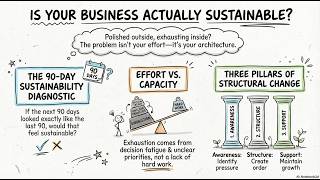
In this narrated business talk, the speakers contrast the polished public image of a business owner with the hidden, exhausting reality that emerges when daily operations cease. Using the example of Lisa Murphy, they illustrate how a seemingly successful business can push its owner to capacity limits, leading to a critical internal question: "How long can I keep doing this?" They introduce a 90‑day diagnostic test that asks whether the next three months would feel sustainable if nothing changed; a negative answer signals an overloaded operational model. The discussion frames a business as a physical structure where the owner acts as the sole load‑bearing pillar, and unchecked growth adds weight that eventually exceeds the pillar’s yield point, causing fatigue and collapse. Minor habit tweaks are deemed insufficient; instead, a new engineered framework is required. This involves mapping recurring decisions into protocols and systems that shift the decision load from the owner to designed workflows, creating multiple supporting columns. When Lisa applied this architectural approach, her business shifted to a stable, scalable model where growth no longer depended on a single individual’s effort. The talk concludes by urging listeners to apply the 90‑day test to their own operations and invites them to the Business Built Limitless Summit, a two‑day event focused on redesigning operational models from the ground up.
Chapters
There is a version of business ownership that people share publicly. It is polished. It is measured. Then there is the reality that shows up later in the day when the calls and messages stop and the office goes dark. Take the case of a business owner named Lisa Murphy Murphy. For a long stretch, her revenue was high, client expectations were being met, the business was actively growing, but her internal capacity to run it was was completely depleted. When an owner reaches that state of exhaustion and there is finally a quiet moment to think, a specific question inevitably surfaces—not out loud, internally: "How long can I keep doing it like this?" Outward momentum can hide internal decay for a while, but a widening gap between a successful public facade and total private exhaustion is the first indicator of an operational system about to break. To determine if a business model is sustainable or simply surviving on sheer momentum, there is a clinical diagnostic tool.
Ask yourself: if the next 90 days looked exactly like the last 90 days—zero adjustments, just an exact repeat—would that feel sustainable? A yes means stability. Hesitation is a warning. A no indicates a problem that requires attention now. Most owners assume failing this test means they simply aren't working hard enough. It is actually the opposite. A failing grade on a 90-day diagnostic is a symptom of maxed-out operational capacity. Capacity does not vanish by accident. To understand why an owner gets overwhelmed, we have to look at the business as a physical structure rather than an abstract concept. Operating without a formal framework means every single daily choice requires the owner's active brainpower. That constant demand generates deep decision fatigue. We can map this dynamic on a structural blueprint. In a flawed operational model, the business owner serves as the only load-bearing pillar. They carry the entirety of the business's operational weight. The trap is growth. When the business succeeds, more weight is added to the roof. But adding new clients and more revenue without building new structural support increases the pressure on that single column. The progression of this mechanical stress is predictable. It starts as tension. It compounds into exhaustion. Eventually, as the pillar reaches its yield point, it forces the owner into active avoidance. You cannot outwork a structural flaw. Applying more brute effort to a failing column only accelerates the total collapse of the system. Moving from an overloaded model to a stable framework requires engineering.
Minor adjustments and better habits will not fix a failing foundation.
A new framework is necessary. The first step is awareness. This requires identifying the specific, hidden operational bottlenecks generating the heaviest pressure points in the daily workflow. Structure and support involve mapping out recurring decisions and turning them into protocols.
This moves the operational load off the owner's mind and into systems designed to handle that specific weight. This renovation results in a model that functions through defined workflows rather than the owner's constant manual intervention. When Lisa applied this architectural approach to her own failing capacity, the result was a measurable shift in how the business operated. Revisiting our blueprint, we see the mechanical shift. Clear structures prioritize tasks automatically. By distributing the load across interconnected columns, capacity is restored. The business functions with true stability. Growth happens safely because the model no longer requires constant output from one individual. Sustainability is never a personality trait. It is a mechanical result of how the business is built. Look at your own daily operations. Apply the 90-day test to the pace you are running right now. If your answer is anything other than a clear yes, the limitation is not your work ethic. It is the architecture of the business itself. The Business Built Limitless Summit is a 2-day event focused on redesigning these operational models from the ground up. It is the place to start engineering a structure that can actually sustain your growth.