What could you do with an extra $1.8 million?
Lisa Murphy shows founders how poor systems cost them money and sanity. One client recovered $1.8 million in lost revenue by documenting tasks and building repeatable processes. She walks through a five-day snapshot, AI-powered SOPs, and a weekly 15-minute rhythm that actually sticks.
Chapters
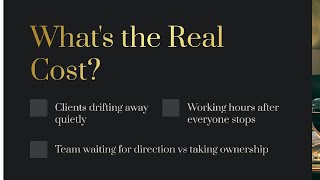
If I could go back 35 years. Wait, am I dating myself? Anyway, I'd tell that version of me one thing. You are not an island. You might do it best, but having a team will help you do more and do it better. When revenue flattened, I picked up the slack. I drove the numbers. I drove my people. And if I'm honest, sometimes I drove them right out. When churn crept in, I blamed myself. I blamed my rbf. If you know, you know. So I softened. I tried to be liked instead of leading. And it only made things worse. I blamed the market, my team, the economy, this new generation, Everyone but the real culprit, my systems. Or rather the lack. The lack of integration, connection, buy in. Then it hit me. I had systems, my routines, my work ethic, my mental checklist. But my companies did not. And the day I fixed that, everything changed. Do you know that feeling when you realize you may be the one holding up the whole show? When you can't take a day off because too many people need something from you? Yeah, that one. Have you ever felt like you're carrying it all alone? Because if you have, you are in the right place. And I know exactly how heavy that feels. Let's talk about what this really costs. In service based businesses like yours, 20 to 30% of annual revenue disappears through inefficiency, missed billing, reworks, leaking pipelines or unclear processes. That's not the economy. That's structure throwing your money down the drain. Burnout costs between $4,021,000 per employee each year. And it's contagious. If you have 10 people, that's anywhere from 40 to $200,000 walking out the door quietly. 41% of your team's week is lost to admin instead of strategy. That's two full days of busy work every week. Every person. You can't scale chaos. You can't inspire your way past broken systems. However, you can fix them. And when you do, growth stops feeling like survival and starts feeling like momentum. Dreams becoming reality again. You already know your current pace won't hold with you being the one running the show plan, plugging the leaks, holding the line. You know that even when it works, it costs something every time. Something you can never reclaim enough of. Energy, focus, sleep, connection, trust. If the next 90 days look like the last 90 days, what is the cost? A few more clients drifting away quietly. A few more nights working for hours after everyone else has stopped. Another year where your team waits for direction instead of taking ownership and driving the success you can't out Hustle, inefficiency. You can't out lead internal chaos and you can't keep doing the work of an entire team by yourself. This is the point where you decide something makes a massive shift. Not because you're burned out. It's because you are done wasting capacity on chaos. When the structure gets clear, people move faster. When everyone knows where they're going and has a compelling reason why, pressure turns into performance. That's what this next part is all about. Learning how to build the systems that carry the weight so you don't have to or feel compelled to. I want to tell you about Sarah. Sarah was the classic feast or famine leader. When she was on, she was on. She crushed it, broke records, blew past goals, amazed everyone. However, when she was off silence. No calls, no outreach, no movement. Her business was unpredictable. Her team was frustrated, and truthfully, so was she. Because deep down, she knew she wasn't lazy. She just didn't have a system that carried her when motivation didn't show up. Together, we built structure. A daily plan that worked even on her worst days. A minimum viable plan. Five outreach calls, three emails, one new LinkedIn connection every single day. That's it. Not glamorous, not complicated, just consistent. And it moved overwhelm and loss into achievement. Within 60 days, the volatility disappeared, her results stabilized, and by day 90, she was hitting 120% of her goals. Not from working harder, from removing friction. She said, I didn't need more hustle. I needed a better system from a new perspective. That's what happens when your company runs on structure, not stress. You don't need another pep talk. You need frameworks that work for you even on the days you don't feel like working. This is the systems over struggles framework. How you stop chasing growth and start controlling it. First, structure before scale. You can't scale what you can't see for the next five days. Write down what decisions you make more than once a day, what questions your team repeats and what tasks bounce back to you. Those are your missing systems. Fix even one of them and and you'll buy back hours every week. When you do this five day snapshot exercise, here's what you'll notice by day two. Patterns start jumping out at you. You'll catch the same small interruptions, the same hey, quick question moments again and again. Here's how to turn that noise into data. Every time someone interrupts you or sends a quick slack jotted down, label it with one word decision, approval or clarification. At the end of the week, Count out how many of each you handled. That's your map. If you have more decisions than clarifications, you're missing delegation or leveraging. If approvals dominate your list, you've built a bottleneck. If clarifications lead, you need clearer SOPs or training. That one observation exercise alone can reclaim five to 10 hours a week for you. And here's the insight. The more interruptions you handle, the more your team learns that you'll always come to save the day. When you fix the system, they learn to save themselves. That's real leadership leverage. Next, standardize what works. If it works, automate how it gets done. Pick one recurring task Onboarding a client Kickoff anything. Instead of trying to build it from scratch, use tools to quickly and completely record and then write out all of the steps, including screenshots or video. To begin, record yourself doing it for real using Loom or Zoom or Meet or some other screen recorder. Also record yourself talking through every step. If it is not an interactive meeting with others, then upload it to an AI tool like Scribe or Tango. Or use the built in transcriber on your recorder. Then upload the Transcript to an AI tool like ChatGPT, Claude, or Genspark and tell it to build you a detailed SOP. I always ask for the Four Dummies version. The book, not the staff from the record recording, saying strictly within the script, no assumptions. Make sure it stays within your script in minutes. You've got a step by step SOP built for you from just doing the work you already had to do. Check it over and then hand it and the job off to your team. If it breaks, refine it. If it works, you've just cloned a piece of your brain. Let's take this deeper. Most leaders think documenting processes is tedious, but with AI now it's a 15 minute activity that saves you hundreds of hours a year. Here's a quick example. A client named Melanie ran a smaller interior design firm. She was stuck re explaining how to onboard new clients Every two weeks we did one thing. She recorded herself walking through the client intake process on Zoom while talking out loud. She uploaded that recording to Scribe and in less than five minutes she had a fully formatted SOP with screenshots, instructions and timestamps. She handed it to her assistant and never explained it again. One 10 minute recording gave her back three hours a week. Forever. If you record even one repetitive task a week, you'll have 50 SOPs by year end. And the best part? You'll never again have to say, let me show you how to do that. That is how you turn tribal knowledge into team knowledge and chaos into capacity. Finally, scale through systems. Scaling isn't about adding people, it's about multiplying clarity. You can't manage what you can't see. And most teams don't fail from laziness. They fail from blindness. When you lead without visibility, every conversation starts with where are we on this? That's not leadership, that's detective work. The antidote is the 90 day scoreboard, a simple rhythm that builds accountability right into the bones of your business. Here's how to build it step by step. Step one Pick the right metrics. Three is the magic number. You need one for performance, one for capacity, and one for health. As an example, revenue growth tells you how the business is performing. Hours worked on, project load shows if you're scaling sustainably or burning people out. Client Satisfaction Score Simply put, would our clients recommend us to others? This is often called the Net Promoter score or nps. But you can track it with a quick one to ten post project survey. These three metrics give you a snapshot of your business's overall health. Are we growing? Are we overworked? Are we keeping our clients happy? Step two make it visible. Visibility creates accountability. Open up a shared Google sheet, a notion dashboard, or use a simple project management tool like ClickUp Monday or Airtable. Create three columns labeled metric, goal and actual. That's it. Simple beats complex every time. Use color coding. Green means on track, yellow means trending off. Red means immediate attention needed. When it's red, it's a conversation. When it's green, it's a celebration. When it's yellow, find out what support is needed. STEP 3 Run the 15 minute Friday. Every Friday, meet with the key people who own each metric, the owners, not the entire team. Pull up the scoreboard and ask three questions. What moved forward this week? What got stuck or slowed down? What did we learn? That's your leadership rhythm. 15 minutes of truth that saves you hours of confusion. Next week, you're no longer guessing where things stand. You're leading from evidence, not emotion. And finally, log the learning at the end of every quarter, review your notes from those Friday meetings. Better yet, use an AI system to go through your notes and analyze them for you. Review the key points the AI finds in your notes to verify it is correct. You'll start to see the patterns where breakdowns repeat, where cluster wins or where wins cluster and where opportunities hide. That becomes your upgrade roadmap for the next 90 days when you Lead from data and reflection. Your business starts to grow with intention, not just effort. As an example, a client of mine, David was a driven, capable leader. But everything lived in his head. He knew what every deal, deliverable and timeline looked like, but his team didn't. If David got pulled into a client fire or a family event, progress froze. When we built his 90 day scoreboard, the first week was messy. Oh my gosh, it was so messy. No one knew exactly who owned what and some of the data was just educated guesses. That discomfort was great. Visibility always feels awkward before. It feels empowering. By week three though, something changed drastically. They started spotting small problems before they turned into big ones. By week six, their meetings dropped from 75 minutes to 20 because everyone came in prepared. And by week eight, they had exceeded their quarterly goal by 35%. Not just because of a big new client, but because they finally saw what had been invisible. David told me for the first time, I'm not managing emotion, I'm managing evidence. Everyone sees the same truth. That's what visibility does. It turns confusion into confidence and chaos into control. The real takeaway here, when your team can see the system, they start to trust the system. And when they trust the system, they start leading themselves. They take ownership. That's the moment your business becomes scalable. Not because it's bigger, because it's clearer. That's how you scale through systems with rhythm, not rush. That's the playbook structure before scale. Standardize what works. Scale through systems. Once the system carries the business, you finally get to lead again. Your authority gets a major boost within your team. Lydia proved it. She ran a small marketing firm and found four recurring client issues concerning 60% of her time fixing. One, the handoff process gave her back eight hours a week and cut reworks in half. James, a fractional cfo, recorded his onboarding process, fed it through AI and handed it off to his assistant. For the first time ever, a client onboarded without him and he never had to handle that non revenue generating task again. He laughed and said, I didn't realize I was the bottleneck until I wasn't in the room. And Tina, she ran a small agency. She decided to build her 90 day scoreboard revenue hours satisfaction by quarter's end. She didn't just hit her goals, she understood why and how. She said, I used to lead by feeling, now I lead by facts. That's the shift from firefighting to forward motion. Every day I work with high performing business leaders and entrepreneurs who are tired of carrying too much alone. They've built solid businesses. But underneath the success, there's strain, flat revenue, team fatigue, no breathing room. I help business owners replace chaos with clarity by building systems that grow revenue without burning people out. Because you don't need more hustle. You need a business that runs as well as you do. And that's the work I do every single day. Helping leaders turn struggle into structure, pressure into performance, and motion into momentum. Let's be honest about what happens when you don't fix it. Firms lose 20 to 30% of their potential revenue every year to inefficiency. Burnout quietly costs between $4,021,000 per employee per year, not including the cost of hiring and training, replacements and human error. Those small oversights drain trillions globally. One client I work with, Andrew, found leaks of over $1.8 million for his company alone. Nearly 1 million of that was within one single branch. You end up losing clients and revenues you didn't see coming or going, rebuilding teams that shouldn't have been broken, and blaming everything except the real issue, the systems. That's why I created Unbind your business executive coaching. It's private, tailored, one on one coaching for founders and executives who are ready to stop carrying the business on their back. We meet every seven to 10 days for 90 minutes to identify and fix the structural gaps that are holding you back. Bottlenecks, decision loops, accountability breakdowns. In addition, there are options that include in person team training and visits, quarterly team workshops, and more. Together, we install the systems that let your business run without running you. Each week we work side by side to build structure, stabilize and grow revenue, strengthen your team and reclaim your time. Coaching starts at $3,250 a month, and I guarantee this, you will hit the metrics we agree on by month 12. Or I'll refund every dollar and keep working with you until you do at no extra cost. All I ask is that you follow through on the work between sessions and honestly implement the systems we develop together. Clients usually notice it by month three. That first deep breath. That's what happens when your business is unbound from your constant effort and finally runs with rhythm. Now the next step is simple. Book your complimentary growth systems audit. It's a one on one working session where we will pinpoint your top three bottlenecks, quantify what they're really costing you, and identify the one system that will give you the biggest lift right now. You'll walk away with a written snapshot of where you are, what it's costing you, and what to fix first no pressure, no pitch, just clarity. If you've been carrying the whole business on your back or if you've had a backslide in business, let's change that right now. Book your complimentary Growth systems audit in under an hour. We'll uncover where your revenue is leaking and show you how to unbind your time, your team and your growth. However, when you choose to enroll, you won't have to do all of the heavy lifting. We will be there right with you to help you implement the tools and to train your teams. Every week you wait, you lose hours you can't get back and opportunities you won't even see. I only accept a handful of growth systems audits each month to make sure every session delivers results. Other leaders are already reclaiming their time and team clarity. Don't be the one still firefighting six months from now. Click below. Schedule your audit. Let's start building the systems that finally set you free. For now, be awesome.
More from Lisa


Lisa Murphy on Speak Feed Lead Conversations with Jackie Bailey | Premieres October 16







