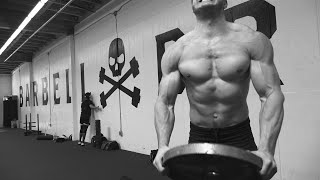
Brian Turner demonstrates the front plate raise, a shoulder exercise that targets the front delts, mid delts, and traps. Key form points: grip the plate side-by-side, keep a slight elbow bend, brace your core, and raise about 30 degrees past shoulder height. Do 12-16 reps, then a drop set at 75% weight.
Chapters
What is up guys? You may have noticed I'm not Rob Lipsett. I'm almost as buff as he is, right? Almost, almost. I'm getting there, I'm getting there. Anyways, Rob was kind enough to let me upload this video to his channel to give you guys a little tip, but also so you guys can get to know who I am. My name is Hubris Fitness, that's my channel. My real name is Brian Turner. I'm a fellow machine athlete with Rob and he's a real good friend of mine. Met him at BodyPower officially, but we've been watching each other's channel for a long time. Now the exercise that I want to show you guys today is very simple. You've probably already seen it a few times, but I feel like there's some tips and there's some very minute little details that are very important as far as actually getting a correct contraction and not doing this exercise incorrectly using your lower back and whatnot. And this is just a front plate raise. The thing with the front plate raise is if you only bring it up to just about your shoulder height, you're only really going to work your front delts. You might work a couple of things, but my little tip that I love doing with this is to overextend by about, I'd say about 30 degrees. When you do that, you're hitting your front delts, but you're also adding your mid delts in there and especially your traps, which is huge. So if you can manage it, start with a 45 plate, but if you can't manage 45, that's too heavy, then do a 35 or a 25. It doesn't matter. Even do a 10 if that's what you have to start at. It doesn't matter. Weight is important, but it's not something that you should force. You should do this with correct form. The first thing you want to worry about is where you're grabbing with your hands. Usually what I like to do is grab exactly side to side, like horizontal of the plates, so left and right. But you can also grab a little higher if you have a little bit of issues with your shoulders or your elbows like hurting a little bit. You can grab a little higher on the plate and that'll add a little bit more front delts and a little less mid delts for you. You want to have just a slight bit of a bend in your elbows, just a slight one, so that your arm isn't completely straight. This will keep some of the, the stress out of your elbows so your elbows aren't getting in pain and stuff like that. You want to keep that angle the whole time though. You don't want to bend your elbows as you're going up and then straighten them as you're going down. You want to keep the, the angle of your arm the same the entire way and keep the stress in your shoulders. You want to keep your chest up, flex your core, and flex your glutes. And this is going to give you a stable base to basically push off of or pull off of, depending on how you think about this exercise. And at the top of each repetition, you want to squeeze your delts as hard as you can. And it's kind of a weird concept because a lot of people are going to like hump the weight up and then just try to slow the weight down. But if it's too heavy for you, then lighten the load. Go up to the top, squeeze, give it a nice— just 1 second pause or half-second pause so that you stop the momentum, and then use your shoulders to slowly drop the weight. Don't just let the momentum drop. If you want to, you can do this exercise as a burnout. You don't have to, you can do it just individually, one set, one set, one set. Or if you want to though, you can drop the weight by 10 pounds. So if you're starting with a 45, you can do your 12 to 16 reps, that's what I like to do, drop the weight and grab a 35. 45, and then finish that out for— I usually like to do about 50 to 75% as many reps. So if I did 16 reps, then I'm going to aim for 12 reps with the lighter weight. Or if I did 12 reps, I'm going to aim for about 8 reps with the lighter weight. The cool thing about this exercise, personally what I really like, is that when you come to that overextension point, you're going to— well, you might not feel it, but you will tomorrow when you're all sore. Your serrates are actually getting a pretty good workout because you're causing your shoulder blades to protract as you come to the top, and you have to stabilize with your serrates. So I know it sounds weird that your serrates are getting a workout, but give it a day or two and you'll feel those Light up. It feels like someone's been punching you in the ribs, and that's a good thing. It's not, it's not a bad thing, it's a good thing. The serratus are the things that when you get to a lower body fat, people, people are weirded out. They're like, what is that muscle? I don't even know what that muscle is. It's basically your rib muscles, which makes it look like you have more six-pack than you actually have. Alright guys, so that is it. I hope you guys enjoyed this exercise. If you haven't tried it already, I would love for you guys to try it. If you have tried it already, try it with the tips that I've given you. Leave a comment below, let myself, let Rob Lipsett know what you guys think about it, because I think you guys are going to dig it. And if you haven't checked out my channel yet, please check out my channel, the link will be in the description below right under this video. Click it, come check out some videos. If you like my videos, come subscribe because you're going to see me and Rob doing lots of workouts next year at BodyPower, which I'm freaking so amped about. Thanks for checking out the video. I'll see you guys later. Team Beyond the Weak.