My 2020 Bodybuilding Competition Prep Routine | Rob Lipsett
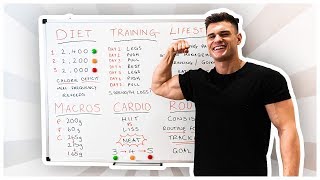
Rob Lipsett walks through his 12-week competition prep using three calorie phases: 2,400 kcal in maintenance, 2,200 in amber, 2,000 in the red zone. He trains legs-push-pull twice weekly to preserve strength, adds cardio from 3 to 5 sessions per week as calories drop, and tracks everything in MyFitnessPal for the full 90 days.
Chapters
Hey! What is going on everybody? Welcome to today's video. 2016 Rob is back, the whiteboard is back, and as you may or may not know, I am prepping for my first competition since 2016 and I'm very very excited. We are exactly 90 days out, 3 months, 12 weeks, whatever you want to call it. And today we're going through my plan for the next 90 days on how I'm going to get shredded beyond reality. Now, as a disclaimer, this is my plan, this is what I personally do, but I'm sure that you will find a lot of gems and a lot of tips and guidelines that'll be very useful to your fat loss efforts. So give the video a thumbs up and let's get into it. So as for a bit of background, I've competed twice in my life. First time I competed, I did not even place. I was so not ready and I learned a lot from that. Second time I came first in my class and top 4 in the overall, and I learned a lot from that as well. So I'm really looking forward to bringing my best package ever and just getting my best physique to date. I'm super motivated and I'm ready to do this. So without further ado, let's get into it. But before we do that, give the video a thumbs up. And I'm also going to give some timestamps in the description box and in the comments because it's probably going to be a long one. So anyways, let's go. So we have 6 points here. We have diet, we have training, we have lifestyle. We got macros, we got cardio and routine. So now we're gonna start right up here. It's the diet. It's definitely what people ask most about. And it's probably the most important factor when it comes to fat loss efforts. So the main thing when it comes to losing body fat is calorie deficit. It's all that matters. If you wanna go vegan, you can go keto, you can go 6 meals a day, you can go if it fits your macros, You can go intermittent fasting. You can go all of them at the same time. It doesn't matter if you're not in a caloric deficit. All those ways I just mentioned there are just fancy ways and different ways of getting a caloric deficit. Now, what the hell is a caloric deficit? Basically, we have maintenance calories, and this is the level of calories that we eat and consume that'll make us stay the same. Now, for me personally, my maintenance calories are around 2,900 to 3,000 calories. If I eat that per day, my physique will stay the same. Everyone's got different levels levels of maintenance calories. If you're a pro athlete, or if you're a construction worker who trains 6 days a week, or if you sit on a desk in an office 9 to 5 and train twice per week, your activity levels is going to change so much person to person. So what you need to do is you need to figure out your own maintenance levels. And how to do this— I've done tons of videos on it, but quickly, my kind of best way, my recommendations are go on to Google, go to macro calorie calculator. You'll get tons of them for free. They'll give you a good starting point. And then the most important thing is trial and error and trying it out yourself. You need to track your calories, actually make sure you're taking in what you think you're taking in, and see if your weight goes up or down. That's how you get your maintenance calories. From there, when you got your maintenance calories— hooray, we got the maintenance calories— we go into a calorie deficit. What's a good amount? 1,000? A little bit much. 200? Not enough. You're going to see very slow results. I like to recommend, and most people, -500 calories. So like I said, my caloric maintenance levels are about 2,900 to 3,000. So I'm going to start off on 2,400 calories. Now, what the hell is this? It looks like the traffic lights, but it's not. Okay, I'm getting all fancy here. I'm going to call it the green zone, the amber zone, and the red zone. So these are going to be my starting calories. Okay, it's very important that I stick to these calories, and we're going to get into tracking later on too. But these are going to be my starting calories. Now, I am going to stick with these calories until I plateau or stop losing weight. This is a very important factor, and I want this to really be a takeaway point for a lot of people. Some people change up their diet, or they change up their training, they change things for no reason at all, okay? If it ain't broke, don't fix it. Say it with me. If it ain't broke, don't fix it. If it ain't broke, don't fucking fix it. Seriously, that is the biggest takeaway point. Some people will just keep dropping their calories for absolutely no reason. So now let's say I stop losing weight. One of the reasons why we hit a fat loss or a weight loss plateau is because we drop actual physical weight. Let's say I'm carrying around a 10-pound dumbbell all day. All of a sudden I lose 10 pounds, so I stop carrying around that dumbbell. I don't have to carry that dumbbell to work, I don't have to carry that dumbbell around the gym, I don't have to carry that dumbbell every time I'm standing up and sitting down, okay? So I'm gonna burn less calories because my body's gonna need less energy because it just dropped 10 pounds. So when we lose weight, our calorie requirements go down. On top of that, our body says, oh Jesus Christ, Rob is starving himself, we need to preserve some energy. This is like some biological evolutionary thing that we have going on in our bodies, uh, that's like the most simple way of putting it. But basically, to avoid starvation so we can reproduce and carry on the human race, our body burns less calories when we're in a diet. So what do we do? We've hit a fat loss plateau, we need to increase the deficit. So next thing I will do is go down here, and I got a little green zone, amber zone, and red zone for cardio later, but we'll go into that. So what we do is we drop our calories down, okay? And this, for me, in the past I've gone down to about 2,200. I get very, very lean on that. I'm not sure if I'll even have to go lower than that. We'll just have to see, um, how things go. But again, I will not go past that until I hit another fat loss plateau. Now going back to my last competition prep, the time I won, I got super lean, and I remember I went on 2,000 calories, poverty calories as some people like to call it. I went on that for about 2-3 weeks. It was very difficult, and a lot of people in the bodybuilding community, it's called the digging phase. Okay, this is not sustainable, and this is very much for a competition prep. You're gonna have to go low calories. That's just the harsh reality of it. So anyways, there are most likely going to be my 3 caloric intakes over the next 12 weeks. You can even maybe call that like the first month, the second month, the third month, but you know, who knows, we'll just have to see how we go. So that's calorie deficit. Meal frequency— how many times am I eating per day? Am I going to do intermittent fasting? Am I going to do 6 meals per day? Does it even matter? The answer is no, it actually doesn't fucking matter at all. Meal frequency is one of the most overhyped things that I've seen in the fitness industry. People like who work full-time jobs, they're like packing 6 Tupperware lunch boxes going to work. You don't have to do it. You don't go catabolic after 3 hours. It's completely fucking bullshit. Okay, your meal frequency should be tapered towards your preferences. Stay with me. Towards the preference. I guess I gotta stop dancing, I guess. But anyways, if you want to do intermittent fasting, if you want to do 3 big meals a day, if you want to do 6 small meals a day, whatever you want and whatever is going to help you sustained calorie deficit. Okay, so meal frequency is down to personal preference. Me, I'm gonna go for 3 big meals a day and 2 snacks. So one other thing is keeping an elevated muscle protein synthesis for bodybuilding and, and stimulating maximal amounts of muscle building. You do want to space your protein feedings out throughout the day to at least 3 to 4 times. So by me having 3 big meals a day, 3 main meals, and also a protein shake and a protein bar on either side, that is going to keep my protein synthesis elevated throughout day. So refeeds is basically when you decrease your protein intake a little bit, you keep fat as low as possible, and you double your carb intake. This is to replenish lost glycogen that often occurs when cutting. These are not necessary, but some people do like to include them and they see good results. I have done them in the past, and I actually— when done properly, you do notice quite a benefit from them, and I will be incorporating them. Now, how often do you incorporate refeeds? So when you're first starting off cut, general guideline is about once per month. When you're into a cut, maybe twice per month. And then when you're in the final stages, you're really lean, you've got that really good nutrient partition because you've got like no body fat, you can do them even more regularly. My kind of rule of thumb is just do them when you feel really, really depleted, and don't look at it as a cheat day. You still have to control your calories. So that's refeeds. I will be implementing them, and I'll be not planning on them per se, like X many times per month. I'll just be doing them when I feel I need one. All right, so that is diet, that is calories, and foods that I'm going to be eating are going to be the usual suspects that you see in my full day of eating, but I'll obviously be eating out a lot less, but we're gonna get to that later. Next up quickly is macros, and this is macronutrients, and this is what makes up your calories, okay? In a gram of protein, there's 4 calories. In a gram of fat, there's 9 calories. In a gram of carbs, there's 4 calories. So when you multiply these numbers, you will get that number. And now, as I was saying, My calorie intake will most likely go down as we get leaner and leaner and as the prep progresses. Okay, with protein intake, I like to set that at about a gram per pound of body weight. A lot of people say less, but I think it's just a good general recommendation. And now I've actually set it about 30 grams more than it needs to be for my body weight. Why have I done that? Because I love protein. It makes my diet a lot more satisfying. It stops me from getting hungry. It makes me feel good. I love protein. Who the hell doesn't love chicken breasts and beef and steak? Vegans are disliking this right now. Yogurt, egg whites, everything. I love protein, okay? And then fat. We all need some fat in our diet for healthy— just health benefits in general, healthy hormonal function, okay? Fat is an essential part of our diet, okay? So I've set myself fat at 60 grams. I find that when I go higher than that, I don't feel too much benefit. Some people love keto, they really high-fat diets. That is all down to you. Like what we said at the start, the main thing is protein and total calories. Your macros aren't actually that important, and you can play around with them a little bit. But me personally, I like to set my protein intake and I like to set my fat intake and keep them consistent. So if protein and fat are set, how are we going to change our calories, Rob? We've got carbs to play around with. Like I said, 50 grams of carbs is going to come out— multiply that by 4, it's going to be 200 calories. So we're going to start off with 265 grams of carbohydrate. When fat loss stalls, we'll drop it down to 215, and that's going to give us 2,200 calories. Then if fat loss stalls, we're going to have to drop carbs down to 165 grams. That's going to suck because I'm not going to be able to eat like nice big bowls of protein oats, but we're going to do it for the shreds anyways. We're going to do it for the glory. We're going to do it for the LF Army, bitch. And like I said, I like to leave protein and fat where it's at, and then we dig into our carbs the leaner we need to get. Now, as a disclaimer before we go on, calories is so much more important than macros. The main thing in your diet, okay, is total protein intake for body composition and total calorie intake. So one day you fuck it on fats, you go really high on fat, you can just go lower in carbs that day, or vice versa. As long as your protein is consistent and you hit your calorie goal, well, that's the main thing. And even more important than protein is actually calorie goal. Probably heard before, calories in, calories out. That's the secret to fat loss. That's the secret to weight loss and weight gain. I know, it's so crazy, right? Who would have thought it would be that simple? Mad. So that's done. Okay, they are the basics. Obviously I could talk about diet all day. I think in terms of everything, nutrition is the most interesting topic. And it's crazy, people get so into it. People treat their diet like religion. I could talk about it all day, okay, but we don't got all day. So next up, we're going to go on to training. Now, this is my favorite split. You've seen me do it loads on this channel. It's the legs push-pull split, okay? It's in my ebook if you guys want to check that out. I'm linking that down in the description box. But I'm not biased. I don't think that's the best split. The best split is, again, the one you will enjoy the most, the one you'll actually follow, the one you'll actually sustain and adhere to, okay? So if you can't I'm not saying to everyone, you go to gym 6 days per week. No one even need— hardly anyone needs to go to gym 6 days per week. You can see amazing results lifting weights 3 to 4 times per week. And if that is the case, I recommend people going 3 times per week to do a full body program. If you're going 4 days per week, personally I'd recommend an upper-lower, upper-lower program. If I'm going 5 days per week, which I'm sure there will be some weeks where I miss a session, I'll actually do legs, push-pull, upper-lower. Okay, so again, this is just a split that I'm gonna set for myself, but who knows, it may change a little bit. But either way, I'm gonna be hitting every body part twice per week to get in enough, enough frequency and volume. So that is split I'm gonna be running. Again, it's linked in the description box. Now let's go into most common question I got, and it is about strength loss on a cut. And now this, I'm about to go on a bit of rant here, I'm about to go off a little bit, okay? Most common question: People have this mindset that, oh, I'm cutting and I'm gonna lose strength. That is a bullshit quitter's mindset. That is weak, okay? If you've got everything else on point, if you've got all this on point, you can not only maintain your strength and your training, but some people, especially if you're in the beginner and intermediate phases, you can actually increase your strength if you get all this right, because there's so many other factors that come into things. Now, when I'm in the red zone in the digging phase Am I going to increase strength? Most likely no. But in these two phases here, I'll definitely be looking to maintain strength, and I'm really motivated. My training right now, it's going amazing. So don't expect strength loss. That's a terrible way to go into your training. You should be focusing on maintaining your strength at the very least. If you start off benching 100 kg at the start of your cut, you lose a ton of fat, and at the end of it you're benching 100 kg that's a successful cut, okay? So the main focus in your training on a competition prep or on any cut, any fat loss diet, is maintaining strength on the bar. That's the key takeaway, okay? Maintain your strength in the bar. Say it in your— in your— mark down your lifts at the beginning of your cut. Say, I will do my very best to not go lower than this level of strength, okay? That's the takeaway point for training, okay? And that's how you get that full look of having muscle and a low body fat percentage. Like, see these people on Instagram and they're doing these like HIIT bodyweight workouts like it's the fucking '80s and they've got like the pink dumbbells? That's bullshit. That's not going to maintain your muscle, okay? You got those muscles from lifting weights and lifting heavy weights, okay? You're not going to maintain them by doing the booty bands thing, okay? No, you need good old classic weight training, okay? It's been proven around for years, right? Hit the gym, keep lifting weights. So that's going to be my weight training. Now cardio, HIIT versus LISS, doesn't fucking matter. What? Wait, do you know I've written a book on this? Everything, smoothies in it. Okay, let's go to the cardio section. HIIT versus LISS, there's pros and cons to both of them. What's the takeaway point? Do whichever one you're going to sustain and stick to and do best. Are you seeing the pattern here? This is why plans need to be personalized and there's no one-size-fits-all. That's why I also do personalized coaching. Hit the link in the bio to check that out. Plug. But so HIIT versus LISS, there are pros and cons to both. So go with whichever one you're going to stick to and whichever one you enjoy the most. I know some people that love HIIT, they love— maybe I need to do some more cardio, I'm getting out of breath here. I know some people that love to do HIIT and they like just getting their cardio sessions over and done with Me personally, I love putting in a podcast, getting some emails done, even doing like a Skype call, whatever, and just knocking out 40 minutes on the StairMaster or even going for a big long walk. So just go whichever one that you prefer. And like I said, I'm going to start off with 3 cardio sessions per week. In the second half, in the amber zone, it's going to go up to 4. And then in the digging phase, the red phase, it's going to be 5 times per week. That's going to be very difficult, but we're going to get it done. What have I got written here is NEAT. Looks like I'm spelling meat. It's a short way of saying it, but that's actually non-exercise activated thermogenesis. And now this is a really good fat loss hack, okay? And so basically what NEAT means, it's the calories you burn when you're not exercising and working out. And the reason why this is so good is because you're burning calories without even realizing it, okay? So you're actually burning calories and it doesn't seem like formal exercises. So what is NEAT? It's like going for a walk, it's taking the stairs, it's just moving more, okay? And so this is a really good way to get your energy expenditure up without even realizing it. So like you guys know, at the start of the year I moved to London and I'm going on so many walks. The city is amazing. Walk to Buckingham Palace, walk around Hyde Park. It's really good. So I'm going to be doing a lot of that and I'm making a conscious effort to make my NEAT high. Again, it's also very relaxing to go for walks and that actually perfectly Brings us into lifestyle. Nailing it. So we've got the most important things out of the way, which is training, nutrition, but last but not least at all is your lifestyle. Okay, so a few points I've written down here. Sleeping pattern. I've only really in the last year realized how important sleep is. It was actually a Joe Rogan podcast with Matthew Walker, I believe he's called. It's a 2-hour long podcast and my mind was absolutely blown. I'm doing a full video on sleep next week. I just need to prepare it so I give you guys the best information possible. Sleep is huge. It literally impacts our performance in the gym so much. It actually has a huge impact on our diet. When we're sleep deprived, we're more likely to cheat on our diet, eat highly palatable foods like pizza and donuts and all that delicious shit, because our inhibitions are lowered. We're tired, we reach out for stuff. So it's actually got a huge impact on your nutrition, your training, and even your hormones, your stress. You're more irritable and snappy when you're sleep deprived, and you're going to be irritable and snappy on a diet anyways, on a competition prep diet especially. So the last thing you need is to become more aggro and more annoyed. It's like, great. The last thing you need is to be more snappy and more irritable when you're sleep deprived. So sleep is just huge, and that's getting a video by itself. Next is stress management. Like I said, you're putting your body under a lot of stress, okay? So you need to be conscious of that and do things that relaxes you. One thing I'm trying to do, and I need to do it, I'm so bad at it, is meditation, okay? Or even just some mindful thinking from time to time can help a lot. For things, like I said, go for a walk, you know, watch a movie, read a book, relax, have sex. Oh cool. This guy totally has sex. No, I'm actually serious. It's a very important human function. Do stuff that relaxes you and be very conscious that competition prepping or dieting in general is stressful on the body. Drinking and going out. Now here's one that we're going to talk about, right? In general diets, you just, you know, looking to get lean, get a six-pack, get down to 10-12%, I recommend keeping your social life as active as possible. You need to adopt a lifestyle and changes that you can sustain That doesn't mean you're never going to eat out again, or you're never going to go for a beer with friends. That's not true, okay? There's actually a full chapter in my book on incorporating alcohol into your plan. Name another fitness YouTuber who does that? This is the fun fitness channel. This is where the party's at. But for me personally, like I said, I'm giving 100% over these 90 days. This is not like a sustainable thing for me. This is like an extreme. Like competing is like pretty much an extreme sport, like powerlifting, okay? So I will not be drinking any alcohol over the next 90 days. But if you go out on Saturday, like, your sleep pattern is going to get thrown off. Obviously, alcohol is very high in calories. You'll eat a pizza that you don't even remember. There's really no room for it in competition prep, so I'm gonna do without for the next 90 days. This is actually something that I've done in the past, and it kind of does help a lot. Um, I definitely think you can have the odd drink here and there if you're just cutting down, but I think going out every weekend and getting wasted screws up a lot of people's results. So no more whiskey sours until the 17th of May. But as soon as competition's over, I will see you all for a whiskey sour, and we will toast, and it's going to be a great time. But until then, no alcohol, and very minimal going out. It'll just be kind of— you just go out and meet some friends for a coffee or whatever. Eating out. Now again, kind of like what I said the last time, if you're just doing a normal fat loss diet, eating out is fine if you track it. That is no problem at all. On prep, it is a little bit more extreme. You really have to know what you're eating, and you have to go to a place that, that is kind of like a fitness-orientated place. Like, some places will have the calories on the menu, but they're not accurate, you know, they'll just have them. So you really got to make sure that, you know, what you're getting is what you're actually getting. Like, you really got to make sure that the menu is accurate. But so, like I said, prep is not the same as a fat loss diet. So I will be doing very, very little eating out, and I'll be preparing, I'd say, at least 90% my own meals and getting meal prep. So yeah, very little eating out, but on normal cut you can eat out for sure as long as you track it and take it into account for your total day. All right, so next up we are on to environment. And if you've seen my apartment tours or my kitchen tours, like, people are like, is this guy a serial killer? Is he Patrick Bateman? I'm very neat and very clean, and that helps a lot with your diet. Okay, if you go into your kitchen, there's pots and pans everywhere, it's a complete mess, you're not going to want to cook a meal. Okay, so keep your environment clean, keep it organized, and that's going to help your prep and your diet a lot. Next up is time management. This is very important, especially if you work a strenuous job. And if you are working a strenuous job, I recommend placing your training sessions either first thing in the morning, getting it over and done with, or at lunchtime. If you leave it later in the day, there's just so much stuff that can go wrong that'll make you say, ah, screw it, I'll skip the gym today. So time management is a very important one, especially if you're working a strenuous job. Now on to routine. Again, getting into a good routine is just so important. And if you read the book The Power of Habit, it's a great book, I recommend it. Once you build up good habits, things almost become effortless. And even though as my prep goes on and that things get more difficult, we get fucking red zone, things get more difficult, but I actually build up more of a habit and I build up more momentum. And even though I'm on lower calories and my training's more intense, I actually find things get a little bit easier. Because I'm just so in the zone. So after a while, once you build up these habits, you get into a routine, things will just start to flow. And that's what's always happened to me every time I do a competition prep, or if I do a really serious fat loss diet, like for a magazine cover or whatever. So routine forms habit, and habit is your friend. Next up is tracking. This is something that I've started rigidly again yesterday, and I'm not actually for rigidly tracking for most people For most of my clients, what I recommend doing is tracking really rigidly for about a week, maybe 2 weeks, okay, or as long as you like. And then once you kind of know what certain foods look like, you know, you know, a bowl of oats this size is about 30 grams of carbs, a chicken breast about fist size, it's 30 grams of protein, okay. Once you know what you're taking in, then, you know, you don't need to track so rigidly. You don't need to weigh out everything. You get a much better idea of food just by looking out for it. But again, this is not a fat loss diet. This is pretty much an extreme sport. It's competition prep. We're getting shredded beyond reality. So I'm gonna be tracking everything for the next 90 days, and that's gonna be very difficult. But again, once you get into the habit of it, it gets easier, and it's kind of enjoyable. Okay, like, you know, if people are scrolling through Instagram, scrolling through Facebook, why don't you have a scroll through MyFitnessPal, huh? It's not that hard. So I kind of look at it as a fun little game on my app, and a game that gets you shredded. The last thing is goal setting. This whole competition prep is like one big goal that I've set, but in general, on a fat loss diet or, you know, a simple cut, goal setting is going to help you a lot, especially if it's just like, I want to lose 1 pound per week. You know, you set short-term goals and medium-term goals, and they play into your long-term goals. They're going to keep you motivated, and they're going to help a lot with your routine and your consistency. So set frequent goals, set short-term goals, medium-term goals, and and long-term goals. And guys, I think that's it. I really don't want to rub out this whiteboard as it's like, it's so nice to look at. Like, I love it. I might actually just leave it here until the next whiteboard video. Anyways, that is the video. Please leave it a thumbs up. I cannot wait to absolutely kill this prep and take you guys along with me. I'm actually flying in blas to London to make episode 1 and the intro of this prep, so I might be gone for maybe a week just while we're preparing that, but I want to make it absolutely epic and I want to make it the best series that I've ever done on YouTube. I said in 2020 I'm not messing around and it's going to be my best year of YouTube, and I'm sure that— can't wait to take you along this journey with me. If anyone's looking for personalized online coaching or even an ebook to tell you exactly how to do up your own plan, if you purchase the ebook and you read the whole thing through and through and you can't put together your own plan, I will personally refund you, okay? It's foolproof. It's It's super simple to understand. It's linked in the description box. That is the video. See you in the next one. Keep it real. Peace. Let's get shredded.
More from Rob










"I Haven't Worked in 10 Years" - How Rob Lipsett Built a £1M Fitness Empire From Nothing
