My Entire LEAN Bulking Plan
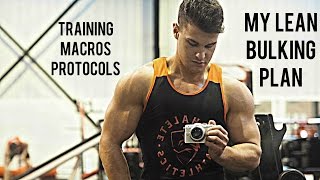
Rob Lipsett breaks down his lean bulking approach: a 10% caloric surplus builds muscle as well as a 30% surplus but with far less fat gain. He targets 0.5 lb weekly weight gain, measures progress by strength not scale weight, and uses mini-cuts to shed excess fat without losing muscle.
Chapters
What's going on everyone, welcome to today's video, much requested video, and that is my entire lean bulking plan. So we're going to talk about macros, rate of weight gain, how I'm going to do it, everything. So let's dive right into it. I believe the scientific term for lean gaining is actually getting swole as fuck. Okay, so let's start with what is a lean bulk, what is a dirty bulk? And it's not actually about the foods you eat, but it's about how big the surplus that you go into is. Let me explain. We basically have studies where we take two groups and we overfeed one group by 10% of their caloric intake and another group by 30% and compare the results. Both groups gained the same amount of muscle, but the group that overfed by 30% gained some fat as well. So there's really a cutoff point where extra calories doesn't equal more gains. There is a cutoff point where more is not better. Increasing calories has a lot of anabolic effects, but there is a ceiling where more is not better. Next up, I want to quickly talk about transitioning from a cut to a bulk. Now you want to start your bulk as lean as possible so you can bulk for longer without letting your fat gain get out of control. Once our body fats get too high, we start to notice a lot of negative effects like decreased insulin sensitivity. Our testosterone actually goes down and we just feel sluggish and bloated, and we obviously don't look as good too. If you're just finishing a cut, you've probably heard people talk about reverse dieting, and I think it's absolutely pointless reverse dieting at a painstakingly slow rate. Some people recommend to reverse diet at like 10 grams of carbs per week, and that's literally just prolonging the cut for weeks on end until you even get to maintenance, never mind a surplus. Another thing is 10 grams of carbs, you can't even track that. That's like a handful of grapes. So my recommendation is just go up to maintenance as fast as you can, and other guys like Lyle McDonald and Al Nargon will also recommend the same. So a typical cut is 500 calories below your maintenance level, but I like to add in 400 calories. Now the reason for this is because due to just metabolic adaptations and metabolic slow down after a dieting phase. Your body weight will go down, your metabolism will decrease, so your maintenance levels probably have changed. So this is why I added 400 just to be on the safe side. And then after this, I stay in maintenance for about 1 to 2 weeks, maybe about in between 10 days. This is where I'm currently at, just to kind of let things stabilize and see how your body responds to the extra calories. After that, I would make increases of 250 calories at a time from fats and carbs, mainly carbs though. And remember, there's no point increasing calories if progress has not stalled. If you're gaining weight, if you're lifting more in the gym and things are going well, just leave things how they are. So to summarize that up, go back up to your new maintenance for about 1 week, maybe 2 weeks, and then increase by 250 calories from there. And only increase when progress stalls. So what are my macros? I'm currently in that transition period, so protein's at 180 grams, carbs are at 375 grams, and fats at 60 grams. Total calories is 2,760. So my next increase will probably bump carbs up to 400 grams and maybe about 65 grams of fat or 70. Next up is rate of weight gain. So how fast do you want to gain weight when you're lean bulking or lean gaining, whatever you want to call it? And the answer as always is it depends. It really depends on what level of training you're at. If you're a beginner or a newbie, you'll gain muscle very easily, often known as new gains. So someone like me who's been lifting for 5 years, the gains aren't going to come as easy. If we could all keep gaining like we're just new to lifting, gaining, you know, 20 pounds a year, whatever it is, we'd all be freaks. So I'm going to aim for about 0.5 pounds per week or even 2 pounds per month. I know that seems really slow, but if I gain 10 pounds of muscle in the next 6 months, that would honestly completely change my physique. That would look like a lot of muscle on my physique. Anything beyond 2 pounds per month for me is most likely just going to be unnecessary body fat. So how do I measure progress when bulking? So like I said, the scales— I will be weighing myself regularly enough, but it's very hard to kind of tell if you're building muscle because a lot of that could just be water weight, glycogen, actual food volume in your GI tract, time of day, everything. So I'm going to pay close attention to the weight that I'm lifting in the gym. You can eat all the calories you want, but if you are not providing any stimulus to grow your muscles, they will not grow. Why would they? You're giving them no reason to grow. People always say things like, oh, it's 80% diet and 20% training, and I really think that could be further from the truth. I think you should give both aspects 100%. Like I said, if you don't train, you will not gain any muscle. And that brings me on to my next point, and it is my training on this bulk. Already the last week or so, training has been so much better. I can just power through workouts, increasing reps and sets, overall volume. And I also have been setting some PRs, which is nice too. Haven't done that in a while. I'm gonna stay on my usual legs push-pull split for the moment, but I might be getting a more strength-orientated program from my Alpha Elite teammate Russell O'Rourke. Comment down below if you'd like to see that. It could be interesting, and you know, I could do with a new style of training. I can be like a white Russ Swell. Next up, something I want to talk about is mini cuts, and these are a fantastic tool for improving your body composition and As it says in the name, it's just going on a little, really mini cut or a little short diet. So when you've noticed you've let the bulk get a little bit out of hand, you might have gained more fat than you planned. Just go back into a deficit for 1 week, maybe 2 weeks. And the reason why these are so good is you're not going to lose any muscle in that short space of time, but you will lose some body fat. So these are a great way to kind of, you know, pull the bulk back and make your body composition a bit more favorable. Next up is how long am I going to bulk for? And really, as long as possible. I'm going to go till about March and then I'm gonna cut down for the summer, for like April and May. And yeah, I'm really gonna use this time as a bit of a mental break away from dieting, not having to think about food so much, and just enjoy it. So guys, that is the video. I hope you enjoyed. Please leave it a thumbs up, really helps the channel grow. Any more questions, please ask them in the comments and I'll try get back to you. Tom, get massive and leave humanity behind. That is the video. Keep it real. I'm outta here. Peace.
More from Rob










"I Haven't Worked in 10 Years" - How Rob Lipsett Built a £1M Fitness Empire From Nothing
