Q&A: My BEST Life Advice, Genetics, Increasing Metabolism, My Beginning
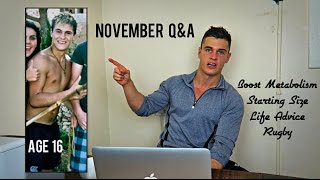
In this informal Q&A, Rob Lipsett answers a wide range of viewer questions covering personal life balance, early training mistakes, macro tracking for athletes, career advice, evidence‑based nutrition sources, consistency in diet, low‑macro dieting strategies, metabolism, genetics, 9‑to‑5 lifestyle tips, training while traveling, food weighing, prioritising compound lifts, refeed days during cuts, and skepticism toward the fitness industry. He shares personal anecdotes from his rugby background and early lifting years, emphasizes the importance of building lean mass to boost metabolism, advises tracking macros consistently (even on non‑training days), recommends hitting each muscle group twice weekly, cautions against overly restrictive diets, and urges aspiring entrepreneurs to act quickly on ideas and consider international exposure. Throughout, he balances encouragement with realistic caution, offering practical, evidence‑based recommendations and personal reflections.
Chapters
What's up everyone? So welcome to the Q&A. I posted a picture on my Instagram, asked you to ask a ton of questions below, and you did. And some really good and intelligent questions. So let's get stuck into them now. Okay, first question is— it's a good one, and it's one that I had to think about. So, let me read it out. I'm 17 and don't go out drinking unless it's a big occasion or a holiday. I stick to my macros and I train hard. My friends think I'm wasting my life away, but I see it differently. Do you think I should be taking it so serious at a young age? Okay, my answer would be a lot more clear if you didn't say that you go out unless it's a big occasion or a holiday. To be honest, if you're not missing any big events, you know, you're going on holidays, you're partying, you're having fun, it doesn't really sound like you're wasting your time. You know, obviously when you are like between the ages like 16 and 19, go out, be crazy, be young. Some of my best memories, some crazy stories I'll bring to the grave happened when I was that age. So, you know, I really recommend don't let fitness take over your life and go and have fun, but If you're going to all the big events and going on holidays and stuff like that, and you're just skipping random pointless nights, to be honest, it sounds like your friends are wasting your time. I've been on tons of nights out that are just literally the same shit. It's like same nightclub, same bar, same people talking about the same things, and they're a waste of time. So, you know, drinking for no reason isn't really productive. So, you know, if you said that, you know, you weren't going out at all, then my answer would be different. But seeing as you said you go out on big occasions, I don't think you're doing nothing wrong. So keep it up, enjoy your life, go to these big events and have— make some crazy memories. But do not take things too seriously unless you are an elite-level athlete, a fitness model of some sort, or you get paid for your physique in some way, shape, or form. Then there's no reason to take things too seriously and let it take over your life. Will you be coming across the pond to any expos in America? I haven't booked anything yet, but I will most likely be at the LA Fit Expo. What were you doing in your first year of lifting? What exercises, how many times a week, diet, etc.? Yeah, I got a lot, a lot wrong in my first year training. You know, I still got results because I pushed myself, I trained hard, but I could have got a lot better results. I followed like a freaking bro split that I got out of like Flex magazine. I had like a bicep day, a tricep day, you know, your typical chest day, back day. Ah, very, very bad split. My diet was like extremely low carbs. You know, I, when I went on a cut, I lost a ton of strength. I could have done things so much better. And, you know, I started seeing so much better results when I started hitting everything twice a week and, you know, leaving carbs in my diet. So yeah, that was like the mistakes I made in my first year of training and dieting. But yeah, my advice is, you know, without going too into things, hit everything twice a week and don't completely cut out carbs. Do you think as a gas/rugby player I should track macros/calories as strictly as, say, a bodybuilder? Okay, this is an interesting question because as I'm probably going to get into later in the Q&A, I come from a rugby background. You know, the school I went to, a lot of my friends are professional rugby players now. So I, you know, know a lot of pros. And there was actually a pro rugby player, he plays for Leinster, you probably all know him. And you know, we were talking a while ago and he was saying that his training and his physique, his body composition was the best it's ever been when he started tracking, you know, Macros and things like that. You know, obviously tracking how much protein, carbs, and fat you eat is pretty much like— it is a huge— it's a game changer. It's obviously— there's not much else you can do with your diet. You know, there's not— you can't be that much more accurate or more on top of things. I definitely recommend tracking your macros and calories if you can, if you're a guy, rugby player, an athlete, but as strict as a bodybuilder, no. By bodybuilder, I presume you mean dieting for a show, a bodybuilding show, and No one needs to be that strict with their macros unless they are in the final few weeks of a prep. That is when every calorie counts, really. So, um, if you are a gas/rugby player, yeah, absolutely, definitely, you know, track your calories and macros, have an idea of what you are taking in. As strictly as a bodybuilder though, that's your question, no. What's your dream car and who's your favorite YouTuber? My dream car is an Audi R8. Already got that A5, so we're slowly, we're slowly Totally get into that, alright fam. My favorite YouTuber? I watch tons and I don't have any favorite in particular because, you know, I watch different people for different things. Everyone brings something kind of unique and different to the table. This question is from Brittany Lesser, another really good channel that you should go check out, especially females out there. If you could give one piece of advice to your younger self, what would it be? Okay. Time for some real talk, okay? You're probably not gonna believe me, but basically a couple of years ago I had an idea, like, you know, an idea for a company, a brand. Um, I know I had it written down and everything, same name as, as everything. You're not gonna believe me, but about a year after, somebody else created that brand. It is a huge brand nowadays. It's a fitness brand. I'm not gonna say if it's supplement, clothing, or like a product or something. And it's huge, and it's actually crazy that I thought of this, you know. I thought of the exact name and like what everything would be like a few years ago, and someone did it before me. So my advice is, if you have an idea, if you have a plan, fucking do it quick. Do not hesitate, do not procrastinate, and just do it. That's probably, you know, it's obviously a huge regret, but like, I learned from it. Because if you've got an idea, the world is a big place. If you've got an idea, there's hundreds of other people with the same idea, but it's about who acts on it. It's about who does it first. So advice to my younger self would be, if you're thinking about doing something, just do it. Hey Rob, you say it's all about nutrition and I believe that, but where's the best advice to get that info from? Well, I don't think it's all about nutrition. You know, I think like obviously training, nutrition, rest, recovery, sleep, I think it all plays apart. And like, you know, I don't want to say like this is more important than that because it's really just— it all comes into it. But to answer your question on nutrition, um, my favorite go-to sources are people in the evidence-based community like Lyle McDonald, BodyRecomposition.com, Alan Aragon, Brad Schoenfeld. I'll put the, you know, their website names up here. Brett Contreras, uh, Danny Lennon, who's also Irish, has a great podcast. Basically, these guys are all gonna tell you the same thing, you know, and they're all great sources of information. If you type the names in, look at articles they've written, you can literally, like, learn everything there is about nutrition. A fun fact is when I sat my sports nutrition exam, I passed without opening a book. I'm not even exaggerating. I didn't open a book. Do you see yourself having to leave Ireland in the coming years to further your fitness career, moving to the UK or America? Or do you think you can achieve everything you want by remaining here? Like I said earlier on, I am most likely going out to the LA Fit Expo. And can I achieve everything I want by remaining here? No. A lot of like YouTubers and other figures in the fitness industry, I've talked to them online and stuff, and they're all like, whoa, the fact that you've gotten this far on some tiny little island that the fitness industry isn't even big yet. 'You know, it's great, you've done very well.' So a lot of people have advised me that to really kind of take things to the next level, I do need to go to like America or somewhere like that. You know, I can definitely— obviously it's all online, so like I can of course always be, you know, progressing in Ireland, but everything I want by remaining here, no. I'm definitely gonna have to take a few trips to America to collab with some people and stuff like that. How important is it to hit your macros on the days you're not lifting? Just as important as it is on the days you are lifting. I really, I'm not a fan of chopping and changing your nutrition on a day-to-day basis, mainly because what you eat one day can often affect you the next day. Why do you think marathon runners start carving up days before an event? Why do you think bodybuilders start carving up before the show? What you do one day doesn't just kick in like that, you know. Sometimes when you eat a large portion of food, those calories, that food is digesting for up to 72 hours. So to try and, you know, change things on an hourly or daily basis, it's just a bit of a crapshoot, and I really don't recommend it. And Danny Lennon, who I mentioned earlier on, has a brilliant article on this, and he even has a chart kind of, you know, explaining that I'll put here, and how it's all about pretty much your weekly average of macronutrient intake. So, you know, you can change things up if you like, but it's really just going to come down to this weekly average. I personally do not recommend it as it's unnecessarily complicated and there's just no need for it. And when you have a consistent diet, when you make changes to it, you know, you're a lot more accountable for it. And so how important is it to hit your macros on the days you're not lifting? Just as important. Do you have any tips for people who have to diet on poverty macros to get lean? Yeah, um, when you're on very low macros and calories, maybe it's like, you know, the last few weeks of a cut or something, you— the whole kind of if it fits your macros flexible dieting thing, your food choices aren't going to be that exciting. You're not going to be fitting chocolate cake and Haribo and donuts into your diet. Your diet is going to have to consist of filling, high-fiber, voluminous foods. So things like big salad bowls, you know, bran flakes with high fiber, because, you know, obviously fiber fills you up, it stops you from getting hungry. So yeah, lots of green leafy vegetables and things like that. And literally just eat foods that will take up room in your stomach. Parsnips are another one. You can actually also look up the satiety index. Yes, it's a real thing. It basically rates food on how filling it is. So like at the very bottom of the list, it's things like croissants and pastries, sugary cereals. And at the top of the list, it's actually white potatoes. And white potatoes are very filling. So yeah, you can Google that, check it out. So to answer your question, high volume, high fiber food to stop you from getting hungry and cheating on your diet. What is the best method to increase metabolism? Okay, this is a really good question. And you really have to say, you really have to ask yourself, How do I significantly increase metabolism? Keyword being significantly. You can drink coffee, take like a, you know, a fat burner pill, and that'll like increase your metabolism for a short period of time, like 10 calories or something, and then you could still count that as increasing metabolism. So the only way to actually significantly increase your metabolism for long periods of time is to build muscle. It is to increase lean body mass. Yeah, I really want to get that point up 25 female viewers, you know, lift weights, build muscle. You're gonna look good. You're not gonna look like a man, and you will significantly increase your metabolism. Did you start off skinny, or did you have some mass prior to lifting? My starting physique was just pretty much your skinny fat. Do you even lift? I'll put up some pictures here. I think I was like 16 or 17, and then, you know, started lifting properly when I was like 18. But again, like I said earlier on, my diet and nutrition still wasn't great. So this is me at age 19, and then, you know, the last few years is when I kind of learned about everything and started taking things seriously. How far did you get in rugby, school district or whatever, and what was your position? I was on the senior cup panel. I did not make the starting team, but seeing as we won the senior cup that year, we were one of the best teams to ever go through the school, is since Gordon Darcy's year, a lot of people say. And like I mentioned earlier on, a lot of my friends have gone on to play at a professional level. So the fact that I was even on the squad is— I'm pretty happy with it. My position, I started first year to fourth year I was flanker, and then fifth and sixth year I was hooker or prop, you know, low center of gravity, stocky. Was there ever a point in your life when you got bored of lifting and stopped? Stopped completely? No. And but there are times when, you know, completely fell off the wagon and stuff like that. But I always try to keep things interesting, be it, you know, meeting up with a friend you haven't seen in ages and going training with them, trying out a new gym. I do that the whole time. Or even buying some new workout gear, kind of, you know, just do whatever you can to keep things interesting. That photo is ridiculous for after only 1 year of lifting. Do you think genetics play much of a part? Genetics are huge. Huge. And like I said, I was following like a crap program and, you know, I got pretty nice results. But genetics is just— it's really kind of the defining factor of how you will look and how big you can get. So yeah, do you think genetics plays much of a part? Yes, big time. Why are you so awesome? Thanks, man. It's just the way it is. Tips to eat well and exercise working 9-to-5 job. And I actually used to work a 9-to-6 9-to-6 job, and I hit the gym every day and hit my macros every day. I get like Subway every day for lunch and just fit that into my macros. And here's actually a picture of what I looked like when I worked a 9-to-6. So my tip is just to do it, you know, stop being lazy and just get it done. I can't really sympathize with you there. Sometimes the calories and macros don't add up on MyFitnessPal. Do you only look or follow macros, or do you follow your calorie goal? And yeah, this is— I get this quite a bit. And Lyle McDonald actually wrote an article on this. This is just basically incorrect labeling, or, you know, you can enter like things into the MyFitnessPal database yourself. So this is just people making mistakes. Ideally, you obviously want them to add up or at least be close to each other. But if I had to choose one, I would probably just track macros. But, you know, as we always know, macros and calories, they are the same thing. Macros, what makes up your calories. 1 gram of protein equals 4 calories, 1 gram of carbs equals 4 calories, 1 gram of fat equals 9 calories. So by default, if you track macros, you're tracking calories too. But I think by your question you already know that. How did you get into the fitness industry? It actually all started with last year. I made like a Facebook page and just started writing like mini articles from that. I'd like mini articles as statuses, and it kind of all went from there. You can go to my first ever videos, you can go to my first ever Facebook post, and you could literally see where everything began. You can see my first ever post. How will you approach training whilst in Thailand? This is a good question. I'm not going to be training 6 days a week. I'll probably lower it down to 4 days a week, maybe 5. I'll literally just, as always, hit everything twice per week. Probably follow an upper/lower split. 2 upper, 2 lower. Do I weigh my rice raw? Yes, weigh all your food raw. It's much more accurate. You know, there's so many variables that come into weight when you start cooking things. For example, if you have a cup of rice and you add more water or you cook it for longer, it's going to absorb more water and the weight is going to be completely different. Same as if you're cooking chicken, if you cook it for like a few minutes longer, it's going to be drier and it's going to be a different weight. So just weigh everything raw, and it's a lot less messy as well. Do you track progressive overload or isolated movements as diligently as you would for compound movements? Uh, the answer is no, I don't. Compound movements are obviously going to be the primary kind of stimulus in your training. Isolation movements are often referred to as accessory work, and you know, that's what they are. I'm not saying they're not important, but your compound movements are kind of, you know, what's going to be make or break. And obviously, you know, I look to set PRs on my compound movements, you know, increase volume over time, add weight to the bar. But you know, I don't go for a 1 rep max on bicep curls. I don't think anyone does apart from CT Fletcher. But, uh, no, I'm not that diligent. Of course I'm always trying to lift heavier or more sets or more reps, but no, I'm definitely not as diligent as I am with my compound movements. Naturally, during a cut, one feels very flat. Should one increase carbohydrates then, or should one just continue? Okay, yeah, you are gonna have those days when you're cutting where you're gonna be flat, tired, you can't get a pump. And if this— you know, you're gonna have bad days, okay? And sometimes it's just a bad day, then, you know, the next day you're back feeling good again. So, you know, it's only really a problem to worry about if it starts becoming continuous. Like, if you have 3 to 4 days in a row when you're feeling like this, it's probably time to have a refeed day. But you know, a lot of people are very easy on themselves when they're cutting. They have one bad day and they're like, oh, time for a refeed day, you know, time for order Domino's. I'm feeling, I'm feeling flat and weak. So don't go easy on yourself. Be honest and only have a refeed day or a carb up if it's, you know, a continual thing. Okay, last and final question. Do you think the fitness industry takes advantage of young people by making them think that reaching 6% body fat unlocks infinity opportunities in life, and that taking numerous supplements is compulsory for muscle growth. Okay, in any industry you're gonna have people trying to bullshit you, you're gonna have people, you know, trying to take advantage of you. Hell, you know, when I went into mechanics a while ago to look at my car, you know, they're always trying to charge you the most possible for the little amount of effort. When I was getting my website designed, I went to like a few web designers, and some of them were literally offering me to do, you know, shit all with a website and charging me through the roof. And this is just a part of life. Welcome to the real world. Welcome to planet Earth. People are always going to be trying to take advantage of you. There's also people who say that if you believe everything you read on the internet, maybe you deserve to part ways with your money. But that's a little bit mean, so I'm not going to say that. My advice is, yeah, you know, obviously in any industry there's going to be people trying to take advantage of you. Just don't believe everything you read. Don't be so gullible and do your research first. That's one of the reasons why I made this channel, to kind of stop people getting bullshit and to give out sound advice for nutrition, training, supplementation, because I just don't have it in, in me to bullshit people, to rip people off. I can't. Okay, so that's all we have time for today. Let me know your feedback. Let me know if you have any further questions on anything I answered I will try to reply to you down below. And let me know if you want to see more Q&As. I definitely don't do them regularly enough, and it's probably the easiest way I can give out information in a video. So I hope you enjoyed. If you liked the video, please go give it a thumbs up. It would be much appreciated. I'll catch you next time, and most of all, keep it real.
More from Rob










"I Haven't Worked in 10 Years" - How Rob Lipsett Built a £1M Fitness Empire From Nothing
