Starting A Business With No Investment
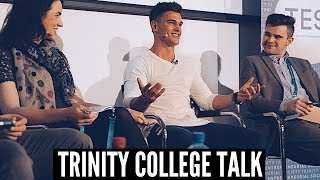
In this 2017 vlog‑style recording, Rob Lipsett delivers a live talk at Trinity College’s Entrepreneurial Society on how to launch a business with little or no capital. He shares his own journey from a part‑time retail job and a €300 bank balance to building a successful online personal‑training and nutrition business, using a friend’s low‑cost web development, free social‑media promotion, and niche event hosting. The discussion expands to low‑budget marketing tactics—leveraging video, personality, and niche opportunities—while emphasizing the need to quantify social‑media time as a real investment and measure ROI. Rob stresses authenticity, consistent personal branding, and the value of mentorship and honest feedback. The panel also features Jack Kavanagh, who recounts his severe injury and how he turned adversity into a motivational platform, illustrating resilience as a key entrepreneurial trait. The video concludes with Rob’s post‑talk vlog, showing his gym routine, cooking, and upcoming travel plans, reinforcing the theme of disciplined daily habits supporting entrepreneurial success.
Chapters
What's going on everyone? I woke up today feeling like a goddamn savage. So today we have the Trinity Talk, right? And I know what you're thinking, Rob, another talk, you know, come on, come on, switch it up. Right now I'm just putting in the work, okay? I'm putting in the grind. I'm literally every single day making it a productive one because later in March that I am going to Australia and I'm planning on taking the foot off the gas a little bit. So right now I'm just you know, overreaching slightly. And I have also actually moved my travel dates. Instead of going to Australia on the 14th of March, I'm actually going on the 10th of March, so we don't have that much time. So today's talk is in Trinity College, which is one of the most prestigious, if not the most prestigious college in Ireland. So the fact that me, a college dropout, is giving a talk there, it's an absolute honor. It's for the Trinity Entrepreneurial Society, TES, and the topic is starting a business with little to no investment. So I'm so excited to do this. Gonna meet up with Thomas Arnold now, and then we are gonna head into town, into Trinity College. It's just a short talk, but I'm looking forward to being there, and Trinity, it's a really cool architecture and everything. So getting some cool shots for you guys, and just creating a really good vlog. So let's go. You know, I was about to say sorry for like the repetitive content, even though it's not that repetitive, and you know, I'm not actually sorry for giving you free valuable information that some people pay for. So sorry, not sorry. So I was told to dress business casual for today, but business casual is me not having rips in my jeans. So this is what I feel comfortable speaking in. Let's go pick up Thomas. This is how I get psyched up for a talk, some NWA. I'm not the only one who does this, right? All right guys, I'm back with Thomas Arnold. Uh, his details are linked in the description box, go check it out. We previously have worked together. We're on the way Trinity though, and I think this is like the most pumped up I've ever been because it's just like such a— like Trinity, it's such a powerhouse, like it's a real university. Topic is so cool as well, it's starting a business with little to no investment. Talk is at 10:20, so it's in about like half an hour, 40 minutes. So we're going to do that, then we've got the whole day to just have a sick day. So let's get into it. Pretty pleasant day in Dublin, it's not raining, it's not windy, it's mild. And time's it? 10:10. Speeches begin at 10:20, so right, let's get a move on. Hey, great to see you, man. Great to see you.
Yeah, absolutely, man.
Great to see you. Officially made it, everyone. I've got my name on a badge.
Right, perfect.
Awesome.
Excited for today, it's going to be a lot of fun. I got to do a few exercises to get people to ease up, so put your hand in the air, say what's up to the guy next to you and everything, so everyone gets chilled out. So when it does come to question times, everyone is like, "Hey, you know, I'll ask questions," because sometimes people can be afraid to ask. Marketing on a tight budget, which is something that very much goes with our theme of embracing disruption. This is something that is very topical in what is now the age of the startup. With this in mind, what better venue to host such a talk than Trinity College, Europe's most entrepreneurial university? The best way to get started is to ask each of you to give a brief overview of your venture and any experience you have with marketing on a tight budget. So Rob, if you'd like to begin. Right, is this thing on yet? Can you all hear me? Okay, excellent. First off, I want to provide a little bit of perspective, okay? The fact that it's 2017 You've already killed it, okay? You could go back 50 years ago, 20 years ago, none of this existed, none of it was around. You've smashed it, okay? We're gonna go deeper down the rabbit hole here, okay? You are in Ireland. It is a first world country, it's a neutral country, we don't go to war, police hardly carry guns, there's no poisonous animals, the weather sucks but it's mild, it doesn't kill us, okay? Let's go even further, just even Narrow it down to more how lucky you all are, okay? You're all sat here right now in Trinity College, one of, if not the best colleges in Ireland, and the fact that you're even in this room just shows that you're a driven, motivated individual that is eager to make change and eager to make their dreams into reality. Tap you out there, does everyone have a phone in their pocket? Yeah? You have this insane tool at your fingertips. So when you look at all of these opportunities, to actually waste this opportunity— like, sometimes I feel how lucky I am, and I'm actually like, and I complain about something, I actually feel disgusted at myself that I'm complaining when there's so much people in worse situations who are absolutely killing it and working extremely hard to get towards their goals every single day. So now with that perspective out of the way, I hope you realize just how lucky you all are. And that, once I started realizing that and being grateful for external motivation, I didn't even need it. So I'm gonna tell you a little bit about myself and how I started. First of all, just because I've got an upper-class South Dublin accent doesn't mean my parents gave me a shitload of money, alright? That was not the case. They actually made me pay rent when I was younger. But that's brilliant. I'm so glad they didn't spoil me because it made me dependent and it made me want to go get things done. On my own. So basically I gave college a shot. I'm not anti-college by any means, but I am anti doing a course that you don't love or that isn't following something that you're passionate about. So I did generic business course and I was led to believe that I was stupid just because if you can't do accounting or a certain module, well then you get a big F and you feel bad about yourself. So I failed first year twice. 'Laugh it up.' Yeah, laugh at the village idiot. Okay, but then I realized that, okay, just because I'm bad at something doesn't mean that I'm bad at everything. And in this society, we're really taught to work on our weaknesses and not play to our strengths, when it should be the opposite. So I said, you know, I did a lot of thinking, a lot of like self-reflecting, and I said, 'What am I good at?' Right? And I said, 'What do I love to do every day?' And that is learn about fitness, nutrition, training, and go to the gym and lift some damn weights. So that's what I love to do. And I said, well, I want to make a career out of that. You know, I don't want to work a day in my life, so I want to do something that I wake up every single day and that it's just, it's second nature to me. It doesn't, it doesn't have to— I don't even have to think about it. It's effortless. So I started writing statuses as articles, or articles as statuses even. And that's even going to show how lucky we are. You don't even need to make a website, right? You can literally just post whatever you're into on social media now. It's absolutely insane. So a lot of people were coming to me, they're tagging their friends in these posts, and they said, "Hey, look, here's a good training tip." You know, "Here's good nutrition advice. You could use this." And then I started getting a lot of inboxes saying, "Hey, I'd love a training plan. I'd love a nutrition plan. Do you do one-on-one personal training?" And, you know, my goal has always been to live a life of freedom, so I didn't want to be stuck in a gym training people one-on-one. If you like doing that, I think that's great, but For me, I'm very into travel and, you know, living life on my own schedule. So I said, "Okay, how about I email you a plan and you follow it for me?" So they said, "Sure." And at this time I was doing it for free, okay? Because I love doing it. I was like, "Ask me any question you want. I'll talk about the gym and fitness all day." So I was doing it for free and these people were going off, coming back a month or two later with these killer results and just being like, "Hey, thank you." So I was like, uh, I can make a business out of this. So, and a lot of times when people are struggling to think of a business, us often, it's just the answer is right in front of you and it's something that presents itself to you every single day and you just need to just realize what it is. So that was for me. I was getting clients every single day. And now here's the funny investment part that ties into the talk that we're giving today. And so I said, okay, I'm gonna make a website that can take payments and I'm gonna do online training nutrition plans. I have my certificate and everything. I was doing that alongside college. And funnily enough, just on a quick tangent, I passed those exams without having to study. So it just goes to show, I wasn't, you know, if you're good at something, it just comes naturally, right? And I wasn't an idiot that I was led to believe I was. So I started up a website and I went to a few web developers. And at this time I was working in retail, just had like a little bit of like a couple hundred euro in my bank account. From just working part-time, if even. And I was just, you know, living week to week. So I went to a web developer and I always laugh at this. I was like, "Hey, I want a website like this. Can you do it for me?" And he was like, "Yeah, sure. Tally it up. That will be €8,000 to €10,000." I was like, "I will call you later." Right, okay. Not a hope. Couldn't afford that. Not a hope, right? I literally had €300 in my bank account. At the time. So I think when people want to start a business, it's not money that they need, it's work ethic and thinking outside the box. So I said, okay, I'm gonna have to think outside the box a little bit here. So I went to a computing college. A friend with a few mutual friends, a connection, an acquaintance, he was studying computing. I said, mate, can you make me a website that can handle credit card payments and, you know, looks somewhat decent? It doesn't have to be that fancy. I've got the customers already. He said, "Sure." Had it done in a week, €300.
Boom.
He was happy, I was happy, and it went from there. So things started to snowball and snowball. And once that I started doing these online training plans, which again don't cost anything, don't take any investment for me to do, it literally just takes me and my time sitting at my laptop and the experience and the know-how that I've learned. And then once I started making more revenue off that, that is when, after you get over that initial hump, that's when you can start putting more revenue back into your business. And then you've got past that initial start of starting a business with little to no investment. So that is where we are now. That was 3— less than 3 years ago. The business has grown very nicely, I have to say. And that should give you a little bit of background about how I started a business with, you know, part-time wage. And just a bit of hard work and thinking outside the box.
So I'll get the two of you to do the same, maybe a little less time.
Apologies, I tend to blab on.
After one or two of those, I got kicked out, and so I went to the local nightclub that was Bondi in Stillorgan at that time. I said, look, I'm having a party, a couple of hundred people have been in my house, I'd love to host it with yourselves. They did a deal with me, they just said, look, for everybody that turns up 'If they pay £10 in, I'll give you 50%, so you'll make a fiver.' It was really, really simple. I, again, no budget, no anything, just said, 'That's great.' A couple of hundred people turned up, I made a bit of money, looked at that as a model and thought it was amazing. It took no investment from myself, it was just literally just catering, I suppose, in terms of entertainment needs to what students didn't have at that stage. So kind of a philosophy I've had in terms of marketing is always that there's niche opportunities that will sell themselves. They don't necessarily you don't necessarily need a budget. If a product is good enough, it will sell itself. My kind of history in business went from there to that evolved and evolved and evolved. We did it socially, naturally through social media at the time. There wasn't— 10 years ago, Facebook was just starting. Actually, it was Bebo at the time, and the term was social networking, not social marketing. So we promoted— we didn't even realize we were promoting the nights through social media, but we just mentioned that they were on through social media. But as that expertise refined, we'd really developed a strong way of using social media completely free of charge to support our business. And fast forward 2 years on from there, we were hosting about 30 nights a week to 20,000 students every week all over Ireland, north and south, not spending a cent. So we were doing it all free of charge through social media or else through literally friends networking amongst themselves through college. So I think it's a really, really interesting theme for the talk today because there's a funny trend that I've had that anytime we've gone into a project with a huge budget, it hasn't necessarily gone as we'd like. But anytime we go into it with no budget and, as Rob said, get really, really resourceful, think outside the box, things have worked really, really well for us. That evolved and I developed two websites, College Times and Teen Times, which were essentially tabloids or magazines published through social media. And we were really good at the social media side. We built an audience of over 100 million every week through social media, but like a lot of publishers, we found a real challenge in monetizing that on the websites. I sold them recently, and what I do now is I work with businesses on their social media marketing, basically helping them get real business results through their social media. Now, a funny, a funny thing for us is that a huge amount of businesses are using social media but they're not quantifying their investment. So they might be doing 4 or 5 hours a day, but if they put those 4 or 5 hours a day up against an hourly rate, they're actually spending a huge amount on their social media. So generally we come in and we say, look, you're not actually measuring what you're putting into your social media marketing. If we quantify that in an hourly rate, you're actually spending this much on your social media. And a lot of time they're not identifying what the real return on investment from that work is. So interesting enough, a lot of our kind of our niche opportunity our way of pitching to businesses is actually saying to them, look, once we quantify this, we can actually do a hell of a lot more for a hell of a lot less. And that's developed a really strong business for us. Now we work with clients nationally and internationally. And it's a really, really good space. But it's all very much built around this theme of marketing and building businesses on a tight, tight, tight budget and doing it really, really efficiently.
What do you reckon is the most powerful social media tool? In this day and age to market on a tight budget? Well, nowadays I think video, whatever platform that may be, so Facebook video, YouTube, even Snapchat video, Instagram stories, or even Instagram— to even actually just put it into perspective, Instagram have now added 1-minute videos to their posts. I'm sure you've all seen that. Because video, a picture can only tell you so much, but a video can really give you an idea of what the person is like, the message they're trying to convey, and what the company, what's behind the brand. So I think whatever platform you are utilizing, they all have their, you know, time and place and their benefits and their pros and cons. But I think video has gotten very powerful.
I actually think the most, like, the starter's block for anybody when they're approaching social media is they take a step back and they go, okay, who am I going to be on social media? I'd say, like, personality is probably the best asset you can have going into social media. If you take the time to actually think about it, giving yourself consistency in terms of that approach with personality, those are absolutely key. Whether you're using any medium then, if you're pushing out a consistent message that's full of personalities and it's interact— it's engaging, it's of interest to people, that's the number one key advantage when you're using social media. It can manifest itself in terms of photos, videos, text, copy. You can go into any mediums, but The biggest issue with people is that they're not actually thinking about how they're going to push themselves out. And that's where you see a massive success in influencers on social media. A lot of the time, brands struggle to figure out who they really are. But people know a little bit more naturally. Or if they're not conscious, it's unconscious. And for yourself, I imagine— well, actually, when you spoke earlier, you said, look, I didn't really know what I was doing. But I just pushed myself out there. Whether conscious or unconscious, there's a very likable person in there. And as it's moving forward in a consistent fashion, it builds a market to it.
Does that make sense?
From our side, we would have started like you're saying, just said, 'Oh God, we really should do this social media stuff.' So we put something up every week, or— and it was very tired. And like, it did work, and more so for connecting with people. So tweeting at a food industry that you wanted to work with, or, you know, it was very a lot of our kind of generic posts weren't very targeted, had no idea on return on investment. So I suppose what we've tried to do is linked out all our branding and messaging that goes out to our kind of values and vision as an organization. So we want to be positive solutions orientated and we want to kind of drive change. So we've then been able to line up all our any kind of social media, or that goes with any communications that go out from our team, it's always positive and solutions orientated rather than, "Oh God, isn't it terrible that so much food is wasted, and isn't it terrible that there are so many people that need this food?" So we decided that that wasn't what we were going to do. But it was only then that we were able to actually be able to track what we were doing, because otherwise it was just a chore that we were saying, "We haven't put up anything on our blog in in a while, we haven't done any Facebook, so we would have been probably the other side, or the companies that you would, you know, be helping to work with. So I think getting your vision and values right and your strategy right and then hooking all your communications off that is really helpful, and then it doesn't become a chore and it becomes part of, you know, whether you have a team building up, everybody has the same messaging, whether they're talking to somebody directly or doing it through Twitter and Instagram. So it's just around aligning the message across the organization.
There's a funny thing, like when you talk to a lot of younger people, they're obsessed with setting up their own business, but they're not necessarily obsessed with the given idea. You know, there's so many I've talked to and they're like, I'm gonna set my own business up. And they're like, great, what are you gonna do? And they haven't necessarily thought about that. And so what you get as a repercussion of that is people actually hopping on ideas that aren't necessarily outstanding. I think it's really, really important that people really scrutinize what they're getting themselves into because realizing a business idea and bringing it to life is so, so challenging. And so you want to have all the assets stacked in your favor. So when it comes to the first steps for any startup as it's starting to evolve, I'd really look hard at the business and look hard at what problem it's solving or what it's actually doing. I have a solicitor as a father who doesn't really get technology too well or social media too well, and he does not understand what I do, I find it a really, really interesting, interesting thing trying to communicate what it is that I do to him. And I hope it really, I think, helps refine my overall marketing. When we were promoting nights, we used to have this idea that if your message is gettable to the thickest person in the audience, ultimately it'll market itself really, really well because everybody gets it. So I think it's something to think about when it comes to an idea evolving.
Yeah.
Really scrutinize it.
That's so funny because my mom is literally the exact same. And if I can explain to her what I can do, anyone can get it. And to add to that, the last thing you want to be making is forced content because people will be able to tell it's forced and they're going to be able to tell you're not enjoying making this, so why would they enjoy taking it in? So just to add on to that, that is just so well said that you need to actually really be into it yourself and really enjoy the process.
Completely agree.
I think the only thing on top of that is that sometimes people shy away from the really good, good stories. And so, for example, they're all the time presenting things as really, really positive when in actual fact they're not. And when somebody's presenting them as positive, you can see straight through when they're not. And but actually, sometimes those stories about those failures, about those negative experiences, are actually of real interest and real value to those watching on. The thing that I'd add on top, but I completely agree with both your points, I think they were solid.
Yeah, if anyone thinks that you're gonna just start this really successful business and it's just gonna be this really nice linear progression all the way through. It's, it's going to look a little bit like this, you know, your chart. So document the lows, show people where you came from, show people that you're relatable, and just turn it into a positive and learn from them. So if you get something wrong or you fail at something, that's fine. Address it and learn from it and go on.
I know during your growth of your business you may have had like maybe a mentor or maybe looked to more of a kind of competitor that caused you to grow. So do you believe that it would be better to have a mentor to aid your growth or more like base yourself based on competition and who would that have been in your own environments? And then also with the growth of kind of influencers such as Gary Vee, Tai Lopez, who do you think is doing it right? Like, 'cause everybody has contrasting views, but like, you know, do you feel that, you know, new entrepreneurs, new people wanting to start their business should kind of follow the similar strategy such as Gary Vee is like, you know, saying of spray and pray. Go to everything and hope something sticks.
To talk on what you first mentioned, the mentorship, I've actually reached out to Jamie quite often in the past. We've enjoyed a nice coffee together, you know, just a little bromance. If you can meet people that you look up to, spend as much time with them as possible, Go to seminars. Even being in this room shows you're being proactive. So definitely. So I think, yeah, mentoring and surrounding yourself with the right people is very important. But don't surround yourself with people, with just yes men, OK? People that are just going to kiss your ass and say yes, yes, yes, do whatever. You need to also surround yourself with people that are going to give you honest, constructive feedback. So, you know, that's why having some close, true friends is very important or just someone who's going to be honest with you. And as for the question about the Gary Vee, you're talking about him right now. I'd say he just got a couple subscribers in this room that didn't know who he was. So yeah, he's definitely doing something right. Like you said, there's a lot of different approaches. Like Tai Lopez would take a completely different approach. But the rule, my personal rule number one of marketing is to get people talking about you. I guess that's really it at a fundamental level. So there's no one way to do that. As we've seen, there's plenty of different approaches and they all work. Worry a little bit. Yeah, somewhere like a bit more quiet. All right guys, so this is Jack Kavanagh, someone that I just really want to put on the channel and introduce you guys. And he's going to kind of tell his story of what happened to him and his life and how he turned it into a positive. So I'm going to let him talk and introduce himself.
Cheers, Rob Lipsett.
And Rob actually were in school together.
Yeah, it's kind of funny the two of us end up here after a couple of years. It's crazy, like, and it's Awesome, like all the shit that life throws at you, and then we end up speaking at the same business forum.
It's crazy.
So I suppose going back to the beginnings, I was just after finishing first year college, was working down the west of Ireland as a windsurfing instructor and a lifeguard, really just doing the things that I love to be doing. And it was the kind of time in my life when I'd answered a lot of questions for myself. I was just turning 20 and all all that sort of negative self-doubt and stuff like that, all those questions that you go through and things that you go through as you're a teenager were starting to fizzle out. And just when I thought when I was getting to my peak, my whole life got flipped on its head. It was a normal day, first day of my holidays. I ran down the beach and dived into the water and didn't realize how shallow the water was. And when I hit the bottom, I broke my neck. And from there, things really changed for me, you know. I won't go into the whole rigmarole, you can catch it on my own media, but basically I've been left with about 15% muscle function. To begin with, I could move nothing but my shoulders, I couldn't breathe by myself or anything. But really, I suppose, between the ins and outs, but I recognized this as rather than the end of my life, a real opportunity for this is the challenge I've been presented with and what What can I learn from it and grow from? So that was it. I flipped it on its head and I said, this is a decision I have to make. Do I just survive through this challenge or do I learn from it and absolutely thrive out of it? And luckily I chose to thrive from the decision. And now I speak to people about my learnings. I do all sorts of things, work around resilience, change management, all these kind of things. Myself and my mates have also released a documentary called Breaking Boundaries, and it's starting to get a lot of traction. We just got released on Amazon Prime, and it's a really exciting time for us.
Exactly.
So it's funny, you know, you look at some of the biggest challenges in your life and how you can turn adversity into your biggest opportunity, and I think it's a real thing that you can learn from it.
It's like literally chills, okay? Some people, they think they've got it bad, or they're like, oh, you know, this has happened to me. And I'm not gonna lie, I do think of Jack's situation to motivate me a lot. When something like bad happens to me, I'm just like, you— this is just— it's not a chance to give up, it's a chance to make an epic comeback. And there you go, Jack has literally proven it and is a huge source of motivation for me. So when I found out that we were both speaking at this event, I just had to put him on my channel. So Jack, pull it in here, man.
Great to see you, Rob. Great to see you.
So good to see each other again. Hopefully we'll cross paths a bit more often. Yeah, looking forward to it.
Yeah, good luck guys.
Peace out.
All right, so I dropped Thomas off there and now we are just enjoying a little car wash. Uh, but yeah, so that was so good. I'm pretty fired up after that talk. I had a really good time. And even talking to Jack, honestly a true motivation for me. And once you think about people who've been in situations like that, it's just like there's no excuse, you know. It just, you know, it hit— it definitely, it definitely just hit me. On with the day. Alright, so I'm home now, feeling pretty tired because after I do a talk I give out a lot of energy, so I'm always feeling a bit drained afterwards. But again, I'm just kind of in that really no excuses mode. But anyway, so we're gonna get ready for the gym in a little bit. Alright people, so we're here in Raw Gym and I'm not gonna lie, I was close to skipping this session and then I just thought back to some of the stuff I heard today. So we are knocking out a push day.
I swear to God, I don't do chest like every day.
I do legs, push, pull, I just vlog every other day, I swear. So we're gonna do 45 kg here, see how we get on. Come on! Getting a lot stronger. It is the end of the day. We are doing some cooking with lit. I actually haven't put in an order with NutriQuik in a while, which is the company that preps my meals, but that's a good thing because it's actually forced me to start cooking a little bit more again, which is something I love to do. We are having bacon, chicken breast, green beans, and then some pasta. All right, I'm gonna finish up this video here as the It's definitely long enough. It's gone on for a while, I'd say. Hope you enjoyed. I was meant to go to Australia on the 14th of March, okay? And our flights have been changed. We're gonna spend a little bit more time there, so we're now going on the, on the 10th of March. So that's like not long at all. Today is the 2nd of March, so it's in like a pretty much a week. And I'm also in that week, I've also got to move out of this apartment, so a lot of changes coming. Be sure you're subscribed to follow along on my journey through life. See you in the next one. Should be interesting. Keep it real. I'm outta here. Peace.
More from Rob










"I Haven't Worked in 10 Years" - How Rob Lipsett Built a £1M Fitness Empire From Nothing
