The Only Guide You Need to Get Shredded (Full Training + Nutrition Plan)
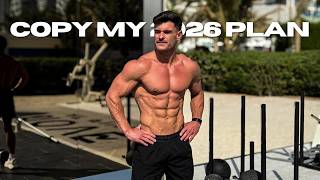
Rob Lipsett breaks down a complete system for getting shredded: a 4-day upper/lower split, 0.8-1g protein per pound of body weight, zone-2 cardio plus 10k daily steps, and 8 hours of sleep. He emphasizes tracking fasted weigh-ins, gym lifts, and progress photos while keeping 20% of calories flexible for foods you actually enjoy.
Chapters
What's going on, guys?
Welcome to a brand new year. And now it's a little tradition on this channel. At the start of every year, I like to go through my plan, how I'm going to be the best version of myself and how you can copy me, plug it in and customize it to yourself.
Hey, new beginnings on the cusp. Not too old to adjust. Old dog, new tricks. Remember, I was just a pup. Something dirty in my cup. Clean soul. Good karma is a must.
So let's get right into it. Here in Elements Gym. We got La Concha in the background. It's a perfect backdrop. So we're going to start off with training, the splits that I follow, the splits that I've had success with, and how I choose a split and adjust it based on my current life, my current schedule. So I would say the split that I ran for most of my training career and most of what you've seen on this channel is a 6-day split, which is legs, push, pull, legs, push, pull, rest. So if you can make it to the gym 6 days per week and I think it's an amazing split, but let's be real, you don't actually need to be in the gym 6 days per week. A sweet spot for a lot of people is actually 4 days. I've worked with thousands of people via my app or one-on-one over the years, or even looking at what splits people follow when they purchase my ebook, which is available on roblipsett.com. Just throwing that in there. The most used split and the best for everyone is probably going to be a 4 day upper/lower split. And if you want to go somewhere in the middle of that, 5-day legs, push/pull, upper/lower is an amazing split. And that is currently what I am following and what I'm going to be doing for most of this year. Now, with the 5-day upper/lower, legs, push/pull, it's the same. You start off the week with legs, you go into push, you go into pull. You can already take a rest day and then do the upper/lower on Friday and Saturday. It doesn't really make too much of a difference, But I love that split, and it's like a nice combination of high-frequency training and also a little bit of bro split. Then with the 4-day, amazing. Like I said, going to be the best for most people. That is upper, lower, upper, lower, and then the rest of your week is going to be the rest days. Or you can do upper, lower, rest, upper, lower. When I am prescribing someone a training split, the main thing that I want people to do is you want to hit every body part twice per week. And the reason for that comes down to muscle protein synthesis and how it peaks and dips over the week. To keep muscle protein synthesis high, you want to hit everything twice per week or even more. The 3-day split that I recommend following, if that is your thing, it's going to be amazing for a lot of people too, is 3-day full body. But with that, I recommend doing a full body A, a full body B, and a full body C. So what that means is you start off your full body workout with a different compound, so there's a different emphasis with every full body day. So full body A would be you're starting off with squats, so it's kind of a leg day in a way. Full body B, you're starting it off with a pushing movement, so that's going to be bench press, incline dumbbell press. Full body C is going to be you're starting off with a pulling movement such as the deadlift or rows, rack pulls, something like that, just simply a pulling movement. So you're still hitting full body every workout but you have a different emphasis on each and every day. So the first thing, training, that I want you to think about is realistically, how many days off the week can I make it to the gym? What am I realistically going to stick to? Because if you start the 6-day program and you're doing that for 2 weeks, then you have a hectic week and you can't really continue it, and then you're doing 3-day, it's all just messy. It messes up your routine, it messes up your progression, and things are just a little bit all over the place. And inconsistent. So just to reiterate, when you're choosing a training program, think how many days a week can I realistically make it to the gym? What can I stick to? 3 days full body, 4 days upper lower, upper lower, 5 days legs push pull upper lower, and if you're psycho like me, 6 days legs push pull, legs push pull. But most people don't need to train 6 days per week. So quick one on volume and the amount of exercises per workout. I really think the sweet spot for a lot of people is going to be around 5 to 6 exercises. Personally, I would stick to about 5. I remember when I first started in the gym, I would think you just have to do every exercise, and I'd go in and I would do 8, 9, 10. And then I had a podcast with Dorian Yates, and we got into a great conversation about intensity and how if there's too many exercise, too much volume, you're just going to lose that intensity. So I think 5 exercises, 3 sets of 6 8, 10, roughly in around that level of volume is going to be absolutely perfect. And go hard on them. Generally speaking, I love 3 compound movements and then 2, 3 isolation movements at the end of your workout. And with reps, your compounds are going to be around 6 to 8 reps. So as the workout goes on and the exercises get more isolated, I would increase the reps that I'm doing, just from a practical injury prevention viewpoint of things. I need to use this viewpoint more. Look at that. This is insane. So just to finish off the training portion of this video, I want to talk about, uh, finishers, supersets, and drop sets. In my opinion, these are just a little bit overrated because they are very fun to do, but there's no magic muscle-building benefits to these. The main thing they're great for, especially supersets, are saving time. If you want to superset, especially your isolation exercises, you're going to build just as much muscle doing them as long as it doesn't take away from your intensity. So if you're supersetting, let's say you're doing a full body and you're trying to superset squats and bench press, that's going to be very tiring, and I think that's actually going to take away from your ability to build muscle. But if you're at the end of your workout, you want to superset curls and tricep extensions, well then I'm all for that. So no rest times, just going in between the two that is going to save you quite a good chunk of your workout. So supersets, drop sets— again, drop sets, just a great way to get more volume in. Look at these as time-saving techniques instead of muscle-building techniques. Before we just completely wrap up training, I want to talk about progression and also deloads, when to take a break. So starting off with progression for hypertrophy, you've probably heard the good old 3 sets of 8. You can do your 3 sets of 8, but there needs to be progression. The guys that go into the gym, they do the same amount of volume, they lift the same amount of weights, the same amount of sets and reps week in, week out, just think to yourself, why would my body change? Building muscle, getting bigger is an adaptation so you can handle more workload. That is like the most simple way that I can summarize it for you. So if you go into the gym and you do 60 kg bench press for the rest of your life, you're going to be at that level. So you need to be lifting heavier, you need to be lifting more total tonnage. So what I like to do, a really, really simple form of progression, is weeks 1 to 2, you can go in, you do 3 sets of 6 with, let's just say, uh, 100 kg, then 3 sets of 7. Then the week after that, you do 100 kg, 3 sets of 8. And then what you want to do is increase the weight and drop the reps. So say that again: increase the weight, drop the reps. So you're cycling reps up until the point where you're getting to a high rep range, and then you increase the weight and drop the reps, and you just keep progressing until you're Ronnie Coleman winning the Olympia, and that's how it goes. So of course this is very simple, and you will get to a point in your training career where you can't just keep lifting more weight. By that time you're going to be advanced, and then you're going to have to do some more advanced training techniques. But that is the most simple way of linear progression, is cycling reps and cycling weight. Now the next thing I want to talk about is deloads. I think deloads are a little bit overrated in of scheduling them in and being super regimented and telling yourself like, week 12, I must take a deload. What I prefer is you incorporate in life deloads. So for example, let's say you have— you're meant to deload on week 12 of your training program, but you're going on holidays on week 13. Well, then just push it out to week 13. I call these life deloads. And you're scheduling your deloads, you're scheduling your your time off, or your time when you cut your training volume down in half, or you just take it easy in the gym. You're scheduling these deloads around life. Maybe you've got a stage where you're very busy with work, or you've got a stage where you've got a lot of family commitments, or you're going on holidays, you're going traveling. Schedule your deloads for a time when you know training is going to need to take a back seat. So that is the progression that I recommend you follow, and that is how I recommend you incorporate deloads and time off into your training regime. All right, next thing we're going to be talking about is cardio and conditioning. So first off, when it comes to body composition, the best things that you need to focus on are going to be lifting weights for retaining muscle, and then your diet. Let's be real, it is all down to your diet when it comes to getting shredded and comes to getting lean. So we're going to be talking about diet in depth after this. But when it comes to your health, improving your zone 2 cardio— so that is a light jog, uh, you know, going for a 5K, 10K, whatever it is, at an easy pace, something something that you can hold a conversation during. This is going to be great for your zone 2 cardio and for your health. When it comes to longevity, lifting weights is 10 out of 10 important. It's also very important improving your VO2 max, and this is going to come from more intense things such as, you know, intervals or conditioning work like sled work, sprinting. There's also a crazy fact: the amount of people that sprint after their 30s is an extremely low percentage. Think about it, when's the last time you ran at 100% effort? Most guys after 30s and into their 40s, they will probably injure themselves if they went for an all-out sprint. You want to be able to sprint well into your older years. Very important for your actual health. A high step count is also fantastic. I recommend a general guide of 10K steps per day. This is not only great for your mental health to get out in nature, get out in the sunlight, it's very relaxing, but it's not going to take away from your weight training session. So steps, lifting, and diet, 3 golden key points when it comes to body composition. And then when it comes to your You want to be doing zone 2 cardio and also some more intense stuff that'll increase your VO2 max. All right, let's talk recovery. I'm going to be real with you, you can do sauna, it's amazing as well. Ice baths, good too. The main thing when it comes to your recovery is just going to be sleep. So when it comes to your sleep, you want to be aiming for those golden 8 hours per night. And I'm typically a very bad sleeper, and when it comes to getting a good night's sleep, these are the main things that change the game for me. Number 1 that I found out from my Whoop scores is eating late at night. It's just uncomfortable having a lot of food digesting in your stomach when you're lying flat overnight. And I find when I eat very heavy meals late at night, I get a terrible Whoop score, and I'm just tossing and turning all night. So you want to ideally cut off your eating as early as possible. If you're going to bed at 10 PM, for example, try to have your last meal around 6 PM. So that's something that changed the game for me. As somebody who loves a late night snack, I didn't want to do this when I first started realizing it was affecting my sleep. But now that I'm in a good habit and a good routine of I actually much prefer finishing my calories earlier. So sleep is the main thing, but ersoft like sauna, absolutely fantastic. You've probably seen a huge rise in sauna use, especially in Ireland, in the last couple years, and I'm all for it. Super legit. Try to do 2 to 3 sessions, if not daily sessions, just as much as you can, 15 to 20 minutes. And one thing I love about saunas, especially in Ireland, is the social scene that it provides. I think that's massively beneficial and something that we're all needing more of. In today's day and age. Next up is ice baths. And now I have an ice bath in my villa. I love doing it, but the recovery effects are a little bit overexaggerated. They can be a little bit performative for social media. Everyone loves filming themselves getting into an ice bath, but they are good tools. First of all, they wake you the hell up in the morning. There's nothing gonna wake you up more and get that dopamine, get that adrenaline firing like ice cold water. So they are fantastic for waking up. Combine that with a cup of coffee and you're going to be absolutely buzzing for the day. Next thing they are good at as well is inflammation. Think about it, when you get a bruised knee or you're swollen ankle, what's the first thing you do? You put an ice pack on it. So you're essentially just putting an ice pack on your whole body. That's probably the simplest way I can explain it. Some people think they're, you know, magic cure to everything. They do have their place, but they're not going to be a game changer. I just think they're fun to do and they wake you the hell up and they do have some recovery benefits. Now let's talk about nutrition. So important when it comes to everything. Your whole life is actually dictated by your diet. It's something that you do 3, 4, 5 times a day. Focusing on your nutrition, having a good diet plan, having a good relationship with food is just, it's a life-changing thing even beyond fitness. So here are some guidelines. That I follow when it comes to having a good diet. So first of all, at the base, it's going to be sustainability and adherence. I've been eating the way I do for well over a decade now. I walk the walk. You can go back to my first ever videos on YouTube, and I'm eating the same forever. So I'm actually walking the walk, and these are the protocols, the guidelines that I follow. So 80% whole nutrient-dense foods— that goes without saying. Some people will say 100%, and I actually don't agree with that. I think you should leave 20% off your diet, off your calorie intake, for fun stuff, for stuff you enjoy, for stuff that aren't typically unhealthy. You need to have flexibility in your diet, and we have literal research showing that people that have a more flexible diet get better results in the long term. They get results and keep those results. Protein intake, 0.8 to 1 grams per pound of body weight for lean individuals. If you're overweight, you should do that multiplication with lean body mass. But generally speaking, 0.8 to 1 gram per pound of body weight for protein is a great guideline to stick to. And by default, by hitting a high protein intake, you're also going to have to eat that with nice whole grain carbs, with complex carbohydrates, with vegetables. You know, no one just eats 200 grams of whey protein shakes. The next is you want to set your fat intake. So Fat is essential to our hormones and general health. Typically, I recommend 20% of your calorie intake should come from fat. My favorite source of fat would be eggs and avocado. They are probably the two healthiest fats you can consume, and they would be my two top picks. And they're actually something that I start my day with every single day. Eggs, avocado, sourdough toast. I could just eat that forever. Then you wanna allocate the remaining calories that you have left to carbohydrates. The main thing you should focus on is of course eating nutrient-dense, high-fiber carbohydrates, but don't be afraid to throw in some fun stuff in there as well. And total daily carb intake is the main thing. So that's your protein, your fats, and your carbs sorted. The next thing I want to talk about is meal timing. And this is one of the biggest myths in the fitness industry. This is complete bro science for the most part. Whatever eating routine you like and that allows you to be consistent, is the best one. For example, some days I like intermittent fasting. Some days I'm not hungry in the morning. I just want a coffee and energy drink and go to the gym and have a really sharp, fasted training session. I also find I'm more productive and sharp when I just have caffeine and electrolytes in the morning, and then I'll have my first big main meal of the day around 11 or 12 PM. If you want to have 3 large meals or 6 small meals, just go with whatever one you prefer. The main thing is hitting your total macro and calorie intake. After working with thousands of clients, this is one of the biggest mistakes I see people make is getting hung up on meal timing. It is really not that important and it is really far up in the hierarchy of importance. And again, the post-workout shake, it's not a bad idea as well, but it's going to make a 1%, 2% of a difference. The main thing is your total daily intake. Okay, how do you track your progress? Extremely important. The first thing that I want you to be doing is a daily weigh-in. Oh, Rob, the scales messes with my head. Oh, it's too much. Get over it. You're taking things way too seriously. If you just weigh yourself once in a while, you're going to fluctuate weight daily and you're just going to get an inaccurate reading. What you want to do is daily weigh-ins, fasted, in the morning, after you go to the bathroom. And here's the key point. You want to take a weekly average. And if you're female, you're a woman, watching this, you actually wanna take a monthly average because the time of the month is gonna make your weight fluctuate a lot as well. So daily weigh-ins, don't overthink it. It's gonna change every single day. The main thing is the average. And just like a chart with a, a Bitcoin chart or a stock chart, you wanna look at the trends. If you're looking to gain weight, you wanna see it slowly going up. If you're looking to lose weight, you wanna see it slowly going down. Weighing yourself is great as long as you are doing it consistently. It takes literally 2 seconds in the morning to step on a scale, so there's, there's literally no excuse. So along with daily weigh-ins, you want to combine that with progress pictures. Take them in the same spot at the same time in the same lighting as regular as possible. Again, more regular the better, so you can really see those changes over time. And then I want you to also combine those 2 methods of tracking with your lifts in the gym. If you are going down in weight, looking leaner, and your lifts in the gym are staying the same or even increasing. If you're a beginner, you are losing fat while retaining and building muscle. This is what we want. So they are the 3 main markers that I recommend you follow when it comes to tracking your progress. All right, informative bits out of the way.
Now we're going to get stuck into a good old hardcore training session on Elements. We're going to do a push day. I'm excited. Start off with some good old incline dumbbell press. Let's get into it.
The Ireland is part of the requirements. Could have joined the union, kid. Andrew turned to fireman, but I'm still doing fire shit. Adapt to my environment, and now I'm up so high. And I—
today's workout is going to be incline dumbbell press, going to be overhead barbell press, going to be some dips. Then we're going to do 2 tricep movements, so push downs and overheads. 5 exercises, nice and easy. We're gonna look insane afterwards. It's gonna be a good day.
Let's go.
All right, so top working set. Let's get the 40s.
Oh my God, perfect.
Oh my God. Oh, the older I get, if I can I can stay lean, stay strong, and stay injury-free. That is progress for me. Not gonna lie, there's no nice way to say it. A lot of guys, when they hit their 30s, they get fat, they get out of shape, they stop lifting weights, they essentially just clock out. And that will never be me. I'm so against that. Like, men, you actually hit your peak, you hit your prime if you stay lifting and stay lean. That's literally all you have to do. To be in the top 1%. So my goal is to just keep a lean, athletic-looking physique, stay strong, and if all my lifts and everything, my body fat percentage, everything stayed the same as I get older, that's progress in itself, and I'd be really happy with that. So I've achieved my dream physique. I've got on the COVID of huge fitness magazines. I've built a massive fitness career, a massive brand. This is— I'm happy where I'm at. Which is very hard for a lot of people to say, to look at their physique and be like, oh, I'm actually content where I'm at. So to answer the question, what are my training goals and my goals of my physique? It's just maintain as I get older, stay healthy and stay injury-free. One more, one more. Oh my God. So you can see it's our last set there, and I just— nothing left in the tank, all out. Alright, these are the worst shoes you can possibly lift in. Super comfortable day today, great to run in. These are just your standard Hokas. If you're lifting, if you're squatting, deadlifting, or in this case if you're overhead pressing and you want a firm foundation, Do not wear these shoes. You want to have a strong base and you don't want to be squatting on a mattress. Something that is very secure and planted on the floor. So that can be barefoot, in socks, or Vans and Converse are two good choices that you often see lifters use. Just don't use big massive padded shoes. So, going on some overhead pressing now. We're going for about 8 to 10 reps here. Let's get into it. There is something about this lift. Getting a barbell, putting it right over your head. It's just a powerful movement. Like, if that doesn't psych you up to lift, make you feel like the man, make you feel powerful, I don't know what will. Do some overhead barbell pressing. Amazing movement.
Love it.
What a rush.
Oh, let's go!
One thing I absolutely love, I do them at the start of my workout, the end of my workout, in the middle of my workout, is some dead hangs. These feel so good on your shoulder. As the name suggests, you just hang here, let it stretch your entire body out, decompress your spine. Loose up your shoulders. I even recommend putting your head back and forth like that, left and right. Feels absolutely amazing, especially if you've been sitting down all day. Do your dead hangs.
They are just therapy for the upper body and the spine.
Even swing a little bit back to forth, left to right. Let your body drag itself down. So good. Oh man, that was a killer.
So some non-negotiables that I have every week.
First of all, it is going to be at least 3 workouts per week, lifting weights at least 3 times per week, with nutrition. It's going to be eat the majority of my meals at home. So cook as much meals as possible myself. And then number 3 is going to be get in at least 3 walks throughout the week. When I just put in my headphones, listen to a good podcast, listen to some real aggressive music that puts me in a good mood and get outside, get some sunlight in my face, it's hard to have a bad day. So there are my 3 non-negotiables. They're things that I've done every single week without fail for the last decade.
Oh, tough.
That's our third compound of the day, so now time to go on some easier your stuff. A little bit of isolation work. It's fun time now.
Killer. Yeah. Oh man. Oh, toast. Oh, wow.
I'm done, I'm done. Calling it up here, guys. I hope you found this video informative. Hope you all have a very productive 2026. Hope you all make tons of gains. More videos like this coming. Please drop a comment below if you liked it.
See you in the next one. Peace.
More from Rob










"I Haven't Worked in 10 Years" - How Rob Lipsett Built a £1M Fitness Empire From Nothing
