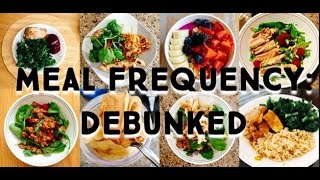
Rob Lipsett explains why eating six small meals doesn't boost metabolism more than three larger ones. The thermic effect of food depends on total calories, not meal frequency, so 500-calorie meals and 1,000-calorie meals cost your body the same to digest. Research shows people eating six small meals actually reported more hunger.
Chapters
Hey, what is going on everyone? Sorry, another boring video, but I was asked to talk about meal frequency and, you know, the whole 6 small meals to boost the metabolic furnace and, you know, increase your metabolism myth. And I wasn't gonna bother because I really thought that this myth was long gone. But today I was picking out a new book in Easons and I went over to the health and fitness section and I saw a book by an Irish author. So I picked it up and I flicked straight open, and the page I landed on, I was greeted with an array of bro science. So it must be a sign that I should do this video. So I'm sorry to Carl Henry, I don't know who you are, but I'm gonna have to drop some science on yo ass. Okay, so people still think that eating 6 small meals a day or eating more frequently will burn more calories or boost our metabolism. When we eat food, something happens in our bodies called the thermic effect of food. This is basically the energy our body uses to digest the food you've just eaten. People think that if you eat, you know, 6 small meals a day, your body will have to turn on TEF more often compared to when when you eat, say, 3 times a day, your body will not stimulate TEF as much, which in fairness does sound logical. But the TEF actually varies depending on the size of the meal and your total daily caloric intake. TEF will also vary in certain foods. For example, protein has a very high TEF, whilst fat has a low TEF. But a commonly used estimate for TEF is 10% of one's total diet. So if someone eats 6 meals consisting of 500 calories, which comes to 3,000 calories in total, this will be the same as if someone eats 3 large meals consisting of 1,000 calories. Again, it just adds up to 3,000 calories, and it's— your TEF is 10% of that number. And of course, I will link all kinds of peer-reviewed research in the description box. Pro's or cons? So, how many meals should you eat a day? Well, as often is the case, it just depends on personal preference. I know that if I ate 6 small meals a day, I'd never really feel satisfied. So I tend to go for 3 really big meals a day. And one of the studies that I link below, the group that ate 6 small meals a day compared to the group that ate 3 big meals a day, the group would, uh, the smaller meals ended up feeling hungrier throughout the day. So I hope this cleared a few things up. I also just passed 600 subscribers, which is a big deal for me. So keep 'em coming, and my next video I'll try to do something more entertaining. I'll try and make George run on a treadmill or something. Anyways, thanks for watching, catch you next time, and as always, keep it real.