The Ultimate Guide to Building Muscle FAST
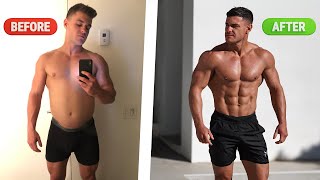
Rob Lipsett breaks down muscle building into four metrics: body weight, strength gains, photos, and body fat. He recommends a 200-300 calorie surplus, 0.8-1g protein per pound of lean body weight, and training splits like 4-day upper/lower or 5-day push/pull/legs with 10-20 sets per muscle group weekly.
Chapters
Imagine waking up in the morning and every single piece of progress, every ounce of muscle, every measurement of strength had just evaporated overnight. I wouldn't panic, but simply follow this proven game plan. I actually definitely would panic. I would probably think I've been struck with severe illness or there was some sort of virus, some muscle wasting virus going around. I would definitely actually freak out. After I freaked the fuck out for a while, then I would just follow this proven game plan. What's going on? My name is Rob Lipsett. Today I'm going to be talking about how to get jacked as possible if you are starting from zero. This is the plan that I would give to myself before first entering the gym. If you're a beginner, you want to get absolutely ripped, absolutely jacked, you want to get sexy in 2025, this is the video for you. And look, even if you're an intermediate or advanced trainee just looking to brush up on a couple of things, I know we all slack from time to time. Well, then this is also going to be a fantastic video for you. So before we get into it, hit that subscribe button, drop the video a like, maybe even leave a comment even though you haven't watched it yet. Let's get into the video. Let's have a laugh. When I first entered the gym, I had no idea what I was doing. YouTube wasn't as popular as it is now. There wasn't so much evidence-based information out there. I was literally just reading Ronnie Coleman's program in Flex magazine and being like, all right, let's do this. Let's, let's have a calf day. Let's have a bicep day. I would just flick through the pages and follow whatever bodybuilder's meal plan that I would land on. I would also read forums and websites like Cutting Jacks, Simply Shredded. It was actually quite— it's quite nice how simple those times were and how you really had to dig to find some good personalized information. I spun my wheels so much in the years starting out, but eventually I did get to a decent physique just simply through guesswork and doing my own research. But if I had all this information, it would just fast-track my progress. And honestly, you can achieve a really, really amazing physique in 1 to 2 years, and then years 3, 4, and 5, you are off to the races. All right, so first of all, what is the objective? And that is to build some muscle. If you are over 15, 16, towards 20% body fat, I recommend you do a cut. Your body is essentially already in a calorie surplus. That's what fat is, it is just stored calories, it's stored energy. So you will be able able to actually pull from those energy stores, and you can actually make progress, gain muscle, gain strength while in a deficit if you are overweight and have a high body fat percentage. But if you are around 10 to 15% body fat, you want to build muscle, you want to get jacked, well then here we go. So first of all, the metrics to track. Look at that nice little graph that we got going on there as well. Now number one is the scales, it is your weight. And now people hate on the scales a little bit, and they say, hey, it doesn't tell the whole story, it doesn't paint the full picture. But hopping on the scales every morning fasted after you go to the bathroom is the most convenient and easy way to track your progress. In terms of the rate of weight gain that you want to achieve, ideally you want to be gaining 1 to 2 pounds per month. And you may say, oh, this sounds pathetic, Rob, I want to get huge, I want to gain 5 to 10 pounds per month. That is mostly just going to be fat gain. And if you actually look at the year as a whole, if you gain 1 to 2 pounds of muscle per month, at the end of the year when you're 24 pounds up on the scale, that is a lot. 24 pounds is a huge amount of mass to put on. So 1 to 2 pounds is ideal rate of weight gain. Another amazing way to measure progress is your strength. If your strength is not increasing, if you are just lifting the same weights week in, week out, you are not building any muscle. And the reason here is simple: your muscle needs stimulus to grow. If you just keep eating calories and keep gaining weight and you're not hitting PRs in the gym, why would muscle grow? Muscle is a physiological adaptation to cope with the stress that you're putting it under. Your muscle needs to grow to cope with the the heavier stress, the heavier weight that you are putting it under. You actually break your muscle down and then it rebuilds bigger. Pretty basic stuff. Strength is extremely important. You want to be using an app or a notepad, something to make sure your compound lifts in the gym are going up. Now you don't have to be, uh, crazy anal. What did you say? Pause. You don't have to be super neurotic about tracking every single lift in the gym. If you're just tracking your compound movements, your main core exercises, and making sure they're going up, you're going to be all right. So next is photos. And the key here is take a progress photo in the same spot, in the same lighting, preferably at the same time of day, and do this maybe every day if you want, or at least every week. And now if you're looking at your photos daily or even week by week, you'll say, oh, they all look the same, they're not any different. But if you're making progress, your weight is going up and your lifts are going up, you'll actually look back 6 months and you say, oh my God, when you compare month 1 to month 6, the difference is actually crazy. But remember, we see ourselves every day in the mirror, so it's hard to notice those daily changes. But then when you look back a long time, the changes are significant. Next up, we have body fat percentage. Now this can be an absolute pain to track. I'm not expecting everyone to do a DEXA scan every week. The easiest way to track your body fat percentage, in my opinion, is just look in the mirror. If you're getting too fat, if you're looking like a tub of lard, a stick of butter, a melted candle, wind it back a little bit. You're probably in too much of surplus. Body fat percentage is of course very important, but you don't be doing a DEX scan every week. Just keep it tidy. Now that we have our goals, we know what we're tracking, we know the timeline, let's move on to nutrition. The big one. If you want to build muscle, you don't need to be in a massive surplus. I've done it before when I first started out. I come from a rugby background and I just wanted to get as big as possible for rugby. That's all I cared about. So I just ate. I took weight gainer shakes, Serious Mass. I would order like takeaway multiple times per week, takeout for the Americans. I'd be eating pizza, Chinese food, everything thing, just trying to gain weight and see an increase in the scales, and it did not go to plan. I gained a ton of body fat, and then I had to spend months and months cutting it off when the time did come. It's just not ideal. It's not good for your health either. You want to have a surplus of 200 to 300 calories. Now, just a quick one on finding your maintenance, your surplus, and everything. There are tons of calculators online. You can even sign up for my app, the Gameplan app, can figure it out all for you. But the main thing is, once you pick a number, you eat at that certain amount for a couple of weeks, 3 weeks preferably. You weigh yourself daily. If your weight stays the same, that's your maintenance calories. If it goes up, you're in a surplus. If it goes down, you're in a deficit. But the main thing is finding your maintenance calories. Macros: protein, carbs, and fats. Typically 0.8 to 1 gram per pound of body weight. If you are overweight, take lean body mass. So if you're 20% body fat— well, one, I don't think you should be bulking anyways, but for in terms of protein intake, take 20% of your weight and that is your lean body mass. So you want about 0.8 to 1 gram per pound of body weight. And now if you are going on this higher level of 1 gram. The main benefit here, in my opinion, is it's just by default, it's going to clean up your diet. So it's going to help with appetite and it's going to stop you from overeating. So we're actually going to skip past carbs and go to fat. You want about 20% of your total calories coming from fat, or another calculation that people do is 0.5 grams per pound of body weight, and you put that towards your fat intake. So for numbers sake, if you're 150 pounds, you'd be eating around 150 grams of protein, maybe a little bit less, and your fat intake would be 9.75 grams, and then the rest of your calories would be made up by carbohydrates. Now, one thing I used to be very neurotic with getting the perfect macros and hitting them so precisely when I first started out— it's actually not that important. The most important thing is your total protein intake and your total calorie intake. If you want to interchange your carbs and fats a little bit, it's okay. They can both be used as fuel, and this allows a little bit more flexibility. So don't freak out if one day your carbs go a little bit higher, your fats a little bit lower. Or vice versa. It's not a big deal. So tracking your nutrition, this is the most important thing in my opinion, and it's something I wish I just did from the get-go. My recommendation is that everyone should just track their nutrition extremely accurately for 3 weeks. You don't have to do it forever. You don't have to carry around the scales with you. You don't have to log every single bite you eat into an app for the rest of your life. Just do it for 3 weeks, even do it for 2 weeks, and you will learn so much. It is an eye-opening experience. Most people that say they can't gain weight are chronically under-eating, and most people that say they can't lose weight are chronically over-eating. It's a tale as old as time. So the way you do this is you get a digital scales like this, you put the bowl on, you put whatever you're eating in there. You can actually set it for zero. So if you're pouring out some milk, you put the carton on top of it, you set to zero, you pour milk into your cereal or whatever you want, and you put it back and it will will tell you minus how much grams you use or how much milliliters. So scales and an app is all you need. There are countless good apps out there— MacroFactor, MyFitnessPal, Gameplan— whatever it is, whatever you prefer to use, you do that. So be super accurate for at least 2 to 3 weeks, and it's going to be eye-opening for you. Next up is hydration. So there are some calculations on the exact amount you should drink depending on your body weight. If you're a bigger dude, you sweat a lot, you're probably going to need more water. But as a general guide, line. 3 to 4 liters is a good spot for most people to aim for. And once again, you don't have to be too neurotic in terms of your nutrition. You can also just drink until your pee is clear or until you feel hydrated. It doesn't have to be super exact. Bonus points if you use electrolytes. They're very legit supplement. I like to have mine first thing in the morning. I find that it wakes you up a lot. Like, sometimes we think we need caffeine in the morning, but we're just dehydrated after not drinking water for 8 hours. The ones I use are from Ghost, and you can use discount code Lipsett for 20% off all Ghost products on ghostlifehealth.com. Not only do they taste amazing, but they work. And while we're on the topic of supplements, some other staples that I recommend are whey protein— nothing magical here, it is just like getting protein from milk or yogurt or chicken breast or whatever. It's just a very convenient way to hit your protein intake. Electrolytes, as I mentioned. Creatine monohydrate— this is the most proven sports supplement on the planet. 5 grams a day every single day. No need to cycle off. You don't have to do a loading phase, but you can if you want. Pre-workout slash caffeine, one of the greater joys in life. Nothing beats a sip of coffee. None beats a sip of coffee as soon as you wake up, or slamming a double scoop of pre before a big session. Caffeine, a very proven supplement. And if you use a good quality pre-workout like Ghost Legend, there are some other good bits in there as well, such as beta-alanine, for example. Other things I recommend are vitamin D, fish oils, a green supplement or multivitamin— same thing in my eyes. I think of them as nutritional insurance just to make sure you're covering all your bases. But of course, it's best to get as much micronutrients as you can from fruit and vegetables and just healthy food in general. But they are my main recommended supplement staples. Back to the whiteboard. Next up, we got training, and this is something that I messed up so badly. I would just follow a Mr. Olympia bodybuilder split. Typically, a bro split is when you would annihilate one certain body part and then you wouldn't train it for 7, 8, 9 days. So I had a forearm day, I had a bicep day, a tricep day, a calf day, a chest day, a delt day, a trap day. By the time I got to hit chest again, about a week had gone by, and this is not optimal, especially if you're natural. You want to keep muscle protein synthesis elevated throughout the week. After a session, this usually takes about 48 hours, so hitting every body part 2 to 3 times per week is what is optimal. So here are the splits that I recommend following. For a 3-day split, you want to be doing 3 full body sessions a 4-day split, upper, lower, upper, lower. 5-day split, legs, push, pull, upper, lower. And then 6-day split, legs, push, pull, legs, push, pull, rest. That's what I currently run myself. But if I was starting out, I would recommend following the TriX full body split. The reason for this— if you're just starting out, if you're starting from zero, you want to get as proficient as possible with all the compound movements. You want to get familiar with them. You want to actually practice the movement patterns and improve on your form. And the way to do that is doing them regularly. So you want to be doing the squat, bench, deadlift, barbell row, pull-ups. You want to be doing these 3 times per week. This is going to fast-track your progress. So from all of us starting from zero, we're going to follow the 3X full body split. So just to recap: full body, upper, lower, upper, lower, legs push-pull, upper, lower, legs push-pull, legs push-pull. Some training principles that I follow: we want to be doing our compound lifts first when we're freshest at the start of the session. These are the best movements that are going to give you the most bang for your bucks. You want to perform them when you're at your freshest. And then finish off with isolation movements, which are great as well and have their place too. Volume, you want to be doing 10 to 20 sets per body part per week. For rest time, I have 2 to 3 minutes jotted down here as a general guideline, but in terms of compound movements, just go again, begin your next set whenever you're ready. Actually, the more rest you take, the stronger you will be, the more weight you will lift, and the more muscle you will gain. Pain. Now obviously we have lives outside the gym, so we can't just camp out there all day, even though a lot of powerlifters do that. Just as a general guideline, 2-3 minutes between each set for compound movements is a good one to follow, and about 60 seconds in between each set for isolation movements. The most important thing in the world is progressive overload. That means lifting more over time— more sets, more reps, more weight, just more. So on that note, what is the best form of progression? Is it more sets? Is it more reps? Is it more weight? The answer is it's more weight. The reason for this is, let's say doing 3 sets of 8. One week we go into the gym, and then the next week we're doing 4 sets of 9, and then 5 sets of 10. When does it end? Your workouts will eventually— if you keep progressing with just sets and reps, your workouts will eventually just be hours long. Whereas if you're increasing the weight, this doesn't actually take more time. So increasing weight is the best form of progressive overload, just practically speaking. So now we got our training sorted. If you want a customized program tailored to the gym you go to, your schedule, what exercises you can, can't do, everything. Get a training program by gameplan.com, first link in the description box. You'll also be working directly with me, and that includes weekly calls with myself. Honestly, this program, I guarantee results. There is also a 14-day happiness guarantee. If you don't like the program, I just refund you. That's it. Okay, so lastly, we got recovery and lifestyle. So we got the 3 S's here, and that is your sleep, stress, and your sex. Sex. That's not part of it. If you, if you have sex, great. But if you don't, it's okay. Mainly after you do all this, you will have more sex. So sleep, 7 to 9 hours is what you want to be getting. And in terms of a nighttime routine that I follow, a few things that help me a lot is setting an evening alarm telling you to wind down. It's pretty easy to just get caught up watching a movie, get caught up in work, be scrolling on your phone, and then you look at the clock and it's midnight and your sleep is completely thrown off. I have an alarm set at 8 PM telling me to wind down for the evening. And I also have, it's a feature on iPhone. Android probably doesn't have it. Damn, I joke. Android users, don't kill me. I have something on my phone that after 7 PM I don't get any notifications. This helps me wind down a lot. So stress and steps. Of course there's things like meditation, which is very effective for lowering stress. Breathwork as well is something I do. And steps, I actually kind of combined the two of these. So one off one of the best things you could do for your stress levels and to increase your activity levels is go for a daily walk. It is such an easy thing to do. It's such an easy win. I always just like walk to the shops. I know like this shop in particular is going to give me 10,000 steps. I'll get like a zero calorie drink that I enjoy, and I— so I get like a little reward for going there. And then I walk back, I listen to a podcast. So one of my favorite parts of the day. So that's how I get my stress sorted and my steps good. Now we have alcohol and holidays, two things that I'm very fond of. So I'm just going to be real with you, in terms of productivity, your health, your fitness, your muscle gain, fat loss, drinking alcohol is probably the worst thing you can do. It puts your body out of a fat-burning state, very high in calories, it messes up your sleep, so the knock-on effect it has is huge throughout the whole week. It makes you make poor food choices either on the night, like getting a kebab at the end of the night that you don't remember plus the hangover dominoes the following day. You don't do any steps the following day. You're just stuck on the couch and you're not going to the gym realistically if you're properly hungover. And personally, me, I'm like getting old now. I'm 32, so I'm like, I'm hungover for a week. Hangovers after 30 are just not worth it. What is going on? That's one thing I don't have the science for. I don't have the answer. Why are they so bad? Why do they just all of a sudden get so bad? So alcohol is probably the worst thing you do. But look, obviously life fucking happens. Some of the best nights I've had in my life are when I'm on the booze. So what I recommend you do is just take some carbs and fats from your daily intake and put that towards your alcohol intake. So not optimal, but that towards your alcohol intake so your calories don't go sky high. Try and get some activity in the following day. Before you go to sleep, do have some electrolytes and some water so the hangover, you're not too dehydrated. And just plan in advance and try to just get back on the wagon as soon as possible. Okay, and down here I have holidays, vacations. Again, I love traveling, so there's— that's a whole other video on how to stay in shape when you're on holidays. I'm pretty sure I've made that in the past. But one thing that I like to do is schedule a training break for when you have an upcoming holiday or so. Some people call it a deload as well, and that's where you lower your volume and you train less and you give yourself a break. Usually this comes after an intense 6 or 12 week training period. What I recommend you do, if you do have a deload, push it until that you've got a holiday or a period of time where you won't be training anyways. Last but not least, people, we have mindset. Discipline over motivation. That is my best advice there. Motivation, it comes and goes. Discipline is always there as long as you build it up. Wherever your focus goes, results flow. So you need to be all in on this. You need to think, if you're serious about building muscle muscle, getting your dream physique, getting strong, getting healthy. It needs to be something that you're thinking about constantly. Next up, we got habits. All this will just become habits. It will become second nature to you. So the way you get killer results and the way you make progress seem effortless is you just build this into your routine, and everything here becomes habits. I've been training for 14, 15 years. I don't even think about it anymore. It is just like brushing my eat. It all just comes easy to me. I don't even— I— it's just part of my day. I don't even think about it. All this stuff has just become habits that I follow. Last but not least is your circle. No matter what you're doing, maybe it's business, getting jacked, whatever it is, the people around you are going to define your results. So if you're around a bunch of out-of-shape people who eat like shit, drink loads of alcohol, they don't lift, you're going to become one of them as well. So if you can, get around a bunch of people that are serious about their health, serious about the training, serious about building muscle, and you're fast-track your progress. Same goes with making money, anything. Your circle is just like looking into the future. That's it. Whiteboard vids are back. I absolutely love doing these. Like, I just— I don't even need to think about the video. Like, I just jot it all down and I have fun making these. So guys, give the video a thumbs up if you enjoyed it. See you in the next one. Let's all get absolutely jacked in 2025. Peace.
More from Rob










"I Haven't Worked in 10 Years" - How Rob Lipsett Built a £1M Fitness Empire From Nothing
