What I Did Then Vs Now
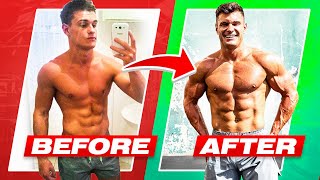
Rob Lipsett compares his early lifting mistakes to what science shows actually works. He ditched hour-long cardio sessions and six daily meals for shorter workouts and flexible eating, and now relies on just three supplements: creatine, caffeine, and whey protein.
Chapters
What's going on guys, welcome to today's video. So I was just planning out my training schedule, my plan for the coming year 2023, and it got me thinking. I was jotting down all the methods and things that I do now, and I thought of everything that I used to previously do when I first started out lifting. So I said, let's grab the camera and go through them because there's so many that are the complete opposite of what I do now. So if you plan on starting the gym in 2023, or maybe you just want to rethink a few things about your current training program, program and your current nutrition program, this is the video for you. So let's get into it. Some of the stuff that I used to do, the kind of bro things, they do have some merit, and I'm not saying that they're completely wrong to do. What I'm saying in this video is that it's not the only way, and there's other approaches too. And one thing I've learned about the world of training and nutrition, it's good to have an open-minded approach. So let's get into it. Okay, so we gotta have a laugh here as well. We gotta picture young Rob starting off in the gym reading Ronnie Mike Coleman magazines, okay? I saw Jay Cutler on the front of Flex World or whatever it was, and I said, all right, look, this guy is jacked out of his mind. Whatever he's doing, count me in. I remember I also read magazines like Cut and Jacked, Simply Shredded, which I think are a bit more evidence-based nowadays, but the articles at the time, I think anyone could just write into them and just give their thoughts really. So the information that we had 10 years ago was so much more limited compared to what we have now. Nowadays we have amazing YouTube channels like the one you're watching right now that you need to hit subscribe on right now if you want to take your training nutrition to the next level and fast-track your progress in 2023. For each point, I'm gonna list what I used to do and then what I do now. And it's actually crazy, a lot of them are like opposites. This goes to show how wrong I was. And for the first 3 years of my lifting career, when I was doing this stuff, I saw such little results. And then when I started doing the stuff that I do now, just results fast-track. It's kind of hard to believe because you're like, oh, I'm doing things that may seem easier but I'm getting better results. You're like, surely that's not how it goes. Train each muscle group individually. So this is when I was peak bro split. Now, like, there's some bro splits nowadays that are really not too bad, that they're kind of frequent enough. Like, you train a body part and then maybe like 4 or 5 days go by and you don't train it again, which is not ideal. I'll go into in a minute. But I was following the most bro split you could ever follow. I'm not joking. I thought you you had to have a day for every individual body part. I taught you how to have a calf day, not a leg day, not— you can't hit all the legs. You gotta hit quad day, hamstring day, calf day, bicep day, tricep day, forearm day, chest day, shoulder day, trap day, lower back day, upper back day. Like, I taught you really had to isolate each day and to allow them to recover enough. And compare that to what I do now. Now I recommend training every every body part twice a week. So the splits that I recommend following, if you're making it to the gym 3 days a week, 3 days full body. 4 days a week, upper, lower, upper, lower. 5 days a week, legs, push, pull, upper, lower. 6 days a week, which is what I do now, is legs, push, pull, legs, push, pull. So they're the splits that I recommend following. Now again, grouping body parts together so you allow yourself to hit them much more frequently, twice a week. The benefit of doing that is you're keeping muscle protein synthesis elevated. Not only is there benefits to this from keeping training frequency high. You simply train the movements, the compound movements, more often. How are you even going to learn to get good at a bench press or even a shoulder press if you're doing it every like 8 days? So there's so many benefits to hitting every body part twice per week. The main benefit is you're keeping muscle protein synthesis elevated. So there's so many benefits to hitting each muscle group twice per week, and it's what the evidence suggests is ideal nowadays. Spend hours in the gym. So like the last point, I would think you've got to spend at least 2 to 3 hours in the gym, or I just felt I wouldn't have done enough. Nowadays I go in and a lot of my workouts on average are 1 hour. A lot of them can be even less, 45, 50 minutes. I've had some amazing workouts. I'm not staring into my phone, I'm not looking around, I'm not having a chat, I'm just listening to music and getting it done. And my rest times are usually 60 seconds for isolation exercises and 120 seconds for compound movements. But there's actually really good research, and it just makes sense, that the longer you rest for your compounds, the stronger you're going to be, the more weight you're going to lift. Of course, you know, you're more well-rested to do your other sets. You're going to lift more. You're going to progressively overload your muscles. Lifting more weight equals more gains. The more rest time, especially on your compounds, the better. You don't think like a powerlifter, really, in that sense. The only drawback is your gym sessions do get too long. You can't take 20 minutes in between each set. Now you're just taking the piss. The lesson there is I used to spend 2-3 hours in the gym and thinking I just had to, and now 1 hour on average is what I spend in the gym. Fast cardio first thing in the morning. And this one, it's not too bad, okay? It's not too bad. I enjoy doing my cardio on an empty stomach. I hardly want to eat a full Irish breakfast and then go for a jog, all right? It would come up seconds later, okay? That would feel terrible. You'd feel heavy, sluggish. I do like intermittent fasting nowadays, but I'm not doing it for any magical special fat loss benefit. But I thought you had to do fast cardio in the morning, as that's what Mr. Olympia would do, that's what pro bodybuilders would do. But it really doesn't lead to any more fat loss. And the best way to think about your training, your diet, your exercise is look at your daily totals. Okay, how much cardio in total did you do that day? How much calories in total did you eat that day? How much weight did you lift that week? Even is a good way to look at things. Now what I do is I do my cardio, be it a light jog or something low intensity steady state, a hike. I just do it when my schedule allows me to do it and when I'm feeling my best. But with that said, sometimes going for a walk in the morning fasted, it feels good, but it's nothing special for fat loss. So fasted cardio first thing morning is what I used to think you had to do, and now I recommend just doing it when your schedule allows it and when you feel best. Time my meals like clockwork. Safe to say that I used to be a slave to the clock, and I thought you had to eat every 2.5 hours to stoke the metabolic furnace or to keep muscle protein synthesis elevated. And I was absolutely a slave to the clock. I would meal prep these very melee meal prep containers. I bring them around with me into college. I had a shake, and back in the day, shakers were so bad. Like, I've had a shake and I put it in like my, my little school satchel. The shake just spilled all over my books on my laptop, and that was the tipping point. That was when I said, I'm no longer doing this. Then I read into research and I realized that the most important thing is what you eat in the entire day, and this applies for fat loss and muscle building. Now, with muscle building, ideally you do want to spread your meals out evenly if you can, but it is not the determining factor at all. So So nowadays I just focus on what I eat in the entire day, and I wish I knew that in college. For my short stint in college, that is. I obviously didn't make it to the end. Maybe if I wasn't carrying around meal prep containers, I would have actually finished college. Yeah, that was the reason, just carrying shakes around. So going off the last point, quick one, is I used to think I had to eat 6 times a day to stoke the metabolic furnace. And this myth actually comes from TEF, which is the thermic effect of food. Termic. So basically, every time you eat, your body burns calories to digest the food you ate, and this is usually said to be around 20% of your calorie intake. So people thought, oh, if I eat more often, I'll get that 20% boost every time I eat a meal. But the truth is that TEF, the 20%, is actually off your total daily intake. So if you eat 3,000 calories a day and 6 500-calorie meals, or 3 1,000-calorie meals, the TEF is just going to be 20% of either. When I realized that, I was like Huh, makes sense. So now what I like to do is, funny enough, eat 2 to 4 large meals a day. Like, 500 calories, when you look at it, obviously depends on the food type, it can be a very small, unsatisfying meal. So what I personally like to do, and I find a lot of people are the same, is to eat a nice big filling meal, especially when you're cutting, and you get like a nice big plate in front of you 2 to 4 times a day. You kind of just feel like you're eating more. So again, that's a personal preference, but Don't think you gotta eat 6 times a day to stoke the metabolic furnace. Eat certain magical muscle-building foods or fat-loss foods. There's like— I saw an article recently talking about like blueberry or blackberry extract for fat loss. That's a video in itself. Of course there are no magical muscle-building foods. Like another thing people say is like oysters, like a cycle of oysters, like a cycle of blueberry extract. What will actually probably have bigger impact is eating something that you individually love every single day. This is gonna make your diet so much more sustainable. It's gonna give you long-term results, and you're actually gonna be able to adhere to your plan. And like I always say, it's better to get things 80% right in the long term instead of 100% right in the short term. So instead of looking for certain magical foods, Jack and the Beanstalk shit, just eat something you love every single day. Eat slow-digesting protein before bed and fast-digesting protein post-workout. This goes on carbs as well. And just general fast-digesting, slow-digesting foods. It is true that you can have quicker gastric emptying depending on the certain type of food you eat, but in a typical mixed diet, this doesn't even matter. And even the American Diabetes Association has kind of done away with the glycemic index. So let's say if you eat white bread, okay, let's say your diet consists 100% of white bread, that's, that's all you eat. Well, then yes, the glycemic index on white bread is high. But let's say you have a white bread sandwich with avocado, so some healthy fats in there, and some chicken breast pure protein, and then some veggies, so that's more fiber. The protein, the fat, and the fiber, when all mixed together in your stomach, completely changes the glycemic index and how you digest it. So unless you're eating a diet consisting of one food, which virtually no one does— there's not one person watching this video who eats like that. There's no one who eats like that. So if you're following a mixed diet, focusing on how fast certain foods digest really doesn't matter because there's so much different levels of fiber intake, protein intake, fat intake, even even like the size of certain foods, the volumes. Now there is foods that will just digest with the individual better. That's fine with me. You know, some foods make some people feel good. There's intolerances. But trying to time the digestion with fast carbs, slow carbs, fast protein, slow protein, I think is a complete waste of time and I don't get too caught up in it. I used to sleep beside a whey protein shake so I could have that fast-acting protein the moment I woke up. It would be like, oh, warm. It's disgusting. Safe to say it didn't do anything for my physique. It didn't get me any better results than just focusing on what I eat in the entire day. So instead of worrying about fast, slow digesting protein and carbs, just focus on what you eat in the entire day. I used to follow a meal plan with no flexibility, so I thought there was something about planning out your meals and, you know, having them all perfect and eating the same things at the same time every single day. I thought that would just get me results. Following a meal plan is not all that bad. It gives you kind of less thinking to do, and you have your go-to meals that you can just follow. You don't have to track your macros because if you eat the same thing every day, you will just hit your macros by default. So I'm not against meal plans, and I do give meal plans to my clients as well. And if you sign up to my app, you will also get a customized meal plan to go alongside your macros too. So I'm not completely against meal plans, but I used to think that you just couldn't go off the meal plan. And this leads to a really bad all-or-nothing mindset of thinking, oh, once I'm off my meal plan, I'll just say screw it. The analogy I like to use there is imagine you drop your phone on the ground and say say, oh look, I'm off the meal plan. Oh look, I dropped my phone on the ground, I might as well just stamp on it a few times and finish it off. So that's something that having a really strict meal plan can lead to, that type of mindset. So nowadays, almost kind of follow a meal plan. I have my go-to meals that I eat every day, such as protein oats, egg white omelets, shakes, whatever it may be. But I'm not afraid to go off that meal plan, and I'm not all or nothing mindset about it. Cut out specific foods— carbs, bread, gluten, all the stuff that makes you happy in life. So I used to think gluten was the enemy. I used to think the way to lose fat was just to remove carbs, and it wasn't about calories, it was about the carbs and my insulin being spiked. If you want to lose fat, just get in a calorie deficit, stick to it, hit your protein intake, and that's really the large part of it. If you have an intolerance, or— to be honest, a lot of people give themselves an intolerance that they don't actually have. If you have an allergy that you legit can't eat a food or food group, group, then of course don't eat it, okay? As per your doctor's orders, I imagine. So many people, they go vegan, gluten-free, keto, carnivore, and they cut out all these food groups completely unnecessarily, and that can actually lead to a lot of nutrient deficiencies. And what I do now, and this is a really good way to cover all your nutrient bases, is to eat a varied and mixed diet. So if you haven't ate a certain food group in a while, say, I'm actually gonna put some of that in my dinner. And to also have a colorful plate. Now I know that sounds really simple, but it's actually true. Having just a lot of colors on your plate shows you're getting a wide array of nutrients. So eat a varied and mixed diet and stop just cutting out food groups unnecessarily. Now this one hits home for a lot of teenagers, and I used to spend hundreds on supplements that did nothing. Okay, some of the things— my top hitters of waste of money supplements: test boosters. Again, just herbs. Like, you can't go on a cycle of herbs and expect crazy steroid-like results. Just not gonna happen. I used to have like CLA. I used to get like certain like vitamins and minerals that like weren't bad, but they were like marketed as something special. Like I take like a ZMA, zinc magnesium mix, which is great, you know, it's, it's a good vitamin to add into your routine. But I used to think taking that before bed would like boost my testosterone and again give me steroid-like results. And nowadays I just stick to a few proven supplements that work. So my top 3 picks nowadays would be creatine, most proven sports supplement supplement in the world. Increases your muscular power output and it gets you stronger in the gym and lifting more weight, and that's what it's all about. I think pre-workout drinks, so caffeine, very proven sports performance enhancer and also the most commonly used drug in the world. Again, plenty of research behind that. And then the third thing I use the most is a whey protein supplement. Now I've said this in the past, I'm not really sure if whey protein is a supplement because it comes from dairy. It's kind of like saying like cottage cheese is something, but in its powder form it's just a very quick and convenient and tasty way to hit your protein requirements. So there are the 3 things that I use the most. I'm of course sponsored by Ghost Lifestyle. If you want 20% off your entire order of no-nonsense proven supplements, link in the bio, code Lipsett. We got 2 more to go and then we've covered all the Rob Jr. mistakes that he made. Another one I used to do is overly restrict myself, which led to cheat days. And this is again something that comes from the magazines, is the whole cheat day mindset and thinking that you need a cheat day for anabolic benefits, recovery, or some people actually try to say having a cheat day would help with fat loss. Having a huge whack of calories all in one day is not helping your weekly deficit. It may help your adherence long term, but there's much better ways to go about it. I used to overly restrict myself, have these epic huge cheat days that weren't even for YouTube. Like, now I do them for entertainment, but I'm very wary they're not helping my gym progress. Now I follow a flexible diet and I don't feel I need to get all this out of my system because again I eat foods that I love regularly and every single day. And if I am craving something that is a little bit out of the ordinary, I'll just have it. Let's say it's 1,000 calories. I'll just allocate 1,000 calories to eat that that day. And again, that's also another point— providing too much value here. It's another point why it's good to have 2 to 4 larger meals a day, as you can fit in stuff that you're craving into your diet. So something I used to do was have these uncontrollable cheat days. Now, more balanced approach. The last one is I didn't know anything about tracking macros and tracking calories. And now I'm a certified macro wizard. Did I just call myself a macro wizard on the internet? Should I leave it in? So I did not know how to track or calculate macros at all. Nowadays I've realized that it's just pretty much the most important part of your diet, whether you realize it or not. So now I'm very good at tracking, and I'm also gotten so good at it that I can track for like 3 to 6 months of the year, and then for the other half the year I can just eyeball things. So I'm in a really great position where I can monitor my nutrition, and it's almost second nature. Also, if you want to calculate your macros, your calories, get a meal plan around those calories along with a training plan too, hit the link in the bio, sign up for my Game Plan app, and I'll actually be working with you directly over WhatsApp, the Facebook group, everything. So if you do want that, hit the link in bio. It's actually currently on sale right now. So if you enjoyed this video, give it a thumbs up, share it with someone who might be making these mistakes. I hope you enjoyed. It was kind of like a a podcast, long format video, just me sitting on the couch having a chat with my younger self. So I'll see you guys in the next one. Hope you're all having a great week. Keep it real. I'm out here. Peace.
More from Rob










"I Haven't Worked in 10 Years" - How Rob Lipsett Built a £1M Fitness Empire From Nothing
