Episode 729: Thinking Time Unlocks Your Uniqueness

Lisa Woodruff separates remembering (tracking tasks) from thinking (synthesizing ideas), and argues that uninterrupted thinking time is how you discover what makes you unique. She carved out this time during nap hours and flights, and a five-year cycle in 2017 led her to define her company's mission and values. Handwritten notes engage different brain regions than typing, prompting actual thinking instead of rote recall.
Chapters
I'm gonna be honest, I recorded those other 3 podcasts just so I could record this podcast. Today in the podcast, we're going to be talking about thinking time and how thinking time unlocks your uniqueness. So this podcast idea came to me this summer when Rosa said in the app, thought leaders have thinking time, and I was like, That is so true. And then I was reading an article about handwriting and how it supports— science has support that when you write things by hand, you remember things better, and it uses a different part of your brain. And in there it said written notes make you think instead of remember. So these 2 concepts are what I'd like to talk about in this podcast episode. Number one, written notes make you think instead of remember, and thought leaders have thinking time. So I like to say that I am unusual, but actually I don't think I'm as unusual as I say I am. I think I just say things out loud that other people keep inside of their head. They have the same thoughts, they just don't tell the whole world about them. As Greg will often say to me— Greg is my husband— he will say, Lisa, you don't have to tell everybody. Everything, but I do like to tell everybody everything because I think we are having the same thoughts, and also I want to get into it. I want to talk about it. So I love, love, love, love thinking time, and to me, thinking time is when I talk to myself in my brain. You could call it daydreaming. You could call it—I don't know what you call it. I call it thinking time, and I have loved this kind of time my whole entire life. Actually, I was having a conversation with someone the other day. And they said the older they get, the more introverted they are. And I said, tell me more, like how so? And they said, well, I love being out with people and I love having conversations, but I really like having my alone quiet time. And I said, well, I am the same way, and I don't think that I'm becoming more introverted at all, but I really, really, really like my time with me. So I like having time with me just like I like having time with other people. But I didn't become an introvert. I just really like having time where I could be thinking and playing with my thoughts. So first, let's talk about how thinking is different than remembering. So remembering things— perspective memory— was what I did my dissertation on for my PhD. And when you remember something, what you're doing is you are surveying the environment for when a task might come to completion. And many of us, especially I think women, are constantly in a hypervigilant state of scanning the environment for what needs to be done next or where we are in the process of doing things. So just a classic example is you're making dinner, and let's say you're starting to boil the water. I'm boiling the water to make corn on the cob. Then I just ran in, I changed the, the laundry, and I am emptying out the dishwasher while I'm doing it. Okay, the water is now boiling, I can add in the corn. Then I'm noticing, oh, my grandchild, you know, he's crying, so I'm gonna go pick him up, come back over. 2 more minutes before the corn is done. All right, so he's happy, I'm putting him in the high chair now. I start to set the table, the corn is done, I get the corn out, I butter the corn. In that, we are constantly scanning the environment. How are the people in our care doing? My grandchildren, you know, how are the everyday tasks, emptying the dishwasher, getting done? How is the making of the corn getting done? From waiting for the water to boil, for waiting for the corn to be done, buttering it, putting it on the table. Oh yeah, the table has to be set. And so we're doing all these things in this orchestration all the time. And we are monitoring our environment for the things that we're actively doing like making the corn, and the things that are just byproducts that will need to be done eventually, like emptying the dishwasher, and things that become emergent, like the crying baby. Okay, and that is like every single day, all day long for most of us. That is what we are— we're in this constant stage of doing and remembering and monitoring the environment because we don't want to forget to get these tasks done, and the tasks are never-ending. There are so, so many tasks to do in running a household and living as a human that, you know, we just end up doing this until we get to a certain point in the day where we physically can't go anymore, or we say, you know what, 7 o'clock at night, kitchen's closed, whatever, make any messes you want, I will deal with these tomorrow morning. I'm gonna go take a bath, I'm gonna go to bed. Okay, that's how we get out of doing the tasks. I personally love having thinking time. So time where I can mindlessly be thinking, and I'm usually also consuming some kind of content— an audiobook, a podcast, a webinar. I love to— like, if you could pay to get the replay of a webinar, I'm dropping my credit card all the time because I can't necessarily attend webinars when they are, but I want the information. So right now I think I have 3 different webinars I paid for that I'm still waiting to go watch the stuff, but I always have a couple audiobooks going, a whole slew of podcasts I listen to, documentaries, a couple of newsletters I read every single week. Like, I just— there's a lot of inputs going into Lisa's brain, and I love it. So I need time to consume that content. But then I also just need time to, like, mull over and think about how these different things that I'm learning go along with who I am as a person and what I offer the world and how I can create this uniqueness. So thinking time is—it's not passive, but it is. How do I explain this? First of all, I'm always thinking. When I wake up in the middle of the night to go to the bathroom, I'm thinking about what I was just dreaming about, and then I think about it as I go back to bed. When I'm getting ready in the morning and I'm quietly curling my hair, I'm thinking about this podcast I'm going to record for you, or what I'm going to do in a meeting that day, or how I'm going to support my daughter and grandchildren. Like. I am always thinking. The only time I'm not thinking is when I'm sick and I have a migraine and I'm begging my brain to stop thinking because it just makes the migraine hurt more. I can't even not be thinking when I'm sick unless I'm asleep, and then I think I'm still usually thinking about things. I'm just always, always thinking. And I find for myself personally, I really like time where I don't have inputs coming in From other family members or team members, so I can really get some deep work done. Which is why when I did my PhD, I ended up the second year of my PhD doing all of my PhD work at the office. So I'd come to the office, I would work late two nights a week, and I would work for six or eight hours on a Saturday. And it was glorious because there weren't any humans that are interrupting my thoughts. Because trust me, my thoughts are busy interrupting my own thoughts. I don't need humans to interrupt them. So I was able to like. Think through one idea and then think through it another way and keep having those thoughts without being interrupted. And what I think thinking time is, for me personally, is that normally we're using our brains to remember things or to process the environment around us and interact with the humans that are around us. Thinking time for me is when I'm processing my own thoughts and I'm taking 2 different thoughts and I'm putting them into my brain and coming up with something that is unique to me. Or with my unique spin on whatever the idea is and creating something new. And the only way I know how to create something new is to have enough time to think about different concepts or different things in order to put them together into something new. I get very, very grumpy if I do not get enough thinking time. So I remember when my kids were little, you know, kids are little, like they depend on you for everything, and I would take their nap times and use that for thinking time. I would take their bedtimes and I would use that for thinking time. I would, um, you know, I craved that alone thinking time. That was the hardest part of being a stay-at-home mom was not having enough time to just think. And I think best when I am doing or moving. So washing the dishes, I could be thinking. Going for a walk, I could be thinking. Driving a car, for sure. On an airplane, Anytime when I could be alone with my own thoughts to create something new is what I do with thinking time. The first time that I really remember in a significant way that this thinking time was unique and explosive was in 2017 when I was flying out to a conference from Cincinnati, Ohio, where I am, to LA, California on one 5-hour flight there and a 5-hour flight back. So I was flying out there, I was going to a conference, but I was also going to a one-day mastermind with a mentor I had been following for a long, long time. And so the whole way out there, I was thinking about the company I was growing. We'd been in business 5 years, um, and I had a lot of new ideas about what I wanted to do in the company. We were actually right at the 5-year mark. So I started Organize 365 in 2012, and we were at that 5-year mark in 2017. And I'm flying out there and I'm thinking, okay, well, we were an in-home professional organizing company. And I started a podcast, and I just started my first course teaching you how to organize the house. And I was like, where is this company going? I knew we were moving out of in-home organizing and fully into selling things online, and I was thinking about what that was going to look like and what size the company would be. So in 2016, I think we made like $140,000 in revenue, and we were on track to at least double that by the next year. And sure enough, the next year we sold $440,000 that year in revenue. So we tripled the company in one year. And I knew that we were at an inflection point for myself personally and for the company because we were running all the company finances through our, our regular tax return, just like everybody does, like an LLC. And I thought, well, if you're going to make almost half a million dollars in income in a company, You don't want to realize all of that revenue on your personal tax return, number one. And number two, I didn't— I mean, it wasn't all profit, and I didn't want to take all the money out of the company because I knew I was going to manufacture physical products. And so I needed to retain earnings inside the company in order to place those first orders that were going to be, you know, $100,000. So I didn't want to pay taxes and then turn around and order stuff. So I needed to figure out, how do you even do retained earnings? And that's when we became a C corp. So Organized 365, a C corporation, so it can have retained earnings. So I was in the process of making those retained earnings, becoming an official business, a C corporation, hiring employees as W-2 instead of 1099 contractors, and realizing that, hey, this little idea I've had— I had had many little ideas, and now I was turning 45, and this idea that I started at 40 was actually, you know, like a real legit business here and was generating enough money that I had to incorporate it into a separate entity so that I didn't get slammed in taxes. So I thought, okay, Lisa, you created something that's actually revenue generating. Like, this is like a thing built on your own ideas. So what is this thing going to be like? I had been so busy doing the tasks and the projects, which I talked about in the last couple podcasts about getting the company going and getting the company profitable, that now it was profitable. I was like, okay, what is the mission of this company? What is the vision like? What is this going to look like going forward? And on that airplane out there and back, that's when I created the mission, vision, and values of Organized 365, during that thinking time. So the Organized 365 mission, which has not changed, is Organized 365 helps you get functionally organized in one calendar year so that you could do what you are uniquely gifted and created to do. Here's the thing, people did it. They got our home organization program online, they started to do that home organization program, they got organized, and then they had more time than they knew what to do with. And they said, darn you, Lisa, we don't know what we're uniquely gifted and created to do. And that is your job in life, is to struggle with what is the reason you're on this planet. Like, what is your uniqueness? And that is going to take thinking time. So before that happened though, I was like, okay, that's my mission. My mission is to help people get time for their uniqueness. And the way I do that is by getting them organized. But what are the values of Organized 365? Like, how do we do that if I'm going to hire employees? Like, what are the values of our company? And I've done previous podcasts on that, but our values are the power of positivity. I realized that when I started the company at 40, I was the most negative I had ever been. I was gossiping all the time. I just— I was not a positive, happy person to be around. And I had finally broken through that and become more positive again, like I used to be, and more the glass is half full, and my rose-colored glasses were back on. And I just love being a positive, happy person. And I realize bad things happen in the world, and there are days where you're going to be sad. But I believe that our words and mindset and actions shape our reality. And the more that we look for how this is happening for us and not to us, the better it is for all of us. So we believe in the power of positivity. We also believe in life in abundance. I had been in direct sales for decades, and I always grew my direct sales team with the idea that there's, there's plenty to go around. I mean, I sold scrapbooking supplies, and in our neighborhood alone, there were 7 consultants. And I was like, this is no big deal because the most I could ever handle in clients was 200 clients. And whenever I had 200 clients, I would beg some of them to become consultants so that they could help service these customers, because I could only handle 200 people who were making scrapbooks at any one time, because I called every single one of my customers 4 times a year, and I knew I couldn't call any more than that. And so I believe that there are plenty of people that needed scrapbooks done today. I believe there are plenty of disorganized people that need professional organizers. Like, trust me, We could all become professional organizers and there still wouldn't be enough for the amount of homes that we're going to need to organize going forward. So I don't believe that there's this limited pie and you can only have this little piece of it as a business. I believe that there is plenty for everyone. The next value I have is transformational freedom. As you let go of one thing, you're open to receiving the next. I know in the process of getting organized and decluttering, sometimes it's really, really hard to let go of something you have in your hand, like you already own it, you don't use it anymore, you don't need it, but you paid for it and you have it and it's in your, in your house and it's really hard to let the thing that you know go. But every single time I noticed that when you let this thing go, this new thing comes in over here that couldn't come in until you let go of this other thing. So that's a really big part of Organized 365. I also wanted our company to be very proactive in anticipating what was coming next. As opposed to reactive and looking about what we missed or what was done in the past. Like, how can we always be focusing on the female head of the household and how we can anticipate what she will desire, like we're reading her mind? Like, that is something that I'm always thinking about. Like, okay, this is what I'm doing. Do you know this is what's coming next? So that we can kind of do this together versus you forgot this, you missed this, and always being in that way. I also believe that Everything is easier when you do it in community. And women, we need good communities of like-minded women who are working on our tasks, getting our projects done, so that we have time for whatever we're uniquely gifted and created to do. And then we cheer each other on as we go forth in our uniqueness. And all of this came, um, to me in that flight over to California and back. And I realized that as I was 5 years in business, there is this law, I think it's been, or this scientific study, which I think has been disputed, but it was that 10,000 hours is what it takes to become an expert. And I did a little bit of math, and if you work in a regular job 40 hours a week, you about 2— you spend about 2,000 hours per year in that job working 9 to 5 with 2 weeks of vacation. You work 2,000 hours. Now, anybody who's an entrepreneur knows we work more than 9 to 5, but even with that math, 2,000 hours per year. I had been in business 5 years in 2017 when I was flying to California, and so I had put 10,000 hours or more into Organized 365, and I noticed a huge burst of growth in myself and in the company when I hit that 5-year mark, and I've seen it in my colleagues as well. I've had some friends and they're like, oh my goodness, this, this, this, this, this happened in business, and I'm like, can I ask how long you've been in business? And they're like, we're about to hit 5 years, or we just hit 5 years. I was like, yeah, That's what I thought. Kind of like when I'm talking to a woman and she's like, I'm so overwhelmed and I have all these things going on and I don't know how I'm going to get it done. I'm like, can I ask how old you are? And they're like, 37, 38, 41, 42. I'm like, yeah, right around that 40-year-old age group. Or like, if they're 41, 42, they're like, I just quit my job and I did this, that, and the other thing. I'm like, yeah, you had your 40th birthday. Like, there are just some things that once you see them, patterns, once you see them, um, You really notice them. And once you're in your 40s— speaking of 40s— once you're in your 40s, you've gone through, um, a couple of 5-year cycles since you've left your childhood home. So 20 to 25, 25 to 30, 35 to 40. 20 to 25, 25 to 30, 35 to— 30 to 35, 35 to 40. You've gone through 4 cycles in your adult life Of 10,000 hours. And so these things that happen in your 20s and 30s really inform what it is you're going to become in your 40s and 50s. I've seen that for myself personally, but I've watched it in other people as well. And so one of the things that I was really craving and needed in my 40s in order to escape the quicksand, the book that I just came out with, was I needed thinking time. I was spending so much time doing and doing the tasks and doing the projects and checking things off the list and driving the kids 25 hours a week. And all those things were eating up all my time, but I had all this experience that was kind of like stacked up that I needed the time to really be able to think and process that. So that is why I recorded those podcasts first about tasks and projects, because what I noticed for myself personally was that once I had Um, this experience of my lived experience in my 20s and 30s, I didn't have any time and capacity to implement it in my 40s because I was so busy doing. So one of the things that I did early in my 40s, which is in the book Organization Is a Learnable Skill, the year that I turned 40, I went through my entire house and I organized it. So that's currently our program, The Productive Home Solution. But Organization Is a Learnable Skill is the book, and it's available as an audiobook as well, where I go month by month by month through that whole year and share with you what I was decluttering and what I was organizing, but more importantly, how I was feeling about it and what emotions came to the surface and how I dealt with those emotions as I was organizing my house. Um, So once I was 40 and got my house organized, What I realized was that task-oriented working on projects and the next project and the next project and the next project that I'd done in my 20s and 30s was not serving me in my 40s because I had task stacked too many projects and tasks to do, and I did not have enough thinking time. And so what I ended up doing was taking all the projects that I found around my house the year I turned 40, and if they were not done by December of that year, I either got rid of them or I put them away in storage because I couldn't handle all of these little projects I had been doing in my 30s and also building this new company, which is what I was doing next. So my time got more focused and funneled into growing Organized 365 and not in completing so many other projects. So as I was thinking about this and telling you about this, I had some, um, thoughts come to mind, or things that I've heard. I don't remember where I've heard them, but they resonated with me at the time. So I'm going to kind of pull this over into Talking about why we resist sometimes doing tasks and/or thinking time, and how I've heard that this kind of plays into what people call ADHD, whether it is or isn't. So I was recently diagnosed with ADHD, but I have never, um, it has not been a disability for me. Side note, most people who start companies or are entrepreneurs or are inventors or are visionary Usually end up with a diagnosis of ADHD or some other psychiatric diagnosis. And I think it's because our brains just think differently. Like, I'm not a good employee. Like, I'm not good at doing the same thing at the same time. Like, I just don't think that way. I need thinking time, and I think about new things, and I make a lot of assimilations, and then you go into something new. So whether I am or I'm not ADHD, whatever, this is how I think. And I've heard people say that People who have ADHD tend to leave things to the last minute so they can use energy and adrenaline in order to get that thing done. And I would say for myself personally, I could answer yes and no to that statement. Yes, I do definitely leave things to the last minute, and I do have more energy to get projects done at the very last minute. And I do that sometimes because I think it's more like a game. But also I could say no to that, and the reason why I leave things to the last minute to get them done is not because I need the adrenaline and the energy of the deadline in order to finish the task. I leave things to the last minute because every minute before that decision needs to be made, or every minute before that task needs to be done, or every minute before that project needs to be completed, is more time for me to think about, find a new solution or association, or make that answer more unique. And also, it's just kind of like a gut feeling, which is totally not scientific, but it's totally true for me. So like classic example is we were— we set out our dates for our team and our website calendar, you know, 1 to 3 years in advance. And we've run out of all the dates that we've already set. So we're setting all of our dates for 2027, 2028, and 2029. This is not rocket science. I mean, we do planning days at certain times of the year. We do CEO days like It's very formulaic and very easy to figure out when these dates would be. So we started putting all the dates on the calendar and we got to spring and I would— there were 2 events that we schedule every single spring and I was like, yeah, I'm just not sure when I want to do those. I'm not sure when I want to do those and I'm not going to be sure like by tomorrow. Like I'm not going to have this done, so I'm not going to make that decision until like, you know, end of 2026. Like nobody really needs to know these dates until 2027. So I'm not going to worry about it. And I don't— the 2 big events that we normally do, and I'm just not going to be— one for the team and one for you— that I don't know when I want to do them. And I was thinking about it. I was on an airplane. I was like, Lisa, you should be able to, you know, your team needs these dates. You should be able to figure them out. I was like, nope, there's some reason why I'm not supposed to be doing that now. So I'm just not going to. I'm just not going to pick a date now. Sure enough, the next weekend I'm with my mom and we're planning, and we decide we're going to go to Europe. And had I already locked in the dates for those events, um, I would have had to re-communicate it, whatever. Now, now it's no big deal. I'm just gonna move those dates around the trip of when we're gonna go to Europe. And I had this whole big long spring, um, time frame where when my mom and I were talking about that, we were able to pick a bigger trip, we were able to pick a different time, different location. Whereas had I already made those dates, uh, for the, for the team I still could have changed them, but I would have thought, oh, I can't do it because of this or because of that. And for whatever reason, I hadn't made that decision yet. And so then this one became easier, and then the next one became easier as well. And I think that— I mean, I don't even know how to explain energy or gut feeling. Like, it's very woo-woo. I don't, I don't have any, like, here's how you do this. I just know that I sometimes intuitively know I'm not supposed to do that yet. And I can't think of an example right now, but there are so many times where I'm ready to work on some project that either I don't have the idea of what I exactly want to do, or I don't have the energy, or I'm like, oh, I mean, I guess I'm supposed to do this. I don't really want to. I don't have the energy, but somebody's asked me to, so I'm going to go ahead and do it. And I'll just keep pushing it off and pushing it off and pushing it off, and I'll get it pretty close to the deadline. And I always hit my deadline, so I don't worry about it. I'll get it done. And I don't stay up all night to do it, but sometimes I'll just be like, I'm not really sure. I'll push it off, push it off, push it off. Sure enough, the day before I'm supposed to do whatever it is, it gets canceled or it gets changed. I'm like, oh yeah, great, glad I didn't waste my time. So do ADHD people leave things to the last minute? Probably. I mean, yeah, I do, but I don't do it because I need the energy and the adrenaline in order to get the work done. I do it because sometimes things happen before it's due that make the thing Not even necessary to be done, or make it be done in a different time frame. Um, and then I wrote down this thought that says, what if getting better at task management and project management gave you more time for your uniqueness? Because the other thing that I hear often from people who have ADHD will say, oh well, I have ADHD And I don't want to break down tasks, or I don't want to write everything down, or that's too much administration. I don't want to do the Sunday basket because that's too boring, that's too rote, that's too much administration. I want to be able to be creative, and I want to have my time for what I'm uniquely created to do, and I want to go do my projects. And my answer to that would be, I'm the same. I abhor administrative things. Lately I've not been very good at my email. I usually am not bad, but lately I really have not been good at my email. My first hire in my company was an executive administrator who could do my email, who could do calendar. Like, yes, I— if it could be done twice, I'm gonna hire somebody to do it. Like, I don't want to do things that are not in my uniqueness. I agree with that as somebody who also has ADHD. However, there are tasks and projects you have to do in order to support the team that you have, if you have one, or to set you up for better thinking time for yourself personally. So here's what I mean by that. I pay the bills in our household. Now, I could do it reactively or proactively, but I'm just better at paying the bills, and I don't mind paying the bills. So by putting all those things I don't want to do in my Sunday basket time, I've made my Sunday basket time, one, something that I like to do, and two, where I make all my tasks go. So if I have a thought or task comes to me on a Tuesday, I'm like, uh-uh, you're going in the Sunday basket because I don't want to do you ever. But if I have to do you, I'm doing you in the Sunday basket time. So it's kind of like a game. By the time I get to the Sunday basket, I'm like, can I get all this done in 90 minutes? No, I don't want to take 90 minutes to do administrative things in my household. But if I don't do them, then it's going to take me even longer, and then things don't get done. And then do you know where that, that time comes from? If it doesn't come from the Sunday basket, it comes from my thinking time or my project time. And I don't like that more than I don't like doing the tasks. So I could do just tasks and to-do lists all day long and just do little tasks here and there so I don't have a big Sunday basket block. And then I guess in theory I'm— I have more like creative time, but I found the opposite was true. I will take and shove as much as I can into that Sunday basket time and try to do that Sunday basket work in as quick of time as I can, and then that opens up the other, you know, 6 and a half days for me to do creative things because I know the things that have to get done before the deadline will get done in the Sunday basket, and then I can wait right up until that deadline. Before I actually get them all done. You must know what needs to be done so that you can waste time growing your uniqueness. That's what I'm gonna say. Like, I, I mean, I guess it's not really wasting time, but I don't know other people who are talking about like, oh, I'm trying to find as much time as I can to listen to podcasts. I'm trying to find as much time as I can to just like journal what I think the company might be. I'm trying to find as much time as I can to like dream what all my vacations are going to be for the next 10 years and how old the kids and grandkids are going to be and like what trips might happen when. Like, I'm always dreaming about those kinds of things and thinking about those kinds of things, but I cannot fully, you know, pour myself into that just expansive thinking without knowing that my schoolwork's done, my tasks are done, my housework is done, my work is done, you know. And so the ability to be able to have those tasks and projects in the Sunday basket and know they're either done Or they're being safely held until when I need to do them gives me so much more time to think, and I love thinking time. As Rosa said, thinking time is where thought leadership comes from. So I hope you have enjoyed this 4-part series on the Sunday basket, getting your household management tasks out of your head onto paper, getting them done during your Sunday basket time, and then having a safe place for your projects, pulling those projects out, making sure you have all the things you need to do when you're ready to get going on those projects. And then what we're creating time for— hopefully we're going to get done with those tasks and those projects, we're going to get our house organized so that we have more and more and more thinking time so that you can grow what you are uniquely gifted and created to do and give the world.
More from Lisa





Podcast 726: Time, Money, and the $300 Million Impact of Household Productivity


Parenting Isn't the Only Caregiving Role That's Draining Your Energy #Parenting #Caregiving

Turning 40 Isn't About Age, It's About Responsibility #TimeManagement #Organizing #MentalLoad

The Sunday Basket Saves Hours Every Single Week #SundayBasket #Organizing #TimeManagement

Your To Do List Will Never Be Done, and That's Normal #TimeManagement #Organizing #MentalLoad
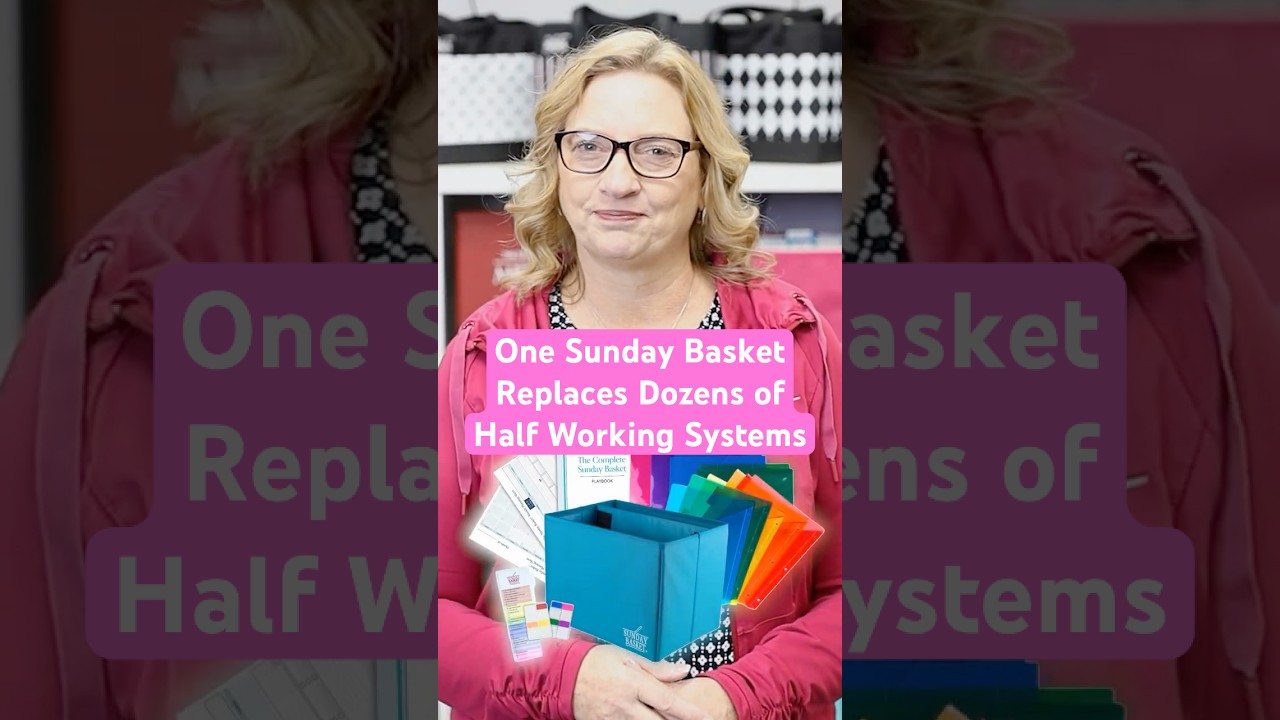
One Sunday Basket Replaces Dozens of Half Working Systems #SundayBasket #Organizing #TimeManagement