Podcast 726: Time, Money, and the $300 Million Impact of Household Productivity

In this solo episode, Lisa Woodruff examines how private household decisions drive a massive share of the U.S. economy and how making those invisible decisions visible can generate huge personal and macro‑economic value. She begins by contrasting public discourse about trillion‑dollar deals with the everyday calculus of a family deciding whether to buy a coffee or switch gas stations, then reveals that 68 % of U.S. GDP—about $19‑$21 trillion annually—comes from household spending on services and goods. Woodruff maps a life‑stage “yin‑yang” of time and money, proposing a personal time‑value benchmark that rises from $20 /hr in one’s 20s to $50 /hr in the 60s. She introduces the “Sunday Basket” – a 90‑minute weekly paper‑based planning ritual that consolidates household administration, task stacking, project management, and thinking time. Drawing on productivity research (1 hr planning saves 5 hrs execution) and her own experience, she claims the Sunday Basket saves roughly 5 hours per week per user (effectively 7.5 hrs when accounting for planning efficiency). By monetizing saved time at the personal hourly benchmark, she estimates each user gains $100‑$250 weekly. Scaling to the 1,000+ sold systems, she reports 15.5 million hours saved, equating to $310‑$775 million in economic impact over eight years. Woodruff reinforces the value of regular system maintenance for mental‑load reduction, shares a listener’s email illustrating how the process keeps the mind from “pestering,” and previews a four‑part series that will dive deeper into task stacking, project management, and purposeful thinking time. Throughout, she frames household management as a professional role—“Productive Home CEO”—and urges listeners to treat time with the same concrete, monetary rigor as money itself.
Chapters
How we talk about money and time in private is different than how we talk about money and time in public. In public, we talk about trillionaires and billion-dollar deals and billion-dollar IPOs and how much debt the Americans have. And then in private, we sit and we think, can we afford to get a Starbucks coffee? All right, well, if we drive 2 extra miles and we go to the different gas station, We'll save $4 on gas, or if I use my coupon code, that's 1 cent less. And then if I get both, like, I mean, the way we think about our finances in our household is not the way we talk about finances in the world. And I want to kind of make visible some of the invisible ways that we deprioritize our effort and our work at home, and we overprioritize sometimes things in the media and in how we report things. All right. All right, I have said, and I just double-checked, and like, there are like a gajillion references for this, so I am on point. 68% of US GDP is household spending, meaning that these billion-dollar IPOs on the stock market of these companies that we buy our stuff from are powered by us. They're powered by us going through our finances on the weekend and deciding to place another Amazon order, deciding to go to the grocery store, deciding to go on vacation. And I was like, gosh, that's a lot of money. Like, how much money is that? So the GDP, or how much money the United States generates in one year, is $32 trillion. I know, I can't even think about how many zeros that is. 68% of that is roughly $19 to $21 trillion. We are spending $19 to $21 trillion every single year with every single transaction that we put through our Visa check card, Or credit card or pay for in cash. Now that money is divided. Part of it goes to services and part of it goes to goods. And roughly we spend twice as much on services as we do on goods. So what's the difference there? So services is when you have someone come in your house and service your air conditioner or service your microwave or cut your grass for you. Goods is buying the lawnmower, buying the refrigerator, buying the new HVAC unit. So there are service things and there are hard cost goods, and we have these in everything that we do. You know how you spend money. All right, I'm going to move beyond that, and I want to talk about, um, other ways in which, you know, we spend all of this money. So we spend a lot of money in services, we spend a lot of money in goods, but we don't value our time as the laborer in our house of everything that we do. So I was thinking about this, I'm going to take us back in time and thinking all the way back to when we were new adults in our 20s and up into where I am in my 50s and projecting forward into my 60s. So there is this interesting yin and yang between time and money that happens throughout your adult lifetime, and at first you feel like you have all the time in the world but you have absolutely no money. Like in your 20s, like you can't even go out and get a pizza because you can't scrape together the $20. To get the pizza, but you have all the time in the world. Like, you could go to the store and buy the ingredients and make a pizza, no big deal. And then when you get into your late 30s, definitely in your 40s and in your 50s, like, you have no time. And early in that season, you also have the most constraints on your money. But as you get more into your 50s and 60s, you actually get into your highest income-earning years, which is why many people actually start their businesses in their 40s, 50s and 60s. Like you'll see on the media, people who start their businesses in their 20s and 30s, they are unicorns. It is usually people like me turn 40, start their company, the company starts to take off in their mid-40s and really hits its stride once you're into your 50s. That is more indicative of how small businesses work in the United States. So when we think about this time and money yin and yang, early in my 20s and 30s, I would DIY, do it yourself, everything that I needed to do in my household because I couldn't afford to have the service people come over. Now I can afford to have the service people come over, and as I'm getting later into my 50s and looking into my 60s and 70s, I'm like, darn right we're gonna get the service provider to come over because I don't want to fall or hurt myself or get taken out of commission, um, while I am fixing something. So when you're thinking about this yin and yang, I'm just putting this in modern-day dollars, and I think about how much I earn as a babysitter, how much we pay for babysitting for our grandkids. Most people, if you're going to hire a babysitter, you're going to pay about $20 an hour, and that's kind of on the low end in most areas for a babysitter. So we're going to start with that as the base level of what we should value our time at. We should value our time at $20 an hour. Let's say we may not have $20 an hour to pay ourselves for all the time that we do, but $20 an hour is going to be our base. So in our 20s, we have plenty of time. $20 an hour can be hard to come by. In your 30s, it gets a little bit easier to get maybe $25 an hour. We're starting to have that crunch on our time. You get into your 40s, and this is what was really hard for me— still didn't have the $25, but I also didn't have any time. And that's where we all get really squished and squeezed in our late 30s, early 40s. And you see a lot of women making a lot of hard decisions because they just can't do it all anymore. What I know now, which I wish somebody had told me, was when When you get into your later 40s and early 50s, you'll have a little bit more capacity. You'll have a little bit more capacity of time, and you'll definitely have more capacity of earning income. So as we go into our 50s, we're going to think about our time being valued somewhere between $30 an hour and $40 an hour. And then when you get into your 60s, we're going to value our time at $50 an hour. Now, if you've been in corporate America since the day that you graduated from college, you're like, $50 an hour in your 60s? Like— That's only $100,000 a year. Like, I— you should be making that in your late 30s or 40s. Okay, depending on what industry— I'm not worrying about what industry you're in or how much you actually make in your corporate job, or if you never have a paying job and you manage your household. That is not what I'm looking at the money for. I'm more looking at how much access to capital you have the older that you get. And also how much we value our time the older that we get. Like, if you go to work in your 50s and 60s, you're likely not going to start working at $20 an hour. You have a lot of lived experience, you have a lot of knowledge. And so we're just going to use these as benchmark numbers, but you know your number. Like, as I was going through those, you're like, I wouldn't do anything for $20 an hour. Like, I make whatever, $100 an hour. I'm, I'm a lawyer, I make $350 an hour or something like that. And some others of you may be in your 60s, you were stay-at-home parents, you did homeschooling, you did a lot of volunteering, you're like, I've never gotten paid for any of my time. I've made a lot of impact with my time, but I've never thought about how much my time is worth. For this scenario, we're going to give ourselves a number, so just pick whatever number you want, $20 to $50, any dollar amount you want. All right, now we're going to do some math. A couple of years ago on my birthday, I did math to figure out how much time the Sunday Basket has saved people who use the Sunday Basket system. So the Sunday Basket system is my kitchen counter filing box where you drop in all your notes, your actionable to-dos, keeps track of all your projects, and then you set time aside on the weekend, about 90 minutes, and you go through and you make sure that everything is on target. As the manager of your household, you make sure your finances are in order, all of your actionable to-dos have a place to go, you've pulled out the to-dos you're going to do. There are any tasks that you could do during the week, you do those on the weekend. You manage all of your projects and make sure your projects are on track, and you plan out your week, and you really look at the time management of how you're going to use your week and get everything done that you need to get done. I have said since I started selling this program in 2018, but I started using it myself in 2002, that this process saves 5 hours per week. Where did I get that from? Well, I tried to do a study and that was ruined by COVID, and I haven't had a chance to redo the study yet. So it's not research where I got that number from. I got that number from logic and just lived experience. Productivity specialists will say, and there are numerous places where you can find this confirmed, that for every hour you spend planning, you spend— you save 5 in execution. For, um, I think it goes all the way back to Benjamin Franklin. So when you spend an hour planning, you save 5 hours during the week. And a lot of people will say, well, I do this Sunday basket and I feel like I don't have as much anxiety and I'm getting more done, but I don't have these magical 5 hours that you're talking about, Lisa. Well, I— they're not like laying on the couch bonbon and eating bonbon hours. They're, you know, like just productivity hours. So productivity hours means you're going to deploy these hours differently than just chasing your to-do list. So I've said for every, um, 90 minutes you spend in the Sunday basket, you save 5 throughout the week, which actually, if you want to be technical, you probably save 7.5 hours per week. For me personally, what does this look like? This looks like I get as much of my administration and my management of the household done on Sunday as possible, and I pretty much don't do any Monday through Friday. When I first started doing this system and I was in active parenting years, I would spend a good chunk of my Monday through Friday like running errands and making phone calls or things like that. But now my current phase of life with grandchildren and children, but I'm not actively parenting any of them, I am able to do like a task or 2 Monday through Friday. I literally don't even think about my household Monday through Friday. If you told me that in my 30s, I'd be like, well, do you not care? No, it's just a different phase of life. So with that scenario, thinking that the Sunday basket saves you 5 hours per week, What are those hours worth? So if you just think of like 5 hours per week, $20 an hour, you're gonna pay a babysitter, that's $100. Every time you sit down and do your Sunday basket for 90 minutes, you're like handing yourself $100. $100, you know, 5 hours at $20 an hour that you have capacity to use during the week. If you are giving yourself $25 an hour, then that is $125 that you have during the week. If you're at the high end and you're giving yourself $50 an hour, that means every single week that you do your Sunday basket, you are saving $250 per week. Now we can extrapolate that out to the month. That's somewhere between $400 a month and $1,000 a month that you are paying yourself to do the management of the Sunday basket. And in this series we're about to go into, I'm going to talk about the different levels that you get to inside of the Sunday basket, the tasks Stacking is the first level. Project management is the next level, and then thinking time is the third level. And if you've been doing the Sunday basket a long time, you're like, oh yeah! When you start your first year doing the Sunday basket, everybody's going to get back twenty dollars an hour. Okay, a hundred dollars a week. I mean, a hundred dollars a week. I'll take it. Give me a hundred dollars a week. I will definitely take it. But the more, the older that you get, the more complexity in your life, and the more that you do, you're like, okay, a hundred dollars is good. but it's going towards a car payment that's like $40,000 or something. Like, it's a dent, but it's a ding. It's not, you know, like a fender bender, you know. It's not like a major amount of money. However, as I was getting ready for this podcast and I was thinking about you, those of you that started the Sunday Basket back in 2018, I was like, oh, you started at $20 an hour, you're probably at $50 an hour now because your management skills have increased and you've become the CEO of your household and you are much better at allocating your time, talent, and your treasure, and you allocate it across everything. And so you have earned pay raises as you've continued to do your Sunday basket. All right, now here's where it gets exciting. I have been tracking how many hours I can attribute are saved by household managers through the purchase of the Sunday basket. Now many of you start by DIYing your Sunday basket. You get the Sunday Basket concept. I have over 1,000 podcast episodes. You've listened long enough. You get a box, you figure it out, you put it on the kitchen counter, and you have your own system. Many of you have told me that once you get the actual Sunday Basket system with the support of the Sunday Basket Club and the course inside, you're like, okay, this is different than my DIY version. But those of you that have a DIY version, I'm not even counting those hours. I am only counting every single Sunday Basket system we've ever sold. And we have it on a spreadsheet of when you purchase the system, we wait 6 weeks before we calculate any time because it takes you a while to get it set up. And then starting at week 7, we calculate 5 hours for every single Sunday Basket system we have sold. And we just passed 15.5 million hours saved. That is a lot of hours. That we have unlocked for household managers all over the world. We don't know what you've used these hours for, but we know you've used them for good and you've continued to grow and evolve and give back to your community and your family and all that. Like, that is an amazing amount of hours. But that headline is not the real headline. When we start calculating how much those hours return in economic stability in your household or economic return for you at $20 an hour? At $20 an hour, that is $310 million. You could say, okay, that's, that's a reach. Whoa, Lisa, whoa, whoa, whoa, back up the bus. Like, come on. Okay, I mean, if it would take you 7.5 hours a week to do what you could do in 90 minutes, and you start doing it in 90 minutes, and you unlock those 5 hours, whatever you're uniquely gifted and created to do, that is real time saved. That is real time saved. And time needs to have a tangible monetary attachment to it. And so if you would like, oh my gosh, I'm so overwhelmed, I need to hire a babysitter to watch my kids for 5 hours. Oh my goodness, I'm so overwhelmed. I need to take the laundry out and have somebody do it for $60. Oh my goodness, I'm so overwhelmed. I'm gonna hire somebody to come in and deep clean my house for $350. Like, oh my goodness, I'm so overwhelmed. I'm just gonna grab takeout. Takeout right now, I mean, just Chick-fil-A for myself, my daughter, and my grandson for lunch was $36. $36. Like, if I bought it for a whole family, $75. And these are the things that we do with our money when we don't have enough time. So I don't think it is unrealistic to say that the Sunday Basket has saved $310 million for household managers that are using the system over the last 8 years. But if you're making $50 an hour, that is 3 quarters of a billion dollars. And not everybody who's using the Sunday Basket is earning $50 an hour, but by the time you get into your 50s and 60s usually are. And so somewhere between $310 million and $775 million is how much economic impact I believe the Sunday Basket has had in the last 8 years. How does this work? This works because we're taking our administrative tasks, we are pushing them together, and we're doing them in one time chunk on the weekend. We're not spreading them out All over everywhere. We're just taking that 90 minutes and we are putting it into that one weekly time. So I'm going to read for you an email that I received back in January because I print out my emails and I put them in my podcast folder so I can pull them out when they are relevant for a podcast. And this person says, something about the way your systems help us that I don't think I've ever heard you reference before occurred to me this morning. All of these systems have periodic review maintenance component to them, and when we do that maintenance, part of it keeps our minds soothed so that it's not pestering us about all these things. I mean, what would you pay to not have your mind pestered? It happens in the Sunday basket first because you look at every paper every week. Your brain stops bothering about things in the Sunday basket because it remembers that that thing is in there and you'll see it again in a few days, Or will remember where it is if you need it. With paper and the Productive Home Solution, doing the periodic updates refreshes your brain of what's there so you can recall when you need it, or at least remember that you used to put that kind of thing in a certain location. When we skip the Sunday basket process or skip the maintenance update portions of the paper solution or the Productive Home Solution, our brain gets back into that worry mode As it gets farther away from the last time it saw those things and can't easily recall what's there. You definitely said multiple times that you have to maintain all these systems. It's not a one-time setup situation, but I don't think you've ever talked about the maintenance doubles down on keeping the mental load light. Oh my goodness, this has so hit home for me. When I did the, um, when I got my PhD for the last 3 and a half years, I put off maintaining my paper solution and the productive home solution. I did not put off the Sunday basket. The Sunday basket is what kept me sane. But now that I finished the PhD and I'm going into these areas of my house, like just this weekend I spent 2 hours in my laundry room going through every single cabinet. I ended up with a trash bag and a half of trash out of my laundry room. My laundry room is super small and I didn't even get it all the way done. I agree wholeheartedly with this reader in that my system supported me through the PhD, but it has been so long since I've gone through and really just kept them in that maintenance mode that I feel like I don't know where things are in my house anymore. Even though I didn't bring a lot of things in in the last 3 and a half years, I didn't change phases of life, like not a lot changed in the last 3 and a half years, but my systems are not as maintained as I usually have them. The weekend before, I went through all the drawers in my bathroom, went through all of them, reorganized. There wasn't a lot of trash, there wasn't a lot to move, but I just kind of reallocated my inventory and really understood what I had and where it was. So, so true. Running a household is huge. Like, it is the biggest life's work that you will do, is to run and manage your own life. And there are a lot of moving components to that running of that life, and we need to manage them, and we need to come back around and make sure that we have what we need when we need it, and that our tasks are getting done and our projects are on track, and that we are still setting and achieving the goals that we like, the goals that we want in life. So I like to say that, you know, we think a lot about money Because it seems so tangible, and it is tangible. You either have it or you don't have it, and you can't spend it 2 different ways. Like, once you spend money, you spend money. We tend to spend our time— oh, I'm gonna do this, this, and this simultaneously. It never works, does it? And you're like, why didn't I get everything done? Because you're trying to overspend your time, because you don't see it as concretely as you see money. And I want you to see your time and your energy as concretely as you do money. And that's what you could do in the Sunday basket. You make all of those invisible requests of your time visible when you put them on index cards and drop them in the Sunday basket. You take the time that it takes to run the administration of your household and you calendar block it. Like, I think just calendar blocking the Sunday basket for 90 minutes on your calendar really is another way in which you make the invisible visible. Otherwise, you're gonna just, you know, respond to this text thread here Answer this email here, pay this bill here, you know, place this Amazon order there, and you're just doing everything in the little pockets of time. You don't really see how much time it takes to run the administration of your household. So not only do you see where it goes, but you get much more efficient with that time as well. All right, so I am super excited about this podcast series where we're talking about really our role as a household manager. Remember, household management is level 3 in the Productive Home CEO theoretical framework. Work. We've moved from the maid and the professional organizer into being the manager of our household, and we are managing the projects that need to be done and the regular work that needs to be done and adding on all of the invisible work, that work that academia is always talking about, that's the mental load and everything that is weighing us down, all gets put into the Sunday Basket. The Sunday Basket gets set up in 6 weeks or less. You can be up and running very quickly. And learning how to prioritize your time, organize your tasks and your projects, getting all of the different things that you manage out of your head onto paper and in different boxes. So this is the first of a 4-part series. Next week we're going to talk about task stacking. How do you get more done in less time? How do you figure out what those tasks are and just assign them a time and get them done? Then the next level, we're going to talk about, okay, well, tasks are like basically a to-do list. What about those bigger projects that maybe you've been putting off, or you're running multiple projects? How do we find deep work and uninterrupted time in order for us to move our projects forward faster? And finally, when you do have the holy grail, which you will, where all of a sudden you'll end up with some time and it doesn't have a task or a project or something assigned to it, What do you do with this open time? How do you really spend thinking time unlocking your uniqueness?
More from Lisa







Parenting Isn't the Only Caregiving Role That's Draining Your Energy #Parenting #Caregiving

Turning 40 Isn't About Age, It's About Responsibility #TimeManagement #Organizing #MentalLoad

The Sunday Basket Saves Hours Every Single Week #SundayBasket #Organizing #TimeManagement

Your To Do List Will Never Be Done, and That's Normal #TimeManagement #Organizing #MentalLoad
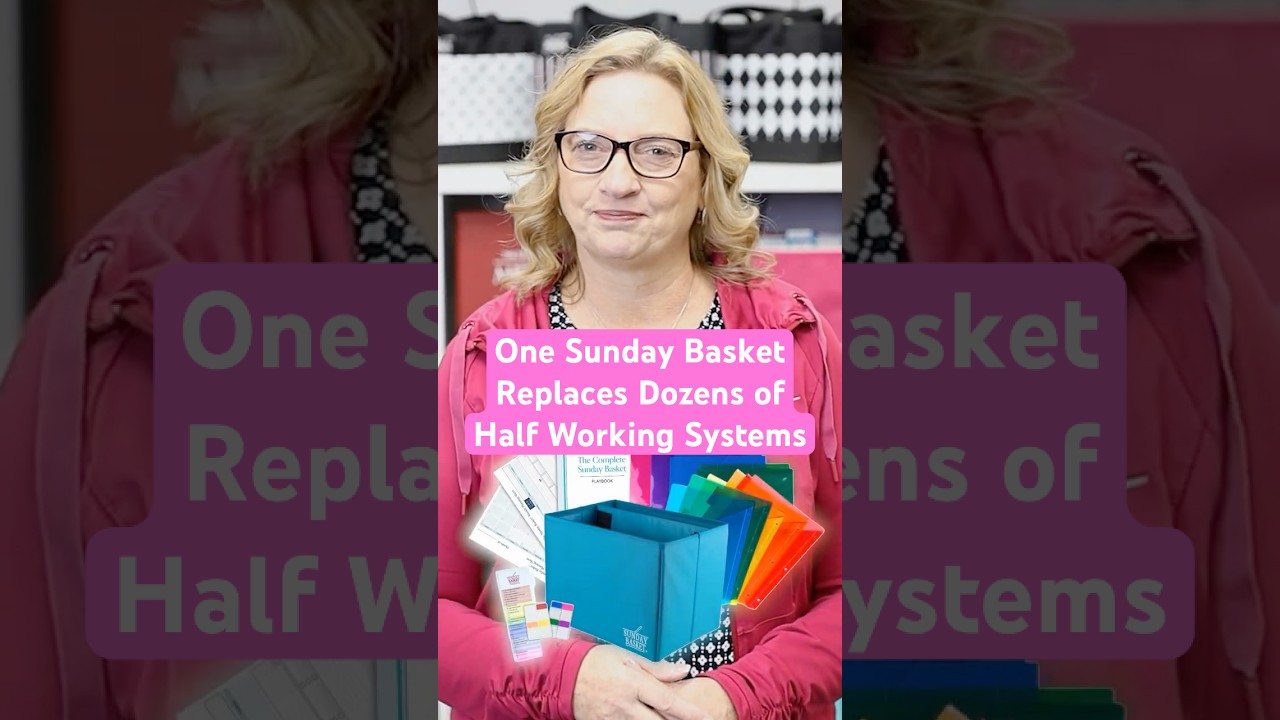
One Sunday Basket Replaces Dozens of Half Working Systems #SundayBasket #Organizing #TimeManagement