Episode 730: Time Blocking Household Tasks - Level 3 - Household Manager

Lisa Woodruff breaks down how to time-block household tasks using three color-coded stacks: Sunday for bills and planning, Saturday mornings for laundry and cleaning, Tuesday for errands. She shows how to estimate task duration, batch similar work, and shift blocks to match your energy levels throughout the week.
Chapters
Today on the podcast, we are going to be talking about how long does it take to do all that household tasks that we do as household managers, and how am I able to estimate how long that takes. First, I'm going to tell you the story about how I became a really good estimator of my time, and I literally can look at any kind of list at work or at home, figure out how long those tasks are going to take, and get them done. That Maybe isn't necessarily a skill you even need to know, or I can necessarily teach you, although I will tell you how I learned how to do it. I think it's more important that we realize that the different tasks that we do, uh, have like-minded tasks that we can stack together in blocks on our calendar and be doing the same kind of tasks, which will reduce the amount of task switching that we do, and the amount of time that we spend on our housework will become more and more predictable when we put them in these different task stacks. And I'm going to go through 3 task stacks that I've created over my lifetime, how those stacks have changed as I have gone through active parenting and now I'm in a non-active parenting role. Then I'm going to talk to you about those task stacks and where we place them on our calendar based on our individual energy. And then how do we go pro? Like, how do we take what we just learned and how do we go pro with what we just learned? So going all the way back to 2004, 2005 was the first time I realized I was a little odd. So my mom had come down to spend some time with me and my young kids. They were probably 2 and 3 or 3 and 4 at about the time when we had this conversation. And back then I was using yellow legal pads and I had like a legal pad of everything I need to buy at the grocery store and a legal pad of everything that needed to be done around the house. And so these 2 legal pads were sitting there on the kitchen counter, and I had all of my groceries listed with all these little numbers next to them. And then I had all of my tasks that needed to be done that week with all these little numbers listed next to them. And my mom said, what are all these little numbers? And on the grocery list, I was like, oh, that's how much everything costs. She said, you know how much everything in the grocery store costs? I said, well, within 50 cents. Like, I know if it's like $2 or $10, like Pretty much I know how much it costs. And then she said, well, what are all the little numbers on this other legal pad? And I said, that's how long everything takes. She said, so this is gonna take 5 minutes and this is gonna take 15 minutes and this is gonna take 30 minutes? And I said, yes. She says, how do you know that? I said, I don't know, I just know that. Don't you know that? She's like, no, I don't know that. And I was like, okay, maybe I'm a little odd. And I could tell you exactly why I was doing that. I was doing that because my list were so long. They were so long that I knew that I couldn't afford everything at the grocery store and I couldn't get everything done at home. So I knew that if I could figure out how much things cost and I knew how long things took, then I would be able to make better decisions about what wasn't going to get bought and what wasn't going to get done. Because even though I was pretty young, I knew I wasn't going to get it all done. And that being able to quantify groceries based on dollars and tasks based on time made these abstract things more concrete for me so I could look at them, evaluate them, and plan and decide what I would and wouldn't get. So every time— I mean, I don't know about you, but every time I would go to the grocery store in my 20s and 30s and pretty much ever, I am manually calculating in my head how much money everything in the basket is. So that when I get to the grocery line, I know that I have enough money to pay for it. And at that time, we were using cash envelopes, so I was paying cash. Have you ever been in the grocery line and like you are cold sweating because you're afraid you don't have enough cash for everything that is in that basket? I mean, that's happened to me a couple of times. And so when that happens and I see that total and it's not what I have in my cash envelope, I need to know what things to take off so that I can get what I've gotten and leave the store. So that's why I know how much everything at the grocery store costs. Or like nowadays, we're just putting it into an online cart, which is really nice— pluses and minuses. It's really nice because you could see what the total is before you check out. Uh, the negative is you could buy things so much easier now than you could when I was in my 20s and 30s. So I don't think I would have made it. I would have been in debt all the time, and I would have bought things on impulse that I— the way that I did things in my 20s and 30s helped me really make our small budget go as far as it did and maybe get as many tasks as possible off of our household task list, even though I didn't get everything done. So if you think that magically you're going to be able to get everything done at the end of this podcast, you're not going to magically be able to get everything done. But you will buy the right things, you will do the right things. Okay, so that's where that idea came from. And over time, like when I was a stay-at-home mom with 2 young kids running a direct sales business, I was pretty much— if I was awake, I was moving and doing something, and if I wasn't moving and doing something, I was asleep. Those were like, for like 10 years, that's all I did. There was no such thing as leisure. I didn't do any jigsaw puzzles. I didn't go hang out with girlfriends. I was driving kids somewhere. I was at a doctor's appointment. I was running errands. I was cleaning. I was calling someone. I was doing a scrapbook for someone. Like, I was just moving for 10 years of my life. Then as I got older, those never-ending to-do lists, even though I knew how long everything took on them, I mean, it's just exhausting to, to finish a task and go to a to-do list and be like, okay, which task can I do next? Which task can I do next? And so I started time blocking and batching all of these household tasks. And I did these for a couple reasons. Number one, it was just easier to do one whole category of tasks And I did this when I was in these active parenting years. I had these 3 buckets of time that I'm going to tell you about, but what happened over time was those buckets of time got smaller, and it was the capacity from that time that allowed me to start Organized 365. So if you're watching on video, I am showing you some math manipulative cubes. So imagine back to your, like, 1st and 2nd grade math days when you had these little stackable blocks that were different colors. So they're not Legos, but they're little stackable— Cubes. Um, unit blocks, and we have orange, purple, and blue. And let's just imagine that these are all the tasks that are on your to-do list. And for many of us, most of us, there are some tasks that we have to do every single week: laundry, cleaning, everything food-related, picking up the house. You know, they're just things that we have to do, housework that we have to do because we are humans. There's also invisible work that we learned about in level 3 The calendaring and the paying the bills and the processing the mail and going through the email and all those invisible work things that we need to do. So invisible work is represented by the blue color. All of those housework are represented by the orange color. And then the purple color is home organization. That's level 2 from our Productive Home CEO theoretical framework. That's the work that you do where you're like going to take and do a little organizing task and get it done. And you won't necessarily need to do that task again next weekend. That task will stay organized a little bit longer. It'll give you some extra capacity in your week until that task needs to be reorganized again. So those are our 3 colors. So I want you— and you can even do this on if you have a to-do list app or if you have a to-do list— go through and color code what you have based on color. And then I'm going to tell you how I created 3 time blocks in order to get these things done in my week. So the first one, this is not going to be a surprise to you, I'm going to start with the invisible work because the invisible work is actually the thing that I organized first when my kids were little. And that was, of course, it was 2002, so everything came in snail mail. We had email, it just wasn't really well used. So that was, so that was calendaring Processing the mail, and we had more mail back then than we do now, but we still have mail. Figuring out my budget, getting the cash out of the bank, putting the envelope— the money in the different envelopes. This is also when I would look through and I would figure out what was on sale at the grocery store so I could maximize my grocery dollars. This is when I actually made my grocery list, was in my Sunday basket time. I would pay all of our bills. I would plan out any babysitters or any school things that we needed to do for the week. Um, I would build my grocery list, and this Sunday basket time took anywhere from 90 minutes to 3 hours. And when my kids were little, it was closer to 2 to 3 hours because I did something called the grocery game. So back in the 2000s, um, grocery stores would have their sales. They still have sales, but they would have sales, and they did— they'd have doorbusters, and then they would double coupons, and then There was this way that you could figure out when the lowest time was to get— like, I liked Coca-Cola soda. And so there was a time every 12 weeks where it would be the lowest price for soda. And I was listening to a couple of people talk the other day, and they were talking about these crazy ladies who were at the grocery stores with carts just full of diet soda. And I asked them, I said, well, what price is the diet soda right now? And they said, well, it's buy 1 pack, get 2 packs free. I'm like, oh yeah, that only happens twice a year. Like, because I remember back to those days, there were just your things that you wanted, the things that you always wanted to buy. There would be sale prices, and then there'd be better sale prices, and there— then there would be the lowest, lowest price you could get it. And for soda, like twice a year, you have this like doorbuster sale that like you just buy as much soda as you possibly can because it's such a great cost savings. So I was like, yeah, I, I would have been that crazy person. So that was a lot of my Sunday basket time, was figuring out how to take the income that we had and maximizing it for the needs of our family. So this is your first calendar block of tasks. And the nice thing about when you make a block of tasks, you take all these individual tasks and you put them into a block. Yes, the block is 90 minutes, 2 hours, 3 hours, however long. I don't know how much invisible load you have. Maybe it's 9 hours. I have no idea. You have so much invisible load. The nice thing about the calendar blocks is a couple things. Number one, creating the block literally on your calendar or in your planner creates these boundaries around this time that you're going to spend doing this work. It also makes this work visible because it's at least visible on the calendar to you. Now here at Organize 365, we actually put all these invisible tasks in a Sunday basket, and that is the second thing that creating this calendar block does, is it literally creates a place for all of these tasks And this kind of work to go the other 6 and a half days of the week. So all week long, Monday, Tuesday, Wednesday, Thursday, Friday, if I remember, you know, a bill that needs to be paid, I gather the mail, I print out an email I need to respond to, I get an invitation for something that needs to go on my calendar, I think about something that I want to buy somebody for a holiday and I write it down, all of those things go in the Sunday basket. Then on Sundays when I do it, on Sunday I pull out my Sunday basket and I sit down And I do all those tasks all at one time. The only other way to do it is to write all those tasks on a task list and to do them all week long. So I'm taking all these individual tasks and I'm blocking them on my calendar and I'm doing that on Sunday. When I did this when the kids were little, I did it on Sunday afternoon. So for us, we'd get up, we'd go to church, we'd have brunch, we'd come home, and then the kids would go play, my husband would go do whatever he did, And it'd be like 1 o'clock in the afternoon. I'd get my Sunday basket, I'd get all the circulars of everything that was first on sale that week at the grocery stores, I'd get all my mail for the week, and I would sit down on the floor in a spot of sun with my Coca-Cola at the time, and I would just sit there and I would do all my household administration. I loved it. When my kids were older and they were like middle school, high school age, that time shifted to be Sunday night. It was usually after Sunday dinner. I'd come home and I would do all of those things. And now that time has shifted into the morning. We'll talk about that when we get to energy in the next section of the podcast. But now I do my Sunday basket first thing in the morning, and my husband and I are watching church online still. Started doing it pre-COVID, and we just have stuck with it. So that is your first task block, task stack. You're going to pull everything off of your to-do list that is invisible, administrative, repetitive, can be done in one like desk section. And we're going to put those over in our Sunday basket time block. The next block I want to talk to you about is what I did on Saturday mornings. And I, I started this a little bit later, maybe a couple years later than I started the Sunday basket with my kids. My kids were probably 5 and 6 when I really started doing this in earnest. And this was my Saturday morning housework time frame. And for me at that time, it took me 6 hours. Oh my gosh. I know, it's kind of crazy. But what happens when I would do my housework time block is I stacked a bunch of things in there. Um, pretty much anything related to running my household physically went in my Saturday time block. So I would get up first thing in the morning, I would take all the laundry downstairs, I would start the laundry. Then I would go into the kitchen and I would wash the dishes and I would start the dishwasher. Then I would— any other machines that— this is where the machines came from when I'm always talking about getting your machines started. If I was making a Crock-Pot dinner, I would make a Crock-Pot dinner. So I'd get all my machines started, then I'd get the kids started. So I'd go upstairs, and if you know about the kids program and you know about teaching your kids how to clean and organize their bedrooms, I would get them started. So I'd say, okay, get me all your laundry. They bring all the laundry down. Get me all your dishes. Bring all the dishes down. So I had my dishes going, I had my laundry going, then I would send the kids back upstairs to get their trash and to get started on cleaning their bedrooms, which I had to do with them for a long period of time. And they would gather trash and I would walk through the house and pick up anything that was trash and we'd take that all out. Then I spend about the next, you know, 3, 4, 5 hours depending on the weekend going through and I kept moving the laundry. So about every 30 to 45 minutes I'm back in the laundry room moving the laundry during this whole process. I'm cleaning the bathrooms. I'm cleaning the kitchen floor. I'm cleaning out the refrigerator, taking inventory of the pantry. I'm usually doing a little organizing project here and there, maybe cleaning out a drawer. I mean, I call this putzing around the house. It's very productive putzing. Oh, I love—I mean, I love it. I love to be home on a Saturday morning and just going from room to room to room, getting things done, straightening things up, tossing things that are. Past their lifetime, reorganizing those spaces, just resetting the entire house. By the time this time was done, which would take anywhere from 4, 5, 6 hours, all the laundry was done and put away, the dishes were out of the dishwasher, cleaned and put away, the kids' rooms were cleaned and organized, my room was clean and organized, the whole house was vacuumed, all the bathrooms were done, and it would take me usually 6 hours. So I'd start at like 8 in the morning and I'd be done about 2 in the afternoon. This worked for me even though I was a stay-at-home mom, because when I was a stay-at-home mom during the week, I was like driving kids places, doing the little classes, running my direct sales business. I don't know, I just didn't want to— I don't like to do laundry all the time. Like, I like to do things in a big block of time. So if this doesn't work for you, the other thing you could do is you could take your housework and you could divide it into smaller blocks And so maybe 3 times a week you're gonna do, you know, laundry and bathrooms on one day, you're gonna run another load of laundry and do the kitchen on another day, and then another load of laundry and vacuum the whole house on a third day. I like it all in one. Now, as the kids were entering middle school, I needed to earn even more money, so I started cleaning other people's houses. Now, I could clean somebody else's house top to bottom in 3 hours. I could do the bathrooms, vacuuming, change the beds. Clean the floors, all of it in three hours. The difference between how I was doing it at home and how I did it for someone else was that when I was doing it at home, I was also doing laundry. I didn't do that when I cleaned people's houses. I was also running the dishwasher and putting it away. Didn't do that when I cleaned other people's houses. I was cleaning and organizing kids' bedrooms. Didn't do that when I was in other people's houses. You could see how there's you spend more time when you're cleaning. Your own house each week than you would if you had a service come in and clean your house each week. Now today I do have a service come in and clean my house every other week, and I still do my laundry, um, and I still wash the dishes, but we don't do as many dishes because I work away from home and we don't cook from home as much. And we just don't have as much laundry because it's just my husband and I. So my housework doesn't take 6 hours on Saturday anymore, and it is more spread out during my week. It's in a couple of different sessions, small sessions. So you, when you make a calendar block and you start to identify how long tasks take, it'll change over your lifetime. So Saturday morning, when I was doing this in my 20s and 30s, Saturday morning when I would get up in the morning and I would do all these tasks, I would do all these tasks in the morning. Usually around noon was when I transitioned over to whatever organizing task I was doing. And I would do that for an hour, 2 hours, up to 6 hours. I might do that until 4 or 6 in the afternoon. And then that was also the day that I would read a book or we would watch a movie or go on a date or whatever we did in the evening. So Saturdays started to become the day that we called a family free-for-all by the time my kids got into middle school. And what that looked like was we all got up and we organized our bedrooms, cleaned and organized our bedrooms and did our housework. And as soon as your housework was done, the rest of the day was free for you. You could do anything that you wanted. And bonus, we didn't do any cooking. So my husband would go to whatever fast food you wanted for lunch and for dinner. He would go get it and he would bring it back before the days of Uber. Plus also, I'm not paying for Uber. My husband likes to leave the house. So I'd get up, I'd start putzing around, I'd start doing laundry, and then around noon he would bring home whatever we wanted from fast food. I'd transition into my organizing project. Around dinner, he'd bring home whatever we wanted for fast food, and we transition into our, our evening and our playtime. And that is how this block got done when my kids were grade school and when I was in the active parenting age. Okay, the last block that I want to talk to you about, which now is a lot done online but wasn't when my kids were younger, and a lot of people don't do these things online, and this is all of the errands All the extra buying that you need to do and going to the grocery store. So for me, this time block always happened on Tuesday morning. Such a random time, right? So I would always do it on Tuesday morning, and the reason I did it Tuesday morning was because it was when the grocery store was the best stocked and the least amount of people in it. I could literally get into the grocery store, get in and get out like with a full huge cart full of stuff in like 40 minutes because Everything was restocked from the weekend. There weren't a lot of people and you could just check out really quickly. So that's why I picked Tuesday morning. The other thing I would do is I would make my list of all the errands I needed to run, drop things off at the dry cleaner, go to the grocery store. At that time, I was always picking up pictures because I was doing scrapbooks. Um, you just— anything I needed to do. I was going to different grocery stores to get all the best deals to save the money. And I would make a list of the things I needed to do, and I would start with the farthest away location, and I would work my way back towards home. And the reason why I went the farthest location away and worked my way back towards home was because I usually had my kids with me, and I needed to make sure that their energy was going to make it all the way through all those— all the stops. And if it didn't make it through all the stops, then I could just go run out and do whatever I needed to that night when my husband got home, or the next day if they didn't make it through all the stops. But my poor mother, back in 2003 or 2004 or 2005 or wherever she was when she saw all those numbers next to the, um, the list of things we were doing, the money we were spending, or the time I was allocating, she and my sister also remembers if you were at my house on Tuesday, you got in the minivan and like we did, we did all the, we did all of the stops. So she watched me do all of those stops, um, in order to get it all back. And I had strategic things like once we got to a certain time, they would get a snack out of the bag. We would always get like— fast food was a big thing for me when I was in my 20s and 30s. We would stop and they would get like fast food, french fries or whatever, and I'd put them in the double stroller and push them through the grocery store while I pulled the cart behind me and filled it full of things. And yes, you can get a lot of this delivered now, and so maybe a lot of this block isn't even on your list anymore. But it is on your list because you still need to plan what you need when you need it, and how much it's going to cost. So the amount of time this list takes may now be like this in today's day and age if you're using online shopping, as I am, for literally everything. But the cognitive load of getting the groceries and every other errand that you need to run is still this big. Like, you're still managing mentally all these things that you need to get into your household. So these are the first 3 ways to really visualize your time as a household manager, how you're spending your time. You're spending time doing invisible tasks that need to be done. You're spending time running errands and getting things into your house, and you're spending time cleaning, organizing, and managing what is in your house. And if you just start by blocking these 3 blocks, maybe 3 blocks, maybe more, on your calendar, that is going to start teaching you how long it takes to do these tasks. You don't have to know How long does it take to do every single load of laundry? How long does it take to empty the dishwasher? How long does it take to pay the bills? You can, I know, but I'm weird and you don't need to. It's not necessary. You don't need that level of detail. Now let's talk about energy. So I am a morning person. I am a morning person. So I like to get up on a Saturday and putz around the house, and by noon I want to be done with all my housework if at all possible, so I have the rest of the day to myself. When my kids were really young, I was not really a morning person. I mean, I was, but I was so tired, you know how it is, that actually I would get a second wind after I put them to bed at 8, and I would stay up until 12 or 1. In that phase of life, sometimes I would go to the grocery store at 10 o'clock at night. This was pre-COVID. They used to— our grocery stores used to be open all the time. Everything used to be open all the time. It was great. Once I went to the grocery store in the middle of the night. I was like, wow, you can get a lot done in the middle of the night. I don't recommend it. I'm just saying I did do it. So you have to figure out what is your energy level. I am a morning person, and I have physical energy, but I have a lot more mental and talking energy than I do physical energy. So for me, the Sunday basket is, uh, a great thing for me to be doing in the evening, in the afternoon and evening, because it's not a lot of physical energy. It's a lot of sitting on your hiney going through the mail, going through your computer, going through your financial statements like you're sitting at a desk. This is not normally something I would do first thing in the morning. I do it first thing— you're like, but you're doing it first thing in the morning now. You're right, I am, I am doing it first thing in the morning on Sunday. However, I'm usually going folding laundry, doing a couple of housework tasks before I do the Sunday basket on Sunday. I do it like late morning. I am always going to do housework if possible in the morning. I'm always going to start doing the big part of my big organizing tasks first thing in the morning, not after work. Like, that's why after work is not an option for me, because I am just like out of energy. But if you have a lot of energy after work, then you can move your time blocks to a different time block. And then for errands, you have to have the high— if you're going to do physical in-person errands, you have to have the highest amount of both Physical energy, and also friction with people energy. So what I mean is, if you've ever been to Costco, that's friction with people energy. There's no good time to go to Costco. If you know a good time to go to Costco, I will rearrange my work schedule around it. I mean, you can't go into Costco without seeing every person that lives in your township. Like they're all there all the time. It is efficient. Costco is very efficient. It doesn't take a long time to get through. the line ever even though there are so many people everywhere in that store and I'm a people person so I don't even know how you guys do it who are not people people. So you have to not only have high energy for yourself physically to get through all of those tasks that you need to do with other people but also you have to interact with the people. So those are the levels, highest level of energy down to the lowest level of physical energy needed and then you need to match those in your day. Depending on what your work schedule is, your home schedule, you get the idea. So now you're going to start playing around with your blocks, and you may see over time that you are like me where you used to do it this one time frame, but now it's going to be this new time frame. Oh, and I'll give you one more idea for those of you who are like, you know, Lisa, that's wonderful for you, but I literally get up, I get in my car, I'm driving, I'm at work, I get in my car again, I go get kids, I'm in my car. Like, I'm in my car all the time except for maybe one day a week. I used to do my housework in my car. You can't vacuum your house in the car, although now you can with robots. You couldn't before. I would literally get all my laundry done and I would put all my clean laundry in my minivan, and then I would take my kids wherever they needed to do— ever needed to go, and I would sort socks and underwear and fold laundry in my minivan. I know. And also, the Sunday basket has a portable Sunday basket for a reason. I, you know, I told you there was like a decade where all I did was I was awake, I was working, I was asleep, I was awake, I was working. It was for pay, not for pay, as a parent, whatever, always working. I would literally bring my whole Sunday basket with me everywhere. It went to the pool, it was in the car. At one point, I think it lived in the car, and I would just put things in the car, and then I would bring it in when I needed it and put it back in the car. Because if I was waiting in car line and I was sitting there for 20 minutes, I would do a slash pocket. I would dump some more notes in there. Like, I would, I would do that. I went to so many doctor's appointments that I would just grab a couple slash pockets out of the Sunday basket, bring them with me, and do the work while I was sitting there in waiting rooms. So the— when once you understand you have invisible work, you have housework, and then you have errand work, then you could start to say, oh yeah, okay, so today And this is what I did. I'd be over on the wrong side of town, stuck there for an hour between 2 appointments. What are you gonna do? Okay, well, some errands can be done on the other side of town. Like, if there's a Target here, there's a Target there, right? Like, I could just go to that Target. You wouldn't want to drop off dry cleaning on the other side of town, but you could go to Target. Or maybe there's something, some project you've been meaning to get to in your Sunday basket that's portable that you could take with you that you could do in the car while you're there. So understanding how long tasks take, what kind of tasks they are, where you need to be in order to do them— once all of your time is now in these little blocks, you can say, okay, I'm never going to get all this done on Sunday, but I have this 2-hour block on Wednesday between doctor's appointments where I could take some of this work with me and get it done, and then it won't be there on Sunday when I need to do it. That is how I have figured out how to conceptualize the tasks that I need to do, how long they take, and put them into time blocks, and then break those time blocks apart when I wasn't at home long enough to get all the work done. Here is what is really, really fun about this, about going pro. So let's talk about going pro. Once you see it— and I'm sorry, you can't unsee it now because I just showed it to you— once you realize that, like, okay, this huge long to-do list is not a huge long to-do list, it's actually 3 to-do lists and it might be 4 or 5 or 6 to-do lists. You might have a whole separate thing of, you know, work and then kids and then whatever. You realize like, oh, all tasks are not created equally but tasks can be similar in the energy they need and the location of the task and the outcome of the task. So I could start grouping these tasks into these blocks and putting them on my calendar. Once you figure out like, okay, this is my Sunday, this is my Tuesday, this is my Saturday afternoon tasks, your brain will start to give you ideas or things that need to be done almost as like a, hey, not remember to do this, but hey, when you're in your next Sunday message session, do this. Hey, when you're cleaning the house, do this. Hey, when you're running errands, do this. Like your thoughts will start to categorize themselves. So when you go to write them down, it won't be just like writing down random tasks. Now you'll be writing down, oh, this is a task and it's a housework task. Oh, this is a task and it's a Sunday basket task. Now initially I have you write down tasks, they all end up in the Sunday basket. What you'll find is, and you could even make a slash pocket labeled housework, we do have one labeled errands. Things will end up in different slash pockets, and then those slash pockets can sometimes come out and get done on different times. So your thoughts will start to categorize themselves. Second, the longer you do something— like you get up on Saturday and you get all your housework done on Saturday— if you haven't done it this way before, it may seem overwhelming, not fun, you don't want to do it, and, um, you're like, I mean, yeah. I can't believe I'm gonna do housework for like 3 or 4 hours. Like, I'd rather do an hour a week. If you'd rather do an hour a week, stick with it. Like, you don't have to do it my way. But what I am— what I noticed for myself personally was when I moved it from doing it all the time to doing it on one block per week, it usually took me a little bit of energy to get myself going. But once I got going, I was going, and I just kept doing one more thing, one more thing, one more thing. And that's the way that you build the energy. Like, You may start doing your housework and you get 90 minutes in and you're like, oh my gosh, I cannot keep doing housework. Just listen to me and do one more thing. Just pick one more thing off the housework list and then you're allowed to be done. Kind of like when you were a kid, just have one more bite of broccoli and then you can go play. So just hear me and you're gonna be like, okay, fine, I'll go, I'll go clean all the toilets and then I'm gonna be done. I'm done. I'm not doing this anymore. That's fine. That's a win. After you do this a couple weeks, then I want you to go like, all right, what's one more thing I could do? What's one more thing I could do? And now I challenge myself. I get towards the end, I'm like, oh, I'm really out of energy. And I'll say to myself, oh well, what's one more thing I could do? And I usually could do 1, 2, or 3 more things, and then I'm like, I'm done. Like, I don't want to do this anymore. And you're allowed to be like, done. Like, you could be done. But over time, your capacity to do housework gets bigger and bigger. Your capacity to do the Sunday basket gets bigger and bigger. Like, you could sit for longer and longer sessions. And also, because now you do these things in batches, you do them faster. So not only do you increase your capacity to sit in a Sunday basket session for 2 hours, but now you've created a little system for the first 90 minutes of your Sunday basket that's compounded— that's collapsed down to, um, 75 minutes. So you're gaining the 15 minutes from the, um, increased ability to do the Sunday basket faster, and then you've increased another 30 minutes of being able to sit and do the Sunday basket because your, your body has just gotten into that motor memory of like, this is when we do the Sunday basket. Now you're doing 45 more minutes of Sunday basket time, and that will continue. You will continue to collapse the amount of time it takes you to do the Sunday basket and increase your ability to sit and do the Sunday basket. That's what happens in Planning Day and Planning Day Prep. So if you've been to Planning Day Prep and it's 2 hours and you're like, you started before I started recording and you're still going after I'm going, that's because you've increased your ability to sit and manage all the invisible load that you have. And then the next day for 4 hours, we move into the CEO Mindset and we start planning out the next 4 months. That is increased capacity from the skill of doing the Sunday Basket. Same with your errands. When you have all your errands on one day or all the things that you need to order on one day, then you start to look at your time differently and your money differently for the week, and you can figure out how it's going to be allocated. You place all those orders at the same time, you move all those email confirmations wherever you're going to move them, and then you're done with that for the week. And so you're increasing your energy, you're increasing your capacity And the weird thing is your brain, your body will start to naturally follow this rhythm. You'll have created a new rhythm for your body that it will actually crave. Like, you will wake up on Saturday, make your coffee, and you'll be ready to throw that first load of laundry in. Like, you'll be ready for spending your house in the morning on Saturday. When you, you know, get home Sunday afternoon, if that's when you do your Sunday basket, like, you will be ready to sit down and spend a couple hours with your Sunday basket. Once you get to where you're doing all of your ordering or all of your errands on one day, you will get to that point in time and you will be ready. You will have the capacity, the energy, and your body will be ready to do whatever that thing is when you need to do that. That's what I find we have in the Productive Home Solution too. Like, once you do the Productive Home Solution a couple of years, like, you get to a certain point in the year and you're like, oh, I'm ready to plan the holidays, I'm ready to do the back-to-school blitz, I'm ready to do planning day. I'm ready to close down the yard. I'm ready to clean out my closet. And like, you just have like this urge to do this thing. You're just on a 1-year cycle. We're talking about a 1-week cycle right now. That is the 1-year cycle. And everything is cyclical. And we love— our bodies love structure. Our brains love scaffolding in order to put our lives into. And that's what you're creating here. Um, just checking my notes. All right, so that is how I have this weird little skill of being able to know how long everything takes. And that's not as important as understanding that there are these different kinds of work that we do as household managers. And if we can create these different calendar blocks on our time— on our calendar blocks of time on our calendar in order to put those tasks, then we will not only know how long every little thing takes, But we will know how long our housework takes, our errands take, our household management takes as a bigger block of time. And as you get more adept at using that time, you'll be able to collapse the amount of time that takes and/or increase the capacity of those tasks that you do during that time. All right, I would love if you're watching on YouTube, comment below if this is helpful for you, what tasks you do for household management, errands, Um, and your invisible work, and, you know, so we can all crowdsource it. If you're listening to this on the podcast, I have started making videos for these podcast episodes, and they are over on our YouTube channel. Would love it for you to like and subscribe wherever you are listening. Thanks, everyone.
More from Lisa





Podcast 726: Time, Money, and the $300 Million Impact of Household Productivity


Parenting Isn't the Only Caregiving Role That's Draining Your Energy #Parenting #Caregiving

Turning 40 Isn't About Age, It's About Responsibility #TimeManagement #Organizing #MentalLoad

The Sunday Basket Saves Hours Every Single Week #SundayBasket #Organizing #TimeManagement

Your To Do List Will Never Be Done, and That's Normal #TimeManagement #Organizing #MentalLoad
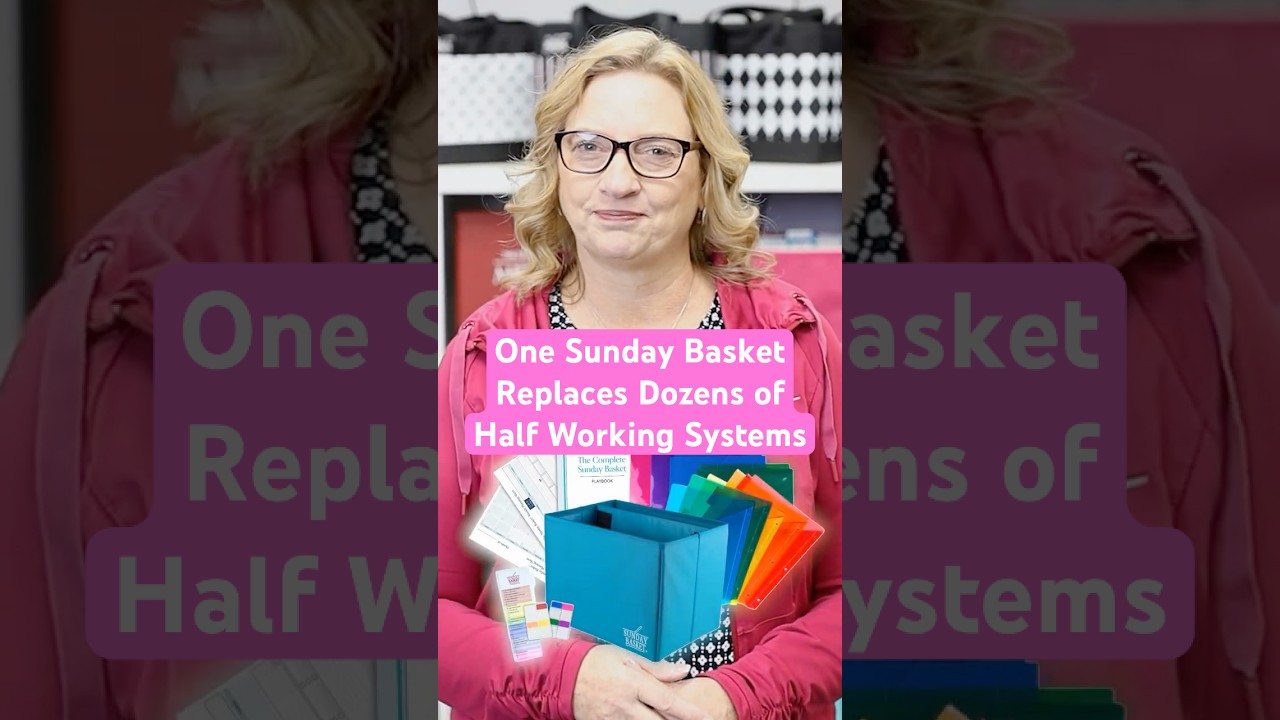
One Sunday Basket Replaces Dozens of Half Working Systems #SundayBasket #Organizing #TimeManagement