Somatic Reset for Stress, Creativity & Gut-Brain Health w/ Matthew T. Cooke [May 9, 2025]
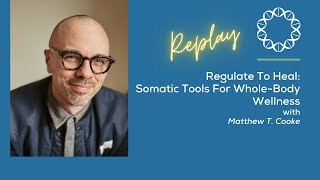
Matthew T. Cooke leads a somatic nervous-system reset with guided breathing, movement, and journaling. The H-D-I-A framework helps you map stress sensations to a desired state, then identify one concrete action to take within 48 hours. Participants reported shifts toward clarity and calm.
Chapters
Hello, hello everyone.
Welcome, welcome.
Happy Friday. All right, as we're tuning in here, let me know what you're most grateful for today. Let me know what you're most grateful for. Denise says hello, grateful for such a beautiful day. Happy says grateful for a warm sunny day. Very good sunshine. Yeah, it sounds like it's a beautiful sunny day here. But a typical sunny day here in Toronto sounds like it is in other places. Just my mom, great friends, conversation, sunset, ice cream, back home after a day we had a complete boat ride up and back down. Glorious weather, out for a walk right now. Most of that's friends and family. Can you guys hear me now? Is that better?
I turned the music down a little bit.
Sorry, I had a few audio issues with my computer, so I had to— with my main computer, so I had to switch over to my laptop. Which is why I was a few minutes behind. Can you all hear me now? And if you're able to, I would love if you could turn your cameras on. Matthew says he's grateful for deeply impactful relationships and community in my life. Lots of— yes, well, so without further ado, I do want to introduce our very, very special guest today. I'm excited that he's here with us. So we have, uh, Matthew Cook joining us today. I'm just going to unmute you, Matthew, as well. So Matthew is a somatic body expert, and he is the founder of Body Based Breakthrough. And today he's going to share an experiential session with us, which is going to help us with regulating our nervous system and really have us walk away with some practical tools for personal use. And without further ado, I'm going to let him take over and just get us kicked off here. Let me put my music down.
Awesome. Thanks, Deepa. Really appreciate it. Yes.
So glad to have you here.
Oh, thank you. Well, excited to be here with you all. This will be really sweet. And it looks like we've all, um, yeah, I love the, the curiosity around our gratitudes. So that's super fun. This is a nice, uh, way to start out any kind of session. So grateful that we're all here. Um, and I'm curious for folks, are we mostly all seated? Are some of us driving? Or what's the— I guess maybe don't drop that into the chat if you're driving. Hopefully you can just drive. But anyone in terms of— for most of us, because I know a lot of us don't have cameras on— is we're okay seated at work? Cool, cool. I'd love to give you all an experience today. Are we open to that? Okay, Becca's moving about, but a lot of folks seated. Cool. Awesome. Yeah, I'd love to give us all an experience of, um, the work that we do at Body Based Breakthrough, uh, or B3 might be another fun way to say it. That's how we usually refer to it. Um, so let's talk about it. Let's talk about the nervous system. Let's talk a little bit about, um, how we support our clients at B3, and we'll, we'll actually do a session together. Um, so let's see, can I share my screen, Deepa? Sweet.
You should be able to share now.
Okay, cool. Thank you. Sweet. So I'll just share. Let's see. Starting screen share will stop others' computer sound. Yes. Okay.
Cool.
Awesome. So I'll just give you a real quick little presentationy deal, but, but it'll be super quick cuz I'd love for us all to actually have an experience. That's my understanding is that Deepa actually gives y'all really, um, potent experiences. And so I want to do that. So as we're kind of jumping in, I'd love to hear from all of us, when and where do you typically do your best thinking? When and where? What times of day? Are there certain environments? You know, is it morning, evening, afternoon? Yeah, where do we typically get our best thinking? Yeah, on a walk in the morning. I'm seeing a lot of those. Evening, morning during a run, evening on a walk. Lots of on walks. This is great. Yeah, yeah. And so I've been sharing this work now with my clients for about 15 years now. And in those 15 years, I've shared this with a lot of different organizations. I've been very blessed. I've gotten to share my work with, with, um, the Googles and the Apples and the SpaceXs of the world. And, um, that is typically what I get, um, when, when I share this. A lot of people say, you know, it's on walks, it's in the shower. Um, I've even had it's on, on the toilet. Some people share. Um, but it, you know, it's on long drives for some people. On runs. But did you notice that nobody said— yeah, Patty, I love that, mowing the lawn, that's actually great. Becca, during meditation. Nobody said at work. Nobody said while I'm sitting in front of my laptop at my desk during a workday, which is sort of ironic, right? I think that's when we're expected to have really good ideas. But what's really fun is that we do find with the nervous system that it's actually in a more sort of subtly sort of dropped back or settled place with a little bit of our, what we'd call undirected attention going versus directed attention. So, this is a photo of a gentleman named Thomas Edison, you know, contentiously the inventor of the light bulb. And the funny thing is most people don't know this, he had over 1,000 patents. Him and his team produced so many things. They had a, they had a rule for themselves is that every 6 months we need to create a world-changing invention, and that every 2 weeks we have to have an industry-changing invention. And so one of the ways that he would go about doing that is, as you can see, Mr. Thomas Edison would take a nap. And if— I don't know if you can see, if you squint in, if you look really closely at this photo Next to his pillow, can you see what's there? All those white things? It's paper. So what he would do is he would write down a question for himself. We call it at Body Based Breakthrough a headline, but essentially he had like a question. It's like, man, like, how does the filament work in a light bulb? On some conscious level, I keep hitting my head against the wall trying to figure this thing out and I can't quite understand it. And so what he would do is he would take two metal ball bearings in his hand. He didn't have an iPhone, unfortunately, at the time, right? Or maybe fortunately. And, he would hold these two metal ball bearings. And, what he would do is he would actually begin to drift off towards sleep with this question sort of rolling around in his mind and in essence his body, his unconscious. He would drift off to sleep. And, of course, there's a certain point in our sleep cycle we all know where our muscles go limp, otherwise we have sleepwalking. We don't want to act out our dreams in general. So, there's a process in the brain that shuts down motor activity, physical motor activity. And so the muscles would go limp, the ball bearings would roll out of his hand, they'd crash to the floor, and he would wake up with the creative solution to his problem. Pretty cool, right? And that's because the brain starts to get into a mode called the default mode network. But again, it's really this really cool autobiographical way that the brain works in order to pull together all of these pieces of information that I've been picking up throughout the day. And it starts to make sense of them. It starts to weave them together and we start to have more coherent thinking. And so it's really fun because we can do that on demand without having to take a nap. So I like to share this just to say that the world of somatics is getting larger and larger. And so modern coach, modern therapist, modern whatever healthcare practitioner, we're finding that a lot of wellness professionals are seeking a more holistic approach. And I think Deepa and Sachin do that so well, this ability to sort of bring together the mindset stuff, which we totally need, and this world of somatics or sort of the living aware body. Somatics comes from the Greek somaticos to mean the living aware body. Has anyone ever had traditional coaching or talk therapy? I'm sure that many of us have. I certainly did for many, many years and still do talk to therapists. And I have found— and maybe we have like lovers of Tony Robbins. I love Tony Robbins' work. Tony Robbins has been such a pioneer in our industry. And I also find that a lot of times in mindset work, I'll get on with my coach or my therapist or whatever. I'll get a huge hit of inspiration. I feel massively excited. I'm going to go take massive action in the world. You know, and I go do it. And then unfortunately, I don't get my body on board. And so then I kind of crash because I'm not able to keep up with it. And so I go talk to my therapist, my mental health provider, and I go take massive action and do the thing. And then it doesn't work. And then it— and right, you can see it's like this roller coaster of transformation is what we call it. Versus somatics. Ideally, if I'm bringing the body on board, I mean, and to me, it's just simple math. I come from Wisconsin. I'm a very practical Midwestern boy. So, it's like for me, if we want to talk about alignment, you can talk about the chakras and like over 1,000 hours of yoga certification, so I can talk chakras all day with you. But, if I want to just very practically, very pragmatically talk about alignment, I'm thinking mind, body, and actions. My mind, my body, and my actions are all doing the same thing. They're all lined up. And so, if I'm able to line up my mind, my body, and my actions, it's going to be a much smoother ride. And the reason you can tell, the reason it's not like a perfectly straight line is because like, well, goodness, life happens, right? Life happens. And so, of course, there's going to be little dips, but it's a lot smoother of a ride and it's a more sustainable ride. So that's why I love this work. One last quick thing here I want to share about— if anyone's familiar with the window of tolerance, this might be new to some of us, and some of us this might be like, I've seen this. So the window of tolerance is essentially my capacity. This is a gentleman, his name is Dan Siegel. He wrote about this in the early 1990s, but essentially it's my capacity to be present with life, to be present with life. And so, for some of us, what happens is we get really overwhelmed by life. And so, it shoots us out of our capacity to really be present and hold life. And what happens is sometimes dissociation happens. Sometimes fight, flight, freeze happens. Sometimes burnout when it's chronically outside of my window of tolerance, my ability to be present and hold the bigness of life. Anxiety, and even procrastination can live outside of that window of tolerance on the high end. On the low end of the window of tolerance, we get depression, collapse, shutdown. And I say all this stuff because it's not— the last thing I want to do is to shame anybody because these are patterns in our nervous systems that were patterned into us in many cases from a very young age. It can be very developmental. And so I just want to say like zero shame about that and to say that there is another way. There is another way. And ideally, it's that we're doing, um, this thing called relaxed alertness, called presence, called, um, yeah, inside of this window of presence, window of tolerance. There's another name for it of range of resiliency. So choose your own, whatever you think sounds the most interesting. But this idea of like, I can hang out with the ups and downs of life and then ideally expand this window over time to be able to be present with bigger and bigger, what we'd call activations or intensity. I said a lot. I just want to quickly check, am I just sounding like a totally crazy person or does like any of this make sense? Okay, I'm hearing like, okay, cool, cool. I just want to quickly check the chat and then we'll get into a session here. Randy just had a conversation with a friend about this last night, not bringing our body into alignment or allowing it to speak to us or listen. Boom. Thank you, Randy. That's beautiful. Stephanie. Yes. Love the window of tolerance. Randy, this is great. Makes good sense. All great. Love it. Awesome. Yeah. Cool. Well, this is great then, friends. Uh, I figure if y'all are working with Deepa that you probably have a pretty clear, uh, ability to like grok this material. So I didn't want to, I didn't want to under-talk you. I wanted to over-talk you, get you, get you to a place where you can really handle, um, what I'm sharing. So let's do a session. Let's do a session. I'm going to share with you, this is, this is like a very stripped-down version of what we teach in our training to our practitioners. We actually have a journal that we use, and this is not for me to pitch it. It's more to say that we have a journal that we use that has a pretty in-depth way that we work with clients. But I'm giving us a little bit of a stripped-down version that's really helpful for people. And you can use this. This is literally like, like Deepa said at the very beginning, This is a tool you can literally go home and use today, and we're going to do it right now, and then you'll get to— you can experience it and you can do it on your own. So I want you to grab a journal, grab a notebook, grab a loose-leaf sheet of paper. And you'll notice for a very specific reason we don't use a phone, and you'll notice as we get going, but part of the value for the nervous system is to actually take a beat from technology, like just to take a beat. Not saying I want to be a Luddite and completely devoid of tech, right? We need tech. It's such an integral part of our lives, but we just want to take a beat. So, I'm going to actually analog write for 20, 30 minutes here. So, grab a pen, grab a pencil, Sharpie, whatever you got. Top left-hand corner, I want you to write the letter H, and I'll explain what all this means. So, so, no, uh, yeah, no worries there. Letter H, uh, and then top right-hand corner is going to be DE. H stands for headline, DE stands for desired experience, which again I'll explain in just a moment. And then your bottom right-hand corner of your sheet of paper is going to say I-A. And I-A stands for inspired action. Inspired action. This is really dope. I'm really excited for y'all to experience this because I just get giddy every time I get to share this with new people because it's fun. It's actually a really fun experience. I don't know if anyone's ever had somatic work before, if you've done really intensive breathwork and you're, you know, it's like the sort of cathartic, you're like rolling on the floor and foam is coming out of your mouth. We're not going to do any of that. This is going to be a very gentle approach to speaking with the body, having a conversation with the body. So, um, so your headline, your headline is essentially like if you went into a therapist's office or were talking to a coach, or maybe you're talking with Deepa and you go like, man, Deepa, like, how do I get my, um, health back in order? What's the next step in my career? How do I reframe my approach with finances or money? How do I get my relationship life back on track? So it's usually a what or a how question. And you may have a what or how question right now. If you want, you can jot it down next to the H. Otherwise, I'll actually cue us through it so we can experience it together. Top right-hand corner then, is essentially the opposite of that headline. So it's kind of like assuming that I solved my headline. Like, what if I actually could figure out the answer to that? Just like assuming in an ideal world, assuming I solved that headline, what would I be experiencing? What would be happening for me? Most likely I would probably have clarity, but it could be, you know, Connection, play, joy, trust, safety, power, dominance, you know, like love, like whatever the words are for you that are most meaningful to you. Calm, peace, you know, these types of words. That's what desired experience is. So, we have our headline, we have our desired experience, and then at the very bottom, we have inspired action. So, at the end of the session, Well, after having this sort of conversation with our body, we're going to come up with an action, something that's sort of aligned with what we come up with. Sound good? Yippee! Okay, so that's it. Let's, um, let's go into a session, friends. I'll give you a little bit of an experience. We got, we got about 30 or so minutes. We'll do a few minutes of Q&A at the end, but I want to give you all a little bit of an experience here. It'll be really nice. So if you can find a seat, that would be lovely. And if not, that's okay too. You know, our work is very trauma-informed, meaning that I want you to have full choice, like full agency, full sovereignty to decide what you want to do with your body. It's your body, and I want to give you full permission to use it as you want. So to begin, just have your journal open or your pen and paper just sort of like there and available for you. And to get started, we'll do something called orientation. So just feel free to let your eyes just kind of take a walk around your room. I'm just sort of taking in your room. You've probably been in this place a couple dozen times, couple hundred times, couple thousand times. So just as you look around, just notice what colors, shapes, textures really stick out to you in this time, just at this moment. Maybe you see a plant or a painting, or maybe something that a loved one gave you at some point. I'm just noticing. And what this does is this tells my brain I am here in this space at this time. So it's very, it's very regulating for our systems, meaning very settling for our systems, because we can also track that there aren't any immediate threats in my environment. Maybe there are threats, and so there's also that, but, you know, the hope is that maybe there's less threat as I look around. And then also noticing, if you want to either soften your eyes or you can even close down your eyes, notice what sounds come into your ears. What sounds you can hear nearby? A fan, certainly the sound of my voice. Cars on the road. What are the sounds? And then feel your feet on the floor. It's helpful to wiggle your toes just to notice what's it like to have my feet on the floor right now. Texture of either your socks or your bare feet on the floor. And then notice your seat in your seat. Sometimes it's helpful to even kind of wiggle your, your hips a little bit just to kind of notice, oh, I, I put a little bit more weight in this hip today than I am in the other hip, and that's okay. Just noticing that. And then we'll start to bring our attention inward towards the breath. Satchin teaches the breath so well. We'll just encourage today though, if it's helpful, I'm going to invite a breath, and if it doesn't feel good, just to track your breath. So together, we'll just— I'll invite you to do a 4-4 breath. So it's just a very simple 4-count inhale, 4-count exhale. Again, if you'd prefer to just track your breath and not do it 4-4 breath, that's perfectly fine. So to begin, just take a big inhale, fill up your belly, and then open mouth, exhale it out. And then inhale for 1, 2, 3, 4. Exhale 1, 2, 3, 4. Inhale 1, 2, 3, 4. Exhale, 1, 2, 3, 4. Inhale, 1, 2, 3, 4. Exhale, 1, 2, 3, 4. Natural cycle of breath for you. And as you're breathing, feel free to consider what's been on my mind for the last 24, 48, 72 hours? Like, what's been taking up my mental and emotional bandwidth? And as that begins to bubble up to the surface, you can just make your way to your journal, and next to that H for headline, write down a what or a how question. How do I get back on track with this? What's the next step in my career? What's the question? You could put it into one sentence. Something that I want to unpack or gain a little bit newer, more full, um, yeah, understanding of. Sweet. And so we are in a group, and I just want to honor and acknowledge that, that like some of us might be writing and some of us may be ready to move on. So I'm gonna— today I'll try to sort of roughly pace the group, but also just know that you can take your time and you can journal as much or as little as you want. Cool. So for the second breath here, and then we'll get into a little bit of really simple movement here in the chair. As you close down or just soften your gaze again, you can close down your eyes or soften your gaze. We'll do something called a breath constellation. So just breathe naturally as you would and bring your attention just behind your eyelids. Just notice how the eyes soften back into the eye sockets, almost like the eye sockets are like hammocks for your eyes to soften into. And bring your attention to your throat, the pit of your throat. The center of your chest, very center of your chest, just behind your belly button, and then the very tip of your tailbone, the very tip of your tailbone. Notice what it's like to breathe right there. With your awareness. And then begin to draw a constellation along these points. So draw a line or a, a breath all along those points. So the eyelids, throat, chest, belly button, tailbone. Yeah, and consider, how would I desire to experience this headline in an ideal world? As I think about my headline, what would I desire to be experiencing? Trust, joy, connection, play, clarity, power, fun. And as that bubbles up to the surface, just make your way to your journal and write down 1 to 5 to 10 adjectives. This is how I'd like to experience my headline. In a way, it's like the opposite of how I'm feeling. Could be, could be. In an ideal world, what would I be experiencing?
Cool.
Awesome. So if you're still writing, keep on writing. And again, you can write at any time. Like, please, there's no like, hey teacher, can I go to the bathroom? Like, remember when we were in school? You don't have to do any of that. You just go straight to your journal, just start writing. So for this next part, we're going to get into what we call the moving meditation portion. So we'll do a little bit of movement and do what feels good. So if it's like you don't want to do what I'm doing, then that's fine. You don't have to do it. You can do something that feels more comfortable or good in your body, or even like neutral maybe. So invite you to just take your chin and just draw it down towards your chest so you feel a nice stretch in the back of the neck. And again, what we're going to be searching for is what feels good actually. So instead of stretching to the edges of, oh, this feels uncomfortable, or oh, how do I get the biggest stretch? Instead, it's like, oh, actually what feels kind of nice here? Like, is there a pocket of what feels kind of pleasant or even neutral? And just allowing for the back of the neck to open up a little bit. And as you breathe here, you can gently— in your time, you can gently bring your chin up towards your right shoulder. So you might feel a stretch in the back left side of the neck. And as you're doing that, you can soften your gaze or close down your eyes. I'm not gonna— we're not gonna move in any jerky or sudden way. You can just really— you can really settle here for a moment. Consider those desired experiences. If you want to take a look down at those again just to see what they were. And as you think about those desired experiences, notice what thoughts come up and also what images or memories or mental movies are connected to those desired experiences. Maybe you have a time or a memory in your life, or maybe even a metaphor bubbles up, or pictures, metaphors, memories, mental movies. As I think about my desired experiences, and if those bubble up, you can certainly make your way to your journal and you can doodle or right. I'll just give you a few moments to see those images. Yep. And in your time, you gently swing your neck back to center, and then the chin comes back up toward the left side. So as you're on the left side here, again, just exploring a little bit of the stretch on that right side of the neck now. So chin towards the left. Consider those desires— excuse me, just consider your headline. So we're going to pendulate towards the headline now. So as you think about your question today, what thoughts and what images come to mind? Pictures, mental movies, metaphors. As you think about your headline, your question, could be a sunrise or a field, or maybe you have a memory with a parent or a caretaker or a coach or family member. It's all just data. We're all just— we're just gathering information and wisdom from the body, what it, what it can tell us is connected to this, this question, to this headline. And then slowly, slowly, gently come back to center with your chin. And if you want, you can gently bring your neck back up where your eyes would be meeting the horizon. Yeah, so just taking a moment just to sort of settle with that. And then take both of your palms— and again, if you're writing, please continue to write— take both of your palms and just place them on your upper thighs, just on your upper thighs. And then as you do, you can press into your upper thighs and just lift your chest a little bit. Shoulders come down your back. Right, just really opening up the front of the body. And then as you exhale, you can gently curl your spine like a cat, roll your tailbone underneath you, curl, curve your upper back. And then as you inhale, you lift your chest. And as you exhale, you gently depress your chest. Inhale, lifting. And exhale, curling, and going at your own pace. So just moving back and forth. And then again, feel free to close down your eyes, soften your gaze. Now that you kind of know the movement, you're just going back and forth, flexion and extension of the spine. So what we're doing is we're waking up the spinal column, which is where the nervous system, uh, certainly the central nervous system lives. So what we're doing is we're waking it up and we're inviting it into a conversation. What's the wisdom of the body? We have 12 million stimuli per second that the nervous system is aware of. Only 40 to 50 bits of information are processed by the conscious brain. 12 million, 40 to 50. Kind of a lot. So back and forth, couple more breaths here. Almost like saying hello, spine. Hello, good morning, good afternoon, good evening. Yeah. And then when you feel like you've done enough there, you can come back to a neutral spine. And then take your right hand, stretch it up and over your head. And then I like to just bend at the elbow and flop And then take a nice stretch through the right side of your body. So root right hip down, stretch all the way through your right elbow, right pinky. And then as you exhale, you can gently wave that arm down, and then the left arm comes on up. Easy peasy. It's a little bit like we're in a sporting event and we're just kind of doing the wave. So it's your, it's your time. You go back and forth, just opening up the side of the body. And what this is doing is lateral opening of the body from side to side, lateral opening of the spinal column, all the tiny muscles around, around the central nervous system, back and forth. Yeah. And again, noticing what, what areas or parts of my body as I do this feel good, like what actually feels kind of pleasant, enjoyable. And what, what feels less enjoyable? But I'm going to sort of hang out a little bit more with parts that feel really good. And then as you exhale, both arms can come down and we'll do a gentle rotation to the right. So now we're getting the rotation of the spine. So you can take your left hand to the outside of your right thigh. Might even want to have your right hand behind your spine as a pillar of support. And then once you're there, you can close down your eyes and continue to exhale and just settle there. And now with your eyes soft or closed, I want you to consider desired experience sensation. So as I think about those desired experiences, what do you notice in your chest? Do you notice in your belly? What do you notice in your feet, in your shoulders, in your hands? Is there a warmth, a buzzing, a lightness, a heaviness? What's the sensation as I think about my desired experiences? You can either experience those or you can write them down if you notice what those sensations are. Cool. And then you can slowly, easy peasy, wrap your way back to center. And of course, we'll go in the other direction. I don't want you uneven. So as you land on the second side, notice it's a very different side. Maybe it's a very similar side, just in the other direction. And as you're there and you settle, now it's headline sensations. As you think about your headline, now obviously you can feel a rotation through your spine, right? But notice what else do you— what else are you aware of? Warmth in the belly, or is there a heaviness? Do you feel a light tingling? What's the sensation as you think about your headline? And then when you're ready, you can really gently come back to center. Yeah, and then we'll just gently rock side to side, or sort of sway, almost like you'd be like rocking a little, a little being. Maybe it's a little kitten or a puppy or a baby. Just a gentle sway from side to side. And consider your desired experience again. So we're going to do again this thing called pendulation. We'll go back to the desired experience. As you're thinking about those desired experiences, what emotion are you aware of? Happy? Joy? Sad? Grief? Anger? Disgust. So you think about your desired experience. What's the emotion that's there? And then headline emotion. So we'll come all the way to the headline. And again, same idea. What emotion is there as you think about your headline? What's the, what's the emotional tone? As we call it, valence. What's the, what's the feeling there? Happy, sad, Anger, joy, disgust. Yeah, what do you notice? Cool. And then when you feel like you've done enough swaying, or you feel like you've gotten a sense of the emotion that's there, or emotions, um, we'll transition into the final piece of this practice called deep rest or surrender. So, um, find a position that feels comfortable, it feels restful. We'll only be here for about 30 seconds, so don't feel like you have to go into some deep sleep thing. Um, we're just going to go into a really gentle form of, of rest for you. So it could be to slouch completely back in your chair, could be to slouch completely forward. If you have a desk in front of you, you could put your hands on the, on the desk and your head into your hands. Maybe you want to bring a knee up, or you could just lay down on the ground. Whatever would be most restful for you for just like 30 seconds to a minute.
Yeah, yeah.
But the idea being that I'm supported by the chair, by the ground. And so as you arrive there, notice with every inhale the rise of the body, the lifting, the lightness, and then every exhale the settling, the softening, the resting. Every inhale, the rising, and every exhale, the heavy, the resting. And in this place of stillness Ask your body, what wisdom do you have for me today? What wisdom do you have for me today? As that bubbles up to the surface, you can make your way to your journal and just start writing. Yeah, what is it that I know, that I know, that I know to be true? Where can I trust myself a little bit more? These are all just hypothetical questions. You don't have to answer these. It's more just prompts. What have I been avoiding? Again, there's no A+ for answering all these, just options. What's missing? What's missing in this situation? Like, what still needs to happen? What would, what would help me complete this thing? And feel free to ask your body one more time, what wisdom do you have for me? And just breathe and notice what arises to the surface. Mm-hmm. Yeah. And then just take like 30 seconds to a minute and just look over, look over everything that you've written and notice what's the theme. Like, if there's like a word or a sentence that could really encapsulate everything that I've done here, what's that word? What's that sentence? What's the theme? And then the moment you've all been waiting for, what is the inspired action? And maybe not, I joke, but what's the inspired action? Like, if there's one thing that I could do in the next 24, 48 hours to move this thing forward in my life in the tiniest way possible, what would that be? Could be to take a nap. Literally, it could be to take a nap. It could also be, um, to send that text, write that email, have that conversation, write the intro paragraph to the book. My coach jokes, floss one tooth. What's one thing you could do to move this forward in your life with this new wisdom? Yeah. And if you're still writing, just keep writing. Some of us might be wrapping up a little bit, so if you are, feel free to just— we'll come out the same way that we came in, which is through orientation. So you can just gently open your gaze, very gently and slowly opening up to the environment around you again. And letting your eyes receive the environment around you, noticing the plants, the paintings, the— yeah, whatever's in your environment now. And notice what's different, like what's shifted. I notice for me sometimes things look a little bit brighter, like there's a little bit more clarity or crispness to the edges of things, or things look smoother sometimes. So just noticing what you notice, right? I make that up. That's something that occurs for me at times, but what is it for you right now? Yeah, Randy says definitely brighter, right? Yeah, Teresa, mindset has shifted. Yeah, cool. Yeah, so as you sort of start to make your way back to the computer, which again, it's like, oh whoa, we've been on Zoom for some of us. Um, yeah, Deepa, yeah, noticing there's some clutter you want to, want to move on with. Yeah, so curious, what are you noticing? What are you noticing? Yeah, what are you noticing? So feel free, if you want to come off mute, you maybe could, or otherwise just type into the chat just like what you're noticing. Could be about your environment right now, could be about what you wrote down or noticed inside. Yeah, so I'm sitting taller, says Becca, with more confidence. Heck yeah. Yeah, Natalie, body softened. And says calmer viewpoint to things. Our deep feeling, feeling calmer and more at ease and feel more at ease. Yeah. Oh, nice, Joanne. Yeah, I have direction to accomplish my ask. That's awesome. Yeah, so what's really fun, and I really want to challenge you all, like a nice, like healthy, fun little challenge, is to take your inspired action and actually go, when we hop off, go put it in your calendar for the next 24 to 48 hours. If you feel like you can do it today, like right away, do that. But if you feel like, you know, well, maybe later this evening or tomorrow I could do it. You know what, actually tomorrow at 1, I could do it then. I have a little bit of an open spot. Um, let me do it then. I'd encourage you to do that because, um, that's how momentum occurs. There's something called the inspiration horizon. So we have about 48 hours to take action on inspiration. I know I'll say that again. We have about 48 hours to take action on inspiration. Otherwise, it starts to wane, right? Does anyone else experience that? Like, you get a great idea on Sunday, it's like Wednesday, and you're like, I mean, I'll get around to it, I'll do it eventually. And it just kind of like fades away. Whereas you get a great idea on Sunday, you take action Sunday night, Monday morning, all of a sudden this ball of momentum just starts rolling down the hill. Around that thing. So I really encourage you to like really do the thing. The thing, so Claire, Deepa said, I'm a bit afraid of my inspired action. Teresa says, me too. Randy says, I think that means it's true. Yeah, that very much so can be. What I encourage you all to do is maybe see if, can I do even a smaller like chunk of that inspired action? So sometimes it's like, I don't know that I can do all of that. That feels so overwhelming for my nervous system. Or just my mind, whatever. But that just if I did like the tiniest little bit of it, like finding just a little tiny chunk of it, um, that can be really helpful. So sweet. Yeah, any other sort of like questions that sort of arise for anybody? I know we're kind of coming up on time. Just want to check in with what folks are noticing, what questions you might have. Thoughts? Yeah. Um, Randy says this was really helpful. The thing that came up, um, has been pinging me all week. This helped me see that I could do a chunk as the whole thing is a bit much to do at once. Yeah, beautiful, Randy. Yep. Yeah, yeah. So I mean, really what we did, y'all, is we just got like information, right? We just gathered a bunch of data. Like that the body has to share about the thing. Um, Randy, I'm seeing you did raise your hand. Did you want to say something? Yeah, go for it.
Yeah, I just— it's cool to see. So I had a conversation last night with a guy, and we were talking about just allowing things to express through the body. And so often we want it like our mind, you know, we give meaning to it, we focus, whatever, and that just kind of blows it up. But, um, this was cool. I mean, I've done different things with some body work, but it was really interesting for me just to see going to the right side, the like, what are the, what are the emotions I want to feel? What do I feel? There was a lot of resistance to that, whereas to the left, like, what is my, what am I focusing on? It was like, wow, okay, that's, that's smooth, that's easy. So what am I pushing up against here on the right? And it, it just, it gave me a different way to see how I can experience stuff in the body and recognize what are some of the pain points to work on more, as opposed to just, okay, where is it? But actually the movement allowing that feeling to, um, to help identify where some challenges are. So this is really helpful.
Thank you. No, you're so welcome, Randy. Thanks for that. Yeah, for that feedback. And I imagine that might even be illustrative for other folks too. I don't know if anyone else had similar experiences to Randy, maybe some tiny variances or nuances, but noticing that maybe you had a similar experience. And one of the things that I always recommend to folks is like, just stay in movement around it. And I mean that in like the metaphorical sense. It doesn't have, you don't have to literally move, but sometimes even literal movement helps us with those sort of stuck points. 'Cause right, like stuck, frozen, freeze is this idea that everything is just sort of And it's just there and it's in stillness. So if I can even imagine just like a little molecule moving around that thing, that can sometimes open things up. Yeah. Thanks so much, Randy. Appreciate it, man. Yeah, we got about 2 minutes left. Maybe the best way to do this would just be, Deepa, if you have anything to say, but also even just like a one-word checkout, I really love doing, like I'd love just like if there's like a word for everyone, if you wanna drop it into the chat, Um, yeah, and while you're doing that, I don't know, Deepa, if you, if you have anything else you wanted to share.
Yeah, thank you so much. This was a beautiful experience. I think everyone would agree. Just gives us a different framework in terms of how to work around any challenges or issues we may be facing. I think a lot of the times we try to come from our head, right?
Yeah.
And logic. And, um, as you've demonstrated, the body always speaks to us in different ways, right? So I think it was a very unique process. And as people are dropping in their, their word here, I would love if you could share a little bit more about your work, perhaps put a link in the chat where people can follow you or find out more information, or even, you know, the journal. I think that was a helpful tool. Anyone's interested, I would love if you could drop a few things so that we can about your work and see if anyone wants to go down the rabbit hole and dig a little deeper, right?
Yeah, yeah. So I'll, I'll drop in— this is our training program, it's bodybasedbreakthrough.com/somatic-training. But if you just want to chat with me more, this is my calendar link. Please don't share that with everybody, obviously, because that is a 30-minute connection call with me. So if you want to chat more or sort of integrate what you learned or what what's sort of coming up with you today. And if you want to chat about further work, happy to do so. Um, yeah, thank you so much, Deepa. It's been such a pleasure.
Yeah, such a pleasure. We, we do have some practitioners on this call, so I'm sure some of them perhaps take you up on, you know, how they can integrate this into their practices too, because many of them do one-on-one calls, do coaching, and it's a good way for us to help our clients as well in terms of of, you know, addressing any health issues or challenges they may be experiencing as well. Because as, as we, as you know very well, like a lot of issues are in our tissues, right?
So 100%. Yeah. Yeah. Awesome. Totally. Thank you so much, everyone. It's such a pleasure.
Thank you so much for being with us. Appreciate your time. And thank you to everyone for being with us and participating in the exercise. And we'll chat soon. I'm sure we'll be in touch, Matthew.
Awesome. Thank you so much, everyone.
Thank you. Bye, everyone.
More from Living







Is exercising at the gym the best way to recover after a bad night's sleep? #shorts


Most people focus on supplements, diets, routines…but ignore the most important thing — their be