The Pricing Masterclass with Madhavan Ramanujam & Pete Flint
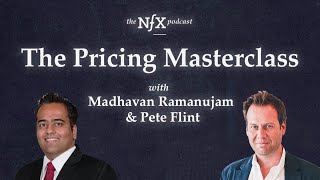
Madhavan Ramanujam breaks down why startups get pricing wrong and how to test willingness-to-pay before launch. He shows five pricing model families, explains why how you charge often matters more than the price itself, and walks through case studies like Etsy and Evernote that changed their models and saw conversion jump.
Questions this video answers
January 25, 2021.
72% monetizing-innovation failures.
Etsy's stock price rose ~40% on the day the changes were announced.
Changed from per-user-per-month to a per-user-per-device model (free ≤2 devices; pay for 3+). Reportedly nearly doubled conversion and moved from loss to profit within ~3 months.
Chapters
So, hi, Madhavan, great to have you on the NFX podcast today.
Thanks, Pete. Pleasure.
Well, Madavan, it's a real pleasure. You know, you're like the Jedi Master of pricing for startups. And a number of years ago, you wrote a wonderful book that I recommend to all my startup SEO's called Monetizing Innovation. And you're a partner and board member at Simon Kutcher, which has worked with with dozens and dozens of unicorns like Uber, Asana, Eventbrite, and Segment and many others. And so it's a real pleasure. And of course, Trulia. We worked together a number of years ago on a project at Trulia.
Yeah, that's right. I think it brings back good memories. I think I need to also make a note to myself to update my LinkedIn title, Jedi Master. I never heard that one before.
We at NFX love Star wars analogies, so maybe that sort of casting back to when we were together, truly, if I recall correctly, the business was scaling quite incredibly quickly. We were doubling revenue year over year, going public, and I think we had, in retrospect, an incredibly unsophisticated view about pricing. We launched a product, we were making money, things were going great, and I think we were at a juncture of really thinking about product evolution. The time that we spent together really enabled me to unlock the idea that pricing is incredible and underestimated, an almost magical lever. And so hopefully today we'll have on the NFX podcast a real sort of founders masterclass on your pricing philosophy and practices and also some practical tips for the founders and executives out there.
Absolutely. Look forward to it. That sounds good.
Let's dive in. We speak to a lot of incredibly talented founders and executives and startup advisors, and we hear all this advice around coding and design and hiring and fundraising and branding and culture. And actually, there's very little on the thing that many of them think most about, which is making money, growing revenue, and being profitable. And that's really where you spent your career in terms of pricing strategy and philosophy. And so maybe just from a high level, why do you think that startups have this blind spot with regards to pricing and monetization?
So I think that's really well said. I mean, over the last two decades, I've been spending time on this particular topic, and I witness how Silicon Valley especially has obsessed with creating amazing new innovations, but hardly put any attention to monetize them successfully. I mean, we used to get a call even saying, hey, I've built a product. We have been working on this for the last two years and oops, we need a price. And by the way, we needed it last week, right? I mean, when you couple that with, you know, the failure rate that we actually see in the Valley, then you start seeing some patterns when you take a step back. The classic phrase that comes to mind in these companies is spraying and praying. In other words, the fundamental issue for the high failure rate of innovation is that people build products without any clue as to whether someone will value the product or more importantly, whether they would pay for it. In other words, pricing or commercialization becomes an afterthought after building the product. And that is the core reason why many of these innovations fail. But then if you ask why is that the case, like why do people not pay attention to pricing, let's say from the very beginning stages of an innovation? I think the root cause is pricing as a discipline probably is, you know, not that often taught to CEOs in any kind of setting. Like for instance, in a business school you might learn quite a bit of like finance, operations, marketing, etc. But pricing as a course probably doesn't necessarily exist in many business schools. You know, pricing remains a bit of like a black box. Most people think of this as an art, but they don't realize that there are, you know, tools and it's actually more of a science than an art. And, and that's also where we've been spending quite a bit of time like sort of educating and demystifying pricing and putting more of the science and rigor into everyone's thinking. And I think when you think of it that way is then you can take a systematic view at monetization and have a short, long term commercialization strategy that goes along with it.
And then just, you know, obviously that sort of innovation and sort of software cycle has evolved substantially. You know, you wrote think of the book the root of all innovation evil is the failure to put the customer's willingness to pay for a new product at the very core. Core of product design hasn't kind of the startup ecosystem evolved to kind of match that.
So the startup ecosystem has evolved a bit to understand whether there is a product market fit. But I don't believe it is fully evolved to understand whether there's a product market pricing fit. And let me explain what I mean by that. With a lot of emphasis on things like, you know, lean startup, putting customers in the sort of center of innovation process. I think there is realization that you need to test and learn in terms of like building your products. But often this test and learn measures don't involve any kind of pricing insights. I mean, to give you an example, like for instance, the headset that I'm wearing right now, if someone asked me, do you like it? I would say, yeah, I like it. Do you like it? At $400? The whole conversation is different. If you don't put pricing as part of that product market fit validation, you're often hearing what you want to hear. So it's really about achieving product market pricing. And as a company or an entrepreneur, I mean, if you think about it, you don' to have a choice whether you'll have a pricing conversation with your customers. You can build your products and then slap on a price and have that conversation, AKA spray and pray, or you can actually have this pricing conversation much earlier in the innovation process. Test and learn, and then truly try to understand whether people value the product and are they willing to pay for it. And if not, ask the most important question, why? And often you hear so much insights and how you can design your products in such a way that you'll actually maximize your chance of commercial success. So I think while the ecosystem has evolved quite a bit in terms of test and learn capabilities, I do still think that there is a lot of room to grow in terms of testing and learning. Pricing and willingness to pay.
Maybe let's go there. So let's think of like, so nfx. We fund primarily companies at the product market fit stage. So what are like some practical tips, advice for founders at the sort of seed stage? You're like, how can I identify the willingness to pay for these actual startups? What are some things I can do today?
Yeah. So in chapter four of the book Monetizing Innovation, we actually write quite a bit about this. But in a nutshell, I would urge founders, you know, to start with ideas, you know, wireframes, blueprints, whatever it is, and start having the conversation with customers, first of all to see if their eyes light up, right? I mean, pitch the value to your customers and, you know, have that conversation where you're truly educating them about the value. Have that first and then ask the simple question, would you pay for it? You know, if someone says no, ask them the most important question, which is why, like we just discussed, and you hear information to really design your products in such a way that they will actually pay. I mean, if you think of this, you're kind of having a marketing and sales conversation with your customers much before you bring the product to market. And if they don't bite, chances are they won't buy it after the product is built either because you're going to have the same marketing and sales conversation. So counterintuitively, in fact, your customers are not even in a negotiation mindset and hence they tend to give you more objective information. So there's various ways that you can go about sort of asking the willingness to pay questions, right? I mean, and I can probably for your listeners, give a few examples or techniques just as a flavor stuff that they can try Monday morning when they're back in some ways, right?
Please just give us some frameworks.
Perfect. So at the very simplest way, after you've had the sales and marketing conversation, you know, put a price to it and say, would you pay for this at this price? And if someone says yes in your future tests, keep doubling it till you reach a point where, you know, people start reacting violently. You know, there's a really simple way to like really find out where are you crossing some psychological thresholds, right? I mean, just put a price. This is part of the conversation. I mean, to take the headset example, if I was testing and learning this, I would pitch the value and say, you know, 50, 100, 200, 400. And at some point it's going to break, right? I mean, just understand where is that? Another way to test this is to anchor people and test in a relative way. I mean, I can a tongue in cheek say that people are absolutely meaningless but relatively smart. What I mean by that is if you go and ask someone, hey, how much should I charge for this product? You'd get some garbage back. Because I mean, people don't understand magnitudes. They're not supposed to even tell you that stuff because that's your job. But relatively speaking, people are a lot more comfortable in actually making judgments. So for instance, let's assume you're a SaaS startup, you know, pitch the value, have the sales and marketing conversation and then switch gears saying, you know, things like, for instance, ask them, do you use Salesforce? If they say yes, ask them if Salesforce was, let's say, indexed at 100 in value that it brings to the table. Where do you think we would stand this trade off most people can actually make because you're actually asking relative to something they already know. So if they say 80, that means that, you know, your relative value is 20% lesser than Salesforce and so on. And then ask them the question, let's say if Salesforce was indexed at 100 on price, where do you think we should be? And again, this is something that people can actually make judgments For. So I think these are some simpler techniques. Things can get a bit more interesting when you actually do this more systematically. I mean, one of the interesting ways that we've also recommended in the book is to ask what I call the acceptable, expensive and prohibitively expensive questions. So these are ways to quickly identify psychological thresholds. After you pitch a product and have the sales and marketing conversation talked about the value, ask someone, okay, what do you think is an acceptable price for this innovation? Of course we know that people love to lowball, they love to negotiate with themselves. They'll give you an answer, clock it, then ask them, what do you think is an expensive price for this innovation? And then follow that up with what do you think is a prohibitively expensive price for this? What we have seen over and over again from many thousands of projects that we have actually done. Acceptable price tends to be the price where people not only love your product, but they also love your price. And if you're in a growth stage, you need a low friction price. Maybe acceptable is okay because it becomes a really, really no brainer. Expensive price tends to be the price that is more value priced. As in prices align with the value that you deliver. And people don't necessarily love you or hate you. They're kind of neutral. And that's that prohibitively expensive tends to be the price. People laugh you out of the room. I mean, these kind of things. If you do it at scale, like even through a, you know, let's say a quantitative survey, you start plotting graphs like we've shown in the book, which actually show you cliffs in the demand curve where there are some psychological thresholds across the population. And knowing these kind of things are important. I believe Rahul Vora from Superhuman talked about this in one of your podcasts. This is the exact technique that he used after reading Monetizing Innovation to really identify pricing in a Superhuman. We also talk about more advanced, let's say, methods of having the willingness to pay conversation, using, you know, trade off exercises and such. But I would leave that to, you know, people to read the chapter. And if there's one chapter you read in the book, read chapter four that's titled have the willingness to pay conversation and how to have it.
Yeah, and I remember vividly those charts which was like eye opening. There's a sort of, you know, and sometimes your intuition is right, but more often than not that it's wrong around these things because you're not as close in the psychology of the customer. And I think if there's other areas around segmentation and kind of how you charge customers as well. Thinking through those elements as well.
Exactly. And I remember back to the Trulia days, it comes down to like having that conversation and just doing it in some way, shape or form. Right. I mean, I remember when we were looking at the product, you came up with a new innovative, you know, idea around mobile leads. And I think your intuition, rightly so, was that mobile leads would be perceived to have more value than, let's say, a desktop lead for a real estate agent, and hence they might actually be willing to pay more for it. And I remember some of the debates where people were like, oh, are we going to double charge this for desktop versus mobile, et cetera. But when we went and validated this on your behalf, we clearly found the willingness to pay and we found these psychological thresholds that we talked about. And if you don't do it, you're never going to find out and you're just going to guess.
It's incredibly eye opening. Let's just say you build this framework and you understand this willingness to pay. And then for so many startups, the last 12 months has being like a roller coaster ride. Radical shifts in the market, radical shifts in consumer behavior. I'm curious, just maybe first at a high level, what have you seen as pricing expert in Silicon Valley, what have you seen happen to the way that startups have been and larger companies have been thinking about price? And just what is some advice that you would give to startup founders and executives?
So we are seeing, I would say at a high level, two types of patterns. Either your demand spike, like crazy demand was falling and often pretty fast. Nothing a bit in between. If you look at companies benefiting from the crisis, those would be companies like for instance in the video, conferencing space, delivery platforms, collaboration software and so on. Right. I mean, stuff that was already digital, but you need more of it during a lockdown period for these companies, you know, or companies where you're seeing a demand spike, it could be tempting to think about a price change in terms of an increased price because you're seeing, you know, more demand. So like classic economics would actually tell you that, okay, let's increase our price because we also see, you know, increased demand. But the obvious backlash is that you could come across as gouging your customers. And that is absolutely something you should not do. Right. Instead, a better strategy would be to focus on gaining as much market share as you can, but at the same time creating more premium lines of services. Because if you're onboarding many more Customers, chances are you can also sell more premium stuff to those existing customers. So like focusing on more of a land and expand strategy. Like for instance, if you are in a delivery platform, you know, creating a new line of service like rush delivery or like extra add ons that can be upsold to customers, those are the things that you really want to focus on if you're seeing a bit of demand spike. To like differentiate your products in such a way that you're still landing and gaining market share in a disproportionate way, but also preserve some expansion room using other products and innovations that you might actually be able to sell to them. But the far more dominant pattern I would say that we are seeing is, you know, companies losing some sort of demand anyway, 10 to 20% or even even more, and hence on average being 10 to 20% or a bit more down on revenue. For these companies, it could be super tempting to lower the price because they're seeing demand actually fall down and should they lower the price to actually gain back the demand, et cetera, lowering the price would be absolutely the wrong thing to do in most situations. If you lower the price, it does not mean necessarily that you will get the demand. In these kind of situations that we live in, what you rather want to do is think about probably options that you might have at your disposal that could probably achieve the same purpose but without dropping your price. I mean, if you drop your price, you're necessarily going to be training your customers to expect your service for less when things pick up. Again. The one rule that I give startups is think of three non pricing concessions before thinking about dropping price. So for example, can you give more product and preserve the price? So like if you had let's say a good better best product lineup and you're seeing drop in demand, can you actually give a better product or best product preserve the price to your customers so that they won't actually leave. Can you be more flexible? Let's say with payment terms, can you work on a risk or reward basis? Can you bundle products and create a white glove service? There are various things to actually do to actually see if you can achieve or perhaps even create a lower entry offering like defeature the products and create a low entry offer that people can actually take during these times so they still are in the system but at reduced value. Essentially keep price and value alignment intact even during these kind of tough times. I mean some examples of things that really worked well in the last recession, for instance, I mean like flexible payment terms really helped Hyundai in the last recession when they actually said something like return your car if you lose your job, their market share increased by 5x just based on some of those kind of adjusted payment terms kind of mechanisms. One of the startups that we actually recently worked with, we changed the entire licensing model to be more of a usage based rather than a fixed fee. By this way, we did not lose a single customer because if you're not using the product, you're actually not paying for it. But if you're using the product, you will pay in alignment to the usage. You know, I mean you can think of this software as a software that serves the leisure, travel and tourism industry, which is, you know, pretty much really impacted really bad. Right. I mean, so of course, I mean switching to a usage model actually really helps because this is something that they actually wanted to do over the years, but this gave them a unique opportunity to actually do it. And when things actually pick up again, the prices now going to be aligned with value and it's not going to be just a simple, let's say per month, per user kind of subscription, but more on a usage basis. They have not only kept their customers and reduced their churn risk, but they will recover when things actually become stronger. So I think there's a lot of pricing lessons that startups can actually take from the last pandemic, but it's at the highest level, testing and learning. Pricing during these times has become that much more important because all the stuff that you knew about your elasticity has gone out of the window.
It's interesting how certain startups which have kind of meaningful scale while customers are kind of struggling and there's definitely a willingness to add to give customers a break. Then the switching costs are so high and the substitutes are so poor that some of these companies just, they come out of the recessionary environment incredibly dominant, you know, and it's through the test of time, whether in 2001 or 2008, these platforms come out of it in incredibly strong position. So that's super helpful.
Absolutely. I think like the saying goes, when there is a strong wind, some people take shelter. The best ones build windmills. Some or so you need pricing windmills. Right.
I love it. So in your book you mentioned five pricing models that stand the test of time. Clearly there's kind of not one size fits all. Maybe just touch a little bit on like the different pricing models that you found to be kind of most common and successful from your research.
Yeah, I think before we get into the five pricing models, I think one tip that I would definitely want to leave with your listeners, which we summarize quite succinctly in the title of that chapter. It is how you charge is often way more important than how much you charge. And this is an aspect that most people actually neglect because when they think about pricing, they're thinking about a dollar figure which is just a price point. How you charge is way more important because you can align price with how your customers perceive value. And if you do it in the right way, then you have a winning model. Choosing a price point becomes that much more easier in a sense that even when there is a break even kind of situation, people have an inherent preferences for you pricing models. And we often do this interesting exercise with our clients customers to like truly understand what model might actually make sense. And this is something that your startup founders can do, let's say Monday morning when they get back. I mean the idea is to put people through break even situations. So for instance, let's assume that I'm an E commerce platform and I'm charging based on a commission structure and let's say their customer is selling something at $10. If you ask them, you know, which of these following fee structures is more appealing to you. And if you say, let's say you know, 3% as a commission, you know, or you might say 30 cents or 1.5% commission and then 15 cents or you're indifferent in among these options, you know, if you're an economic rational human being, you would say you're indifferent because all of the math adds up to the same thing. Right? But we've literally not found a single case where people would actually say this in a dominant fashion, which means that people have an inherent preference for what makes sense. What we've seen is like for instance, in these kind of examples, if people gravitate to, let's say the 3% that actually intuitively makes more sense to them than a flat fee. So this goes back to your sort of example of HomeAway and Airbnb and others. And if you tap into this and you identify pricing models that just make sense for your customers, then you're often unlocking a lot of magic because then you're aligning your pricing with perceived value automatically. I mean, there are companies like for instance, AWS that pioneered some of this also. I mean based on a usage basis or a metro mile is insurance on a per mile basis. So don't just run to coming up with a price point. Think about pricing models. And I think how you charge often way more important than how much?
Super. Yeah, it seems a simple thing, but if you can unlock that, then absolutely breakthrough pricing innovation.
So to go back to your original question of what are the five powerful monetization models that make sense, we wrote about subscription, which I think is pretty obvious for most people. I mean this is charging on a per month basis. If you're a software, it might be per user per month, etc. One caveat though I would mention mention is don't just rush to a subscription on a per user per month because that's the most familiar model for you. Really test and learn if that is the right model. And even if you're on a subscription basis, what is the right metric to actually align your pricing is key for you to actually think about. We also talk about dynamic pricing which is becoming increasingly more important, especially when the world is moving way more digital. Having the ability to actually flex your price based on supply and demand thing is becoming, becoming a thing. And even in many consumer situations where it was thought not to be possible, it's actually becoming more and more possible because you can hyper personalize an offer to a customer through a combination of pricing and promotions. So dynamic pricing I think is really important. Market based pricing or auction based models are also equally getting back a bit more in vogue and trying to see if that's an option that actually works for you. The pay as you go metric, or aligning more on a per usage kind of metric is probably now one of the hottest trends in SaaS companies where people are thinking about is there a usage based metric or a usage based model that I can come up with? Because often when you just have a subscription price, you're capping out on your monetization potential. Of course you're giving predictability to your customers, but truly your price is not necessarily aligned with usage of value that people actually derive. So if you can unlock a pay as you go kind of model, like Snowflake for instance, is something that we saw recently that could actually be really meaningful. And the last one that we talk about in the book, we talk about it as more of as a pricing model, which is something that people really need to think about is the freemium pricing. To us it's more of a model than a strategy because if you're really having a freemium pricing, the key is to have a proper expansion motion from the land of free to expand to paid offerings. Many companies that actually put out freemiums don't think about this very strategically and often have given the farm away. And there's no Room to expand. Because funny enough, what we find time and again, I mean, Parito's rule probably applies to, you know, customer value and willingness to Pay as well. 20% of what you build dictates 80% of the value. All of the entrepreneurs and startups build this 20% of things pretty quickly and they call it an MVP and throw it out in the market. But they've given away 80% of the value and then they obsess over 80% trying to build stuff that's only worth 20% more. And they don't have any room for expansion. Right. So before rushing into freemium, think hard about it. And if you do do it, do it in such a way that there's a proper land and expand motion or restrict a premium usage beyond a certain point so that, you know, there's a natural expansion that happens in your customers. But these are the five, you know, sort of pricing models that we talk about and someone needs to think about before rushing to pricing.
That's super helpful. Yeah, I can see many examples come to mind. When you say giving away the freemium model. Giving away. And like you say, think about price almost before product, which defines the strategy. So we've talked a lot about, about successes in pricing. Let's talk about some of the challenges, like how startups fail and mistakes that teams make when they're thinking about pricing.
We were able to run some of the world's largest studies on pricing, monetization, et cetera. And routinely we try to understand what is the state of the union on pricing per se. And the last time we ran this, it was across 2000 plus companies, predominantly C level people, taking some of our studies. And we're trying to understand what is the success or failure rate of innovation and why that is happening. And what we find is there's 72% monetizing innovation failures. Let's leave it at that. Right? In the sense that 72% of innovations don't meet the light at the end of the tunnel. That's actually pretty high. And it's not just us saying it. I mean, if you look at Harvard Business review, you'd see 8 in 10 startups fail. The cool thing that we were able to do is to zoom in back across the thousands of projects that we've done in pricing and then try to understand what are the failure types. And when we look at it, it only comes down to like four monetizing innovation failure types. And when you recognize these four, you can actually avoid these four and build the fifth category, which I call breakthrough success. So in a nutshell, the four are as follows. The first one is what I call as a feature shock. So these are products where there's simply too much going on. It's over engineered, often over featured. And because it's over featured, it's overpriced and it just doesn' not sell. Right. I mean, it happens in the best of companies. For instance, Amazon, one of the most successful companies of our times, when they build a fire phone. There was a plethora of features that people simply did not need that was well documented, I think by MarketWatch. And one of them was even four cameras that could actually track your eyeball moments so that you didn't need geeky glasses to get 3D perspective. Sounds cool, but would you pay for it? No, right? I mean, the phone launched at $179 in literally six months. It was 99 cents. And they rolled off the business another three months. It was an over engineered, feature rich product that no one simply wanted. The way to avoid a feature shock is to build versions of the product so that you're not trying to build a what I call a one size fits none, but you're sort of rationing the product based on different types of customers. You actually might have the second monetizing innovation failure that we often see, especially with the ones that actually have a product market fit is what we call as minivation. So this is a failure type where you probably have the exact right product market fit, a lightning in the bottle, but you just have the courage to charge the right price and you undervalued your own innovation. Right? So you basically charged much lesser than what you could have charged. Just to give you an example, for instance, one of the semiconductor startups here in the area, they came up with a groundbreaking chip that was supposed to revolutionize consumer electronics. And they were thinking about how to come up with the price. They said, okay, the last generation we priced at 60 cents. Okay, maybe this is really groundbreaking and we have to understand undo Moore's law and we can't be pricing it less than the previous generation. Let's do this as 85 cents. You know, I mean, this product flew off the shelves. But the sort of hidden secret in the room was everyone knew that they could have done better in pricing. And they did a postmortem for their own pricing. What they found out was these consumer electronics companies charge up to $50 premium from people like you and I, because this part was actually inside those electronics. So if you look at the economic value of $50 generated 85 cents. That's simply not fair. And in fact the companies participated in the postmortem were joking that you could have charged up to $5 and we wouldn't have blinked an eyelid.
Right.
I mean, so if you didn't have the right courage to charge the right price, you're under monetizing and producing an innovation. The third type of monetizing innovation failure we see is what we call as hidden gems. So these are products that simply go against your DNA, your company and you probably don't bring it out because you're worried about cannibalizing your existing business. And if you don't go looking for it, you're never going to harness it and find this hidden gem. I mean classic example of a company company that failed to do this was Kodak which had, you know, the IP for digital photographs back in 1973 I believe, but never productized it because they were just worried about cannibalizing their print business. And the risk is a bit in history they're living mostly on patents. And you know, a company that probably did this successfully is someone like autotrader or cars.com, which actually got launched by the Atlanta or the Chicago daily newspapers when they realized that, you know, the age old advertisements in newspapers was going to go away because of the inflection of the Internet and they actually built two sided marketplaces because which are now multi billion dollar businesses in their own rights. Hidden gems often happen when there's an inflection point and this is actually pretty crucial especially given the last pandemic year. Right. I mean when companies try to switch from offline to online or when you're having a software business, but you also want to pivot to hardware or the other way around. Whenever there's an inflection point, often there's a hidden gem waiting to be uncovered.
And it's the startups which are the fastest moving and they've got less than sort of competency baggage which can take advantage of, of that.
Absolutely. But if you don't go looking for it, you're never going to find it. They remain hidden. So I think knowing when to pivot, what to actually do, is that a hidden gem? I think it's startups definitely have an advantage over more established companies because there's a bit of like in their DNA. The fourth monetizing innovation failure that I talk about, probably my favorite is what I call as undead. These are products just like in classic science fiction movie fashion. You should have never launched it because they come back to haunt you. And they come in two flavors. Either they're the wrong answer to the right question question, or they're an answer to a question no one cares about. Either way, you shouldn't have productized it, but you threw it in the market and, you know, hope for the best without understanding the product market pricing fit. A classic example of this was, you know, Google Glass, which was, you know, thrown out of the market for $1500. Probably lived with a paparazzi for a few weeks before it was gone.
And that just creates massive internal disruption and distraction and then obviously just brand damage as well. Are there any frameworks to help founders think through how to avoid these failures? Any, any kind of quick sort of perspectives for founders to avoid these failures?
Yeah, so we actually write about a nine step framework in monetizing innovation to avoid these kind of failures. It starts with having that willingness to pay talk early, without which you can't really prioritize what you're actually building and integrating pricing and willingness to pay into the product design process. And it ends with maintaining your pricing integrity and avoiding knee jerk reactions when it comes to pricing. I think probably some of the key steps in the framework for startups that people have to probably internalize is, I would say probably summarize it as having the early willingness to pay conversation is truly important. You know, don't default to a one size fits all solution. I often call it one size fits none. Like it or not, your customers are going to be different. So understanding segmentation and differentiation is at the heart of monetization. That's an important lesson in the framework or step in the framework we already talked about. You know, how you charge is way more important than how much you charge. The pricing model is an important step in the framework and how to determine that having the right monetization strategy is important in the sense that are you skimming, are you penetrating the market or are you sort of maximizing short term goals? Trying to understand what the strategy is and how to pick one is important. And I would probably say last but not the least, if you don't speak value, no one will get it. And this is a mistake that I see startups do time and again, as in they're so obsessed over building products and are probably more engineering focused that they talk about features and they don't talk about benefits. I mean, benefits is what people get. Features is what you build. You need to RT articulate benefits and speak value and not speak features. And we've seen actually double digit improvements in revenue by just changing the articulation of value. And I think that's a really important step in the framework.
Yeah, I've seen so many kind of radical improvements just in, I don't know, our time at Trulia, just working through some of the messaging, some of the imagery, some of the selection of products which can have this radical impact. So maybe just think about, we talked a little bit about Trulia before. I think it'd be great again to a couple of examples. We talked about Trulia, how we worked on the kind of mobile product and that was, you know, one of a couple of breakthrough projects we worked with. Maybe if you're willing to share a couple of examples, companies you work with and breakthrough kind of products, maybe start with Etsy. You know, the last year we talked about earlier in the conversation around how the pandemic has kind of changed a company's trajectory. And I think Etsy has just had a remarkable year. And maybe just share a little bit about, you know, how you think about Etsy and the kind of work you did with them, which I think started pre pandemic.
Pandemic, yes, exactly. I mean, we worked with them in 2018 timeframe and what Etsy did was they actually changed their pricing model and they also rolled out at that time new monthly seller subscription packages. And that was based on work that we had done with Etsy. I remember the Etsy stock price. There was something like Left 4 Dead, Etsy stock price comes roaring back. That's literally what happened. On the day the changes were actually announced, the stock price for etsy increased by 40%. And then a look back in some way, shape or form, Josh, the CEO actually announced that the most significant news of the second quarter at that time was the change in pricing. And they actually announced this and the street rewarded them. But more importantly, what they were able to do is to align that price with the value that they delivered and also create these sort of seller subscription packages that would right size customers to the right product for the right value that they actually needed at the right price, rather than having again, a sort of one size treatment across the board. So I think many of the lessons that we talk about in monetizing innovation actually applied in that particular case as well.
I mean, it sounds like it's hard to understand the numbers, I think in abstract, but just having worked with you, the projects here are kind of not like flipping a switch. There's kind of months, if not years of work. But you know, one change delivers 40% stock price increase and it probably, you Know, I don't know the exact numbers, but the revenue increase over time is certainly higher than that. So it's like the leverage at scale is just unbelievable.
Absolutely. It's a gift that keeps giving. Right. Because it's not just that one time activity, but it's an annuity in some way, shape or form. Right.
And then some of the other companies, so perhaps Uber or Evernote, I know you've worked with them.
Yeah, for Uber. What we actually did with them and I discussed this because we had even a press release with Uber that we helped them design the, you know, Uber rewards or loyalty program. So if you actually open the Uber app, there's a systematic way to actually actually, you know, sort of earn points based on your spend patterns and use those points to qualify for reward tiers and also redeem these points in a sort of reward store to actually gain, you know, rewards back for the points that you actually earn. So this entire loyalty program, you know, design, we actually helped them with and helped them operationalize it. This gave a proper mechanism for Uber to invest in their customers, you know, especially the ones that, that were providing value to Uber to really invest back to actually earn their loyalty, so to speak. I mean, the thing with pricing is monetization is a really broad topic. I mean, you really need to think about your customer lifetime value. And when you think of it that way, loyalty programs are at the crux of your overall strategy, so to speak. Especially many cases, a loyalty program when combined with other things can actually make a lot of sense. In many, many, let's say marketplaces, there's a lot of emphasis to give promotions, probably disproportionate amount of promotions to gain kind of demand. But promotions end up training customers only one way. As in when promotions actually exist, people are in the boat. Loyalty programs are a bit more sort of, you're giving something, you also get something back. And what you're getting back is people's loyalty. So focusing on customer loyalty is critical in many of these sort of marketplace companies. And that's why what we actually help Uber with.
Curious. Just from a. There's often sort of two schools of thought. The best, you know, loyalty is driven by kind of product satisfaction and just, you know, perhaps Amazon is like, is very much focused on that approach. And then an Uber obviously, you know, chose the rewards like in what environments, you know, whether that's competitive set or kind of product set. Should people think about a rewards program?
I would argue Amazon has a rewards program which is of course different than Uber's in the sense that it's a paid membership ship through the form of prime. Right. I mean, and if you look at prime, the key proposition is that, you know, you eliminate all kinds of shipping costs. A membership program really works well when, you know, there is a single or probably a handful of pain points that everyone has. And if you pay for a membership, those pain points go away, like the, for instance, the shipping cost. So I think in those kind of situations, a paid membership could actually make sense. For instance, even in, you know, companies like food delivery platforms, if you have a subscription that actually gets rid of all the delivery fees, that actually is usually a home run in many kind of situations. Right. I mean, so I think those kind of things I would broadly classify as membership programs, not even just subscriptions. In those situations, a membership or loyalty program makes sense. In other situations where, you know, let's say you're in a situation where it's highly competitive in some way, shape or form and you need mechanisms to, you know, keep your customers, keep them coming back. Things like, you know, loyalty programs with points and redemption structures makes a lot of sense because in a way, you know, endowment effect can kicks in in the sense that if you actually give something to people, they value it way more. And if you points and other mechanisms, people actually start expressing their interest and loyalty to a brand because they actually have some skin in the game and they have some points, et cetera, which they actually hold. And we've seen over and over again that you're creating an alternate currency, but the value of this currency increases a bit irrationally when you have loyalty kind of constructs.
So maybe Madhavan just switching to Evernote, that's another company work with which, if I recall back a number of years ago, was highly criticized online media about the trajectory of the company. How did you work with that company and what were some of the lessons from that engagement?
Yeah, in fact, if I remember, Business Insider called them the first dead unicorn in 2014. Right. I mean, it was really tough times. We actually worked with Evernote in 2016 and the core emphasis was trying to understand how can we accelerate more conversion from free to paid, and what is the right packaging and pricing strategy. We tested a whole bunch of things on behalf of Evernote on what is the right product sets, what are the right features that go into products, what is the right monetization model, etc. Etc. The key nugget came down to changing the monetization model. What I mean by that is, I mean, they used to charge based on a per user per month kind of model. What we actually changed this to was a per user, per device kind of model. As in if you actually go and try to use Evernote today, if you use Evernote on two or less devices, then it is free. If you use Evernote on three or more devices, you need to pay for it. And this was a change in the monetization model which greatly benefited them when we operationalized this 2016. And they in fact ended up almost doubling their conversion and in three months switched from red to black. And we coincidentally also ended up writing a Harvard Business case with them on how to turn the elephant and the Evernote monetization strategy. But at the heart of it, it totally made sense because it was also aligned with how people perceive value. I mean, if you're using Evernote on three or more devices, it is more accurate in with, you know, getting all the benefits of a cloud based, note taking kind of structure, you know, premium users with MaidSense. And if you're not, then you don't pay for it. Right. I think that was a key example on how you charge is way more important than just how much.
Fascinating. So maybe just to end with like, let's take a step back and you know, obviously you've spent your career studying kind of pricing and monetization. Like I'm curious, like taking a step away from startups and technology. Any advice for the listeners out there that just like, how can you apply some of these principles to life? In some ways we're all products. In some ways we have features and we have bugs, but you know, we're all products in some way. And like, how might, you know, like engineers or professionals or teachers, like how should kind of people think about, how do they kind of effectively you know, create the value that they deserve in what they do?
That's quite deep. I've never gotten that question before. Let's talk about pricing philosophy. I mean if, if I have to abstract this at the highest level, at some point people need to realize what value they bring to the table and what price or let's say rewards or compensation that they actually need to get in proportion to the value that they actually bring to the table. So I think the lessons from price and value sort of equate even in our own lives to some extent. I mean, the Latin actually had only one word for price and value. It was called pretium. I think they figured out long back that value and price are the same reflections in some way, shape or form. So for example, for instance, if you are, let's say in a position to negotiate your compensation. All of the methods that we talk about in terms of, let's say anchoring, tapering and all of these kind of techniques to negotiate when you are in front of a salesperson probably also applies to you when you're also negotiating about your own compensation packages in some way, shape or form, or put another word, putting yourself in a situation where you have stake in the outcomes at the becomes way more important because then you're aligning yourself to the value of what your entity actually provides. So I mean, kind of partaking in the overall equity or value generation of your company actually becomes that much more important. I think that's a bit of a life lesson in some way, shape or form. I mean one of the main reasons that pushed me to even be a partner in my current firm and I would probably argue that that's a better monetization model for yourself in some way, shape or. Or form. Yeah, I mean I think that those could be some interesting life learning. And I would probably say the third one if you're pricing your own you said we're all products, which is a really interesting take. I mean, sounds a bit like science fiction movies, but let's go with that. If you're all products and we are pricing ourselves as in pricing our own services, let's say you're a contractor or a consultant or come what may, if you're pricing your own services, avoiding a cost plus mentality is critical. I mean, don't just say, okay, it's $100 per hour or something. And that just makes sense because I mean, you want to align your price with the value that you actually bring to the table rather than a dollar per hour kind of defaulting, which is easy to do, but often the absolutely wrong thing to do. And thinking about more value based pricing or pricing based on outcomes is also something that you want to think about if you're pricing yourself or your services.
It's fascinating. Well, maybe with that madhavan, this is just a fascinating conversation. Thank you so much for joining us today and again, monetizing innovation. Terrific book and thank you for your perspectives and thoughts. Really appreciate it.
Thanks Pete for the opportunity. Really loved it.
Wonderful. You've been listening to the NFX podcast. You can rate and review this show on Apple Podcasts and you can subscribe to the NFX podcast on Apple Podcasts, Spotify, Google Podcasts, or wherever you get your favorite podcasts. For more information on building iconic technology companies, visit nfx.com.
More from Madhavan
Delphi's Library of Minds Episode 11 - Monetizing Expert: Your Pricing Is Killing Your Startup
How AI is Forcing Startups to Rethink Pricing with Madhavan Ramanujam | Ep. 5 The NFX Podcast
Pricing your AI product: Lessons from 400+ companies and 50 unicorns | Madhavan Ramanujam



Madhavan Ramanujam (Managing Partner of Simon-Kucher & Partners) on pricing strategies for growth