Unleash Your Superpower
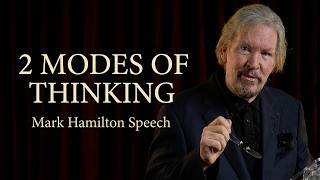
Mark Hamilton argues humanity has been trapped in a 2,500-year mental cage created by hierarchical authority, tracing it back to the Axial Age and Julian Jaynes' bicameral mind theory. He proposes the NeoThink system, AI integration, a legal principle called the Prime Law, and a physical zone called Neovia as tools to unlock human potential and create "superhumans" capable of unprecedented thinking and creativity.
Chapters
Hello. So it's an honor to be here with you today. We have a lot to go through, so I'm going to get right into it. Oh, by the way, when I look over here, I'm looking at you. So I will be looking back and forth here and then to the camera and back to you. Okay. All right. So today I want to— well, I want to present a problem that we have lived under or within for the past 2.5 millennia. Tomorrow, over the next 2 days, and specifically when I come on tomorrow, I am going to remove that problem. All right, isn't that the nature of everything we've done at the NeoThink Society? We identify the problem and then we remove the problem. That, that's what makes NeoThink so valuable to so many people. The problem: there's been a cage that has been put over and around our consciousness. What makes us human, our consciousness, what separates us from the other animals. There's been a cage put around our consciousness for all of civilization. All your greats have also been in this cage. Your Elon Musks, your Steve Jobs, your Henry Fords, they've all lived with this cage put around their consciousness. There's a superpower that you have never experienced, nor has the world, nor has civilization. There is a superpower in our consciousness. And today and tomorrow, during these Days of Enlightenment, we're going to open the cage to give you a way out so you can experience, so you can unleash the superpower of your consciousness. So let's begin. Historians have always expressed and seen history in segments—in countries, nations, religions, governments, regimes, empires that rise and fall, periods of great art and science rise and fall. Different ages. We have great age of Pax Romana. Then we have the Dark Ages. We have the Renaissance. We have the Enlightenment. We have the bloodiest century, the 20th century. We have all these different segments throughout history. And that's how the historians and the scholars have always presented the past. But there is, there is a way to bring all these segments, bring them all together into one easy-to-understand unified field that explains what happened every step of the way. Brings it all together into A puzzle picture. NeoThink. A NeoThink puzzle picture. A unified field of humanity, of conscious civilization. So let's go through history. Let's pull together the pieces to the puzzle for the first time. Let's see history as a unified field. And how do we do that? Well, the way we do that is not to look at history through Governments, you know, capitalism, communism, socialism, or through regimes, through, you know, the Hitler regime, the American founding, freedom, tyranny. All right, those are all ages and epochs of history, yes. But we can snap it all together by going to the very most important component of humanity, and that's our brain, our minds, our consciousness. There is a man named Carl Jaspers who talked about the Axial Age. He was amazed about how during a short period of time, from about 800 BC to about 200 BC, how across the world in civilizations that never communicated or had any access to each other, at the same time rose this incredible transcendent of philosophy. These great thinkers. In China you had Confucius and you had Lao Tzu In India, you had the Buddha. In Israel, you had Elijah, Isaiah. And in Greece, you had Socrates, Plato, Aristotle. All during the same time. You see, prior— Jasper's pointed out that prior to the Axial Age, Humanity was run by ritual, by external authority, by inherited beliefs, by gods, by kings. Man was guided tribally from external gods and kings and rituals, but he didn't He didn't understand how man turned from this external guidance into these deep inner studies of the human mind or consciousness. These great philosophies that rose around the world during the same period of time with no communication between civilizations. He was amazed. And he didn't have an answer to it. And he conceded that future generations will figure this out. Well, a half century ago, in 1976, this, this publication, The Origin of Consciousness, The Breakdown of the Bicameral Mind by Julian Jaynes, who was a professor at Princeton University. He psychologically explained what happened during this time, the Axial Age. He identified the bicameral mind, which I'll spend a moment here and explain to you. The bicameral mind. 3,000 years ago, we were essentially, we were by far the most intelligent of the animals. We had a much larger brain than all the animals. In fact, we were so intelligent that we developed primitive language. Now, the animal kingdom, propagation of the species, survival pressures, Mother Nature guided animals in times of stress. All animals, yes, including humans. And it guided us through the same process, through strong impressions. So let's take an animal, a rabbit or a deer. A prey, and they're in an environment when suddenly they sense through smell or sight, they sense a predator approaching. Well, Mother Nature in this time of stress would move in with a strong impression that would command, would direct the animal on how to behave. For survival. Or say the animal were in a forest and suddenly there was great heat and flames, forest fire. Again, in times of stress, Mother Nature would swoop in with a strong impression and it would cause the animal to turn and flee. Same impression if a predator were approaching. Strong impressions. Mother Nature. Survival. Survival of the species. Now, humans were no different in that regard. Mother Nature guided us. Mother Nature would come in with a strong impression during moments of stress, times of stress. If we were in a situation where predator approaches, say a lion or tiger or mountain lion, well, Mother Nature would come in and that's a time of stress and come in with a strong impression to guide us, to guide us, and we would obey that with the utmost obedience for our survival. Mother Nature was looking out for our survival. So, without any challenge, with complete obedience, we would obey that command from Mother Nature. Now, humans were much more intelligent than the other animals, and we had developed a primitive language. So, Mother Nature is going to use the greatest efficiency on that strong impression. So if a predator approaches, Mother Nature has much more, much more capability to have us survive that situation by using our language. Now here's how this all happened, and this is from Julian Jaynes from the bicameral mind mentality, his theory, which by the way, in my new, uh, NeoThink manuscript I think Josh had referenced. The title of that is Unleashed. Where did that come from? Well, we are going to unleash your consciousness, my friends. Unleashed. The subtitle is The Promethean Promise: The Power of the Gods Wielded by Humans. All right, back to Back to Mother Nature and times of stress for humans. And Mother Nature is going to use the greatest of its capacity to give you the strong command for you to obey for your survival. And that command is much more effective coming to you in your primitive language. Now, let's step into what our mind was, two hemispheres, the left and the right hemisphere. The left hemisphere was more the action brain, what you're doing, okay? You're eating, you're picking, you're traveling, you're preparing for gathering, you're preparing for battle, you're preparing for sleep, you're preparing to eat. This is the left brain activity. Now, the right brain, as Jaynes points out, is much more aware than your immediate left brain. It absorbs everything that's going on around you. So your right brain, to protect you, will give a command to your left brain because it has much more knowledge about your, say, your environment. The right brain may have detected a cave nearby, or it may have detected a river nearby where your left brain is just looking at the lion. The right brain, using the survival mechanism to give you in this moment of stress a command to obey, will say whatever is going to be most effective for your survival. So your right brain might say, "Run to the cave. Turn to your right, run to the cave and take cover." because it would perceive that would be your best chance of survival. Or it might say, run downhill to the river and swim. It might, with much more capacity to know your surroundings, the right brain is going to give you the best course of action. And you, as a, in a survival mode, you're going to listen to that voice, that voice of the gods. That's how you look through ancient literature, Gilgamesh, or the Iliad and the Odyssey. You see they always talk about the gods and the gods and the commands and what the gods tell them to do. This is what was happening. This is the explanation that they had for the voice, the voice of the gods, which they unconditionally obeyed. This is the bicameral mind. As explained by Julian Jaynes. So you have this unconditional obedience out of survival to the voice of God, of the gods. Now to expand that a little bit, you had thriving civilizations and there was a hierarchy, the pharaohs or the god kings, the kings, were more proficient at communicating with the gods, with having these audio hallucinations. So they would come out and they would speak to the masses, and it would be the voice of God to the masses. There was no judgment. There was no deceit. Just as in an animal, a beloved dog, a dog cannot lie to you. Because it's just guided by nature, by Mother Nature. It does not have the capacity for deceit or lying, for example. Neither did bicameral man. You only had the ability to survive, and you had a hierarchy and a structure which became very efficient. You had the pharaohs, the god kings, who would guide civilization for its greatest survival. During times of drought, during times of floods, during times of stress. And you had oracles, and this is all part of— oracles were very efficient. These bicameral peasants, often young women, young girls, could very effectively have the right brain step in and give these audio hallucinations. And they were the best direction to bicameral civilizations. And why is that? Remember when I told you the right brain, the right hemisphere of our brain, took in much more information than our left brains, our external stimuli response of just our immediate surroundings? But the right brain takes everything in. So the voices of the gods were very effective of guiding these bicameral civilizations. Very effective. Until it wasn't. And the way this all broke down was when civilizations began to intermingle. You had trade. You had conflict. You had different primitive languages. You had intersex. Things got more and more complex. Civilizations became more and more complicated. And the voices became contradictory, which led to loss of survival. It was actually— the voices actually became harmful and damaging because the complexity became— grew too great. So civilizations began to break down as the voices began to break down and began to give contradictory messages. And then the voices went silent. You see, Mother Nature could no longer guide the complexity of humans. We were different than the other animals. Our civilizations became far too complex for Mother Nature to guide us for survival. The breakdown of the bicameral mind. Now, what happened during this time? Well, first imagine this. Imagine that if you can— now I've done this myself, I've meditated about this format of the mind, the bicameral mind. There's no inner mind space. This is it, what's right in front of your eyes and your smell, your hearing, your touch, your taste. It's just your perceptions and it's external stimuli. There's nothing inside your mind. There's no inner mind space. It's stimulus-response. The bicameral mind. And imagine suddenly your guidance system to survive vanishes. This is why you see these great colossuses and pyramids and these awe-inspiring symbols that rose during this time. They were trying to, to bring back the voices. They were trying to create these awe-inspiring figures to trigger the voices for guidance. They needed guidance. They were falling apart. They were lost civilizations. This was an extinction moment. Great wars. History shows great wars across the world. Civilizations tearing themselves apart from the inside out. Because they were lost. They didn't know what to do. Their guidance was gone. Their minds were blank. There was no inner mind space. This brings us to the axial age that Carl Jaspers identified, but he did not understand fully. As language became a little more sophisticated, as there were trade routes developing and intermingling of civilizations, language became a little more sophisticated. And here was the big breakthrough, the aha moment, the big bang of our inner mind universe was the metaphor. The metaphor. The metaphor uses something to explain something else. And what that allowed was, for the first time, a separation from this— what's right in front of us. To be able to step back a little and use a metaphor to separate from the world directly in front of our eyes. The metaphor was the great linguistic breakthrough of humanity, and that opened the inner mind space. And this is what Carl Jaspers wrote about this internal reflection. He didn't fully understand how it happened or where it all came from, and he knew that future generations would figure this out. Julian Jaynes, a great psychologist who studied schizophrenics— this is how this all began— he figured this out through his science. Now, the academia have not accepted Julian Jaynes, and I understand why. I understand why now. But in my new NeoThink manuscript, the evidence, it's proven. It's so overwhelming there can be no debate. So Carl Jaspers, Julian Jaynes, and now Mark Hamilton, this all comes together into this unified field to explain all of humanity. Every step in humanity, every moment, every epoch that the historians have studied will now be explained. And I'm going to walk you through this. So Julian Jaynes, the bicameral mind, the breakdown of the bicameral mind. Suddenly, the axial age these great philosophies that all of civilization for the next 2.5 millennia are functioning off of these original philosophies. Unbelievable. But we'll explain why that is. So I'm going to, I'm going to zero in, I'm going to hone in on Greece, on Athens, on Socrates, Plato, and Aristotle. And then we'll take it from there. I'm going to start with Socrates. So Socrates was a fully conscious individual, fully conscious, in Athens. You were still struggling with the people who many were bicameral, far more bicameral than conscious. And then you had these half-conscious people who were walking around with some inner awareness, but no internal agency. They are, they are living by inherited beliefs, by things that have been passed down, beliefs that have been passed down from what they've heard outside of themselves. And yes, from growing philosophers and philosophies. They're latching on to history, to tradition, to ritual. There's some inner awareness but there's no internal agency, where there's no internal causality, where they are perceiving reality and internally building that, observing and building it through reason, through integration, into identifying through internal agency, identifying and forming, seeing what reality is around them. They're half-conscious. They do not do that. But Socrates was fully conscious, and he would walk around and teach. He would teach people, these half-conscious as well as bicameral. He would teach them, and fully conscious as well, through the Socratic method is what what we've titled it, the Socratic method, by asking questions, very poignant and deep questions. What is justice? What is good? What is honesty? And they would begin a conversation, and the interlocutor would believe at first that they're handling the conversation fine. But as Socrates continued to probe deeper, they would discover to their dismay and create great stress that they really didn't know reality, that they were really just inheriting beliefs from around them, and they weren't developing it from the inside out. They were taking it from the outside in. Now, when you understand those times, this was causing great stress throughout Athens. The youth loved Socrates, but those in power were threatened because once you bring internal authority to the polis, to the people, to society, there's really no more need for external guidance or external authority now, right? So as you'll see, this will be the big challenge throughout history. We're starting to come upon the problem. So the results: they put this great, great man to his death. Drinking the poison, the hemlock, executing him. Now, there's a wonderful, huge story about Socrates that I address in my writings, but we must move on now to Plato. Plato, he was Socrates' favorite student, and Plato loved Socrates. Plato was born into the breakdown of the bicameral mind, chaos, the Peloponnesian Wars. Athens was sacked by Sparta. This was the environment. And then Plato sees his beloved mentor. He idolized and loved Socrates. Executed before his eyes. This created enormous trauma in Plato. Enormous trauma. Plato was a brilliant man. Brilliant. A philosopher. Up until that point, in a class of his own. Now, I want to just jump forward for a moment. To a great hero of mine, Ayn Rand, philosopher Ayn Rand, who I know many of you are very familiar with. Ayn Rand, Atlas Shrugged, The Fountainhead, Anthem, wonderful, beautiful philosophy. In fact, my father's philosophy, Neo-Tech, grew out of Objectivism, and we owe a great debt to Ayn Rand. Ayn Rand said Plato was the most evil man who had ever lived. Now, from Ayn Rand's perspective of consciousness, she would be absolutely right, correct. However, and she did not have access to Julian Jaynes' breakthrough. And she did not have access to NeoThink and what I'm discussing with you today. So I'm going to explain that no, Plato was not the most evil man who ever lived. In fact, he was a very benevolent man. And he was part of the evolution of human consciousness from Socrates through the bridge of Plato, as we'll see, to the great breakthrough of Aristotle. But we're going to go back to Plato here and realize the environment to which he created his philosophy. He had to stabilize the mostly bicameral and half-conscious civilization, society, Athens around him. He had to stabilize that. Athens had been sacked by Sparta, had been war-torn by the Peloponnesian War, saw his hero executed. He became the great stabilizer. He put a scaffold on the structure of civilization, of society. And benevolently, benevolently, he put consciousness in his philosophical hierarchical structure. He put consciousness, he put the form of good in charge. So let me explain. Plato said the reality existed in forms. He had wonderful forms. The most prominent, the most important form was the form of good. And then he had philosopher kings, and only the philosopher kings could see reality. Could understand the forms. Then he had guardians, and then he had the cave, the allegory of the cave of prisoners who were chained inside the cave. Now this becomes very, very interesting. All of history has seen Plato as the father of authoritarian philosophy. A hierarchical structure of the philosopher kings controlling civilization and the prisoners. And casting the shadows from the fire behind the prisoners, casting shadows upon the wall in front of the prisoners. So these are illusions, and the prisoners believe that's reality. That's their reality. The shadows on the wall. Now, in that allegory, Plato even had a prisoner escape into the light, the blinding light. But later, and the light, you know, all the prisoners were afraid of the light. They wouldn't turn around. They didn't want to see the light. Later, that escaped prisoner comes back as a liberator He's going to liberate the prisoners from the cave. And what happens in this allegory? The prisoners reject the liberator. They recoil. They want him to go away. They do not want to be freed. They collude amongst themselves. They want to kill him. And why? Because in the cave, when we put on the lens, suddenly the lens of the bicameral mind and of the Julian Jaynes theory, when we all of a sudden, all these, everything just snaps into place. All the compute, and I'm going to explain that these things have to be befuddled historians and scholars for centuries, for millennia. Suddenly they're fully explained. Everything just falls into place, just snaps together like that puzzle. So you have this liberator who's rejected. So now if we put the lens now of Julian Jaynes, the bicameral mentality, suddenly everything just, like I said, falls into place. The form of good, the greatest form, is consciousness. The philosopher kings are the fully conscious people in the Athenian society, and they're going to control society for the survival of those who need, must have, direction and guidance. The prisoners in the cave, well, they're the bicameral folks in civilization. And yes, they must have guidance. They do not have the capacity to guide themselves. And so the liberator— maybe that was Socrates— comes in and they want— they collude to kill him, right? Now, I'm not saying Plato had that in mind and that was Socrates. I'm just saying, let's put the bicameral lens, the Julian Jaynes lens, on this part of this, this moment in history, this This segment of history, this segment of history, let's put the Julian Jaynes bicameral mentality lens on that. Let's see what happens. Well, suddenly Plato becomes a benevolent, not the most evil man who ever lived. He's a brilliant man who's bringing clarity and structure —to a civilization that could destroy itself. A scaffolding, if you will, using consciousness, yes, using the philosopher kings, the fully conscious, to guide the bicameral. So it was actually a wonderful thing. Then we have We have his greatest student, Aristotle. Aristotle grew up in a very different environment than Plato. You see, well, first there's very little known about Aristotle, but what we do know of him, he was born in a family that was His father was a physician, a physician for royalty. And so Aristotle is in an environment, a secure environment. The wars were over. Everything was stable. He grew up in a family— well, his parents died when he was young, but his initial early development was that of a physician seeing reality, seeing an illness, seeing a wound, and then trying to, through internal agency, perceive that reality and figure out how to address it, how to shape reality through medicine or through bandage to fix that problem. That was Aristotle's earliest exposure to consciousness. And again, very little is known about his childhood. But we do know that much. Then Aristotle, in a stable environment, the wars were over, Athens was fine, he travels to Plato's Academy. Yes, Plato started an academy, and it was the first experiment in antiquity of fully conscious beings together in one place. And this is at 17 years old. A teenager. This is what Aristotle enters Plato's Academy. Now Plato is in his 60s, his early 60s, or maybe 60 years old when Aristotle arrives, and they don't meet for, I believe, another year or two. So Plato's in his 60s, Aristotle's a teenager, and Aristotle, in a peaceful society, is now surrounded by fully conscious individuals. So just let that sink in for a moment before I continue. Environments. So now with Aristotle's upbringing, with early exposure to a very prominent physician, in a stable environment, surrounded in this amazing experiment in history of this Plato's Academy. And by the way, that's going to show the innocence of Plato too, how he provided this to Aristotle and created the environment for Aristotle to do what he did. Now Aristotle begins to see reality through this evolving of consciousness from Socrates to Plato to Aristotle. So Aristotle starts seeing from the inside out to perceiving through your perceptions what's in front of you, reality, and then putting it through reason what I call integration. You begin pulling together these percepts and forming them into concepts. This is the beginning of full consciousness. And Aristotle had taken this amazing leap that no other philosophy anywhere else on the planet, not in China, not in India, not in Israel, nowhere else on the planet had any philosopher taken it to the full conscious integration that led to value creation, as did Aristotle. Now, Aristotle He became quite famous. People loved Aristotle, and his ideas were spreading. And they would have taken over consciousness if the great tragedy of history had not occurred. The great tragedy is that his greatest works were lost. It was a cascade of events that caused this loss. Some of it was through the Lyceum being sacked by Sulla, and it burned. And many of— the Lyceum, by the way, was the school Aristotle started when he was older, where the bulk of his philosophy was generated at the Lyceum. Later, his scrolls were in the Library of Alexandria, which again during war had experienced several fires that destroyed many of the manuscripts. You had a situation where there was a political uprising. Athens had a real problem with Macedonia, and Aristotle, having tutored Alexander the Great of Macedonia, Athens was turning against Aristotle, and he had to flee, and he left his library at the Lyceum. In the hands of his successor, and he was concerned about the kings getting their hands on Aristotle, the antagonistic political times, so he had them shipped out of Greece, and they were buried in a cellar and were exposed to moisture, soil, worms, and much of the library of Aristotle, his corpus was destroyed, deteriorated. There are other situations that for time's sake I won't get into, such as the lack of translation of Aristotle from Greek into Latin, and just a series of very destructive events. The Aristotle that was meant for the common man that would have spread this like wildfire, all of that's lost. Those are called the exoteric— that's E-X-O-T-E-R-I-C— exoteric works. They're all gone. There's nothing remaining. And those were world-changing for the common man. Cicero said that whereas Plato's works— if Plato's works were silver, Aristotle's works were rivers of gold. So that was all lost. And of his corpus that was buried in Southeast Asia in a cellar, perhaps a third of that, and even when that was recovered 200 years later, unburied, and the destruction and damage and deterioration, the deterioration. It still had to be— still have an outsider third party come in and try to connect pieces, put pieces together, finish pieces. So it wasn't pure Aristotle. The great power of Aristotle's mind was lost forever. Forever. And I'll just jump ahead and say the only thing that could ever make up for that is for what will happen next through us. It's the only thing that could make up for what was lost. So, you know, there's a great duty amongst us to make that happen. So we have Aristotle lost, which would have completed the evolution from Socrates through Plato to Aristotle, the full consciousness. And no other place in the world had completed the full evolution of consciousness. So this begins to form the cage around human consciousness. That has plagued us for 2,400 years. As I said earlier, even your greatest greats had this cage, or have this cage now, around their consciousness. And to give you some feel for that, you know, I meet and talk to scientists all over the world, all around the world, who are working on extending human life, on curing aging. And I am dumbstruck by my conversations with them. Whereas when I initially began to meet these scientists, I always believed that they're just working day and night, as I do, as I have in creating my literature. I felt that they were doing something similar, but on the scientific front. And to my amazement, to my distress, each of them tell me the same story. Oh, I'm not doing much right now. I've done this. I can't move forward. Well, why can't you move forward? Goddamn it, why can't you move forward? Well, it's because this regulation is blocking me. There's nothing I can do. And they all then switch to funding. They can't get funding. And why can't they get funding? This is the most important. And now longevity has become mainstream. The most important thing humanity can be doing is extending human life. You know, Elon Musk sits up at night worrying about the human race, the birth rate is depreciating, we're going to go extinct. Well, not if we extend our lives, not if we actually someday create immortality for us. So this is the most important thing to the human race for our survival as a species. But there's no funding for it. All right, so I'm getting a little off track. I'm going to get back to it. But so I just dug into that a little bit. Why is there no funding? Well, it's because today it takes 10 to 20 years to get a life-saving drug approved. And it costs from $1 to $2 billion. And to top it off, 1 out of 10 actually ever get approved. Okay, so what does that do to any potential investor? He says, well, wait, I have to wait 10 to 20 years and I have to spend $1 to $2 billion, and there's a 1 in 10 chance I'm ever going to get payoff, and, and I, I may be dead by the time I'll get the payoff. So there's no funding. And why? Because of the regulations. From what? A hierarchy. A structure. And what goes with a hierarchy? Force. There's a force-backed structure on society, on our conscious minds. The greatest geniuses walking the earth cannot move forward because of a cage around their minds, around consciousness. Maybe you're beginning to see why the title of my next NeoThink manuscript is unleashed. Going back now to Aristotle and the loss of Aristotle, we have— I'm going to just put this in here— the greatest 200 years or 2 centuries in all of antiquity was known as Pax Romana. Great. It was almost a proto-prime law civilization. What— okay, and the person who is credited for that is Augustus, and he did amazing things. He stopped the civil wars, the chaos, right? The civilization tearing itself apart from the inside out. He stopped the civil wars. He gave property rights. He made individuals the individual somewhat sovereign, and he encouraged input from the populace. He gave authority to the individual. So he's credited with this great 200 years, and of course what happens after 200 years? Well, force enters again. Into society because the hierarchy is still there. And you're going to see this is what happened to America too. The hierarchy is still there, but you have this great spurt of time, this epoch of incredible prosperity and safety and peace. But the hierarchy is still there. So the external authorities, the ones with power, The philosopher kings, we'll call them. They still control society in the end. And in the end, they can't let internal authority grow too great because then they become extinct. So in the past, I called it the loop of the anti-civilization. But this explains this unified field that I'm going through today, explains why every great burst of prosperity peace and wealth is always pulled back down. It's because of the hierarchy and what's inherent. Force is inherent. So what really caused— Augustus, I give great credit to him, but something historians miss is Sulla had recovered Aristotle's corpus, his buried works, and brought them to Rome. And I believe it was about 80 BC. And then in about 40 BC, they were transcribed, or they were developed, redeveloped. There was a lot of missing material. A lot of decay, and they were put together and then presented to Rome in Greek, not Latin, in Greek. So your very well-educated elite Romans— Cicero in particular— discovered Aristotle and affected the higher regime of Aristotelian philosophy. It got into the law of Rome and into the structure of Rome. And I say, and history will prove me out, that Aristotle had a lot to do with Pax Romana infiltrating into the law and the structure for 200 years. Then you had another figure arise right at this time, Jesus himself. Jesus has had more impact on the world than any other human being. And what was Jesus doing? It's not the Jesus necessarily that the Roman Church turned him into. It was the Jesus of internal agency. This man had figured out that reality and morality comes from within. Not from what's inherited, not from what the scribes tell you, not from what Rome tells you, but from within, from within yourself. And when you study his parables, his teachings, his ministry, it was all about internal agency, internal morality. The kingdom, the kingdom, of God is within. Not in Rome, not with Caesar. Within the person. And his ministry was very heroic. He was traveling the countryside, and he was teaching essentially the bicameral peasants' consciousness so that they could rise and not just be pawns of the ruling class. Incredibly heroic. And what happened? Well, he was a great awakener. Socrates was a great awakener. And yes, they were both executed. But I believe that too, and history will prove this out, My work, my next NeoThink manuscript goes a long way in this direction. Jesus was a great asset to Pax Romana as well. He lived from about 6 BC to about 30, 32 AD, or Common Era. So Jesus' ministry spread throughout the region. And in private gatherings as they learned internal morality and conscience through the teachings of Jesus, through his parables. Now, we go forward a few centuries, and this is where the greatest tragedy occurred, and that was with a church father. You know, Rome was falling, and this is about the 4th century Common Era, AD, with the church father St. Augustine of Hippo. He adored Plato. And he was a tormented man, by the way, and he was seeking truth. And he found it in integrating Plato with his transcendent style of philosophy, with the forms that the common man could not access, where only the philosopher kings knew reality and so on. Plato's Republic explains all of this. St. Augustine grabbed Plato and the Neoplatonists and he brought it and married it to religious doctrine, to the Roman Church, to Christianity. And once he did that, he took this, what Jesus was actually teaching this internal agency, this internal conscience, this internal place of love for humanity, for your fellow man, for reality. He took this and he re-externalized it. Heaven, God above, and the man, mankind walks the earth in guilt. And there must be a connection between this world up here, God in the heavens and the otherworldly, with humans earthly man, and the connection are the church fathers. They become the philosopher kings. They have all the power and control. Goodbye, internal authority. Goodbye, internal agency. Goodbye, reality. Goodbye, consciousness. The cage came down hard And we entered the Dark Ages. Knowledge stood still for 1,000 years. The medieval times, we— the Dark Ages were for a few hundred years, but knowledge didn't really move forward for about 1,000 years until the Renaissance in the Western world. And as identifying what our unified field is, we have to say, why is that? It was the bicameral hierarchical structure slammed down on conscious civilization. That's the cage. Now, we had this golden age of Islam from about the 8th century to about the 13th century. What happened there was the Greek manuscripts— it was recognized in Islam that there was great knowledge of the Greeks. Much of it had been lost. So there was a massive race to translate the Greek into Arabic. And guess who was part of that? Aristotle. Now, backing up a moment, Aristotle was never translated into Latin. That's why Augustine only had Plato to work with. He had no Aristotle. There was no Aristotle in Latin, in the Latin world. There was no Aristotle. Aristotle was lost. And it was through this brilliant moment that he was rediscovered in Islam. It was this brilliant moment where Greek was translated. And later, as you'll see, when Aristotle was discovered in Latin, in the Latin world, in the Western world, it wasn't from Greek, it was from Arabic that it was translated. But back to the golden age of Islam. They had a great prosperity while the rest of the world was in the medieval period, in the Dark Ages. Well, I guess at this point it was beyond the Dark Ages, but still knowledge was not moving forward in the Western world. But in Islam, they had this incredible golden age. Why? Well, you know why. Because Aristotle had been brought back into their law, to their societal structure. They had an incredible boom, safety, peace, prosperity, wealth, while the Western world was not moving forward. It was struggling. But Islam had this Golden Age because of Aristotle, the resurgence of Aristotle. And let's tie this back to the Unified Field that I'm developing here. What happened in the Golden Age? The bicameral hierarchy was greatly reduced, not removed, but greatly reduced. Still had a hierarchy. Still had a structure, political structure, but greatly reduced as Aristotle infiltrated society. So force was lessened. Internal agency was amplified in prosperity, peace, happiness. Well, the Golden Age. Then the loop comes back in the 13th century, and the leaders, the external authority, did not want the internal authority to grow too great because then there's no more reason for external authority. For their wealth and riches and leadership. So they suppressed the philosophers who were Aristotelian by nature, and they basically sacked the Golden Age of Islam. The beauty here is that now Aristotle was picked up by the West, translated from Arabic into Latin, Saint Thomas Aquinas brings Aristotle into the church. Of course, he has to do it with a lot less power of Aristotle. He has to do it, he has to integrate it with Plato and with the doctrines of Christianity. So it was Aristotle-lite, I'll call it. But that opened up— look at that, you bring in a little bit of Aristotle, a little bit of that internal agency, and boom, you have this explosion in science, the Renaissance, in art, Michelangelo, and, oh my goodness, Frankie, the name of the great scientist, artist. During the Renaissance. Leonardo da Vinci threw a— I have too many names in my head right now. Just the great explosion of the Renaissance. But the Renaissance still had, of course, the bicameral hierarchy structure. Still had that. Then you had even a greater explosion of prosperity as the Renaissance moved toward the Enlightenment period. The Enlightenment, our days of enlightenment, the Enlightenment, the greatest, greatest period of humanity, particularly as the Enlightenment brought about The founding of America. Now that's something to talk about, the founding of America. America came so close, within a whisker, of full Aristotelian structure to what we'll call a full prime law civilization. Just a whisker away. But why? I've been thinking a lot about this the last 2 days. Why did the founding fathers— why did they not get the prime law? It was right there. Why did they not get the prime law? It keeps me up at night. Why? It was right there. They put in all the obstacles. They identified the problem of external force. They really honed in on that issue of force. Aristotle identified that, that force constrains volition. Which means it constrains consciousness. Right? There's the cage. Why didn't the Founding Fathers get the prime law? It was right under their noses. But I realize why they were so close and yet so far. You see, their minds also were in the cage of around consciousness. They had no way to step outside of what had always been. You know the old saying, you don't know what you don't know. They had no way of just taking that little step, and it was a little step at that point, outside of the bicanal structure that always been caged around human consciousness. They just couldn't take that final step. They could creep right up to the edge of it, but they just couldn't step out the boundary because the boundary was there. It's been set for 2,400 years. The boundary— the only person who fully stepped outside of the boundary was Aristotle. Well, possibly Aristotle and Jesus, and I believe Socrates existed before the boundary had been set. Yes, Plato, through no fault of his own, had been adopted throughout all conscious civilization, that hierarchical structure with the philosophy kings ruling the masses. Through no fault of his own, because that was not supposed to be a— and he had no way of knowing— a civilization of full consciousness. Even Aristotle— this has baffled historians and scholars for centuries, for millennia— Aristotle, who was so anti-force, how he could have referred to a group of people as natural slaves? Well, that was the only language Aristotle had. He did not have Julian Jaynes to say, oh, those are bicameral. They are still animals, or they are not human. They do not have human consciousness. They do not have internal agency. They must be guided. They must be led. So I call them natural slaves. That solves again the pieces that have puzzled scholars and academia for centuries, just all easily snap right into place with this unified field. This neothink job of building, of snapping all the pieces together into a puzzle picture. So we're back now to America, and it's really bothered me for a couple of years now why the founding fathers, how they could have missed the prime law. And by the way, The prime law, let me just define that quickly. The prime law is, it's 111 words. I'm not going to recite it, but essentially what it says is that no person, no group, no government, no institution may use force, threat of force, or fraud on any individual self, property, or contract. I have— we have a 111-word formal prime law, but that's essentially the message. So when you see how simple that is— that was one sentence— when you see how simple that is, it drives me insane. The founders of this country Didn't see that, didn't get it. Now, I've wrestled with that for a couple of years now, but I have finally come to terms with why that is. And I realize, as close as they were, it was night and day. They couldn't see it. They were not able to see it. And again, it goes back to psychology. They were not able to step outside of the cage that was around their minds, that is around Elon Musk's mind, around Stephen Jobs, and saying great people throughout history, around Henry Ford's mind. They were not able to step outside of the cage or across that one boundary because that's all we've ever known. And only through this process of neothink. You know, neothink is not a philosophy. Neothink is an operating system of the mind. And those of you who have read some of my manuscripts understand this. It's an operating system of the mind, of integrating as opposed to following specialization, things that were handed down to us from our boss. Uh, we, we— I've talked about, I've always talked about the following mode, uh, how, you know, we were born into a world, we don't know what to do, we follow what our parents do and our older siblings, and we get a little older, follow what our teachers do and say in school, get a little older, we follow our professors in college, we follow what the news tells us, we follow what, uh, The politicians tell us, we vote, we go into the military perhaps, we follow the rules, we get a job, we follow our bosses, we follow our tasks at work. Everything's in this specialized following mode. There's not this deep internal Aristotelian perception of reality and then pulling in those percepts, integrating them. Into concepts, and then building those concepts and integrating them into puzzle pictures and breaking through into new knowledge. Now, that's how our minds were designed and born. And that, that's the great tragedy that for— since the Axial Age, we should have been operating in that mode, in that form of consciousness. You have no idea of what our world would be like today had Aristotle not been destroyed, had been lost, and we lived through that neothink mind. The neothink mind is the mind of the future. It's the superior mind. It's the supermind. But it's also the mind of the past. It's the mind Aristotle and Jesus and Socrates were bringing to us. The neothink mind. And unfortunately, we still have to call it Neo, new, neothink, because we don't think that way. We are in a cage and we must unleash that power that we hold and that civilization holds. Look, I went back and I traced I traced the segments of history and I saw if Aristotle had held and if we had gone into the NeoThink mind 2,300, 2,400 years ago. I see, wow, like 100 Common Era AD, We'd be, you know, there'd be no slavery, we'd have prosperity and peace, we'd be working into longevity. We will have colonized Mars by 200 AD or sooner. It's unfreaking believable. And no, this is not just guesswork, my friends. This is deep integrated thought going into how consciousness would have accelerated if it had been unleashed. With Aristotle. But we are going to unleash consciousness, and that's what this 2 days is about, my friends— unleashing your consciousness. Look, you can— you have a superpower that you're not even aware of. I am fully aware of this now, and I've been working at this for 45 years, standing on the shoulders of giants, as they say. There is a great power that humanity has never seen. Yes, the great Elon is nothing compared to what you can become. Look, I love Elon and I admire him greatly, but let's unleash his mind. Let's unleash your mind. Let's unleash civilization as it should have been for 2,400 years. I'm going to call it at this point. We need to move forward. I need to get Wallace back on the screen here. But I've identified— this has identified the problem. And this is the brand of the NeoThink Society. We identify the problem, but we don't just stop there. Then we fix it. Then we fix the problem. And that's what this 2 days is about, fixing the problem. For you. So when you walk out of here, you are completely different, unrecognizable to yourself. You are the person, or at least we've opened the door to the person you were meant to be. I'm not saying we're going to have that in 36 hours, but we will open the door. We will unlock the cage around your consciousness to unleash your superpower. The next 2 days are going to be mind-blowing. Tomorrow, when I talk to you, I am going to walk you out of that cage step by step into the future mind, the new human, that person you are meant to be. So that ends my talk this morning. We will talk more about this, about freeing you tomorrow, because you are in a cage. Let there be no mistake. And I know many of you have read my manuscripts, but you are still in a cage. And this is going to change over the next 2 days. So with that, Josh, I'm going to turn it back to you, and then you could bring Wallace back on. And let's get to it. Let's roll up our sleeves, guys. Let's get to it. Let's unleash our consciousness. Well, good evening, and it's great to be here again. I'm going to give you a talk that carries off of yesterday's talk, so let's get right to it. All right, so yesterday we uncovered the unified field of conscious civilization, and we learn that it's tied to our minds. It's not tied to empires, not to politics, not to nations, not to eras and epochs. It's not leaders, it's not regimes. It's all tied to our minds. Now let's define it. The bicameral structure built by Plato sits on all civilizations ever since, for the past 2,400 years. It even sits on all conscious, fully conscious civilizations. Now, in hierarchy, in just the nature of hierarchy, exists force. Force is inherent in hierarchy, and force constricts consciousness. In fact, it puts a cage around consciousness. We talked about this yesterday, and we could never escape it. Even America could not escape. The hierarchy, the bicameral hierarchy, the cage put on consciousness. We came very close, remember? We came very close. But here's why we could not escape it. Let me use an analogy. Let's go back 13.8 billion years to the Big Bang of the universe. Well, did you know that the odds or the possibilities of life in our universe were trillions and trillions to one? It's almost— the number is so great that it's almost impossible. Now, in any of those constants at the initial Big Bang of our universe, we're off by trillions of a fraction, we would have no life in our universe. And by the way, that's another subject that will appear in my upcoming book, Unleashed: The Promethean Promise: The Power of the Gods Wielded by Humans. But I want to compare that analogy to the Big Bang of human consciousness. At the beginning of the Big Bang, remember yesterday I talked about the Axial Age, and this was the Big Bang of consciousness, the Axial Age. Karl Jaspers, the Axial Age. This is when the constants of the Big Bang of consciousness formed, and one of the major constants was lost. And as I explained yesterday, that was Aristotle. So early on, the conscious universe drifted off and full consciousness could not exist. You see, our universe, a trillionth of a fraction off, there could be no life. In our conscious universe, the loss of one constant, we could not have full consciousness. We have never had full consciousness in all of humanity. Never. Because all consciousness has been in this cage I talked about yesterday. And today I'm going to lead us to the point that we can step out of the cage. You'll be among the first humans to have done so. You'll become a new human with a supermind. So let's move on. So this transitional structure that I talked about yesterday with the Plato, very benevolent actually, philosophical structure— remember, Plato walked into the time when there was a lot of chaos, the wars, the Peloponnesian Wars, Athens being sacked by Sparta, witnessing his beloved mentor Socrates being executed. Back in those transitional, the Axial Age, societies were destroying themselves from the inside out, civilizations, and there was war and chaos because The bicameral man has lost all guidance, lost his guidance system, and that's why philosophies arose. A lot of people misinterpret philosophy as sitting around, you know, in robes and drinking and thinking and creating these high-fluting philosophies. That's not how it formed. It formed out of desperation. And Plato's philosophy did just that. It stabilized, stabilized civilization, stabilized Athens. And it was a very benevolent philosophy. It's not, as I explained yesterday, it's not what Ayn Rand thought of Plato. You see, civilization is tearing itself apart, and he comes in and very benevolently structures society through his philosophy with consciousness being the forms, being the form of good, the form of good. That's consciousness. Wally, can we get the noise down? So that's consciousness, the form of good. You see, when you understand and you You decode Plato and his philosophy. You put the lens of the bicameral man, Julian Jaynes, upon history. As I said yesterday, all the pieces come together. Everything falls into place, into order. So you have Plato. He developed this philosophy with the forms. That, that was reality. The forms are reality, and no one can know the forms except the philosopher kings. All right, so putting the lens of the bicameral man and consciousness on history, on Plato, you realize, all right, the forms are reality. The philosopher kings, the conscious individuals of society, know reality. And I believe the form of good is consciousness itself. That's the most important form of Plato's Forms. So you have the conscious people benevolently guiding those who need to have guidance, the still bicameral and the still half-conscious people who must be guided to prevent chaos and destruction. So it was a stabilizing philosophy. It was a transitional stabilizing philosophy that replaced the lost voices of the gods. And then along comes Aristotle. And remember now, by the time Aristotle came along, civilization was stable. There were no more wars. He was put in an environment created by Plato, the greatest environment in antiquity of consciousness, Plato's Academy, so he can focus strictly on what consciousness really is and what it can do for humans. This was Aristotle's role as his constant in The Big Bang of consciousness. So Aristotle really got in and understood the nature of consciousness, about how it comes from the inside and we build it outward. It doesn't come from outside and constrain us, which Plato's philosophy does that and was necessary to do that as a transitional. Is a bridge. But Aristotle comes in and he realizes this power in our heads can look at reality. We perceive reality through our percepts, perceptions, and then we can take those perceptions and we can integrate those into concepts. And this is how we reason and we figure out how to create value, how to see and deal with reality in the best ways. And as you know now, Aristotle's writings that were meant for the common man that were spreading and would have spread like wildfire. Unfortunately, those were destroyed. They said that this is the greatest manuscript loss in all of history, greater than the loss of, say, the Constitution, for example. Much greater. The loss, the greatest manuscript loss of any event in history. And I talked about this a couple weeks ago, got me emotional as a writer myself to realize what that meant and what that did to the world and what it did. And during the Big Bang, you know, everything's molten and flexible and, uh, and shapeable. And but as time went on, as time went on This molten beginnings, early beginnings of the conscious universe, cooled and hardened, became brittle, unshapable, and the constant of Aristotle was lost. Now, ever since this birth, the Axial Age, the birth of consciousness, ever since, we have known no other structure than Plato's hierarchy. Or say other Axial Age, philosophers— Confucius, for example— but we have their original stabilizing philosophies. And this is, this is something that's puzzled historians and psychologists, how we still operate off of those originals. Well, what I just described, that little metaphor with the Big Bang, explains why. Because the structure cools and it locks into place. And the original constants were lost, so we can't go back now and change things. It becomes— what happens is it becomes knowledge outside of ourselves. We know nothing else. We can't know what we don't know. It'd be— it'd almost be equivalent to us trying to figure out what's beyond our universe. We just don't know, and we can't know, at least not now. And this is how it's been throughout all history. They don't know. And even when we got to the point where we had the shot, a legitimate shot of changing the conscious universe, and that was the founding of America, the founding fathers still could not step outside of the universe, of the conscious universe, into another universe, something never seen before. I've come to understand why that is and how that happened. For one thing, the founders did not have access to, to some modern thinking tools that I have. That is, they did not have access to Carl Jaspers and the Axial Age identification, and they didn't have access to Julian Jaynes and the bicameral mind theory or discovery. I had that, so I was able to, through a large NeoThink process, a large NeoThink puzzle-building process, I was able to step outside of the only conscious universe that we've ever known, and that's the hierarchical structure. Even when the American founders put into place the most effective tools ever put into place for removing the force out of government, they still did not remove the hierarchical structure itself. So whereas for the first 150 years it worked beautifully, like the other golden ages— I talked about the golden age of Islam, I talked about Pax Romana, I talked about the Enlightenment, you know, the— with the, uh, with the apex of that being the American founding. I talked about the Renaissance, but I also talked about the loop, and we were always pulled back because when you have the hierarchical structure on civilization, there comes a point where the external authority is going to end or crush the internal authority that's rising. Because once everyone has internal authority, they no longer need external authority. So those in power know that, and they aren't going to let that happen. And that's what happened to America, by the way. Uh, the Founding Fathers— and it did baffle me for, for quite some time why they didn't get the prime law, but I understand it now— that you have to see You have to see the unified field of conscious civilization in order to see outside of the conscious universe as we know it today. I was able to do that with the help of Julian Jaynes and Carl Jaspers, and of course my neo-Think Mind, my integrating mind. So Plato's philosophy spread around the world the transitional hierarchical structure meant to stabilize a largely unstable bicameral civilization. As I said, everything cooled and hardened, and that's what we had from then on. We also learned yesterday that the nature of hierarchy is embedded with force. And we realize by going through history that wherever the force rose, the prosperity and health of the humans sank. And wherever force was pushed down, as in Pax Romana, as in the Golden Age of Islam, as is the Enlightenment, as in America, Well, the prosperity of the humans rose dramatically. The hierarchy was always there. And look at that, here we had America, but then in the 20th century— and by the way, without the hierarchy, the whole world would have, would have followed. They tried, you know, the French Revolution, but that ended up going bad eventually. And you had revolutions all throughout South America who were following the American model. But still, the hierarchy, Plato's hierarchy, the bicameral structure, was still there, not fully removed. And that led to what? The bloodiest century we've ever had in the 20th century. So without removing the structure itself, we will always fail. And now we have nuclear power that can annihilate, can eliminate the human species. So the 20th century was the bloodiest. The 21st century will— could be our extinction if, if not for what we're doing right now. So we need to stay connected on this, and we need to allow this to spread, and we'll talk a little bit about that too. Okay, so as I said, the founders, they were incredible neo-thinkers, by the way. They brought to the world what no one else had seen. Before by codifying the Enlightenment principles, not fragmenting them and just trying this here and that there. They brought it all together and codified it. That's why we had the greatest time in all of human history was America, particularly those first 150 years. So by removing now this hierarchical structure that pulled America— I mean, we're still the greatest country in the world by far, but we are losing our freedom, we are losing our sovereignty. We're doing fine right now, But again, with the nuclear threat over our heads, the nuclear decision threshold, which by the way, my father is the person who came up with that expression, shortly followed by Carl Sagan. But the nuclear decision threshold, well, we have to pull the bicameral structure off of society, lift that cage off of conscious civilization, off of our consciousness. So here are the components to explain this. One, NeoThink. The integrating mind, that's one component. Two, artificial intelligence, the rapid integrating tool for the NeoThink mind. Three, the prime law to lift the bicameral hierarchical structure off of civilization, lift the cage off of consciousness. And four, NeoVIA. Now, I think most of you are familiar with Neovia, but for those who aren't, Neovia is our effort. Uh, myself and Wallace are focused heavily on this right now. Our effort to start a zone, a zone that is governed by the Prime Law. In other words, absolute freedom. Well, excuse me. Is that you, or is that somebody outside? They're chatting outside in the driveway. Okay. So Neovia is a zone that we're working very hard to obtain. This would be a place where, where we can function off the prime law. When you bring it all together, you have— we'll have neothink minds working with this rapid integration tool of AI, living in a place where there is no hierarchical structure, no force. Force is removed. Remember, for those of you who don't know, and I'll just say one sentence approximates the prime law. It's a formal 111-word document, but the one sentence is that no person, group of persons, or government may initiate force, threat of force, or fraud against any individual's self, property, or contract. That's the prime law. That's what the founding fathers missed. And once you hear and see it, It is so simple and so obvious. That's why I struggled with the fact that our founders did not find this. But now I realize it's truly, you have to step outside of the hierarchical structure. You have to say, wait, we have no state, we have no government. How is that even possible? You see, it requires new knowledge. So in this Neo-Via, just to give you a little glimpse or an idea, uh, it will bring out naturally Neo-Think minds, not following minds, because of the freedom that's afforded us. In other words, when we think in this structure, we're thinking like the scientists I brought up to you yesterday. They're thinking, how am I going to get past this regulation? How am I going to get this funding? In this structure, this bicameral-like structure, that's how their minds function. And I was dumbstruck by this when I talked to them, as I mentioned yesterday. I thought they'd be saying, oh my gosh, You know, we're working on this acceleration of this molecule. You know, that's where I thought our conversation would go. But it's like, no, we're not doing anything right now. We have the path, we know what to do, but we don't have the funding. I'm spending all my time trying to get funding. So that's where the mind goes in that other structure. The structure is always set on society. Now you know why I call it the cage on our consciousness. Well, in Neovia, your mind will stop working from the outside in and being suppressed and held down, and it will start working from the inside out, the way Aristotle meant for it to be, the way it's meant to be, the way you were born to be, the way civilization was designed for. It'll start working from the inside out, and I've uncovered something that I'll reveal to you today called the supermind for the new human. In fact, I call them the superhumans, and that's who I want you to become. So I'm going to launch you with the help of the evening session that will follow my talk. I'm going to help you into the supermind so you become the new superhumans. All right, are we ready? I'm going to pull out a new set of notes here to do this. Put these over here for now. Pull out the new notes. Wait, did I get them all here? Yes. Okay. All right, so here again are those components coming together to create the new world of superhumans with superminds. Sorry, were you signaling me? Oh, okay. Oh, okay, okay. All right, sorry, a little mishap here. Uh, all right, so, uh, we're coming together to— these components are going to come together to create the new world of superhumans with superminds. Uh, component number 1 is the integrating NeoThink mind. Now most people are held in the following mode. You know, I've talked a lot about the following mode. But I just want to make a point here. Most people don't know it. They just don't know it. Just like Socrates, remember we talked about him yesterday, would walk around and when he would talk to his interlocutors about what they knew, subjects of whatever, justice or peace or whatever, education, whatever their discussion was, And they thought they knew. They thought they were internal agency. They thought they created the reality from the inside out. But as Socrates would talk to them, they would be left empty and feeling actually quite upset, sometimes angry, because they realized their thoughts were inherited from around them. Are adopted from philosophies or tradition passed down. They realized after having this conversation with Socrates that no, these were not their own unique thoughts. So people will become amazed at how they have lived in the following mode and didn't even know it. Uh, component number 2, this is a big one: AI, the rapid integration tool. Now this takes the NeoThink mind to another whole level. It lifts it up into that supermind I'm talking about. So we'll get into that a little bit more, and I'll give you an example of myself to show you just how powerful this is. It's not just AI by itself. I mean, that's one thing that's valuable. But AI, believe it or not, can become an external authority very quickly. But when you understand, when you have a NeoThink mind and understand internal agency and integrating, you can do amazing things. Things with AI as your assistant. Component number 3 is the Prime Law. This lifts the bicameral hierarchical structure off of civilization, lifts the cage off the conscious civilization, off the, off the conscious mind. But to enact the Prime Law, we need the 4th component, and that's NeoVIA, which I talked a little about. It's a place where the neothink mind of the future It's linked with the integration super accelerator AI, protected by the prime law in the location of Neovia, and it brings it together, all those components, for the supermind of the future to thrive, creating the new superhumans. So the, the components will come together with our efforts unlocking a Neovia zone, and we'll keep you updated on our progress with Neovia. The world of the new humans with new minds and the new freedom of the Prime Law is coming. Let's look closer at the convergence when the human mind breaks through the cage. For 2,400 years, humanity has lived inside that cage that it could not see. Even our founding fathers could not see the cage. It was mental architecture. It wasn't political. It wasn't regimes or leadership. It was a mental architecture formed and dropped on all civilizations. It's a hierarchical bicameral structure that trained humans To look outward for authority, to look outward for permission, for validation and command. Civilization did not merely organize around this structure, it embedded it into the human psyche. You see the scientists, right? They stop. No more moving forward, just looking for funding. I mean, look, some of them are going to be watching this, so I don't mean this as an attack on them. But my, my reaction is, how pathetic. And I'm not blaming them per se. It's the whole structure that none— no one sees, right? Until now. You're the first. You are the first to truly understand this. And so, you know, consciousness stalled. It never became full consciousness. Remember I said at the initial Big Bang of the conscious civilization. The constant was lost. So we did not have a universe, a conscious universe, that could harbor full consciousness. Yeah, brilliant minds appeared, genius flickered, but the integrated mind, the fully self-led, self-authoring, reality-integrating mind, never became the norm. It remained rare, fragile, and easily crushed by the systems built to reward obedience, not integration. Remember the scientists. So what is happening at this moment today will change all of that with a convergence. Four forces arising simultaneously for the first time in history. Each alone is powerful, but together they change the human species. Let's look more closely. Component number 1, the integrating NeoThink mind that can now scale. That's the key, can now scale. The NeoThink mind is not a belief system. It's not an ideology. It's not a philosophy to memorize. It is a way the mind operates once it learns to integrate reality instead of submitting to authority. Remember yesterday I called it an operating system of the mind. For the first time, the human mind is trained to hold vast multi-domain information without fragmentation. This is what I'm doing with the Unified Field, for example. The mind is trained. The neothink mind is the human mind trained to integrate history, psychology, economics, science, ethics, and strategy into one coherent internal model. And it's being trained to self-lead without needing an external voice to tell it what is true, good, or possible. This is the end of the borrowing mind. Most of us are borrowing our philosophy, our mode of living, our mode of thinking, our operations day to day. We're borrowing it from tradition, from around us, what we heard, what we saw, what we follow. The following mode. Most people have no idea that they live on borrowed or inherited thinking from the world around them. Again, that's what Socrates was undoing, but he was undoing it one person at a time, very slow, very slow. The NeoThink Mind replaces compliance with comprehension. It replaces reaction with integration. It replaces belief with seeing for oneself. A neothink mind does not just follow rules, it understands causality. It does not obey, it knows. Remember, well, I've told you that I knew that Julian Jaynes was absolutely correct in his theory. 50 years ago I knew it, even though the academe have not recognized Julian Jaynes. In fact, I've known the unified field of conscious civilization for decades, and you'll see little bits and pieces of those throughout my manuscript. But I never fully brought it out to the world because I would have to devote— I would have had to devote my entire life to the research, to develop the evidence to prove the Unified Field of Conscious Civilization. But now And within 2 months, I brought it all together, and it will be released in a few weeks. That's Unleashed, my next NeoThink manuscript. Why? Because of this new superpower of AI and making AI work for the integrating mind, not as an external authority. But as an assistant to myself. Okay, so for most of history, this kind of mind—referring to the NeoThink mind—was too slow to scale. Integration took years. That's what I was just expressing to you. It would have taken me my entire life to have developed the evidence and done the research to prove the unified field of conscious civilization. I scaled with AI and did it in 2 months. It's a 900-page NeoThink manuscript. It's an incredible piece. In fact, it's the most important NeoThink manuscript I've ever written or put together with the help of AI. Now, that's saying a lot considering Super Puzzle took me 9 years to write. 9 years. This took me 2 months, and it's the most important book that the NeoThink Society will be putting out in our 50-year existence. Why is it the most important? Because it's going to release the new human on this planet. So that limitation I talked about, how it was too slow to scale the NeoThink mind, it's gone. It's gone now. It's gone. The NeoThink Not Mind now can scale, and I'm going to get you doing this. You, you wait and see. Component number 2 is the— is AI, the integration accelerator. So realize AI is not intelligence replacing human beings, it is integration replacing fragmentation. For the first time, the human mind is no longer forced to choose between depth or breadth, speed or accuracy, vision or detail. AI collapses the time required to integrate reality. What once took decades now takes weeks. Remember, it would have taken my whole life to develop what I— to create what I'm going to have available to you in a few weeks. Took me less than 2 months. What once required teams now requires a single mind. Yes, I would have used teams to have done what I've done with my own mind, single mind. What once fractured under volume now strengthens under creativity— under complexity. Sorry. So What that means is as I brought, started bringing this all together, it became enormously complex what I was doing. Suddenly I had over 1,000, approaching 2,000 pages that I needed to pare down and streamline. Enormous complexity. But the more complex it got with this tool of AI, the more it's strengthened. It's unbelievable. AI does for neothink, for the neothink mind, what machines once did to human labor. AI does not think for the neothink mind, by the way. It thinks with the neothink mind. It becomes a rapid integrating mirror feeding back patterns, inconsistencies, historical echoes, and unseen connections at machine speed. The human remains the meaning maker, the value chooser, the author of direction. So instead of calling it artificial intelligence, I want to call it something else. Let's call it, for the NeoThink Mind, let's call it Augmented integration. And for the first time, the integrated human mind can scale, revealing a new supermind. So back to my example. As I said, for decades I've pondered about this structure by Plato. I remember when Ayn Rand called him the most evil man who ever lived, and I remember feeling— and I love Ayn Rand, I absolutely love her— but I remember feeling I don't agree with that. But I had no way to go in and prove this other than a right-brain sense from the extensive reading and studying I had done. That there is something different here. And those of you who have read some of my literature know, for example, how I address Jesus in the Three Insights. This is all part of my neothink integration, my neothink mind. But now, with my augmented integration with AI, I could bang out the proof, the evidence. I just had to direct it. And yes, I know about hallucinating and all of that, AI hallucinating, so I'm very careful about that. And yes, that's just a little side note, a sidebar. But for decades, I knew it, but I had no way to prove it, to provide the evidence, until AI. and I said less than 2 months. Okay, component number 3: the prime law, removing the cage. This is what it's going to take to remove that cage, to remove the hierarchical structure off of civilization. It's going to require the prime law. That's the only way to remove it. Even the greatest minds, they collapse when trapped inside coercive systems. Again, the scientists. History proves this relentlessly. Yesterday you saw that whenever integration threatened hierarchy, the Golden Ages, Pax Romana, the Golden Age of Islam, the Renaissance, the Enlightenment, America, well, you saw that eventually hierarchy crushed integration. Today and then tomorrow, on your own, you will unleash the supermind in you. But first, but first, we need to talk about the prime law. A little bit more, and then about Neovia. So the prime law changes this limitation, the cage, permanently. Again, no person, group of persons, or government may initiate force, threat of force, or fraud against any individual's self, property, or contract. No, the prime law does not regulate behavior. It simply removes coercion. It removes the negative. It lifts the ancient bicameral structure off civilization, the structure that trained humans to submit upward rather than to integrate inward. For the first time, no authority may override consciousness. No hierarchy may replace self-ownership. This is completely New thought. It's new thought. It's outside of anything ever seen before, and why our founding fathers missed it. Once the cage on civilization and consciousness is removed, something extraordinary happens. The human mind does what it was always meant to do. It integrates. And with AI, The NeoThink mind advances into the Supermind. Now let's hit component number 4 before I get into releasing your Supermind. Component number 4, we must make these components very clear because this is the, the key to our future for saving the planet from nuclear holocaust. Okay, we must start with Neovia. Neovia will start and it will be a zone. That's what we're working on, a zone. And as the advantages swell so dramatically and there's no more hierarchy to protect itself and start shutting it down, uh, it will so outdo all neighboring lands, nations, uh, that it will create a suction sound. And the idea is to, once we have this proof of concept, just thriving. Other countries are going to want to, to bring in the prime law. I even have hopes that America will add the prime law as an amendment to the Constitution, as the 28th Amendment. It would instantly fix all the problems we have today, because anything that is initiating force can't pass through that amendment, which means all those regulations that are stopping those scientists I keep talking about because that's very dear to my heart, is curing age-related diseases. So the new mind, mind you, cannot fully emerge in the old world. Okay, I'm going to call everything until now the old world because my mind's in the new world now. Every prior awakening failed there in that old world. Brilliant ideas were born but forced to survive inside these hostile environments designed for obedience, not self-authorship. Even the strongest minds bent, most broke. Neovia changes this. Neovia will be a habitat for consciousness. I call it the new world. So we have the old world, that's everything until now. And we have the new world. That's what's coming with Neovia. It will be the first place on Earth where the NeoThink mind is enabled, and the Prime Law protects it. This is where the 4 components that I've been discussing lock together and make the new world unstoppable, unlike any time before it. Remember, always before anything good Not pulled back down. Nothing can pull this back down. Unleashed. In Neovia, the supermind of the future is the standard. Children grow up integrating instead of obeying. Creators build without permission. Scientists explore without bureaucratic paralysis. Entrepreneurs move at the speed of thought. This, what I'm describing, is post-Cage humanity. Now let's observe the emergence of the new human. What happens when minds integrate instead of fragment? Integration accelerates without coercion. Freedom is structurally protected, and an environment, an entire environment reinforces self-leadership, what happens? Well, a new human emerges. I'll just name him right here, the superhuman. Not genetically engineered, not artificially enhanced, but consciously liberated, consciousness unleashed. These superhumans think in systems, not slogans, act from internal authority, not fear, create value naturally and abundantly because they understand causality. They cooperate voluntarily because coercion is unnecessary. They are not ruled And they do not rule. They self-govern. This is the superpower that civilization has been waiting for and suppressing for millennia. Let's look at the world after the cage is removed. It took new thought to get here. And once this model exists, it cannot be contained. NeoVIA renders the old world obsolete. The old world built on hierarchy will get increasingly left behind, stuck in a simple competitive disadvantage: compliance versus creativity. And the outcome, well, I'm sure you can, you can guess, is inevitable. The future does not belong to those with power. It belongs to those with integrated minds. None of this has to do with the next political era, for politics, well, they vanish. Politics vanish. It takes the new mind to see and embrace this new knowledge. This is the end of humanity's long detour through submission and the beginning of consciousness and of consciousness ascent unleashed. We went through that huge detour yesterday. Today I'm talking about the future, where it's coming, and I'm going to take you And I'm going to push you into the future here. So for the first time, the cage is lifting. For the first time, the human mind is finally free to become what it was always meant to be. Now I want you to wake up tomorrow morning with a supermind. Yes, starting tomorrow. I want you to take what Wallace will deliver this evening, your Golden Life Sheet with your Million Dollar Vision, and I want you to put that into your new supermind starting when you wake up tomorrow morning. Here's how. I want you to study your vector that he talked about yesterday. I want you to study that tonight, your vector. And I want you to begin to integrate your path using your neothink mind. And I know you, the people here, are capable of that. I know that many of you are in the neothink mentality already. Now, what I just described to you, thinking about this vector and how to get there, what is that? Where's the chat? Someone tell me what that is. When you are thinking about the future and bringing it back to you today, what is that? I'm looking at the chat. Anyone? Or am I? Oh, there it is. Power thinking. Power thinking, right? Power thinking. That's when you look ahead and you have a vision and you Don't try to go from here to there. I believe Wallace explained this yesterday. You go from out there and work your way back. What project will accomplish this, and then what project will accomplish that? You get all your projects lined up, and then you break those projects down into tasks. And those tasks are physical tasks. And those of you who are familiar with the Mini-Day Power Thinking Team, you know what you do with those physical tasks, right? You plug them in and you move through them. At outrageous, as Steve Jobs would say, at insane speeds. All right, so at this time tomorrow, I want you to work with AI. Okay? I want you to take your power thinking of your golden life sheet that Wallis— now make sure you're alert and energized for the next session because this is bringing everything together. That you've heard over the last 2 days, and it's turning it into a tool to operate from or with. And I want you to then put the, the integration accelerator onto that. It's very exciting what's going to happen because you're going to release your supermind. You're going to use— first of all, you're going to create this golden life sheet with your million-dollar vision. And I've seen Wallace do this. Before. And it's, it's, it's my favorite part of the Day of Enlightenment, to be honest with you. It's moving, it's emotional, and it's self-discovery at another level. So I want you to take this Golden Life Sheet and, and this power thinking of your vector and start putting those integrations that you are making through your power thinking I want you to put those into AI. You can do it as a question or questions. You could do it as comments. You can do it as directives. It just start doing it. And you will open up something you've never experienced before. Because now you're in charge. You're not just receiving external direction at all. You're in charge. You're the neothink mind, and you're waking up your supermind by accelerating the integration process, by taking what Wallace is going to give you this afternoon and start plugging that into AI tomorrow. I don't want you to do it tonight. I want you to sleep, rest, get ready, because once this supermind explodes, whoo, it's hard to stop. You can ask my sons. They have seen me just buried and buried and buried in, in my integrations with AI, taking up the whole kitchen, taking up the dining room. The office is already buried. Once you get into the supermind, man, there's no stopping it. So this Integration Accelerator is going to release your supermind with you using NeoThink along the way. And, uh, I have a note here that says, okay, this is an important note: your integrating power will go off the charts. Goodbye following mode. Hmm, that's a huge statement. Goodbye following mode. Wow. Most of us don't realize it, but most of us have lived in the following mode all our lives. If I were Socrates and I were to walk through our members here and I used the Socratic approach, a lot of you would be surprised and dismayed at how much the following mode controls us. So when I make a statement, and you know when I make statements, they're fully integrated honesty. When I make a statement that huge— goodbye following mode— it's life-changing, absolutely life-changing. So, um, the experience, well It'll rock you to your core, and I speak that with personal experience. I call it your thunderstruck moment. Suddenly you will know that your golden life sheet with your million-dollar vision is for the first time achievable. You will manifest your million-dollar vision once you free your supermind, your NeoThink supermind, with the augmentation integrator AI. Oh, by the way, with AI, because there's maybe some people here who, who don't have AI, it's very easy. You just download the apps. I personally use ChatGPT, and I do pay the monthly fee because I need the enhanced power that I get from that. But it's free for— you don't necessarily have to pay the monthly fee for that. And my wife particularly likes Grok. That's Elon's AI. But there's several. There's Claude. There's a number of different AI now. But just download the app, and usually it's free. Some you pay. So when you experience the release of your neothink mind and as it rises up into the supermind with this assistant AI, you'll feel overwhelming glee. I guarantee you, you will feel overwhelming glee, and not to mention power. Benevolent, good power because you're a neo thinker at a high level. So major things are going to happen in your life. It's unstoppable. See, this is unleashing your conscious power. So it's quite the emotional experience. I do want you to pay very close attention to the afternoon session— or the evening session, I'm sorry, the evening session, the night session we'll call it now, the night session with Wallace. This is going to give you the tool to release within yourself the new human. This night session is where everything you learned the past two days all integrates together into your Golden Life Sheet with your Million Dollar Vision. It's when the entire universe, your entire universe, comes together to unleash your Big Bang of your consciousness. So from your Golden Life Sheet, that single sheet of power, well, after a good night's sleep I want you tomorrow morning to do your power thinking that Wallace taught you yesterday. I want you to feed those integrations, and I want to hear back from you. I really do. I want to know what happens to you, because I know what happened to me. I know what that's like. It's a new life. It's an absolutely new life. I plan to accomplish more now in the next decade than I did in the last 4 and a half decades. Mark my words, Wallace, mark my words, that I will accomplish more in the next decade than— many times more than I did in the past 4 and a half decades. All right. And when you join me with this new mind, I do want to hear back from you. The super mind You become the new human. And for those of you now in Stargazer, well, first of all, congratulations. You're going to be very, very happy that you rose to Level 3. You are soon to be new human with a supermind And there'll be nothing that can stop you because you will have all of our leverage working with you, including my leverage. And that's huge. I don't— I'm very protective of my time, but with the Stargazers, I do spend a lot more time than with anyone else. So good night, everyone. That's it. That covers my notes. I want you to turn up your energy now to tackle the night session. This is the most important segment of the 2 days, the night session, as we pull everything together into your Golden Life Sheet with your Million Dollar Vision. So thank you, thank you, and it's been a pleasure. Good night, everyone.