Mark's Interview with an Escrow Officer: "I only hire notary loan signing agents that...."
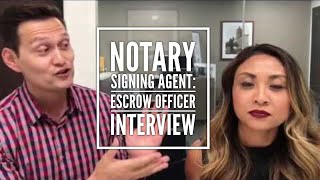
Mark Wills interviews Joanne Castillo, an escrow officer at First American San Diego, about what she looks for when hiring notary loan signing agents. She discusses common mistakes, best practices, pricing, and how signing agents can build relationships with escrow officers to get more work.
Chapters
Hi, everybody. Mark here at the loan signing system, as promised, I'm going to start interviewing escrow officers, real life escrow officers. I'm here with Joanne Castillo. She's an escrow officer here at First American San Diego. If any of you guys are. I know some of my students are realtors and mortgage officers. If you guys need an excellent escrow officer, Joanne Castillo, I'm going to sit here and ask her questions that I have listed so I don't forget anything. She's going to read them off the cuff with me and just kind of let you guys hear it from an escrow officer. What they look for in a signing agent. She's going to talk about what to. When you walk into her office and trying to get business from her, what she does or doesn't like about notary public loan signing agents, pet peeves, biggest signing agent mistakes notary public loan signing agents make. So I'm gonna go top and bottom here. And so without further ado, this is Joanne Castillo. Hi, Joanne.
Hi.
Thank you so much for taking time with me. You're welcome for me and my students here. So let's just go straight down this list. So what I got here is you are where you work for First American San Diego. How long have you been an escrow officer? And maybe you can tell them real quick how long you've been in the escrow business.
I've been an escrow officer for about 12 years. I've been in the escrow business for 14. So started as a receptionist and worked my way up all the way to an escrow officer and been with first American for 12 years.
12 years. So you guys are learning from someone who's been in the business for 14 years. So what she's about to tell you, it can't be from somebody better. So, you know, I tell a lot of my students that, you know, every escrow officer, if they're employed and at a desk, they should be closing probably a minimum of 30 loans a month. 30 files a month. Would you say that's an accurate estimate?
Sure, that's accurate, yes.
Okay, so how many files would you say you close? On average?
On average. Just depending on, of course, the market. Anywhere from 50 to 100 files. Over 100 files.
So you heard it from her, mouse. She does about 50 to 100 files. Guys, what I'm trying to point, I'm trying to make to you, and I tell you in my videos and in my classes, is those are 50 to 100 signings. 50 to 100 different notary public loan signing agents get, guys, there's business out there for you. She is one escrow officer, 50 to 100. So it means she roughly does a thousand loan closings a year. That's a thousand loan closing you can get from one escrow officer. How many escrow officers are in your office?
In our office there's four.
So there's four. So everybody averages that, say a thousand a year. That's 4,000 signings, signing agents can get. So when you guys hear me in my video saying you only need one escrow office to be a full time signing agent, that's really the truth. Would you, you say absolutely. You think one office can supply a couple different notaries with, with full time signing work?
Yes.
How instrumental is the signing agent to the overall loan closing process?
Well, I mean they're the ones that go out and meet the clients and do the closing. Technically they are sitting in front of the customer, having them sign the documents, making sure the documents are signed properly, bringing them back to escrow. They're very conducive in the closing process.
So is it safe to say that if a notary public loan signing agent makes a mistake, the whole deal could.
Be gone, it can be detrimental to the deal. I mean a lot of it is very fixable. But yes, it's possible.
It's an extreme case, but it is possible. Even if it's, it's. I would say it's probably more annoying than it is detrimental if a notary public loan signing agent makes a mistake.
True.
Okay, good. So we're gonna talk a little bit about notary public loan signing agent mistakes in a minute. But I just wanted to, you know, I'll tell a lot of my students that, you know, we are a big part of this, part of the real estate transaction. Signing agent. So a good notary public loan signing agent is worth their weight in gold. Could you agree that, you know. Okay, so before we dive into it, what would you say to a notary public loan signing agent who tells you that their only job is to not miss initials, to not miss dates, to not miss signatures?
I would tell them that that is not their only job. I feel that they're an extension of the escrow office. So going out to meet the client, they should be very knowledgeable in what the documents are and not just initialing and signing, but being able to explain what each document is, what it might mean for them to be able to, for them to help the customer understand what it is that they are signing. Not just there to acknowledge signatures but to be able to answer questions.
So yeah, that's what I teach my students, is why I ask that question. A lot of students come to me and go, mark, I'm already a notary public loan signing agent for three years. And I'm not supposed to say a word at the closing. I'm just supposed to shove papers in front of them. And I say, that's not true. And escrow officers don't like to know, don't like to hear. That's all a notary public loan signing agent does at a public loan signing appointment.
No, no, that's definitely not what we want to hear. We want to be able to know that you understand and can explain what these documents are to the customers.
Great. And that's what I teach, you know, I teach this everybody to make sure they understand. I tell people our job is to be unbiased, impartial, but not uneducated.
Just like the escrow officer.
Just like the escrow officer. So we should know if they want to know what the interest rate is. We should be able to point to that in a piece of paper and locate it. If they want to make sure that there's no prepayment, we should be able to locate it. Not just say look and read it yourself.
Correct?
Exactly. Perfect. In your experience, what are the most commonly made mistakes that signing agents out of county do? So when, you know, when you send one of your files out to we're in San Diego, you send one of your files out to Los Angeles. So that's what I mean by out of county. So out of county signing agents, what do you think? One of the biggest mistakes they make.
Are not understanding the notice of right to cancel. Not initially on the notice of right to council. When they change dates or do certain things like that.
How is important while you're thinking about how important is that out of countary signing agents to make FedEx?
Oh, it's very important. I mean, obviously if you're signing in the evening time, you're not going to make FedEx.
It's.
There's no Dropbox. But you know, if it's. If it's important for us to receive the documents the next day and we've set up the signing so that you can make that FedEx drop. You have to make that FedEx drop so that we get those documents.
And once again, very crucial, very crucial. That's why I try to explain to them, you know, a good notary public loan signing agent will always make FedEx. And the escrow officer will appreciate that let the signing service know, please use that signing agent again because they were excellent. Right. So it's all kind of everything is a relationship to everything. That's what I try to teach my students. Do you feel like there is a difference between the mistakes an out of county notary public loan signing agent makes and a local in county notary public loan signing agent?
There is. When you have a local notary public loan signing agent, someone that you use consistently, you know how they work, you know how they're going to do the signing. And again, extension of the escrow officer, it's a huge difference. Being able to count on the notary that you consistently use to not make the mistakes that they've made in the past. Obviously you learn from them. Right. That's why we use local notaries, which.
Is a great segue. It's a great segue. So what you're saying is that you know, when the local notary is, you know, you prefer to work with a local notary because of the relationship you will build with that notary and knowing how they do or do not business but more specifically how you like assigning executed. So with that being said, and this is a great piece of content for my students is do you prefer to work with a local notary that comes from a signing service or a local notary that you know, that's that you.
Know personally, preferably for me, one that I know personally.
And that's because of what we just said. Because you know how they want to work. Because a lot of these students believe that, you know, they say, Mark, title NASCAR officers want to work with local notaries that work with signing services. So they tell me all the time via email, I don't want to. Mark, you're not, you're lying to me. Escrow officers only work with signing services on their local business. Can you debunk that myth or can you say that's a true statement?
No, I would prefer to work with a local notary that I consistently work with. It's, you know, fine, it's a signing service. Obviously sometimes your local notary is not going to be available. Just I'm a little weary when I do have to hire the signing service to hire a notary that I'm not familiar with or if someone a notary that I haven't worked with before. Yeah, it's a little bit uneasy, but preferably a local notary so that.
Guys, what I tell you is that escrow officers do not want to work with signing services on local files. I cannot Tell you that enough, you heard it directly from an escrow officer. So next time you hear somebody saying, oh, title and escrow companies only want to work with signing services, even on local notaries. That is not true. Joanne is letting you know that for her specifically. I can't speak for everybody. Joanne, who does 10001500 closings a month, a year, excuse me, is telling you herself she prefers not to work with signing services at all. Chances now, if a local is not available, her backup's not available. She will, but she's a little begrudging against it. And so I just wanted to let the students know that, you know, go into escrow offices. They want more signing agents, backups to the normal notary public loan signing agents. So let's talk about local business, because, you know, I don't know if you know, Joanne, but I mean, you probably know that escrow business is kind of the holy grail to a notary signing agent, because signing agents don't have to split the fee with the signing service. So if somebody comes in, the fees 150, they get the full 150. So, you know, a lot of my students always ask Mark, you know, what's the key to getting escrow business? You know, how do you walk in and speak to an escrow officer? So let's kind of go down that path, if you may. So, you know, my first question, excuse me, is what do you specifically look for, if anything? I don't know, I don't want to speak for you, but what do you specifically look for when working with a local notary public loan signing agent? So before you answer that, just kind of let you know where I'm looking for or the answer is, you know, are you looking for notary public loan signing agents who are always available? Are you looking for a notary public loan signing agent who has a package loan documents? Are you looking for a signing agent who isn't like, who fills out all the forms that are inside the package? So what are things that you look for when working with a local notary?
I look for a notary that's knowledgeable, one that is also personable, you know, who can react and talk with the customers. Nice and courteous. Also, of course, availability that they're able to take on signings back to back if I have to ask them to take them back to back, like you. And of course, filling out forms. Every form that's within the loan documents need to be completed.
Great point. That actually segues me to my next question is I let it in my notes. Let's talk about forms. So you know, a lot of notary public loan signing agents that I teach in the NNA specifically teaches them, you know, you don't. The forms are the escrow officer's responsibility to fill out. You know, I have a lot of these students who email me like Mark, my job's not to fill out a trust certification or my job's not to fill out the PCOR or preliminary change of ownership report. You know, my job is not to fill out the VA relationship form. My job's not to fill out the disportsman of proceeds. You know, so your answer to students, you know, who are saying, you know, it's not my job to fill out forms, what would your answer be? Or what would you say to those students?
It's your job to help them and assist them in filling out those forms. You don't fill out those forms, the signer fills out those forms.
Great point, great point.
And you being knowledgeable about these forms helps them complete the forms, which in.
Turn makes you want to hire them.
Absolutely.
So, and that's what I try to tell people in my class is, you know, there's a relationship between a notary public loan signing agent who knows how to do a complete signing which would be filling out forms etc, etc and a notary public loan signing agent who actually gets business. And would you be concurring with that statement?
I would.
Perfect. So yeah guys, like I said, you know, when you're hearing it from Joanne herself and if there are forms in the stack, you need to get them filled out. If you don't know how to fill them out, well, you take my course, plug plug. But the point of asking her that question, so you hear from an escrow officer, you know, let me ask you this question because I always tell this in my course, but let me hear it from you is if a form comes out blank, back to you. So let's say notary comes back in your drops off docs, it's signed, it's notarized, but it's blank. What do you do then?
I'm annoyed. Okay, well I'm annoyed that it's not complete again. It goes back to the notary being an extension of the escrow officer. So you being knowledgeable about this form, being able to assist the customer in completing this form and it coming back to me means, guess what, it's less.
Work for me because you in turn have to go hunt down the borrower or call a loan office or call.
The real estate agent, get the forms completed.
And that's what I teach you guys in class. If you, you're not doing it, they are. And if the escrow offers doing it, you're not getting another phone call back for business. Is that fair to say? Okay, great. I teach a lot of these things in the class. Once again, I'm not the escrow officer, so, you know, it's really cool to take your time. Thank you again for doing this for me and my students. But yeah, guys, so filling out forms is super duper important. You heard it from her. Once again, they don't magically get filled out. Someone's filling them out. And if you're not doing it at the loan signing, they are. And if they are, you're not getting a call back for business.
That's true.
Okay, perfect. Out of curiosity, you know, using out of county, not using local notaries, because you have good relationship with local notaries like myself, what percentage of times do you feel like all forms are filled out? So, like when I do a closing for you, 100% of the forms are filled out?
Absolutely, yes.
And so if we get something from out of county, what percentage of. For what percentage of files come back where there are at least one or two forms not filled out?
If not all of them, I would say about 75%.
And you heard it from her. So what she's saying is 70% of 75% of notary public loan signing agents don't know how to fill out forms. She off top of head, just gave us a number of 75%. So what that should tell me and you is 75% of notaries today don't know how to fill out forms. So, Joanne, do you think this is a fair statement if 75% of notaries don't know how to fill out forms? If you're One of the 25% that does, you are in the good minority. You're the notary public loan signing agents who should get busy, should be busy, should be. And it's because so many notary public loan signing agents don't know what they're doing. And for another plug of my course is because there's no courses like mine that teach them how to do it. And so but I just want you guys to, you guys always hear me in class say, I use your word 50%. 50% don't know what they're doing to fill out forms. And she just increased that to 75. So learn to fill out forms. It's what we're hired to do. You know, the NNA is like, oh, your job's just, just a date, initial and sign. And that's not true. If you want to be a busy notary public loan signing agent. Okay, does that. So if, and I think we just kind of touched on. But I have it in my notes here. If forms come back blank, it is a poor reflection on that notary period. End of story.
Yes.
Like there's no way about that.
Yes.
And are you probably not going to hire that signing agent again?
Wouldn't. I wouldn't prefer them. No.
That's a good way of saying it. So wouldn't prefer. Well, you wouldn't be like Mark, don't use them again because she does use my signing service. But you'd be like Mark, you know, that's probably not using because it caused more work from them. That guys, that's the key to being a busy signing agent. Create less work for them, you get more business. The more you make their job easier, the more signings you get. And I cannot hammer that home. And I love that. She says, I have a little note down here. Is there any like specific pet peeve you have? Maybe it's trying to give some students some, some tips. Like is there any like a pet peeve a notary does that that they shouldn't do?
Just don't harass the customer. If we ask you to call them and set up the signing, set up the time, date and place, it's not necessary for you to call them 5 times, 10 times, email them or go to their home and leave business cards. It's not.
She's talking from experience.
Yes.
Okay. On the same vein, how bad is it if notary public loan signing agents late to an appointment?
It's, it's bad. But obviously if you're courteous enough to call and let them know that you're going to be late, that is 100% what you need to do. Pick up the phone, call them and say I'm in traffic. I my last appointment ran late. Whatever you need to do, just let them know that you're running late.
Perfect. It's great. It's great advice. I think I touched on the course. If I don't, you know, everyone's human. They realize we stuck in traffic. Just let the borrower know that you know you're running in traffic. Everyone's cool. What our worst nightmare is is like the borrower calls the mortgage officer like wires of notary and then the mortgage officer calls the escrow officer. Then the escrow officer calls you. That's a Bad chain of events. Right? Yeah. So, yeah, exactly. Once again, our job is to make sure it goes smooth. And if it is, you get more business. That's kind of what I'm hoping you're gathering from this interview right now. So let me ask you a question on personal level. As an escrow officer, if I say NNA certification, what does that mean to you?
It just means that all you're there to do is acknowledge signatures and nothing else.
Right. So, you know, because a lot of these students go to me, and once again, a lot of these students don't know what they don't know. You know what I mean? A lot of these students aren't in the trenches. And that's why I love that you took time out of your day to help them understand the trenches. And the point I'm trying to make by that is a lot of people, I get emails, I'm NNA certified, and I'm like, escrow officers really don't care. Like, it doesn't hold. Like, when you're saying you're NA certified to an escrow officer. Okay, like, cool. You got it.
Same as taking the course that made you a notary public in the first place.
Oh, that's even better.
It's, you know, all they're doing is reiterating what was in that course and certifying you for it.
It's a baseline.
Exactly.
It's a baseline. So if someone comes to you and says, I'm MA certified, you literally don't. You don't jump out and go, oh, my gosh.
Okay, signing agent certified.
How about that? Yeah. Now, notary public loan signing system certified. We're gonna get to that at the end. How? She loves LSS certified students. But, you know, but you know, the NSA certification, you need it. The First American. You can't be a notary public loan signing agent for First American if you don't have it. But the point I'm trying to make is, you know, just saying you're NNA certified doesn't all suddenly make you better than the next notary. It's not going to give you like, oh, my gosh, let me give you my next signing.
Right.
It's much deeper than that. Correct. Okay, great. So have you ever. Just kind of curious, once again, this is more tips for some of my students. Have you ever blacklisted a notary? Like, I don't want to. I think you kind of brought an example up. But have you ever given an example to them what would cause you to be like, I'm never going to use you again.
I have a couple, actually more than a couple of. But there is one that I remember I did blacklist her. She showed up to the signing, had only one set of documents so she didn't have a copy set for the to leave with the borrower. Funny enough, the daughter of the signer was a notary public before a signing agent notary public and she had a copy machine at their home so she had to make the copies of the documents. She didn't complete any of the forms. Whatever needed to be completed, PCOR trust certification, nothing was done, initials were missed and long story short, we had to resign those documents. So it cost another notary fee to not necessarily the borrower because we hired that signing agent but to the mortgage broker who was not very happy about it.
Great story. So the moral story is two sets of loan documents, one for the borrower to keep, one for the borrower to sign and the fact that the notary only brought in one made the whole chain of events be bad and they got blacklisted. So thank you for giving that story to everybody. Let's talk about loan document packaging. So I tell because basically third of my course is all about how to package loan documents. So a lot of these signing agents don't know packaging loan documents is, you know, once again, some notary public loan signing agents don't know what they don't know. A lot of these signing agents not only don't know what packaging is, but they don't understand the value of packaging. They don't understand the relationship between packaging loan documents for an escrow officer and getting business. So if you can just maybe talk about, let me ask you this question. If a local, somebody came up to you as a local notary, says joanne, I want to be your notary but doesn't know how to package loan documents, what are the odds they're going to be your local notary?
They're not going to be my local notary. Packaging saves your escrow officer time. So if you don't package them, your escrow officer or their assistant has to package them and we have, you know, as many as two to three, ten signings a day. That takes a lot of time to package documents. So if you are able to package, that's, I mean I would call you absolutely.
So I tell you guys in the course, if you're not packaging, they are packaging and if you can package, you can save them time. You're going to get business. I hope you understand the moral of what the whole Interview is really shaped into. And that is, you know, the easier you make their job, the more you're going to get their business. And packaging is the biggest one because filling out forms take, you know, if you send a form back that's blank, it might take them, you know, three minutes, five minutes of the day to go get that fixed packaging. They sit in front of a copy machine and high heels usually for 10 minutes, you know, and like they're cursing the notaries who didn't package a loan doc. Right. So I guess what I'm trying to tell people in this video is if they don't know how to package loan documents, I shouldn't make it general because I was going to say if they don't have package loan documents, they're not going to get local business. Let's not make that generic because I believe that's a true statement. But for you specifically, if they don't know how to package loan documents, they don't package your loan documents. Are you going to use them for a local signing?
I would say they wouldn't be my first call.
Perfect. That's great. No, it's great. So guys, once again, package, package, package. The NNA doesn't teach you how to package loan docs, the loan signing system does. And then it doesn't even like tell you what it is. But packaging loan docs at the end of the day saves her 10 minutes per file. She can probably package in five minutes. But nonetheless you times five minutes times the 10 files that she just said, that's an hour. So you know, it's an hour she doesn't want. That you can do for her. And that ensures you get the next signing appointment that she has. Let's talk about pricing. What does, what is the base? How about this? What do you allow notary signing agent to charge?
150 to 175.
150 to 175. That's what I tell you guys. I always tell my notary public loan signing agents start at 150 if the escrow officer allows 175 grade. If not, 150 is a good baseline. Let's talk about signing agents who have a pricing, a pricing scale meaning that if a notary public loan signing agent told you, you know what, that's a 5 o' clock during rush hour, I'm gonna charge $25 more. What would you say?
I would call the next notary that's not going to charge the 20, 25 more.
So you're telling Me or telling my students that pricing scales don't work, they.
Don'T work for me, know that they work for any other escrow officer. I wouldn't. Because there's a disclosure that we, there's fees that we disclose to the lenders. So if I'm disclosing 150 or 175 and you want to charge an extra $25 because you're traveling a little bit longer, I'm sorry, I'm going to go with the notary that's not going to charge that 25.
That's exactly what I say. So to clarify that, there's something called closing disclosure, which I teach you in the system, and the closing disclosure is telling the borrower that the signing agent can charge you 150. The signing agent can't come back and make him charge 200. It's already been pre disclosed. So if you insist on charging 200, then she's got to find another signing agent or the escrow officer who will take the 150 signing fee. Perfect. So. And that's why you go ahead, slide. So let's talk about when do you think it's appropriate to charge more? First and second?
Yes.
Okay.
Two loans.
Two loans. So, so what do you allow a notary to charge on a first, usually 150.
And the second 75.
Okay, so like I tell you guys in class, your second fee should start a second at 75. If escrow officer allows you to charge 100, great. But don't go more than 75. Usually start at 150. If they say, oh no, we let you go 175, which Joanne does, then cool. Change your invoice, but don't start off with 175. And then don't start off at 100 on your second loan either. So 150, 75. Would you find it? Would you allow a notary to charge more for a reverse mortgage?
For a reverse mortgage? No, I wouldn't.
That's what I tell my students as well. One flat fee. FHA, VA reverse. There should be one flat fee. Right. Once again, you like to, you know, I don't put words in your mouth here, but you know, you like to work with someone who's just consistent. Like they're not nickel and diming you or nickel diming your borrower, nickel diming your clients. Right. It's one flat. One flat. Perfect. Now let's talk about the Holy Grail. Everyone, probably frankly in this video is like, Mark, let's get to the chase here. The Chase is, you know, like I told you, the holy Grail is getting escrow business. Right there is a huge myth, there's a huge, what's the word axiom. People are afraid to come into an escrow office and get business because they feel like, oh, there's already a notary that's been there for 10 years. There's already, they already have their 15 notaries. To watch the rest of this amazing interview, you're gonna have to be a loan signing system student. We are the only course that brings escrow officers, real estate agents and mortgage officers directly to you so you can learn from the source and as you just heard, a successful notary public loan signing agent, an educated notary public loan signing agent. So to learn exactly how a mortgage professional truly wants a loan signing executed, click on the link on this video to get my loan signing system six figure course. Not only will you learn all of my best strategies, including a word for word script on what I say to get direct loan signings from escrow officers, mortgage officers and real estate agents, you will learn from these mortgage professionals, from themselves to you, on how to market yourself to them. And it can't be any more direct than that. And as a six figure notary public loan signing agent student, you will also get uncut access to this full interview as well as all the other interviews that I do with other escrow officers, mortgage officers and real estate agents so you can hear directly from them. So you can ultimately have an edge over other loan signing agents and, and make even more money. So get the number one rated loan signing agent course on the Internet today. Click on the link on this video or go to loansigningsystem.com today to get my six figure course and I look forward to seeing you in class.
More from Mark

I Tripled My Notary Income in 30 Days 💰 $1.5K to $4.8K | Loan Signing System Review


How She Built a $125,000/Year Notary Signing Agent Business From Scratch (Colorado)

Can I still be a notary public loan signing agent while having a full time job?