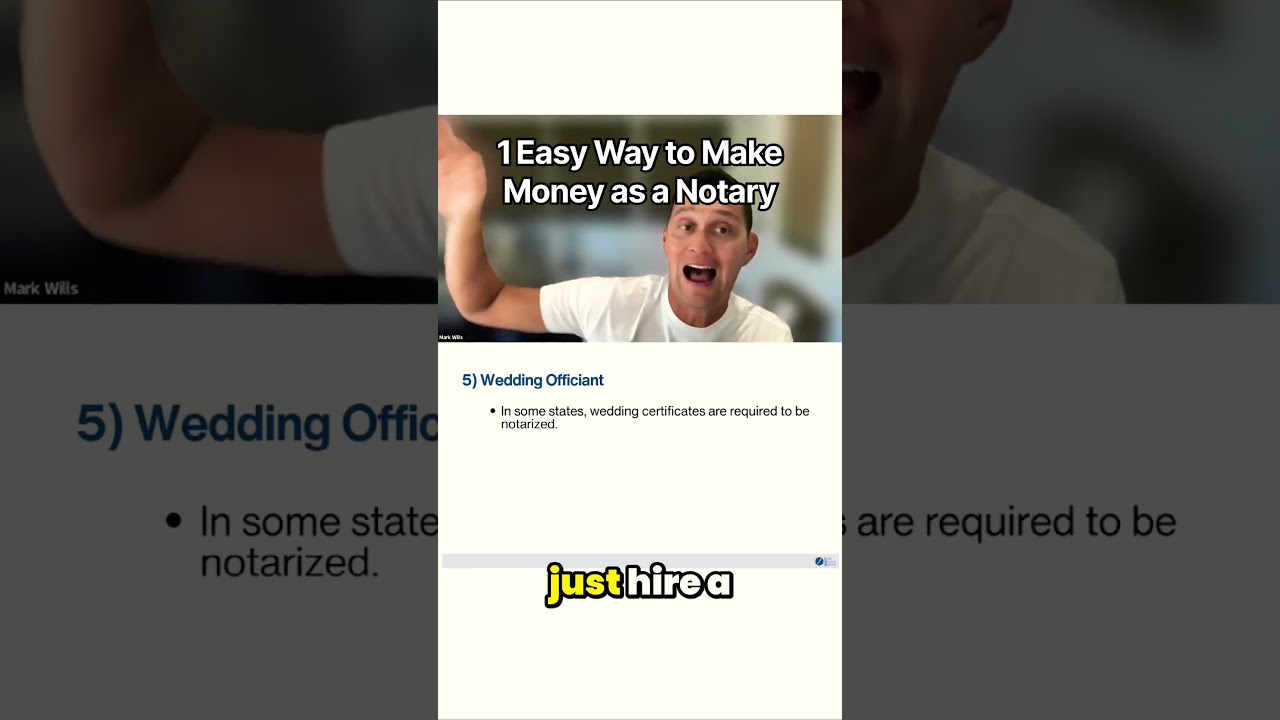
Rates Below 6% 🤯 Is This The Best Time to Become a Notary Signing Agent?
This content was created by Mark Wills. This content was uploaded by Mark Wills. This is a YouTube video titled "Rates Below 6% 🤯 Is This The Best Time to Become a Notary Signing Agent?" (posted 2026-03-10) featuring Mark Wills delivering a solo, instructional talk aimed at current and aspiring notary loan signing agents. He explains why recent mortgage rates falling below 6% create opportunities, the 30–45 day lag between rate changes and loan document volume, how short-term (Fed) vs long-term (Treasury yield) rates are determined, the main drivers of Treasury yields (supply/demand, inflation, economic strength, Fed signals, debt issuance), and how the Iran / Strait of Hormuz situation could push inflation and long-term rates higher; he closes by outlining short- and longer-term rate scenarios and urging listeners that it’s a good time to enter the business.
Chapters
It is a good time right now as we speak to be a, a notary loan signing agent, and I'm gonna tell you why. So last week, mortgage rates fell under 6% for the first time in the past 3 years. So I hope you don't need a degree in economics to understand this. If it's the lowest interest rates have been since 2022. Everyone who's bought a home or refinanced in the previous 3 years has interest rates higher than today. Did that land for everybody? 5 million people bought a home or refinanced in the past 3 years, so that's 15 million homeowners in America who have interest rates higher than they are today. Um, there's been all over the place— Realtor.com, Business Insider, Yahoo Finance— saying the exact same thing. So mortgage rates are tumbling as we speak, going below 6% last week. Uh, so if you mix low interest rates with how the housing— right, housing market itself is becoming a buyer's market, so that means home prices across the board are dropping, lower interest rates are dropping We should, in theory, have a very busy spring and summer months. Did that land for everybody for the home buying market? So the news is everywhere. The market is softening for home values. Interest rates are dropping. It's all over the news. Make sure you guys pay attention to your financial news. Now, uh, here's what I want you guys to hear crystal clear, because uneducated notaries on the internet Oh, like, I heard mortgage rates are dropping, how come it's not busier? Because mortgage on average take 30 to 45 days to close. So when mortgage rates drop, applications are locked, but it takes 30 to 45 days for docs to go into process. Did that land for everybody? Give me a 1. So whenever you hear news about interest rates dropping, understand there's a 30 to 45 day delay until loan docs start coming out from that lower interest rate. Uneducated notaries like, oh, the interest rates didn't do anything because I'm not busy. I'm like, dude, yeah, I don't get the market. Did that make sense, everybody? Interest rates drop, applications go up. Did that land for everybody? Applications go up, it's 30 to 45 days. So in about 30 to 45 days from the the past 3 weeks, we're gonna have an uptick in loan documents. So if you're a brand new notary, no, you did not miss the boat. The boat hasn't even left the freaking dock. Did that land for all my newbies? Okay. They still gotta underwrite the loan over the next 30 to 45 days. So you're in the right place at the right time. But obviously the bombing and the war in the Middle East is going on. So what is going on specifically? Specifically because of that. So I can't really teach you that until you understand how interest rates work. So take some notes. I'm going to do my best to simplify a very complex way interest rates are determined. Give me a 1 for you econ majors. Don't be calling me out in the, in the chat, Mark, it's not that easy. I get it's not that easy. But I also need to teach thousands of people the most basic way of understanding interest rates. Give me a 1 if that landed, everybody. So I know for all my econ majors out here, this is not exact verbatim, but I'm going to tell you right now, 99% of what I'm about to teach is how interest rates are derived. So hear me carefully. Let's get going. A good economy equals high interest rates. So it's really counterintuitive for a notary public loan signing agent. Where you're like, we want a good economy because we want our 401(k)s and our retirement accounts to be good. But a good economy doesn't really equal busy for notary public loan signing agents in the lending industry. Does that make sense, everybody? So we are like torn as an American. As an American, we want low unemployment. We want high— people want people working. We want the stock market to be up. But when all those things are humming, then we're at 6, 7, 8% interest rates. Does that make sense, everybody? So it's a little counterintuitive, but you are now in the lending industry to almost want a bad economy because a bad economy lowers interest rates. Give me a one if that landed. If the— we're in a recession, if we are, we're not, I'm giving you a very generic understanding of how interest rates work. So let's say in a recession no one's spending money, then the government lowers interest rates to encourage spending so money re-enters the market. Does that make sense? So COVID was terrible, no one was spending money, so the government said let's lower interest rates until it's so freaking low that all of us are like, we're buying a car, we're buying a house, we're buying a motorhome. Did that land for everybody? So the first thing to understand about interest rates, if you want to understand what's going on in Iran and how that's going to affect interest rates, is we actually in a weird way are rooting for a little bit of economic turmoil. Did they give me a 1 if that landed, everybody? And I feel sometimes like a weird American even saying that, if that makes sense. Like, I'm like, why would I kind of root against the economic strength of our country? But because I understand mortgage rates, I then understand I actually don't want a humming economy if my job is predicated on how many loans are closing. Give me a 1 if that landed, everybody. All right, so if you understand the basics of good economy equals high interest rates, you understand the basics of bad economy equals low interest rates, let's get a little bit next level. So there are two types of interest rates. There is short-term interest rates and long-term interest rates. Short-term interest rate is what we all know as the Fed rate. Have you ever heard that the Fed is cutting rates? Give me one if you've ever heard that before. Fed is cutting the rates. That has nothing to do with mortgage interest rates. Did that land everybody? So an uneducated person on the internet's like, Fed's cutting interest rates, that means mortgage rates are coming down. Not true. Now there's a little bit of a gray area in what I just said. The Fed controls short-term interest rates, so it is true that adjustable rate mortgages interest rates will go down and home equity line of credit interest rates will go down. It just doesn't mean long-term interest rates go down. Give me a 1 if that landed, everybody. So when you hear the Fed cuts rates, you're like, yo, all that means to me as a notary public loan signing agent is there might be more adjustable rate mortgages being applied for, or there may be more people finally tapping their home equity because that money is cheaper to take. Does that make sense, everybody? Give me a 1. This isn't kind of complicated. I'm doing my best to break it down. All right, so if you understand that, then here is the confusing part. 15, 20, 30-year loans are considered long-term rates. Anything over 10 years is considered a long-term rate. Did that land for everybody? So what controls long-term rates is something called a Treasury yield. Have we all heard of Treasury notes? Everybody heard of Treasury notes? Give me a 1. So if you have not heard of Treasury notes, what these are is a government-issued bond. You give the government money, and the government gives you a guarantee interest rate. Okay, that's called a Treasury bond. Banks borrow from Treasury bonds to lend you money. I'm simplifying that for my econ majors, don't yell at me. Okay, so here is how you got to understand long-term rates. This is going to circle back to Iran, but I can't tell you about Iran if you don't understand this. So long-term— so here's how it works. The US Treasury is set by the government. The government says 4%. I'm gonna tell you why in a moment, but don't get ahead of me. The banks go, okay, I can borrow from the government at 4%, but I want to make a spread on that. I want to make profit on that. So then banks add 2% and then let you borrow at 6%. Did that land for everybody? So let's just say the U.S. Treasury note is at 5%, the banks tack on 2% for their profit, and interest rates for long-term mortgages are 7%. Give me a 1 if that landed. So all banks are doing is looking at what the Fed— the Treasury note index is and adding 2%. That's called their spread, or better known as their profit margin. Easy peasy, everybody. So far so good. Give me a 1 if I'm doing a decent job of explaining a very complicated topic. All right, so now you should be saying, Mark, I'm confused. Why the— then why would the Treasury note move up and down? That should be your next question. How come the Treasury note is at 4 one day, 5 next day, 7 the next day? Did that land for everybody? So there are many factors on what raises the Treasury note or lowers the interest on Treasury notes. But what you're looking at on your screen is the top 5 reasons why the US government changes the rates up or down. Give me a 1 if you know what you're looking at right now. Now, there's more than 5. You econ majors, don't be emailing me. Okay, so I know there's more than 5, and I know I'm simplifying this. So the reason the Fed goes up and down— excuse me, the Treasury note index goes up or down, or the yield or the interest rate Number one is supply and demand. It's very simple. The more people that want to buy Treasury notes for an investment, the interest rates go down, the yield goes down. The more popular it becomes, the government's like, well, why are we giving out more money if everyone's buying our Treasury notes? Did that land for everybody? Then if no one's buying Treasury notes, then the government goes, well, we need to make that more attractive. We're going to raise the rate that we give money back on. So one way the index, the Treasury yield, or the interest rate given goes up or down is based on if other people want to buy them or not buy them. Okay, so number 2, listen to me carefully. Number 2, I am foreshadowing here on Iran. Number 2 reason is because of inflation. So if everything's starting to cost more then the government, then the investor, me and you by the way, go, well, I need a higher return on my money if everything in America is going up in cost. So if inflation goes up, then the interest rates go up with inflation. Give me a 1 if that makes sense. So if, if you're always looking at the inflation report and the inflation goes down then the government says we don't need to give out more interest. So inflation is one of the biggest markers on whether rates go up or down in the long-term market. Does that make sense, everybody? I'm gonna say that one more time to make sure people get this. Because by the way, if you regurgitate what you're learning today to your clients and be like, oh my gosh, Ken, you really are the notary I want to work with. Because you know everything. Does that make sense, everybody? Okay, so inflation goes up, the cost of goods goes up. We as investors— me, literally you guys with me on this call— are like, I'm not going to give the government more money if the government's not matching my return to inflation. So I need the interest rate to go up on the Treasury yield. So that's the main driver on why Treasury notes go up or down. Number 3, we talked about this earlier. The better the economy, the higher interest rates are. Do you remember me saying that in the beginning? Okay, and then so again, these are investment tools. The government's like, hey, if everything's humming, we're going to give— we're going to raise the price. If everything's lowering, if the economy is doing bad, we're going to lower the yield. The lower the yield, the more we're going to want to borrow money. Number 4 is based off the Fed cut. We can kind of get an idea of where the economy is going to be. So the Fed rate doesn't directly affect the lowering or raising of interest— of long-term interest rates, but obviously there's a window. And then number 5 is as we sell more debt, then the yield goes up. So these are the 5 reasons why the Treasury note goes up or down. Give me a 1 if that landed. I really want to focus on number 2 for the sake of the Iran conflict. So let's just really take a look at this Treasury 10-year Treasury yield. So this was from 1965. Everybody see my blue dot? See, back in 2020 when interest— remember we had 2.5% interest rates? Everybody remember that in COVID? All you need to know is the yield went to 0.5. If you add 0.5 to 2%, what do you get? 2.5%. Today as we speak, interest rates are just over 6%. Oh my gosh, the yield is 4.05. If you add 2% to 4.05, you now know why long-term interest rates are 6.05. Give me a 1 if that landed. So if you can watch the US Treasury Index, add 2%, it's a rule of thumb that that's what the long-term rates are going to be. How many people feel really empowered right now by this knowledge? So you guys should all be watching Yahoo Finance, CNN. You're like, oh my God, I see the Treasury yield going up to 4%. That means interest rates are going to be 6%. Knowledge is power. Okay, so let's keep moving. So let's talk about where rates are today. Did we all just see that the Treasury yield was 4%? So if we add 2%, Do we now know why that we see interest rates are roughly 6%? Does that make sense, everybody? So the question is this: why did the Treasury index go up when it just hit an all-time low? Inflation was down. That's what was driving more— that's what drive long-term rates down. That's why we hear it under 6% basically since COVID ended. But then something said, uh, no, it's going to go up. So let's talk about this. So I want you to be educated here. I'm not trying to tell you what is wrong or right, what's going on in the Middle East, but Iran declared the Strait of Hormuz basically closed. So what does that mean? That means higher expected inflation. Why is there higher expected inflation if we— if they declared that? So let me show you. Okay, so this is what you're looking at on your left side here is where the majority of the world's oil comes from, all the Persian Gulf, whether it be Saudi Arabia, Qatar, uh, uh, the UAE, or Iran. And you see this little point right here? Everyone's see that right here? Iran has shut this down. They've threatened to basically blow up any oil tanker that crosses it. So if you look at this other picture, you see all— by the way, these dots represent oil tankers. How nuts is that? So you have all these oil tankers who cannot get through this. So if oil can't go through the main way to exit into the world supply, what do you think's going to go up in the next week, everybody? Gas. So if gas goes up, that is literally called inflation. Does that make sense, everybody? So because of the disruption in the oil distribution in the Middle East, they're anticipating the cost of gas to go up which is inflation. Give me a 1 if that landed. So if you're asking me, Mark, what's going on in the Middle East, well, the answer is the only thing we know right now, a week into this conflict, is gas is getting choked. 20% of all the world's energy comes through that strait, and that's what's going on. Do we all feel a little bit smarter right now? Give me a 1 if you feel a little bit smarter about why interest rates are going up. So you should be sharing this with your clients. So the answer in real time is interest rates are about 6%. Everything's on hold until we see how long the conflict draws out. So you're asking me, Mark, what's going on with the interest rates? You now know why. Now it's 20% of the world's flow. It's not 100%. So it's just enough of the world's energy supply that gas is going up. 20 or 30%. That causes inflation, that causes the Treasury note to increase. You add the 2%, and voilà, we're at 6% interest rates. Everybody understand why the impact right now on the conflict? And we're talking 7 days in. And as the conflict goes longer or shorter, I will keep you updated to all the goings of interest rates. Everybody happy about that? I got you. I just need you to understand. All right. So everyone's like, Mark, what's your prediction for interest rates? I don't know, dude. I don't know. I mean, so I have no idea. I literally have zero idea. But let me give you a couple scenarios that may play out so you can either get excited or get bummed out as far as interest rates are concerned. So short term, there's a slight rise in interest rates. We went from 5.9, 5.95 interest rates. To 6.5, 6.10— I mean, 6.1. So right now the markets are like, we don't know how long this is going to play out. So they're just kind of monitoring it day by day. So short term, there's going to be a slight rise. If this conflict, in my opinion, from what I've read, if the conflict lasts longer than 4 months, we should probably expect a half point to point rise in interest rates. That's pretty significant, truth be told. No one has a crystal ball. That's what the conflict is. Now, this is really based on if no other countries really get involved, okay? So if it locks— if it lasts longer than 2 or 3 months, interest rates will probably drop. Why? You're all educated. Why do you think it's going to rise sharply in the short term but then drop greatly if it continues to drag out? I just taught you everything. And Sarah had it correctly. The econ— the world economy will drop. Our economy will drop. So if our economy drops, we're going to be spending billions and billions of dollars on a war. And so as our economy drops, unemployment goes up. And now we have the reverse happening where they need to give lower interest rates so we actually borrow money to spend. Do we all feel a little bit more empowered and not so scared now that you understand how rates are going to happen? And then, God forbid, we get into World War III. But if that happens, we should probably expect rates to be like COVID. So no one knows what's going to happen, but these are the 3 of the most likely scenarios. So nobody knows. I don't know. But bottom line is these, you guys now should be empowered. The most important thing that you need to understand is right now, it is a great time to be a notary public loan signing agent. Give me a big let's go.
More from Mark
How a Former Realtor Made $107,000 as a Notary Signing Agent (Small Town in Michigan)

I Tripled My Notary Income in 30 Days 💰 $1.5K to $4.8K | Loan Signing System Review


How She Built a $125,000/Year Notary Signing Agent Business From Scratch (Colorado)


Can I still be a notary public loan signing agent while having a full time job?