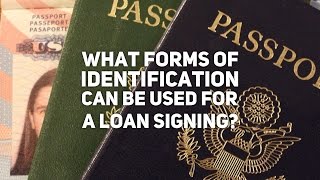
Mark explains which government-issued IDs work for loan signings and why they need to be unexpired. Lenders and state laws set the rules, so you have to check what each one accepts before the signing appointment.
Chapters
Frequently asked Mark what forms of IDs can be used for a loan signing? What if an ID is expired? And what about using credible identifying witnesses? Well, the answer varies on a few factors. First and foremost, be sure to have knowledge of your state's specific notorial laws around what is acceptable and not acceptable forms of identification. But whatever your state may allow you to identify a borrower with may not be the same thing the lender allows you to identify a borrower with. For example, using expired identification cards are legal in particular states like California and Tennessee. Those states allow notaries to use an ID that's within five years of the date of issue, not relative to the expiration date. So in using the same example, while notarizing a document with an expired ID may be allowed according to some state's notorial laws, it may not be allowed by the lender. Why? You may ask, and if it comes down to the loan documents, if the set of loan documents you have has a Patriot act form, a form that the signing agent fills out to confirm the ID of the borrower, then an unexpired ID is required. No if, ands or buts. Therefore, if there is a Patriot act form or any kind of ID verification form, an unexpired ID is required, not relevant to what your state may allow you to use. However, if your loan docs do not have a Patriot act or do not have an ID verification form, then you can follow your state's ID verification laws. Which leads me to the second question. Can you use two credible identifying witnesses to identify a borrower who for a loan signing? If you don't know what this is, some states allow you to use two witnesses that attest to the borrower's identification in lieu of any form of actual identification. This scenario can occur when the borrower has lost their id, for example. Once again though, it comes down to the loan documents. If there is a Patriot act or there is an ID verification form that requires information of a non expired id, then no, you cannot use two credible identifying witnesses or anything other than a current form of id. And similarly, if your loan documents do not have a Patriot act or other verification form, then you should go ahead and use whatever ID laws your state allows. Understand that lenders have their own set of rules of what they allow as acceptable forms of identification, and you need to be aware of that. While some states allow notarizations with expired IDs or with credible witnesses, it doesn't mean the lender allows it. In my experience, 80 to 90% of lender documents have Patriot Acts or some type of ID verification form, so it is safe to assume that a borrower will need some sort of government issued unexpired form of id. Here is my advice. Always make sure the borrower has unexpired ID present. Not only because the Patriot act or customer verification form that's in almost every set of loan documents, but because it ultimately protects you as a notary public loan signing agent. Mortgage fraud should not be taken lightly. Yes, you have errors and emissions insurance, but is it really worth taking the word of two strangers or an unexpired ID to identify someone? I personally don't think it is. The reason that we make 75, 100 or even $150 per signing is because it's our responsibility and job to accurately identify the borrower. You as a notary public loan signing agent are on the hook for making sure that the person who is borrowing the money is actually the person who is borrowing the money. And in my opinion nothing less than an unexpired government issue ID is acceptable. When you are setting up or confirming a loan signing, it is absolutely appropriate to ask the borrower if they have an unexpired government issue ID and to make sure it's present at the signing. In conclusion, regardless of what your state allows, it is always the safest and most prudent thing to ask your borrower for a current government issued id. Remember, it is your responsibility to make sure that there isn't any question that the person in front of you is the person that is signing the loan documents. If you are interested in learning how to become a notary loan signing agent and making 75 $150 or more for an hour long appointment, click on the link below and take my Loan Signing System course. My name is Mark, I teach the Loan Signing system and I look forward to helping you become a top loan signing agent.