Tebello Ramakongoana: How Running Transformed Tebello’s Life: From Rural Lesotho to the Olympics
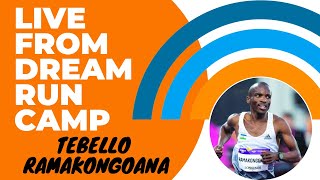
Tebello Ramakongoana grew up in rural Lesotho in a single-parent household and discovered running in school. He raced the 2022 World Championships in borrowed shoes after losing his luggage, then moved to Flagstaff to train with coach James McCurdy, running a 2:08:09 personal best at Osaka and setting multiple national records. His goal for Paris is to win a medal.
Chapters
You're in my camp. Inside joke, but it's hilarious. Yes. So I am extremely pleased and grateful to have next to me— I'm going to do my best— Tabelo Ramakongowango.
How close?
85%.
85%.
That's good enough.
You say it. I had no time to practice. Please tell us your name.
Okay, my name is Tivelo Ramagumana. I'm from Lesotho.
Oh my God. That wasn't 85%.
It was close. In the English pronunciation.
I think it was like a D minus. That's all right. Yeah. Anyway. Yeah, welcome. You're on your way to Paris for the Olympics. Is this right?
Yes.
Yeah. No big deal, right? Have you been to the Olympics before?
No, no, first time. First time.
Yeah?
Yes.
How long have you wanted to go to the Olympics? Very long time? Not so long?
Yeah, it's a long time, but I was still schooling that time. So I didn't have enough time to train. So after I finished schooling, I started training hard. Then I qualified for World Championship in 2022, which was in Oregon. Then I went there, so That's how I meet coach.
Yeah, we'll get, we'll get into that.
Yeah, yeah.
Uh, so the coach he's referring to is James McCurdy, my, my friend, friend of the show, sitting, sitting to my left. Continue.
Yeah, so I meet coach there. So I arrived there, uh, it was 24 hours before the race, so I didn't have a good race, but I was well prepared, but I arrived there late, so that's what affected me. Then my luggage was lost, so I have only clothes on me, no shoes, no racing shoes. I have shoes on me and clothes on me.
So you're at the World Championships.
Yes.
You're running the marathon.
Yes.
And you arrive 24 hours before the race.
Yeah.
And your luggage was lost.
Yes.
Okay, that's fun.
That's a great word to describe that.
So then when I arrived there, I go to the reception, then they give me the, the key room. Then I went to the room. Then when I tried to open the door, the door didn't open. So I was trying to open it.
So what time of day is it? Is it 12 noon?
It was too late.
Very late?
If I still remember, it was Maybe 10 p.m. or 9 p.m. It was too late.
Who was on the other side of that door?
It was like 11:30 at night. Yeah, it was. It was a Friday night at 11:30. It was late. It was very, very, very late.
Yeah. Later for him than it was for you.
I'm in bed by 5 p.m., so I'm on my third REM cycle.
So then what happened?
I managed to open the door. So when I opened the door, I saw Colt. Then he was so scared, he asked me, who are you? Then I tell him, no, this is my room.
Get out of my room.
Then he said This is also my room. Then I get inside the room, he asked me where I come from, then I explain everything to him. So then in the morning—
Wait, you just jumped ahead. Where did you sleep?
No, he showed me the— there was two bed. In the room. So I use another bed, he use another one. Then in the morning—
you were just hoping he didn't snore. Oh, and vice versa.
So in the morning, uh, we go for— he helped me to go for COVID test. We do the COVID test. After COVID test, we went to the shops, he buy me shoes.
And you guys had just met, like you didn't know him before? Yes. Yeah, just complete stranger.
Yeah, buy me outfit, shorts, vest, then go back to the hotel, then we prepare the bottles. He shared me the supplements for his athletes. Then we sleep. In the morning, we go. Then the race come. Then I run. I try to fight until maybe 30K. Then after 30K, I was too tired. My body was too tired. Then I drop. I just walk to the finish. I run 2:12. A good position.
That's usually my time when I walk a bit in a marathon.
Yeah.
Go ahead, it's fine.
Then after Budapest, I decided to, to be his athlete. He coached me after 2022 World Championship.
What made you want James to be your coach? I guess he was nice to you, but what else?
Yeah. He was nice to me, then I saw his personality, he's good. So I decided to, you know, let me work with him. Then in 2021, I go to Devon International Marathon, which was the third marathon. Then I run it, I win the marathon. I run 2:10. Is it 2:10?
2:10:09.
Yeah, 2:10:09. Then I qualify for Budapest or World Championship. Then I go back home, then I prepare at home. Coach used to to, to check on me each and every time. So then I go to Budapest, then I run so well in Budapest, I place position 4. That helped me to, to qualify for the Olympics. But after that, I told coach, no, coach, I want time, I want to run time to be in Olympics. So coach find me a good race in Japan, which is Osaka Marathon. Then I went there, I ran my personal best of 2:08.09, which is Olympic standard.
By 1 second.
Yeah.
Right.
Nice work.
Thank you. I think— Maybe around that time because I didn't wear the super shoe. I didn't wear the shoe with carbon. I just wore the normal shoe. So I think if I was using the carbon shoe, maybe I would run—
1:08.
1:08, I don't know.
An hour, an easy hour.
About an hour, I would think. Yeah, very advanced technology. Yeah, well, congratulations.
Thank you.
I welcome questions from the group. We have an honest-to-goodness Olympic runner sitting here with us. Huge opportunity. I've got plenty of questions, but was that you? Sorry, go ahead. Kind of a theatrical throat clearing over there. You got a great question.
Oh, thank you. So what, like, why did you start running and what was your longest run? Is it the marathon? When did I start running?
Those two very different questions. Yeah.
She's asking why did you start running?
Why?
Yeah.
Oh, I start running because, as I told you, I was schooling. Then in school, you know, in schools, small schools, all the students, the— our teachers, they used to force us to do all the sports. So then I saw I'm good in running, so that's why I decided to run. But me, my focus was on football. I love football. But I was not good in football. So I see I'm good in running, so I decided to switch.
That's a very American story, is it not? Sucked at soccer, took the ball away, thrived. I can really— yes, it really is. Yes. So you grew up in Lesotho? Yes. Lesotho.
Yes.
Am I saying that right?
I say Lesotho. What do you say?
What does he say? It's your country.
Lesotho.
Lesotho.
Yeah.
It's funny because like as part of my— because I've never been there, I would love to go. But as part of my research for this interview, I went to like dictionary.com. No, it's on Merriam-Webster where you can like not only like get a definition, which you don't really get for a country, but like you can have it pronounced for you.
Yeah.
And I want to get it right. If I can't get the name right, I'm going to at least get the country right. And it said Lesotho.
Yeah. Yeah. I heard it many times on, on, on, on like races. And the announcers would say Lesotho. But then the Federation president said Lesotho. And so I'm like, I don't know what I'm supposed to say here, but I'm just gonna go with what Tshebalo and the Federation president say because they live there.
Yeah, yeah, carries some weight for sure. Okay, Lesotho, that's really great to know actually. But tell us about what it was like to grow up there.
I didn't grow up well because I'm raised by one parent. My father left us when I was still young, so he come back when I'm old, so I didn't know him well. So he come back. When he come back, he was sick, then he die. So my life was so hard because my mother, she was not working. So I used to stay with my grandparents, my grandmother and my grandfather. So yeah, my life was not Good. Yeah.
Were you hungry?
Yeah, there was no food sometimes. Yeah.
Yeah, I remember, um, Sabela was telling me, I think maybe in January of 2023, it was a big windstorm. Yeah, right. And your uncle's house blown over because of the wind. Just blown over. And it's not an uncommon thing.
Yeah.
Some of the homes are stable. Your home is stable. But some of the homes are— they're not as stable. They're not as strong. It's an incredibly different experience. I've learned so much just by spending time, by asking. But that— for the people watching, who end up watching, it's a different world where we are, different parts of our country. But certainly the Soto has got its— it's got great areas and it's got areas that are incredible, incredibly challenging spots.
Mm-hmm. Yeah. So it's interesting. I mean, here you are now in Flagstaff, Arizona, United States of America. That's a long way from home yet. You still refer to Lesotho as home. You still go back there. So what's your relationship like with home now? And do you like America?
Yeah, yeah, I like Blackstaff because I told my coach I plan to maybe to come back again next year. Yeah, to train here.
Okay, that says something. Yeah, you want to come back?
Yeah, I want to come back next year.
Well, he definitely— on the way over he said, you know, maybe Matt can sponsor me. And there's many— he doesn't have to pay me. There's many ways of sponsorship. Yeah, well, shoot. And maybe there's a room in, in this for me.
We'll talk.
Yeah.
Hey, shoot, I like to put other people on the spot. You just return the favor.
I love it.
All good. Yeah. Well, shoot, I like to start with a provisional yes to every question. Every question. Yeah. So, so yeah, that's funny.
Oh, well, so Tavello's been here since March, end of March, right? The idea behind Tavello coming to the US was to get out of the winter of Kajasnek, the village where Tabelo's from. Because the winter— I mean, describe the winter. Go, go into the winter detail of what training is like, where you live, and what November into— or sorry, March into August looks like.
It's really hard. When it's winter, we normally start training by 11 AM or 12. So in winter, if you— we have double training, it's hard because in the morning it's very cold, very, very cold. Yeah, so I decided to come here because home is It's winter now, so here it's summer, so the training would be good.
Yeah, yeah, he basically bypassed winter. Yeah, he's having summer the entire year.
Yeah, like the surfers, like, yeah, yeah, just chase summer.
What I was, what I was most, um, curious about is when he got here, we all— I mean, you guys have been here for a little bit. You've been here for a few years now. The hills here in Flagstaff are challenging. Mm-hmm. Tibello arrives here, he says, "Coach, these are not hills." Well, that's an advantage. Yeah, yeah, it makes, it makes training really interesting.
Yeah.
Dave, you had a question.
Yeah, I had a question. I mean, hearing your story and your background and like having to move homes a lot and like moving in with your grandparents and starting out your running career. My question is like, was there a figure or like a person in your life or an idea that you hold on to that like inspires you to keep running? Like, because you seem like a very driven person to me. Yeah, and I want to know your secret. Like, I want to know if there was someone who like gave that gift to you, or is that something you've learned?
Okay, uh, I can say, uh, the, the only person who, who inspired me is one of the South African best runner. His name is Stephen Mukoka. In home, always the athletes in my area, always they talk about him. They keep talking about him. Then other day he was running Cape Town Marathon in South Africa. Then I watch him running, so I saw him running and beat Kenyans. Yeah, win the race with 2:07. That's how I get motivated. Yeah, yeah.
You see him and you're like, you see all the great things he does.
Yeah.
And you want to be like, yeah, I like that.
Yeah, that's really cool. Yeah.
Lesotho is, is an interesting location. Yeah, it's landlocked inside of South Africa. Didn't know that. So it's on like the northeast corner, so to speak, of South Africa. So South Africa athletes, South African athletes, and the Basotho— Tebello's on Team XL, which is a South African-based team. So there's a lot of unity in athletics and running in South Africa and with Lesotho.
It's cool.
You are a husband and a father as of recently? Yes. Do you have a child?
Yes, I have a son.
Yeah, congratulations. How old is your son?
He's 1 year, 1 year, 8 months.
Yeah, yeah. So you, you've said that you, that you had a, the, the life was hard for you when you were very young growing up, and now your gift for running and your strong mind have given you really amazing opportunities. And so what are your hopes for, for your son and any other children you have? Like, how do you hope that, like, your success as a runner can benefit your child or children?
I want him to be a runner.
Okay, well, hey, no pressure.
No pressure. When you say that's 18 years old, no pressure.
There you have it.
I once told the coach that he must start coaching him when he's 6 years old.
And the answer to that was no, by the way. I don't train 6-year-olds.
What else?
Yeah, and I'd like to, to send him to very good school. Yeah, I want him to be educated. Yeah.
Yeah, what's— what I love, um, one of the, one of the aspects I love about Tabelo is that the drive is there, not just with, with running, but Tabelo also built his own home, and he built, uh, he built a, a place where other people from the community can live and rent and have a safe environment. To work as teachers, as construction workers. So there are people in his immediate home, not too dissimilar to the Dream Run camp. Yeah, not too dissimilar at all. But now athletes are reaching out and saying, hey, from, from Lesotho, I, I want to come train with you. I want to be with you. I want to, I want to live in Katjesnek and, and learn and, and run with you. It's inspiring what you have accomplished in these 2 years, really 3 or 4 years, much of it on your own. What you have accomplished is it's a small ripple that is turning into a really big wave. And it's something.
It's fun. Yeah. I mean, do you think about that? David asked you a very A good question about who inspired you, but do you also hope to inspire others? It sounds like that's happening already. Yeah.
Yes.
Yeah. Do you have— Yeah. Well, say more about what he was saying, like what you're doing back home to elevate other runners behind you.
I don't understand. Well, Tokizo.
You've known Tokizo for a long time. You've had an opportunity to run with Tokizo, but it never really happened until over the last year, 2 years. How did that start?
To train with him?
Yeah, when did he ask you to say, "Hey, I want to come." Tokizo?
Yeah. No, I was thinking, so I was with him since we were at school.
Okay.
Yeah, we are friends in school, so he was always there when we are training. When I am training, Alo is there.
What about Kamahilo?
No, Kamahilo, he's staying in Maseru. Yes, he's far.
But when did he reach out to you?
Some weeks ago.
Yeah, some weeks ago. It's starting.
It's starting.
Yeah, ripples become waves, my friend. Yes.
So what are your hopes for Paris?
Hopes?
Yes. What do you hope to achieve? Are you racing to win?
I just want the medal.
A medal? Yes. Racing for a medal?
Yeah. Just want the medal.
Yeah.
I don't care about the car.
Yeah.
Well, I just want the medal. Yeah.
I mean, you know, if you can walk a little bit in marathon and finish in 2:12, it's not unreasonable to aspire to.
This is the first time that you've had an opportunity to truly train with other top-level runners? You've raced with other athletes in South Africa on Team Excel and a few others, but this is the first time you've lived for an extended period of time training with others, with Yemane Haile Selassie, with Segai, with Tesfu, with John and Kevin, Nathan, where you raced with him at Grandma's Half Marathon. What has been the difference for you in this period of time of training comparative to being in Katya's neck?
I think here I have people who, who are strong like me, so in training Sometimes training is like a competition, so that's a good challenge to push myself. But home, I normally train alone, especially when I'm going to run marathon, because my training partner, he run half. He started running full marathon this year, so when I'm going for marathon I normally train alone. For example, last year, last year Budapest.
Yeah, August.
Yeah, I train alone for Budapest, training alone.
Every, every speed session. Yeah, almost everything. Yeah, yeah, yeah.
And long run, I was alone. Yeah, so, and In home, there is no one helping with nutrition. You don't run. But here, coaches is there helping me. So that's a big difference to be here. Yeah, so I think I will run well in Paris. Even if now I am ready Even if they can say Paris is next week, I will go.
Since Tebello's been in the US, and even just before, Osaka was a national record. The national record prior was 2:09:47, and he just missed it in Budapest with 2:09:57. So 10 seconds away from the national record a year ago, but you got the national record. We've also set the 5K national record, the 12K national record, and most recently the half marathon national record at Grandma's in '60s, '17, which is pretty darn cool.
Yeah, yeah. So, um, yes, you're 27 years old, right? Uh, so that's like, that's prime time. You, you're, you're at your physical prime. And you're having, you know, like a new sort of training experience. Like, you know, you do remind me of Nathan Martin, who, you know, Nathan, you know, similar to you, kind of trained in a bubble, like very talented, very driven, but isolated. And then he came here, spent some time and kicked ass at the Olympic trials, finished 5th in the Olympic trials marathon. So do you feel that you, that you're— 7th.
You don't want to slight CJ Albertson. He was 7th.
I thought he was 5th.
No, 7th.
Damn it. We'll edit that out. I'm actually, no, I'm just sticking with 5th.
Yeah. Overruled. Overruled. Yeah.
You're out of line. Yeah. That's not nearly as good. Terrible story. Yeah. Uh, so do you feel like you're still improving and that your best races are in the future?
Yeah.
Yes.
You should see the workouts he's doing.
Well, I, I do, because you are like a prolific Instagrammer. That's true.
Oh my gosh, we did a little compare and contrast from the training from Nelson Mandela Bay Half Marathon a year ago in June last year where Tabelo set the national record of 60:35 in the half marathon, comparative to what he just ran in Grandma's. And the difference in training and the mentality going into that half marathon at Nelson Mandela Bay was to taper, was to relax, to give him the best chance to run as fast as possible. We eased off, we reduced the volume of running, we lowered the speed workouts, to make them as fresh as possible. Hi, Chris.
Chris is here.
And then, uh, Chris is here if you don't know. Um, but then the compare and contrast of now— Grandma's wasn't an afterthought. It was important, but it was about training through Grandma's and the, the, the ability to run even faster at Grandma's. I mean, that, that for you. Can you walk us through what you were feeling and thinking in Grandma's half marathon? Because when you won that race, you won it by almost 2 minutes. So what— the gun goes off, boom. You have teammates that are here that you train with that are running with you, but the gun goes off. What happens for you here and here?
I just told myself that I'm going to push, so I didn't even look back who is coming. Because I look at them at my watch, I saw the pace is too high, so I don't even think there's anyone can come. So I was— my target was to run sub-60, but I missed it when I think there was 19K to finish. So there was many tents and it was raining and it was in front of me. So that's why I missed the sub-60. Yeah.
Yeah.
Same reason I missed sub-60.
Yeah.
Yeah. Yeah. So where does your— have you guys worked out a kind of strategy for Paris? Because like, I love it when the Olympic marathons, which they often are because they tend to be summer races that they're interesting. There's, there's hills, there's, there's heat potentially. So if you want to win a medal, like, how, how do you win a medal? Like, you're, you're a great runner and you're going this way, but you'll be racing against a lot of other great runners. Only 3 can win medals. So what's your strategy to win a medal? Your tactics?
I think to me hills is nothing to me. Hill and down, it's nothing. So I think if I can, if I can push hard on hills And down, maybe just relax on one day flat. I think I can succeed. Yeah, because I enjoy hills.
He is the mountain goat of the Basotho people. What's different about Paris comparative to Tokyo, which is also hot, humid Rio, hot and humid. Even Athens, you know, had its challenges. What's different— because it's summer— what's different about this course is that it has a bit over 1,200 feet of gain and loss. New York City is considered one of the hardest marathons that professional runners will run and only has about 700 feet of gain. This is almost 1.5, maybe almost, almost 2 times that. And it has it inside of, uh, basically a 12-mile window, a 20K window. So yeah, you know what, Kipchoge is there. Great, awesome. I'd love to see him run up a mountain just like this guy.
I don't know.
I think hills and heat— hills, even good weather— so many of these athletes are, are time trial abilities. You know, the marathon, the Olympic standard is based off of your time trial.
Yeah, it's true. There's kind of a mismatch between how athletes qualify and how they actually have to race for a medal.
Yeah, there's a reason why the Olympic record is 2:06:30, you know.
So is that Wanjiru?
Yeah, yeah.
Hot, hot and humid.
Hot and humid on a flat course.
I don't know.
I mean, I think this course presents the challenge that everyone— it will make the champions.
Yeah, absolutely.
Yeah, no one's stealing this thing.
Yeah, I wouldn't want it to be— as a fan, like, you just want an exciting race. You don't want a stupid time trial.
Yeah, no.
Yeah. And if, if— yeah, if, you know, I think I'm quoting you, hills are nothing to me. Like, you know, you know, if we get— if it, if it's, uh, if it's part possible in the Olympics?
I mean, it'd be cool to see a fast time.
This course is— watch out.
Yeah, no, there are other races for that. No Olympics.
Yeah, yeah. I would love to see a fast time on this course because then, then the pundits will be like, well, what they— what could they run at Tokyo or London? You know, like, how many minutes is this worth? Like, none of that matters. What matters is being healthy and fresh and well-fed. That's one of the things we've been working on is making sure that food is coming in every 3 to 4 hours. It's turning into a joke between the team and Cibelo is they go up to him, "Eat!" Because I just cook food all the time.
Yeah.
Dang. But yeah, it's gonna be fun.
Watch out, world. Yeah, yeah, I know. You're, you're never wrong. You're not— you don't talk like that unless you could just stop.
You're gonna stop with that one. You're just— you're never wrong.
Well, just like I've seen it, like, you know, what, like, uh, when you, you were, you were talking up Nathan before the trials and he finished 5th, not 7th. 5th, okay. You know, I'll be on Wikipedia later tonight. Tonight, I'm just going to correct that. He was fit.
Manual adjustment.
Yeah. Yeah.
So, so in Budapest, though, what Tabello does so well is you listen, you, you are a world-class listener. You are patient. You know, there's stress. Stress in your life. There's stress in everybody's life, but you, you find a way like I have never seen out of anybody I've ever met before to just not block it out, not ignore, but to take it in, acknowledge it, and then move forward. And, and you listen through all of it. In Budapest, The plan of attack was followed to a T through 30K. And after 30K, after 18.6 miles, he had the green light. And that green light— he started off the first 2 miles, he was in 54th through 3K. 54th place through 3K, the back of the pack, waiting, waiting, and just slowly inching pinched up. It was, it was marvelous. It was, it was beautiful. It was wonderful. And whatever the, the race strategy is, whatever we come up with together, I have full confidence in his ability because all he's ever shown me over these 2 years now is just, is an amazing ability to just listen and trust and go with it. There's no second guessing, there's no, there's no second thought. Even in Osaka, I made some coaching, some tactical errors, but he followed it to a T.
Followed yours. It produced an Olympic time right off the cliff. It was incredible. It was like, we learned a lot.
We learned so much. There was so much success in the small little failures that came out of that. But I wouldn't say a national record and a personal best by 90 seconds and more is a failure, right? Like, or wearing certain shoes, right? We learn so much, and it's like, okay, now we know what we're gonna do in Paris. Now we know what mistakes did we make tactically to apply moving forward.
Can you stay for dinner? We want to feed you dinner. Yes. Do you like bread? Yes. We have bread. Do you like potatoes? Yes. We have potatoes. Do you like chicken? Yes. We have chicken. All right. Yes.
All right.
Thank you so much. I've really enjoyed the opportunity to get to know you. Come back anytime. Use the hyperbaric chamber, the sauna, the pool, treadmill, whatever you like. Yeah. Good luck in Paris.
Thank you very much.
More from Matt









Hosava Kretzmann: Live from Dream Run Camp, Hopi/Diné runner and Flagstaff local!

Chris Thornley: The Story Behind Squirrel’s Nut Butter: Funny Name, Serious Lube

Nick Arciniaga: Running Plateaus, Chasing the Olympic Marathon Team, and Supershoes!