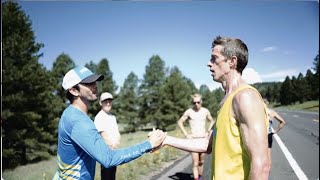
Author Matt Fitzgerald quit his job to train with NAZ Elite in Flagstaff for a month, chasing a marathon PR at Chicago. He documents the daily grind of elite preparation: interval workouts, altitude runs, massage and strength work, and the mental battle of trusting a 6:05 min/mile pace. He finishes with a personal record and a message that older runners can still break through with the right commitment.
Chapters
I've redefined my sense of possible here. Especially if I go— I've already done it in workouts here, but I mean, if I go to Chicago and run that time, I will have done something that I told people was impossible before I came here. That could give a lot of hope to a lot of people. Like, hey, you never know what you can do. So when I was 37, 9 years ago, I ran 2 hours and 41 minutes for the marathon. And I always felt like that was, that's kind of part of the reason I wanted to do this is I never felt like I realized my full potential. You know, from the time I did my first marathon, I had like 2:39 in my head. Like I knew I had the ability. I knew it. But you know, it just, it was like God didn't want me to run 2:39. It was injuries. It was like, you know, bad weather. It was just one thing after another, and eventually I got old. I had to accept. A lot of athletes come to this experience where they just have to like, you know what, I never did what I wanted to do, and I have to make peace with that. So I did. I made peace with it, and then suddenly, very, very unexpectedly, I had this chance. In the 8th of the 8 marathons I ran this spring, I ran 2:49, which is not a heck of a lot slower for being in my mid-40s now. And obviously I've been running marathons runs every weekend, hadn't been doing speed work. So I feel like, you know what, I might be able to come within shouting distance of the best I've ever done, well beyond the age I thought I could even contemplate that sort of thing. So, you know, I'm 46 years old now, and, you know, for a while I was very focused as a runner and a triathlete on getting faster, improving. I've shifted my focus more toward just having different kinds of experiences, like continuing the journey as an athlete and as a human being. And one experience I had never had as an athlete and really always wanted to was to go all-in with running, just to make running the center of my life. What if I could just, you know, push aside everything else, you know, my job and all the distractions, and just live like a professional runner? You know, why can't people with, you know, average or above-average talent like me also have that kind of experience? So I wanted to be a running bum, and I decided to just go ahead and do it. So I reached out to Ben Rosario, the coach of Hoka Team Northern Arizona Elite. Told him I want to do this not just for myself, although I certainly am doing it for myself, but also do it for runners who have the same fantasy but may never get to have this type of experience. Well, I've been in Flagstaff for 1 week now, and Coach Ben has eased me into, you know, the whole altitude training thing. Today is the first day where I'm doing a full-on workout. I'm actually doing exactly the same session that the real pros are doing, only slower splits, obviously.
Yeah, it's 16 by 300 with 200-jag recovery. Not super fast, um, it's almost like a structured fartlek.
It's the kind of thing, it's the kind of thing that should be fairly manageable. I mean, it's a challenging session, but it shouldn't leave me dry heaving at the side of the road afterwards.
Matt, you sore at all from weights?
Yep.
Well, what the guys always say is that It doesn't really affect the way you—
No, I thought it was going to. If I warm up anymore, I won't have anything left of the food. These guys have bigger fuel tanks than I do.
He's claiming that it's private, you know, so it's different. That's what I asked him though. I was like, so you would call the police? He's like, I'm just doing my job.
I'm like, I'm just doing my job. I like, because he said something like, do you have a permit or—
Yeah, I mean, because it's only supposed to be for— even though it's not gated, it's only supposed to be for use by these people. Well, yeah, I mean, we're part of it.
It'd be different if we're not part of this group. Apparently not. Apparently not. So the group hasn't trained here before. A private community. And we were all warmed up and ready to go when some kind of authority representative of the community kicked us out. We have to go to the nearest place that will serve to host the same type of workout, which I guess is just down the road. That's how, guys. He's back from sleep. How you doing? It went really well. It was— I wasn't expecting actually to have Eric Fernandez, 2:14 marathoner, pacing me through it. That helped a lot. And but I felt good. I had good legs today and my lungs were good. It's not supposed to be a killer workout, so it shouldn't have been. I was a little hot on the pacing. I'll ask Ben what he thought about that. The hardest part was just, you know, I did a strength workout yesterday and I just kind of felt it in my butt. But it was fun. Off to a good start. I knew Ben just a little bit and really respected him as a coach. I liked the idea of being at altitude. Flagstaff is 7,000 feet. It's a really high-powered team. I just like the idea of being around some of the very best this country has to offer. The biggest change is adding on a lot of the ancillary stuff that the pros do. The things like the massage and the chiropractic and strength and conditioning stuff. Those things are things that a lot of the recreational runners like me feel we just don't have time for. If you can only choose between a massage and a run, well, you're going to do the run. But even simple things like some of the warm-up drills that they do, those don't take a lot of time. But again, that's a corner that a lot of runners like me will cut. We'll just jog and then start running intervals, whereas they will jog, do some drills, to make sure their bodies are really ready and then go into the workout. Yeah, for initial onset was 2009. I've had it on and off since. It's a little unpredictable, you know. The most predictable thing is that when I run fast, it aggravates it. But here, you know, I'm pushing myself. That's what I'm here for. And I really don't, you know, I don't want to have my training limited. So, you know, I've been thrown to the wolves kind of these last 2 weeks. And predictably, I mean, I absolutely knew this would happen. And right now, you know, it has been worse than this. In 2009, I would be jumping off the seat, you know, if I did this, but it hurts. I just want to do absolutely everything I can, you know, to make sure I can run Chicago fit and healthy. So before I came to Flagstaff, I knew that even in my best-case scenario for my training out here with NAZ Elite, that I would probably have at least one injury scare. And 2.5 weeks into the experiment, here I am, forced to take my first day off from running by a chronic Achilles injury that I've had for 8 years. It, it comes and goes. So on coach's orders, I am cross-training today., and then we'll see about tomorrow. You know, I'm here trying to train like a pro, do what they do, and when they, um, have an injury issue, they don't say, "To hell with physical therapists." You know, they, they do everything they can, um, and that's what I'm doing. So, um, I've been seeing, uh, AJ Gregg at, uh, Hypo2, who's been doing— shooting it with a laser and shocking it with a shockwave device. He, you know, diagnosed some imbalances that I'm working on. Yesterday was kind of the day when I decided this thing was getting a little out of control, and when Ben said, you know, we need to change your training. And I did get frustrated. I tend to get angry initially when I'm injured. I talked to Matt Janno about this yesterday. He said I'm the same. So I was a little bit curt with my wife, and I felt bad about that. She's seen it before, so I just, you gotta try to be the same person because the psychological side of injury is just as big as the physical side. So you have to try to stay positive. You have to try and stay rational. It can be hard, but I have had a lot of experience with injuries, so I kind of can step back from myself when I see I'm kind of mentally going in the wrong direction. So I'll be borrowing Matt's Elite2Go, riding that this morning, uh, strength and conditioning, um, at 11 this morning, and then I'll be doing one of my patented steep uphill treadmill walks this afternoon. So full day of exercise, just no running today. Professional runners are dreamers. They're the people who believe they can make the Olympics. They are people who believe they can, you know, break records. And so I want to be a dreamer here too. You know, I'm surrounded by people who think they can do things that a lot of other people don't think they can do. And I sort of want to absorb that spirit and not put any ceiling on what I might be able to achieve for myself here. There's so much that's new for me here that it's, it's early to talk about a goal. I've never trained at altitude before. I've never trained in the way I'm going to be training here. You know, I'm making little tweaks to my diet. You know, I'm all in. I'm doing everything they do. I will confess that I have thoughts in the back of my mind about like what my dream scenarios are, but I'm scared to share them actually at this point. I'm gonna screenshot it for you and send it to you, but he's 4 miles from here, 0 to 4 at 6:35, then 8 miles at 7:20.
He'll go out and back from 4 to 8 and back, and then he'll go 4 miles at 6:35, but then he You can cut it down.
Okay. Yeah. Nailed my first pile. Let's do the second. I'm getting it.
4:54.
Nice job, Matt. Level 1. Good. Go, 50. That was great. Huge.
That's got to be one of your better logs.
Yeah, yeah. Wow, we're gonna find that gear, man. 230 right through there. Oh, it was great. This is the first time I've done a workout that was exactly the same as the real pros did, so I was super excited about that. It's not the paces, of course. 7 times 1K with 1 minute rest, um, and 3 minutes rest after the last one, and an all-out 1500 cut down. That was It was the first time since I've been here that I got a chance to kind of haul myself out, like just go to the well, run as hard as I could. I did, and it was deliciously painful, but I ran fast, faster than I thought I could. And Ben Bruce did me a solid by picking me up halfway through and running with me for 400 meters, the most crucial part of a 1500 when you're inclined to sag a little bit. So that was some awesome, generous teammate-type behavior there, which I've seen a lot of in my time here. And so I just feel great about the workout. What was your closest? 4:48. Yeah, my goal was to break 5. I thought that would be all I could do. Like, if I got 4:59, I was prepared to like buy myself a cake. But that's what it's been like here. Like, I keep doing—
now you can tell Ben to bite.
It's a great feeling though, because I'm, I'm old, man. I just did not expect to be able to run this well again. Yeah, so two things have happened since I last updated the camera. One, I took a trip to Portland for a family gathering and to run a race. I won the race. It's a 5K. I've done it 3 years in a row, and my time was 40 seconds faster this year than it was last year. Clearly, what I'm doing here is really working. I tried to kind of think like a pro, being a little more competition-focused. I'd asked Matt Yano for advice before. The race and he told me, "It's simple, just run faster than everyone else." And came away with the victory. I won a disco ball and a t-shirt. And then I came back here a couple days later, feeling on top of the world, did my first hard workout yesterday, and I just killed the workout and maybe overkilled it. Got to within a quarter mile of completing the workout, which was really, I was really on top of the world. And then suddenly my groin seized up on the left side. It was so painful that I just had to stop immediately, and my first thought was, you know, it's over. Like, I'm— not only can I not run now, but I cannot, based on how painful this is and just the way it came on, I felt like I'm not going to be running again anytime soon. Just a little over 7 weeks from Chicago, so I was devastated. I kind of threw a tantrum. I might have alarmed Jen Rosseri a little bit by hurling a water bottle against the pavement. You know, it's a terrible position to be in. Every runner who's ever been injured with a lot at stake knows how, you know, just it's emotionally devastating. It's hard to kind of get your mind off it. The uncertainty is dreadful. I guess the best way through it is just to do what you can, you know, both physical and psychological reasons, just to stay focused. Focused on, you know, making the best of the situation that you find yourself in. So that's hence the lasering I'm performing on myself here, heat, icing, ibuprofen, rehab exercises, all that. I've been ordered by Ben, the coach, not to run, not even to cross-train for 3 days. That hurts. Welcome to Death Grip.
He has, uh, he's right now an honorary member of the Northern Arizona Elite team.
He is living in Flagstaff right now getting ready to run the Chicago Marathon, and he's writing a book about that training with our group.
So if you want to be in a book, talk to him a lot. Yeah, he's very good at remembering stuff. He'll go home and write about it and remember pretty much word for word.
So you've been warned. So he'll be in and out of camp. He'll be here most of the time. He will be doing some running, but he, like a pro now, got his first serious injury in the build-up to Chicago, so he's off running for just a day or two to try to let it die down. I guess Matt could talk a little bit about like his mission of why you really wanted to come out and write this book. Sure, yeah, like most passionate runners, I fantasize about living living a running-centered life where you just kind of go all in for running. Kind of what you're doing for 4 days is what I'm doing for 13 weeks. So that's what I'm interested in talking and meeting some of you to talk about is how you would love to trade places with me and do what I'm doing right now. But if you're passionate about running and you just, you know, you kind of have had that same kind of dream, which is I think what brought you here, I'd love to hear a little bit about your stories. Don't be shy. All pies are one size, one size only. 12 to 13 inches, 6 slices, and we say they serve 1 to 2 people, with the margherita and the Amore Amore being the 2-much-popular pizzas. So we would like the SS145. But I mean, in truth, like, my first thought was, I'm done and I need surgery. Yeah, that feeling of like something tearing away. There's a selfish benefit to being here, which is just, you know, Shannon Thompson, when I met with her, she told me like, yeah, don't isolate yourself. I mean, unless that is truly your style, you know, from experience, you need to just go crawl in a hole, but even that should be temporary. But like Be around the team. This is one, Bronny, one. That's not— if it's Joe, yes, there's a camera following us.
Just act normal.
That's a great out of I'll be assisting you this evening. I'll start by asking about cocktails, wine. Should I give you a moment to settle in? Like, signature cocktails on the back of your dinner menu. Uh, wines by the glass for the first two.
Do you have any mocktails?
Make you a mocktail. Okay, I don't know what it will look like yet. Okay, that's okay. Maybe Vineyards Pinot Gris? Yeah, perfect. I'll get that started, and, uh, when I come back, I'll cover the menu with you. Okay, sounds good. Perfect. Date night.
They have rabbit on the menu. So honey, what looks good on the menu?
Well, you know what, I haven't gotten that far, but I'm mostly just glad we're here. Yeah, we had to move date night up one day today. I know. Got AJ, my physical therapist, who I see pretty much every day. All too much, though. I like him and he's a foodie, he recommended this place. We got 6 more Fridays here. I think I'm gonna have all the things you can't have. Oh, you're gonna get rabbit? All right, maybe not all the things. It is 5 o'clock on a Sunday morning. I have ahead of me this morning what's known as a depletion run, a deliberate attempt to underfuel your body for a long run. To kind of challenge it in ways that make you fitter and better prepared to go long distances, for example, in the Chicago Marathon as I have coming up. Right out here on the counter, I have what I would normally be eating before a run. So this is my Quaker Oatmeal Squares, full of carbs. I'm not allowed to eat carbohydrate before a depletion run. That's the whole idea. So this is going back in the cupboard, unfortunately. Back in the refrigerator. Full of carbs. Full of carbs. It goes back. Here's the good news, though. I also do depletion runs on my own. And what I do is when I'm not allowed to have carbs before a run, I eat— this is not my usual breakfast, but at least this way I don't have to go hungry. Problem is, I discovered only 2 days ago that the NAZ Elite version of depletion run forbids you from having any food at all before your long run. There's one last item of good news: coffee is allowed. All right, I'm like trying to avoid getting grumpy. Early on, and it's already happening. Let's roll! All downhill from here. Matt was right. Bet you all know. I told him before I left the house, I'm starving. He said, that'll go away as soon as you start running, and it will come back in the last mile. It was a really important test to pass for me, both on the fitness side and with the, the injury. The injury hurt a lot more than I wanted it to. I just need to talk to AJ about it. It's like, is that acceptable at this point? But fitness-wise, that was a piece of cake. They didn't challenge me at all. It shouldn't, you know, but it might have. So I'm just glad it didn't because it's 5 weeks. Like, I don't have— I need to make some progress. And, you know, that showed me that I have enough time given where I am now to get where I hope to be.
Okay, so this is the gang.
Matt's gonna wait a second to warm up, so you guys are good. 2 miles. 2? 2. 2 miles. Off we go. So I don't want to be too anal about this. My ideal scenario would be actually to warm up in my flats, strip down, and then when I get get to the start, grab a bottle from someone, drink half of it, leave it, and then on, on, on. Not even stop.
Yeah, that's fine.
Yep. Here we go. He gets nervous. Beautiful! All right, Vince, 10 for that last one. Woo! That's different than a few weeks back, huh? Yeah. Good, way to go, buddy. Thanks. Ben, I got a jack, but we'll talk.
Yep, we'll talk as well.
All right, great, great, great, great. Dude, it's awesome. That could not have gone better. That was fantastic. See you in your car. Happy birthday. Happy birthday? Yeah. Oh, happy birthday, Ben. How's it feel, man? First mile was rough because of the way I warmed up. Like, I wasn't warmed up, right? But then I just felt great. That's awesome. How'd you feel 8 to 9? That's always the hard part on this road. You know, I just, I don't break it up like that. I'm just like, I don't really pay attention if it's going up or down. I just never have on this road. It was very quiet until like the last mile, and then it just started to pull a little bit. But that's been the case, I Every time I do something I haven't done yet with it, it rumbles. And so yeah, AJ keeps assuring me that's a good thing. I'm a little nervous. 3-mile tempo, 3 times a mile, and 3-mile tempo. That's 9 miles of work. When I hurt myself back on August 16th, I was doing a big multi-pace workout with 9 9 miles of work, so it's unnervingly similar. I'm really feeling it, like the, the—
I, that's interesting you said. I, most of the people said tend to say they don't necessarily feel it, they just see it in the splits, you know?
Yeah.
Oh, you'll feel good. I mean, it's not— I mean, it's just pure science. I mean, it's not—
ready to go.
It's the white mark coming up right here, right now.
Okay. Yep, 54. Hey guys, All right, we're good.
Okay, so we want to be 18. We're at 17:43. That's second mile that fast. 4:57, 4:58 on that one.
Sorry, coach. Yeah, a little quick on that one.
I just think the young guys, they are the pros, whatever you want to call it, they just do so many repeats over the course of their lives. You're so good at hitting it spot on.
Yeah, but that's not an excuse. Yeah, it's not. Well, you just got me too fit too fast. It's actually your fault. That's right. That's right.
Let's hit this one.
The beauty of this workout is hitting these miles that are pretty fast, pretty close to top end. Yeah.
And then realizing, you know what, I can always run these last 3 miles.
Yeah. You know, boom.
4:31, 4:32, 5:25, 26, 27, 28. All 3 together.
That's what we want. 451, 452, 453, 1438. Come on, Matt. Let's go, Fitz. 1725.
And the groin is still intact.
Yeah, that's actually the biggest thing, honestly. Yeah, how'd you guys do? Beautiful.
Well, we've never really, you know, almost never blown up. It's the way we train with the long runs and the completion runs and the long steady states. We've just never really blown up, so we really shouldn't, unless you make a mistake.
That's my big worry.
So you should have it in you to finish it off, even Mellon at Houston debut, I mean, she was hurt at the end, but she still ran like 6:15, you know, which is not blowing up when you're running 5:40s, 5:35s.
Well, I learned a lot from that workout. What did you learn? Well, just like where I am. Yeah, you know, that's the first workout I've done at low elevation and then the hardest workout I've done post-injury. Yeah. And so I learned that I'm not as fast as I used to be. I'm not as fast as I thought perhaps I might be. Yeah. But I am very strong. Jumping out of my skin. Good, good.
I think that's a great way to be, right? Like, look, like, that is the way to be, going excited to race. It's less common than you imagine.
Yeah.
People legitimately being excited to race.
Yeah. When you get to race week, I like to obsess. Like not in an anxious way, but like it's almost, you know, just I like a singularity of focus. Life doesn't always allow that. I'm still a husband before I'm a runner, so like, you know, I just have to push. Focus can wait. Then I wake up this morning to the news of what happened in Las Vegas, you know, and that's like— so I've had some distractions in race week already. Executing a plan that I didn't create, you know, which is a little bit new because I'm usually self-coached, you know. So I've been given a plan by my coach. I've run 40 marathons, but I've never run one the way I'm going to try to run this one, and I've never run one as the runner I am. Yeah, so there's a little— there is some anxiety that surrounds that.
What, what is, what is that plan like in comparison to other plans that you've had?
Ben has told me he wants me to run 6:05 miles from the start until basically I just can't hold myself back any longer. Okay, okay. So he's saying like, you know, at least like 18 miles in. He said, you know, 6:05 is the fastest pace that I'm 100% sure you can sustain that distance. Okay, yep. I think what I've always done in the past is picked a pace that I was 80% sure that I could I can sustain. So it's a really good place to be because I am as confident as he is that I can do that, but I also think I can do more. That's how I operate as an athlete, is I want to finish knowing that was absolutely the best I could have done. I've done too many marathons and I know, like, you can get out there and just—
you can just—
you become something that you become possessed by, like, something that you know is a terrible idea before it becomes a great idea. So I— it's weird because I'm me and I should be in control, but I do worry about like, even if I'm physically able to execute the plan, I worry about like just being taken over, you know, my mind taken over by like that, that old runner because I've done it in the past a bunch of times. Yeah, you know, no matter what. Yeah, like, don't defy the plan, I guess, in this case. Yeah. And then like, but it's almost like it's a different me who's in the race who's just telling the me who said stick to the plan, it's like, but no, something changed. I didn't expect to feel this good. Yeah, I know, it's a lot.
You don't feel that good. You don't feel that good.
I don't trust that guy. Like, I don't entirely trust the me that's going to be running that race. Like, for a lot of runners, they'd be like, dude, what are you— like, you're just making something out of nothing. You have a plan, just execute it. And like, for me, it just doesn't feel quite that simple.
I know you remember the runner you were, but I think in so many ways you're not that runner anymore, physically and mentally, as far as the choices that you make.
Ben has— he's coached me this exactly the same way he coaches anyone, which is like all-in. He's invested so much in me, like he will be as disappointed as I am if I blow it. Back before I got injured, right before I got injured, when I went to Portland and ran that 5K, I went down there, I dialed back, I ran the 5K, I ran well, I won the race. The next day I was supposed to not run at all. Yeah. I was staying with my younger brother who's training for a marathon, the Portland Marathon, same day. Yeah. And he wanted to run 12 miles. Yeah. And I'm like, I feel fine. Yeah. I can run 12 miles and Ben doesn't have to know. 4 days later I had an injury.
Ah, right, right. Yeah, yeah.
And I don't think it's an accident. I think that may not have been the thing, but that is That was the one time I just sort of openly defied what Ben had told me to do. I put it in my log. I figured he'll just see it and then we'll have the conversation. But he never brought it up. I don't know if he just didn't see it, but like, I would feel a great deal of shame. Thinking in those terms, I think, ought to be another thing that puts the brakes on me because I wouldn't want to do that to than, you know, I really— Totally.
Good, good. I kind of like it you've already had that happen, you know, it was like a very clear message you can then go back to and remember. You know, if you're gonna be honest with yourself, what that effort should feel like.
Like, that's—
I think that's an incredible pleasure, is being able to experience the best you've been, period. No matter how that compares to anybody else.
I've gotten to the point where like I could run 2:42 and be crushed. Totally. You know, all this talk about experience or whatever, I have my heart set on running sub-2:40.
Deal.
I mean, yeah, you know, yep, I'm an athlete. Like, it's like, I mean, my heart is absolutely set. If it is one of those days, you know, where it's just I don't have it'll be— it will be very tough to make the best of it.
I would like to believe that the way we've trained as well takes away some of that uncertainty. I just think that's such BS when people say, well, it's a marathon, you never know what's gonna happen. I mean, it's Wednesday. I mean, the race— I hope we know what's gonna happen. You know what I mean? I mean, that's what we've been training for. So yeah, I don't think you should have that. Feeling at all. You should be very aware of how it's gonna feel. I mean, we've trained for 3 months and whatever, so I think you need to be a little careful, you know, with the hype and the adrenaline that's gonna be pumping at first because you're in that elite corral. I do think that'll be a little different maybe than times past. I'm even saying that experience, you know, like you'll be warming up and Bronny will be there and it'll be really, it'll be really quite— yeah, I mean, there's a lot of tension, but— and I don't mean tension in a bad way, I mean the positive connotation of intensity. Yeah, it's really— the atmosphere is thick. Yeah, I just think it's a matter of being patient and waiting till we said like past 30K and then making the decision, okay, do I think I can go now and squeeze it down a little bit? And if I do squeeze it down, can I go all the way to the finish. And if the answer is no, or I'm not sure, then you just keep waiting until you're sure. And it's really the only thing I even remotely worry about is that you'll misjudge that piece. So like, it's just got to be absolutely 100% sure. I mean, we shouldn't think that it's going to be great, you know. I mean, it's going to be great, but it's still— in order to run the very best you can, you have to have to hurt at some point.
If I feel like I still can do what I want to do, I don't care how much it hurts.
Now it's a matter of for the next few days. I mean, I think it's even more important for Aaron because he puts a lot of pressure on himself outside of running, you know. Um, but I think it's still important for you too, which is to just really enjoy the experience. I mean, from the moment you leave tomorrow, because it's so fun. Yeah, I mean, you've said it a million times, like, this— you don't know if this opportunity is going to come in the same way ever again. So you might as well just stop thinking about the race, like, really put a moratorium on, on the race. Like, when it comes in your mind, just push it out. When you start feeling those butterflies, just push them out and just enjoy Chicago. Enjoy a World Marathon Major. I mean, get off the plane, you're in Chicago, it's so huge. I mean, you've been in the small city for the last 3 months, hold up, you know. Just enjoy it. The days will go by quicker that way too, you know. Don't hole yourself up in your room and feel like you have to not move around for 3 straight days. I mean, obviously you want to relax, but just soak it up, soak it up. And then so totally stop thinking about it from now until, you know, basically race morning. And then on race morning, just try to sort of soak in that energy and bottle it up for later. And then during the race, it's really do what you're prepared to do. Try to hit a 6:05. If you don't, try to hit a 6:05. If you don't, try to hit a 6:05. You know what I mean? Just keep— don't, don't start compensating and doing the math in your head. Just keep trying to hit a 6:05 every single mile. Try to hit a 6:05. Um, well, I'm, I'm very excited, and I'm trying to do the same thing you guys are trying to do. Let's just stay calm about it until race morning, you know? Um, but I'm very Very confident in both of you guys.
That'd be my first question after I finish, regardless of how I do, is like, what did Bronnie do?
Oh yeah, of course, of course. Well, if I can see you at 23, which I plan to, I'll try to pass that info along.
I feel like I'm probably asleep and dreaming right now and will be woken up any minute, which I really don't want to happen because I'm having a lot of fun. I flew from Flagstaff to Phoenix and sat next to Faiza Lalisa, who may well win this race. It's a fantastic runner. Runner from Ethiopia who I've admired for a long time. So that was super cool. I just chatted with him the whole flight, picked up my race number and all the paraphernalia. It was just a trip to be going through this process where I'm signing a form that basically says where I want my prize money sent if I win the race. You know, this is stuff— because I signed an elite contract, so This all comes with it. So I got the little stickers that I'm going to put on my bottles that will end up at the elite aid stations every 5K during the race. And now I'm just happy, enjoying myself, definitely feeding off the energy of the environment. We're in the media room of the Hilton right now, and you're wall-to-wall with some of the greatest runners in the world. You have Galen Rupp here, you had Jordan Massé there, you had Ayesha again in the room. If I didn't have the journalistic experience, it might freak me out or make me nervous, but I've been in rooms like this as a journalist, you know, the Boston Marathon, the New York City Marathon, just running around with a pad interviewing folks. It gives me a certain level of comfort to have that experience, which I'm pleased about. You know, it is different because I don't have the notepad this time. I have a race number just like Kaitlyn Roberts. It's just, it's an invigorating environment and not not one that stresses me out or makes me feel like the moment is too big or anything like that. We are less than 24 hours out from the Chicago Marathon. We're in my hotel room in Chicago, and I'm doing some final items of preparation. Things that— a couple of things that amateur runners like I am normally do not have to do, but things I have to do for this because I'm registered as an elite athlete. Bottle preparation. So I've got these 8 bottles bottles that I have to hand over to the race organizers later today. I get to choose whatever I want to put in them. They'll be placed on tables exclusively accessible by elite athletes. I've chosen to use this product called Mar10, very high-tech. You drink it as a liquid and it turns to a gel in your stomach, or so they say. This one has 320 calories per 17.5 ounces. That will be 2 servings for me. I'll, so I'll put half of this in each bottle. And Aaron Braun, my teammate as well, found that going straight 320 all the way through is a little much on the stomach. So we're both going to alternate 320 with 160, which is the same volume. You mix it with the same amount of fluid water, but it's got half as much carbohydrate. My 30K bottle I'm going to dissolve one of these two caffeine tablets in it. It's got to be fully dissolved. Okay, call that mixed. Nearly all elite runners still do the, the high-carb breakfast, and so that's what I'm going to do. I do this for pretty much every marathon except for those few high-fat ones I've done. Easy to eat, prepare, eat, absorb, digest carbohydrates. Banana, big old whopping serving of carbs in there. And then my adult nutrition shake. Not many people under the age of 70 consume these. And this is 220 calories in that tiny little bottle, and it's 33 grams of carbs. It takes no time at all to get that down. You know, I'll start at 4:30, race goes off at 7:30. Then closer to the race, about an hour out, maybe 45 minutes, I'm gonna take 2 caffeine pills. I do not drink coffee before a marathon. Instead, a lot more convenient and effective to take a couple tablets. And then this is a concentrated beet juice increases blood flow. There's nothing worse than having to pee during a marathon, so I basically cut myself off from hydration an hour out. If you race as a pro, there are IAAF regulations for like what you can and cannot have on your uniform. So this is the uniform I'll be racing in, and so I have to show it to the authorities. So my number will actually go on the back of the singlet. My name My name will go on the front, and that's really so that the media that are covering the race know who's who. They don't have to go look up numbers. And then this one here has to be pinned on my warm-up. So there's an elite bus that leaves from the host hotel, and this will sort of be my pass to get on the bus. Even more than wanting to achieve my goal, I want to experience the race. I want to be in the race during the race. The hardest parts. That's what I'm excited for, those 2 hours and 39 minutes. Part of you is like, get me out of here. I just tell myself, this is where you want to be. It was a marathon. You know, each one's different. They're just— you experience like a whole world in a marathon. Just like Josh Cox told me before the race, he said, you're gonna get out there and you're gonna be like, I'm jogging. And I thought, I thought of those words and exactly how Josh said them early on. I thought, well, this is good because I'm running the pace I'm supposed to run and it feels easy. I was just so fit, so well prepared, and my race was so appropriate that the process of fatiguing was very slow. You know, I started to get a little tired, but I knew I could do it. Energy-wise, I felt like I could have picked it up and gone for 2:38, but because it was getting warm and because my groin was making me nervous, I just said, you're on pace, just finish it. And so that's what I did, and honestly, it was the easiest PR attempt marathon I've ever run. Ben Rosario deserves half the credit for that performance. I know he would disagree, I did the running, but he really deserves a lot of the credit for that. So I achieved my goal, I'm ecstatic. It's so funny, it was so scripted, it came out so much according to plan that when I finished I actually had no emotion at all. I'm just like, yeah, check that box. But now it's starting to sink in. It's pretty special, you know, to run my best marathon at this age, so long after my previous best marathon. So I was thinking about Aaron a lot out there. That's the thing when you have teammates, like, you can be happy if you have a good day, but you're not as happy if your teammates don't have a good day. So third American in a field as deep as this is great.
I feel like you guys both did a good job enjoying the whole weekend.
I could have been on the moon. If I had untapped potential given as much as I invested in running and as long as I have, then everyone does. Yeah, except pros. And that's how you do it. You just— these people know what they're doing, so emulate them to the degree you're able. We can't all like move to Flagstaff, you know what I mean? There you go, there you go. Yes, you can, but we don't want You don't want anyone to?
No, we don't want everyone.
I'll move and then shut the door after me.
More from Matt









Hosava Kretzmann: Live from Dream Run Camp, Hopi/Diné runner and Flagstaff local!

Chris Thornley: The Story Behind Squirrel’s Nut Butter: Funny Name, Serious Lube

Nick Arciniaga: Running Plateaus, Chasing the Olympic Marathon Team, and Supershoes!