E676: Chris Sacca Matt Mazzeo PT1: Building co's, investing rules, Twitter spills, solutions, buyers
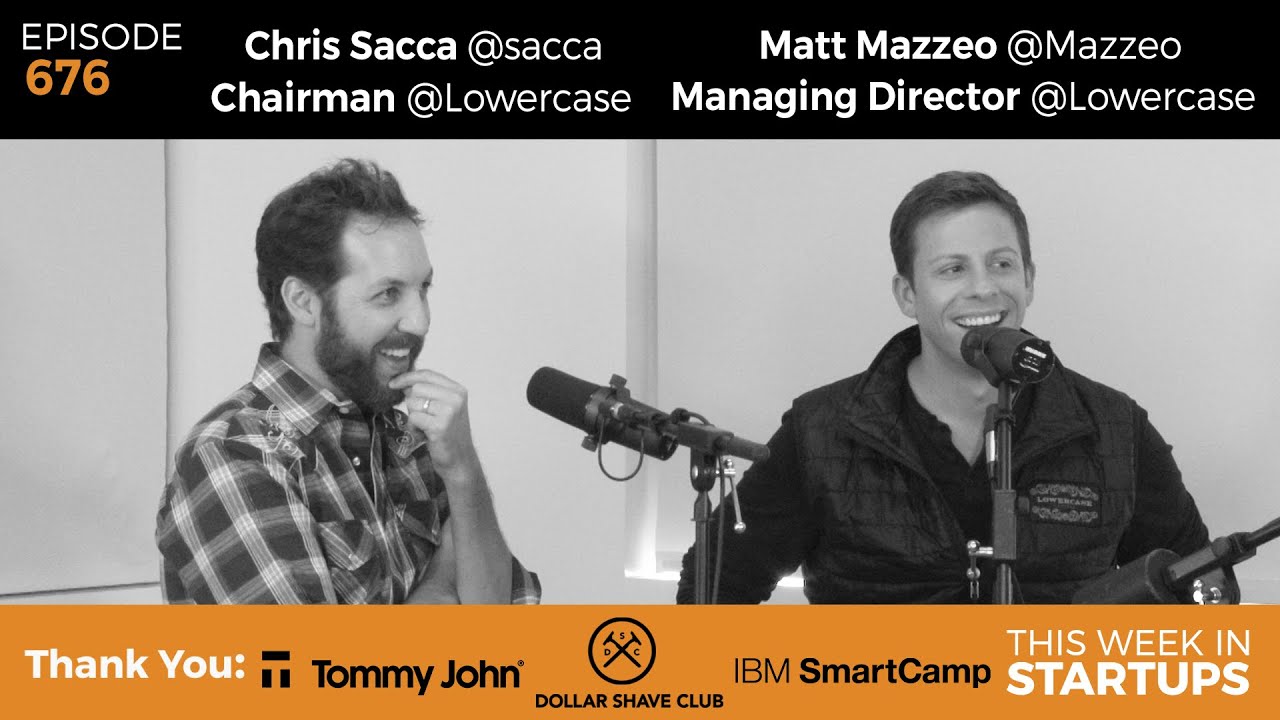
In this episode of This Week in Startups, host Jason Calacanis sits down with Chris Sacca and his Lowercase Capital partner Matt Mazzeo. The conversation weaves through a wide range of topics: the contrasting roles of Sacca (storytelling, PR, deal sourcing) and Mazzeo (hands‑on operational work), the early‑stage investing philosophy of Lowercase Capital—including a rule to back founders with real‑world experience, a focus on family‑friendly companies, and a willingness to write small pre‑seed checks (as low as $150K). They discuss landmark investments (Twitter, Uber, Instagram, Twilio, Docker, Optimizely) and the personal impact those deals had on their lives. The duo explains how they add value beyond capital, emphasizing narrative crafting, hiring assistance, and press strategy, especially for technically brilliant founders who lack storytelling chops. They dive into niche bets in the esports ecosystem (Smash.gg, MobCrush) and the challenges of evaluating products they don’t personally use. A large portion of the episode is devoted to a deep critique of Twitter’s product and growth problems, potential acquisition scenarios (Google, Facebook, Microsoft, private equity), and the importance of fresh user perspectives. They also touch on Lowercase’s internal product, Lowercase Alpha, and the broader evolution of startup storytelling from the early Web‑1 era to today’s media‑driven expectations. Mid‑episode, the hosts break for a sponsor read promoting IBM’s Smart Camp startup competition, outlining the program’s global reach, mentorship, and prize structure. The conversation also includes lighthearted banter about politics podcasts, a whimsical “Wheel of Bullshit” idea, and a teaser about Mazzeo’s involvement in an esports team house, reinforcing the playful dynamic between the hosts. Throughout, the core dialogue reveals the partners’ investment criteria, operational philosophy, and views on the future of key portfolio companies, while sponsor reads and casual jokes provide contextual flavor.
Chapters
This Week in Startups is brought to you by Tommy John, the revolutionary men's underwear brand that's redefined comfort. Go to TommyJohn.com/twist for 20% off your first order. And Dollar Shave Club. See why over 3 million members love Dollar Shave Club. Get your first month of the club for free, just pay shipping. DollarShaveClub.com/twist. And IBM SmartCamp powered by Launch. Over 20 cities worldwide. Get mentored, pitch on stage, compete to win investment from Jason, and become IBM Global Entrepreneur of the Year. Apply at smartcamp2016.com. Thanks to Jay Martin for his iTunes review where he said TWIST is the best podcast for startup news out there. Leave your review on iTunes and be featured on the show.
Hey everybody, welcome to This Week in Startups. I'm your host, Jason Calacanis, and we do the show twice a week. There are some episodes that have become legendary on the show, among them when we had Travis from Uber on, uh, and of course when we had Chris Sacca on, relatively unknown investor at the time, uh, for 2 or 3 hours. And that became one of the most popular, the most popular episode of the show ever. Well, here we go. Today I'm in Los Angeles and I'm taping a couple episodes and My good friend, co-investor in many companies, uh, Chris Sacca is with me again and his partner in Lowercase Capital, Matt Mazzeo, who actually does all the work. This is true. Welcome back to the program.
Right on.
Uh, after that incredible— they've got like an unknown guy, he doesn't do any more work. And then they got this guy who does all the work.
Yeah. The, the ball busting right now, huh?
It has to start with just chop busting.
But, um, Seriously, how hard it is to get out of bed in the morning, put on one of these shirts specifically to come here. I mean, yeah, it's incredibly easy. I haven't worn pants in a couple of weeks.
It's being an investor is easy or is it hard? What do you think, Chris? Is it easy or is it hard to be an investor? I mean, that's a legitimate—
I mean, let's frame it. What are we going to frame it against? Like washing dishes? It's a cakewalk, right? And I think that's one of the reasons why we have a rule about only working with entrepreneurs who've had real jobs, who've had real life experiences, who've been exposed to the human condition, not just in our country, but outside of our country. You've been exposed to poverty and understand how fortunate all of us who are in this game really are.
Yeah.
That said, it's an exhausting job. You are constantly competing to be at the forefront of knowledge, to push your own thinking, to learn as much as you can, to not miss out on anything, to deal with the emotional turmoil of everything from, from FOMO to coaching other entrepreneurs to knowing you've screwed something up. To taking incredible risk and letting it all ride. And, you know, most investors, particularly early-stage investors who start their own funds, have a lot of their own money into the game, probably all the eggs in one basket. And so it's a real job and it comes with a lot of stress. Now, most investors don't want to show that vulnerability. They don't want to show that. It's that taxing. But there are some incredible ups and downs where you deeply, deeply start to doubt yourself. Along the way.
If I think of this job felt like work, it'd feel like an incredible amount of work. If it feels like just something you do because you love doing it and because you wake up and because you can't stop yourself from like staying up on the products and actually playing with the products and meeting people. If you get high on like meeting people and having a conversation, talking about what's happening next and actually helping those companies come to life, then it's like the greatest gig of all time. It doesn't feel like a job. The second that feels like work though, I imagine it's overwhelming. It hasn't for me, but You're enthusiastic.
How long have you been doing it now, Matt?
Uh, at lowercase, 4 years.
4 years.
Well, it's funny, when Matt, when Matt joined a few years ago, I, you know, I'm more introverted than I think people would ever give me credit for. You've called me a misanthrope at times, but I generally, I don't feel like I'm moving the needle for any of my projects when I'm stuck in a meeting. And so when Matt joined, I gave him all my tips for avoiding meetings. I mean, step number 1 was leave San Francisco, move to Truckee. Yeah, don't let anyone know your address. Just completely drop out of the game.
Right.
And then what I did was I picked and chose the people I wanted to build relationships with and invited them up for quality time. But otherwise I did no coffees, no meetings, etc. So when Matt joins, I'm like, hey, here are some of my tips for getting out of meetings. And Matt, who had come from CAA, where he was a power, you know, Hollywood—
I mean, CAA, your job is meetings.
Yeah.
Yeah.
You have a— if you have an agent, you walk in the room and every agent in the firm has to come in that room. Every seat has to be filled.
That's a little entourage. It's an—
somebody showed me yesterday a picture. A director showed me a picture of going into Endeavor. And literally—
was it a big director?
No, it was like a medium director, and there was literally 20 people around the table and looking at him, and he took a picture.
Yeah, that's happened for sure.
No, it's— but, but he, he interrupted me. He's like, Chris, you don't understand, I love meetings. Like, I do a couple of breakfasts, maybe a lunch or two. I'll work out with some guys as one of my meetings. I'll get drinks later, and I'll just stay up till 4 in the morning and get all my email done on the way. And I'm like, that sounds torture.
I love, I love the conversation. I love the back and forth. I, I think one of the hard— if there is a challenge, this job is that it can be isolating a little bit. And that's why I'm lucky to have Chris and friends and you and other people who like enjoy the jam. And I love that about this gig is having like the conversation about what's next and thinking about it and how you can improve it. And I think that comes from meeting people. For me, that comes from like a back and forth, a dialogue, a conversation that happens. And it's often in person.
Yeah, but it's not 12 of those a day. So I'm a little— I mean, you and I met in a jam session, South by. You and I have gone deep. That's how I built that friendship, you know, the relationship with Travis that led to our investment there and Kevin Systrom and Instagram and Evan Williams at Twitter. But each of those was the result of really substantive, come stay at my house for a weekend and let's go hiking or let's ski, let's drink beers, let's have a dance party, let's spend too much time in the hot tub types of interactions. Those types of friendships that happened before we ever did any investments. It's, you know, in the, in the years when I was at Google, I was one of Google's outward-facing people. If you want to do business with Google, you emailed me and my email address is public. And so I just spent all my time playing defense to all of that inbound bullshit. And after I left Google, that email was still pretty public and some people were still spamming me with all of their stuff. And I found I could spend an entire day at Brick House on Brannan just literally lining up from 9 to 5, meeting, meeting, meeting, meeting, meeting. At the end of the day, I'd be exhausted.
You would look busy.
Yeah, I'd be fat because I just ate, you know, I ate something during each one of those meetings. Yeah, I would be tired. I'd be losing my voice and I'd be like, what did I just accomplish other than give all these people feedback on their startups? But all this stuff that I want to do, the writing I want to do, the ideas I want to work on, the research I want to work on, the workouts I should be doing, the hikes I should be on, the people I should be out dating. All of that was falling by the wayside because I was just responding to inbound all the time.
And so every time you take one of those meetings, it fires off more meetings and more follow-up because what happens in the meeting, we discuss what other meetings the person should take and we should discuss what's the next step.
Yeah.
Because that's what they always leave you with. Every— somebody gave these founders this advice: when the, when the investor declines, ask them for 3 more meetings and friends. I'm like, how is that good advice?
Well, I don't— we tend to not pass along anything that we've declined on, and as a principle, unless we think, look, there's a specific reason we decline it. Like, we don't invest in weed startups. And so You know, if I know somebody who does do that stuff, then— and they ask for an intro there, then I'll hand it off. But we just— if I've made a qualitative decision that your thing is not a fit for us or I don't believe in you, the team or the product, etc., I'm not going to go pawn that off on other friends because I know the cost it has. And I think that's why we have great relationships with other investors and we know we don't waste their time.
I— if I'm going to send something to you, it's like it has to be really good. And I know that he's the guy who's going to meet with them. And you're gonna just look at the website. That's at least my perception of you're gonna like peruse it and just see if it appeals to you in some way and that you're gonna go deep, um, in a meeting with them. Am I correct?
Well, here's the idea is that I think as my career developed and as my life situation changed, started making money, I have a great wife, I have these kids, like I've never swiped left or right on a girl on an app.
Yeah.
Matt certainly has.
Are you suggesting that I swipe right?
Oh, are you kidding me? I have ridden in the car with you. I mean, you're now in love, et cetera, but I am in love. There have been many times Many times where he was like, I love you, Jess.
But, you know, like the Snapchat guys, I wonder if he's still got Tinder on his phone.
Absolutely not.
No, deleted.
Is that like the thing that you millennials have to do when you get in a committed relationship?
Yeah, it used to be Facebook official. Now you delete every— every step beyond that is deleting Face— Tinder, Raya, and all the rest.
Does anyone whisper anymore? Am I sounding different?
That's a different purpose.
I'm an investor in Whisper.
Okay, so, but You know, there was a, there was a really pivotal moment when the Snapchat guys came up to me once and said, we're a big fan of your work. We love your ethos. We really want you involved in our company. I was like, the dick pics? Like, I don't know if I would, you know? And so I said no to them. And then I went back and I told Mazzeo and he was apoplectic. He goes, what the fuck? You know? And by then we had missed our window.
Right.
And so what I realized is that—
Now you're using it every day. Your wife uses it. Everybody in your firm uses it all day long.
Of course. It's a great product. And I, and by the way, It's a different product than the one I passed on.
Right. You had the ephemeral message product.
Yeah.
You're talking about where the messages disappear. But now Stories—
Stories is genius.
It's completely different format that we've seen.
I don't know any company that, that reinvents itself faster and more efficiently than those guys. They're amazing.
And before they have to, right?
Yeah. And by the way, we're not investors at all or anything like that. I, I'm just really impressed by them. But the point was that was one moment that drove home the initial meeting is not my strong point anymore. I am not. The user of this stuff. Like Matt goes to like League of Legends tournaments. You pay money to sit in a stadium and watch a bunch of guys play esports against each other.
I love having you in that world. We've now made 3 investments in that ecosystem.
So.
Right. And you—
and I've never played any of them.
You think it's dumb? Yeah.
Well, no, I, I mean, look, look, Matt Mazzeo, you are so obsessed. I mean, be honest. Like, fess up. What, what, how deeply involved are you in esports at this point?
At this point, we've made 2 investments. —And I made— so we made an investment in a company called Smash.gg. They power some of the biggest tournaments and events. OK.
So they make the intranet software or the management software?
Yeah, and the compendium and all the sort of monetization for the players. OK. And then we made an investment in MobCrush. What is MobCrush? MobCrush is a feature today, by the way. Today it's actually the very— you can download— if you download iOS 10, you're checking out new apps in the App Store, it is the number one featured app.
What does— why do people download MobCrush?
They're the only player that has ReplayKit integration, where if you're playing a game now, you can livestream directly from that that game to the world on your phone. On your phone. So no tethering, none of that.
You go also like it. So what I thought was interesting is it's if you're playing an iPhone casual game, so you're playing Clash of Clans. Yeah, Vainglory. And so you watch people like the best guys in the world play Clash of Clans. Yeah. And then there's a huge audience, like a huge audience.
There's 5,000 people, right? I checked it actually because I checked the feature. There's 5,000 people right now watching somebody play Vainglory on MobCrush on the platform.
But if you think about So you would look at these investments and you would just be like, nonsense, I can't, I can't vibe it. And you wouldn't write the check.
I don't think I'm a great judge and arbiter of that stuff anymore. Like, I don't game, you know?
So when he brings you those things, how do you just trust them? Or you ask him to write a memo? How do you, with your partner, what do you, how do you like, is there a deal memo? How does it work?
How do you, you just tell him write the check? No, look, we, we have very complementary skills here. So what I was going to say is, and complement to the first meeting is where my value comes in is there are very universal principles in building all of these businesses ultimately. And so while I might not be a great arbiter of that original idea, I certainly am valuable in determining whether your story and describing it to a mass audience is working. I'm certainly good at sussing out, are these the guys and gals with the hustle? Do their backgrounds and the way they are pitching this and the way they seem to be collaborating to date are they indicative of the kind of teams that we see win? Right. You know, are they really— when we talk to them, are they evoking a visceral reaction to the fact that they're going to be the people who are going to take this all the way? You know, where I specialize at helping them hire the next 2 people in their company or convincing the, the hire who's on the fence that this is the company to join, where we excel at convincing the next investors to come in, you know, and really start to shore this up. If you're worried about your communications or press strategy, that's something that's universal. And I have years and years of experience and all those connections. And so that's why I think our approach has been really complementary, is that the more of these companies you see, the less different the company building part really is. But that said, I'm just, I'm not a kid. I, you know, here's a great example. You're not single? You're not millennial? If I see an app in the App Store at $4.99. I'm like, okay, whatever, $4.99. And yet we know that is a huge tipping point where a lot of people, millions and millions of people abandon that option. Like, $4.99, what the hell? Yeah. And so that's real money. And so I'm not in a great place to determine pricing strategy for, you know, the vast majority of users these days because I just don't care about it. All right.
When we get back from this break, I want to talk about what most people consider a complete and utter disaster at this point, one of your most famous investments, which is Twitter. And I wanna know if you think that this company is dying and if it's gonna be sold and how it might be fixed, or if you think it's still a great company. Uh, and I wanna talk about a product you made internally that I personally think is the most brilliant thing I've ever seen a VC firm build, which is Lowercase Alpha. When we get back on This Week in Startups. Hey everybody! I want to tell you about the upgrade cycle. Yes, we upgrade our phones, we upgrade our computers, but when's the last time you upgraded your underwear? I recently did, and I wear Tommy John's exclusively. It is a revolutionary men's underwear product. I wear it, and it's perfect. I wear the boxer briefs. You might be boxers, other people might be briefs. I split the difference. I like boxer briefs. They're so comfortable. They're so lightweight. Tons of breathability, which, gentlemen, let's be honest, breathability is important. It never rides up your leg, and the waistband never rolls down. I met the founder, actually, of Tommy John, and he has ground out this business from revenue and iterated on this product. He is obsessive. He's a maniac when it comes to product design, and he's applied his product design to underwear, t-shirts, socks, all this great stuff. And really, they are much more than just underwear. I have their undershirts, and they are beautiful, like a second skin. If you want to wear an undershirt and have multiple layers, because layers are for players. We all know that. And you see those VC pictures. Those VCs have the undershirt, huh? Then they have the shirt on top of it. Then they have a sweater. Then they have a blazer. Sometimes you'll see some of those VCs with a scarf. 3, 4, 5 layers if you want to be in the game. Layers are for players. It's patented 21st century technology and design. It's impossible to get a wedgie if you wear Tommy Johns. It's the best pair you'll ever wear, or it's free. That's their guarantee. The best pair you'll ever wear, or it's free. Tommy John. No adjustment needed. Alright, here's your call to action. This is the important part. Go to TommyJohn.com/twist. Go to TommyJohn.com/twist to experiencing life-changing comfort, and you'll get 20% off your first order. You can't do better than that. TommyJohn.com/twist. Tommyjohn.com/twist to experience life-changing comfort and get 20% off your first order. Welcome to the Tommy John family. It's a great startup and they make great products. Get in there and upgrade your underwear, socks, and your undershirts. Great product. Love it. I'm really— I'm wearing it right now. Okay, let's get back to this amazing episode. All right, everybody, welcome back to This Week in Startups. My guests are Matt Mazzeo and Chris Sacca of Lowercase Capital. Did you just get top billing right there? Is that what happened?
I'm trying.
The kid's going to get— I know the kid's going to get a little beat up on this program. Am I going to get beat up?
A little hate. It was alphabetical order.
Uh, Mazzeo. Yeah, yeah, it is alphabetical by last name. Um, and, uh, they are with Lowercase Capital. Of course. Um, Chris is a very famous investor. Uh, Matt is pretty unknown up-and-coming investor.
I think earlier in the podcast though, you took credit for making me a famous investor. I think that's what you're saying.
Basically I was saying like nobody really knew. —But it is interesting how one investment can change everything in your career, and you really have two life-changing ones, I think. Twitter— I mean, there's others, but Twitter specifically and Uber are just two massive, massive wins. I mean, Instagram, you were an investor in as well. Yeah. And so that's—
Instagram bought me a house, so that was pretty life-changing. It's pretty life-changing. Heroku bought me another house, so that was definitely life-changing. Right. So Twilio has been unbelievable.
It seems like a good one for you.
I was right, first money in and advisor to Twilio. So amazing. Yeah. So those are all home runs, but you have two grand slams. Lookout, Optimizely, Docker. I'll take them.
I'm just talking about the, you know, the decacorns are the ones that will return a magnitude of all of that.
Yeah. Depending upon where your basis was in those things, right? Yeah. So basis being where you got in. Yeah. Remember Twitter. Has been a phenomenally life-changing event for me. And at a few different, you know, I was in that first round, I started buying, I was an advisor to the company, so I got shares that way. And then I started buying up everybody's shares along the way. So by the time the IPO, yeah, my affiliated funds had 18% of the company. So that said, you know, the original valuation of that very first round was $20 million at a time when that was an absurdity.
I think that's why Sequoia didn't invest actually, and Fred Wilson got the deal, was he was willing to pay the $20 million pre and the $30 million post.
I mean, there was a lot of deep belief in Evan Williams. Sure. Jack Dorsey was still unknown there. He's a talented guy, but he's still unknown then. Uh, there was— we were kind of taking a flyer on Evan Williams, and a lot of us thought, hey, this is a fun product. There's no one with a straight face who can tell you they knew how big it was going to be and how useful it was going to be and how much information would be in there. It was fun. And so, but that was an incredibly high pre-money valuation for something at that— in that era, 2005, 2006 era. 2006, I think, is when they raised. And so You know, comparatively, during that same time, the Twilios of the world were raising at a 2, right? You know, Uber, our original basis was just under 4, you know, under $4 million, $3.7. Yeah. And so, and so that's what's funny is the multiple and the, and then you have to take into account the amount of dilution, you know, we, we have companies who aren't doing so well. They go into their Series A and they lose 40% of the company on day one. And so it doesn't even matter how cheap it was in the beginning. You just get an incredible haircut. Right. And so I'm very proud of how we've done on paper, even in realized returns with the Twitters and the Twilios and the Ubers of the world. But we've made bank on some of these companies where we get in at an incredibly low valuation, right? Make an oversized bet because we believe in the product and the team and then sell it for $100 million. And they don't get magazine covers. Right. But, but you absolutely— life-changing for a guy from, you know, who grew up in a small town outside Buffalo, New York. Right. And I think that's something that's—
you have a target ownership percentage these days. You try to own 10%, you try to own 20%, or you just want to be in the business with the best founders.
All those rules, all those rules do is serve to give people reasons to miss out on getting rich. It's, it's fascinating. Like, we, we, we see investors are like, look, I won't do a deal if I don't get the board seat. And we're like, look, even at the seed stage, in the earliest days, you either have a relationship with that entrepreneur where you're providing value and you feel like you're getting along, or you don't. And the board seat is not going to change that because in the seed stage, that board member, that investor board member has no control. They, they're overridden by the founders' votes and stuff. So literally you can't formalize a collaborative friendship. Paper can't force that relationship. And yet we see so many people like, I can't do your deal if I don't get a board seat. And we're like, okay, well, we'll just go in and hang out with these guys and collaboratively work and give them advice and hope they take it, et cetera. And we'll make all the money. Okay. So good luck.
We've even written smaller checks that, you know, most funds wouldn't consider like meaningful to the fund, knowing that once that company starts hitting their, their marks and we're close to it, we can lean in and we'll aggressively lean in into companies that start to really hit.
You've written in the last like year or two, what is the smallest size?
We just did a $150K into a pre-seed at a company that's sub-$4M. $150K. $150K into a $400,000 round at a $4 million valuation from like killer entrepreneurs, seasoned founders. And, you know, that's a—
well, I mean, look, we have a few rules that aren't about check size, but, you know, first of all, we only invest in companies we'd be proud to tell our families and our daughters and our wives, etc., that we invested in. So when ultimately these things return and we end up being lauded for however we've done, I want to be able to look everyone I know straight in the eye and say, I'm really proud of the impact that thing has had on the planet. And I don't want to be embarrassed by any of it. So, and, you know, we invest in things that we feel we can personally move the needle. So instead of just throwing darts at a board like in the public market, I want to know that this is a company that we can help. We know exactly how to be helpful.
Why is that important? Because you— if you're not helpful and you made a bunch of money, wouldn't that be a fine outcome?
No. But what happens is it's a lot less likely you're going to make a bunch of money if you're not helpful. So it's a signaling thing. And so it's not even just a signaling thing. It's just First of all, I sleep better at night knowing that I have control over my own destiny, that I can, I can take a company that's good already and hopefully make it great. And so, and so that makes it, you know, I've been a public markets trader. That's the worst I've ever felt. You see red on the board and there's nothing you can do about it except beat yourself up that maybe you're wrong on this one. Right. And so, but with our companies, I feel like I and we are de-risking it in a way. We see that the ways we can help are the ways that are complementary to what they need. They have talents we don't have.
What are the most impactful things you can do for a company? Because you can't go to work with them every day. You can't, you can't build the product, you can't live it. But what are the things that you found, you know, you can actually do that moves the needle?
Yeah, it totally depends on the company, by the way. And what are the top 2, 3 things? Yeah, the top few. The biggest one that I see at the seed stage is more often than not helping them tell their own story. I think you walk in with a company early stage, they're great engineers, often they're incredible technical capacity, but even in their initial pitch, they are just struggling still to encapsulate what their company does. By the end of most of those pitches, by this point, you, the three of us have sat in thousands of startup pitches, know exactly how to tell a narrative.
This week?
Yes, literally, literally by the end of that meeting. And this isn't to knock anybody. I think there's incredible storytellers out there still at the founder level, For the most part, because this is a learned skill, we can tell a narrative often for a company better than that company can and can help train them how to pitch their company to different audiences, to a founder, to a first hire, to the press, to their first thousand users, to their first million users. Each one of those narratives is very, very different. And I think teaching a company how to be a, a soundboard of this is hitting the part that you want to hit. This is telling your narrative that you want to hit. This is missing it. Let's refocus on, you know, you don't have empathy for your users here. Let's talk about how this can be reframed. That is, I think, day one, the biggest impact that we can make. And frankly, whether we invest in a company or not, we try to help sort of reframe that for companies. When we pass, that's often a lot of the feedback we're giving back.
So we spend a lot of time revising decks and, and changing copy on websites, even for companies that we don't work with in the end. Like, so it's funny. We've seen a cultural shift. You, you were out in the web, you know, in technology well before I was. I mean, you were in that crazy movie where they, where they followed all you guys. What was that thing? We Live in Public. Yeah. Yeah. Yeah.
Josh Harris in the '90s, like when we were doing streaming media. Yeah.
I mean, you were an OG's OG, but what you've seen is this transformation where there was an era in Web 1.0 where it was, this whole sector was dominated by slick talkers and storytellers.
At the peak, it became like just salesmen, sales executives, former MBA, and the most important people in sales Silicon Valley were the investment bankers.
They were the true rock stars at the time. And so because the whole journey was, look, have a tight enough story that you can convince somebody to give you the couple million dollars it took to start something and go public with no revenue. And, and then ultimately have that VC pawn it off to another VC and have that VC who is usually an ex-banker get it to the public market and hope you could get out of your lockup before everyone picked up on the fact that your company was all bullshit and smoke and mirrors. And so What happened was when that all collapsed, all those people left town. Yeah, they went to Wall Street, they went to these other places. And the only guys who were left were the actual true dyed-in-the-wool entrepreneurs and the actual coders. And so it coincided with the emergence of true open source tools where now instead of having to have a multimillion-dollar Sun and Oracle development environment, you could literally just code from your laptop. Yeah, you're on it in 10 seconds instead of having a dedicated T1 line that costs thousands and thousands of dollars a month. Yeah., you could just log into AOL and ultimately you got 3 megs of DSL to your house or you go to internet cafe. Yeah. And you could start building. And so what happened was the storytellers left, the builders through stuff like Y Combinator and that whole ethos that came with it of let's empower the builders started to rise and there was a lot of improvement. The legal documents got easier. So that was demystified. The fundraising process was demystified. Who actually wrote checks? A lot of it was standardized.
Yeah. Who were the angels? Open Angel Forum was designed because nobody knew who the angels were. Exactly. They couldn't find us.
And so there were all these obstacles to the traditional startup that were being removed and it was being really democratized. But the one thing that wasn't injected back in the ecosystem was the storytelling. It was just gone. Right. And so you would go to a Y Combinator Demo Day and you just bang your head against the wall and you're like, those might be the smartest kids I've ever seen when I actually get into a conversation with them, but they cannot sum up in 2 sentences what the hell it is they're doing. No.
But they can tell you the TAM and they can yell into the microphone.
Well, it's certainly better than any— I mean, there's too much yelling now. Over the years, they've certainly tried to invest in storytelling and it's become a little bit standardized and cliché. Yeah, but back then it was, it was, you know, the original Demo Days at Y Combinator were, were 12 companies running live code on stage, doing live demos, inviting VCs up to participate and try it out for themselves. There was a lot of feedback in Q&A. And so these were much better, truly truly talented, geeky engineers who were blowing all of our minds what they were capable of building with so few resources. That was a massive change from the web van era, but they didn't have the storytelling capability. But they didn't have the storytelling. And so I would have answered the question the same way. First and foremost, that is the thing that I think is one of our competitive advantages. Yeah. And I think is the thing that, that is so complementary to these guys who have good product chops and good coding chops. But that last mile is missing of how do we tell everybody what we're doing here? I mean, look, none of our companies can actually afford to market, right? It has to be a product that's not only intuitive to use, but we have to empower each user to be able to describe that product to another user, right? Because they're our marketing force.
The over-the-shoulder, here's how Uber works, here's how Twitter works. Even Snapchat, which is impossible to learn how to use unless somebody gives you a walkthrough. I mean, you can't just figure it out, can you?
But, but no, but, but the thing that Snapchat— first of all, you're old. Uh, and so let's be clear about that.
In the original version, like, I think that you had to like have somebody.
But here's the thing, like, you know why Snapchat is particularly hard? I figured this out because you don't swipe. Like, swiping is a— that we are non-native swipers, right? So we think about the mobile native generation. We're absolutely clickers. Yeah, there's a, there's a, there's a mobile native generation. Like, I didn't have a cell phone in college. Yeah, the class just after us started to have cell phones in college. I had a voicemail account I shared with my roommate. That I got to check once a night, right? And if I left the dorm and didn't know what was going on, I was gonna miss the party. So we now have a generation of people who are native swipers. Yeah. And, and the, the only way to master Snapchat is to be a swiper. I think it's actually, it's different than that.
I think it's actually, you have to tinker. Like, this is a generation that just like, they don't wanna read an instruction manual. They never wanna be told what to do. Just gimme the product, let me play with it, and I'll start jamming on it and figure it out. The two of you just don't do that in the same way.
That's bullshit. We tinkered with VCRs and stuff. Like, the only way we got to where we are in our careers.
But are you tinkering with a social product like a Snapchat?
Our parents tinkering with the social apps. I'll tell you what, when I look at— when I look at an app— stuff in it, it is like— that's exactly right. When I look at it, so much hidden stuff. It is not— it is not intuitive to me to be like, oh, if I pull the whole thing down, that's what I'm saying. Yeah, part of the app comes up. Yeah. Oh, and by the way, and if I move the whole thing this way, like, oh my gosh, there's— oh, they'll talk to people.
Here's a framing of it. Kids will wander in the sense that they will— they will not have necessarily— they will jump in. They don't— they have time, and so they'll wander through a product, they'll discover things in a product in a way that like— I don't buy it.
You're discounting like the curiosity and tinkering are intrinsic characteristics of anyone in our business, of any entrepreneur, of any investor. And so, but, but literally the gesture of— I mean, if there's, if there's a next wave of it and it's the three-finger swipe or something like that, or the touch your nose, etc., that would not occur to me if I'm like— I'm stonewalled in this app. Yeah, I'm stonewalled in this app. What would I do? But there's a bunch of kids here.
I don't think anything in I just realized that I never used the touch—
what do they call it? The 3D Touch?
The Force Touch. I've never used Force Touch. Is there any hidden features in Snapchat with Force Touch?
I think you can go directly to the home screen. I haven't seen with iOS 10 yet. Interesting.
Alright, listen, before we went to this commercial break, I asked you about, um, the disaster that is Twitter.
Do you qualify— and I just called my therapist and she said I should really pass on talking about this. It's just I'm still— there's still a lot of PTSD.
How many days a week do you got? 2 days?
Uh, is it just for the Twitter therapist? Yeah, it's a whole separate—
it's a whole separate bill. I mean, it's the most promising product.
It's a $13 billion company, Jason. Yeah, so let's, let's frame it.
It was a $45 billion company last year, or the year before, and when none of us could sell the stock. Just none of us, just to be clear, to bring up even more therapy and to really trigger you.
No, illiquid stocks will trade at crazy premiums, right?
Right, okay, so trigger warning. But the thing has not been able to grow, and that is the core problem. Why has Twitter not— and to have a sort of serious discussion of, yes, it's still an incredible product, the most important people in the world are using it every day, but nobody else is using it. It's not growing, and not growing, as we all know candidly, equals death. Why can't it grow after 2 leaders and hitting 300 million people and hitting great revenue numbers and still having the world's most important people on it hours a day? Why can't it break 500 million? There's—
so I'll parse that into a few different things. It's funny to hear you say a sentence like, and it doesn't have anybody using it. There's 68 million Americans on the service. That's more than the combined audience of MLB, NBA, NFL. I'm only comparing it to the contemporaries. The amount, the amount of attention and time it gets Yes. Is eclipsed only by Facebook, Snapchat, and Instagram at this point. It is a huge cultural force. And I would argue that the users and the audience of Twitter are even more influential, more impactful than the audiences of those other services.
It's the most influential people.
So, and so let's— I do this to both give it its fair credit, but also contextualize why it's so frustrating. Yes. So the growth is very, very real. I mean, this is a product that should be growing organically. But it's not, but it's not because it's too hard to use. Still, that's the reason. Number one. So too hard to use. Like they haven't taken the obvious steps to eliminate the syntax you need to use. I mean, how many times do you see somebody start with an reply and not, and they don't intuitively know that their users or their followers aren't going to actually see that unless they follow the person. Yeah. It's just crazy. The dot, that's a broken thing. Yeah. You know, I watched, an officer of Twitter yesterday. DM fail again. Really? I mean, this is— you're like, how is this still happening right now? Like, I'm not gonna bust his balls, but I watched, I watched somebody at Twitter say, look, in order to watch the, the Thursday Night Football game that they paid a ton of money for, enter in this URL, that'll go into your browser, then open it in the app, and then you'll load this card, and you're like, What, kidding me right now? Like, like it's, it's an NFL game. Yeah. No, because I mean, think about it. They would do these great little specialized sites for the NBA games, but I would post the link. I would have to hunt for it. I would post the link. They didn't feature it to anybody. I remember like, holy cow, this is amazing. How did this happen? It's just not there. So, so this is a company that just hasn't gotten out of its way in making the product easier to use. And again, another layer of frustration there is that for every single person on the planet, I guarantee you there is stuff in Twitter that is uniquely interesting and compelling to that person, right? I don't care what your interest is, what your obsession is, what your hobby is, what your background is, that you will want to read. It is in there. And maybe not the whole account. That's the other thing that, you know, Twitter has always thought about things as an account rather than the atomization of the tweet. Yeah, you get worried sometimes about opting into an account. Sure, that could be a full commitment. And yet there are incredibly, incredibly valuable individual tweets that come out. Yeah, there is no lean-back way to consume tweets, right? So I should be able to go right now. Let's say we spend 3 hours sticking around here. Yeah, I should be able to open up Twitter at the end and just see what were the most popular tweets that happened while I was stuck here, like punching the— while you're away, right? Yeah. And so like, you've seen this now with Nuzzel, an investment of ours. Nuzzle does that for all the news and links that we're—
yeah, you're like, here's 10, and it's like they're all bulletproof.
They stack rank them by what the engagement popularity was in feed, and that is always time well spent. But the fact that Twitter can't do that and can't do something with just stack ranking tweets by popularity— I mean, they've tried with the algorithmic feed, but they're overthinking it. They're trying to bring too much science to something that is just so easy. Give me the greatest hits. Just shut the fuck up and give me the greatest hits. That's it. They literally could call it— don't waste my time. Don't waste my time. How do you put something in my feed that says 'while you're away' and it has zero fucking likes on it? Yeah, like Why do I want to see that tweet? Give me the most engaged stuff.
So all that auto-magical machine learning AI signaling stuff that Facebook does with their feed where you just, you don't miss the most important stuff, they just haven't figured out.
But Facebook act— I mean, it's funny, we, we, we give a lot of credit to AI and we, you know, everyone acquires all these startups, et cetera. But Facebook, really all they do at the end of the day is they just accelerate the things that have the most likes on them. Yeah, like that's really what they're just putting— they just look at engagement and they're just like, this thing, I don't even need to know what's in it. But if everybody in your graph is talking about this thing, then the odds are you're going to want to know about it for sure. So sure, they do the targeting and sure, they do the siloing around— you're a Republican, you're a Democrat, let's get in the echo chamber. That's all interesting. But the number one thing they do is just look for the most resonant content. The announcement, bar mitzvah. That's why it goes— whatever. Everybody— you had twins. Everybody favorites your twins. And so it doesn't even need to know that your kids are cute. It's just like everybody in this graph should probably see this thing. Cal Canis normally gets X hundred likes on something. He just got X thousand. Everyone needs to see this, even if it's 7 days old.
Hey everybody, I'd like to welcome a new partner to This Week in Startups. Our family continues to grow as our ratings and the viewership program continues to grow. All these great guests and our latest partner is Dollar Shave Club. I love this product. I have been shaving every day. With the Executive Blade. I love it. I've never gotten such a clean shave. I've been using this Dr. Carver Shave Butter that they do. It's the smoothest I've ever had. It's like this really thick, buttery— you rub it into your beard, and then this Executive Blade. I have to say, I've had to adjust my shaving because my old blades, I had to like really dig in there. Now I just glide it right down with that Executive Blade and love it. You can go to Dollar Shave Club right now. Pick a razor from the lineup of amazing blades and you never have to deal with the drugstore hassle or get these locked-up razor fortresses ever again. You can just very easily get them delivered right to your door. And it's really cool, the packaging is very tiny, it's very discreet. You have this nice little bag, you open it up, and it— I don't feel like it's wasting any environmental problems or anything. It's just very efficient. And never having to go to the store again or think about my shaving again and just having that daily routine taken care of. And I'm throwing the blades away and I'm using fresh blades on a very consistent basis, I've locked in to Dollar Shave Club. It is the answer if you want to get a great price and have quality. You're not going to make a decision over quality or price. You're going to get incredible quality at an incredible price. I absolutely love it. So here's your call to action. This is what you got to do if you're a superfan or if you shave. Dollar Shave Club is so confident in the quality of all their products that they're going to give you the first month free. That's right! Just pay the shipping. After that, it's just a few bucks a month. No long-term commitment, no hidden fees. Get the first month free. Dollarshaveclub.com/twist. T-W-I-S-T. Dollarshaveclub.com/twist. Dollarshaveclub.com/twist. I absolutely sincerely love the product and been using it every day. You will look, smell, and shave like a million bucks without paying for it. Literally, you know, I don't need to read commercials for a living. I've done okay as an angel investor. I would not steer you wrong. I genuinely have gotten the best shave of my life with their Executive Blade. It is amazing. Go ahead and go to dollarshaveclub.com/twist and get the best shave of your life at a really fair price. And just think of the cognitive overload. You never have to think about shaving again. I love it. All right, let's get back to this amazing episode. So Jack's had a year in there. He's a halftime CEO. He's working around Square. You were very publicly supportive of him. Adam Baynes done a great job. This last Thursday they talked about selling the company.
They didn't talk about selling the company. A lot of people—
the board meeting was about selling the company. I know this.
How do you know that? I know. Just because you, you read about it with everyone?
No, there was a— it's on the table. That it's on the table. Let's just put it that way. So if it's on the table, the door has been open for a while. The door has been open for a while. Let's call it what it is. So what would you like to see happen? Would you like to see it be bought by somebody, and if so, who? Or would you like to see a change in leadership? What is— what would Chris Sacca like to see happen?
Yeah, but so I was a very vociferous advocate for Jack to get back into the company, but that was part of a broader deal Yeah. So Jack as a halftime CEO to me made more sense if Adam Bain were really elevated to a true operating CEO running the company type role. And so, and in parallel, I and the other shareholders that, you know, that I was representing in that, in those talks, really wanted to see Evan Williams come back and have a product role in the company, even if it wasn't a formal title as a product role. But I think Evan Williams is the most visionary product guy in this space. Yeah. 2.5 years before the Periscope deal, he was pounding the table about live video, live video. We got to have live video. He just sees it. Yeah. As a buddy of yours. Yeah. It's, it's really disorienting to talk to him sometimes because he's living 3 to 4 years in the future of web and social. You know, people kind of joked about Medium and now they realize it's a behemoth. What he's built there is going to be one of the most powerful traffic generators that the web has seen for long-form content. And it'll be very easy to monetize when the time comes. And we're seeing massive publications move their stuff onto his platform. So the guy sees what's happening. And remember, he built that company from 2 million users to, to, to 200 million users. He has a deep understanding of audience. He doesn't excel at telling a public story to the investor class, to board of directors. It's just not his game. He's not a schmoozer. And that's what caught up with him in the, in the, you know, the kind of palace intrigue of Twitter. Yeah. But the game of— he has a true product vision and I really wanted, and I, and I wanted it. Everybody else wanted to see him back in. Yeah. That was my What I think we ended up with, unfortunately, was a result where we have Jack halftime and we get a lot of talented performance for him out of that halftime. And the employees really like him. Yeah, he has the gravitas of the founder and inventor of the product. Clearly, Ev is not that deeply involved. Yeah. And Adam Bain was not given all the responsibilities that I think people expected a COO to be given. You know, within months after the after the, the transition to Jack as CEO, he still had something like 11 direct reports. And that's an impossibility to do with a half day. Yeah. And so I think without a really streamlined management team that's not bottlenecked on a half-time CEO and without real product vision. Yeah, it's a company that's going sideways. Yeah. You know, I'm really impressed by Adam Bain's success in monetizing the users they have.
They have over-monetized as far as I'm concerned. The platform is brilliant and the video stuff that he's been put in charge of has been going really well.
Well, I think the transition from, you know, text to video. Yeah. Is not only in step with the evolution of how mobile— the direction we're all going with web and mobile, uh, and content, but it's also the only way that company has been able to accelerate its monetization in the face of no user growth. Right. So take each user and make those users who are engaging more valuable to the platform. Yeah. But ultimately there's a— there's a ceiling on that.
And so time for a change as a shareholder.
And I— and I mean, I guess the way I would describe it is I, I certainly don't own all the shares I owned at the IPO because I'm not an asshole, but I own more shares than I should because I'm an asshole. And so, you know, I'm still sticking with them. You're a diehard. I am not all in on the stock, but I still do care about them. Yeah. Partly because of this. You know, it's like that. It's like the kid who that you're raising has so much promise and then one day you lift up the mattress and there's like heroin needles and you're like, come on, you could have been something. Oh man. And you get the note from school that they're not showing up to class and you know, and you're like, they're not showing up to class and they're skipping their job. And you're like, shit, what did I— I mean, I thought I cared for— didn't I show you love? Didn't I nurture you? Like what's— all those hikes all that time. So, so it's very, it's very frustrating from that perspective. And, um, is there a natural buyer? There is. And here's why.
So who's the natural buyer? What's it suffering from?
So it's suffering from distribution. And you've got platforms out there that could easily add distribution to this thing, whether it's Google, Facebook, Microsoft. These are, these are platforms with massive distribution. Apple, easy ways to get this thing in the hands of more users. There's no doubt about it. Growth could be accelerated immediately. Right. Um, you've got teams within those companies that are able to take a fresh look at products and make them simpler. Yeah. And so I think right now, one of the things that that Twitter suffers from is everybody who works there is a power user of Twitter, right? And so rarely do they get any fresh eyes on the product at all. And so everybody works there, knows how to use DM. Well, apparently not one of the corporate officers, but, but, but everybody knows this weird syntax, knows how to work their way through the app. But so they don't actually see a lot of the obstacles to this. I think it would be very helpful to the culture there to be exposed to another company.
Yeah, but what do they have?
They have a unique information asset that nobody has. Facebook has—
It's no brainer for Google to own it.
Facebook has obsessively tried to go after that. Yeah. And they haven't been able to replicate it. They can't get to it. They have better information faster than everybody else on the planet. And they also didn't get government either, right? And they didn't get news. Nope. And so they tried, they tried with Pages and stuff like that, like, yeah, and with all their publisher deals, they don't get it as fast.
They're now resorted, Facebook, the mighty Facebook has now resorted to paying off people to use their products. Yeah. That's how bad it got for them that they couldn't make any inroads. So they finally started cutting checks to influencers, correct?
Yeah. So, but, but I'll tell you what, I mean, with that in mind, so they have this unique asset. What do they do? They gave it to Google for free, like in exchange. So Twitter trying to chase MAUs, monthly active users, to try and keep Wall Street happy is trying to generate some source of inbound clicks. So they give all of their index results to Google to include up at the top of the page. It makes Google users very happy because now they have the best real-time results on search. Awesome. And all they get are some incidental clicks back to Twitter and a process that's way too hard to log into, et cetera. I mean, you choke on it. Yeah. And so remember the very first revenue deals we did in the history of Twitter were Bing and Google.
Find Google.
Yep. And we gave them access to the fire— to the firehose. It wasn't even called that then, but we just gave them access to our whole index. That they could find. I remember the very first time we met on that. I was— Twitter didn't have a business guy, so I was, as an advisor, I was their business guy. I was negotiating this deal. Marissa Mayer came in from Google and said a stat I'll never forget. This is 2009. She said, we just looked at your index and you guys, 62% of the URLs in your index are URLs that our spiders had never seen. Wow. So that's, that is in 2009. Think of how polished and successful Google's Web crawler already was at that point. And we had all this information they've, they've never seen. And it's only gotten better since then. And they paid us tens of millions of dollars for access to that data back then. Yeah. Right. And Bing did the same thing from, from the Google side, by the way, or from the Microsoft side. You know who negotiated that deal for Microsoft? Satya. Wow. He was literally the guy in the room negotiating that deal back then. He's been a believer. He's been a believer from the beginning. He knows the value of that data.
So Microsoft's the most likely Likely buyer.
So, I think there are a few buyers. I also think some of these guys are gonna have to play defense to each other, right? Google cannot let Facebook get such valuable and unique information. Facebook will buy it in a heartbeat, but it's a regulatory issue, isn't it? No, no, no, no, no. Well, look, these things don't get caught up in antitrust because strangely enough, what happens is when two web companies or two internet companies combine, they're framed against the total market that includes IBM and other computer services stuff. So this stuff never gets blocked, actually. Uh, but so the— there are also, um, there is another group of buyers who are just pure financial buyers at this point. The Verizons, the Comcasts of the world. You've got a company right now that's doing billions of dollars of revenue, still growing. And you look at the multiple and you look at where the Yahoo deal just traded and you look at where the LinkedIn deal just traded and you're like, you could just really, as a suit in an office, make a case for why this thing makes sense, particularly if you have an existing ad network. And you can scale across the ad packages you're already buying, get that much— or you're already selling, get that much more reach. It makes perfect sense for those kinds of buyers.
So buy Medium and put Evan in charge again. Does Evan not want to do it? That's what I speculated would be the best solution.
I think one of the challenges for being a public company in today's era, and we go back to storytelling, is that there's a demand upon you to be both an incredible product person, the visionary, and people— employees look up to., but also have the gift of gab to manage. Yeah. So you send Bane as the new CS president and you have Ev like, you know, by the way, they never would. Isn't that frustrating? They never like—
just let Adam Bane do all the press, make him president.
Bane is the best talker in the company and they never go out and do that stuff. He should do 100%.
When Jack was on CNBC after he took the job with the big beard and he said to the person, I don't think people should be judged on how they look when they asked about the beard, it was like, really? You just become CEO and now you're making a moral stand on people— you're insulting the host of CNBC that he is judging you based on your looks.
Are people— I mean, people listen to this, right? They can't see me putting my head in my hand. It's just like, dude, it was a joke.
You have a grizzly bear beard nobody's ever seen before. You look like Luke Skywalker at the end of Episode 7. Like, we haven't seen you in a year. And you show up looking like Luke Skywalker on an island in exile. Well, what about—
you've got a company who lost 50% of its market capitalization. Yeah, it's in turmoil. The CEO is on his way out. Yeah. And to, to go on CNBC and say to the entire investing community, it's just going to be business as usual. Like, that was where everyone just like, take my shares and just light them on fire. Let's roll up these certificates and smoke them for sure at this point, because we might get more return out of that than actually holding on. For sure. Heads down. And I think so. What? So why not? So, so the challenge— so, but the challenge is, so Evan Williams, talented product visionary. Yes. But Evan Williams, his, his core strength isn't doing the interview. It's not doing the earnings call. It's not going on CNBC because Evan Williams doesn't speak in soundbites. He doesn't need to. Is the philosopher king of the internet.
It's time for the return of the king.
Evan Williams, I will tell you most succinctly, Evan Williams is long form. That, that's who he is. Of course he is. His essays are incredibly thoughtful. Yes. The conversations with him are incredibly thoughtful. Yes. The prelude, when you get into a jam session with him, you give him some room and he has a prelude and a contextualization. Then ultimately he builds and he starts standing up and he gets excited about the conclusion. But ironically, Evan Williams is not a 140-character guy. No. And yet that's what the market, and that's what the attention demand from a CEO right now. So you said, look around at these people who are excelling with their storytelling. Look around. I mean, Elon, who's a great buddy of yours, is not only a product visionary, but God, that guy knows how to tell a story. He does now.
He didn't then. It was very interesting. You know, he used to make fun of blogs when I first met him. He's like, what do you do? I'm like, I have a blog business. Like, blogs?
You do blogs?
And then like his ex-wife started doing blogs and he would make fun of us at dinner. How's your blogs? And I was like, you should do a blog and you should be on Twitter talking directly. He's like, Oh, you want me to tweet? I'm gonna tweet. And I was like, now he's like the world's greatest tweeter.
He— and it drives the market capitalization of the company. Yeah, I mean, to take this a step further, like, Donald Trump is a 140-character guy, a disaster, no substance, also 18 miles wide, 300 pounds, you know, heavy, and an inch deep. There's nothing there. He has not read a book in his life. I don't even think he read the book another guy wrote for him. No, that, that he knows the guy.
Literally, if he met the guy who wrote the book, he wouldn't recognize him. I don't think he's met the person who wrote his book.
But I think, I think the market right now, both the investing market and the public, demand these figures who are TV ready. I mean, look, you've, you've heard me say I believe Mark Cuban will be president of the United States for sure. There, there is no doubt. So I think the United States overindexes on their faith in billionaires. I think they consider business success to be the ultimate arbiter of your worth as a person. Yes. And I'm saying it's right. It's, it's ridiculous. No, I'll get into a fight on Twitter with Cuban, who's a good buddy of mine, and they'll just be like, literally, people will be like, shut the fuck up, his stack is bigger than yours.
Exactly.
I'm like, so it has nothing to do with the merit of my point and Cuban being wrong right now. Yeah. And by the way, who knows this better than Trump, right? That's why the guy has gone to such extreme lengths to lie about the money he doesn't have, because he knows America gives a shit about the total.
When they find out he's worth $600 million, they're gonna be like, you fucking loser, you're worth $600 million. You piece of shit. You're like, it's $600 million. I have a big private jet.
Fuck you. The only person who would nickel and dime their own campaign, their own foundations, is the guy who doesn't have the cash. Yeah. To do it right. Short. Like, he doesn't. He doesn't have that. And billionaire after billionaire have been calling him out on it. And he, he talks shit, but he will not provide a modicum of evidence.
You had a choice. Google or Facebook buy Twitter at double the current price, or they buy Medium and Evan Williams comes in and has to grow it from here. Which would you rather do? Double your stock share price and get out, or have Williams at the current price?
So do we take it private with Evan Williams? That's what I would love.
Okay, I would love— and then that's the third choice.
I would love if Evan Williams private, or Evan takes it private.
I, I would love—
and this isn't going to happen because there aren't the cash flows and profitability to finance an LBO, but let's play the game. If Evan Williams were given the opportunity to run Twitter quietly, privately, with a long-term vision, again, there is no doubt he could make the kind of radical changes to accelerate user growth, to simplify the product. Again, took it from 200 to 200, hypothetical, from 300 to a billion. Not hypothetical. He did that. Yeah, right. And I think what he didn't do was along the way shine the board on like, hey, look at me, I'm accomplishing all this stuff, right? And go out and make the rounds at all the conferences and really build that brand as the enigmatic, kind of high-gravitas CEO. That was a real challenge. And I think that's what ended up sneaking up on him in that case. But if we had the opportunity to have a real product visionary in there building it the long term—
so you just need to have some huge private equity firm buy it and make it profitable.
It's just not going to happen though, because what happens is, well, a private equity firm buys stuff by borrowing against it and you finance the borrowing by cash flows. And we have a company that that has great revenue but isn't profitable from cash flows, you don't have anything to finance the debt on that. And so that's just not going to happen. I mean, look, the other thing you have to look at with Twitter, you have to admit too many people work there. Stock-based compensation is way out of—
you think you have to cut half the people?
I mean, who knows what the number is.
I don't know, people are saying half.
Hillary Clinton got in trouble for saying half. And so, you know, Donald Trump got in trouble for saying half. Yeah. So some of the people—
many— when did they say many people are saying they said half of his people are wingnuts, right?
Half the people are— it's a basket of deplorables. But he also said half of the people in this country are carrying the other half because half the people in this country don't want to work for a living.
Yeah, nobody mentioned to him that they're over 70 and under 18. Like, when he did the statistic, it's like, by the way, the people— not a large percentage of people not working are opting to not work, or they're not legally allowed to work.
When you want to start your politics podcast, let me know. I'll be on every episode just, just as a catharsis.
All right, when we get back from this break— I think I'm supposed to do a break, right, Jake?
When we get back from this break, I want such a power move, by the way, to like talk to your producer in real time. I mean, that's— I know Stern is like your biggest influence for this. I would Hey Stern, and, um, it really just builds a lot of authenticity into it. Yeah, so am I allowed to tell— winning jacket— but am I allowed to tell everybody that there isn't actually somebody here?
No, no, we just have— we have a— we have a recorder. I set this all up and hit the record key. There's producer Jake, producer Jackie. Um, can you ask associate producer to handle this for me?
Can we just make up names for your fake director? Absolutely. Uh, he's got a whole whack pack right here. Absolutely.
No, you know, interesting thing Um, I had a radio company, two different radio companies actually approached me and say, we listen to your podcast. One of them is a local station. One of them delivers through a different mechanism. We'll leave it at that. And they were like, hey, we want to talk to you about maybe you talking about things other than just tech and business. Would you be interested in maybe doing a drive time radio thing? And I was like, that's interesting. When is Stern— is retiring in 4 years?
What have you always wanted to talk about?
I would like to have a podcast where I talk about politics and entertainment and just everything else in life. I would talk about the other topics for sure.
I would love to see you have the Arbitrary Wheel of Bullshit podcast where there's literally a Wheel of Fortune. Yeah, just randomized topics, and you've got your Vanna White equivalent who just spins that thing. Yeah, for sure. And then all your guests— Matt, you're available to spin the wheel?
I will be Vanna. Yeah.
All right, when we get back, I want to ask Matt about this esports team because you bought an esports team. This is true.
I didn't realize we were going to get into this. This is one of the more embarrassing chapters. I want to get into Well, no, it's just awesome. Matt owns— he owns a share of some geeky kids.
All right, I want to know what's going on in Matt Mazzeo's esports team house. We'll be back on This Week in Startups. Hey everybody, I want to tell you about the second year of us partnering with IBM for something called Smart Camp. We had a great partnership last year, and now we're on to smartcamp2016.com. .com. It's a startup competition. It occurs in 20 cities from around the world, and you can find your city on the website, smartcamp2016.com, smartcamp2016.com, or you can find the city closest to you, one you can get to, and you can apply. Applications are closing in a few weeks, so I need you to apply today. And if you win, you're gonna get to pitch on stage at the Launch Festival or the SCaLE conference, and you're going to get mentored by local IBM city leaders, and you can compete for a chance to be a finalist. So you're gonna pitch on stage in your city, become a finalist, you're gonna crush it, and then you're gonna come to the SCaLE conference, the LAUNCH conference.
It's gonna be great.
The top 10 finalists get to come to the LAUNCH Festival in the spring of 2017 here in San Francisco. They get to meet with me. You have lunch with me. It's great fun. And the top 3 finalists are gonna present on stage at the LAUNCH Festival in front of thousands of people. The winner will get $25,000 from me and come to my exclusive incubator, the LAUNCH Incubator. Last year, CarForce went to the incubator and received an investment from me.— actually doubled my investment in the company, went from $25K to $50K. And you will become the IBM Global Entrepreneur of the Year. A title you want to have in your pitch deck when you go meet with investors. So go ahead and visit smartcamp2016.com and start your journey. It's gonna be an amazing conference, an amazing competition, and you're gonna learn a lot, and you might wind up getting an investment from me, Jason Calacanis. Okay, let's get back to this amazing program.
Thanks to Jay Martin for his iTunes review where he said, said Twist is the best podcast for startup news out there. Leave your review on iTunes and be featured on the show.
More from Matt


Coatue Management Matt Mazzeo’s path into VC and his philosophy on being helpful


Matt Mazzeo, Managing Director, Lowercase Capital (Pt. 1) | Product Hunt LIVE

EP 43 - When Should Startups Raise Money? Matt Mazzeo (ex-Coatue) on Fundraising, Product & Growth

Bothsides TV Episode 12 with Matt Mazzeo, Managing Director of Lowercase Capital