
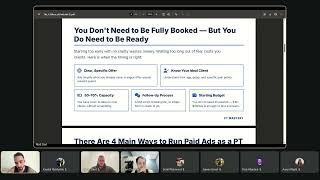
In this 45‑minute live training, Matt Dart walks a group of personal trainers through the fundamentals of paid advertising and why it is essential for scaling a fitness business. He contrasts paid ads with organic marketing, emphasizing that ads provide predictable, controllable lead flow while organic relies on ever‑changing platform algorithms. Matt outlines four core paid‑ad funnel types that PTs can implement: (1) Book‑a‑Call funnel using Meta lead‑forms and calendar tools; (2) Direct‑Message (DM) funnel that captures leads via Instagram/Facebook DMs and can be partially automated with ManyChat; (3) Follower/Boosted‑Post funnel that grows a warm audience by paying to boost high‑performing organic posts; and (4) Webinar/Workshop funnel that builds authority and sells to groups through live events. For each funnel he details required software, pros and cons, ideal client profiles, and typical budget ranges (e.g., $10‑$20 /day for testing, $200‑$300 /day for DM or Book‑a‑Call). He stresses the importance of a hyper‑specific niche, a validated offer, and a rapid follow‑up process (speed‑to‑lead). Matt also covers operational realities: the learning phase where ad spend may lose money, ad‑creative fatigue and the need to refresh creatives weekly, and the necessity of tracking key metrics such as cost‑per‑lead, cost‑per‑follower, and ROI (often 10× return). Throughout the session he answers live questions, offers personalized funnel recommendations, and announces a series of deep‑dive workshops on each funnel type. The training ends with a reminder to use the community for ongoing support and a note about upcoming public holidays.
Chapters
Um, okay, so we're going to talk about the 4 pillars of paid ads today, team. So, um, there's 4 main, uh, obviously 4 main pillars that we're going to go through. But later this month, uh, and each month for the next couple of months, we're going to do deep dives on each individual type of funnel. So you guys know, uh, I'll basically give you the overview today so you kind of know, uh, what's out there, and then you guys can just pick the right type of formula, um, for you guys. Um, and then as I said, we're going to do some deep dives, uh, later this month. So I'm going to start sharing my screen. Um, just before I do that, um, can you let us know in the chat— because this is purely about paid advertising today, so nothing to do with organic— um, if you guys are not running paid ads right now, can you tell me at what stage you're wanting to start running paid ads? If you can let us know, you want options to be within the next 30 days, in the next 3 months, or 6 months plus, kind of tailor-make this, uh, session for you guys. I can't put in the chat because I'm driving to me tattoo, but in the next 3 months. Awesome, tattoo day today, my friend! How good, how exciting! I'm excited for you. Yeah, okay, nice. Awesome stuff. Um, can everyone see my screen? Someone give us a thumbs up. Cool. All right, team, so let's go through the 4 pillars of paid ads. So if you guys got any questions, just ask questions as we go along. I'll have the chat on the side here. So As you guys probably know, I've been pretty successful with paid ads. I've been running paid ads for probably about 12 months or so now. I think I've spent probably around $70, $80 grand on paid ads. I don't know how much I've made from them, but I've made probably half the money that I make each year is from paid ads. So there's obviously organic and then there's paid. Generally, you want to do both, okay? So if you just want to do paid ads, you generally want to have a little bit of organic in there as well, but ideally you want to combine, combine the two together. So let's go through it. So the difference between organic and paid advertising is paid advertising is predictable. So what that means is if you're relying on organic marketing, you're relying on the algorithm, which changes all the time, um, and you're relying on word of mouth as well. So it just doesn't become predictable. When you master paid ads, or when you have an understanding of paid ads, you can literally turn the tap on and off as you need to grow the business. Prime example, we've got a couple of clients in our community that are absolutely crushing with ads right now. Ibrahim, uh, Clint, as an example, they're generally spending about $100 on ads, and each client is worth $1,000 or more. So if you make it simple, you're basically putting in $1, you're getting $10 back. $100 in, $1,000 back, etc. $100 grand in, $1 million. Okay, the 10x return. So I just want to make it super clear, I definitely suggest doing organic at the same time as paid advertising because paid advertising will just give you more attention, and that is basically it. If you've got bad organic, um, or you don't have a good service or a good offer, then paid advertising just isn't really going to work. Okay, so a couple things here. Generally, you want— you tend to hit income ceiling with one-on-one clients if you're doing face-to-face, so you kind of want to tap into like the online space. Or if you're potentially even hiring a team member, obviously this is going to free up some time so you don't have to rely as much on the gym. But the whole thing of paid advertising is to get predictable income week in, week out. Okay, so I've covered a couple of these things, um, already. So turn tap on and off. Now the good thing about paid ads as well, you can obviously start super low, which I'll go through shortly, but you can also go super hard as well. At this current time, I generally spend about $1,000 a week on ads, and that generally makes a very good return on investment pretty much every single week. Predictable lead flow. So instead of you having to call cold leads like you usually would do in the gym, these guys are inquiring with you so that the, the chance of success is a lot higher because they're specifically inquiring with you. You own your growth, so you don't have to depend on the gym. Um, there's a few other things that we'll cover very shortly. Just before we go into the deep dive, does anyone have— I'm not going to cover all these things right now, but does anyone have any specific questions on ads that you do want me to cover today? Because I'll go through all the training and then I'll get into some Q&A after. So just drop the questions in the chat now and I'm going to come back to them. So for example, if you, if you want to know how much you should be spending on ads, the number one funnel right now, for example, for ads, or how to even set up ads, just put them in the chat now just so I know what questions I need to cover. Um, now other thing to note is you don't need to be fully booked to start running ads, but you do need to be ready. So if you're going to be running ads, just remember you're competing against the world, essentially. Actually, I'm just gonna mute everyone so there's no feedback. Okay, so what that means is you need to make sure you've got a clear and specific niche and a clear and specific offer. So if you're just trying to help everyone right now, and no offense if you are, but if you're just trying to help everyone, ads are not going to work very good for you. You need to be hyper, hyper specific with exactly who you want to help, what their pain points are, because you need to call out their pain points, and you need to have an offer that is already converting. So do not do ads if you're brand new to this game. You ideally want to have a 50 to 70 capacity. Taking on new clients. Because once you start to get ads working for you, meaning you're putting $100 in, you're getting $1,000 back, you will not want to slow down because you are literally just printing money. You're at the Reserve Bank of Australia, they just keep printing money, so it's going into your bank account. Um, you also need to have a follow-up process, which means if you don't have— if you don't have time to call the leads or message the leads back it's not going to work for you. Stats show that the people who inquire on ads, 70% of the time they'll go with the first person that responds to them. And you guys need to understand, as soon as someone clicks on your ad, they're going to get bombarded with people that do the same type of thing as you. Okay, so speed to lead is a massive thing. And then the budget— you don't need to spend thousands of dollars to start with. You can start for as little as $10 to $20 a day. Just to test, um, the market. Now I also want to make it super clear that there will be a period of time when you first start ads that you will actually lose money, and that is normal, um, because if you're a brand new ad account, Meta or Facebook and Instagram need to learn who your ideal client is, and it takes a little bit of time for them to figure that out. So for the first maybe month, couple of months, uh, it's gonna be a little bit hit and miss with the quality of the leads. It's just because they're trying to figure out who exactly is your ideal client. Okay, okay, before we get into the pillars, can someone just— or just everyone just give us a yes or no if that's making sense so far for everything that I've said, so make sure I'm on track. While you guys are doing that, the locksmith is here. Just give me one second. I'll be right back. False alarm. All right, we're getting back into it. So here's the 4 ways that you can run paid ads as a PT. Um, I've tried all of these, by the way. So you've got book a call funnel, you've got DM funnel, you've got follow-up funnel, and you've got a webinar/workshop. Now all of these work, it just depends which one you want to do and also which one your ideal client is like, which one your ideal client is more likely to convert from as well. And what I was saying before is remember you got to consider sometimes you will lose money on these things. Which is okay, but just prepare yourselves. It's like gambling. It is literally like gambling. Sometimes you'll lose and sometimes you'll win. Obviously, the whole idea, once we find the winning formula, we just keep increasing what you're doing. So I'm going to go through the pros and cons of each one of these funnels, and I'm going to go through what you need in terms of systems and software to set it up. And then by the end of this session, you should know what type of funnel you guys are going to start with when you do decide to do some paid ads. Again, if you guys are in a commercial gym, you don't need to do paid ads. If you're online, you absolutely do, unless you've got a big audience. But ideally, you want to combine both. Okay, let's get into it. So the book a call funnel— so what is it? It's an ad that drives people to a landing page or a form, uh, typically a lead form, which is done directly through Meta, and they book in like a free call or a consult, health assessment, whatever you guys want to call it. And then they basically book themselves in, or if they don't book in themselves, um, basically you get a lead form which is basically their name, email, phone number, and you have to manually call them to book them in for their consult. So again, if you don't have time to call people relatively quickly, this might not be the best fit for you. So what you will need, you will need some type of software ideally for this. Um, you'll need— if you want, you can either have a landing page or you can use the lead forms directly through Meta. Doesn't cost you anything if you're using the Meta stuff, so probably for most of you guys you'd be using that one. And then you've got a calendar booking tool. Calendly is a good one. You can use a free one or the paid version. Otherwise, you can use a full CRM. If you want to sort of like go high level, which I know Jason's got, that's all you would need for, for this type of strategy. A follow-up process, you can either do it manually or you can automate it. Obviously, if you're doing automations, you'll need to use a CRM. Otherwise, you can do a manual process if you guys do have the spare time. So up to you guys. You can obviously use some free softwares, um, which obviously will have limited capabilities, uh, or you can do paid software, save you a lot of time, and you can automate a lot of these things. So pros and cons: high-intent leads because they're actually filling in their details and inquiring with you, so there's more, there's more intent. Clear, simple process to follow up on. Works really well for high-ticket offers that are $500 or more. If you guys are selling online coaching, ideally you want to try and have your pricing around about that $1,000 plus because In the world of marketing or advertising, the people who can spend the most money to acquire a client is the ones that win. Okay, it doesn't matter how good you are as a service, the ones who can spend the most money to get that client will win. Prime example for me, I mean, obviously a different industry for you guys, for business coaching, each client that I get cost me $1,100. A lot more than what it costs to get fitness clients. For fitness, between $100 to $400 usually. Almost a 10x for my industry because there's a lot of people that are doing ads. The cons of the call funnel, uh, you need to obviously be good at sales, which, you know, depending on you guys Most of you here are pretty decent at sales, but obviously we can always improve. You ideally need a reliable booking system, which most of you guys should have. There might be a small drop-off between booking a call and them being, them showing up to the call. You can attract tire tickers, tire tickers, yeah, can't speak, tire kickers if the ad is not specific enough, which is what I was saying before. You need to have a hyper-specific niche and hyper-specific offer that's going to get people to show up. So in that learning phase that I was talking about before, that's where you guys need to test different things, especially if it's a newish niche that you guys are working towards. So really good offer if you guys are selling a high ticket, anything over $1,000 or more, because generally you could, you could probably spend up to, you know, $400 or $500 to get that client, and then you still got a $500 profit margin. You still double your money. Okay, DM funnel. Now this is the funnel that's working the best for me right now. Now this is basically a similar setup, except instead of them putting in their details, um, they are just sending a DM to you. So it's an ad that drives people to send you a direct message on Instagram or Facebook you have the conversation, qualify them through DMs, and you either book a call or you can sell them directly through DMs. Now, if you're brand new to like the DM formula or you're not sure how to sell in DMs, always just book in a call. You always convert way more people on a call rather than DMs. Now, the good news is what you need— you need no extra software. It's all through Facebook and Instagram. Okay, so you don't need landing pages, lead forms, anything like that. Everything can happen in the DMs. The bad news— I'll go through the pros and cons in a second— but bad news essentially is you're going to be in the DMs all the time, so it's going to take a bit of time away from, um, you know, face-to-face sessions, family, friends, etc. Pros and cons to this one: lowest barrier to entry, so they don't need to put in their phone number or their email. So you'll probably get a few more leads, so your cost per lead will go down. Um, no extra software as well. Just give us 2 seconds, Dan. Might be a second. This case, this case, um, so I probably rekey these ones separate. Yep. And because they're obviously different And the profiles are same, the keys are same, the key to block stores is exactly same in the screens, but it's more cost effective and efficient for me. So the DM funnel. So just to recap the pros versus cons: low barrier to entry, they only need to send you a message, you can't call them or email. Okay, so that's one of the cons as well, you can't literally pick up the phone and call them. Uh, it's a bit more personal, you can send voice messages, for example, you can send them resources through Instagram and Facebook, but they can also check out your social media profile as well, which is why you want the organic presence at the same time. Uh, very good for PTs that are good at communicating through DMs as well. Cons: it requires time. So as I said before, you're going to be in your DMs quite a bit. Um, you can mess with a little bit of volume without a system or scripts. You might miss a few messages, or you might miss messages from friends and family, as an example. Uh, and it's a little bit slower, so you have to go back and forth a few times on DMs before they're probably willing to book in with you. Whereas if it's a lead form or a book a call funnel, you can call them up, have a 3-minute conversation, and book them in straight away. Okay, so again, there's pros and cons to all these things. You guys just need to pick the one that's going to be best for you. If you get stuck, obviously I can have a conversation with you about what I think is going to be best. Um, but you still need a consistent follow-up to convert for this one. So if you're just starting out with paid ads, generally we would do either a DM funnel ad or the, uh, book a call funnel because they're the easiest ones to set up. Okay, so now let's go through the follower funnel. Now this one's commonly known as the boosted post system, which is basically you're trying to get new followers. Okay, so the whole idea is you get new followers, they check out your or basically you basically get people to view your profile. If they like your profile, then they'll follow you. And the whole idea is that for you to send them a message when they follow you and engage a conversation that way. So obviously a little bit more of a colder audience than the DM funnel, because the DM funnel, they're specifically opting in for a specific offer. Prime example, it could be, um, an offer could be, hey, um, would you for lose 10 kilos in 10 weeks as a DM funnel, and they DM the word weight loss as an example, uh, and you can kind of, you know, it's from that DM ad, for example. So they're specifically opting in to try and lose 10 kilos. If it's a follow-up funnel, you might be boosting a post which is just some general education on how they can lose 10 kilos. It doesn't necessarily mean that they want to lose 10 kilos right this second, but they see value in that content. It's a little bit colder of— a little bit colder audience, however very cost effective. So, um, this is basically an engagement campaign designed to grow your, uh, following, either Facebook or Instagram. You still need to have your ideal client dialed in, and you still need to nurture them through your content. So this one is vital that you've got organic content that's already performing. So super simple setup for this one. You just need an Instagram and Facebook account, of course, consistent quality content, um, and it literally takes 5 seconds, 15 seconds to turn this post into a paid ad. If you guys want to set this one up, we do already have a deep dive on this type of funnel. It's called the Boosted Post System. So this is like the bare basics of paid advertising. Okay, so again, just to recap, you have organic content. Your organic content ideally performs well. Then you do paid advertising to boost that post to more people, and if they see value, they will follow you. The key KPIs that we're looking for here is $5 per new follower, and every 50 followers you should get one new client, or 50 conversations you should get one new client. So generally you'll spend $250 to get one new client from this, this funnel if you've got content that is specific for your niche. Okay, you can also do this through Ads Manager. It's a little bit more complicated. You can literally just do this simply through Instagram. One thing to note though, do not boost the post on your phone because Apple will take a 30% cut. Cut, um, because it's run through the App Store. So you need to do it on a desktop or laptop, for example. Okay, so this funnel, or the follow-up funnel, pros and cons. Um, this is more of a long-term strategy, so it builds a long-term audience or warm audience that compounds over time. So your content is consistently nurturing them. Lower cost per result compared to direct response funnels. Great for branding, building, and establishing authority. Your audience keeps growing and becomes easier to convert over time. So obviously if you want to grow your audience, this is a very good way to do that. Cons, again, this is much slower to convert into paying clients. You're going to be in your DMs all the time, and obviously the results are less direct and it's harder to measure in the short term because, you know, they might take a month, 2 months, 3 months to convert as clients, whereas the other funnels, they're hot right now. They want, they want the 10 kilo weight loss, for example. Okay, so this one's more of a long-term game. So really good if you're already posting consistently, you're getting some traction organically, and you want to accelerate audience growth and build long-term pipeline. Also very good if you just want to kind of test, um, test your feet in paid advertising. Generally, I wouldn't spend any more than $30 a day on these type of ads, the follower ads. For example, the follower— sorry, not follower, the DM funnel I'm spending about $200 per day on this ad right now. And I've also spent around $200 to $300 a day on the book a call funnel. Okay, so it just depends on where you're at in your business as well, which would determine the best, best way to go about it. Now the last one, which is the webinar/workshop funnel. Some of you guys might have come through my workshops before, but the whole idea about this one is to prove your value before they buy, essentially. So drive people to register for a free— or you can do a paid one— free or in-person workshop or webinar, a high-value, build trust on the cold— as a cold audience, and then either sell them onto the, um, onto your program specifically, or you sell them on the next step, which could be booking in a call for a health assessment, as an example. So for example, if you guys want to specifically target people who are between 40 to 60 that have XYZ issue, you might run a webinar or a workshop that solves that specific problem for them on that call and gives them a bit of an idea of like what, what it would look like if they were to get some help from you. And then you offer, you know, 5 spots for, for people to book in for a health assessment to get a tailor-made solution to that problem that they've got. Okay, so this one you'll need a few systems in place to run this one. You need to have a CRM because you'll need a landing page or a registration form. You'll need to use like a webinar platform like Zoom, for example, which most, most of you guys are familiar with. You'll definitely need a follow-up email or DM sequence before the event to increase the show-up rate and after the event. Because especially if you're going to do a free one, if you had 100 people register, best case scenario, you're going to get 25-30 people show up live. Best case. Worst case, like 5%. So you need to have like a sequence where they get the reminders, or even you calling people to confirm that they're coming to your workshop or webinar, okay? Because everything happens at at the workshop or webinar. There's not a whole lot happens afterwards. It's— you need to spend as much time as possible getting people to show up to this webinar, uh, and you need to be able to— you need to be like a good public speaker. Like, you have to have a presentation, clear offer, and next step at the end. So generally, you're going to lose money on the first couple of times you do this, like I have. I've probably done 8 or 9 now, and it's starting to perform. So this one's more of a long-term play. But if you want to do a whole lot of marketing and then just like a big chunk of selling all at once, this is really, really good for that. So pros and cons for this one, I kind of went through a couple just then. You basically, you're advertising this to a cold audience, so people who don't even know who you are. And the whole point of you building trust and delivering high value straight away is so you instantly build the trust and authority on the spot. And it creates impulse for them to want to work with you more because you've built so much trust on the call. So that's why you need to deliver so much value. Generally, this will go for 60-90 minutes, or 60 or 90 minutes, give or take, on the, on the, um, on the problem that you're trying to solve. And then ideally, you want to get as many people as possible booking in at that time because that's, that's like prime time. The other thing as well is you need to consider is you need to book these people in ideally within 1, 2, or 3 days after the workshop. Otherwise they're just gonna forget about it. It's too— the impulse is gone. If you guys think about it, when you guys are doing consults, the reason why we pitch them on that, on that first session is because the impulse is there. If you guys do the webinar or workshop and you're selling the consult, then you need to book these people in within like 24, 48 hours ideally. Otherwise they'd lose the impulse. Okay, a couple other things here. Builds trust instantly, which I kind of already covered. You can convert a large number of people all at once. Okay, so for example, if you had 100 people, even if you were to sell them into your program, $50 a week, for example, if you had 100 people, had 30 people there live, you might be able to get 10 sales on the spot. Add an extra $500 a week just on a 90-minute Zoom. For example. But that's good. That's not going to happen straight away. You're going to have to get good at obviously doing this stuff for that to happen. You can sell people into a challenge or a group program as an example as well. Content's more complex to set up, so it's probably the most complex funnel that you'll have, and you'll have a much higher no-show rate for free events. As I said before, best case it's 30% show-up rate. So basically just assume 70% of people are not going to show up because it's free. If you guys want to have a higher show-up rate, you need to have a paid entry, which means you're going to get less people buy, buy ticket because it's cold audience, right? So they don't know you yet, so that it's a higher chance they're gonna, uh, it's a higher chance that they're not going to buy because they don't know you yet. Uh, perfect for people who want to sell to groups, run challenges, or sell to multiple people at once. So generally you wouldn't want to do this if you guys are starting out, okay? This is down the track. So for most of you guys here, this is probably not something I'd suggest for you guys to start with, okay? So I'm basically giving you guys all 4 options, told you what you would need to do it in terms of systems, Pros and cons. So what we really need to decide right now is which type of funnel is going to be best for you guys. So I've done a little bit of a summary here, but I'm keen to know what you guys are thinking. So if you're new to paid ads, you're good at conversations, um, like you can hold a conversation in DMs, I would do a DM funnel. If you are pretty new to paid ads but you're pretty confident with your sales skills and you can obviously have time to call people, I would do a book a call funnel. If you're already posting consistently, getting a little bit of traction online, and if you want to grow your audience long term, I would do a follow-up funnel. And if you're pretty good at public speaking, you want to sell to groups, or you want to launch like a group program, challenges, or even if you've got time to do like as soon as you do the webinar, like 10 consults within the next 24-48 hours, then I would do a webinar or a workshop funnel. So the key here is you will eventually try all of them. It just depends which one you want to do first, um, because once you start to get a feel of paid advertising, you know how good it is, you'll want to— but the thing is as well, like, at some stage the funnel that is working right now will stop working. I'll just tell you that right now. It's not, it's not something that you can just like turn on once and then let it run for like 10 years and you just sit on the beach and just watch the freaking money rolling. It's not how it works. So there's, there's something called like ad fatigue or creative fatigue, which means eventually your ads will stop performing. So you need to constantly keep changing it up to make sure new things are happening, because otherwise your audience is going to get used to it and they're not gonna, they're not gonna do it anymore because it's the same stuff happening. Okay, so you might do a DM funnel for 3 months, but then it might, it might stop working. It might cost you too much to get leads, so you might change that to a book a call funnel. For example, webinars or workshops. Completely failed last year. This year they are pumping. Everyone that I know that's like crushing it with ads are doing workshops right now. Follower funnels are kind of always pretty decent, but you need to test the different types of content that you're doing the follower funnel for. Um, but yeah, my point is you're going to eventually try all of them, but you ideally want to obviously need to pick somewhere to start with. Don't try all 4 at the same time, pick one at a time. One Once one of them's set up, keep that running and then test the new one. You always want to keep testing, okay? Because I know most of you guys haven't done ads before, so you probably don't know what it's like yet. Um, but, uh, to give you a little bit of context, basically you need to, you need to keep things fresh in your audience. So you guys know, like, what people's attention span is like these days. With TikTok and stuff, like 3 seconds. If you don't capture their attention in the first 3 seconds, you're done. Like, the hook, the hook captures the attention. It's the same with ads, right? So if they see something a number of times and they resonate with that, they're just going to scroll straight past it. It's, oh yeah, I've seen that before. Boom, scroll past it. Oh yeah, I've seen that before. Boom. And that's where you start to get what we call ad fatigue. Which is when the ads have been going for too long and they're not performing anymore. Yeah, so in the chat, I just want to know what funnel are you more leaning towards starting at this stage? Doesn't mean you have to build the funnel straight away. I know some people aren't really ready for ads right this second, but what type of funnel is sounding more, more up your alley right now? DM funnel, Jason, for book a call funnel. Yep, I think that'll definitely work for you, James. Absolutely. Yeah, and just to give you guys some like tailored advice right now, I can't see all the earlier messages, um, but for the people that are— James, for example, I don't think you necessarily need to start ads like right now. I think it's probably, you know, good 3-6 months down the track. Jason, we could probably start relatively soon for you. Um, probably just want to explore a few more organic stuff first. Crystal, absolutely follow a funnel. Your content is on fire. Love your content. Um, if anyone hasn't followed Crystal, by the way, she's got some really good content. Aaron, DM funnel, absolutely. I would also argue, um, book a call funnel will be good for you as well. Yeah, cool, awesome. It's really good. So if you guys— if anyone said like— because Follow a Funnel, you can kind of just run in the background. It can kind of do its own thing because it's just growing your audience. So you can spend $5, $10 a day just on that if you guys like, and then test out one of the other ones as well. So again, Follow a Funnel, it's called the Boosted Post System, um, in school already if you guys want to deep dive on that one. At the end of this month, I think it was the 29th of May, yep, the 29th of May, we're going deep on the DM funnel. So it's a little bit complicated to set up in the backend in terms of Ads Manager, in terms of Meta. So we're going to do a deep dive on that. We're going to show you how to build it from scratch, how to launch the first campaign, and then how to turn the DMs into book calls and paying clients. So each month we're going to do a deep dive into one of these funnels. So it'll probably be DM funnel this month. Next month it'll be the book a call funnel, uh, and then a month after that it'll be the workshop/webinar funnel. Um, so we've got a little bit more time than I had imagined left over, which is, which is great. Um, so I wanted to open up to some questions because none of you guys on the call have actually run ads before, I don't think. So I would imagine there would be a fair few questions. So we might do a bit of a rapid fire. Can you guys just post your questions in the chat? Doesn't matter how silly they are, post the questions in the chat so I can, uh, answer any questions for you right now. And obviously, just to recap, obviously the systems do work, it just takes a bit of time to build it. As I said, at the start, you're going to go through what we call like a learning phase where you probably are going to spend a bit of money with not too much return. But that's a— that's just the requirement, and you can't— you can't get around it. Um, okay, so how is that a good one? So I've got a landing page funnel built, what would you use? Um, so you can use a couple different ways. You can use a full CRM system like GoHighLevel, for example. So we've got a partnership with those guys. Um, challenging part about that one if you're doing a landing page would be, um, you know, it's about $100, $150 a month Australian for that type of software. Um, if you are going to use like just like a book a call funnel, you can just use a lead form For example, Ibrahim and Clint both just use a lead form. They don't necessarily— well, they both have a CRM now, but at the start they didn't have a CRM. So you can just use lead forms directly through Meta. Doesn't cost you anything, and you basically just get— you can get an email as soon as someone opts in. And obviously you're just gonna have to have your email notifications on, so as soon as it comes through you can basically give the person a call and book them straight in. I'm just going to stop sharing for a second so I can see everyone, so I can answer the questions. Um, okay, Aaron's question: can we run, can run through a Book a Call funnel? Yep, I can. I can share my screen in a second. Just going to answer the other questions if they're rapid fire, and then I can share what it looks like. So basically, like, uh, landing page, probably a bit more complicated. We don't need a landing page, to be honest. You could probably just use a lead form. And basically, a lead form will have name, number, email. Once they click that, it will submit the lead form, and you can have a redirect that redirects them to book in for a call. And that redirect link would basically be your Calendly link. Or any type of software that you can use to book in for your availability. If you use a different software, I'll show you in a second. Um, how much content should you be available before running ads? Great question. Um, I don't think it's necessarily a number, but you want to have, uh, you want to have content that is relevant to the niche that you're trying to target. For example, if you're trying to help dads and you've got content on mums, for example, helping mums, it's going to be a disconnect. So there's going to be people confused when they see your ad. So what you want to ideally have is, if I put a number, probably like 7 to 10 posts about certain niche, um, so there's a bit of social proof there. Ideally, people, when they check out your profile, they're they'll look for social proof, they'll look for education to know what you're doing, and they want to like see you. So you need to have content that shows authority so people like, like and trust you. So for example, even the stuff I shared this morning about my tenant, for example, fucking me around, that stuff is going to build trust and authority to a degree. So, you know, people like, oh fuck, he's got a house, he's got multiple houses, blah blah blah. But it's like, um you know, how can you show people that they can trust you? Like, be yourself. So you want to have content like that shows, shows you, content that educates people so you build the trust in terms of what you can help them with. And then thirdly, some client testimonials, ideally. But great question, Liam. Uh, Harley, yes, I literally create my landing pages with Manus, with Manus AI, if you're not following what that is. So also, Jason, if you're not using Manus as well, it can also integrate into GoHighLevel and make landing pages for you, FYI. So pretty, pretty wild stuff. If you need help with that, let us know, because I, I am— I wouldn't call myself a wizard at AI just yet, but I am also hiring someone to do all my AI stuff, um, so we'll be taking it to the next level. Okay, next question. So I'm talking about ad fatigue. To refresh, could it be as simple as changing the artwork attached? Yes, 100%. So literally every single week, uh, we call it the ad creative. The ad creative ideally wants to be changed every single week. So I'm going to show you a live example in a second of what that looks like. Uh, okay, let me just actually share the screen now. Would that be helpful if I just shared my screen to show you some live ads? So you guys can see what it looks like. All right, most of you guys said yes to that. All right, someone give us the thumbs up if you can see the screen. Cool. I'm going to show you my ads. Right now, uh, and I'll probably show you— this is probably gonna be a little more complicated— and then I'll show you another client like Ibrahim's ads, for example. So I'm doing a— this is a DM ad. Let's go in here. So basically you've got a campaign. I'm not going to go through everything here because there's a lot of stuff, um, but I'm just going to go through what it looks like on the back end. So you got ad set and then you got ads. So these are all the ads that I'm running right now for this specific campaign. So as an example, actually, let's go into the ad. So this is the ad preview. So I've got a big long text here and then I've got the actual image, which is commercial gym PC question mark. Here's how to get 50 leads a month without waiting on the gym manager. Daily lead gen routine, scripts that book consults, QR code strategy that works while you train. DM me consults to get the free blueprint. Okay, so the offer is you need to DM me the word consults and I'll give you the free blueprint on how to get 50 leads a month. Okay, pretty clear offer, would you agree? So that's how clear you gotta be. So basically we've got the— this is where you put in your ad creative. So I can go edit media if I want, and obviously you can, you can add images, but I've obviously got heaps of images. Click the image you want to add, and then I've got the text, which is this part up here. So this part up here is where you type in the primary text. So if you're a PT renting a spot at the commercial gym, so you're calling out your ideal client I put together this, this, this. It does this, this, this. Want a copy? Click the send message button below and DM me the word consults and I'll send it straight over. So what I do right now, I actually automate this first part. So when someone sends me a message, um, the first 3 or 4 messages are actually automated through a software called ManyChat, which is a little bit more advanced. At the start, I would get you guys to do it all yourself, um, but I can show you guys how to automate that process. As well. The call to action is just send message, uh, and this is actually— I won't go through this, this is just a little bit more advanced, um, but that's essentially what happens. So if I go preview, this is basically what it looks like on the Instagram feed. So you got the image there, it says send message, and then you got the, the, the writing down the bottom. And then it shows you if it's on Facebook Stories, this is what it looks like. Instagram Stories, this is what it looks like. So it'll literally show you what it looks like before it actually goes out. Uh, is my DM reply automated? Um, yes. To start with. So the way that I've got it, if someone messages me the word consult, um, I say, hey, just wanna make sure this is valuable for you. Are you a PT, yes or no? If they say, if it's, if they say no, I basically say, hey, it's not for you, all the best. If they say yes, I say, perfect, where would you like me to send the document? I collect their email, which goes into my nurture sequence through emails, and then I, I have an automation which automatically sends it And then I have another message that comes through about a minute later and says, um, 'Perfect, I might have some other things that was going to help you as well. Do you coach face-to-face or online?' And then the automation finishes, and then I just take over from there. So the first 3 or 4 messages are automated, but that's just to make sure I'm actually talking to the right people, because I don't want to talk to people who want PTs. Yeah, that's a DM ad. And go into Braham's, for example. Now, for context, he is an MMA coach/kickboxer. He's not in a commercial gym, but he is a face-to-face PC. So these are all lead form ads. So this is his PC that works for him, Darcy. Now you can see here, because there is some ad fatigue, we have a testing budget which we're testing new images and videos, and this is the ones that have kind of always performed. So as you can see right now, we're getting per lead, we're getting like $14 on the testing budget and about $17 on the other ad set, which is the ones that have been converting consistently. So if I go into here, for example, So you can see I've got two kind of winning ads and I've turned off these three because of the performance. So it's obviously around just managing data or organizing data. As an example, let's go into here. So obviously you can add your media in here, which is I shall go through lead form. So basically, lead forms, it's all in the Ads Manager. So you can just go create lead form, and if I want to just show you guys what it looks like, I'm just going to go duplicate. This is what it looks like. So you just call the, call the lead form whatever you want to call it, uh, leave these settings on default, uh, the headline is just going to be request an info call. So basically the offer is we're requesting people to book a call with us, uh, a quick description of what they're getting themselves into. Then we've got a pre-qualifier here, which is, are you willing to commit to ongoing sessions to get higher quality leads, which is a yes or no. If they say no to that, it doesn't let them fill in the form. So we're only looking for people who want ongoing sessions. Okay, full name, email, phone number. So they need to put in those details to come through. Privacy policy, I won't worry about explaining that right now. Um, and then the ending is, wait, there's one more step, booking in for your free intro call and to find out more information. And then we're going to redirect to his Calendly. So basically, when they submit the form it'll go to this page here, it loads to booking a free 15-minute call. That's how you get bookings, or that's how you get people booking in themselves. That's it. If I want to show you what it looks like, this is what the ads look like down here. So you got the long copy, the ad copy, you got the video in, in his case, and then I've said learn more. So they'll click learn more and it'll open up the lead form for them, for them to fill in their details. Does that make sense? Everyone that wanted to talk about book a call funnel, just give us a yes or no if that makes sense, and if you got any other questions. Cool. Um, obviously you got the text there as well. And then the only difference on this one is you pick a headline. This is where it says, uh, Discipline Builds Real Strength. That's the headline. So trying to grab more attention, essentially. And then basically what you do from there, you just set it up so it basically goes into a Google Sheets. So all the leads will go into a Google Sheet, and then you obviously just record them from there. That's all there is to it. So yeah, Book a Call funnel is probably a little bit easier. DM funnel is slightly harder to set up. Um, but yeah, at the end of this month I'm going to go through deep dive on the DM funnel. Um, but Booker Core funnel isn't, uh, too difficult if you guys need me to show you how to do that. Um, but that's it, heaps of juicy new stuff that I've taught you guys today. We haven't done too much in terms of paid ads for a little while, so, uh, give us some feedback. Was that valuable? Let us know, let us know in the chat if that was interesting for you guys, because a lot of time we're obviously talking about organic marketing in previous trainings. But paid advertising is where you really unlock the ability to scale. Like, if you guys want to get from, you know, perfect, if you guys are probably around like $5K a month, you want to get to $10K, $15K, $20K, or even $50K a month, that you need, you need to have some paid advertising in there because the organic game is just too, it's too, um you got to keep up with all the algorithm changes, which changes all the time. Don't get me wrong, there's obviously paid advertising things that change, but you know, the only way to scale organic is if you post more. If you want to scale paid advertising, you just say, hey, look, spend more money. It's like we're chilling the pokies. Hey, just spend more money, please. Um, yeah, I'll leave it there, team. Um, thanks for playing out today. Uh, obviously I'll upload the recording and, um, enjoy your weekend. Reminder, no coaching call on Monday, it's a public holiday here in Queensland. Um, so just remember, if you've got questions, make sure you ask questions in the school community so we can obviously give you the help that you guys need as well. I believe Scott's going to still do the check-ins on Monday because I don't think it's public holiday in WA. Um, but worst case scenario, they'll be done Tuesday if I'm required to do them as well. Cool thing. I'll leave it there. Have an awesome weekend, and I'll talk to you guys next week. Off now. Bye-bye.
More from Matt




Your staff aren’t lazy. Your systems, standards and leadership might be. Check out Episode 138!





Your team can’t take ownership of work you refuse to hand over. Stop being the bottleneck! #shorts


Slow lead replies cost you sales. The fastest business usually wins. Full episode in my channel!