
Matt Dart shows fitness coaches how to build a DM funnel on Instagram that generates leads cheaply and directly. He walks through Meta Ads Manager setup, targeting, ad copy structure, and how to use pre-qualification questions in DM chat starters. The strategy relies on Instagram Reels placements and continuous testing to lower cost per lead.
Chapters
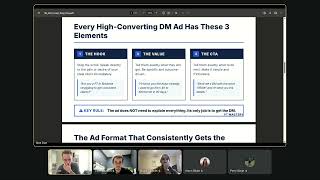
Alrighty, happy Friday team. So Liam Perry, Brock, good morning to you guys. I'm just going to get straight into it today. I'm going to start sharing my screen and I'm going to share to the DM deep dive. Let's go. All right, so this training is specifically if you want to take control of your own leads. So probably more focused on people who aren't in commercial gyms, but if you're in a commercial gym doesn't mean you can't do this strategy to get your own leads. You shouldn't have to rely on the, on the gym, okay? So this is a deep dive into one specific ad strategy, specifically the DMs, okay? Working very, very well for me and works really, really well for a lot of online coaches because you can basically— it's a long-term game, I'll be, I'll be honest, but a very easy way to get leads coming through, people in your pipeline. So we're gonna get straight into it. I'll go through the theory first, and then I'm gonna actually show you how to set up a DM funnel in Ad Manager today. So you've got all the theory and then the practical side of it all in the one training. So, um, so by the end of this session, you're gonna know what the DM funnel is and why it works so well for PTs, uh, or any industry, to be honest, uh, how to set up the campaign in Ads Manager step by step, the exact structure to get people to DM you, and the DM script framework to qualify and convert leads. I'm only gonna probably go through the basics of the DM script because we go through that in the DM Formula training. It's pretty much the same thing, but the main part of today is gonna be how to actually set it up properly. Not so much what to put in the ad, 'cause we've done that in a separate training, but how to actually set up the structure of this campaign. Okay, so the, Benefits of— let's make sure I've got the chat open as well. So guys, while I'm doing this training, just make sure you ask questions as we go. I'll have a little bit of time left at the end, but I'm not going to have a whole lot of time because it's a fair bit of stuff to go through today. So just ask questions as we, as we go along. So the reason why the DM funnel is really, really good to set up, because it's— you don't really need anything on the back end. You don't need a landing page, you don't need a CRM, you don't need email sequences. You literally just need a social media account, and by far Instagram is working the best, um, on this one. Facebook's a bit hit and miss. So if you've got an Instagram page, um, then that's all you need to set up this ad. Okay, so super, super easy. So this is probably the second easiest funnel to set up. The easiest one is just boosting posts to get new followers. That's the easiest one. You just literally click a couple of buttons. This is just slightly more advanced, but still relatively easy. So the reason why this works so well is because there's zero friction. So they don't need to put in their email and phone number, which is probably the biggest risk for people. They don't wanna get called or spammed or anything. They literally just need to send you a message on Instagram. So that's why it's generally pretty low cost per lead. But the thing is you've obviously gotta be good at DMs. As well for this to work. There's, you know, I wouldn't say there's no point doing this if you're not good at DMs, but you, you're gonna have to adapt pretty quickly, otherwise you're just gonna be burning through ad spend. So, um, in terms of a couple of things here, I've already gone through the, the technology side of things. Um, it's a pretty simple experience for them. People are already on Facebook, Instagram already scrolling, so it's, it's not like it's a new thing for them. But also, I got this stat from my mentor the other day, super interesting. Meta released some statistics on people that are watching the most amount of content, and paid advertising has now overtaken organic in terms of how long people are consuming that content. So if you guys want to get— if you guys want to stop fighting the algorithm to try and get views and reach the— not the easiest way, but if you want to get more reach, then paid ads are the way to go. Because Instagram specifically is putting more ads in front of people to get you to, uh, follow them, essentially. If you guys notice, if you scroll through your newsfeed, it's not people that follow you that come up a lot. It's like suggested people. That they think you should follow. So it's like based off your interests, for example. I'm not sure if you guys have noticed that, but essentially Instagram's putting more ads in front of you, but ads that are going to, uh, solve your problems or entertain you. That's what's happening at the moment. So this is the, uh, the 4-step process. So they're going to see your ad in their feed, they're going to click send message, which I'll show you guys what that looks like in a second, uh, it automatically starts a conversation in your DMs. Okay, so there's literally no tech setup at all. It's all done in Ads Manager, and you pre-qualify and book them in for a call. So there's a couple of different ways you can do this. You can offer like a, uh, a lead magnet, which could be, um, ideally solving your ideal client's problems, uh, and they send you a message to get access to that training or to that PDF, to that checklist, whatever it is. Easy thing that you can do is have like a PDF checklist that they can download as an example. So what you could do, you could basically say, uh, here's the 5, 5 things you need to do to lose 10 kilos in the next 10 weeks. Send me a DM and I'll send you the training. Once I send you a DM, hey, just to make, just before I send it through, I just wanna make sure it's gonna be a good fit. Uh, what are your goals right now? So I'll go through that in a second. but that's essentially the, the basic framework of what you want to do for this type of, um, ad. Okay, this is no secret, we've gone through this a little bit before. So every high-converting ad or DM ad has 3 elements. It's got the hook, the value, and then the call to action. Okay, as an example, um, are you a PT in Brisbane struggling to get consistent clients? I'll show you the exact strategy that I used to go from $4K to $10K in 90 days. Send me a DM with the word blah blah blah and I'll send you the details. That's as basic as it can be. You know, are you, are you wanting to lose 10 kilos in 10 weeks? I'll show you how our client Perry was able to do the exact thing, uh, to lose 10 kilos in 10 weeks without giving up his favorite foods. Send me, um, send me a DM with the word weight loss and I'll send you the case study of how we did it. Making sense so far? Just give me a yes in the chat if that's making sense. So I make sure the theory is landing here before we get into the actual structure. Cool. All right, pretty basic so far. Let's keep going. So the ad format. Now, general, general rule here, I want some feedback in the chat. Do you think video ads are better, or do you think static ads, which is like photos, are better? Do you think— give me either a video if you think the videos are gonna be better, or static if you think the static ad's gonna be better, which is just photos. What do you guys think? Video, video, yes, cool, yes. So video, because there is not so much a trust recession, which a lot of people talk about, but people are pretty skeptic, uh, or pretty skeptical, um, of, you know, coaching, investing their money, um, these days, or at, at the moment they are. So generally, if you want to build more trust and likability, the video ad is going to get more, uh, the, the type of people that are going to come through, uh, will like you a bit more. So they're, they're better quality leads. Now generally, you will get a cheaper cost per lead on a static ad or static image. This gives us less friction. Okay, so if they look at, look at an image, it takes them 2 seconds to look and they click the ad. If it's a video, they might need to watch 15-20 seconds, so it's more time that they need to invest before they start to click through. Okay, that's why it's a higher intent lead. So general rule is we generally test both, um, generally, uh, 1 or 2 videos and 1 or 2 images. and we just let Meta kind of figure out what's, what's the best. Okay, so I'm not going to go through super detailed in terms of how to make the ad. This training is more specifically the structure, um, of the ad. But generally, general rule of thumb, no more than 45 seconds for the video ads. Um, direct to camera, like a talking head video, is generally the best way to go for this. Nothing too crazy, no fancy edits or anything like that. More just you're going to talk. And, um, if you guys don't know as well, you can actually get teleprompters, uh, on like the Edits app or CapCut if you guys want to use that, uh, if you're not good at like memorizing stuff. So you can literally copy and paste the script and you can literally have it on your phone. You can literally read it word for word and you literally can't even tell that you're reading off the screen rather than you having to memorize stuff. Okay, so this is getting more into the structure. Now in the, in the document here, I've actually got, um, engagement is probably the primary path. So you can do engagement ads or lead ads. Now I've tested both. It's actually probably more favoring towards leads at the moment, like a lead objective. So for those who haven't run ads before, which is probably most of you guys here, you need to tell Meta what type of ad you want to basically, or what type of result or outcome that you want. So previously we would, we would have done an engagement ad, which generally gets more people to click through on the ad, which means you generally get more people sending messages. However, the problem with that, with engagement ad, is you attract people who are not necessarily wanting to buy. When you switch to a lead ad, it's actively trying to find people who are in that pain point where they're actively looking for a solution to XYZ problem. So the quality of the leads are a lot better, and a lot of the time it's worth paying a little bit extra cost per lead because you're talking to better people. You're not wasting your time in the DMs. Okay, so I'm actually slightly more for a lead objective rather than an engagement objective, and I'm going to show you guys how to set this up in a second so you know where everything is. The budget, you can do whatever budget you want. You can start at $5 a day. General rule for if you guys are just starting ads, generally $10 to $20 per day is, you know, more or less where you want to start. What's that? It'll be about $100 a week, give or take. That'll be a starting budget to really get some feedback, especially if you're starting on a budget like that. You're not going to really see any results until like, you know, 4 or 5 days. In. So you cannot expect to get a massive turnaround in terms of progress or data if you're spending that small amount of money in a short, short time period. General rule as well, what will happen when you launch ads, it'll go through what we call a learning phase. Um, now to get out of a learning phase, you actually need to get 50, um, leads in a week. So you guys are never gonna be able to do that spending $10 to $20 per day. But generally Meta will have a bit of an idea after about 3 or 4 days on the, like the type of person that is gonna click through on the ad. And that's where you'll be able to analyze the data and be like, cool, well we need to turn this ad off. Or maybe the click-through rate is too high or not too high, but the click-through rate is really low. So maybe it's not kind of getting the attention that that we need. I'll go through some parameters on that shortly, but the key here is let Meta find the people for you. Don't change it every, every day because it's just gonna— every time you change something, it just re-enters that learning phase again and you just start from scratch. Okay, now let's talk about targeting. Now previously probably like 6 months ago, you would have to actually make like a target audience. Okay, so luckily, luckily for us, it's now super, super easy to target your ideal client, but it's changed in terms of how you do it structurally in the ads. So what you need to do, so you've got broad targeting and you've got warm audience targeting. Warm audience targeting is for people who already like ideally people who already follow you or people who have already watched a certain amount of your videos on Instagram, for example. So you can do retargeting ads if, for example, someone has watched, um, you know, 25% of a certain video. So let's just say you post a video that's like 2 minutes long and it's like specifically calling out your ideal client and they watch 25% of that, you can retarget those people with a very specific ad. Okay, this is more advanced stuff for retargeting. I'm just going to touch on it a little bit. You can build custom audiences. So for example, if you've got a client list, and to make this work you need at least 100 people on your client list, Meta can make a custom audience of people that are similar to that client list. The other thing that you can do as well, you can do a lookalike audience. So if you've got 100 clients and you give them their name, email, and phone number, it'll search up those people, find out what their interests are, what they— who they follow, etc., etc. And it's going to find a lookalike audience that are similar to those people. So that's how you can target warm audiences. Now, custom audiences and lookalike audiences are not really required anymore because Meta's AI is very, very good at at finding the right people because they've got a lot of— yeah, anything that you pretty much do on your phone, Meta tracks whether you like it or not. So they know exactly what's happening in your world. Like, they kind of— they obviously listen, listen to what you say, they listen to, or they see what you're searching up on Google and whatnot. So they know what your interests are and what you're interested in right now. So I just wanted to give you guys that understanding. That is more advanced ads, you guys only want to do broad targeting. Uh, so as it says, it's recommended for beginners. Now this is just some examples. You can do obviously age, location, but no interest targeting. So previously you would have had to put in interests or what people are interested in to target those people. Now what you do is you just need to say in the ad who it is directly for. Example, 'If you're a male over 30 and you want to lose 10 kilos, this is for you. We help people do blah blah blah blah blah blah blah blah. If you want to lose 10 kilos in 10 weeks, click the link below and we'll see if we can help.' That first line, which is the hook, needs to call out your ideal client. That is how Meta does the targeting. Super, super easy as long as you're calling out your ideal client. If you're just going to say, if you want to lose 10 kilos, um, if, if that's the hook, if you want to lose 10 kilos, then click the link below. That is going to very wide, you know, um, audience. So it's not going to find the right people, at least straight away. It's going to take a fair bit of time to find the right type of people. You're going to get people that are 18, some people that are 60, 70, some people that, you know, male, female. If you only work with males and you don't make that clear in the ad, then you're going to get females coming through. So you need to talk about your specific ideal client in the ad. Same with your organic content as well. If you wanted to reach more people, you need to talk about the ideal client in the caption, and in the video. Making sense? Drop a 1 in the chat if it makes sense. So make sure we're super clear here. Awesome. All right, let's keep going. Now I'm just gonna go through this relatively quickly. This is just in terms of the pre-qualification. So when they've— what generally would happen on a DM ad is you can do like, um, you can preempt the word that they're going to send. So I'll show you how to set this up in the Ads Manager in a second, but sometimes they won't send the specific keyword and it's just they might just ask a random question. So the keyword might be, um, let's just say weight loss as a super easy example. You're going to basically give them suggested words that they can send you to start the conversation. So it might be, uh, weight loss as the first one, or it might be, uh, how does it work? And you might get some variations of that come through as well. But before you actually send them the document, or before you send them the training, or before you do anything for them, in terms of giving them what they want, you need to pre-qualify to make sure it's a good fit first. Don't just send them the thing without pre-qualifying them. So you're going to say something like, hey Brock, thanks so much for the message. Um, more than happy to send that one through. Just a couple of quick questions to make sure it's going to be valuable for you. What are your health and fitness goals right now? And you can obviously determine what type of pre-qualification you want. You might be like, hey, are you focusing on weight loss or muscle gain at the moment? Or, um, you know, if you only work with men, for example, maybe you say, cool, just want to make sure we only work with men over 30. Um, what's your age? As an example, whatever the pre-qualification is to see if it's going to be a good fit. And after they go through their goal, cool, what's the biggest challenge right now in achieving the 10-kilo weight loss? Cool, no worries. I'll send the thing through shortly. I'll get the team to send it through. Based on what you've told me, I think we could probably definitely help. Would you be open to a quick health assessment to see if it, um, or see if we can point you in the right direction? Okay, so once you qualify and it's going to be a good fit, you transition to asking permission to see if they need help. And if they're open to it, then sweet, obviously go ahead. If they're not, of course you just keep nurturing. which is in the DM Close Closing Formula if you guys haven't watched that training. Okay, so things not to do. Don't pitch them immediately. You need to qualify first. Don't ask too many questions. So generally 2 or 3 qualifying questions because at the end of the day they obviously want the thing that you're promising, right? You can't just not send them the thing. You better still send it, send it to them, but just ask 2 or 3 qualifying questions. Send it, but then try and obviously upsell to the, to the call. Uh, don't send long paragraphs. You only just met them, they don't know you or like you or trust you just yet, so keep it short and sweet. I always like to do voice messages as well, uh, keeps it more personable and they actually know you're a real person, not like an AI bot, for example. Uh, and just keep in mind, a lot of people won't, won't message you back the first time. So remember, because it's an impulse thing, so you remember you got to have to follow up Find ways to start, start conversations. Even check out their profile, talk about something that they're talking about on their, on their feed. Okay, uh, generally follow up at least 3 times, um, over the, over the next 5 days at a bare minimum. Okay, so as I said at the start of this call, this is a long-term play because you can't call them. You can't call them all the time like we used to do. You got to keep sending messages or start interacting with their posts, for example, if they're posting stuff. Fortunate in follow-up. Pretty straightforward stuff. You guys should know this already. I'm not gonna go through this too much, to be honest, 'cause I really wanna go into the practical side of things. But as I said before, you guys can obviously read this stuff in your own time. But if people are ghosting you, a couple ways that you can re-engage the conversation is you can copy the message that you sent, uh, unsend it, and then send the same message again. That's one way. Second way is if they've sent you a message, you can double tap on their message to say that you've loved the message. That will go to the top of their inbox again. Otherwise, if they do have some posts on social media, start interacting with their posts, comment on some of them to see if they respond. That'll generally get people to be like, oh yeah, like, I forgot to, forgot to respond. It's some ways that you can do some touch points indirectly without saying, hey, I'm just following up. So if you want to kind of get them to get it to the top of the pile again in terms of the messages, that's a couple of different ways that you guys can do it. Otherwise, there's obviously a couple of things you can do here as well. For example, if they specifically come through an ad about weight loss, you could say something like, hey, I just thought this might be benefit of you if you want to lose weight. Here's a case study that we've done with one of our clients that helped them lose 10 kilos. Do you want me to send it through? There's something of value. Give them some extra stuff for free to build that relationship. Okay, because remember, a lot of these people are a cold audience, so they don't know you from a or so. Okay, all right, what do we got? We're 11:27. Okay, let's build the campaign together. I'm going to do it from the start so you guys know what we're going to do here. Okay. You guys can see Ads Manager. Someone give us a thumbs up. Yeah, cool. All right, so from start to finish, we're gonna go— so we're in Ads Manager, so adsmanager.facebook.com. Um, then we're gonna go with campaigns, ad set, ads. We're gonna go create in here. So this is where you pick engagement, leads, etc. So ideally, we're actually going to click leads. So what we're going to do here, we're going to go campaign name. We're just going to say this— the campaign name is usually what you're offering. So I'm going to say we're going to offer 10 kilos in 10 weeks case study. Whoops. That's essentially what I'm going to offer. That's what I'm, that's what I'm going to call for the campaign name. Leave this as auction. That's where you just selected in terms of the objective. Um, now this is not super important, but generally I would go to an ad set budget and I would turn off this here so you have more control. Basically, you can have a campaign budget which would run the overall budget on the overall campaign, which you might have a couple of different ad sets. Ad set essentially means you might be doing a broad audience and a warm audience, two separate audiences that you want to test. So I might want to do, I don't know, $10 a day on my warm audience and $20 a day on the cold audience. So if that's the case, you would do an ad set budget, or if you're just going to do the one ad set, you can just do a campaign budget if you want. But generally I would do an ad set budget. I realize this might be a little bit confusing for some people, but just bear with me. Everything else stays the same. Then you're going to go to ad set. So we're going to just do broad. So generally you would say the type of audience that you've got in the ad set level. The conversion, this is how you convert people. So this, this defaults to website and instant forms. So we're going to do a single setup and we're going to do Instagram. You can do Messenger as well. I just haven't had a great experience on Facebook for DM ads. Okay, so generally I would say Instagram is the way to go. It'll default to— it's trying to get the maximum number of leads for you. Okay, so previously if we were to choose engagement, it would basically say, uh, maximum amount of engagement, which is going to get people that's going to like just like and comment because it's going to engage. Okay, so we're telling Facebook or Meta we want leads. We want people to message us that want this thing that we're going to give away. Okay, so very important. You can put a cost per result in here. I honestly just leave this blank. Let's just say we're going to do $25 a day. Leave the start date as is. Now this is where you put in your audience. Now remember, we're actually not going to put in an audience in here. Um, because I've made a cracking ad and I'm calling out my ideal client and, um, it's super specifically who it's for. I'm gonna let Meta, Meta AI, read the caption and also, um, watch the video and it'll determine who to put it in front of. Okay, if you really want to, you can change this one. So for example, if you have to work with people over 30, let's just do that as an example. You'll do minimum age Actually won't do over 30, so we'll just do 25. Um, everything else, just leave it as it is. Previously, this is where you would do your interests, detailed targeting. Again, if you only want to work with male, then you do want to select that still. Now, very important as well, in the placements, if you guys want to avoid people that kind of spam you a little bit, just make sure you go into platforms and make sure Facebook is turned off, which is good. So sometimes it, it forgets to turn it off, and then sometimes it clicks on Audience Network. You generally get a lot of spam coming through Audience Network. So pretty much any type of ad, turn that one off. Okay, so we've done the ad set. Now we're going to go to the ad. So I'm just going to call this Ad 1. Oops. Ad 1, what we're going to do, turn off multi-advertiser ads. We're going to set up the creative. So you can do image or video. I'm just going to put something random in here. This one will do. So this is going to be the, um, the ad copy, which is the primary text. Let's just say it's going to be, 'Man over 30, do you want to lose 10 kilos in 10 weeks?' Calling out my ideal client. Okay, we have had '67 people go through our program and lose over 10 kilos.' I'm just making this up, obviously. Um, 'We do this by blah blah blah blah blah,' which is your unique mechanism. 'We do it for— we do it by non-time-restricting training and without cutting calories.' You know, whatever it is. If you want We have made a free checklist that you can download to tell you what you need to do to lose 10 kilos in 10 weeks. Click send message to get Instant order to get access. As an example, probably not the best ad, but gives you a bit of an idea. Headline is going to be lose 10 kilos in 10 weeks. Leave the description blank and we're going to go send Instagram message. Okay, don't do any of these things. The AI in here is tragic, so don't let AI write your stuff. Skip all this for the AI-generated images. Now, very important here, generally I turn all this stuff off. All these freaking meta enhancements are trash. Turn them all off. So once they're all off, you go next. Use code done. It's basically going to be translation, not that it's going to go to anywhere else because we're only doing stuff in Australia. But as you can start to see here, so we've got the ad creative up the, on the right-hand side here. We've got the text, we've got the call to action, which is send Instagram message, and you'll see in here enhancements are still on 1 out of 5. So I'm going to go into here and we're going to go edit, and the cheeky little buggers will have some of these turned on as well. So you turn that off. So no enhancements, make sure that's zero. Zero advanced, or Advantage Plus creative enhancements, turn them all off. Okay, so now the chat builder is the last part of this, which is basically how are you going to start the conversation with these people. So I just, I'm just going to go into an example from what I've done previously. Um, obviously this is for my business, for business coaching, so it's gonna be a little bit different to you guys. Um, so the greeting is, hey, did you want the consult roadmap to sign more clients as a PT? So I was basically giving away, uh, one of our trainings on the consult roadmap process as a lead magnet. Okay, so I gave them two options. The keyword was roadmap, which I gave them the option to send that through. Or I gave them the option, which is, is this a face-to-face or online coaching? That's how I determined if they were a good fit for me, because this specific roadmap is for face-to-face trainers. Okay, so I'm basically trying to pre-qualify people straight away so I don't waste my time talking to people. So as an example, if we go— let me just move this across— this is what it would look like. As it comes through on their side. So when they click send a DM message, it's gonna say, hey, did you want the Consult Roadmap to sign more clients as a PT? They either pick roadmap, or is this for face-to-face or online coaching, or they can send their own message. Okay, so it automatically starts that chat. Now, even if they don't select any of these two, it'll still actually start a conversation in your DMs. So you can still start a conversation back. Okay, so how you make this, um, so you look at the suggested templates if you like, which is okay, but I probably would make your own, to be honest. So just go duplicate for a second. So basically what will happen is you've got— let's move this over again— you got the first message that's going to come through. And again, this is depending on how you kind of want the conversation to start. You can say, hey, did you want to lose 10 kilos in 10 weeks? Nice, easy conversation starter, right? Just a yes or no. And here's the thing here. Yes. I want to lose 10 kilos as the first one. The second option could be, um, how does it work? Okay, so this is what would happen as it comes through. Hey, did you want to lose 10 kilos in 10 weeks? Yes, I want to lose 10 kilos. Or how does it work? You're just prompting them to start a conversation. Okay, so far in the chat, just the one 'if it makes sense' and 'is there any questions?' Uh, all right, question in the chat: assuming the paid Meta ads we run will pop up has both stories and on our target audience's feed? Yes. Yeah, good question. I'm not sure if that was Brock or Liam. I think it was Brock. Yeah, good question. So what will essentially happen, and I'll go back to it in just a second and answer that, but Meta basically optimizes the image depending on where it goes to. So it pretty much always just does it for you. So you don't need to have like, you know, 3 different variations of the same image to update. I'll show you where that happens in just a second. But yes, it will go on to anything to do with Instagram. So the feed, stories, and not so much in the chats, but yeah, pretty much just stories and the feed. And you can actually, I'll show you in a second in terms of managing the data. On how you can determine where you're getting the most amount of leads from as well. So that's essentially the chat builder. So that's what's gonna happen on the chat. Now to go through Brock's question here, now what will usually happen, yeah, so here we go. This is a bit of an idea. So see how it's got 4 different variations? Already. It's already done it for you. So it's got original, it's got full screen, it's got square, which the square will be in the feed. Horizontal, uh, I don't know where that would go, but this would be the feed and this would be like stories vertical. So it just does it for you. What would usually happen, which actually didn't prompt me, let me see if it does this time. Actually, let's do a video. Because it'll usually prompt me. Okay, this is why. So this is— see how it's— I can't do the cropping. So usually, usually it'll say it'll give me 3 different, uh, it'll be like vertical, horizontal, and something else. It'll say keep image or video as, as uploaded, or change to the recommended cropping based on meta. And you can choose if you go original or you use their cropped version. It looks like, um, on this particular ad campaign, doesn't look like we're allowed to, but as I just showed you guys before, uh, it automatically crops it for you. So I think it might not be able to do it if it's, um, DM ads. Um, okay, so now I've shown you guys how to actually do it. Um, from there, if you've got a CRM, you can track what we call a pixel. A pixel essentially— we don't necessarily need a CRM for this, but you ideally want to create like a pixel So a pixel essentially is just data that Meta will give the pixel to train it on your ideal client. So over time, the pixel is trained on the leads that are coming through and it gets better and better as you, as you do more ads essentially. So for example, I've got a couple of different ones as an example, but for example, I've got The PG Mastery pixel is all to do with obviously personal trainers, right? So it's trained on finding people that are personal trainers. Okay, so you definitely want to set that up if you haven't run ads before. Super easy. You literally go into Events Manager and create one. It's like 4 steps. If you guys need help with that, just let us know, but I'm not going to go through that in today's training. What I am going to go through is how to analyze the data. So any last questions on that before I discard the draft? No, cool. Okay, um, so I'm going to keep that, that there. I'm just going to go into a previous DM ad that I have run previously, and I'm going to show you guys some of the data here. Okay, so one of my— this one here. So you see the campaign is IG DM Marketing Blueprint. So I was basically giving away marketing blueprint. You can see in here 179, um, conversations started. So let me go through all the stats here so you guys understand. $179 result, which is the cost per message essentially, which is cost per lead. Um, now I'm not going to go through all this stuff because this is going to confuse the hell out of you guys. So the different types of leads, uh, we've got 41,000 reach. That's how many people saw the ad. Now this is interesting, 4.76, which is the frequency. This is how many times the person has seen that ad, 4.76 times, which is actually quite high. Which means I probably didn't have enough, uh, images or videos to test, so they kept seeing the same ad all the time. So it cost me $19.26 to get a message, which is not too bad for, um, B2B, so business to business. You guys are doing B2C, so it'll be lower for you guys because there's more people that want it. There's, there's not a whole lot of people that run PC businesses, so it's going to cost me more. To get leads, okay. But, you know, general health and fitness, everyone obviously wants that. I was spending $140 per day, and this campaign I spent $3,500 essentially. If we go across this one here, CPM is cost per 1,000 impressions. So to see, to send this out to 1,000 people, it's costing me $17, which is actually super, super cheap. I had 1,200 people click on the ad. Uh, don't worry about CPC, we're going to look at CTR, which is the click-through rate. So 0.62% of people actually clicked on the ad, which is actually pretty low to be honest. Ideally we want to be between 1% and 2%. And don't worry about the other ones, the landing page. Now, so that's basically all the stuff that you need to know. About this ad. Now, how do you know if it's profitable? So in order of preference, um, the overall thing that you need to think about is CPA, which is cost per acquisition, which is how much does it cost you to get a client. So I don't know the stats off this campaign off the top of my head, but if I spent $3,500 let's just say I spent $3,500 and I got $10,000 worth of contracted value from that campaign. So I basically make 3 times the amount of money that I spent. Okay, so $3,500 would turn into $10,000, basically make 3 times as much, which is freaking epic, by the way. So I would, on that indication, I would increase that ad spend, that budget, because I'm making 3 times as much money. If I was spending $3,500 and I was making $5,000, I'm still making a return on investment, but that's only— that's not even a 2x return. So ideally you want at least a 2x return on ad spend. So if I spent $3,500, I would have had to ideally make at least $7,000 for it to be profitable. All good, Perry. Okay, so that's the first metric. The second one you want to look at is your cost per, cost per lead. And I just want to make this super clear, the pretty much the only metric that you want to worry about is cost per acquisition. Is, are you actually making more than you're spending on ads? That's the only thing that really matters. Everything else is just real fluff really, to be honest. So it doesn't matter how much the cost per lead is. If my cost per lead was $1,000 and I signed that client pretty much every time, I would not care. Let's just say, for example, your fitness offer is $1,500. Let's just say— so let me give you two scenarios. Let's see if you guys can pick the right one here. So my— let's make it easy. Let's, let's say your service is $1,000. So every person that signs up, they pay $1,000. Option A, your cost per lead is $10, but your cost per acquisition is $700. Okay, so it costs you $10 to get a lead, and your cost per acquisition is $700, and you make $1,000. Option 2, your cost per lead is $85, but your cost per acquisition is $250. Which one is the better option in the chat? Option A or Option B? Liam's going Option B. Brock's got B. Cool, correct, Option B. So it doesn't matter how cheap the cost per lead is if the cost per acquisition is sky high. So your number one metric is cost per acquisition. Are you actually making money from this ad? The second thing is cost per lead, because if you're getting $10 leads, you're having a lot of conversations, right? So you need to probably pre-qualify more on the ad front to get better quality leads. And that's probably going to come down to what you're saying in the ad, but also are you making it harder for people to message you? For example, if, if you're trying to pre-qualify people that are over 30, in, in the, in the call to action, you might say, hey, don't click this message if you're under 30. Only send me a message if you're over 30. That's going to help you qualify the leads better. The next thing you want to look at if you're not getting a whole lot of traction is your CTR, your click-through rate. Ideal scenario here is between 1 to 2%, which means this is the amount of people that are actually clicking through, uh, the ad, as in like clicking on the image or clicking on the video to watch it and actually are semi-interested in what you're, what you're doing. Um, again, these are just, these things are like in order of what you should, what you should look at. If you're not getting many, uh, leads or many, many clients, it's probably because your click-through rate is not very good, uh, because you're not, you're not really getting much attention. So it's going out to the traffic, but people aren't clicking on the ad. Essentially, think of it as if like you posted a reel and it got like 50 views instead of 500. Let's just say a good reel that you do might get like 500 views, and let's say this one that you posted got like 50 or 100. So it's just the wrong type of image or wrong type of video. It's just not landing. Okay, so cost per acquisition first, then cost per lead, then click-through rate. The last thing would be CPM. So for— this is actually super, super cheap for me. Usually my CPM is around $50. So it cost me $50 to get in front of 1,000 people. For you guys in B2C, so business to consumer, $20 to $30 or anything around $20 or $30, even less is really, really good. That's the only kind of metrics that you guys need to worry about. You can see here there's heaps of friggin' data that you can look at. Now, before I mentioned to you guys, about how do you know, um, how do you know where you're getting all your leads from? So you can— if you go into— let's just go into this one for a second. So because I have all these types of images and stuff, right, they've all got different results. But I want to be like, okay, cool, if I go to breakdown and I'm going to go placement it's going to tell me where I'm getting the leads from. So let's have a look. So you got Facebook feed, feed, explore, explore home, Instagram Reels, Instagram Stories. So you can see in this specific ad, I'm getting the cheapest cost per result from Instagram Reels. So for example, and this is where if you guys want to get really good on ads, you need to analyze all the data and make decisions based off the data. You can see in here the spend that I've got: $170, $121, $118, $54. So these ones are almost double cost per result, but I've spent more money on these ones. So what I might do if it was me, I might turn off Instagram Stories because it's costing me $27 to get a conversation, almost 3 times as much as the Instagram Reels. So I might specifically say, or I might specifically turn off Instagram Stories, Explore, Home Explore, which is they've spent $5 or $6, so obviously it's not really— Meta doesn't think it's going to work. I might keep, you know, I might keep the Facebook feed on, for example. This one obviously is going to Facebook and Instagram, or maybe I just want to go to Instagram and go all on Instagram. 'cause I'm getting $10 per conversation. So I get almost double the amount of leads if I just went with this one. Yeah, and this is how you get good at ads because you analyze the data. And speaking to my point before, you guys need to give it some time to get this data. Let's do another one. Prime example, here we go. Another one. Let me give you guys a test here. We're looking at Image 7. I've spent $769 on this. Which, um, which, uh, placement do you think I should optimize for? The feed, Facebook feed, Instagram stories, Instagram story, uh, Reels, Explore. In the chat, which one would you optimize for based on Image7 data? In the chat, let us know. It'll face— it'll either be Facebook feed Feed in general, Instagram Reels, or Instagram Stories? Which one do you think? Liam says Reels. Tell me why, Liam. Listen to the chat. Yeah, spot on, lowest cost per result. Isn't this crazy how much money I wasted here? I'm so angry now. Look at this, this is wild. So this is why you've got to check the data. I'm getting $9 per conversation and I've only spent $93. I spent $386 in the Facebook feed and got $35 cost per lead. Almost 4 times as much it cost me to get the lead, and it spent an extra $300. Can't trust Meta, honestly. Another reason why I don't usually use Facebook anymore. So this campaign was for Facebook and Instagram. You can see Instagram is by far outperforming every single one. Look at this one. 5 is killing me. Look at that, $62 per conversation. It's $8.55. Literally every single one, Instagram Reels perform better. There you go, I rest my case. Do it on Instagram instead of Facebook. But you can see here, it's very important to— there's a lot to take into consideration when you are doing ads. Um, but it's, it's one thing to obviously create ads that, that convert, but you want to analyze the data as well, which is why, you know, a lot of the people that I'm helping with ads at the moment, um, I'm pretty much not so much managing it all for them, like some of them I do, um, but we just need to know the data so we can make decisions on where to spend the money. Another one here, this one spent 3 times as more money and it's an extra $5 per lead, like not a massive difference, but but still I would basically optimize this whole campaign just for Instagram and I would get triple the results on most cases. So you can do this for everything. Like if you guys are testing multiple headlines, multiple text, you can see how each text compares and then you can obviously make decisions on what's going to be the best one moving forward. I might leave it there. Uh, there was a lot obviously that I covered, um, today in terms of DMs, but I gave you guys some obviously pretty good insights into, um, the type of data that you guys want to be looking at. Let me go back to school. Um, so I've only got a couple minutes, but does anyone have any questions that you guys want to go through ads in general or specifically around the DM ads? I do want to say as well, if you have a question, just like, just unmute. Um, don't feel like if you're in a commercial gym that you can't start running ads, especially if you guys want to have a bit more control over your leads. If it's quiet, or, you know, maybe you just want to learn a different skill, and just start something. Start on like $5, $10 a day. And it's just one of those things where you've got to kind of dive into it and experience it for yourself. Um, of course, like, you know, if you really want to, I can do this stuff for you if you literally want someone to kind of oversee it. Um, but I would encourage you guys, it's a skill that you do want to learn how to do yourself because you don't have to rely on the gym forever, or you don't have to rely on referrals, um, forever, because that's, that's how you get stuck in like the, you know, unstable business. It's because you don't have that predictable pipeline. And that is how you get that predictable pipeline. Any questions, team? No, I was going to say, um, you went over the key metrics, Matt. That was really insightful. Thank you. Um, yeah, what's the longest time that you run an ad? And like, if it's performing well, is there like an actual attrition or Yeah, the 100% the ad will eventually fail. It'll eventually stop working. Uh, it always, always will. I don't know how much, how much my total or my biggest one is. Let me see if I can find it. Anyway, I'll share the screen again. Um, but eventually the ad will stop working, which is why you need to keep testing new things. Um, but it can go quite a while. Um, so my longest performing one, I don't know how long I did this for, but this one was, uh, 5,700. This was 5K. This is 3,500, 2,800, 2,200, 2K, 1,200, etc. Um, but the, the key here is you just need to, as long as the ad is still profitable, you just keep it, keep it going. You don't just stop it because you want to, you want to try and get a 10x instead of a 5x. You don't, you don't do that. You just keep the 5x one going until it gets to like a 2x, and you're like, okay, cool, I'll, um, you know, I'll do something else. Um, but yeah, every single ad will eventually stop working. So it's not like you can run it for like, you know, 2-3 years. And I mean, you could do it probably like 5 years ago for sure, but No, not anymore. It will eventually fatigue. So you can, you can basically, you can give away the same thing, but you package it up differently. So the ad copy will be different, the image will be different. That's how you keep it fresh. Um, the mentor that I'm working with at the moment used to own a gym as well, and he used to tell me that he literally sold the exact same offer when people came into the gym, but the ads were completely different every month. In terms of the promotion. So the sales process stayed exactly the same, you were selling the exact same thing, but the way it was packaged or delivered in terms of marketing was different every month. So we never ran out of leads because everyone's like, oh well, the Summer Shred Challenge or the, the Winter Challenge or whatever, whatever, you know, New Year Near Me, whatever it is, they repackage it differently. So this is something that you can do in terms of like AI as well. Like once you've got something that you're starting with, you can be like, cool, I've done this angle. What's a different angle that I can, that I can approach to still serve this type of market that's going to be different for them? Because there's always different angles. It can be nutrition angle, nutrition angle. It can be, uh, you know, sick of doing the same stuff in the gym. It can be you don't know, you don't want to injure yourself in the gym. There's all different angles that you can do that still serve the same ideal client. But they've all got different problems. Okay, so that's how you— I say never run out of ideas for ads, but yeah, you will have to always analyze the data and determine, you know, is this ad kind of fatiguing? And if it is, that's okay, that's normal. But the key here is to be proactive. So you've got like 2 or 3 ads that are performing And then there's, you always, you always have new things that you can, you can test. It's where a lot of people get stuck. They'll just keep the ad running and then they won't do anything to be proactive. And then all of a sudden the ad fails and then they've got nothing in their pipeline because they've got no backup. So you've got to have, you know, this is, this is why like we, we suggest starting with one funnel, like a DM funnel. But once this one works, do a different type of funnel, like a call funnel, for example. Or a lead magnet. You wanna have multiple, multiple setup. Good question though. All right team, I'm gonna leave it there. Next week is gonna be more of a mindset one. It's gonna be called the, what did I call it? The 10K operator. Ooh, I like it. More of a mindset next week, which will be nice and juicy. And if you guys haven't, I think I got Scott to send you guys a message about confirming attendance for the Sydney event. So if you haven't got back to him yet, just confirm numbers for that because it's only about, about 6 weeks away, our in-person event. So looking forward to catching up with you guys in person. And apart from that, enjoy your weekend, and I will see you guys on Monday. Bye for now. Bye-bye.
More from Matt




Your staff aren’t lazy. Your systems, standards and leadership might be. Check out Episode 138!





Your team can’t take ownership of work you refuse to hand over. Stop being the bottleneck! #shorts


Slow lead replies cost you sales. The fastest business usually wins. Full episode in my channel!