
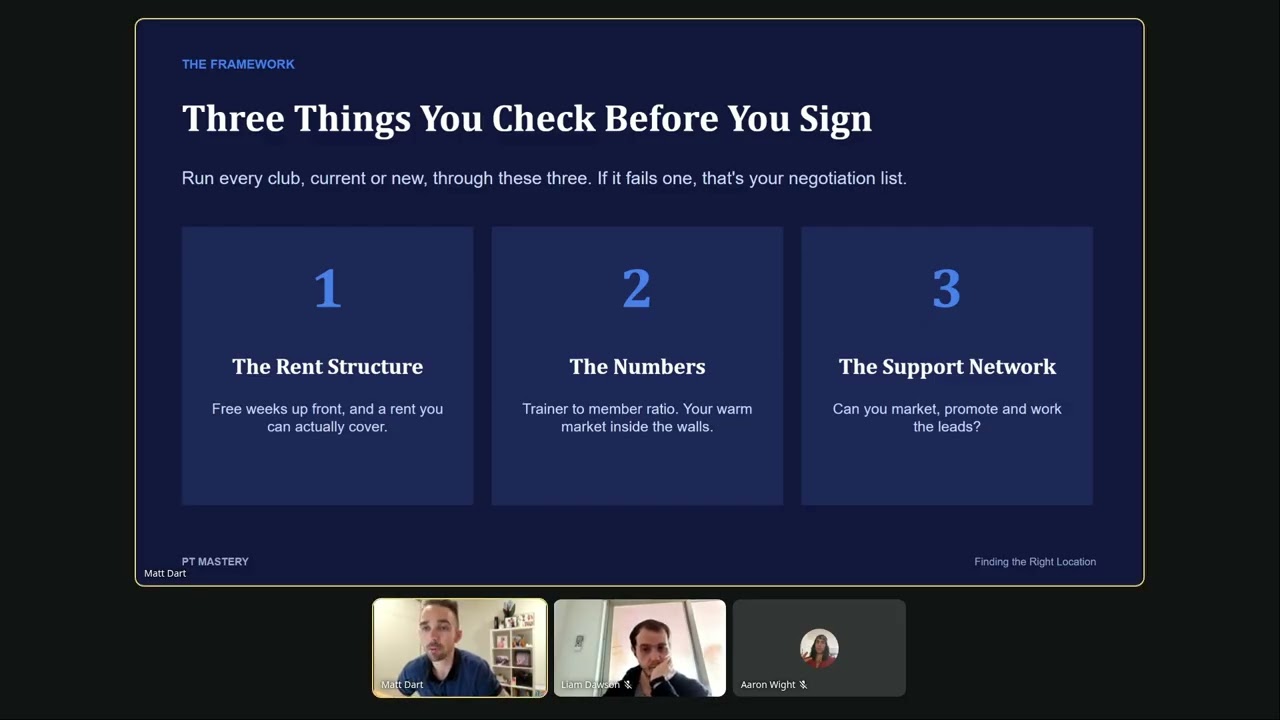
Matt Dart teaches personal trainers how to evaluate gym locations using three pillars: rental structure, trainer-to-member ratios, and marketing access. He shares concrete benchmarks like $275-$350 weekly rent, one trainer per 400 members, and 50-70 new members monthly, plus red flags to avoid like full rent from day one or long lock-in contracts.
Questions this video answers
Matt explains that while city‑center residents may earn more, they also have higher living costs, so disposable income isn’t automatically higher; gym membership price tiers can be a better proxy for client spendability.
Matt advises adding exercise variations, tempo changes, or alternative equipment to keep programming fresh, maintain perceived value, and reduce plateau or injury risk.
Chapters
First time doing this. Jesus Christ. All right, let me reshare. All right, team, today's training is going to be about finding the right location. So this is good for you if you are kind of brand new to the industry or brand new to being a PT and you want to find the right gym to work from, or if you're at an existing club and you're exploring the idea if it's worth moving locations, or maybe you are someone like Liam that is actually moving locations, then you need to suss out the best option for you. So we're going to go through like the metrics to look for in terms of if the numbers make sense, but also what it looks like in terms of support and management to make sure it's a success. So 2 ends of the spectrum here, obviously the business metrics for logic and then kind of the emotional side of things, which is if the gut feeling is right in terms of the support network that you've got there. So, um, yeah, it's one of those two options, um, for today. So, um, I'm just gonna go through this bit by bit here. So it's not necessarily about like being at the best gym in terms of like equipment or how nice it is or how luxury it is. It's about, is it the best option for you to have the highest chance of success as a business. Now, of course, you want to make sure that you do like the gym. Of course, you don't want to be in a gym that you don't like going to, because that'll show in how you act and how you act around clients as well. But you obviously need to make sure it's a business decision, not so much an emotional decision. So the right location is the number of decisions. Um, so a couple things to look out for. Uh, well, this is kind of what most people kind of, um, do themselves. So you generally sign because the gym looked good, and then the rent ate up a lot of your profits. So, you know, some people that I talked to were paying like $400 or $500 a week in rent. It's crazy numbers. You're one of 8 trainers fighting over the same members. The club won't let you market or touch the leads. Pretty common for a lot of people. In the community, and then you're busy on the floor but the money still isn't there. So it's a couple of mistakes. So the location actually sets the ceiling about what's actually possible, or the opportunity cost itself. So if you've got the right type of club, the right club hands you warm leads, or like a warm market on day one. It's got pretty fair, reasonable rental terms. You can't have it all. You're never going to have a club that gives you absolutely everything. There's pros and cons to everything, but realizing, you know, what, what outweighs more, uh, is what I'm going to go through, um, in a second. Supportive club feeds you leads you'd otherwise pay for. So I, I talk to you guys about this a lot of the time. The difference between people in commercial gyms and like online coaches or people in studios is you guys obviously pay a rental fee to essentially get access to the members. Whereas if you were to pay— if you're an online coach, for example, you pay by advertising, and it's significantly more expensive for paid advertising rather than paying a rental fee each week. So for you guys in commercial gyms, you've still got it way better than the online coaches. I just want to make that super clear. A lot of people obviously get a little bit Um, upset when I talk about this type of stuff, but, you know, hands down, if I got almost free game to like 1,000 members that I could just market to kind of whenever I want— like, obviously you need to obviously make sure you can market to them, of course, um, or I'd have to pay, you know, $500 to $1,000 a week to get the same amount of lead flow— hands down, I would just, um, you know, go into a commercial facility because then you don't have to learn paid advertising. skills. And the last one, the wrong deal kind of caps your income no matter how hard you work, which is like the high rent that I was talking about before. So there's 3 things you ideally want to look for here. So the first one is the rental structure. Of course, you don't want to be stuck paying full rent to start with when you're first building up. And you certainly don't want to be paying over— $350 is probably like the max that I think you guys should be paying, depending on obviously the, the other metrics. Um, but I think pretty standard rent these days is, you know, $275, $300 is pretty standard for, for most clubs. Um, but what you're essentially looking for, especially if you were to move clubs or you're just starting at a brand new club, is you want to have some type of build-up phase. So what that looks like is it can be, um, free for 4 weeks, half price for 4 weeks, and then you pay the full amount. That's a really good example. Some other ones, they can be a little bit more stingy where they do either half price for 2 weeks or half price— sorry, zero rent for 2 weeks or half price for 4 weeks. So that's like a World Gym offer, for example. So I know, Aaron, you might be looking at World Gym. That's what they do a lot of the time. So it's either zero rent for 2 weeks or half price for 4 weeks. So it's only a 4-week kind of buildup before you pay the full rent. So something to consider. The other thing to consider as well is everything is always negotiable. And when you first start, it's obviously harder to negotiate if you don't have any leverage. But for example, if you're going to be like, hey, I'm going to actually bring 10, 15 of my clients with me and they're going to join as well, what can you do for me about the rental situation? Because you're obviously going to help make them an extra, you know, $150 a week from new members as well straight off the bat. So you've got some leverage there. Number 2 is the actual numbers for the trainer to member ratio. Okay, so the ideal, like, bare minimum would be 1 trainer per 400 members. Now you guys all know this, that a lot of the people, just because they're a member doesn't mean they're active in the gym. So realistically, you probably could contact about 150 to 200 out of those 400. But if you imagine if you if you had like five trainers and there was a thousand members, it's gonna be pretty difficult for you to grow relatively quickly. And the one thing we're looking looking at here is the opportunity to grow relatively fast. So the reason why or one of the reasons why. I believe I was super successful in a, in a commercial gym is because every single gym, every single one that I worked at, I was the only trainer in that gym. Every single one. I only went there because I was the only trainer. Yeah, maybe I just wanted more control, which is correct, but that was, that was one of the sole reasons why I was able to grow from 0 to 180-odd clients in in 2 years. It's because I didn't have any competition and I had full, full reign over the marketing. I could pretty much do any marketing I wanted. And, uh, pretty much all the clubs that I was at, it was just me and it was at least 700-odd members. Now, just specifically in terms of like Aaron and Liam, for you guys, uh, Liam, obviously if you move somewhere close to the city, it's going to be almost impossible for you to get a club with no trainers in there. You're going to have to be a bit further out in the suburbs if you want to find a gym with no trainers. Like, I don't know if you're like in Stafford, that's, you know, relatively close to the city. Around that area, I'd say it's going to be almost, almost impossible for you to get no trainers. But the member-to-PT ratio is what you guys are looking at there if you want to stay like relatively close to the city. Um, you know, prime example, like people, people are more members, but that also means they'll have more trainers as well. So it could still, still be fine for you. Like, we know plenty of gyms around, like especially in Brisbane, where, you know, there's 3,000 or 4,000 members and like maybe 3 trainers. So it's 1 trainer per 1,000 members, like still an absolute gold mine for sure. Just in my experience, I wanted a lot more control of the leads. Doesn't necessarily mean that that's the only way to go about it. We've got plenty of people in the community that do really well with, you know, people that have got multiple trainers in the gym. Just make sure— it's just about making sure you've got the right business numbers overall to make sure you hit those targets. Now, number 3 would be the support Network. So arguably probably the one of the most important things. Can you actually market, promote, and work the leads with your own processes? So some clubs are a lot more strict than others. Prime example, some Fitness Cartel clubs, some World Gym clubs are very strict, meaning you almost can't do anything in terms of promoting your own business. So a lot of the time you have to rely on walking the floor and talking to people. Now, that strategy works, and that's completely fine to do that strategy. But for me personally, as an introvert, I would struggle by having to rely on that. I would much rather just get a list of people to call and just sit at my computer and call them. So you gotta, you gotta pick wisely with the type of club that you go for, because that's— that really dictates what type of marketing you can and can't do. So before you choose an actual club, you need to be asking questions, and I'll go through kind of what, what you can kind of ask the club manager. You really need to ask, hey, what does it look like if I, you know, choose to work at this club? Do you guys give out, uh, lists of new members that we that we can contact to ensure that they know how to use all the equipment in the club? And you got to make sure when you're asking these types of questions to the club manager, it's going to be in benefit of the club. So what you need to do is you need to say, hey, look, the research shows that, um, members will stay with the gym longer if they have a connection with the PT or if they work with the PT. So to help with the club retention, It's in the club's best interest to get the PTs connected to as many members as possible, right? I've owned the gym before, right? So I know this stuff. So you've got to make it about the club. That's all they care about. They don't necessarily care about you because you're just an independent contractor and you don't represent their brand. Okay, so you got to keep that in mind. Let's keep going. So far, team, just drop us— I know it's just the two of us so far. Just drop us a 1 in the chat if everything's making sense so far. So these are the 3 things you need to get clarity on. So drop us a 1 if that makes sense. Cool. Awesome. Okay, so I touched on this a little bit, but good deal versus bad deal for the rental structure. Bad deal is you have to pay rent from day 1, full price. Some gyms do not do a build-up phase. Okay, that's something that you need to be aware of, that some gyms will not give you a build-up phase. Some other things that I've recently come across with that are complete BS is Snap Fitness was trying to charge an annual equipment hire fee of $500. Now that is a complete made-up, made-up thing that you need to get it taken out of the contract. That is just a money grab. You pay the weekly rent for the equipment, and that includes maintenance on the equipment. So if anyone tries to get you to pay like an equipment fee, complete BS. Some other things that some gyms will try and get you to do is like, look, some gyms will do like a bond, which is fair enough. It's a security bond. So if you, uh, if you leave, um, and you've paid all your rent up to date, they'll just give that to you back as a refund, which is fine. That's pretty normal. The other thing as well to consider, I actually never had to do that for any of my clubs as well. So it just goes to show everything is negotiable. And the other thing that some gyms try to get you to do is like an onboarding kind of like a course to a degree. Like if you're with Viva Leisure, which is like Plus Fitness, they will try and get you to buy like a $1,000 onboarding pack, which will be like uniforms, and like a 2-day training course on like the bare basics of business. I think Club Lime is also part of Viva Leisure. So Liam, I'm not sure if you had to do that or not, but, uh, optional as well, team. Do you know how I know this? Because Jason, who used to, uh, do some backend stuff for me, who is also in Brisbane, uh, still works at Club Lime, and he used to own 3 gyms himself. And he said, there's absolutely no way in hell I'm paying $1,000 for you to teach me the bare basics of running a business, and he didn't have to pay it. So it is optional. Now, some clubs are going to be harder than others to take that out, but all you need to know is it is optional. Now, going back to a good deal— good deals, if you can get like a, uh, 4 weeks free, 4 weeks half price, that's like the ideal outcome that you're looking for. Um, But you're not always going to get that opportunity. So sometimes you might just be able to get 4 weeks free or even 2 weeks free. Just keep that in mind when you're making your overall decision. That's obviously going to help you with the build-up phase because on average, the clients that we work with, they generally get 5 clients a month. So if you think about it, whatever 5 clients is worth to you, that's how much you realistically would be able to build up in that first month. So if people pay about $100 a week, so you'd be at $500 a week and you'd be already having to pay the full rent. So just keep that in mind when you're making your decision. Uh, of course, Liam said bond onboarding and 6-week training— oh, 6-week training course. Jesus Christ. So, um, yeah, did you have to pay for that, or was that included? Let us know in the chat. Okay, that's pretty, uh, it's pretty decent. And I think, I think a lot of clubs, because obviously of the turnover of PTs, I think they're trying to create some type of like mini course. Um, but you know, obviously the problem with that is they, they do it based on, uh, generic stuff like they do in the course. There you go, $1,000 for one body. There you go, I was right. So yeah, you just got to be careful of these things that gyms will try and take advantage of PTs that obviously have the right intentions, but it's not necessarily something that you need. Morning as well, Joel. Hope you're well, champion. Okay, so I'm just gonna go through this stuff in a little bit more detail in terms of this is the numbers that you're looking for. So as I said before, the ratio is 1 trainer per 400 members at a bare minimum. If it does not hit those metrics, you do not look at that club. It's just not viable. So generally, like smaller clubs like Jets, Zap Fitness if you're in Melbourne, um, Snap Fitness to a degree, they'll very rarely have a big enough club to fit like 2,000+ members in there. So those clubs are relatively decent in terms of, you know, you might only have like one trainer, maybe two. But you just got to keep in mind about the actual total member numbers. So all of my clubs that I went to, so just so you guys know, just to be open and honest, so I was at Jets, Anytime Fitness, and Snap Fitness for one of them, and Plus Fitness for one of them. Most of my clubs were Jets and Anytime Fitness, and most of them had between 700 to 1,000 members. I don't think anything any of them had over 1,000 members. Now that is purely based on mine were more in the suburbs, so about 45 minutes to a— yeah, about 45 minutes away from the city. There was more chance that I could get a club with almost no members. So not, not all of you guys are going to be able to do that, but if you guys want more control, it might be an option to go a bit further away from the city.
Okay.
Don't get me wrong, you'll be able to find gyms that have maybe 3 or 4 trainers that have 4 or 5,000 members. You'll You'll be able to do that. Both options work. Now, the other thing you want to look for in terms of opportunity is you want to ask the club how many new members are coming through each month and signing up. So a common problem for a lot of gyms is, yes, they might have 1,000 members, but maybe they've only got 20 people signing up a month. And if there's 4 trainers, it's 5 new members each a month. Okay, so you got, you got to think of the potential here. The, the best club that I had, which was Jets, they got between 50 to 70 new members every single month. Okay, so just have a think about the opportunity there. In terms of if you're able to do marketing to those people, how much easier it is to be able to just contact like new members each week based off, or each month based on those figures. You guys obviously all know Scott's success. He's between $20K and $25K per month. His only strategy, literally his only strategy is calling new members and the giveaway. He gets 5 to 10 consults every single week just from new members. Something to keep in mind. Should we ask about the drop-off rate as well to compare? It's handy to know, but it's not gonna really affect your business because obviously you're not trying to save these people. I mean, yeah, you probably could save them by offering them like a a goal setting session upon them, you know, looking to leave. But that's not really the, the metric that you really want to optimize for. You want to optimize for new people coming through because when they're, when they're new, they're the— that's the time where it's easiest for them to, to join. Okay, not when they're in the mindset of canceling, if that makes sense. Great to see you, mate, as always. Okay, uh, the support network. So you— there's 2 options here. So you need to have like, you kind of like a tenant, uh, or you can have someone that's like a partner that's actively not so much helping you grow the business but open to support in any way that, um, you can. So the, the, the bad way to do it is you kind of, you just rent a spot, you pay the rent, and you're not allowed to do any marketing, you're not allowed to do anything around the club to promote you. So that's obviously the bad way of doing it. The good way is obviously like a partnership where you guys are kind of working as a partnership to help grow the gym, but in turn you're helping to grow your business as well. I was just talking to Scott about this, this week because they've got a new gym owner at his gym. And I basically said, you need to figure out a way to make it super clear to the owner or the club manager Ideally both, that you have the best interest of the club. And the best interest of the club as well is to help grow his business. Because if there's more PTs, it's going to be a better environment, the people are going to— the members are going to get better results, and it's going to be better for the community. So if the PTs are full and the PTs are seeing a lot of clients, then it's better for the club. Okay, does that make sense for everyone? It's a win-win. It's got to be a win-win for everyone. So if the PT is doing well, the club's going to do well as well. If the club's doing well, that means the PT team should be doing well at the same time. Obviously, no-brainer here, get all these answers before you obviously sign the contract. Okay, so usually, usually what I'd suggest is like a 2-step process. The first time that you Actually, I'll go through this in a second. I'll go through how to actually get these numbers. Yeah, this is kind of like the walkthrough I was talking about. So these are the things that you need to consider. So obviously the rent, the numbers that we just went through, the marketing, how the leads work, the gym floor itself, obviously more about the equipment if you guys want specific types of equipment itself, and then the contract. Some gyms now are being more specific with the contracts, as in prime example Fitness Cartel. It's a 12-month contract when you first start, no matter the success of your business. It's a 12-month contract, and they are very, very strict with this. Again, like, it really depends on the type of gym you want to work from, right? So things like World Gym, Fitness Cartel, Good Life, they are a lot more strict on their contracts, whereas Jets, um, Jets for example have no lock-ins for their members. So it's actually the same thing for the PTs, it's no lock-in, um, just like a 4-week notice period. So something to consider if you want more flexibility, maybe you might have to go to a smaller club to start with. Um, but if you want to see— play with the big boys, then just expect that they are going to be more strict with their contracts. Okay, a couple of red flags to, um, to be aware of. So covered this a little bit already, but if there's rent from day one, there's no like ramp-up phase, that's a red flag. Club's already stacked with trainers, um, on a small member base, but also a red flag would be if there's a lot of trainers and none of them are fully booked. That's also a red flag as well. If you're not allowed to do any marketing and they hold all the leads themselves or they control it, then that's a red flag. If they're vague or can't tell you about the member numbers or they can't tell you what it looks like when you're part of the club, that's also a red flag. And long lock-in contracts, like long-term contracts are not necessarily a bad thing, but you obviously, you'll need to ask a lot more questions to get more clarity and confidence before you obviously lock in for a longer period of time. So for the guys that are already in a gym, like, uh, like Joel, Aaron, Liam, um, it's exactly the same process for you guys about moving, uh, moving gyms. You've just got a little bit more leverage, um, if you've got clients that want to come with you and follow you and move to the, to the new club. Um, so you might be asking, how do you actually have these types of conversations? So 2-step process. First one is you call. You always call, uh, or you go in in person. I'd probably call if it was me, um, because there's probably a lot of gyms in your area. So you're going to call and you're going to say, hey, my name's Liam, um, I'm an established PT that is looking to move my, um, business to, um, a gym like, like yours. Um, am I able to talk to the club manager or the owner? about what that would look like. So you obviously wanna talk to the right person. Don't just talk to the receptionist because they probably don't know any of these details. Then you'll talk to the club manager ideally, or the owner if you can. And you say same thing, hey, I'm looking to move my business to your gym. Do you mind if I just ask a couple of questions to see if it's gonna be a good fit for us? And then that's pretty much just you asking permission. And then you say, cool, obviously curious about obviously how many trainers you've got. Usually I'd start with how many trainers they've got. Then the rent, and then the members. So the reason why you do the members last is because sometimes they'll have like window shoppers. Everyone know what window shoppers are? Where basically they'll just ring up and just try and get as much information about the business as possible, and they'll use that as like market research. So I'm not sure if you guys know, kind of know much about that, but sometimes the gym will be reluctant to give you member numbers. Unless you're like in person with them. So just keep that in mind. This is why it's a 2-step process. And I'm going to share with you my spreadsheet on what that looks like in a second. Then the second step is once we narrow this down, so you're going to do this basically for like 15 to 20 gyms within 30 minutes of your area. And then you narrow it down to like 3 to 5 options that are viable for you. And you're going to organize face-to-face meetings. With those people so you can check out the equipment, you can ask more questions about marketing, that type of stuff. You do not need to ask questions about marketing straight off the bat in that first conversation. It's more so just the logistical side of things to see if it's going to be worth it for you to consider this as an option. Then that second point is the second point of contact, or the second interview, is where you're going to ask more about know, hey, is, is the gym actually growing? Like, do you guys get like 50 signups a month? Um, what's the goal for you guys? Do you plan on hiring a few other trainers, etc.? Um, to give you a bit more of an idea of where the gym's actually headed. So I'm going to share with you the spreadsheet that I use, um, in a second. Uh, speaking of that, let's do it now. So this is literally the live spreadsheet that I did when I was looking at gyms. And Liam, this is good for you. This is all the gyms on the north side. Frigging billions, not billions obviously, but a lot, a lot of gyms that you could pick from. So what you're gonna do, you're literally gonna make a spreadsheet like this. You're gonna type in the gym name, their number, how far it is to where you live, and then you got members, number of PTs, and rental price. Super straightforward, right? So prime example of good gyms and bad gyms. Let's have a look at some examples here. Genesis at Morayfield, 2,000 members and 8 trainers. Okay, so if you guys can do the math, what's the PT to member ratio? It's under 300, I think, probably worse than that, it's like 2.5, I think. As in 250, so one PT per 250 members—not a good option. Or this one: 300 members with three trainers—not a good option. This one, as an example, is a good option. 500 people with oh actually no, kind of not really actually. 500 with one trainer. Let me give you a good example. This is the one actually that I got fully booked in 2 weeks. Anytime Fitness, Bertham, Gary. 800 to 1,000 members. There was one part-time PT that actually quit before I started, so I had basically 900 members to myself. Call it luck. Yeah, I was a bit lucky for sure, um, but you know, that's the type of thing you're looking for. Another one. This is actually a gym that I worked at, Plus Fitness at Morayfield. At the time there were 2 trainers, but when I went there, there was no trainers. 1,100 members with just me. Okay, you can understand why I grew pretty quickly. A lot of members with no other trainers. So yeah, that's— this is literally the spreadsheet that I used initially. So as you can see here, I made probably 20-odd calls, found out all the information, and then I narrowed it down to 3 to 5 to actually pursue properly. Let me start resharing again. Pretty much almost at the end anyway. So if you guys got any questions, make sure you drop them in the chat. Just want to recap one thing before we kind of get into any questions and finish up. But a lot of people will make decisions on how the gym looks or the type of equipment that they've got rather than the business opportunity. Remember, you guys are running a business. You need to make sure you can actually make money from this. Okay, so I'm going to open it up to some questions. As I said at the start, this is probably gonna be like a, you know, 30-minute training, which is pretty much spot on 30 minutes. So either unmute or drop your questions in the chat so I can go through them. I'll stop sharing for a second. Anyone have any questions about that? Cool. I'll ask a few people directly, and because I know you guys are contemplating the move, but Joel, Aaron, and Liam, if you guys can just let us know in the chat if that all makes sense, because you guys are obviously looking at new gyms.
Um, sorry, do you mind if I go?
Yeah, mate, go for it.
Yeah. One question I had is like, my boss always says like this area I'm in, even though we've got 4,500 members with 8 trainers, like no one's booked out except one trainer, but she's been here for 15 years. But even someone, one of the PTs who's been here for 10 years still isn't booked out. And she says like, oh, you can't be charging like $120 in this area type thing. But then obviously like she doesn't really know, I don't think, how it's all structured.
Yeah.
I know you said an area away from the city worked, but would it not make sense to go for an area closer to the city given the disposable income around that area? Or do you think the disposable income doesn't matter as much as what I think it does potentially?
That's a really good question. So thanks for asking. My opinion on this might be different to everyone else's. But if you think about how much it costs to live in an area that's close to the city versus how much it costs to live in the suburbs, it's a lot more expensive to live close to the city. So wouldn't you think you'd have more disposable income if they didn't have to spend as much for like their rent or their mortgage? For example, prime example, I live, you know, 40 or 35 minutes from the city. My house is worth Just under a mil. But if I was to buy a house 10 minutes from the city, it cost me $2.5 mil to have a house there. So who's going to have more disposable income? Like, maybe, maybe you're going to make more money, but like, that income for that household is going to have more money. But I would say equally they'd have more expenses as well.
Yeah, because, because we get, we I get roughly a week, like 40 new— well, this week the new member list was like 38 people. I think it was actually more, it was in the 40s. And I've already cold called, and it's pretty much typical, and I'll still get like 7 to 10 consults out of that, but just everyone complains on price. So is that like— probably then boils down to the area is probably just not a great one for it.
Yeah. The other thing to consider as well, how much is your gym membership for gold? The gold, uh, $10.
They just hiked it from $10 to $11 a week and everyone kicked off.
Cool. So tell me about the demographic of the area then. They're only spending $10 a week on a gym membership. If you would have— yeah, so this is a prime example. If you, if you had— if they chose to go to a gym that's $10 a week, that tells you the type of client it is, not so much the demographic of the area, because I'm sure there's other gyms in that area that are like, you know, probably Anytime Fitness is like, what, $18 a week?
Yeah.
If someone's prepared to spend almost double on their gym membership, that tells me they've got more disposable income. So even just— even being in the same location but a different gym, you'd work with— there'd be far more people that are willing to spend money on PT.
Yeah, okay, that makes sense. Yeah.
Yeah, prime example, I think you guys only just started having Fitness Cartel over in WA, but prime example, a Fitness Cartel membership is like $22 a week. But why is there still 3,000 or 4,000 or 5,000 people that are prepared to pay that? It's because they like the better equipment, they like the better bathrooms or whatever. But also Planet Fitness. I'm not sure if you guys got Planet Fitness over in WA, but Planet Fitness in here in Brisbane, I'm actually a member of Planet Fitness. It's like, uh, $9 or $10 a week as well. But the type of people that go to that gym, I like— like, no offense to them, but like majority of those people would complain about money. Because that's, that's just the people they're trying to attract. They're trying to attract people that will spend $10 a week and just never go to the gym. That's their whole business model.
Which is— yeah, we get like a lot of bogans and like, yeah, a lot of— there's a lot of mullahs in my gym. So yeah.
Yeah. So I don't necessarily think it's the actual like suburb that you're in. I think it's more The gym, the type of marketing that the gym is doing is attracting people that are brokies. Yeah, but also, okay, it makes sense when you say like you just, you just had your first $2K week as well. So I would argue like you, you are doing pretty well with your current price point, and you, you will never be able to get everyone to buy, as I always say. But like if you were to have this the same amount of consults in a gym like Anytime Fitness that has a membership at like $18 or $20 a week, I guarantee you'd convert 50% of people rather than like the 15% that you're doing at the moment.
Yeah. Oh, sorry. I actually had one more quick question. Just, I don't know what everyone does because for a client, like to keep clients with you, I don't know what the term for it is, but to get them gut keeping, on past the 12 weeks. Like, the way I've been taught to train is like, you don't necessarily need to change a program, right? Because like, you just want to keep getting stronger at the given exercises. Like, doing a different exercise isn't going to make you like better or stronger or more jacked. But I'm finding that like, because I kind of roll with that and people are progressing, but after 12 weeks they've done the same thing. They know so clearly what they're doing, they don't need to pay $120. They could just put it in a spreadsheet and do it themselves. But the people who are lazy and need accountability still need me, but the people who don't and they're so comfortable with it, and I've had 3 people say who've had really good progress, but they're like, yeah, but I know what I'm doing now. Is that my fault for not changing the program up and keeping things fresh?
Correct. Yeah. That's a simple, simple answer. What you ideally should be doing is, so this is just how I was a PT. Everyone does things a little bit different. But when I used to program for people in, in their actual face-to-face PT session, I would do something completely different. This is just me. Everyone does this a little bit different. Some people like to do like their actual program that they've given them, which is fine. But the, the problem is, as Joel just said, if you're doing the same thing every week for 12 weeks, the, the value drops Significantly, and they question why they're paying for something. That's why you need to keep things fresh. Or, hey, cool, instead of doing a barbell bench press, we're going to do a dumbbell bench press instead to show you a different variation of this exercise. Still going to pretty much target the same muscle group, but I'm going to show you some different variations that you can do and keep teaching you some more techniques or variations To make sure, you know, I used to say, look, I'm going to give you some more variations to fatigue the muscle in a different way to keep things fresh. Does that make sense?
Yeah. It only really occurred to me yesterday when I had 3 people on one day say that and I was sort of stressing. I was like, hang on, that makes sense. Like, even though I know personally I've got better results from just sticking to the same program, it's like a marketing thing because at the end of the day, PT is essentially how well you can market yourself. So it's like, yeah, that was my, my bad. So yeah, thanks for reaffirming that.
Just everyone else here as well, can you guys just let us know in the chat what you guys would do with that scenario? Because some people I know stick to the program, like, hey, this is the program, we're going to follow the program. And some people, you know, do something different for their face-to-face session, or they might You know, do something a little bit more variety in their face-to-face sessions. So can everyone just let us know in the chat what you guys do? Because just because I did it that way doesn't mean everyone does it that way, because I know everyone doesn't do it the same as what I did.
Do you mind if I unmute and just share a bit, Matt? Because it's quite a— not— that's not gonna be long-winded, but it's just a lot to type. Yeah. Um, so how I do it is I'll screen people and how they move and be like, okay, I'm going to base your program on some various weak muscle groups that we've got here. So I look at their shoulder blades, how they walk, etc. Whether you've got the qualifications or have done that study to do that or not, you basically just, you want to make them dependent on you and your programming. And that program changes, A, to keep them engaged, because although you get good results doing the same thing, They're coming to you for results, so they don't really care about how you do it. But if they can be dependent on you that okay, we need to change this. A because you're going to get the best results for say training with me for three, four, five years. You can get much better results from doing that. And in order to do that, we want to limit the wear and tear on your body. Why do we do that? Why do we do the variation to limit the wear and tear on your body? So if we just do dumbbell bench every week, we're Creating the exact same strain on the pec tendon, the exact same angle. It's not going to injure you, but it leaves you more likely to injure yourself. So cool, we change up to a different bar, we change the inclination, maybe we change the tempo, and it keeps them engaged. It makes it exciting, and it makes you look like you really know your shit. And then you can change even like, yeah, we're gonna do a supinated grip. You know, all this just basic stuff to us makes you sound really professional.
Yeah, that was a lot of stuff. Well said. That would be a lot to start. Yeah, I used to do the same thing. Like, for example, I literally used to just— like, this might sound bad to you guys, but I'm sure it's a safe space so I can say it. But I literally just used to sometimes just make up sessions on the spot because I was like, cool, let's just do something random today. I'm going to show you some super random things that are still going to help you get the results that you want. But they're like, okay, cool. It's exciting. It keeps them like on their toes and kind of fresh as well. Yeah, cool. So Joel's frothing it. So Liam's following the program, but we do different days of the program each week. Yeah, cool. All good, Joel. Catch you later, champion. But yeah, that's a really good point. Um, in terms of like long-term success, I know this is off topic from the location side of things, but if you guys want people to stay with you longer, you've got to keep it— you've got to keep new things happening. You can't just do the same stuff over and over again. And as kind of Brock said, it, um, it is good to change the variety because otherwise you're just hammering that exact exercise for, you know, 12 weeks straight, for example. Your body's probably gonna— the body is gonna adapt that exercise and it's probably gonna start to plateau as well, by the way, after a 12-week period. So you need to keep the variety. So, um, yeah, that was a good question though. Did anyone else have any other questions, um, about that? Nope. Cool. Sweet thing. I have an early mark on a Friday. Happy days. Just a quick one. Next week we do have our planning session, so it is a 90-minute session next week. Make sure you allocate extra time. It'll take about 90 minutes next week. If you guys were at the planning session in Sydney, this next 7 days is a good chance to do a little bit of self-reflection before next Friday so we can kick off with a new plan of action. Remember, the rule is you can't work on the same thing 2 cycles in a row, okay? It's gonna be something different you need to work on, otherwise you're just gonna keep plateauing on the same freaking thing all the time. So you need new things to, to focus on. So do a little bit of self-reflection this next 7 days, and then, um, have a bit of an idea of what you want to achieve in the next 6 weeks, which will be up until Christmas. Very pivotal time for personal trainers to prepare and make sure you've got the right systems and processes in place. Because some people basically lose half their business during Christmas time. So we need to make sure we've got the right systems in place and we're setting the expectations with our clients about what we're doing over that time. So yeah, that's next week. So it still starts at the same time, but it'll go for 90 minutes instead of 60 minutes. Cool. All right, team, I'll love you and leave you. Have an awesome weekend. Thanks for participating as always, and I will talk to you guys next week. Oh, quickly, last thing. The check-in form is now gonna be sent on Saturdays instead of Fridays, and you'll also get a text message now instead of just an email, 'cause some people it was going to spam and it was a frigging nightmare for me on the backend. So it's now a text message and email. Okay, so there's no excuses now as to people not doing the check-in forms. All right, I'll talk to you guys next week. Bye for now. Bye.
More from Matt




Your staff aren’t lazy. Your systems, standards and leadership might be. Check out Episode 138!





Your team can’t take ownership of work you refuse to hand over. Stop being the bottleneck! #shorts


Slow lead replies cost you sales. The fastest business usually wins. Full episode in my channel!