
Matt Dart walks personal training business owners through a 12-month planning template to hit $100K revenue. You map your numbers across Finance, Sales, Marketing, and Operations, pick your two biggest problems, then reverse-engineer the weekly leads and client conversions you need. The math gets specific: change your average client value or conversion rate and see exactly how it shifts your target.
Chapters
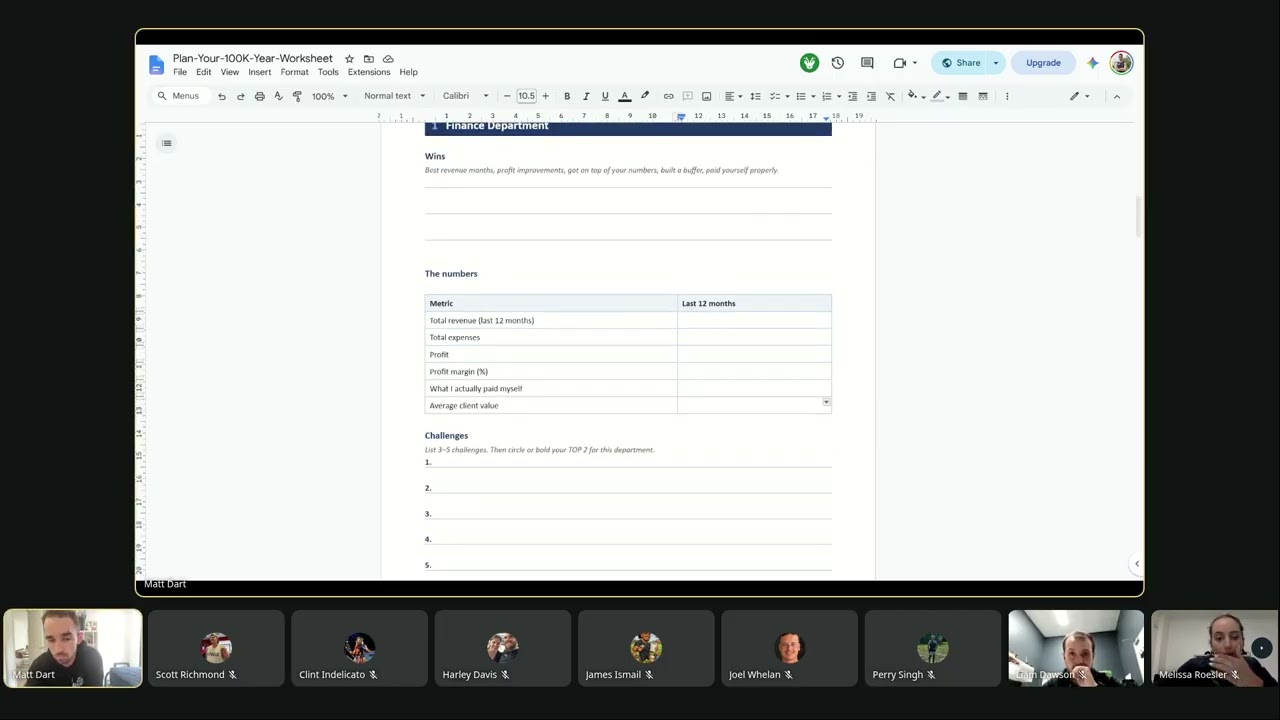
Today's going to be all about planning. Morning, Carly and Joel as well. Okay, so I'm going to drop a document in the chat. Now do not try and request access because I will not give you access to my template. You need to make a copy. Okay, so when I drop it in the chat, just go File and Make Copy. This is the document we're going to do. So this is a working session today, so you're not just going to sit there and watch me. Everyone is going to do this together— or not together, but you're all going to do it individually. But by the end of today, you guys are going to have a plan on how to get— or whatever your goal is. I, I named this session Plan Your $100K Year because most of you guys want to hit $100K, but if it's more, if it's less, whatever it is, then you can just obviously update the document. So give us a 1 in the chat if you're ready to rock and roll. So when you open the document, just go File, Make Copy, and then we're going to edit this document or type stuff in as we go. Give us a 1 in the chat once you're ready so I know we can get started. By the way, for those that are coming to Sydney, this is like a, uh, 60-70% of the way done for our planning session that we do Friday afternoon. So this will really set you up for success. So we're going to talk about like a 12-month plan today. Uh, we'll do a bit of reflection, um, but, uh, in our planning session on, uh, Friday next week, it's all about, um like just the next 6 weeks. So we get super, super specific. So this is going to be like a more, more of a big plan today. Okay, cool. So James, Liam, and Clint all ready to rock and roll. Everyone else drop a 1 in the chat once you're good. We're going to start to go through this document. So it's relatively straightforward. But if you guys have any questions throughout today, just obviously drop them in the chat. So we're going to go through and we're going to make a 12-month goal. So we're going to go through obviously a lot of numbers, but we're also going to break it up into separate departments. So we're going to do finance, sales, marketing, and then operations/systems. I'll explain, I'll explain the different departments as we go, but essentially we're going to go through some wins for each department, and then we're going to also go through the numbers for each department, and hopefully you guys get the numbers relatively quickly, but if you can't, you can always fill them in a little bit later. And then we'll go through some challenges for each department, and then we're going to pick like the top 2 things to really work on. Um, that'll, that'll really help us when we, when we catch up next week in, um, in Sydney as well. So first thing, we're going to set like a financial goal. So we're going to set a 12-month goal pretty much from, from now, um, for the financial year. So revenue goal, so not profit, revenue goal for the next 12 months. I want you guys to fill this in as you, uh, as we go along. If you're comfortable sharing, I'd love to know what your revenue goal is for the next 12 months. I think it'd be cool to, cool to know that we can obviously reverse engineer together and what that looks like. So what's the number? How much money do you want to be able to make next year? And then why this number matters to you. What's the money going to give you? Is it going to give you more ability to go on more holidays, for example, better types of holidays? Maybe you just want a bit of a savings account. Maybe you want to invest in property. Maybe you want to invest in shares. Actually, for this one, I'd actually love to know some stuff in the chat as well, what you guys are thinking in terms of money goal, if you guys don't mind sharing. All right, this one should be relatively straightforward. I'm going to give you 60 seconds, so fill it in on the sheet, and then if you're, if you're okay to share, let us know what your goal is for income, and then we'll get into the finance part. All right, $350K for Scott. Awesome, huge goal. Awesome stuff. $100K sounds good. Freedom from— what's that? Freedom from working for someone else. Yep, love it. Very cool. $100K a year, move out of home and live independently. Huge goal. Awesome. More family time. Yes. 100K a year for Liam. James, 100K. Perry, good morning. 121K. Very specific. I like it. Clint, 120K. Get his own place, start investing. Happy days. Awesome. Okay. So by the end of today as well, we're going to reverse engineer what you guys need to do each week or each month in terms of how many leads you need and how many clients you need to get. So we're going to reverse engineer that. Love to buy my wife's childhood home. That's cool. That's a very cool goal. Very exciting. Okay, let's get into the finance side of it. So we're just going to go through per department. Okay, so we're only going to talk about money for right now. So let's go through 2 or 3 wins. So you're just going to type them up the top here, 2 or 3 wins. Maybe it's revenue, maybe it's profit, Maybe it's, um, you know, maybe you built a bit of a savings account, uh, or maybe you set up some really good structures for your finances. Give yourself some wins. And then ideally, if you got the numbers here for these, I would love you guys to put them in here. You don't have to share everything, but if you can put in the revenue for the last 12 months, expenses, your profit, your profit margin, how much you pay yourself, and the average client value. And then I want you to go through 3 to 5 challenges. So this type of structure is going to be what we're going to do for each department. The numbers will be different for each department, of course, but we're going to do wins and challenges. Oh, sorry, Mel. Yes, there is. Didn't see you come through. Let me send the document. Just make sure you go File and make copy. You won't be able to edit the template. Okay, so we're just doing the finance one to start with. So what are the wins? Just put it in the, in the, in the sheet. You don't necessarily have to put it in the chat. The numbers, total revenue, total expenses, your profit. So if you guys don't know these things, by the way, like total revenue, total expenses, total profit, like if you don't have a system to track that stuff, um, at the end of this month we're going to do a training on Xero, which you can, um, that's going to give you all these figures almost instantly. Otherwise, of course, you can, you can do these types of things in like a Google Sheet, but ideally you want to know these numbers not off the top of your head, but you want to easily be able to access it. I'm also curious as well, who actually pays themselves a wage? Does anyone do that? Say yes or no. Yes if you pay yourself a wage. Modern Aaron as well. That one. Okay, Aaron, if you need the document, just put it in the chat again. Sorry, I'm just driving. All good. Okay, it's okay if you don't pay yourself a wage. Scott, I don't think I've seen you in there, but in your scenario, I would probably pay you a wage. Not so much a wage, but if you pay yourself like a set amount each week. So ideally, we talked a little bit about this last week in terms of structure with the tax stuff, but— oh, Scott, do you want to say something? Yeah, I was going to say, yeah, I pay myself a wage. Oh, cool, cool. So ideally, like, the— all the payments from the clients go into like a business account. All your expenses come out of the business account. Anything to do with the business goes through that, and then you pay yourself a set amount each week into your personal account. So prime example, I'll just be open and honest, I pay myself $1,200 a week. That's all I need to cover all my personal stuff. Everything else stays in the business. So you guys don't necessarily need to do that. Like, if you don't have a whole lot of cash left over, um, you don't necessarily have to do this type of stuff, but it's something that I think you guys should strive towards over the next 12 months is being able to pay yourself a set amount because you're gonna have a lot more control. But also, you— if you're a company, you also pay yourself— you have to pay less tax within the company rather than personal. Um, cool. So if you guys don't know the numbers here, you can, you can fill them in later, but you guys should know the wins and the challenges that you've faced. With the financial side of things. So challenges could be maybe, maybe right now you're living week to week, as an example. Maybe you're struggling with the structure of the business, you know, whatever that is. So I want you to put in 3 to 5 challenges, and then I want you to circle the top 2 that you think are the biggest or the things that you want to focus on. And then I want you guys to drop a 1 in the chat unless you're driving once you're finished. Side note, as well, something that me and Jess do. So we pay ourselves a set amount into our joint account and then I give myself an allowance of $50 a week. To spend on myself. So I sometimes get a massage and stuff. But, uh, yeah, but you can be a bit more structured like that when you've obviously got some spare cash flow. You can divide up where the money goes. Anyone else do that? They put aside money for themselves to spend? To make them feel good, I suppose. Okay, who's finished the finance stuff? Drop us a 1 in the chat if you're finished. Remember, today is all about doing, doing the work. It's not just listening to me, we're actually doing this stuff. Cool, a few people are done. We're gonna go to the next section. So we're gonna go through the sales now. So you guys should know this stuff. So wins for sales. So again, small, big, biggest months in terms of new clients, maybe percentage, maybe increase your price as an example could be a win. And then we wanna go through the metrics. So sales conversion, so percentage of people that are signing up, number of new clients, signed in the last 12 months. If you can get those numbers, if you don't, then fill it in later. Maybe you've got a rough idea. Average client value, which means how much they spend on average per client. So for example, if, if the average client would stay with you for 3 months, so 12 weeks, if your price on average is $100 a week and they stay for 12 weeks, that the average client value was $1,200. If you want to work out easily how many clients you signed, if you— let's say for example you made $100K last year, and let's say your average client value is $1,500, you go $100,000 divided by $1,500, and that'll tell you how many clients you had, which is 66. If anyone needs help working that out, let us know. But total revenue that you made last year divided by the average client value would give you total number of clients. Or if you don't know the average client value, you would go, let's say, $100,000 divided by— let's just say you had 50 clients. $100,000 divided by 50 is $2,000, which means your average client value is $2,000. Okay, so once you get through the numbers, again, 3 to 5 challenges, and then you're going to circle or put it in bold the top 2 that you think are going to move, move the needle the most, or the top 2 things you want to work on. They only need help working out their average client value or number of clients signed. So yes or no, and then once you've done, just give me a— give us a 1 in the chat once you've done the sales department. And by the way, if you guys aren't like tracking these numbers every week, remember everyone has access to, um, I'll show you the document. This one as an example. Everyone's got access to the business tracker where you should be able to see leads generated, booked consults, showed consults, new clients, etc. If you can't find it, let us know, but it's all in the KPI tracker that we set up for you guys when you first started. So, whoops, you guys can't see this. This one here. So everyone should have KPI tracker, and then down the bottom it's got business tracker. So if you guys aren't tracking these things, this is where you would track it each week. Okay, who's finished the sales part? There was a one in the chat. All right, 30 more seconds, then we're going to move on. And if you're not sure on the numbers, just do the numbers last. The, the most important part of today is identifying the challenges for each department and picking the top 2 to work on. All right, let's keep moving on. We're going to go to marketing. Okay, so again, wins first. 2 or 3 wins for the marketing. Could be in person, could be online, could be ads, could be all of the above. Give yourself some credit for the marketing for the last 12 months. The numbers— number of leads generated— and that can be just leads that you've got from the gym if you guys track that stuff. Again, if you use the business tracker, you would go off that. Cost per lead is if you're doing ads, uh, Clint, for example, you would have cost per lead for you. So you should just be able to get that from the ads manager, uh, and then total marketing spend as well for you. For the, for the guys in a gym, just leave the total marketing spend as zero and the cost per lead is zero. You can just work out your lead to consult percentage. So to work this out, you will need to know how many consults you book per week or per month on average. Or you can obviously have a rough estimate. So for example, if you guys are having— let's just say you do 30 calls a week. Let's work this out. So this will be the average. You guys can go on the average as well if you like. So if you do 30 calls a week, if you're calling at the right times, you should get a pickup rate of 30%, uh, which will give you 9 people that you talk to. Out of those 9 people, you usually have about 80% of people booking in, or 70-80%, so you'll get between 6 to 7 consults booked. So let's go, let's go conservative, let's say it's 6. So you go 6 divided by 30 which means you have a 20% lead to consult booking rate. So essentially 2 in every 10 people would book in. So you guys, anywhere from like, I'd say for most people it's between 10 and 20%. So if you want to be conservative, you can do 10%, um, but I'd say if you're calling it decent times and you usually get around a 30% pickup rate, you'd probably be more like 20% lead to consult percentage. But I want you guys to go through the challenges for marketing, and then again, pick your top 2. If you're not sure of the exact numbers for leads generated, if you're in like a face-to-face gym, just go off the average leads that you get from the gym each month and then times that by 12 to give you a rough idea. And then for those who also do a bit of stuff on social media, if you really want to, you can separate number of leads generated from like in the, in the gym versus how many leads you got on socials. You would just add a row like that. So if you guys want to collect more data, then, you know, go for gold. Um, but I'll just put it in the, the one category for now. Okay, so remember, once you've done your 3 to 5 challenges. I want you guys to do the top 2 challenges for this department, and then after this we're going to do operations and systems for the last department, and then we're going to bring it all together. Okay, give us a 1 if you have Finish marketing, marketing department. I'm going to give you one more minute, so 60 seconds to finish off the marketing, then we'll go into operations and systems. Does anyone need help? Does anyone need help working out their metrics? OK, all right, 20 seconds left, then we're going into operations. All right, operations. So we've got wins. Maybe you made better systems last year. Maybe you started to automate some things. Um, give yourself some wins. Maybe you have a really good onboarding process. And then the numbers I want to track for this is how many hours per week are you working in the business. So that's like doing PT sessions, um, doing check-ins, that type of stuff. That's working in the business. Clients handled per team member, that's only valid if you obviously have a team. Uh, so like Scott, for example, that'd be for you. Uh, admin hours done per week. Again, this is just like an approximate 5, 10, 15, 20, whatever the amount of admin hours you're doing. And then client churn or retention percentage. This is how many people have left your program. You can either do it based on number of people that have left in the last 12 months or percentage base. So prime example, you will need to know some rough figures here. So let's say for example you had, you had 50 clients that you signed up over the last 12 months and you've currently got 20 left. So 30 people have left. So what we do to work this out, so 50 client— 50 clients and you've got 20 active. So you've had 30 out of the 50 leave. So you got 30 divided by 50. So basically 60%, you've got a 60% churn. And if you really want to do that per month, which is what a lot of people would look at, you'd go 60% divided by 12, or 60 divided by 12, uh, so it'll give you a 5% churn per month. Now, by the way, some of you guys might think that's a lot of like a high churn. Of course you want to get as low as possible. Uh, any type of business that's on like a decent scale, if you're under 10% each month, that's actually, um, pretty, pretty decent. So again, I'll give you another example for client churn. Let's say— or does anyone want to go through their numbers specifically and I can work it out for them? Drop us the one if you want me to do it for you. Otherwise, I'll just do another example. Anyone want me to work out their numbers for them? I'll just do another example. So let's say we'll, we'll do a high scale. So let's just say you got— you've signed up 100 clients. In the last 12 months. And let's say you've currently got 60 clients left, so you lost 40. So we're going to go 40 divided by 100 because you got 100 clients. So basically you've got a 40% churn. So you go 40 divided by 12 to get the monthly, and you're at 3.3. So 3.3% churn rate. So basically, if you, if you had 100 clients, you would lose 3 of them every month. Okay, so I think the, like, the KPI that you want to aim for is like under 10. Okay, so we're going to go through 3 to 5 challenges and then again pick your top 2 to focus on. Once we've done this, we're basically going to pick, we're We're going to pick the, the two, the two biggest challenges from each department, and we're going to pick two of them to make as our priorities that we're going to focus on. So this would be really good for when we catch up next week for the planning session. This is kind of like, I suppose, like the pre-work that you guys are doing now, ready for that session next week. Yeah, so we're going to do the 3 to 5 challenges, pick your top two. Once you've done that, if you're, if you've already done the operations, you're going to pick the top 2 challenges in total. So you should have 8 priority challenges. So 2 for operations, 2 for marketing, 2 for sales, 2 for finances. You should have 8, and you're going to pick the top 2. They're going to make the biggest difference. For the business. And then when we catch up in Sydney next week, next Friday, we're going to basically reverse engineer what exactly we need to do with these two things to be able to achieve XYZ result. 30 more seconds on the operations and systems, and if you guys already finished, you can start to go through the top 2, top 2 priorities. Okay, if you haven't already, start to go through the top 2 priorities. And once you've got them, I want you to type in your 2 priorities or the 2 challenges that you want to focus on. Into the chat once you've got your top 2. Then from there, we're going to reverse engineer how much you need in terms of sales and leads per week. Um, and then that'll be the end of today. So probably, probably finish like 10-15 minutes early. But, um, yeah, this is going to set you guys up for getting the, the top 2 things to work on straight away. And then next week we're gonna dive deeper into these top 2 things. So once you put your top 2 things, post them in the chat for us. Okay, who has done their, the top 2 challenges? I want to see where everyone's at. Give us a 1 if you finished, give us a 2 if you need more time. Just give us some feedback where everyone's at.
Can you see my messages?
No, type it again, or you can talk, talk to me if you want. Nothing's come through in the last 15 minutes.
Yeah, I've typed a few things thinking you could hear me or see me. I'll open and close the chat.
Hold on. Can everyone else see Holly's messages? Because I just can't see any messages from Holly.
You've blocked me, mate. I get it, it's all right.
Just ask me the questions.
No, it wasn't any questions, it's me just commenting on stuff basically. But this one, that was just putting the priorities down.
Okay, well, what, what are the two priorities?
Uh, mine would be priority one is building system and processes just to like for everything and just having it there ready and knowing it off by heart. And two was just being consistent with calls and KPIs. I feel like KPIs is something I need to work on biggest thing and calls brings the KPIs up basically.
Yeah, 100%. Um, I think everyone, or everyone, but like majority of our clients don't track these numbers here. Who uses the business tracker? Hi, I'm not sure if you can write it in the chat, but I wonder if the chat's broken or something. Can anyone else see anything in the chat? Someone, someone type something in the chat. I want to see if I can see it.
I use it, but I only use it for the, um, I don't know if you ever check it, but I only use it for like the money side of things, like the client tracker part of it. I should use the other stuff too, but I don't.
Yeah, well, this is like your most important— this is the most important stuff. So like leads generated, booked consults, showed consults, new clients, new sessions, conversion rate, lost clients, lost sessions. Those stats there is going to tell you exactly the position of the business. So everyone should be doing that.
I'll put in my business thing each week to check it every day or write it down, basically, like that plan I've been telling you about I do each week.
Yeah, nice.
But I don't remind myself, I don't do it, basically.
Yeah. I used to have a reminder in my calendar each week.
Yeah, I've been making that, um, weekly business tracker calendar thing with, um, Menus, and it works really well. And if I chuck that in at the end of the day, spend 5 minutes tracking what you did for the day, it won't, won't faze me until it becomes habit, really.
Yeah. Um, just for everyone else as well, um, Can anyone else see anything in the chat? Someone else unmute and tell me if there's anything in the chat because I'm not seeing anything. Liam, I can only see you. James, is anything happening in the chat? Yeah, can you see my stuff? No. Uh, I can see Harley's. What's going on? Honestly, I can see both. Okay, hold on a second. Maybe it's because I was sharing my screen. Can someone put something in the chat now? Just whatever you want, just chuck something in there. There you go. Nothing. What's going on? Nope. Okay, team, so if you need anything, you're gonna have to talk to me. I don't know what's going on. That's super weird. Okay, now I'm gonna assume you guys have got your 2 priorities. I can't see the chat, but I'm just gonna assume that you guys have got your 2 priorities. We're gonna do the last part of today, which is we're gonna reverse engineer what your weekly targets are gonna be to hit your 12-month goal. Okay, so I will need some numbers in here, as in like we need to know your client value and your conversion rate., and also your lead to consult rate. But if you don't know them, I'll give you some insights. So 12-month goal, I'm just going to do an example in here so you can follow along with me, or you can obviously do your own specific numbers. So 12-month goal, a lot of you guys said $100K, so I'm going to do $100K and I'm going to assume my client value is $1,500. Okay, so what we're going to do, we're going to go $100,000 $1,000 divided by $1,500, and that's going to give me 66. Now, 66 of the total clients I need to have in the next 12 months. Now, what I want you to do, if you already have XYZ amount of clients, you're going to take that number off because you've already got those clients. So if I was to start— if I'm starting from zero and I want to make— let's just say I want to make an extra $100K per year, then it would be 66 clients. So you can either work it out like this: if you want to make an extra $100K this year, then you need 66 new clients this year. If you've already got 20, for example, you could say, cool, I need 46 new clients to make $100K per year. But that's obviously assuming the current clients that you've got would spend an extra $1,500 with you. So if, if we need to get 66 new clients for the year, you're going to go divided by 12. So you need 5.5 clients a month. So let's just say 6. If anyone is not following, you're just going to have to unmute and talk to me, because like, for some reason the chat's not working. So that's just that. I need 5.6.
So just to clarify, right, so 12-month revenue you got, is that increasing to from what I'm at now? Is that correct?
No, let's, let's go on just the total amount that you want to make. So like, people could do this in two ways. You could either say I want to make an extra amount, which is this much, or we can do just total, total revenue, which I think is probably easier just to do total.
So you would understand, just for clarification, so $100K client value, you just be $1,500, wouldn't it?
Well, how much does your average client spend with you?
Uh, I did, I worked it out a second ago. Um, so it'd be, so I had 21 at the moment, I've had 40 since I started, and I've made $45,000.
Okay, so how much was your total revenue last year?
Um, total I made through would have been even to the right, close to— I'd say about $51,000 because I had a couple people pay up front, so I didn't track that through Stripe. It was direct to my account, so that'd be $45,000 plus $6,000, so $51,000.
$51,000, cool. And then How many clients did you say you had last year in total?
Um, I've got 21, but I think I've worked out to have in total signed up in that year and gone is 41.
Beautiful. So you're going to go $51,000 divided by 41, which means your average client value is $1,243.
Yep, 1, 2, 4, 3.
So I'm going to do your example here. So your average client value was $1,243.
Yep.
Um, so I'm just going to assume that your current 21 clients that you've got are going to spend an extra $1,243 with you this financial year. Okay, does that make sense? So we're going to go $100K, um, divided by 1, 2— whoops— 1, 2, 4, 3. Which means you would need 80 clients for the year for that, minus 21. So you need 59. Yep.
But obviously that, the average client value would be going up because I have increased prices since starting, but we'll just go that for that at the moment. Yeah.
So this is where, like, this is for everyone as well, like, if you guys want to forecast what the numbers would look like I'll show you how to do that in a second. So right now, so your average value is $1,243. So you need an additional 59 clients, 59 clients to achieve that goal. So you're gonna have 59 divided by 12, which means you need 4.9, 4.9 clients per month to achieve that goal. So now what we're gonna do We're going to do your conversion rate. So we're going to work out the consults you need per month. What's your conversion rate right now?
I'd go— this, this— I mean, I want to track more numbers, but off by heart, probably go with probably about 60 to 60, 60 to 65 roughly.
Okay, so now we need to reverse engineer how many consults you need per month. So if you need— let's just say you need 5 clients a month. If you had a 50% conversion rate, you would need 10.
So I think it would be like 10, uh, I think you would need 2.5 a week.
Well, that's if you had a 50— yeah, if you had a 50% conversion. So you could be conservative. You could say if your, if your average is 60 and you've obviously increased, so, um, you would just, you would still just need 10 because if you had 10, you would convert at 50. 50%.
Oh, so yeah, oh, it's per month. Yeah, okay, yeah, gotcha.
Yeah, so you need 10, so you need— yeah, you would still need like 2 and a half, 2 and a half a week. Yes, but basically 3. Now we need to work on how many leads you need per month. So these numbers up here, so when we had—
oh, right, yeah, okay, yeah, that one was hard because Yeah, did you have, uh, where is it? I know, yeah, I didn't get— that he couldn't fill that part out, like didn't have enough, um, numbers or information to figure that out. But I would go each, each week, I could— I, on average, I probably get about 5 per week, like just from new members and stuff.
Currently 5 leads or 5 consults?
Consults would probably be at 2. Leads would be at about 5 to 10 a week, depends when I get the new, so probably I get the new member list once a month roughly. So I don't go to get every week, I just go once a month, I'll get it. But then I have also people that start here and they're curious straight away about consults and PT. So I call them straight away sort of thing when I get a chance. So I'd probably go about 10 leads a month. A week, sorry.
Okay, so it's— so you would— and you said you would get 2 consults a week on average? On average, yep. Okay, so you're basically getting 8 consults a month? Yes, so roughly. Okay, so basically you can see where the problem is. Yeah, so you need to find a way to get more leads essentially because you need to be able to get more people.
Yeah.
Yeah, or call more people. So for example, if you're getting— you say you're getting, um, conservative-wise, you said between 5 to 10 leads a week, so you'd be getting like 40 leads a month roughly.
Yeah.
Okay, so you would need to bump that up to 50. Yeah, yeah.
Okay, yeah, yeah. So need to work on 50.
Yep, gotcha. So then, um, If we go sales, sales conversions needed each week, so monthly consults divided by 4, uh, you basically need to get, um, if we work that out, so if we get 5 new clients a month, it'll be like 1.25. So basically, basically 2, always round up just to be conservative. Yep, essentially. So this is how you work it out. If your goal is $100K And your average client value is, let's assume it's going to be the same, so $1,243. You need basically 5 clients a month, 10 consults a month. You need to make sure you generate 50 leads a month, which will break down into weekly, 12.5 leads a week. You need to basically get 1 sale a week.
Yeah, correct. So the, basically the easiest way to increase the average client value is having people stay on for longer, but also increasing prices.
Correct. So two ways you can do it: either increase the price or they stay with you for, you know, 6 months instead of 3 months.
Yeah, I'm at that point where I'm thinking about increasing prices, not by much. Um, I think, you know, my prices for one is $89. I'm thinking about increasing that to $99, just so it still stays under $100, um, because I think costs is probably I wouldn't go any more than that. And then your 2, I would just increase that by 10 as well.
Yeah, yeah, you always want to have something probably like around that $100 a week. That's what—
yeah, I don't, I don't— as a drop sell still, that $100, I still present the 3 and 2 as my main, and then I drop sell the 2, 1, and always tell them there's options to upgrade.
Yeah, down the track. So, um, thanks for volunteering as well, Harley.
You know, I'm happy to do, I'm happy to be a guinea pig.
Yeah, it's good. So what you guys can do now, so Harley kind of mentioned that he increased his price, right? So what you would want to do, and I'll literally do this as an example, I'm going to put this into AI and I'm going to say if I was to increase my average client value to $1,500, how many, what would my, what would the other metrics go down to? If I was to do that. So let me just give you guys an example. I'm going to see if I can— I should be able to just cop— let me just take a snippet, take a screenshot. Okay. Um, I'm gonna stop sharing this screen and I'll share a different screen. I'll go into entire screen maybe. All right, Claude. Okay, so I'm gonna go in here. I'm just gonna talk to it for a second. Hey, I'm gonna send you through a photo of me reverse engineering one of my clients' personal training businesses goals. He wants to make $100K per year. Right now the average spend per client is $1,243. I want you to tell me what the numbers would look like in terms of how many consults I need per week and how many clients I need per week if we were just to change the average client value to $1,500. And then also tell me what it would look like if I was to increase that to $2,000. In average client value. I'll send the screenshot shortly. So this is literally all you would do, and this will tell you hopefully what the other numbers would look like. Can you—
I'm a big fan of it. I, I'll get it to do stuff like that. I'm like, now PDF it for me so I can read it better.
Yeah, 100%. So the one— so this is a really good, um, example here because I actually didn't tell it that— because I actually, based on the screenshot, it should read that, um, you need 80 clients a year. I didn't tell it that I took off 21. So let me just give it more context. Okay, something I forgot to tell you: when we work out the clients needed a year, which is 80, I actually took off 21 because he's already got 21 clients as of this second. So I assumed that those 21 clients would stay with him and spend an extra $1,200 with him. So just keep that in mind. Can you redo the calculations? Like, AI is really good for like brainstorming and forecasting numbers.
Yeah, I need to load this stuff instead of just content, like content-wise.
Yeah, 100%. You need— but the most important thing is like you need to give AI the data because then it has all the proper, proper stuff. Yeah. Um, okay, so let's see if it's, um— and by the way, I'm gonna go through these figures, but these figures might not be 100% correct. I might have to give it more context, but the, the, the, um, the solution is still the same. Like, once you've got all the data, give it all the data and say, cool, what if I was to increase my, um, sales conversion from 40% to 70%? What would those numbers look like? Um, so it's— you can see in here, like, it's, it's not 100%, right? It's saying we need it's not reading the data right. So it's saying we need 5 clients a month, but we need 49 consults. So it's not reading the data right here, as you can see. But the point still is— I'm not going to go through and fix it, um, because it'll take a little bit longer— but the point here is give it all the, all the numbers that you've got and tell it what would the, what would the numbers actually look like if we were to increase blah blah blah. If I was in— if I was to get 50 leads a week instead of 50 or 15, what would that look like in terms of the numbers for me to hit my goal? And then you just pick what you focus on. So maybe the biggest bottleneck isn't your sales conversion, it's actually the leads that you're generating, as an example. And this is how you can pinpoint like what's the biggest bottleneck and go through like specific data points and be like, okay, cool, well if I was to increase this then I would get this result. If I was to increase this, I would get this result, etc., etc. So what I want you guys to finish now, uh, with— if we go back to the document, there's the last thing on the bottom here, which is to hit my 12-month goal every week, I need to generate blah leads and have— I'm going to change that and just change it on yours— and have, um, and convert XYZ sales. Okay, so don't worry about these things down the bottom here, we can come back to these later. I want you to fill in, to hit my 12-month goal, every week I need to generate X amount of leads and convert X sales, and then we'll be done. And then when we do the full planning session next week, you guys will get a bit of a head start, and then we can spend a bit more time working on the logistics in terms of how you're going to be able to get XYZ leads or XYZ consults. So we'll be a lot more productive. So I know the chat function is not working for me. Uh, if you want to put it in the chat for everyone else for some more accountability, then um, go for gold. If anyone does want to as well, you're more than welcome to share your document of this with me and I can give you some more feedback. You just need to go share off the top and put in my email, which is mattdart21@gmail.com, if you guys want to. Don't know, just a thought.
When it comes to what you did there for me, the thing that we did with men— is it Menace you use?
Korn.
Or I use Menace. I like Menace. I don't know. I'm a stickler. I'm lucky I got away from ChatGPT.
Menace is good.
Yeah. I use it to do some certain things. My biggest thing at the moment is managing my time and that with that. I really want to learn more about that sort of things when it comes to trying to automate a couple of things like each week. With KPIs and stuff. I'm sure it's something you could help me with.
Um, yeah, tell me, tell me if you send me a message with what exactly you want to automate, I can let you know, uh, if it's possible, um, and what system we would need to implement.
Yeah, nothing crazy. I just, just try, just basically trying to have something that's going to help me, you know, reach the KPIs like we're going to set I'm going to set with this document, basically, if there's a way to automate certain things to make it easier.
If you, um, send me a message on what you're thinking, and then we can go back and forth on, uh, what that would look like and what can be automated. Uh, because you can't— you could like get AI to automate your KPIs, but you obviously just need to obviously feed the KPIs directly to Moneypot. Yeah, that's definitely possible, and that'll also keep you accountable as well. Yeah, that's—
yeah, the accountability side of things. Like, it's like why we get coaches, right? We have PTs, accountability, and why we have someone like yourself. Um, and, you know, AI will learn the more you give it, basically.
So one thing that comes to mind as well, just for anyone that wants to like get more accountability, like with AI, you can set up like an AI agent in Claude. Mana should be able to do the same thing. Where, like, for example, as long as you fill in the KPIs, it can give you, like, a weekly report on your KPIs and analyze what's the biggest needle mover. So, for example, if your conversion rate was really low, it'll be able to tell you, cool, we need to fix your conversion rate. Or, you know, if you're— if you only got 10 leads instead of 20, it could be like, hey, Harley, you got— you need to focus on generating leads this week because you fell short last week. So you could— you could have, like, an accountability coach for that, because we're looking at building something like that for all of you guys. Yeah, if you submit your data to us, we can have like an AI bot give you like real-time feedback instantly on what you, what you should be, um, improving on. So we're working on that. But yeah, team, we'll leave it there, uh, right on time. So, um, remember, no, no coaching call Friday for the guys that aren't in Sydney. So, um, yeah, for the guys that are coming to Sydney, super, super pumped. So Monday is still on, um, but Sydney event's live from Thursday and Friday. So no, no school coaching call on the Friday, and then back to normal, uh, the following Monday. So looking forward to seeing everyone in person. Um, and if there's anything else you need, obviously just let us know. Um, from Wednesday to Friday I won't be as active in school because obviously of the event, of course. Um, but, uh, also side note, Perry's message came through the chat, so maybe I did accidentally block some people. So I don't know what's going on. Oh, Harley, I can see your messages! I just saw it come through.
Yeah, he's just a favorite. Yeah, I don't know, maybe it's because you were sharing or some shit.
That's weird. I don't know, that's super weird. But, um, Anyway, it is what it is. Looking forward to seeing everyone next week. Have an awesome weekend and I'll talk to you guys later. Bye-bye.
More from Matt




Your staff aren’t lazy. Your systems, standards and leadership might be. Check out Episode 138!





Your team can’t take ownership of work you refuse to hand over. Stop being the bottleneck! #shorts


Slow lead replies cost you sales. The fastest business usually wins. Full episode in my channel!