
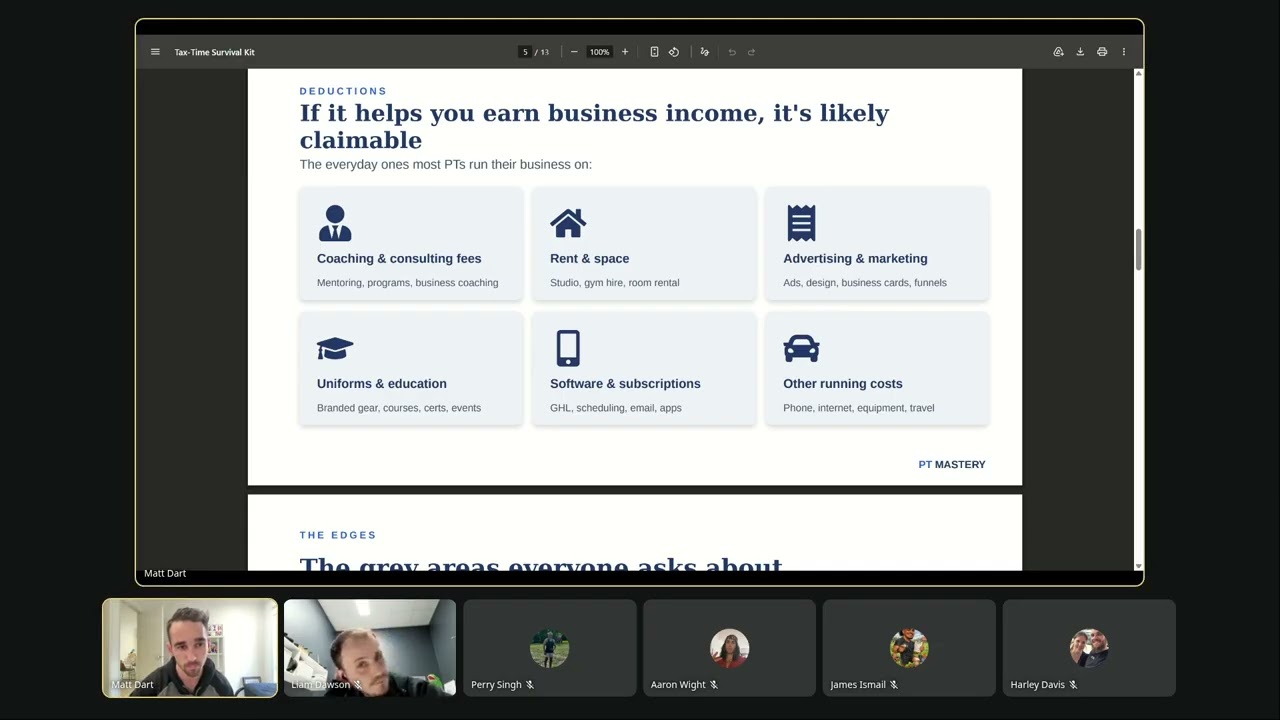
In this live YouTube workshop Matt Dart walks personal trainers and small‑business owners through the fundamentals of Australian tax and bookkeeping. He starts by correcting the common misconception that tax is paid on revenue, emphasizing that it’s only payable on profit. He then outlines what expenses are generally deductible – from coaching fees, rent, advertising, software subscriptions, uniforms, equipment, phones, internet, home‑office costs, car travel, education, events and client‑related meals – and highlights gray‑area items that require careful percentage apportioning and documentation. Matt stresses the importance of keeping receipts (using Hubdoc) and reconciling transactions in Xero, and recommends a three‑account banking structure (daily expenses, savings/emergency, tax) with regular transfers (≈20 % of revenue) to ensure tax money is never spent. He explains the GST registration threshold (~$75 k annual turnover), BAS lodgements, and the ability to claim GST on expenses. The session compares sole‑trader versus company structures, noting the flat 27.5 % company tax rate versus progressive personal rates and the $100 k turnover trigger for considering incorporation, plus implications for car ownership, payroll and home‑loan applications. Matt also touches on superannuation contributions, banking options, and automation tools like Henry. Throughout he fields live questions about phone/internet apportionment, home‑office claims, car logbooks, GST nuances, super, accountant selection, and strategies for boosting loan eligibility. The workshop ends with logistical reminders for an upcoming event and a call‑to‑action for participants.
Chapters
Okay, so we're going to talk about tax time. If you haven't, guys, yet as well, I'd love to know in the chat, what are you guys most excited about for the event? Either organic social media, AI, or sales. 3 epic guest speakers, which is going to be great because that means I don't have to do as much at the event, which is good. So we're going to talk about some tax time survival kit. Good morning, Harley, as well. Great to have you back on the calls, mate. I'm going to share my screen and we're going to go through tax time stuff. In the chat, who has already sorted out their tax? A 1 if you have, a 2 if you have not. Just curious. So who has actually sorted out their tax already? No one. Okay, all right, this would be good then. So I ran a training on this, uh, last year, but I thought it'd be good to run, um, not the same training, but there's a few updated things that have changed, um, because a lot of people kind of put their tax stuff to the, to the side. And then, you know, the worst thing that could happen, which is what happened to me and my— one of my mentors never taught me anything regarding tax, so I thought it'd be good to give you guys all my knowledge. Of course, I'm not an accountant, so I don't know everything, but I'll just tell you kind of what's working for me. So let's get into the slides. So I'm just going to give you guys just my experience. I'll put up a little disclaimer in a second, but it's obviously not financial advice or tax advice. I'm just going to share with you what I've done for my PT business, um, and what's worked, um, for me. So I'll go through like the structure. As I said before, I'm going to go through like the bare basics first. Some of the stuff you might, might already know, but there's a few more advanced stuff that we'll go through as well. And then I'm going to leave a bit of time for Q&A at the end as well, because I think a lot of people tend to have a few questions regarding what they can and can't claim on tax. So any questions that come up, just drop them in the chat. So what we're going to cover today, obviously a little bit about the mindset, what you can and can't claim, how much money to set aside, the different thresholds to know, which do change every year. I will actually— you can literally just Google the thresholds, but I'll go through them if you want as well. What I actually do in my business to make sure I've got enough money set aside for tax, uh, how much my accountant costs and what he does for me, because some of you guys don't have accountants and some of you guys won't need accountants yet. And I'll kind of let you know when to kind of look at getting a proper accountant. And then, as I said, we'll go through some Q&A as well. So little disclaimer, as always, it's not financial advice. I'm not an accountant. I've learned a lot of the stuff just from doing it. I've made a hell of a lot of mistakes, so I'm just going to give you some of the lessons that I've learned over the last, you know, 10 years or so that I've been in business. So let's go through the basics first. So tax isn't money taken from you. You only pay tax on profit. Not revenue. So there's a— there is a big, uh, misconception, and something that I also had for a while is I wanted to almost pay no tax, um, because of various reasons. Um, but in reality, it's, it's almost a good thing that you have to pay tax, which means you, you're making a good profit in the business. Because if you're not paying tax, it could mean that you're not, you know, actual profitable in the business. So we'll start through the basic revenue minus expenses will equal your profit. So if you're making $2K a week and it costs you $1,000 a week to run the business, you don't pay tax on the $2K, you only pay tax on the $1K. Okay, so the goal isn't zero tax, the goal is to keep good records and not overpaying. So little prime example here, when I didn't have stuff set up properly, I had a pretty decent tax debt that I had to eventually pay back, about $50 grand, because I forgot to put money aside for tax. So I'm going to show you guys the lessons from that. So just give me a 1 in the chat if that makes sense. You only pay tax on profit, not revenue. I just want to make sure everyone understands that. Some people think they pay tax on everything that they make in their business. You only pay tax on profit. Cool. All right, let's keep going. So let's go through the deduction. That's probably the biggest part of what we're going to cover today. General rule of thumb, if it helps you earn money in the business or anything really to do with the business, it's generally claimable. Uh, Harley, so the question is, so what is a cost? Yeah, so basically anything to keep the business running, which I'll go through heaps of examples now for you. If you guys have any specific things you want to ask as well, just let us know. I'm going to go through heaps of examples for you now. So all of my stuff, all tax deductible. Any type of coaching, consulting, mentoring, Anything that upskills you is 100% tax deductible. Uh, the rent that you pay, or if you're renting any, anything through with the business, so gym rent, um, advertising, paid ads, if you're renting out, uh, specific rooms through certain services, 100% all tax deductible. Advertising and marketing, as I said, business cards, um, you know, design, if you're paying people to do designs for you for flyers, um, CRM subscriptions that help you manage the business, all tax deductible. Uniforms, education. So if you guys are buying uniforms, which you will have uniforms that you, you'd have to buy, some gyms will include it in their rent, some of them will get you to pay it separately, all that stuff is also tax deductible. Softwares and subscriptions. So if you're using Calendly, GoHighLevel, uh, Zapier if you want automations, um, Trainerize, Everfit, whatever software that you guys are using to manage your client programming and stuff, all tax deductible, 100% of it. Some other things as well, uh, which a little bit of a gray area, um, which could be like claiming your phone, internet equipment,. So if you guys, if you guys are buying equipment to film content, all tax deductible. A lot of, a lot of people won't claim this type of stuff, but this is all tax deductible. Laptops. If you buy a phone, now here's where I can get a little bit gray area. If you buy a phone just for the business, so separate from your personal, and it's only for the business, 100% tax deductible. But if you use your personal phone for your business, you have to work out with your accountant a percentage of how much you can claim. For example, you might use— you might use that phone for 50% of its usage is for the business, and 50% might be for your personal usage. So you can only technically claim 50%. Okay, internet. Now, if you guys do some work from home, which I would argue pretty much everyone would do some work from home, you may, if you've got a decent accountant, be able to claim some of your internet bill as part of your business expenses. So while we're talking about what you can and can't claim, does anyone want to chuck in some examples in the chat if you're not sure if you could claim it as an expense to reduce your taxable income? Anyone have anything so far? Otherwise, I'll keep going. I'll keep an eye on the chat. So these are the gray areas. Uh, Aaron, can you claim the cost of the phone itself? Um, so yes you can, but it would be based on the percentage. So for the same example before, if you were buying a phone purely just for the business— one of Rob as well— if you're buying it just for the business, the whole cost of the phone would be tax deductible. If you're using your personal phone for business, you'd have to work out a percentage that you could claim with your accountant, or you could just try and claim the whole thing. The one thing to keep in mind is obviously you can claim all this, all these things, but if the ATO does audit you, you need to prove it's a business expense. And just so you guys know, I have been audited before, so it does happen. I basically had to send through all my receipts for all the deductions that I was claiming, which luckily enough for me, I did actually keep the receipts. Um, so it was— it worked out fine. But, um, yeah, that kind of answers that question for you. So the gray areas: home office. So I obviously work from home. Now it's a little bit complicated, so there's no one rule here. You have to work this out with an accountant if you're going to claim stuff for the home office. For example, I do claim a portion of my internet. I do claim a portion of my electricity to basically run the business. Now you can't claim your house rent. As, um, a tax deduction. Uh, you can't do that. So this is a gray area. There's a few yeses and nos that you can and can't do. Um, the fixed rate method I'm not going to go into because it's a gray area. Okay, so if, if you want to ask your accountant about if you can claim your home office, uh, you'd have to be spending a decent proportion of your business at home. Like what I do. I don't do anything, you know, in a gym. So this would be like if you guys are doing fully online coaching, this would be something you want to explore with your accountant. So the car is another one that generally comes up in conversation as well. And good morning, Joel and, uh, Clint, as well. Just going through tax stuff, so if you guys got any questions, just ask in the chat, I'll answer them as we go along. Car and travel. So You cannot claim going from your home to the gym as a tax deduction. You can, however, claim your car and kilometers traveled if you are a mobile PT and you're traveling between people's houses, or if you work at multiple gyms and you have to go from one gym to the other gym. That you can claim. So this is why it's a gray area, because some things you can, some things you can't claim. Okay, so there's two ways through it. You can either keep a logbook so you track how many kilometers you're doing, or you claim cents per kilometer. So again, this stuff you'll need to talk to an accountant about, but that's the two ways you can claim your car and travel. Now there's certain things that you can claim, um, that— or that I claim that my accountant has figured out a way to do it legally, which is great. A prime example: my car is fully in, in my company, which means I claim my entire car on the business— the fuel, the rego, and the insurance.. So you guys may or may not be able to do the same thing. You would usually need to be a company to do this. Usually if you're a sole trader, from my understanding, you can't do this because I don't think you can put a car under just an ABN. It has to be like an actual company. Now I know you guys will be asking this question, when should you become a company?. I will cover that very soon, but general rule is you usually want to be making about $100K a year before you become a company, but I'll cover that in more detail soon. Phone and internet, I covered this a little bit before, but you can claim the business use percentage. So whatever's fair and reasonable for how much percentage you use your phone for the business, like making content, client communication, that type of stuff. You guys need to work out what's fair and reasonable. And if you get audited from the ATO, you just need to prove that you use that percentage. Again, you can, you can claim whatever you want, but it just like, if you are going to claim it, you just need to know that if, if the ATO comes for you, you just need to be able to prove why you're claiming XYZ. If you can't prove it, you just mean you're going to pay, you're going to pay back what you, what you got back as a claim. You've got to pay that back to the ATO. Education and events. So courses, certificates, even the Sydney event, prime example, your travel to the event, tax deductible. So if anyone's booking flights, all tax deductible, 100%, the accommodation, any food, anything that you spend at the event is 100% tax deductible. Any Ubers, if you buy some beers, sliders, whatever you, whatever you drink, everything tax deductible. Doesn't matter if it's alcoholic. It's because you're at an event that's going to upskill you and improve the business. Okay, just want to make that super clear. So for those coming to the event, or if you're on the fence about the event, just give me a 1 in the chat if you understand everything to do with the event— flights, accommodation, transfers, Ubers, drinks, food— all tax deductible. Give me a 1 in the chat if you understand. And by the way, in case you guys didn't know, I actually, I actually give you guys all the food for the days as well. So all coffees, morning tea, lunch, afternoon tea, I supply all that stuff. You just gotta buy yourself dinner. But if you catch me on a good day, I might buy you dinner as well. See how we go. Okay. Cool, everyone understands, beautiful. Okay, let's keep going. Now, meals and coffees, great area. If you're just sitting by yourself and you're grabbing a coffee, grabbing some breakfast, you're in between clients, that is not tax deductible. However, if you're having a meeting with a club manager or a team member, it is tax deductible because it is a meeting, or you can say it's a meeting for the business. Okay, so most of it is not deductible. However, it is deductible, deductible if you are having a meeting with someone to do with the business— clients, for example. There's been a lot of questions in the community about client events. All tax deductible. If you're going to shout your clients breakfast, coffees, or whatever, all tax deductible. Okay, let's keep moving on. If you can't prove it, you can't claim it. So as I was saying before, if the ATO demands an explanation, you need to be able to prove the stuff that you're claiming. So ideally, keep the receipts. There's a few apps that you guys can use to upload receipts. A nice one, nice easy one that's free is called Hubdoc. I'll just put that in the chat if you guys want to Google it. Hub— I don't know what they're called— Hubdoc. Yeah, now when I do a training on Xero in a couple of weeks, Hubdoc actually integrates with Xero, kind of just like I down here. So everything's in the one spot. So previously I used to just take photos. So you can just do this as well if you want. You can just take a photo of the receipt. Now I'm not saying you have to take photos of like, or tell your club manager to give you a receipt every time for the, the rent that you pay, but you just need to be able to wait, you just need to be able to prove that you have that business expense. Okay, um, yeah, in an ideal world, the process ideally, when you have something that is tax deductible, you basically immediately go into Hubdoc, you take a picture of it, and you log it as an expense. And then when you reconcile your transactions in Xero, it matches up together. So the receipt goes to the transaction, so it's super Easy. Give me a 1 in the chat if you guys are using Xero. Give me a 2 if you're not, or if you're using a bookkeeping software, give me a 1. If you're not using any software for bookkeeping, give me a 2 in the chat, please. Not one person is using— Clint, okay, Clint, do you use Xero or something else? Rob just loves spreadsheets. Old school. Yeah, cool. Okay, so everyone that said 2 to that, you guys ideally should come to the training in a couple of weeks on Xero, um, for bookkeeping. Um, because that's basically how you manage all your expenses and you can, um, semi-automate a lot of this stuff. As well. Uh, yeah, July 24th we're going to do that session. So it's going to be Xero in an hour, exactly how to use Xero, how to set it up, how to reconcile transactions, etc., etc. It also makes it super easy for an accountant to do your tax returns as well. Okay, let's keep going. Um, I got to give us some feedback as well. Who is putting money aside for tax? A 1 if you are, a 2 if you're not. There you go, mixed bag. Alrighty, cool. Okay, so this is literally my setup right now. So this is the simplest way, I think. Everyone should do it. Obviously this is just what I do. You want to do something else, then go for gold. So I recommend 3 accounts. All of these should be in a business account separate to your personal stuff. Okay, so first thing, create a business account. Don't put everything together in personal. So everyday expenses, so that's where all your subscriptions will come out of. If you're buying coffees or whatever, it'll come out of that account. Then you got a profit or savings account, which is like a like an emergency fund, essentially. Ideally, you want to save like 3 months worth of expenses in there. And then you've got tax, a tax account. So this is money that you do not touch under any circumstance. You do not touch this money. Now, a lot of people ask me, how much should you put aside for tax? Now, everyone will have a different tax rate here depending on how much how much they make. Me personally, I put aside roughly around 20% of my revenue. So how much comes in every week, I usually put aside 20%. Now the reason why is because I probably would pay somewhere between 30 to 50% in tax on the profit, but I know I've got a lot of expenses that reduce my taxable income. So I usually only pay around 20 to— or 15 to 20% of tax. Can you just give us a yes or no in the chat if that makes sense? Just say yes if it makes sense, or no, I'll, I'll explain it a different way. Okay, cool. Cool, cool. So you guys will essentially need to figure out your own number, but most of you guys will cover any tax that would need to be paid, um, with 20%. So that's what I would do. Essentially, this would be like your everyday transaction account. So you'd have a card associated with this, and you'd have 2 savings accounts within the same bank. So you have 3 accounts for your business: one everyday account, one savings account, one tax account. And every single week when you get paid, I would put a percentage into your savings and a percentage into tax. So what you guys really need to work out is this— this is where, like, um, money management comes into it, which, you know, might be a separate training that we can do down the track. Uh, yeah, every week, Rob. Well, you can do it monthly if you want. I think it's probably just easier if you just try and get rid of that money out of that account each week, pretty much as soon as it comes in, and then you just don't see it. The other thing that you could do as well, which is what some people do, is they automatically take the money from the everyday expenses and put it into a completely different bank so they literally never see it. Because when you open up your bank account, you'll still see the money in the tax account. If it's all in the one bank. So some of you guys might not have as much self-control and you might decide, okay, cool, I'm going to put this in a brand new account. Um, so yeah, personal preference. Okay, the thresholds. So we're starting to get into a little bit more advanced stuff. So you will need to start paying GST on your revenue when you start to make around $75K per year. So what that essentially means is the government, the good old Australian government, wants to take 10% of your income as soon as you start to do well in the business. So what that means is you either need to increase your price by 10% for all clients, or you're going to take a 10%, um, pay cut instantly. Now there's good and bad news here. So you can increase your price by 10% of course, but you can also claim back GST on tax every 3 months. So every 3 months, if you're registered for GST, you need to pay a— you need to do a Business Activity Statement, which is a BAS down here, as you can see here. Basically, you have to pay 10% on the overall revenue that you have made in that quarter. So if you made, um, $50K in 3 months, you'd have to pay $5K of that to the government. Now, the good thing about having zero— when you realistically, you need to have zero during this stage is there'll be transactions that will have GST attached. Prime example, my, my charges will have GST attached. So 10% of my fee you can claim back against that $5K. I hope this is making sense. So for example, let's say you've got to pay $5K and let's say you've got $3,000 worth of expenses that have GST part of it. You get to claim that back against that $5K, which means you only pay $2K. Okay, so you pay the extra 10% in GST, but you claim back 10% of expenses that you've got with GST included. So a lot of the time, um, you'll get a, you get a smaller invoice that you'll need to pay. The government. And basically, I've actually never done a BAS lodgement myself. My accountant does this for me. To give you guys an idea, it costs about $350 every 3 months for an accountant to do this. Okay, give us a 1 in the chat if that makes sense. Give us a 2 if you need me to explain it a different way. Okay, Rob, what happens here if you earn up to or over $75K and then you go below that for a few months and then back up? Good question. To be honest, I'm really cautious how I answer this 'cause I'm actually not 100% sure. I might have to actually ask my accountant about this one. My understanding is you only actually have to pay GST if you make over $75K. So if you go under that $75K threshold, I believe you don't pay GST on anything under $75K. So let's say, for example, you absolutely crushed it for 6 months and then you take some time off for 6 months. And let's just say you only work for 6 months of the year. And for that financial year you actually didn't make over $75K, so you just claim all those things back as a tax deduction, like the, um, as your tax return. Does that make sense? So overall, I believe the, I believe the understanding is you do not pay GST, um, unless you're over $75K. Now the annoying thing is once you register for GST, technically you do need to do a BAS lodgment every 3 months. So you would still have to pay it every 3 months, but you'd be able to get a refund essentially at the end of the financial year. Confirm that with your accountant though. I believe that's how it works. I've never been in that situation. Good question though. Okay, uh, what you can do as well, if you guys are worried about falling behind in tax, you can prepay your tax as well. So when you do your BAS statements every 3 months, you can opt to prepay your tax so you don't see the money anymore. So you might want to— let's just say your tax bill might be like $30K, and every 3 months you're like, cool, I want to pay an extra $10K on my tax so I don't have like a big payment at the end of the financial year. Because what happens is a lot of people just forget about their tax. They'll use it to fund the business, or maybe things have gotten pretty tight and they need that tax money to survive. And then, you know, 1st of July comes along and the accountant's like, hey cool, you got a $25K tax bill. And you're like, oh fuck, I've already spent all that money. So this is where you can prepay your tax. You have to do this through an accountant, so it can't be done on your own. So yeah, again, personal preference. I don't do this myself, but I'm pretty good with self-control when it comes to leaving money in the account specifically just for tax purposes. Okay, so let's get into sole trader versus a company. So as I said before, generally when you get over about $100K, not so much profit, I probably shouldn't have put that in there, usually $100K a year in turnover, generally that's the time where you want to have a conversation with your accountant to see if it's going to be a better scenario for you. Now, the main reason why people would go to a company versus a sole trader is because a company has a flat tax rate, 27.5%. Whereas let's just say you're making $200K a year. Let's just do that figure for a second. $200K a year in profit. Let me do the math here for you. You'll be paying 47% tax on majority of that. Ridiculous, by the way, these tax rates in Australia, but beside the point. So you paid $94,000 in tax if you make $200K. If you're a company, you're gonna pay $54K. So you almost halve your tax bill. Okay, so generally it's only really beneficial once you're making around $100K a year. Usually you'd probably have like $20K or so, $20K to $50K in profit once you're making $100K. The other things you can do, of course, as I said before with the car, you can generally put like your car in the company name. The only other thing that really changes for the company is you do need to renew your company registration every year. Through ASIC, so A-S-I-C, costs you about $500 a year. So, uh, pretty much everyone here would probably be a sole trader. Once you start to make probably over that $10K per month, or probably about $9K to $10K a month, it'd be worth a conversation with your accountant to see in your individual circumstance if it's better to be a company. The other thing to consider as well when you're a company, you can put yourself on payroll. So if anyone wants to have a conversation about— if you guys— if anyone wants to buy a house, significantly better if you're a company. And if anyone wants insights on best practices for getting approved for a house when running a business, let me know at the end for the Q&A, because I just went through this process and the banks are not not favorable for a lot of businesses. So there's a few different ways that you can set up the structure of the business to optimize yourself to get approved a bit easier for a home loan. Um, okay, um, that is pretty much it as the sole trader. Um, so this is how I kind of run my business. I've kind of said it throughout this conversation so far, but separate accounts. So I don't, I don't touch my tax, um, my tax account, and I have a set amount that gets transferred out. So for me personally, I don't do it on percentage, I just have a set amount that I transfer, and then as my income grows, I just update that amount to reflect on how much I'm making. Like, my business is the same as you guys, it's sometimes up and down, so I just have a set amount based instead of percentage. So I pretty much know that I'll be well and truly covered for tax. For the records or receipts, I'm not very good at this, but I should be doing Hubdoc a little bit more. But I absolutely use Xero every single month, and my accountant has access to my Xero, so I don't necessarily need to do anything. My accountant just goes into my Xero account and just checks all the finances. He might change a couple things in there to make it more tax efficient. But he just tells me how much I need to pay the government. So it's super, super easy. I literally— I might talk to him twice a year, if that. Um, to give you guys an idea on tax returns, how much that costs for me as a company— um, so cheaper for sole traders. As a company, it's a little bit more complex. Um, he does my personal as well. It's about $3,500. For a tax return. Can you get them a lot cheaper? I just prefer this guy. Um, you can like, you can get a tax agent in like the shopping center for like $100. This obviously, I'm saying you get what you pay for. They're not going to try and optimize your tax. They're just going to look at the data and submit it to the ATO. They're not going to try and reduce your tax for you, whereas a proper accountant will be like, hey, structure your business like this and you can save XYZ in tax. Or hey, if we, if we put these transactions on the business, you'll reduce your taxable income by blah blah blah, as an example. And so yeah, I said this already, but I hand my accountant clean numbers. So I do my Xero reconciliation every single month, so everything's on top of, and I don't have any issues at tax time because all the money is already set aside and the records are all done. Okay, that's pretty much it for the concept, for the theory. So we can go into some Q&A now in terms of minimizing your tax or any tax questions. So drop me some questions in the chat. I'm sure you guys have got questions on this. There's a bit of a gray area for a lot of these things. I'm just going to stop sharing for a second so I can see everyone. Cool. Joel, unmute yourself if you can. Otherwise you can type it in the chat and I'll read it out. I think I've got you now, have I? Yep. You might have touched on this earlier, but would you be putting away your 12% for super as well each month or whatever? Ah, good question. I actually didn't touch on super. So this is just my personal preference. I actually don't pay myself super because I'm— I do quite well with my own investment strategy, and I don't want to pay the fees that a superannuation does. So me personally, I actually do not pay myself super. If you are going to pay yourself super then yes, you would absolutely put aside that 12% in that same tax account, and then you would pay that. I mean, you can pay it every week now, they've just changed that literally 2 days ago. You can, you can do that every single week, but you would do that every 3 months if you're going to pay yourself super, right?
Okay, cool.
Any other questions on the super? Cool. Aaron's question: what banking or app is best to use to create separate accounts and automate tax coming out, etc.? So I use, for my business, I use Commonwealth Bank. There's no real reason for that. All the banks are pretty much the same. You just want to have a bank that doesn't charge you a monthly fee. Um, so yeah, the reason I went with ComBank is because I had my house through them as well. Aaron, did you have a question as well that you want to talk through, or was that an accident?
So can you hear me? Yeah, yeah, sorry, the audio cut out right when you're answering the question.
Okay, let me say it again. Um, so for me personally, I use Commonwealth Bank, but there's no specific reason for that. Um, they don't have any benefits that other banks don't have. The only thing that you need to make sure, uh, is that you don't go with a bank that has a monthly fee for the business. Um, you just need a basic everyday transaction account. And then you want to have options to have savings accounts within that same bank. Uh, in terms of the second part of the question, in terms of automating the tax coming out, what you would do though, you would set up a, a regular transaction. If like, you know, you go into a bank and say, you know, transfer account, and then is it once or is it weekly or daily or whatever? You just change that to weekly. Whenever your income comes in from the client payments, let's just say for example, example, it's Thursday. Every Friday, for example, you would have a weekly transaction going into the tax account of, I don't know, $500 as an example.
Yes, just estimate based on how you kind of doing roughly.
Yeah, so you, you would estimate. So let's say for example you're making $1,000 a week as an example. You might put $100 a week aside for savings and then $200 a week aside for tax. So that way, in reality, you guys should not be spending more than 70% of your income on running the business unless you're pretty much just starting out.
Someone today, uh, Jim, told me that they used an app called Henry and that was, uh, taking their tax out automatically.
So Yes, I have heard of Henry. I haven't used them myself, but from my understanding how Henry works is it's basically, basically what happens is when you get income coming in from the business or from whatever account, so basically it links up to your bank account and as money comes in, it automatically takes out. I think you can set it up to do super and tax, but you can just do tax as well. And it only pays you into that account how much is left over from tax. So you literally never see it. So if you guys don't trust yourself with, um, not spending that extra money, then that could be an option as well. I don't know how much it is. I'm not sure if it's free or not, but I have heard of that one before.
Oh, and just on the super, um, I believe if you are paying yourself super, that's not taxable, is that right?
I'm not familiar with the new, new laws there because I haven't paid myself super in like 6 years, so I'm not 100% sure. I do know any payments, like for example, if you are an employee and you made extra payments to your super, that's actually a tax deduction. As well, because the government was trying to incentivize people to pay extra into super. But I'm actually not 100% sure for business owners, so I might, um, do some research and let you guys know. But otherwise, if you guys do want to do that and pay yourself super, then I'm sure it's a— I'm sure there's, uh, there's no tax on that. It'd be, it'd be very silly if they were to tax people for putting money into super.
Yeah, because it could be a way for some people if they wanted to reduce their taxable income just to make super contributions.
Yeah, yeah, absolutely. Yeah, definitely. Like, in theory, it, it wouldn't be taxed at all. And, and in fact, I think it would be incentivized, um, because that's what they do as like if you're an employee, um, like for example, Liam, you work at the cafe. If you were to So if you were to say to your employer, hey, take out an extra $50 a week and put it in my super, that would be a tax deduction, um, for you, Liam, as an example. So if you guys have another job, for example, if you guys want to do that, you can, you can do that, um, as well. Just double-check that with your individual accountant, um, because yeah, I haven't paid myself super in a long time. But good question, Aaron. Was there any other questions from you, Aaron, while you're unmuted?
I know that's all good. Cool.
Uh, Rob's question: who is my accountant, as I have had mine for a while now and I'm considering changing? Yeah, cool. Um, so my accountant is in Melbourne. His name's Harry. Uh, if you guys want want to message him, I'll, I'll put the email in the chat. Um, so I've had him for like 6 years. Um, so yeah, if you guys want him, there's his email. Just say I sent you. I don't get a kickback or anything, but it's just good, good that he knows because I don't think he necessarily takes on too many people anymore. He usually gives them to his team, but if it's from me, he might take you guys on himself. But yeah, as I said, give you guys an idea on pricing. He does my tax return for $3,500, and then my bath lodgements are about $350 every quarter. So, you know, whatever that works out to be, probably like $4,500 overall each year. But I pretty much, I pay very small amount of tax considering the income that I make, so It's definitely worth— worthwhile investment for me, but he's in Melbourne, so as long as you don't have any issues with that, send him a message. Okay, any other questions, team? If there's any zero questions, just save that for a few weeks' time because I'm going to go into a detailed training. On that. Cool. The last thing I will say, because I know some of you guys would want to buy houses in the near future, I'll just give you guys some quick insights there and then we can wrap it up if there's any other questions. So when you want to buy a house, there's two ways that the bank will look at your income. If you are a sole trader, they will look at— you have to be in business for at least 2 years and they look on— they look at your profit, not your revenue. So in a lot of cases, it's actually more beneficial for you to pay more tax because the bank wants to see more profit. This is purely if you're buying a house. If you're not buying a house, just try and obviously reduce your taxable income. But if you want to get the maximum amount of money that you can you can get a loan for, then you want to have as much tax— sorry, as much profit possible. So they look at your last 2 years of your profit and loss statement, which will be in a software like Xero. If you're doing it on spreadsheets, they won't count that. It needs to be in an actual software because you can just make up the numbers on spreadsheets. It is what it is. Second option is if you're a company What you can do is you can actually put yourself on payroll, which means you're, you're an employee for the company, which is basically saying, hey, I've got a job, basically. So they don't look at the last 2 years of your profit and loss. They look at how much you're paid each week on a payslip. So if you're on payroll for a company, you get payslips every week. And you pay tax every week, as in like the business would pay your tax every week. So they only look at the last 6 months of your income. So what I did to make it super easy for us to get approved for the house was I, on paper, was making like $250K a year for 6 months., which is great because the bank was like, yep, no worries, super easy. Here's your, here's your approval. But then after that, I went back to paying myself a much smaller amount because that's all I need. I don't, I don't need to make $250K a year. All I need, like for context, I pay myself $1,200 a week. That's all I need to cover all my expenses. So I'm, I pay myself as a contractor. Through my company. So this might get a little bit confusing, but generally, if you guys want to buy a house anytime soon, they're either going to look at the last 2 years of your profit. That's the first option. So if you've got a lot of profit, then sweet. If you don't have a lot of profit there, you may want to consider putting yourself on payroll for 6 months, paying, paying yourself whatever amount that the bank wants you to pay to get approved for XYZ. So if you want to get a, a $700K home loan and they say, hey, you need to be making $120K a year, perfect, no worries. I'll put myself on payroll for 6 months to prove that I make $120K a year, get approval, and then take yourself off payroll and go back to normal. Give us a 1 in the chat if that makes sense. Again, this is only if you really like buying a house. Cool. All right, any other questions, team? Yeah, mortgage brokers, great people. All right, any last minute questions? Leave you 30 seconds or 15 seconds and then we'll, uh, wrap it up. Um, for those that are still on the fence about Sydney You guys will have literally until probably like Monday, otherwise I'm cutting it off because I need to tell the people how much food we've got to make and all that type of stuff. So I've got to prepay for everything. So you've pretty much gone until Monday. If you don't let me know by Monday, you're not coming. So, um, yeah, if you're on the fence, have a look at the itinerary— on the itinerary, the kind of like the run sheet. We've got 3 freaking epic guest speakers, all like multi-seven-figure owners, um, but also you get to hang out with everyone else, um, as well. So yeah, if you're still on the fence, let us know what I can do to help make it a no-brainer decision for you, um, because, um, I'm probably not going to have the recordings available. It's probably only going to be for people that are there in person because I'm paying so much for the event. So I'll leave it at that. Have an epic weekend. See you guys on Monday. And if there's anything else you guys need, make sure you post it in school so we can give you the feedback. Catch you later. Have a great weekend. Bye-bye.
More from Matt




Your staff aren’t lazy. Your systems, standards and leadership might be. Check out Episode 138!





Your team can’t take ownership of work you refuse to hand over. Stop being the bottleneck! #shorts


Slow lead replies cost you sales. The fastest business usually wins. Full episode in my channel!