
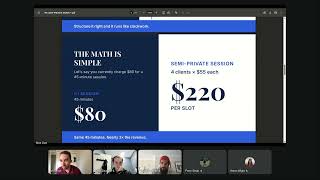
Matt Dart shows trainers how semi-private sessions with up to four clients can boost hourly revenue four-fold to $2,500-$5,000 weekly while working 8-10 hours. He walks through pricing ($55-$75 per person versus $80-$120 one-on-one), matching clients by goals, structuring 45-60 minute sessions, and handling logistics like equipment sharing and programming flexibility.
Chapters
and I'm going to share the screen. I finally found a PDF. So we're going to go through, um, the semi-private model. Um, just making sure you guys can see the screen. Someone give us a thumbs up. Yep, cool. So the semi-private model, just to be super clear, um, you guys don't have to run this model. I'm just giving you guys the options so you can pick what's going to be best for your business. I only started running a semi-private model about 3 years into being a PT, um, and when I opened my gym. Okay, so this is— I'll go through kind of at what stage you kind of want to start to think about this, but you can do this from the start as well. You don't have to wait until you're established to run a semi-private model. Um, so I'm going to go through how you can basically almost 4x how much you your hourly rates by doing semi-private rather than one-on-one. Okay, so title here is How to Break the Income Ceiling Without Burning Out and Help More People, um, at the same time. So the whole idea is making the same, or if not more money, um, with no extra workload. Okay, so this is for you if you're close to being fully booked with one-on-one clients, uh, or you want to grow your income with without any more hours on the gym floor. You feel like you've hit an income ceiling, or you just want to keep helping more people without burning out. So as a one-on-one coach, there's always a time where you are going to burn out eventually. It happens to everyone, me included. And there's always, there's always a ceiling. Like, for me, it was around 60 sessions a week. That was like the cap for me. Um, but I'm not saying you have to stop doing one-on-one sessions, but I'm just going to give you a way that will still allow you to help more people and make a very good income from it, and have you feeling like you're not having to work, you know, 40, 50, 60 hours in the gym to make a decent income. So let's go through what the problem is and what the actual results of this happening. So let me put the chat on the side here as well because I'm going to answer questions as we go along. And if you guys do have any questions along the way, just pop it in the chat because I can see it all the way through. Okay, so the current problem is when you're doing only one-on-one, every extra amount of income that you make requires more effort or more time required on your end. So as I said before, there is obviously a hard limit with how much you can actually do. With one-on-one sessions. So you can obviously only take on so many clients. If you're already at capacity, you can't take on more. You can obviously add online clients, but if you specifically want the face-to-face aspect, then maybe you don't like the online side of things. This would be a really good option for you. Um, so with the one-on-one stuff, the income is eventually stays flat, your energy gets drained, uh, and you can't take on new clients, and then growth feels a little bit, a little bit impossible or a little bit stagnant, should I say. So this is essentially how one-on-one works. I'm going to basically go through exactly what I did in the one-on-one versus the semi-private sessions to make it, um, a no-brainer for a lot of people to do semi-private instead of one-on-one. So obviously one-on-one sessions, there's one client per slot, so your income's obviously capped by hours. Semi-private, for me personally, how I ran it is I had up to 4 clients per slot. So basically, I'll go through the actual framework in a second, but, um, just so I can see everyone, basically what, what I did was I incentivized people to do semi-private rather than one-on-one. So they paid a smaller premium, or a smaller membership— sorry, not a small premium, a small membership— um, that my time per hour significantly increased. So the way that you structure the sessions is completely different to how you would do it if it's a one-on-one client. Okay, now it's very important to realize as well, not every client will be suited to one— sorry, not every client will be suited to semi-private training. So you've got to kind of pick and choose who you offer this to, um, because some people just won't like it, um, or some people just won't get the same results, um, with this option. Okay, so let's go through how the actual model works. So basically you've got, uh, you've got 4 or 5 things to, to explain here. So for me personally, it was a maximum of 4 people per session. Very important thing to note here as well, it's similar people in these semi-private sessions. You don't want to match up like a bodybuilder versus someone who's brand new to the gym that wants to— that's like, you know, 50 kilos overweight. You're going to be doing completely different types of sessions with those type of people. And you've got to remember as well, the semi-private session, most of the time— not all the time, but most of the time— they'll be doing similar things. So you want to match people like— you want to, you want to match weight loss clients with like a weight loss semi-private session. If you want to have people that are interested in building muscle or only focus on strengths, then get, you know, 2, 3, 4 people that are focused on um, getting stronger or building muscle. Um, now these were always 45-minute sessions. Uh, you can do hour sessions if you like, um, but the difference for me is I used to run 30-minute one-on-one sessions and the incentive was, okay, you're going to get more time with me if you're going to do the semi-private sessions. So the 45-minute sessions, if you do 45-minute sessions at the moment, you probably could stretch it to 60-minute sessions, to be honest. Up to you, personal preference. Um, but at a minimum, you will need to do 45-minute sessions if you've got up to 4 people each session. Now, how you still give people one-on-one attention is super important, but because you're not going to run this as like a group class, okay? So the difference is group classes, there's no support and accountability, it's just the training. Semi-private PT, you still need to give them the one-on-one support, the accountability, and some of the nutrition guidance as well. Now, how I used to run my semi-private sessions are every single person for the first 2 minutes, or for the first 5 minutes of the, of the session, I would spend about 2 minutes per person doing a quick check-in, going through their, like, asking questions on their nutrition and accountability in terms of, uh, you know, if they're still managing to go to the gym on their own, if that's what you want them to do. So it's a quick 2-minute check-in to make sure they're on track. And you just literally go one person to one person to one person to one person. While you guys are— while you guys are doing that, the other people are warming up on their own, okay? So they're not just sitting there doing nothing, they're warming up. And you're literally going over to people one at a time and just basically being like— and, and for me personally, I used to check everyone's weight as well. So everyone knew, would go to the scales one person at a time, I'd get their weight, I'd be like, cool, how How's your training going? How's your nutrition? Do you have any questions that we need to go through? Blah blah blah. And then once they're done, they'll go warm up, or they'll do some extra warm up. I'll go to the next person. And that usually took about 5 minutes, I guess. And then you've got about 40 minutes of actual training to get through. Keep in mind, the most important part about PT is not the actual training session with you. The most important part is what they do outside of the sessions. Okay, because you can run the best possible PT session once a week, but if they don't do anything outside of that session, it's not going to help them at all. Okay, so you got to understand that you don't have to fill this session with just training. You still need to give them the appropriate accountability support. If they're struggling with something, you need to make sure you, you, um, you help them solve that on the spot. Now, I'm not saying you need to do their whole check-in during the session. You can obviously do check-ins behind the scenes if you're running a hybrid model. And obviously nutrition as well. So if you're getting them to track everything through like Trainerize or EverFit or Kahuna, etc., you can obviously check that stuff later online. Um, but the whole point of this is you're still going to give them some one-on-one attention. So the client still gets a tailored program. The group dynamic adds energy, not chaos. So it's not meant to be overwhelming, it's meant to add more energy, and they're meant to help each other out as well. As in, like, I've run so many private sessions before where I'm, I'm kind of just holding back and making sure the technique is right. The other people are spotting, spotting the other person as an example, and then they just swap. So the rest period for people— this is how you make it still like a pretty intense session. So let's just say you're doing like a, um, dumbbell bench press for example, or dumbbell flies as an example. You'll have one person on the bench, the other person's spotting the other person to make sure they're doing okay, and you're still going to be there to check their technique But once that person's finished their 10 reps or whatever, then they'll just swap. So that other person just goes straight into it, and that other person is resting for that, you know, 30 seconds or 60 seconds. So that's how you kind of manage, um, manage people. You can— you don't have to get people to spot them. You can obviously just get them to do something else during that time. You can get them to walk around the gym to keep their heart rate up, as an example, uh, or you can get them to spot the other person. It's up to you. Um, now the benefit of this as well is you think about this as like community. Um, your retention is going to go through the roof because they're surrounded by people that are on similar, a similar journey to them. So if you think about it, especially like, you know, females for example, they love talking to other females. You probably don't want to pair them with someone that is a freaking huge like 6'6", 120 kilo person. I'm probably not going to talk that much to that person. But you know, if, if you've got a few people that are around, you know, 100 kilos for example, they all want to lose around 20 kilos, they're just going to freaking talk to each other the whole time. They'll, they'll have a laugh, they'll have some banter, and you know, guess what will happen? They'll probably organize times to train in the gym together as well. So then you don't have to do as much accountability. And then they're just never going to leave. Okay, so this, the semi-private model does build up more of a community-based feel. Okay, your retention is going to go up naturally. I'm going to check the chat as well. Yeah, very spot on. Now the other key thing here is you run these semi-private sessions at peak times because you've got to remember as well, if you're going to discount the— not so much discount, but if you're going to offer a lower price point, and if you only have one person in that session, you're actually going backwards in your hourly rate. So the key here is to put it in peak time so you can have 2, 3, 4 people pretty much always coming to these sessions. So the way I used to do it, I used to do 3 mornings and 3 evenings, same days every single week. So I used to do Monday, Wednesday, Friday, 7 AM in the morning. So 7 AM Monday, Wednesday, Wednesday, Friday, and then 6 PM Monday, Wednesday, Friday. So someone's doing 3 sessions a week, they've got the morning or the evening to choose from, and they're the times. Um, now if you've already got, uh, an established client base, choose the times that you've got the most clients. If you're finding you get most of your clients in the afternoons or evenings, maybe have— you could have one in the morning, of course, but maybe have a 5 PM and a 6 PM as an example. And then what's going to happen to your one-on-one times is your price is going to go through the roof for one-on-one, which encourages people to do the semi-private instead. Because a lot of people don't need— they might need some one-on-one initially, um, but majority of the time you can, you can do the same stuff in a small group of people. So this is what essentially could look like for you. I'm not saying this is exactly how you should do it, this is just what I did. Um, we're gonna have a little bit of time today to go through what this looks like for your individual business as well. So as an example, if you're doing one-on-one sessions, let's just say you charge $80 for a 45-minute session as an example. Uh, what you could do is offer semi-private for $55 or $60, um, per person. So per 45-minute slot, instead of making $80, you're making $220 for the exact same time. Okay, so this is, this is perfect if you guys want to spend less time in the gym and make either the same amount. So let's say, let's say for example you got maybe 20, 30 clients, you could condense some of those people into semi-private and go down to maybe 12 one-on-one sessions and have like maybe 7 or 8 people, uh, semi-private, and you'd work less hours and make pretty much the same amount of money. Now I'm not saying only charge $55 a week. You still want to add on your hybrid aspect to it, meaning you charge $55 for the session, but you might add on maybe $10 or $20 a week for the hybrid aspect. So one semi-private session, or one semi-private membership includes your nutrition, your online coaching, and programming, might be $75 a week. Okay, 2 sessions would be $55 times 2, which is $110 plus $20, so $130 a week for 2 semi-private sessions and the online coaching aspect. Okay, so then theoretically what you— again, this is all hypothetical, we'd have to work this out for your individual business. But hypothetically, if you did, uh, like at our peak we were doing, um, 6 AM, 7 AM Monday, Wednesday, Friday, and 6 PM and 7 PM Monday, Wednesday, Friday for semi-private. So the good thing about that is you know exactly when you're training people So it's like you get, you get like a set schedule. It's not like one-on-one clients where they sometimes move their sessions around, as an example. And if you've got clients that do have to change their times every week, semi-private is not for them, because semi-private is a set time. You cannot change it. Okay, is this making sense so far? Just quickly checking in. We're about 15 minutes in. Just, um, in the chat because I can't see everyone. Right now. Just let us know if that's making sense. Yeah, cool, cool, cool. All right, let's, uh, keep moving on. So this is like the, the bigger opportunity at play here. Let's say you had, um, 6, 6 slots, and this is all just hypothetical at the moment. Like, we'll have some time in a second to kind kind of brainstorm this out. Uh, if you had 6 slots at 4 clients each slot, at, at a bare minimum of 55, but realistically that should actually be like 75. So let me just redo the maths here. Uh, so let's go 75. So this is crazy, right? So for the people that want to make like $100K a year— actually, let's work this out. Let me reverse, reverse engineer it. So let's say you want to make $2,500 per week, and let's say you want to just work 10 hours a week. Let's— this is crazy. Let me, let me work this out. So $2,500 at 10 hours a week. Let's just say they're all semi-private just for this, this just for this example. If you say you want to do— let's just say you're going to do 8 slots, 8 slots of semi-private. So it's basically 8 hours a week. This is, this is taken into account you're doing hour sessions. Just hear me out here for a second. So 8, 8 slots of 4 people each, which is 32 people. 32 times $75 is $2,400. $2,400 a week for working 8 hours a week on the gym floor. That's the opportunity. That's the, that's the big opportunity at play here. So I'm not saying you have to do this exact model, and I'm not saying you're always going to have 4 people every single time doing those semi-private slots. What I'm saying is the— probably the optimal thing to do here is have some semi-private slots and also have some one-on-one clients at that higher price point. So for example, if let's just say it's $75 for one session a week plus, um, one semi-private session a week plus the online coaching, maybe you're going to offer one-on-one sessions for $110 a week as an example for one session and online coaching to incentivize more people to do semi-private sessions. And just in this example here, if you just, um, added 6 slots and got 4 clients in each of those, even if they only pay $55, that's an extra $5K a month just on that. So you're basically making $200 to $300 an hour instead of most people that make, you know, $80 to $100. So just checking in so far, based on what I've gone through so far, who would actually want to, uh, either use some existing clients to have a semi-private option or add a semi-private option, uh, moving forward to their business? Just, just want to check in. It might not be the right time for you, and if you're not sure, we could probably have a conversation. Individually if it's going to be the right fit for you. But I just want to see where people are at. Do you feel like this would be a good option for you right now? Aaron, absolutely, I completely agree. People tend to work harder when they're working— people tend to work harder when others are working out with them. Yep, 100%. Yes. Absolutely. It's why group fitness is so popular, because everyone's like so competitive. They want to, you know, they don't want to stop in group classes, right? So it's the same thing with semi-private, except they still get the one-on-one attention as well. Just a lot of the training aspect of it is in small groups on similar type of people. Okay, keeping their similar types of people in the semi-private sessions. Now to answer a few questions that would have come up in your mind already. What happens if someone needs to change out of their semi-private session? They can only pick the semi-private times. So if you guys are going to run semi-private sessions, you need to have a couple of options. Now I'm not saying do like 10 semi-private slots straight off the bat. I'm, I'm probably saying do Um, if you've got some clients that are interested, and I'll go through how to actually do this in a second, if you've got some clients that want to try it out, I would do 2 mornings and 2 evenings. Or if you can, if you can fit people in a specific time slot, just choose 2 time slots to start with and see if you like training, training people in like a small, small environment and see if they like it as well. And then you can open it up to new people coming through. So if people do want to— if they can't make it, for example, um, then they don't get a one-on-one session, okay? They just, they go on to another semi-private time, okay? So it runs the same as— it runs the same as the, like, the makeup session policy where they need to make up the session within 2 weeks. But the difference being semi-private, they can only go into semi-private. So sessions. They can't do one-on-one unless they want to pay for the one-on-one session. So I've kind of covered this already, but you obviously only want to do this during peak times, um, because you want to optimize how much you can make during those peak times. Okay, the also good thing for this is, of course, you get the same shifts every week. Clients know exactly when they're coming in. You don't have to change sessions every week for some one-on-one clients. Um, you can obviously plan stuff around your personal stuff and you get more predictability both on when you're actually doing stuff on the gym floor and obviously the income as well. So they're still going to be on direct debit as well, that still keeps happening exactly the same. You're just making way more for the time that is required. So you're no longer really trading time from— you still technically are trading time for money, but you're at a much, much higher rate. That probably feels a bit more worth your time rather than, you know, $80 to $100 an hour. Okay, let's keep moving on. Now, just, just before we got on to, to this stuff, one thing that I used to do as well to make it a bit of a no-brainer for people to do semi-private rather than one-on-one is every single month, uh, so you know how we generally do like a goal setting and reassessment session for for one-on-one clients. I would do that for— I would still do that for semi-private clients. So the reason why you want to do that is people need to still understand where they're at with their goals. So like body scans, measurements, fitness testing, that realistically still needs to be like one-on-one. Okay, so basically every month, um, they're gonna get a 30-minute So key thing there is just a 30-minute session, um, to go over measurements, body scan, exactly what's happening, um, maybe updates to their program if you need to do that, uh, just to basically make sure they understand where they're at with their goals and what they need to do to, to keep improving. You know, that discussion might end up being, hey, I need to do more semi-private sessions, or hey, I want to add in a one-on-one session as well as one semi-private session. So we've done it in the past where they can do semi-private, but then they still want that one-on-one support as well. So maybe for the people that are doing one, one-on-one session, maybe you can float the idea, hey, why don't we add a semi-private session as well, just to increase the amount of, um, your energy expenditure that you're doing, um, throughout the week. You can also get a chance to meet some other people on a similar journey to you as well. And it's only going to be an extra blah blah blah. There's so many things you can do here, which we're going to have some time in a second to dive, dive into that. Okay, so it's a win-win for everyone. So the client still wins, maybe even more so than before. So they're still going to get their fully tailored program designed for their goals. The group energy pushes them harder safely, so you can obviously push them harder, but other people are going to push them harder as well. They build accountability with like-minded people, and more than likely— not all the time, but a lot of the time— they'll see other people in the gym, and they might end up training together in the gym on their own as well. They spot each other, and they stay consistent longer. And more importantly, it builds a community which helps your retention long term. With more and more people working from home, more and more people using AI People just want to talk to humans, okay? So clients who train together stay together. It's why group fitness is such a freaking huge business model, is because, like, even the crazy thing is most group fitness gyms don't do anything with nutrition. They only do training. People don't necessarily get the best results with group fitness, but they stay there because they like training with other people. Okay, so going back to what I was saying earlier, it's not going to be for everyone, but a lot of people will benefit from this stuff. Okay, let's keep moving on. Okay, so how are you going to get this off the ground? Now, this is, uh, it's, it's much better if you've already got established clients that you can test this out with. So if you've got 2, 3, or even 5 people that are similar that you could, uh, test this out with, um, then that's going to be your best option to start with, um, just to one, see if they like it, but also to see if you like it. Because, you know, you might not like doing semi-private because it is running a different type of training. Like, one-on-one coaching is super easy. It's obviously all individualized, all tailored. You already know what you're going to do. Semi-private, people might have some niggling injuries— yeah, can't speak— injuries that you might need to tailor the session at different parts. So for example, um, let me give you some examples of what I did when I was doing semi-private. So I had some semi-private sessions where it was people just wanted to lose weight, so I could quite easily just run like a HIIT session, add some strength stuff into that HIIT session as well, and they'd be stoked. They'll be absolutely exhausted at the end of the session. They'll get some strength training in there as well, but it's obviously a high heart rate training, which is what, what they like and, um, more than likely what they, what they need as well. So that one, you can pretty much run the same session for everyone, and it's kind of like a group class, but you're, uh, helping them out a little bit more. Obviously they get way more attention with only 4 people compared to like 50 people in a group class. Um, now the thing that you might need to change, for example, is maybe one of the exercises that you wanted to do, one person can't do them. So you might need to change that exercise just for that person, and everyone else does the normal stuff. So in terms of the planning of the session, it is a little bit more involved, and you have to probably adapt a bit more on the spot. For example, let's say you're teaching someone, you're doing like an incline push-up, for example, and their wrist starts to really hurt. Never happened before. That's okay, no worries. Everyone else keep doing that exercise. For this exercise, I'm going to get you on your back. You can do something else. Okay, so you've got to think on the spot a little bit more. So if you're, um, maybe if you're a brand new PT, it's probably not the best way to dive into it. You probably want to do a bit more one-on-one stuff first. Um, but you know, if you get a bit of experience and you've obviously done a fair few sessions before, then this could be a really good way to increase your hourly rate. Um, so as I was saying, 2 to 3 people that you want to ideally try this out with. Um, similar people, obviously weight loss and weight loss, muscle gain with muscle gain, so the energy and the programming align. I, I have done it before where I've had kind of 2 different types of people. It still works. But you're essentially running two sessions at the same time. So it's a little bit more challenging. Um, prime example is I would have someone that is, you know, on the— on the doing barbell bench press as an example, smashing out some reps, and I'm spotting them. I'm getting someone else to just do like, like goblet squats as an example to the side. So you— it requires a lot more focus from you as the PT So it's a little bit more challenging if you don't have people on a similar, similar goal, I suppose. Run the first semi-private slot as your busiest peak time, prove the model works, and then expand from there. So you start off small and obviously expand as you're happy with the model. So, um, in the chat— yeah, 100%, Perry. Um, in the chat, who If you guys think about your clients right now, do you think you have, um, even like 2 or 3 people that you could try out some semi-private sessions with to see if they like it and to see if you like it? Just in the chat, if you've got a couple of people that in mind that you think, um, would benefit from this, or that you think they would, um, they'd be open to try it. Could I tell? I started just a few people to test it out. Been transitioning some group sessions. Yeah, so Brock, just so I understand, so you're obviously, you're already running some group stuff. But you're not kind of running, you're not running it as like a semi-private model. It's just like, just like a group. Is that what you mean?
Correct.
Yeah.
It's just like a group session. So I do have a little bit of semi-private time where I go over them and give them little forms on their tip forms, form tips. Yeah. Very tip-focused there today, Brock. And then it's more, I guess, um, they're more autonomous. They'd go through their drills and it's more kickboxing based. Um, so I'm feeling that some of my one-on-one clients could benefit to having like training with other people that are similar to them. And then also some of these group session clients can get more one-on-one attention in this model.
Yeah, 100%. I think, yeah, you'll probably find people probably get better results, um, as well. So yeah, it's definitely worth testing out for a few people. Um, and even like, you know, for example, Aaron, you've got clients that have been with you for a long time as well. Might be something to test with a few of those people that might not necessarily need the one-on-one attention. But, um, and also you've got a good community of trained, um, community of clients that might want to train together as well. Um, so yeah, all I'm saying is test it out to see if you like it, see if they like it, um, and then Essentially, and I'll go through the actual offer now. Let me just get the screen back up. I'm literally going to show you what my offer was for when I had my gym, um, for semi-private, so you guys get some— get a bit of an idea. Um, so it is All right, you guys should be able to see my offer doc for the gym. Okay, so, so similar to how we always do it, your own results, then some client results, uh, and then this is what I used to offer Yeah, so how I used to do it was I offered— we call them super sessions so it sounds better instead of semi-private. So super sessions, uh, or they can do one-on-one. So this is essentially how, how you could do it. So this is as an example of some things that you won't be able to do because obviously this is my gym. So this is 3 PT sessions a week. I a 60-minute one-on-one setup session, a 30-minute goal setting and reassessment session every 4 to 6 weeks, body scan every 4 to 6 weeks, 24/7 access to the gym. We did group fitness classes as well, which not many people did, to be honest, so you can pretty much eliminate that. Nutrition guidance, monthly training program that's personalized, uh, free session for up to 5 friends, access to the groups, and then 24/7 access. Um, we used to charge $199 a week for 3 sessions, or 3 sessions as well as hybrid, um, or one-on-one for 30-minute sessions was $219 or $220. Essentially, this is what I used to charge. So most people, as you know, they usually go for the cheaper option of the two. So that's kind of our first option. And then Gold was exactly the same thing except 2 sessions, and you can attend only up to 3 classes a week. So $140 a week for 2 sessions, um, or if they want one-on-one, it's $170. So I'll go back to here. That's essentially what I used to do in terms of running semi-private sessions. And as I said, we used to call them super sessions. So what I want you guys to do now, I just want you to have a very quick brainstorm, uh, or like a little bit of a brain dump, just yourselves. I'm just going to give you guys about 90 seconds. Um, I want you guys to work out if you were to run a semi-private offer, what would your pricing be and what would your one-on-one pricing turn into? So you can still keep your one-on-one pricing the same if you like, but then your semi-private would be a little bit, a little bit cheaper. So, so the reason how I made it a bit of a no-brainer is they would get And it basically an extra 30 minutes with me a week because they were doing 45-minute sessions instead of 30, uh, and it also saved them $30 a week. So it was— that's how I made it like a no-brainer for them to do super sessions instead of one-on-one. Of course, you're always going to have people that just want the one-on-one. That's completely fine. So you still want to offer that, but you obviously want to make it a bit of a no-brainer for people to do semi-private. So I just want to give you guys about 90 seconds now just to brainstorm, um, what your offer would look like if you were to do semi-private. And I'm not saying you have to do this right now, but it's also good to know that when the time is right for you, that you've got a bit of a, bit of an idea of what it would look like. So 90 seconds on the clock. I want you to brainstorm what your semi-private sessions would look like and then what your one-on-one would be. So Paris thinking 40 semi-private, 100 for one-on-one. Awesome. So what I would do as well, um, just make sure you're also including the hybrid aspect. So don't— remember, you don't want to charge that per session because if you don't do the session, people feel like they're not getting the value. It's just a weekly subscription for the session, the programming, nutrition, etc. So For example, for you, Perry, I'd probably add like $20 a week on for that one, to say, so $60 a week for semi-private, and then like, for example, $120 a week for one-on-one. And same with you, Aaron, if you're charging $70 an hour for the session, um, you still want to obviously charge for that hybrid aspect, which depending on, on you, you might charge an extra $10, maybe $20 a week. Just so you still get paid for that, you know, that programming, uh, and those check-ins that you're doing with them outside of the actual session itself. Good stuff, Perry. I'm going to give you guys like another 15 seconds. Aaron, personally, I do, um, but of course you can negotiate and take that off and obviously just not include it. Uh, at the end of the day, you got to— you just want to give them exactly what they need to get the results. Um, and you know, most people need to have that, um, you know, that nutrition and, um, programming to be able to get the results. More importantly, the accountability behind the scenes, because as we all know, the training is just one aspect. Of getting them the results. So I would always include it in here in your offer, offer presentation. It's all included with the hybrid. So like, obviously, as you can see, my, my offer, my value stack is pretty big, so it's full of value. Um, so like, if someone's like, oh, I can only afford $120 a week, I'm like, okay, cool, well, you just can't come to any group classes. For example. And if they're sweet with that, then sweet, no problems. Brusko, 1-on-1 for $135. Love it. Yeah, love it. So that's a no-brainer for like semi-private, right? You can either pay $70 a week or $135 a week. I certainly would go for semi-private if those were the two options. If anything, Brock, I'd actually probably try and make it, um, a little bit— like, as you can see in mine, mine's only $30 a week difference between semi or super sessions and one-on-one. So you obviously want to make it a little bit of a difference, but if your difference is— what's that, it's like $65 difference? I'm not, I'm not against it, I'm just saying you could probably charge $80 a week for semi-private. To be honest. If you're one-on-one, I think you're going higher.
I just, uh, would wonder how you would, um, incentivize that.
Yeah, because like, if people, if people see that big of a difference, they're probably more questioning like, oh, why is that so, why is it so much cheaper if there's too much of a difference? So like, that, that difference, even if it was $80 per week compared to $135, that's still like, that's still a no-brainer for me to do semi-private. To be honest, because then 2 sessions would be like— what's the split of that in terms of how much would— is the actual session? Is that like based on 50 a session plus the 20 a week for hybrid?
So I'm not sure what you mean.
So like when you say the semi-private is 70 per week inclusive of a hybrid, how much, how much are you charging for the hybrid part of it?
Um, so that would be the, uh, semi-private. Obviously this is not something that I've integrated yet, but there'd be like the semi-private hybrid option because I've got, um, just online and hybrid models. So all my in-person stuff is hybrid anyway. Um, okay, that— yeah, that would include the hybrid stuff like the nutritional tracking and their program and stuff on there.
Okay, yeah, all I was, um, all I was asking is like, for example, Aaron was saying his session would be $70 per hour, but that doesn't include like the hybrid aspect. So usually we suggest adding like $10 to $20 a week for that hybrid component. Okay, so I was just saying like, if you're, if you're setting up a session itself would be like $60 and you're just adding $10 a week for the hybrid component maybe you should add 20 a week is all I'm saying, which would put her up to 80 a week overall. Yeah, I'm with you. Yeah, um, cool.
Account for that.
Yeah, yeah. Uh, Liam, semi-private 65, awesome. One-on-ones 100, beautiful. Love your work. And then the only other thing you've got to consider as well is, are you going to have extra time for semi-private or are you going to keep it the same as one-on-one? That's something that will be different for each person. For me, my one-on-one sessions were 30 minutes, uh, and my semi-privates were 45s. It's completely up to you, um, how you want to do it there. But again, you could obviously just— you can try both to see what you— see what you like better. Um, okay, let's go back to my presentation. Um, okay, I've kind of already gone through this. Obviously, your old offer is the one-on-one sessions. A new offer is semi-private, and then obviously one-on-one as your premium add-on, because people still want to do one-on-one, but most people just want the cheapest option to work with you. That's more, more worth your while doing semi-private rather than one-on-one. Um, long-term vision, of course, Um, so what happens right now if you're just doing one-on-one is you'll have a lot of scattered sessions. Um, you might have a different schedule every single week, which means if you're planning other stuff with family, friends, you want to be a bit more social, then it's a bit difficult to plan. Uh, and the biggest thing is your, your income is capped by how many hours you can work. Whereas if you're doing semi-private, or you add semi-private to an option with you, you obviously got your fixed Slots, you've got obviously the predictability in terms of your income because they're all on direct debit as well. But your hourly rate for these ones are actually $200 to $300 an hour. So you basically 3 or 4x what your hourly rate is. Just a side note, I've got— does everyone know Jason? Jason does some admin stuff for us. He helps out on some of the coaching calls as well. But he, um, his model is similar to semi-private except the way that he does it is he doesn't really do any one-on-one at all. It's all semi-private based, but he's just like, it's just on-floor hours. So he basically just does 2 hours in the morning and 2 hours in the afternoon, and that's it. People can show up if they want, and he basically runs them through their program for them during those times. And if they don't show up in those times, then it's all good. They still get the online aspect. Um, but basically he just charges like a weekly membership for access to him. So if they come in, like for example, between, I don't know, 7 and 9 AM, they can get him to run, run him through the, the program or spot, spot him, for example, or ask questions. But if they don't come in during that time, then they just train whenever they want and they do the online aspect, but they still pay for the access. Uh, good question, Brock. I don't think he has a cap, um, but I think it's priced in a way that allocates for that. Um, so it's, it's a little bit cheaper in price because he could obviously, you know, he could sell 100 people in there and it wouldn't matter because you're just like, okay, cool, I'm here, I'll, I'll spend a couple of minutes with you, I'll spend a few minutes with But these guys, he'll just kind of bounce around to people. So, um, his is full of leverage. He does the same times every single week, and he just— he does obviously most of the stuff in the online capacity. But if they want the face-to-face support, you know, they might pay $50 a week to have access during those times. And they— if they come in, sweet. If they don't come in, then also sweet. I haven't fully run that model, so that's why I'm not fully teaching it. Um, but there's a few— obviously there's a few different ways that you can do this to have more leverage. Um, okay, next steps for you guys is to identify 2 or 3 clients who have similar goals who could trial a semi-private session together. Um, pick the first time slot either in the morning or the evening or the most popular time for you. Um, this is how you have the conversation. Um, and similar to like the session upgrade in terms of, hey, we're looking to do a bit of, bit of market research, or hey, I'm looking to try something, um, and I wanted to kind of explore it with you, um, would you be open to trying it out at a lower rate? So I would still do their one-on-one sessions as per normal and do the semi-private as an additional if you can. If you can't fit them in, then you're just gonna have to do it as a bit of a, uh, do a few weeks at a reduced rate to see if they like it for, for like a thank you of them doing it for you. Um, get the feedback, refine the structure. Once it's working, uh, offer the reduced rate ongoing for them to stay on the semi-private model. Okay, so if they're paying $100 a week right now, perhaps as a 2-week trial, you give it to them for $70 a week and then say, hey, I'm really enjoying it, I think you guys are really doing really, really well, uh, why don't we just stay on this moving forward? I'll keep your pricing at $70 a week. Okay, so you get 2 people on that. So instead of you making, um, so you'll make slightly less money overall right that second, but for those 2 people, you'll make $140 for that hour or $140 for that 45 minutes. That's an example. But obviously as you get, you know, as you fill up that time slot to get to 4 people, that will turn into, you know, $280 for the 45 minutes. Okay, so effectively your hourly rate would be over $300 or probably $350 for that hour of your time. Okay, and then what, once that's kind of up and running, essentially you just add more semi-private sessions as they, as they fill up. Um, and that's all you got to do. So that's the semi-private model. Um, as I said at the start, it's, it's not always the, the best time for you to run this type of strategy, but it's, it's there to give you guys the option. If you've got a— if you've got existing clients, and this is a really good strategy to do if you've got existing clients And a really good strategy if you want to hit, you know, $2,000, $3,000, $4,000, $5,000 a week and still only need to really be working, you know, 20 hours on the gym floor at maximum. So if you don't really want to hire trainers or anything like that, or if you don't really vibe the online side of things, this is a really good way for face-to-face trainers to still get to that, you know, that $5,000 a week. Without having the extra headaches of, um, online or the headaches of hiring trainers to work for you. So I'm gonna stop sharing for a second so I can see everyone. Um, but yeah, that's it, team. Um, I'll, uh, I'll stay for a little bit longer in terms of questions. Did anyone have any other questions that they want to go through or specific questions for their individual situation to see if it's going to be worth their while through this model?
Yeah, I was thinking, well, my concerns are that it might be a bit of a programming nightmare. My other one was, sorry if there's a lot of music in the background too, just at the gym. The doing it at the peak times as well, I think, um, might be a struggle just given that there's— you might have 4 people and, you know, equipment availability, dumbbell availability, or just like pissing off the members because you, you've taken all the dumbbells and all the racks and stuff like that. Um, that'd be cool to like brainstorm strategies around that. And the— yeah, and how you'd like structure the program, would you just kind of give it like a 3-day-a-week thing or something like that for everyone to just follow?
Yeah, very, very, very good questions. So, um, I'll tackle them one at a time. So in terms of space in the gym, um, this is why I cap it at 4, 4 people, um, because like realistically, like you're at Anytime Fitness, right? So it's like It's not like it's a tiny gym. Um, like if you take— and this is also the reason why you have people at similar, uh, similar body shapes type of thing. Like, you know, you don't want to have people having like 20 kilo weights and then someone else taking 10s and someone else taking 15s and someone else taking 50s. You want to ideally like share the weights between the people.
So maybe just give them a big rep range and the same weight. So like like, you know, the, the kind of the weaker people, they might do 10 reps, but someone stronger uses the same weight, they might get 15, 20 or something.
Yeah, 100%. That could definitely work for sure. Um, or you can literally pair them up and say, hey, look, you're going to do 15s, you're going to do 15 reps, and then Brock, when you do it, you're going to do 10 reps. And you're going to kind of supervise to be like, okay, cool, next time you're doing 15. And then, you know, Liam, you're doing 20 because you can push a bit harder. So you're still kind of managing their effort, um, but you're kind of— you're not kind of using all the pieces of equipment. So, um, yeah, it's— as I said, it is more challenging. And in terms of the question around programming as well, Um, sometimes you're just not going to be able to follow the program, and that's why, that's why I said you got to be like adaptable on the spot, um, which is why when I do programming, if someone was doing like 2 semi-private sessions a week, I would kind of leave them to whatever I want to do depending on who's booked in, and then you'd have their set program for when they're training on their own. Does that make sense? Yeah, yeah. So that way you're not like fully committed to doing a specific exercise with different people, and everyone's got their own exercise that they've got to do, and it's just way too confusing. Um, so like, if you guys want to test this out, maybe test it out with a few people that are on similar weights, um, to see if you can kind of manage it. And maybe cap it at 2 people, for example, to start with. To make sure it's obviously, um, a good fit for you and for them. But the only way you're going to get better at it is if you test it out, because I was really bad at it to start with as well. Um, you know, you might get a little bit flustered if someone wants to do certain things, or they're just kind of sitting there doing nothing while you're explaining the tech to someone that might not get it yet. So you've got to be like, you've always got to give people something to do while you're doing something else, if that makes sense. So if you're showing someone how to do a certain exercise, maybe, I don't know, you can even just be like, hey, smash out some push-ups for me. I don't know, something like that. Or go walk around the gym twice so you still get steps in to keep your heart rate up while you're on a rest. Cool. I'm just going to show Darren how to, how to perform better for his bench press. I want you to just walk around the gym once and then we'll get back into your set. Does that make sense? Yep. Yeah, um, I think, I think for you, you probably want to test it out with a few like long-term clients first, um, because I was thinking feedback.
I was thinking just like kind of my long-term clients are just kind of just too used to like, you know, having that one-on-one attention and kind of the rapport I've built. Um, so I reckon, I reckon what would work best for me is kind of new people. Um, but I was thinking of maybe a good way to group it would just be like making one of them like, like a glute or like booty sessions, and then maybe do another one that's like a fat loss one. And that way the people that join are kind of got the same goals anyway because they're joining because they want fat loss, so they're joining because they want to do a glute session. Yeah, something like that, and just like focus it around that.
You could definitely have like themed, themed, um, sessions for sure. Yeah, you can even do one on powerlifting. I know you've got a few clients to do powerlifting as well.
Yeah, that'd be another good idea.
Um, so yeah, you could definitely do that. The only problem with doing it with just new people is, um, you're only going to be more profitable if there's more than one person because you're offering you're offering it at a reduced rate to your one-on-one stuff. So it's only really going to work in your favor if there's 2 or more people in there. So you just have to make sure you've got your pipeline filled of new people coming through. So when they do start with you, you're like, cool, no worries, we'll get you in the semi-private session. We've got the glute sessions, we got the fat loss sessions, which one do you want to go to? And you can book them in for that.
Yeah, I'm thinking if you, um, if you do it with kind of the the new signups, but also just advertise it around the gym. And that way, like, that way you might have to just do it with one person for a bit, but you kind of just, because you're doing it at peak time, someone will see, they'll see the advertisements and stuff like that and start to show up.
Also perfect for generating referrals as well. Yeah. I know you're loving the sessions. How about you bring your partner next time? Do the first session for free. You know, bring your housemate or your roommate. Really good way to get people to introduce themselves is, hey, look, hey, I'm going to be there. Why don't you come down and do a session with my trainer? Uh, you know, we're doing a booty workout. So really good way to generate referrals as well because you're, you're already doing that session, right? There's no extra time required on your end. They can just come along and experience it. And then, you know, if they like it, they book in for your consult and they sign up. Yeah. So, um, yeah, for your case, you could obviously just do it for new people for sure. Um, but it's just for everyone, you just gotta test it out to see if you like it. So whether you test it out with existing people, up to you guys, or if you can test it out with new people, just, just know that Um, you obviously got— you're going to make less money, of course, in full-time. That's okay. Any other questions, team?
Um, my brain was just going, uh, because I really like this idea, um, and my brain was just going, listening to Aaron and some of the objections he had to it. Um, if you guys are open, I'd like to share, I reckon, how I would approach it.
And if you get anything out of it, be awesome.
Um, so presuming that the people that you're going to get in these 4 slots are going to have similar goals, um, what I'd do is make everyone do the same warm-up and then program everyone basically the same, because everyone kind of needs the same things, the same accessories. So then you just have like— you put them in pairs like you said. Yeah, so one's doing bench press, one's doing squat, and you can go back and forth and give them that one-on-one attention if one's working out. They're doing their weight, the other one's spotting them and helping them load plates, so there's no dead time. Um, and then at the end you just do like a, a high-intensity, high-intensity interval thing so they get some cardio, and bang, that's like the 45 minutes done.
Exactly how I would run it. Yeah, yep. So pair them up. Hey, you're doing this way, you're doing this way, and swap over in between. Um, and then yeah, we'll move on to the next exercise. Um, I used to always do a lot of supersets as well. So, um, yeah, it's— they'll still get, you know, they'll still get that cardio aspect with supersets as well. Um, so yeah, I think spot on, run it exactly how you just said. Um, and of course get feedback, um, see how you can improve. Um, but I think it's a really good option for you.
I like it.
Awesome. Um, all right, team, I will, uh, I'll leave it there. I'll upload the recording, of course, if you want to rewatch it. Um, and I'll see you guys, um, on Monday. Enjoy the weekend.
Thanks for your time, Matt Dart.
Bye-bye.
More from Matt




Your staff aren’t lazy. Your systems, standards and leadership might be. Check out Episode 138!





Your team can’t take ownership of work you refuse to hand over. Stop being the bottleneck! #shorts


Slow lead replies cost you sales. The fastest business usually wins. Full episode in my channel!