
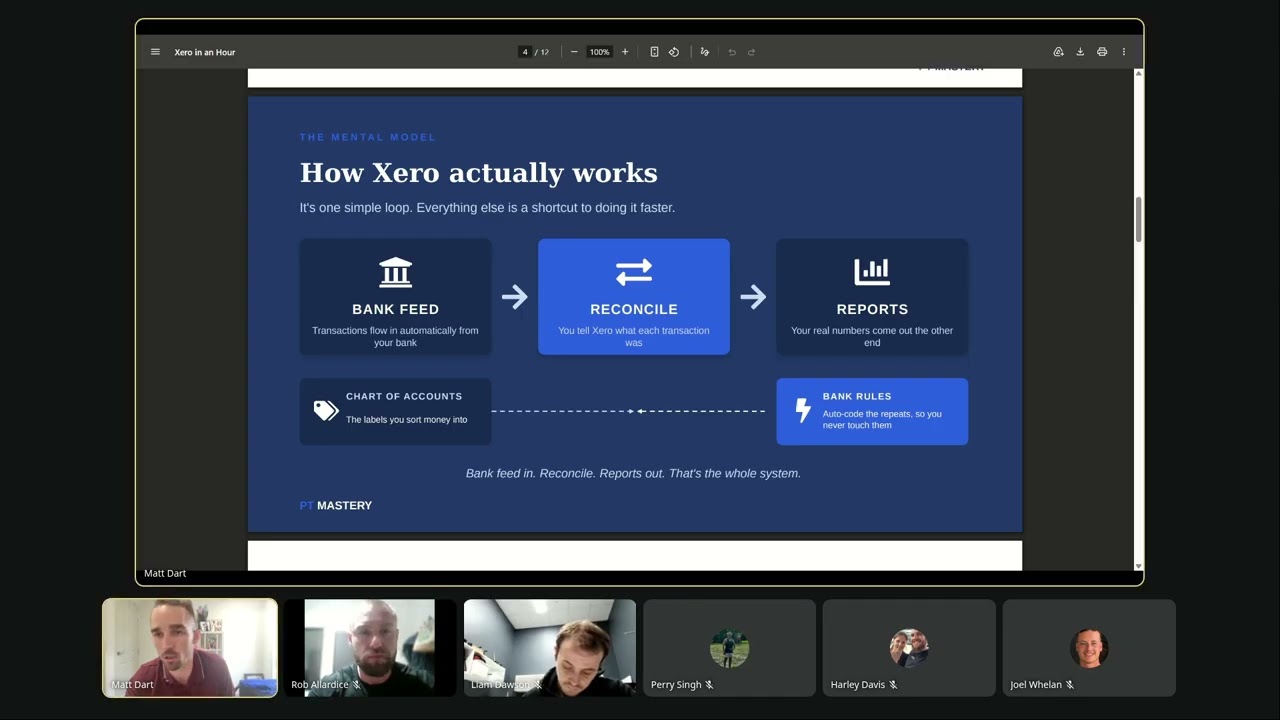
In this live, hour‑long tutorial, Matt Dart walks a small group of entrepreneurs through the essential functions of Xero bookkeeping software. He begins with a high‑level overview of why bookkeeping matters, then demonstrates how to set up a Xero organisation: connecting bank feeds, configuring the chart of accounts, and entering business details (ABN, GST registration). The core of the session focuses on the reconciliation workflow – how to match bank transactions to categories, the weekly habit of reconciling, and using Xero’s AI suggestions. Matt explains how to automate recurring entries with bank rules and shows how Stripe payouts can be reconciled and fees separated. He reviews the main financial reports (Profit & Loss, Balance Sheet, GST/BAS) and explains how proper categorisation affects tax deductions. Throughout, he stresses the role of an accountant, how to grant them access, and how accountants use Xero data to optimise tax. The latter part of the session is a Q&A where participants troubleshoot missing bank‑feed details, discuss GST claim eligibility, and explore personal salary versus business profit strategies, including recommended tax‑withholding percentages (20‑30%). Matt also shares practical tips on avoiding over‑categorisation, maintaining a regular reconciliation cadence, and using third‑party tools to automate tax withholding.
Chapters
Awesome.
All right, team, we're going to go through Xero today. So the title is called Xero in an Hour. So I'm going to do my best to go from teach you guys from beginner to somewhat know what you're doing with bookkeeping. So, um, morning, Harley, as well. So basically how I'm going to do this today, I'm going to try and get through all the theory in about 30 minutes So I'm going to tell you pretty much what you can do with Xero, and then I'm going to go into my Xero, and I will literally show you how you can reconcile transactions. I should have a fair few stuff in there. And just so you know as well, Rob, the overall numbers, it'll— and it's probably not going to give you the right answer here, but it's it's not always going to balance. It's not always going to be like zero balanced. And this is why you guys also need an accountant, because they're able to read this stuff way better than you guys can. Yeah, it's not going to help the OCD, but you know, you can outsource this to an accountant. So the only part that I do now in Xero is reconcile the transactions. I don't even look at the overall numbers. The accountant does the rest, and he just tells me how much I need to pay, and I just trust that he's got my best interest. Okay, so drop us a 1 in the chat if you're ready to rock and roll. Um, and just so I know as well, so give us a 1 if you're ready, and give us a, a yes if you have used Xero before, and a no if you have not. Pretty sure the last time I did this, pretty much everyone said they had not used it. Cool. Yeah, so by the way, team, there's other softwares that you can use. You don't have to use Xero, it's just the one that I've always used. So if you want to use a different one, then go for gold. But it's all about— this is a bookkeeping software So it's going to tell you like profit and loss, so you actually know how much you should be paying for like tax and that type of stuff. Okay, let's get into it. So why is this important? So you know your actual numbers, so tax time stops being a scramble, so you actually know how much you should be paying for tax, um, you make better decisions, and it's only going to ideally take you 15 minutes a week if that, not not a big lump, uh, lump of time. So quick little story before we go too much further. So what— oh, my first kind of ever mentor for PT never taught me this stuff, so this is why I'm teaching it to you guys. And when I finally got an accountant, uh, I had never once done bookkeeping, and the accountant basically laughed at me and said, what do you mean you haven't done bookkeeping in 3 years? And I was like, oh, Well, no one told me that you need to do bookkeeping. So hopefully I'm going to save you guys some embarrassment with your accountant and you guys can do some bookkeeping in preparation for when you need an accountant. So for, um, so basically what I had to do, I actually had to literally go through like 2,000 transactions and try and reconcile the account for the accountant. So hopefully you guys don't have my same issue. Um, but, uh, yeah, let's get, let's get into it. So what we're going to cover today, so it's 4 main things. I'm going to go through the setup, then how to reconcile, which is probably the biggest part that you need to know. Um, bank rules, um, which is how you can kind of automate some things here, and then also the type of reports you can generate through here. So something, something to consider is you can, uh, you can get like a service if you guys want where it's completely done for you, where you have a bookkeeper does do it, doing the reconciliation for you as well. It is just a fair bit of cash to spend if you want someone to do that. So my suggestion is we can get the setup done super easy, uh, you can get an accountant to help you with bank rules. They don't usually charge extra for that, they can just help you do it., and they can generally help you read the reports as well, um, for free. But I would suggest you guys doing the reconciliation because you also have more control over your finances as well. So basically this is all I do now. I only do the reconciliation. In fact, as of right now, uh, I get my VA to do the reconciliation each month so I don't have to anymore. But of course that took a little bit of time to train her up on certain transactions. Okay, so when you first log into Xero, you will need to connect your bank feed. So Robin, you said you connected Stripe. I actually have not connected my Stripe. I only connect my bank accounts. So you might find if you've connected Stripe, that'll probably have an automation where it'll automatically reconcile transactions from Stripe. So happy days. I believe that's how it'll work anyway. So once you've got your bank feed in there, basically you're going to connect all your accounts. Then you're going to tell Xero what each transaction was. So it puts it in different categories. So maybe you have categories of rent, um, consulting, which is like obviously my stuff. Um, but basically how you do that, you, you go into Chart of Accounts and you make categories. Okay, so you can make as many categories as you want. Um, basically if there's like a recurring— if you want to have an itemized subscription or category on your profit and loss statement, you want to make a chart of account essentially. Now I just want to get some feedback before we go too much further. Does anyone know what a profit and loss statement is? Just a yes if you do, a no if you don't. Who knows what a profit and loss statement is? Yes, cool. Anyone else? Give us some feedback. Yeah, okay, cool. We're going to go through that, um, in a second. I was just more curious. Uh, more advanced, you can do bank rules as well. So if you have a transaction that happens every single month, every single week— for example, if you guys pay me weekly or monthly— you can create a bank rule where it automatically reconciles certain transactions if you want to kind of semi-automate a lot of things. So up to you guys, you don't have to automate it. Xero does a pretty good job of doing a lot of stuff for you anyway. Okay, so relatively straightforward. You get set up properly once, so you just need to put in your business name, ABN, if you're registered for GST. You don't have to be registered for GST to use Xero, but you need to tell Xero if you are. Chart of accounts, as I said, that's the different categories or the labels that you put um, and I'll show you mine as well so you guys have a bit of an idea. But the good way to think of it is anything that's like a recurring transaction, you can make a chart of account. So, um, you know, if you've got subcontractors, if you, if you want to put like your certain subscriptions under a certain chart of account, then you can. Otherwise you can have it under a category which is like subscriptions. You can have a category like motor vehicle and a lot of these things are kind of set up for you as default. But if you want extra, you just go into Chart of Accounts. And then, as I said, the last thing is connecting your bank feed. So that generally will take about 24 hours to do. Sometimes it's a bit faster, but you'll connect all your business accounts. So only the business accounts, okay? So no personal accounts, only business accounts is what you do. Little tip here at the end, like, you don't need to over-categorize things to start with. Again, to really get the most amount of this, most amount of insights out of this, you probably want to have a chat with an accountant in terms of what they suggest, in terms of what accounts, what chart of accounts you should set up, and what things they think you guys should keep as separate. Okay, so reconciliation, this is what it looks like in terms of the weekly habit. Me personally, for me, I used to just do it every month. Took me about half an hour a month. You guys, you can do it weekly if you want, you can do it monthly, but I wouldn't do too much longer than monthly because you forget the transactions. So what'll happen is Xero will show a transaction, and I'm going to show you guys in a second my Xero account, and you basically just put it into the category for what it was, and then you literally just click OK. And then it's reconciled. So I'll show you guys in a second what that looks like. Some more advanced things. So if you're creating like invoices in Xero, you can match up the invoice to the payment. You guys probably won't need too much stuff with that, but this is just more of an FYI. If you're not sure how to reconcile it, don't just guess. You ideally want to ask your accountant how to reconcile it because if it's, if it's not in the correct category, what will happen is, let's just say for example you're registered for GST. So you guys should know, if you're registered for GST, you can claim back the GST as a tax deduction. So for example, my stuff, uh, obviously I'm registered for GST, so we charge GST. So 10% of everything you pay me is an automatic 10% tax deduction. Okay, so every 3 months when you're doing a BAS statement— this is only for people that are registered for GST— you can claim back 10%. But if you categorize this incorrectly, you won't be able to claim back the 10%. Okay, just want to make sure that lands. If you don't categorize it correctly, because some things in Xero it'll say GST like non-inclusive, which means you it's saying that you didn't pay GST. Okay, is that making sense for everyone? Just someone just drop us a 1 in the chat if that makes sense. A few others here as well. James, Aaron, Joel, awesome, good to see you guys. Okay, just if you guys got questions as we go, just drop them in the chat as we go along. Um, I'll go kind of COVID this, but you should only need to do this like 15 minutes a week. Most of you guys won't have that many expenses or transactions, should I say. It should not take you that long. Okay, this is the bank rules. So as I said at the start, you can do some type of automations in here. So if it's a repeatable transaction like your gym rent, software subscription, there's a couple ways you can do it. So Xero, it'll recognize regular transactions, and I'll show you what that looks like in a second. So you don't necessarily have to set up bank rules. But you can do bank rules if you want to fully automate it. So you create the rule. So basically, if it's this transaction that comes up, automatically put it into this category. That's essentially what you're going to do there. Let me just check the chat. All good, James. All good, my friend. So a couple of things that you could kind of use as bank rules. Gym rent obviously comes out every single week or every single month. Software subscriptions, so like Trainerize, GoHighLevel if you're using a CRM, phone bills, internet bills if you guys are putting that through the business, and that can all be under a bank rule as long as it happens like every single month or every single week. I wouldn't do it if it's like a yearly thing either, by the way. I wouldn't waste your time. So it's only if it's like weekly, I would probably set up a bank rule. Again, don't feel like you have to do this. This is just if you, if you do want to utilize the software. Then number 4, we've got the reports. So there is a fair few reports that you guys can look at. The number 1 report would be the profit and loss. So profit and loss essentially means, are you actually making any money? And remember, you only pay tax on the profit. You do not pay tax on your revenue. Okay, so if you make $100K but it costs you $40K to run that business, you only pay tax on $60K, not $100K. Now the next one, the balance sheet. The balance sheet is a snapshot of your assets and liabilities at a point in time. Prime example, if you put a car through the business and you get like a, a loan, like finance, uh, it would show on your balance sheet how much you owe for that car, as an example. So my car's through the business, I've paid off the car now, but every single month on my balance sheet, um, I would see how much is owing on the, uh, on the car. So basically, if you don't have any assets or liabilities, then don't really worry about it. Um, but if you do, it'll be in your balance sheet. If you're not sure what this is, talk to your accountant. I'm not going to go through every single report today. Uh, age receivables, um, not going to be super relevant for you guys, but some people that we work with do send invoices manually. So if there is an unpaid invoice that's loaded into Xero, you can get a report on basically outstanding invoices. So not a lot of you guys will do it, but there are some people in our community that do send invoices through Xero. So if you guys— maybe if you guys work with any NDIS clients, you do have to send like an invoice. You can't do a direct debit for NDIS clients. That's where you would utilize that. So not that relevant for the guys on the call, but Some guys will need that. All right, the chat. All of my payments come through Stripe from clients, then Stripe will pay out daily. Am I right? I would just reconcile the lump sum. Yeah, correct. I'll literally show you what that looks like. Just a thought as well, Rob, to minimize your admin work, I would maybe change that to weekly. Payout instead of daily. Otherwise you'll have a daily reconciliation to do for Stripe unless you want the money every day. Doesn't, doesn't really matter. But if you want to reduce the workload a little bit, then perhaps weekly could be a good idea. But yeah, I'll literally show you because obviously I use Stripe, so I'll show you what that looks like. Okay, so I'm just going to quickly explain the P&L, so profit and loss, so you guys know. So, uh, obviously income up the top. So if you have multiple, um, businesses, you can categorize different businesses. So obviously I've got multiple businesses. Well, I've got 3. I do online coaching, then PT Mastery, and then the Leveraged CEO. So I want to itemize where I'm getting income from. For me personally, you guys might, might not, but for me I do. So you can, you can stipulate where you're getting income. And then this is like, remember how I said that you can create chart of accounts? This is the chart of accounts here. So this is the categories. So you got marketing, insurance, vehicle and travel, education, software, equipment, rent. Yeah, if you guys want to categorize them to be more specific, go for Gold. But otherwise, they do have some generic ones in there for you. So just to be super Specific here. So income is obviously everything you earn. Expenses is obviously what it costs to run the business. Net profit is what you pay tax on. Okay, so there's, there's some more advanced things that you guys can do, uh, which your accountant would do to minimize your tax. But obviously, depending on your situation, you obviously want to probably minimize your tax as much as you, uh, as much as you can. Unless you're trying to buy a house, then it's a different story. Uh, Rob, what was that question too? Didn't know you could change it. What was that for? I just can't see the chat like live. I have to go into it and check. Sort of— oh, the trial payouts. Yeah, cool, cool. Yeah, you can do, uh, you can do monthly as well. If you guys prefer. Like, you can do daily, weekly, or monthly. Okay, this is just a couple of things to avoid, and then I'm going to do like a live demo. Um, I've said this already at the start, but just don't over-categorize. Don't try and get everything as an individual category. Uh, like for me, I have all my subscriptions under one category, uh, so I don't categorize like my AI subscriptions versus Trainerize versus blah blah blah. I just put all subscriptions in one category. It's super easy to find where you're spending, spending money, um, because otherwise your profit and loss statements is going to be like very confusing. Um, and then the last thing is letting it pile up. So don't like leave this for like every 6 months or so. I would honestly do it at least once a month if you want to get into the habit and do it once a week for you to get the hang of it, and then go back to once a month. So my VA does mine once a month, and then it's nice and easy for your accountant, um, to optimize your tax position to give you the best possible, possible outcome. Um, hi, I don't think you can do it a certain amount. I think it's It's either daily, weekly, or monthly, I'm pretty sure, for Stripe. Okay, does anyone have any questions so far? Pop them in the chat, um, and then I'm going to do a live demo to give you guys some insights. Alrighty, so, ah, let's go through questions. Can I give my accountant access to my Xero? And that's— yep, correct. So you just give them access. I can show you how to do that in a second. So, um, yeah, basically my accountant, as an example, every 3 months, as long as my transactions have been reconciled, which they are, he literally just goes into my account, looks at my profit and loss, does whatever he needs to do to optimize my tax. And then just does it. He just charges me and then he just sends me the bill on how much I need to pay the ATO. Same thing with my company tax return. So I'd say, hey mate, can you do my company tax return? I've done all my reconciliation for the last 12 months. He'll just go in, he'll change things to, you know, optimize my tax, which is what an accountant should do, providing it's legal, of course. And then, yeah, he'll just do it. He'll, he'll just charge me and, um, that's it. I don't even have to talk to him apart from, hey, can you do my tax? Um, yeah, so you only do a BAS statement if you're registered to GST. So if you, if you're not registered for GST, you only need to do your tax return on an annual basis. If you are registered for GST, every 3 months you need to do a Business Activity Statement, which is a BAS. That does need to be done every 3 months. So recap on that, you usually, once you start making over $75K per year, you need to register for GST. Generally, when you start to make over $100K a year it's better to become a company because you get a set tax percentage rather than a scaling slide of how much you make. So it's almost always better to become a company because you'll pay less tax overall. Okay, good question so far, Rob. Anyone else, drop the questions in the chat, um, and then I will show you guys my account. You guys can see all the dollars that I make. Don't tell everyone. All right, so this is what it looks like, um, in zero. So as I said, Rob, these numbers mean absolutely zero to me. So this has got minus $46K, it's got $26K in there, it's got minus $21K. No idea why, but I just trust, trust that the accountant knows what he's doing. So, um, you can see I've got a fair few accounts. That's just because I've had multiple banks. Um, so just kind of ignore the ones that I just— that say zero. So just so you guys kind of understand my structure here, so I use Commonwealth Bank. I got 4 accounts with Commonwealth Bank. So I've got everyday expenses, I've got my tax account, I've got a war chest, which is like my savings account to a degree, but like in case shit hits the fan, I've got a war chest. And then this is kind of like my, I guess, like profit account or leftover money. So as you can see here, I've got a few things to reconcile, so I'll show you guys what that looks like. And then I've got my credit card as well. Okay, so I'm going to go in and reconcile to show you guys some examples. So can you see here, see where it says okay, okay? This is because the AI in Xero has basically done some stuff for me and say, hey, this matches this, is this correct?, and all I'm going to do is go, okay, so this is the transaction and this is where you're matching it on the right-hand side. So ACR is a subscription, so you can see this automatically goes to who it is and the what. This is my categories, so I've got cost of goods sold, subcontractors, uh, advertising, bank fees, consulting, uniforms. So most of these things will automatically be populated for you guys. Um, so as you can see, I've put a fair few in here, but as I said, most of these will be automatically populated. Like MindBody used to be a CRM that I used to pay for. You can see all the rents that I used to— I used to separate all the rents that I paid for all the gyms that I was at. As you can see, I was at a fair few gyms back in the day. But yeah, if you want to specifically see where things are going, then you just make different categories. Yeah, so this is where the GST part goes. So when I pay GST on my BAS, it goes in here, GST. If you guys are paying tax, PAYG, it goes in there. Income Tax Payable, that's like your— if you, um, you know, when you do your company tax return or, or your business tax return, any income, um, that you pay to the government, that goes under there. So it's all categorized. Okay, so, and this is like revenue So you can see I, I categorize my different businesses. So I've got the Leveraged CEO, I've got sales, which is just PC Mastery, and then I got my online PC clients. So I separate them so I know how much I'm making from each business. Okay, makes sense. Give us a 1 so far if it's making sense. So that's all the categories. So if, if it's good, I'm just going to go okay. Okay, so you can see a lot of them, not all of them, but a lot of them are kind of done, done for you because they're, they're similar transactions. So literally you can see how fast it can be if you've got similar transactions. You just go okay, okay, okay, okay, okay, etc., etc. All right, so let's go through a couple of these and let me give you some insights into what it would be. So this one is actually, uh, for my phone. This is like a phone cover and a case. So I'm going to put this under, um, but usually you would put like the name in the business. So this is like just a random business. I'm just going to put it as PTC Phone Case, and I'm just going to put this under I'm gonna put it on the general expenses. So anything that's not kind of in its own category, I'd put it under general. So if I'm buying stuff for the team from Woolies, I'll put it under general. Now this one here, this is actually a new laptop, so I bought from JB before, so I'm just going to type in JB. So you type in who the business is, and then I'm going to put this under— let's see what I can put this one under. So I actually might put this under— even though it's a laptop, I might put it under telephone and internet because I actually can't remember if it's a laptop or a phone. So I'm going to put it on a telephone or internet so it's categorized in there. You can go into more detail and put why as well if you like, but I'm, I'm not. So I'm gonna get that done. I'm gonna ignore this one because this one's actually wrong. So sometimes it's actually wrong. This is actually a payment to my credit card, so it's not bank fees, but I'm not going to show you guys that today because that's going to confuse you. Who has a credit card, by the way? Who has a credit card for the business? Anyone have a credit card? Rob does. Yeah, is it linked to the business? Perry, the Amex, let's go! Perry loves Amex. So if you, if you link, um, this is obviously in my Amex account, so you can link it all through here. Okay, so let's keep going. So this is Manus. So again, look, Manus AI, and it goes on as subscriptions automatically. Trainerize. So you just quickly check. I have like subcontractors. Scott, for example, one of the guys bought you guys the trophies. So awards and trophies, that's who I buy the trophies from. So it goes on and gifts and donations. It's a gift for you guys, 100% tax deductible. So you just reconcile. My school community, blah blah blah blah blah. Does anyone need me to go into more detail on how to reconcile? Uh, Rob, so mine is not coming up with any info on the left column from my bank. So you're saying you've got no transactions? On the left should be all the transactions that you've had.
So it's got transactions, but it's not labeling them like it would in my bank statement. So it's literally got the date, the amount spent, and that's it. And then it says more details. I'll go into it, and it's literally got transaction date. So it doesn't have payee, reference, description, or any of that.
Okay, so it's got nothing like JB Hi-Fi or Woolworths.
Yeah, it's literally just got the date. Yeah, I've got a— I just took a screenshot, but, um, I don't know if it's because, like, it's definitely linked to the right business account.
Um, which bank account are you with? Oh, which— yeah, which bank, sorry, are you with?
NAB.
Interesting. Interesting. Yeah.
And it's got, it's got only— what are we today, 24th? It's literally only got up to the 20th of July, but it's got multiple expenses on like the 20th, then one on the 19th and 18th, 18th. It's— it definitely doesn't look like it's working right. I've got no filter on or anything like that.
Interesting. Yeah, because I've got a nav as well. Um, I don't know why it's not coming up with that. The only other thing I can suggest right now without— Clark, I can look into it a little bit more for you. If you literally go into your bank account and look at the transactions and see what it was, yeah, and then you can reconcile it that way. Um, but I got no idea why it's not coming up with like the info. Yeah, the actual info, because that's going to make it obviously really hard for you to reconcile, obviously.
Yeah, yeah. Anyway, I'll play around with it over the weekend and I'll get back to you.
Have you got an accountant that you can go to?
Yeah, but I'm looking for a new one, so— okay, she's really slow in getting back to me.
Yeah, that's, that's every accountant. My, my accountant is like, like It's good that he just has access and he just does it, because if I had to keep following him up— but, and I don't know if it's like, because he's like, he's got a pretty big like accounting business, he's got like 10, 10 accountants that work for him. Um, I literally would— I literally have to follow up like 3 times to get something done. Um, but like, I can obviously— I can just call him and he'll do it right away. But if I just email, because I get bombarded with emails all the time, True. It takes a while for him to get back to me. I mean, you can— more than welcome to message him if you want to use mine. But otherwise, I would just call your accountant or set up a meeting with them and say, hey, I need you to help me set up my Xero account to optimize my business. These are my regular transactions. What bank rules or what chart of accounts do you need me to set up? Because now that you've got the theory, you can be like, cool, I know I can, I can set up categories for transactions if you want, and then they should be able to do it for you. All right, um, good question there. Um, so Aaron's question: assuming you can only claim GST on business-related expenses? That is correct. So you can only claim back stuff on the business if it's a business expense, not personal. Uh, okay, so let's keep going here. So I'm not going to reconcile everything here because reconciliation is relatively straightforward. Um, but obviously you need to reconcile all the accounts. It can be as simple as like let's just go into my tax account, for example. I just transfer a set amount of tax each week, so I just transfer $600 a week to put aside the tax. I just go boom, boom, boom, and it'll say great job, it's all reconciled. Okay, that's how you know it's done. Um, down the bottom here, you can be like cash in, cash out over the last 6 months. Also. So if you guys want to see like a summary, you can do the reporting there. Where you're going to find your profit and loss is under Reports. You look at profit and loss down here. I'm just going to give you guys an example of what you can do. So I'm just going to go Uh, let's just do this one for now. Obviously I haven't reconciled everything, but you can see in here income will be up the top, cost of sales. Like, for me, obviously I pay— I've got a team, of course, so all my contract or contractors will be here. So that'll give you like your gross profit. So income minus your team will give you the gross profit, and then your operating expenses will go all under here. So These are all chart of accounts. So advertising, consulting, general expenses, gifts, subscriptions, telephone, and internet. Whatever categories you have for that month or for that time period will go under operating expenses. And then you have total operating expenses, and then you'll have your net profit down the bottom there. So let's just see if I can give you an example. I'll give you one from ages ago. Uh, okay, back there. All right, let's just see if I can give you guys some insights here. So this was back when I had the gyms, or the, the gym. So just under $400K, um, for the year. But you can see it was a pretty big business. I spent like $135K on wages, uh, then I got subcontractors as well. Um, so you can pretty quickly work out where you're spending all your money. So you can see in here, like, I, I was very, uh, conscious that I didn't really want to spend much money on tax. So even though on paper I made for almost $400,000, my taxable income was $930. So I literally paid zero tax that year. That makes sense for everyone. Even though I made $400,000, I paid zero tax. Well, I paid like $50 tax for this. Okay, and that's because all these expenses went into that. So you can see all these different categories, it's all itemized. So if I wanted to, for example, if I wanted to see, uh, let's have a look. Let's have a look at my subscriptions. So 6,496. I want to look at all the subscriptions. I click on that and I can look at all the subscriptions that I have. Okay, so it's all categorized. And then, for example, you can see in here, like, there's a fair few things that are regular, like Clubware was a CRM software that I used to use. I could have made that a separate chart of account, which meant that wouldn't be in subscriptions anymore. It would have its own category. Okay, so for a lot of you guys, you won't have to do too much because you're a smaller size. They don't have any questions so far because there's not too much more that I want to actually show you guys because some of it, some of the other stuff is not that relevant. Does anyone want me to go into more reconciliation so I can show you that a little bit more? Yeah, any questions, team? Drop them in the chat. I'll just do some other reconciliation. Okay, prime example. Have a look at this. So this is actually a gym membership, but it is thinking that it's online coaching, which is not. So what you're gonna do, you're gonna go create instead. So if it's, if it's green, it thinks that it's a match. So it's not. So I think this is actually a new one. I don't think I've done it recently. Oh no, there you go. So Planet Fitness, I'm putting that under subscriptions. Okay, and he's gonna go okay. This is a transfer between accounts, so this is a transfer to my War Chest account. So it's automatically picking this up, so it's saying this is a transfer to the War Chest account. And obviously, if it's a different account, you would put that in there. So this one, for example, is is correct. It's an online coaching, uh, actually no, I'm going to put that under sales. I'll see if I can find a Stripe thing for you, Rob, as well, so you can see what that looks like.
I am in my Stripe one at the moment, and that's got all my, um, income with like member's name, whether it's credit card, blah blah blah. Then underneath that's got the fee.
Oh, okay, so you can separate it so you can isolate the Stripe fee versus your income.
Yeah, which is great. But then the right-hand side column It's got match, create, transfer, and discuss. There's no, like, it's— there's no, like, middle button to reconcile. And I think it's because I've got to match it to something, or—
yeah, so it'd be like this, this one with no— okay, in the middle.
Yeah, yeah.
So what you got to do You would, uh, for the who, you would type in client payment.
Yeah.
Or Stripe payment.
Yeah.
And then the what, you should have a category just called sales.
It should be— yeah.
And then under the description, or under the why, you could just say client payment again. Right., and then once you've done that, it should come up with the OK button. You should be able to reconcile.
And then is it going to remember that for that client or that— or for Stripe payments, and then I don't have to do that every time? I can just reconcile it straight away?
Yeah, I, I don't think the, uh, I don't think it automatically does it for my Stripe. I'll just see if I can find a transaction for you to give you an idea. But you know, it's, it's not going to be too much time for you to be like, hey, client payment under sales, and then okay, let me— I'll show you what I mean. It's in a different account that it comes through. Um, but let me, let me show you. So if I go back here— is anyone confused yet? Too many numbers? It's under here, I'm pretty sure.
What was the— what was the Y again?
What was the what?
Uh, what did you write for Y for that last transaction?
Uh, client payment.
Ah, I literally take everything quite literally, so I would have written who, client name, what, Sales, that's obvious. Why? Because they paid me. Fucking clearly not an accountant.
Oh, it's funny.
Learning, learning everything.
If you ever look at mine, so it actually does auto-reconcile. So if you look like these Stripe payments, so you can see it automatically picks it up. But for me personally, I need to, I need to pick if it's from which business for me personally. But for you, you should just be able to go, okay, okay, it's a client, it's client payments. Yeah, but I need to actually check if it's actually from whatever business. Um, you notice all these, they're all regular payments. So, um, yeah, I'm going to reconcile some of these. I'm going to check those later. But yeah, if you guys are all using Stripe, once you've done it a couple of times, it should automatically come up with the relevant, uh, reconciliation suggestion for you. Okay, then we got a question, um, for, for the guys that, uh, will ask them stuff about GST. You guys see this one here? GST on income. Where's that going? You guys can still see my screen? Yeah, okay. Yeah, cool. So this is, this is where you can, you can stuff up, stuff up, um, your tax if you categorize it in different things. So depending on the category here, some things you don't pay GST on. Um, so here we go. So gifts and donations it doesn't do GST. Okay, so if you accidentally put it under there, you lose the opportunity to claim back 10% of that transaction. But for example, another one, see, it automatically is BAS excluded, which means you can't claim a filing fee as a deduction. So this is the way you ideally want to get an accountant to help you set this stuff up. I can help you to a degree, um, but it's, it's better if you have an accountant because they can actually look at your specific situation and be like, hey, probably best, best interest for you to set it up this way. I think I told you guys, uh, a few weeks ago when I was talking about setting up your accounts. Um, probably when I did that P&L for my business, where on paper, on paper, I didn't make any money. But if I, if I wanted to buy a house and the bank's like, oh, the business is making $900 a year, they're not going to give me any money because there's no, there's no quote profit. In the business. Okay, so sometimes if you want to get like loans and whatnot, it's better to pay more tax because it proves to the bank that you're much more profitable. Whereas if you want to, you know, for a long time I wanted to optimize my tax so I didn't have to pay as much tax, then you know, you can move different subscriptions onto the business account and, you know, reduce your taxable income that way as well. Uh, okay, so you matched one Stripe fee and it just identified. Yeah, cool, happy days. All good, Rob. Sometimes if you got a big tax bill, it's a, it's a good sign. Means the business is very profitable. Okay, who has a question? We've got a little bit of time to just questions.
Yeah, I got one with regards to, um, business claims.
Yep.
Um, so for my business, it looks like I'll have maybe, maybe about $10K roughly of claims. Um, I haven't done a profit and loss yet because I was hoping to do that through Xero, but like I've been old school and just been running a spreadsheet. So I'll probably just do the spreadsheet way, my accountant's used to that, then I'll incorporate Xero for this financial year.
Yep.
Um, so if, yeah, if the business has done like say as an example, it's done $50K in profit, $10K— minus $10K for business expenses, therefore you've done $40K in profit. Sorry.
Yep.
I'm gonna pay tax on that.
Correct.
And then I've been looking at the weekly— uh, not the weekly, the fortnightly tax table that the ATO puts out every financial year.
Yep.
Is that what I should be basing how much tax I should put away for the following financial year? Or if I'm going to earn more, I should technically be putting away more tax, right?
Yeah. The way that I work out how much I put aside for my tax is, um, I base it off how much I'm making each week. And I usually put aside 20% of my weekly income as, uh, as like set aside for tax because I know I'll have a lot of deductions as well. So even if I was to be at like the 33 cents on every dollar tax bracket, I've got a lot of expenses for my business because I've got a big team. Um, because that works really well for me. Um, but yeah, in most instances, I think if you put aside 20%, I think you're more than enough, more than, more than, uh, covered your tax bill. Um, yeah, that's just me. Some people want to work it out to like the dollar, um, which is also fine, but, um, you know, if you, if you really want to, you can be conservative and put aside 30% and then you'll have just some money left over once you pay your tax bill. Yeah. All right, there is actually a software called, um, Henry, uh, which I think someone brought up that can take out the tax automatically. You actually never see, uh, the extra money. So if you guys can't handle having the money in your account sit there and you just will spend it, then, um, you can, you can, uh, use a software like that where it automatically takes into account your, your tax. So situation, then it'll, you know, I think it puts it into a separate account or where it withholds it for XYZ time. But, um, yeah, for me, I just put aside usually, like, I have a set amount now. Like, I put aside just $600 a week, even though that's probably only like 10% of what I make each week. Um, I have a lot of expenses. So I kind of, I kind of know that, um, I'll be fine type of thing, like when I have to pay tax. But that's because I've been, you know, I've been a company for like the last 6 or 7 years or so. So I kind of have a similar tax bill most of the time. And, you know, if I'm, if I'm wanting to grow the business or my income gets to like, you know, I usually make roughly around $6,000 to $8,000 a week For example, right now if I was to get to $15K a week, then obviously I need to increase that number. So I hope that answers it, but between 20% and 30%, you should be well and truly fine. The other thing to consider as well, if you guys are paying yourself a wage, that also comes out of your expenses. So it might be a bit advanced for some people, but Prime example, uh, if you're making $100K a year and you pay yourself $1K a week to your personal account, that's obviously an expense for the business. So you would pay tax on your personal account, uh, your personal income. So $1,000 a week, you would pay tax on that for your personal tax return, but your business tax return, that would come out of your expenses. So let's just say $1K a week, let's just say it's $50K a year, and then it costs you $20K a year to run the business, that's $70K. So it means you only pay tax on $30K for the business. Okay, everyone making sense of that? But you would still pay tax on your personal income, but that's a personal tax rate, not the business tax rate. Yeah, cool. Does anyone, does anyone pay themselves a set wage? Just say yes or no in the chat. I'm just curious. Yeah, cool. Really good idea if you guys are relatively established, um, especially when you become a company, because remember, when you're a company, you have a set tax bracket So more, more than likely you'll pay less tax if you keep more money in the business rather than paying yourself more money. So prime example, the reason I have never paid myself more than $1,200 a week, no matter how much I make, I've never paid more than that because that keeps me under a certain tax bracket for my personal income. Okay, and then I have a flat tax rate on the business. So if I was to, if I was to keep increasing my income to like $2K a week, for example, how much I pay myself personally, I would go up to like the highest tax bracket, which means I'd pay like 47 freaking cents in every dollar just because I'm putting it into my personal account rather than my business account. Hope I'm not confusing you guys, but I just wanted to give you guys some insights. Okay, question is, what if I was paying rent, living expenses from that? Explain, Rob, what do you mean?
Yeah, so I pay myself every fortnight. I give myself, uh, in that payment from the business, I give myself money for my rent where I'm living, not the gym rent, that's already coming out, uh, groceries, fuel for the car, and then weekly, like, let's just call it play money.
Yep. So that's all personal expenses there?
That's all personal expenses, correct. Yeah. So you're saying that'll get taxed at that higher rate if I'm paying myself more than $1,200?
Uh, yeah. So I can't remember off top of my head what the tax bracket is, but I think once you start—
yeah, yeah, yeah, whatever bracket. Yeah. Then I would at least— sorry, there's a delay. Um, so the internet environment is garbage if you're in a building.
Um, so it would make—
would it make sense if I paid myself a lower amount and say my highest expense every week is fucking rent? So would I just make that payment to rent into a separate account so my personal account is lower?
So you remember when you, when you pay, when you pay yourself a wage personally, you, you pay income on the whole amount. Yeah, not, not the net of your expenses for your personal, um, personal life. So The way that I do it, I, because we like, I, I need $1,200 a week to pay for all the stuff that I do with the kids and whatnot. So I only pay myself enough to kind of break even. Like, I don't, I don't have savings in my personal account. Um, yeah, all my savings are my business because I get a small interest rate. So I, it, I would work out how much you need to live each week. Not like, be like week to week in terms of payments, but I have a small buffer. But like, don't just pay yourself like $1,500 a week just for the hell of it, because you'll end up paying more tax. Yeah, yeah. Of whatever you need to live. If it's $800 a week, then sweet. If it's $1,000, then sweet. Whatever that works out to be, and leave everything else in the business account.
You got it.
Because also, uh, you can do cheeky things with an accountant and pay yourself a director's fee at the end of the year, as an example, as like a bonus, which is tax deductible to reduce your taxable income. Okay, but all I would say is try to minimize your personal taxable income. I just— you need not so much, you know, what you want, so to speak. Makes sense for everyone? Really good questions today, Rob. Great stuff. Okay, I'm going to leave it there. If anyone else has any other questions on Xero, uh, I'm happy to jump in and show you guys, like, if you, you want to book in any calls, I can go through and you can share your screen and I can help you set some stuff up. Um, but more than likely, the better idea is to have a chat with an accountant to help you set it up. It's, it's their, it's their, their world. They know a lot more than me. I only know what I've been told. So I would suggest going to an accountant, but if you want me to look at it, I can also help you guys out. As well with that. But more importantly, I think you guys should just focus on reconciling your accounts each month so you know where you're at in terms of the position of the business, profitability, etc., etc. So you're not like spending a lot of money on certain things that you don't need. And then, you know, forecasting budgets and stuff as well. One thing I forgot to mention is in Xero you can also forecast budgets. And you can, uh, you can actually like match up your actual expenses to your budget forecast as well. So if you, if you budgeted to hit $12K a month next month and you hit $10K, you can obviously manage that. But also expenses-wise, uh, if you wanted to cut back your expenses from $5K a month to $3K a month, you can work out what things you can cut back on, and then you can obviously keep yourself accountable by using the budget planner in Xero as well. So I'll leave it at that, team. I hope you guys have an epic week. Uh, next week's training, by the way, we're going to talk about, uh, how you can, um, well, the training's called Charge More and Keep Your Clients for Longer. It's going to be around increased pricing but also client retention as well. So it'll be a nice juicy one for everyone. So have an epic weekend. I'll see you guys Monday, and if there's anything else you need, as always, let us know. See you soon. Bye-bye.
More from Matt




Your staff aren’t lazy. Your systems, standards and leadership might be. Check out Episode 138!





Your team can’t take ownership of work you refuse to hand over. Stop being the bottleneck! #shorts


Slow lead replies cost you sales. The fastest business usually wins. Full episode in my channel!