How to Stop Your Destructive Habits From Ruining Your Life
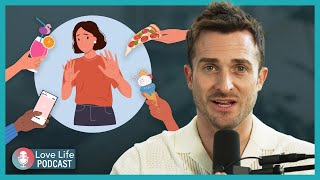
In this solo episode of the Love Life podcast, Matthew Hussey opens with a brief promotion for his upcoming six‑day retreat and a free guide on expressing personal standards, then dives deep into the problem of destructive habits that people repeatedly fail to change. He frames the issue through a client’s question about why she “doesn’t choose herself” when she over‑eats or over‑drinks, and uses that as a springboard to explore why focusing solely on negative consequences often fails. Hussey argues that many harmful habits are symptoms of broader neglect of self‑care—stress, over‑commitment, people‑pleasing, and toxic environments—that create a “voice” seeking escape. He stresses starting from self‑compassion, recognizing that if a habit is hard to change it is inherently difficult, not a personal flaw. He then introduces the concept of momentum: a small, positive domino (a healthy meal, a workout, a nature walk) that can shift mental states and trigger an upward spiral. He encourages listeners to identify their personal momentum trigger and to surround themselves with environments and people who model the desired behavior (e.g., attending Jiu‑Jitsu classes where peers value fitness). He warns that losing momentum often leads to catastrophic thoughts, which should not be trusted. Next, Hussey warns against unsustainable, extreme approaches—trying to overhaul diet or exercise too quickly, setting short‑term “perfect” goals, or eliminating all pleasures. Instead, he advocates a long‑term perspective: ask what you could maintain forever, and design habits that are enjoyable enough to sustain. He illustrates this with diet, fitness, and dating, showing how the same principles apply across health, relationships, and personal growth. Finally, he outlines a three‑stage framework: (1) recognize stagnation and stop over‑trusting negative thoughts, (2) find and nurture momentum by inhabiting supportive worlds, and (3) create sustainable rhythms that can be kept for life. He closes with calls to action for his retreat, free guide, and a new weekly email newsletter called “The Three Relationships."
Chapters
What'S up, guys? Before we get into this episode, quick reminder in September this year, from the 9th to the 15th, we have my live six day retreat. The only one this year. If you missed this one, then it's going to be a long time until the next one. Come join us. There are very few spaces left now to this retreat. the link to go and check it out is www.mhretreat.com Go find out more if you want to spend six days in immersive coaching with me working on the deepest things that are holding you back, whether it's related to your confidence, your emotional patterns, your decision making about what you want to do next or what this next chapter of your life is going to be about. whether it's relating to things holding you back in love or things holding you back in life. This program is for people who are serious about personal change this year. I aim to give people 10 years of growth in the space of six days on this program, so don't miss it. If you know you want to be there now is your chance. Mhretreat.com is the link. Be sure also to download our brand new free guide on what to say when you want to express your standards. This is a very practical guide, it's free. We haven't released new guides in a while but we created a bunch of new ones for our Love Life members and we reserved just a couple to give out for free to everybody. So you can download this free guide at www.boldstandards.com if you are having trouble communicating your standards to someone, maybe you're trying to have a difficult conversation but you're not sure how to have it, this guide is for you. www.boldstandards.com is the link. [Foreign] what's up, everybody? Welcome to another episode of Love Life with me, Matthew Hussey. Solo episode today. I have a topic that I think people are going to enjoy. I want to talk about habits today and the some of the things that we can do to form new habits, especially with those habits that maybe have been with us for a very long time, maybe even a lifetime that we have always struggled with. What are some ways that we can actually get over these habits, that we can start doing things that are better for ourselves that we keep telling ourselves we should do or we want to do, but we never make progress? progress on. That is today's episode. Thank you for being here, as always. Let's get into the show. So, in today's episode, I thought I would just connect with you on this idea of habits. And I wanted to share a question that came up with someone from my private coaching group. in the last week that I know is going to relate to a lot of people. She said, I feel like whenever I'm about to eat a bad food or have one too many drinks, I don't choose myself. She said, I struggle with certain habits in my life that are detrimental. And I feel like in those moments, instead of choosing myself, I do the opposite. I choose the path that hurts me. And she said, how do I get myself to do something different? Do I need to focus on the consequences of not doing something different and really think about those consequences in a significant way and all the damage they're going to do in my life? Do I need to connect to that more? What is the answer here? Because I keep making the wrong decisions. It's true that, and there are plenty of coaching practices that focus on this idea of focusing on the worst consequences of continuing down the road that you're on. And that could be a very valuable thing to create a sense of stakes. like, this is what's going to happen if I keep eating these foods, if my body keeps going the way it's going, if I stay on this, you know, habit with alcohol, or if I keep this habit of people pleasing, never saying no, you know, everyone has their example of the habit that is hurting them. But the problem is that even those consequences don't always wake us up out of a certain habit. There are plenty of people who get the diagnosis from a doctor that if they keep doing a certain thing, they're gonna die. And that doesn't necessarily, on its own, constitute enough for them to go, okay, I'm definitely going to change this. They may come out of the doctor's office saying, I definitely want to change this, but then they find it hard in practice to actually stick to that habit. So what could make the difference? Well, if you take this example that she gave of, I keep eating the bad foods. I keep having too many drinks, and that's affecting me really. It's affecting me adversely, but I don't know how to deal with that. And she framed it as, I'm not choosing myself. when I do that, there's another way of looking at it. What are the things that you're doing the rest of the time in your life outside of that habit that lead you to wanting to engage in that habit? So, for example, you get to the end of the day and you eat something that's bad for you. and that's become a routine. Might there be things that you're doing in the rest of your life that make it more likely that that happens? Like you're stressed, you're overworked, you're not giving yourself any time off, you're not making any space for yourself, you're not treating yourself well, you're overextending yourself. You keep saying yes to people when you should be saying no to more people to keep time and energy back for yourself. You keep indulging in chronically stressful situations like dealing with a person who's really toxic for your life, be it a family member or someone you're dating right now. Are there ways that you're not choosing yourself in other parts of your life that are leading to this moment where you reach for that unhealthy food? Because remember, look, a pizza is still going to be a pizza, even if you don't have something that's pushing you towards it. A pizza is most likely always going to taste good, but there are things that make it more likely that you want to grab for it. And the way I framed it to her was to say that you think you're not choosing yourself when you eat the pizza, but maybe in this weird way, Because you're not choosing yourself the rest of the time, because you're abandoning yourself in so many other parts of your life and not taking care of yourself, maybe there's a part of you that comes out to eat the pizza that says, well, if you're not going to take care of us the rest of the time, then I'm at least going to come along and numb us, or I'm going to at least come along and give us some escapism and give us some pleasure, some indulgence. Maybe in some weird way, that is a part of you coming out to choose you and say, I'm going to do something for us right now because you don't do anything for us the rest of the time. We're exhausted and stressed and anxious and not feeling good because you're not taking care of us, because you're not choosing us. So then this part comes out and says, I'm going to eat the pizza. So this is one question is, the habit that you keep indulging in, a reflection of the fact that you're not taking care of yourself or your needs in another area. And that's predisposing you to have this other voice, this other part of you come out and just need an escape in those moments when you indulge. I think it's really important that whenever it's something very difficult for us to change, that we start from a place of self-compassion, by the way. that if it was easy to change, we would have done it already. Like, I don't have a great relationship with food. That has been the case my whole life. I just didn't notice it when I was a kid or when I was in my 20s, because when I was that age, I never saw any impact of my relationship with food. And the older I got, the more I started realizing, oh, this has consequences, you know, either for my health or for my body or for my mind. This has consequences. So it got to a point where I was like, I can't just do this in the way that I used to. But then when I started trying to change it, I realized how hard it was for me to change. There are certain things that are going to come easy to us in life, and they're different for different people. I know for me, ambition was not something I had to work at. I had, you know, working hard was still difficult, of course, that the result of my ambition was that I worked hard and I did a lot and nothing about that was easy. But the ambition wasn't something I had to try to conjure up. I felt ambitious from an early age. I don't think all of that was positive, by the way, where that came from, but it felt like it was part of me and it was that there was a natural kind of velocity to my ambition. that, you know, I didn't have to try to create. And yet, for me at least, my relationship with food was very, very challenging. Still is. I think it's important for us to recognize when even if something is easy to someone else, if it's challenging to us, then we need to give ourselves compassion. Because if it was easy, we would have changed it already. If something that's causing us pain, and yet we keep doing it, then this is not an easy thing for us to change. In fact, it's probably very difficult. So let's give ourselves compassion for how difficult this is. Okay, wow, this is hard. This is a difficult one. And then start, then we start to think about, well, what would I need to do to start to help myself in this area? And as we've talked about, there is the side of this that is looking at where is me doing this a reflection of other areas where I'm not giving myself what I need. But then there's also on top of that, looking at simply the structure of habits, the behavioral side of it, the pattern aspect of it, because there is just a behavioral side of this that we have to manage with any bad habit and with the good habits that replace them. It's important to realize that momentum is everything. there are times where we have completely lost momentum, where it feels like we've come to a complete standstill. And now, you know, if you take the examples we've been giving, whether it's drinking or eating, whatever it may be, whatever our Indulgence is, you know, it's like I've completely lost momentum. I'm not going to the gym right now. I'm not. eating anything that's good for my body. I keep reaching for the thing that's bad. I wake up every morning and I feel like crap. I eat to escape again that day, or I drink to feel better. But then, of course, you know, I feel bad again a few hours later or half a day later. And that's the cycle. And the further, by the way, we get from the person we were being when we were doing the right things, the harder it feels like it is to get back. But we mustn't trust the thoughts in our mind when we have no momentum. We mustn't take those thoughts too seriously because those thoughts catastrophize. They make it seem impossible to come back. They make going to the gym sound like the most horrible thing in the world. They make eating the good food or not having the bad food sound like hell. But we're only ever a few hours or a couple of days away from having momentum again. And in a state where we have a little momentum, our entire pattern of thinking changes. So, one question I have for you as you listen to this is, what is the domino for you that sets off a sense of momentum? It might be one good meal, like one healthy meal. It might be one short run outside. It might be a workout. It might be getting out in nature. what's the one domino that for you starts to trigger a sense of momentum? I know for me, it's going to the gym or doing one workout, which afterwards makes me think I should eat healthy now because I don't want to waste the workout, which is already a kind of upward spiral of momentum. And then if I can eat well that day, that makes me think, maybe I'll work out again tomorrow. And if I can get to that workout tomorrow, all of a sudden, I'm feeling like I'm on a different track. It doesn't happen all at once, but there's a small sense of momentum. One of the things that we can do to aid that momentum and to make new habits easier in general is to truly occupy the world that helps us to foster those habits. so I know for me, if I go to Jiu Jitsu, which is a hobby of mine, I know that I'm going to be around a lot of people who take their Fitness seriously, because if they don't, it shows up on the mat and you get beaten up and it's pretty. The whole thing is just an unpleasant process because you're feeling out of breath the entire time and the whole thing just feels awful. So, you can't go to one session and not leave thinking, I want to be fitter for next time. Even when I sit on the mats at the end of the session and talk with the other people who are there, and I ask them how they're eating and what their diet's like and what their training is like, I will quickly see people who, if I'm having a bad time with my diet, are making very different decisions about theirs and about how much they're taking care of their bodies or how much they're stretching between sessions or how much they're getting out there and running. I basically am existing in a world where I am both in the world because I'm there, but I also feel like there's a disconnect between me and that world because the people in that world are making different decisions than I am. But that helps me to start making those decisions because I want to be in rapport with those people. I want to be able to engage in this activity on a similar level to these people. So it acts as this real kind of reset for what I expect of myself to be around. that world and these people. What's interesting is when I start being unhealthy, the first thing that goes is those jiu-jitsu classes. Because the last place I want to be when I start feeling, when, you know, when we eat a bad meal, we can shame ourselves, we can guilt ourselves, we can tell ourselves we've messed it all up. And that sends us into a a spiral, a downward spiral. And then if I say to myself in that time, I'm not gonna go to jujitsu tomorrow. Now what I'm doing is I'm starting to remove myself from the world where these habits make sense, where they are the norm. And all of a sudden, it's like I'm stepping into a different world, a world where I make very different decisions. where I spend time with the different people, where I spend time around different influences. And then the habits start to seem a lot harder again. So the key takeaway here is momentum is everything. Don't trust the thoughts you have when you have no momentum because they're lying to you. You will feel differently in 24 hours if you begin a new upward cycle of momentum. Find the thing that triggers your momentum. Ask yourself, in the area where I want my habits to change, and maybe in the past I have seen them change, what was the thing that triggered my momentum? The next question that's important to ask is what sabotages my momentum once I have it. Because everyone has been in that place where you've got momentum, you're starting to move, it's starting to go well, you're starting to feel like you're in a rhythm, and then something sabotages it. What is that thing? It could be that you, you know, one of the very common things that sabotages momentum is when we start to do things in an unsustainable way. So, you know, the moment we start to get some traction, you know, we start eating better, we start working out, we start to create an unrealistic picture going forward. We're like, you know what? I'm going to start working out twice a day, or I'm going to start, you know, eliminating even that thing that I enjoy from my diet. We start getting really, really extreme with it. And this is especially true when we set ourselves this goal of I need to be, you know, I need to have an amazing body by the middle of the summer. And if we look at, you know, the calendar and we're like, well, I've only got a few weeks, then all of a sudden we start to go into an extreme mode to try to get that result and the unsustainability, creating an unsustainable rhythm often ends up being the reason we self-sabotage because then we get overwhelmed and we say, this is all too much. I can't do this. I I I. We get angry at ourselves. Even like, I I I'm not doing this. I can't eat like this every meal of the day. This sucks. This is so boring. This is so. What's the point? And I've had that thought. What's the point? in living if this is how I have to eat 24 hours a day, seven days a week. And I remember a trainer once saying to me, shout out to Cyrus, I remember him saying to me, this is where it's really important that you take the longer term perspective. What can you do for the rest of your life? Which, by the way, on its face sounds like an extreme question. That almost sounds like an overwhelming question, except the whole point of this question is to change what we do today into something that's not overwhelming. He said, what would you... It's like with your diet, how would you eat? if you were going to eat like that forever, or to put it more positively, what would your eating regime need to be for you to want to do it forever? And that's a really powerful question because instead of thinking in terms of where do I want to be in three months, we think in terms of what's if I, if in my life, what I want is to have a body that I enjoy, that I look in the mirror and I'm proud of, and to be healthy on a level that is going to allow me to last a good long while, we hope, if that's what I'd like to have in my life. How can I slowly achieve that in a way that makes it possible for me to keep doing that for the rest of my life? And when you look at things through that lens, it changes the way we go about it. We don't start obsessing over taking away all of the joys in our life because we know if we take away... We've probably done that before. We've taken away Everything that brings us joy in the pursuit of a goal ended up just hating our lives in the process and resenting the whole process. If having the cheeseburger allows you to stay on track with a rhythm, then it's more important that you have the cheeseburger than you don't have the cheeseburger. The thing that makes life fun for you or the thing that allows you to keep going actually becomes one of the most important things. Even if it takes away the idea of perfection or of fully optimizing something. I'm a big believer in the idea that we are all very different. And so our paths are going to naturally look different. I can look at someone who's militant about their eating, about their health on a level that feels really, really difficult for me and maybe even impossible to maintain over a long period of time. And there's no point me comparing myself or judging myself compared to that person because that person might have completely different associations than I do with food. I've got friends who just see food as fuel. And it's not that food's just not a big part of their life. They're not that excited about it. And that's something I don't relate to. Right? That's a food has so many associations for me. Positive, pleasurable associations with travel and fun and excitement and all of these different things. Now, I've gone, you know, my life has taken me way too far in those directions, right? That's the thing I'm having to work on. But if you or I need certain things in order to stay on a rhythm and they're not optimal by keeping that thing that you enjoy, you do 80% better than you would if you just let it all go. then that thing actually becomes really, really important in your sustainability plan. The key is what can I do for a long time and not resent it? That's what's going to allow us to get there because consistency is everything. And by the way, you can take everything I'm saying and map it onto, you know, if we're single and trying to find love, the right approach to finding love. None of us want to be, you know, if we're looking for love, we don't want to hear, you know, what would you do if you were doing it for the rest of your life? But let me just pose that as a thought experiment for the moment. I know you don't want to be single for the rest of your life, but if I said to you, your job is to date today, to remain open in your love life today, to stay curious, to create opportunities in your love life today, but in a way that you can sustain for a long period of time. What would that look like? Would it look like spending hours and hours a day on dating apps or having your head in your phone for long stretches of time or checking every five, 10, 15, 20 minutes to see whether there are new messages in there or new matches. Would you be going on five dates a week? How would you date if you knew you were going to do it for a long time? How would you make that process something that was truly sustainable? Maybe it would mean limiting the amount of time you spend on an app. every day to 30 minutes or an hour and then putting the phone down and ignoring it and living your life. Maybe it would mean saying, I'm gonna go on a handful of dates a month, but I'm gonna be, you know, I'm. I'm gonna not just run at every single date that comes my way because that's going to burn me out. Maybe it would be you would join clubs or communities or, you know, Hobbies that. you know that will be worth it for their own sake, that you'll enjoy doing. Where at the very least, you'll come out with a new skill or a new group of friends, new learning, expanded life. Doing the thing alone will feel like living. How would you look for love if you were going to be looking for love for a long time? versus because by the way, you don't know if you're going to meet the right person a day from now, a year from now, three years from now. So if let's say in your case, you're going to meet the right person three years from now and you date aggressively for three months in a way that's not sustainable. Well, you're going to burn out after three months before you ever get the chance to meet that person. You'll only meet that person, in other words, by staying in the game long enough. And you'll only stay in the game long enough if you do the game. in a way that you actually enjoy. You can even map what I'm saying onto a relationship. Am I engaging in this particular relationship in a way that I could engage with it forever, or am I going to burn out engaging with it in the way that I am today? Am I having to monitor someone constantly and in a hyper vigilant way because I don't trust them? And is that exhausting me? Is my anxiety at a level 10 in this relationship every single day? And it's leaving no bandwidth for anything else in my life to be done well? Or how much am I seeing this person? Is it enough? Maybe I can live with seeing them this little over the next three months or six months, but could I do it for 50 years? These are very sobering questions because then you start to realise I might not be in a relationship that I can sustain for the rest of my life. And when you ask yourself, well, What kind of relationship would I be in if I was trying to sustain it for my whole life? You'll say, well, I guess it's one where I could speak my mind. Okay, it's time to start speaking your mind. I guess it's one where I would see someone more often than I am today, at least once or twice or three times a week. Okay, then I need to start making that an expectation or a demand in my relationship a standard. Otherwise it's not worth me being in this relationship. I guess I'd be able to trust this person and take my hands off the wheel and not monitor everything they do all the time for fear they're going to hurt me. Okay, well, then let me trust this person. And if they betray me, say, this isn't the right relationship for me because I can't be in a relationship where you only don't betray me if I monitor you because that's going to exhaust me and I can't do that for another 50 years. So with all of these things, whether it's the way we manage our health, the way we manage a relationship, the way we manage being single. It's almost like there's three stages, right? There's, okay, I'm at a standstill right now and making no progress. And in that mindset, my brain is telling me nothing works. I'm terrible at keeping to habits, I can't get myself to do anything, it's all so hard. You can't trust those thoughts. Don't trust the thoughts you have when you have no momentum. So my only job is to stop taking these thoughts so seriously and then go out and get some momentum by asking myself, so this is like stage two, what are the things that give me momentum in this area? that I want to change when I do them. And as you start to do those things, really live in that world, put yourself around people where the world that you want to be in, the way you want to eat, the way you want to live, the way you want to, you know, your lifestyle, where it's normal to be that way with that group of people in that world. And being in living in that world can mean lots of things. It can mean going online and ordering the various fun things that allow you to really experience that world. If you're going to start drinking tea, go order some really fancy tea that excites you to order. Go order a great piece of equipment for your kitchen that's going to actually make you excited to make those juices. Go buy a piece of clothing that's going to start to make you feel like the person who does that sport or who works out in that way. Inhabiting the world isn't just putting yourself around people. It's people, places, things that make you really feel like you're part of that world. Inhabit it. Don't be a tourist in the world of the habit you want to create. Go live in that world. So that's getting momentum. And then the third phase is create true sustainability. Okay? Let me not try to maintain a once I've got momentum, let me not set myself up to fail by creating a rhythm here that is unsustainable. It's not where can I be by this summer? It's how would I do this if I was going to do it for the rest of my life, or at least for a long time. And that thought shouldn't overwhelm you. In fact, what it should do is be a recipe for you coming back to the present and not being a tyrant to yourself, but instead finding a rhythm, a way of doing it that works for you. Okay, what works for you? Leave me an email podcast@matthewhussy.com Let me know if you enjoyed this episode. Let me know if you'd like more stuff like this and what spoke to you the most about it. What did it make you think? I want to read some of your responses in upcoming episodes. And by the way, for those of you that don't know, I now have a private email that I send out every Friday as part of something new I'm doing called the Three Relationships. It just started this year. Every Friday, I send out a really high value email with thoughts and ideas, much like I do on this podcast, but in written form. And it's something that, you know, that there are things in there that I don't put anywhere else. So, if you enjoyed my new book, Love Life, if you enjoy my writing, I think this is something you'll really enjoy. It's like getting a new small chapter of a book every week. I don't know if I'll be able to sustain it at this level. I'm putting so many hours into every email that I do. At some point, maybe I'll have to tone it down a little bit and make them a bit shorter. But for now, we're just, I'm really enjoying sending out something super valuable every single Friday. And if you're not on it, you really are missing out. And the people that are on it are loving it. So you can go and sign up for for free at thethreerelationships.com and I'll see you in your inbox this Friday with that newsletter. Thank you so much for listening. I look forward to your feedback and I will see you in the next episode. Be well, my friends, and love life.









