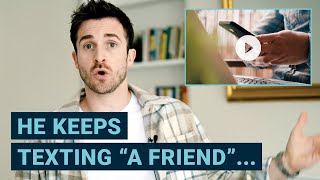
In this video, Matthew Hussey discusses how to evaluate a partner’s problematic behavior—specifically, a boyfriend who frequently texts another woman. He argues that rather than judging the partner or assuming they will change, individuals should first return to their own truth by understanding their personal boundaries and attachment style (“know thyself”). He then advises assuming the partner will not change and asking whether one can be happy with that reality. Next, he suggests examining possible work‑arounds for the behavior and weighing whether those compromises conflict with one’s values or cause more pain than the relationship brings. Hussey warns against the danger of selective optimism, where the desire to stay in a relationship blinds one to facts, and urges a sober assessment of two core questions: can I be happy in this relationship, and if not, do I value my own happiness more than the person? The video concludes with a promotion for a three‑day virtual retreat aimed at personal growth and resetting one’s year.
Chapters
I was recently told a story by a client who was having a massive fight with her boyfriend over the fact that he was texting another woman consistently who he'd met not so long ago, and he said was a friend and wanted her to be okay with it. This created a massive rift in their relationship. It's very easy, of course, for us on the outside to look at that and go, oh my God, she's being daft if she puts up with that. But of course, in a relationship, everyone has different rules, don't they? People have different boundaries. One person could say, it should be no problem for him to have friends of the opposite sex and to be texting them regularly. Another person might say, that's disrespectful for the relationship and opens the door to either a real threat or at the very least, is not a nice thing to do to his partner. Sometimes arguing about what's right or wrong adds too much complexity to a situation. What we can do instead is, number one, return to our own truth. Is this right for me? Rather than judging that person and saying they're objectively a bad human being, simply returning to that ancient Greek maxim, know thyself. Is this right for me? Of course. We could even get into attachment styles here and say, maybe I have my attachment style style, and I need someone who nurtures my attachment style, who soothes my attachment style, not someone who exacerbates the worst elements of my attachment style. If I'm a little anxious by nature, should I be with someone who amps up that anxiety by doing things that make it worse instead of making me feel safe and secure in the relationship? So know thyself. Number two, assume that that they won't change. Don't go forward on the basis that this person is going to stop doing this behavior. Jacob M. Broad said, consider how difficult it is to change yourself and you'll understand what little chance you have of changing other people. Do not go forward thinking that one day this person will cease this behavior. Assume they won't, and then ask yourself, can you be happy with that? Number three, is there a workaround that this behavior, this pattern is causing you pain? Is there a workaround? And importantly, when you've looked at what the workaround would be, is the workaround something that causes more trouble, more pain than it's worth, more pain than the relationship creates happiness? Does the workaround represent too much of a departure from who you are, your values, your true nature? Does does it separate you from yourself in order to be okay with this thing now of course, when someone comes to me with a problem like this and there's even the suggestion that the relationship may not be workable, the pendulum will immediately swing in the other direction. They've started the conversation by talking about how they're deeply unhappy and this thing is causing them pain. But then they swing to, but this person is so amazing, and I really love them and they love me and we have so much in common, and there's so much that is right about it, and that will be the justification for them staying. Now, the desire to continue a relationship can be beautiful on one hand, but it can be extremely dangerous on the other. The passion and the optimism we have for the relationship, for its potential to actualize into what we want it to be, is the greatest founder of unchecked optimism, of our blurring of the facts. We start selectively focusing on what this person is saying and doing in order to create a narrative that this relationship is can still work. We have to get very sober about this and see it for what it is. And this is so important because it forces two fundamental questions. Number one, can I be happy within this relationship? And number two, if I can't, do I value this person more or do I value my happiness more? Because it would appear that in this relationship, I cannot have both. Only you can decide the answer to that question. I'll see you next week. Real quick, before you go, the virtual retreat is coming up. It is upon us. If you haven't yet signed up, if you watch a video like this and you go, my God, I wish I had the bravery to actually do what I needed to do. Or if in any part of your life outside of your relationship, you're thinking, there's so much I want to do, there's so much I want to experience, there's so many ways I want to hit reset on this difficult year I've had and not so squander it, I still want to turn this year into a beautiful piece of art that leads me into next year powerfully. Then please come with us. There is a link right here. Go to that link, speak to one of our specialists, Ask all the questions you want about it, but by God, be there because it's going to be a very special event. Three days live, my virtual retreat. Go to that link. I will see you there. And thank you as always, for watching.