The Subtle Habits That Kill Relationships (Without You Realizing)
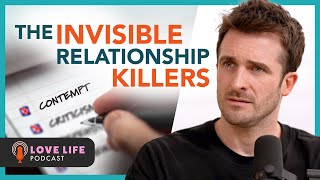
In this conversational podcast episode, Matthew AI, Audrey, and Steve dissect common, often unnoticed behaviors that erode romantic partnerships. They identify three core red‑flags—defensiveness, stonewalling, and an inability to apologize—explaining how each stems from a fear of losing power or safety and leads to loneliness, betrayal, and emotional abandonment. Drawing on psychologist Guy Winch’s work, they link chronic defensiveness to narcissistic traits and incompetence, noting that without ownership of fault, growth stalls. The hosts discuss how early relational scripts about power dynamics and score‑keeping shape adult love, and they propose a remedy: a blend of personal standards (strength), humility, and generosity of spirit that enables sincere apologies and mutual respect. Throughout, they reference a recent “Dating Made Simple” live event (May 20, 2024) and direct listeners to lovelifereplay.com to view the replay before it expires on May 30. The episode blends personal anecdotes, psychological insight, and practical relationship advice, framed in a conversational, supportive tone.
Chapters
What a lot of us are afraid of when we say sorry is that we will get eaten.
Yes.
Like, if I lose my power and I admit fault, I can't trust the other person not to take full advantage of the fact that I'm admitting some fault.
Hey, you seem to have perked up. He's been really miserable all day.
He has been a bit sheepish, hasn't he?
Yeah.
Oh, I was absolutely gutted, Steve. I've been beside myself.
Why is that, Matt?
Yeah, well, that's the thing. You remember the Dating Made simple event I did on the 20th?
Yeah.
The one that was attended by, you know, over 10, 000 people.
Lovely day.
I missed it.
Do you mean you missed it?
I missed it. I was. I was so busy doing the event, I wasn't able to see it and I wanted to see how I did.
Ah, that makes sense. Well, you do know you can just go online and watch the whole event again right now.
You are a liar and a cheat and a deceptionist.
No, it's just a fact. If you go to lovelifereplay.com you can watch the whole event in its full glory.
Here you go. Pulled it up on my phone.
Oh, I suppose. There it is right there. Sorry about the whole deceptionist thing.
No, I mean, it's fine.
Well, it does say here that you can only watch this until the 30th of May.
That's right.
So if you do want to see it, and I will be watching it right now after this podcast, you can go to lovelifereplay.com but only until the 30th of May.
So, number three, defensiveness. That's self protection in the form of denying responsibility, making excuses, or flipping blame to someone else. You're kind of never taking accountability. You're saying, oh, it's not my fault we're late. You always take forever.
Yeah. This is something I talk about in the book as like one of the kind of ultimate red flags that makes relationships really, really hard. Because if someone can't take ownership and if someone can't say sorry, then they really can't grow, they can't improve. It's one of the reasons I remember a psychologist, Guy Winch, talking to me and saying, you know, narcissism is associated much of the time with incompetence. And the reason that it's associated with incompetence is because narcissists have an almost impossible time admitting fault. And if you can't admit fault, you can't learn. And if you can't learn, you can't improve, so you remain incompetent. And that happens in relationships all the time, where people just cannot improve because they can't take ownership. And even if they do improve, they try to improve in quiet, away from you, where there's no humility to it. There's no. Like, I'm doing this for us, and I am. Like, I've heard you, and I'm going to improve this. They just. They. They want to just go away and have whatever their own form of improvement looks like and come back and. And, you know, it's a solitary journey.
Yeah.
That they're on. And that's why it's. You. Being in a relationship with someone who can never apologize and who only gets defensive is an incredibly lonely experience.
One of the biggest red flags, in my opinion. Someone who can't apologize.
Yeah.
And take accountability.
And the blaming comes with that. Right. Because if you can't. If it's. If you can't take responsibility, then you need to shift it somehow so then it goes to the other person.
Yeah. Or you're crazy or you're overreacting or you're too much or, you know, all of those things.
Okay. So take us to stonewalling.
Stonewalling, that's withdrawing from interaction to avoid conflict. So shutting down, going silent, you just leave without any resolution.
Yeah.
I think the problem with this is it makes your partner feel abandoned often. And it makes them feel like there's coldness, there's disconnection. You don't. What. You don't solve things together. They just have to move on and get over it because you're not gonna participate in joining them. You don't ever deal with anything real. You just kind of shut down and leave. That's your way of, like, I'll come back when I feel better. And it just makes your partner feel very lonely.
I think it really activates any. Like, it makes people feel very abandoned.
Yeah.
It can even feel like a kind of betrayal. Like where you left. You left me to just anxiously ruminate about this to the point where I. I liken it to a child who almost loses some innocence because they're just left in a room to cry. I don't. Not talking about babies or. I'm talking about, like, when a parent just abandons a child and freezes them out. And that child goes through stages. Right. Is there's, like a fear there and a survival instinct of, you know, something awful is happening or is going to happen because I've been left and that can't. Some. No One can stay in that state forever because it's too painful. So at a certain point, it's like short circuits. And you. Someone stops crying, but it's not that they've stopped crying necessarily, because they're no longer in pain. You can stop crying because you've gone somewhat numb. You can stop crying because you dissociate. You dissociate. And when we do that in relationships, when someone stonewalls us and we go through that kind of abandonment and what feels like a form of betrayal, when it is in some ways a form of betrayal, it's a betrayal of our safety. And we're just left to, like, anxiously ruminate until the point where we either disassociate, dissociate, or distract ourselves. That robs us of a genuine. Of a deep feeling of safety. It's almost like, I now don't trust you with my emotions. I don't trust you not to hold me hostage.
Yeah.
It now feels like this is a hostage situation and that something kind of breaks in there. I think there's a loss of. There's a loss of innocence in there because you realize there's. We're not playing by the same rules. I. If I saw you hurting like this, or if I saw you struggling with something, I would want to make sure you're okay. But you saw me struggling with something, and you were quite happy, not just to freeze me out, but to then come back and just carry on as if nothing happened. I can't now trust you with my feelings. I can't. And I res. More than that. I resent you for holding me hostage.
Yeah.
There's so much there, though, in all of these behaviors where I think, you know, like, did you guys grow up thinking or being told, being fed a rhetoric which was almost like, relationships are about, like. There's always, like, a power dynamic going on, and there's always someone that loves the other person more. And it's always about, like, almost a. Kind of, like, keeping score. Yeah. Like the seesaw of, like, almost like, who's on top at what moment and who. You know, I think a lot of relationships operate like that where, you know, one or two of the parties have a wound. Maybe they're anxious, maybe they've been through a traumatic childhood or whatever, and they try and control their way into feeling safe. And so when their partner feels. And there's. There's. I'm not condemning this behavior because on the kind of more sinister and extreme end of it, you have narcissism. So I do think that needs to be addressed. But you know, on the more kind of, the less, I suppose, the less toxic side, you have people, a lot of people who are not emotionally conscious enough and mature enough to realize that what they're trying to do is they're trying to put their partners on the back foot so they feel like they're in control. And, and it's really interesting because in so many of these things that we've talked about, you know, you can only sustain a relationship for so long where you're constantly in a kind of push pull dynamic because a relationship, actually the only relationships that work are relationships of equals. And if two people come to the table willing to be wrong and you know, accepting the fact that sometimes they're going to mess up and sometimes they're going to make mistakes and sometimes they're going to, they're going to be the ones who are saying sorry and who are going to have to work on themselves and just always coming in with so much humility about who you are as a, as a partner and how you can improve. I think like, if you're not doing that, if you don't realize that that is kind of the, the magic source to a relationship, then you end up falling into these other traps. And, and it's really sad because a lot of people who have these behaviors at, at the core, they just want to be loved.
Yeah. I think the, the what, what a lot of us are afraid of when we say sorry is that we will get eaten.
Yes.
Like, if I lose my power and I admit fault, I can't trust the other person not to take full advantage of the fact that, that I'm admitting some fault. Like they're, that's going to be the only truth of this situation and I'm going to have lost all of my power. And often that's because we came from some kind of dynamic where it was perceived as shameful or weak to be wrong. We felt we couldn't be wrong with a certain person because they would just eat us alive if we showed them a, a chink in the armor. And so it's like we, we don't, we don't feel safe enough to admit we're wrong. It's one of the things, I don't know that it gets talked about enough that in order to admit fault, we have to feel safe.
That's so true.
And you know, you, Audrey, are so good at this. You, you've been a very healing kind of presence for me because I think I had a healthy dose of that, of thinking that. And it's funny because I'm pretty. I think I'm pretty good at taking ownership in life in general. But I think there was a kind of fear romantically of letting my guard down by, by admitting fault in an argument and being like, yeah, I messed up there in the way I said that, or I shouldn't have done that. And part of that was this feeling of not wanting to be vulnerable, that it would be hugely vulnerable to say I was wrong about that. And you have always been so willing to a. Be going back to the point about criticism. You've always been so willing to be really generous towards my character and to be like, I know you're such a good person, that you're one of the best people I know. And I know that where this comes from for you and, you know, I know why you did that, I get. I understand you and I know where that comes from. And you doing that was like, you know, me feeling very seen. But at the same time, when you would be unafraid to say when you felt you were wrong and to say even, even, by the way, in an, in an argument where really it was me, like, I'm the one who owed an apology and did apologize, you would still say, I know I didn't approach that very well. Like, I was upset with you and I really appreciate what you said, and I know I didn't approach this conversation as well as I could have, or I know that I didn't, you know, like that also, like it was something healing about that because I realized it didn't have to be either or.
Well, if you're arguing, you should both be sorry because you shouldn't. You shouldn't be arguing. And it's sad that you, as a team, as a group, you know, two people, as a pair of people are having this fight. And if you're not both sorry, something is wrong. And unless it's literally a person sat here going, calm down, I don't want to fight, you know, blah, blah, blah, and any other person screaming at them, in which case, yeah, there's a person who should apologize and someone's literally done nothing wrong. But often if it's an argument, you're having a back and forth, and so there's something for both, both parties to be sorry about.
But I, I think that there's a. If I were to define how I think you show up to situations, it's. There's a real sense of strength. And, you know, call it strength, call it confidence, call it standards, but There's a real sense of strength about. It's important someone owns it when they're wrong in your life. But that gets blended with humility, where you're able to share whatever part you played, and generosity of spirit, where you're able to fully acknowledge that someone like the best parts of someone at the same time as they're apologizing. And that has all three of those things together have a very, very potent effect. And I think that that's in. In a way it solves so much of what we're talking about here in terms of criticism, contempt, defensiveness and stonewalling. If you can have a healthy mix of standards for yourself, you know, self respect that you people own problems around you or own the things they do wrong around you, but you combine that with humility and generosity of spirit, that makes for a really, really great relationship. Well, if you all want to restore your hope in love and the ability to find enduring love, go over to lovelifereplay.com because you can watch the replay of the massive live online event I did on the 20th of May. We had thousands of people show up to learn and to get a plan for how to find enduring love in a time where dating feels horrible. If you are tired of dating or the way things are out there or situationships or people never investing and you want to actually find something real amidst all of the noise and the chaos, go over to lovelifereplay.com and watch this before it goes away on the 30th of May. Because once it's gone, it's retired and then it won't be available anymore. So go watch it. Lovelifereplay.com.
Sam.









