10 Blocks of Time to Plan Your Week [Minimalist Bullet Journal Layout]
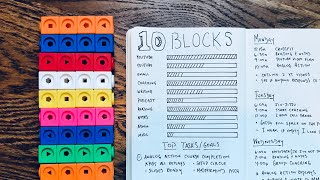
Matt Ragland's 10 Blocks Method divides your week into ten 4-hour chunks, each assigned to a project or responsibility. Blocks are planning tools, not rigid schedules, that help you spot whether you're doing enough creative "uphill" work versus maintenance tasks.
Chapters
The 10 Blocks Method is one of the most popular videos on my channel and a source of many questions about how to make the method work for your own job, career, activities, hobbies, anything that you want to spend focused time on. In this video, I'm going to share a new view of how to use the 10 Blocks to, well, block and boost your productivity in life and in your work. Hey everyone, my name is Matt and welcome back to the channel. This is a very special, specific video for two reasons. One is just that I like updating ideas and videos as I start to think about them more. The other fun thing about this video today, it's not going to come out today, but today's my birthday. I turned 37 today and I, you know, just have a lot of fun, excited energy around my birthday. It's always a fun day. The other thing is sometime around this video, I'm going to hit 50,000 subscribers on the channel. So just amazing, incredible. I honestly, people say this, but I honestly couldn't fathom getting to 50,000 subscribers when I started doing this. I had a hard time thinking about how I would get to 10,000 subscribers, and now I'm here at 50,000 subscribers. Whether this is your first video or you've watched the majority of them over the past 3 years, just Thank you for watching. Thank you for being a subscriber. And there is so much more to come. Literally, the best is yet to come with this channel. So thank you for being a part of it. So let me tell you how 10Blocks started. It started as a way for me to track and understand how much time I was using and spending on different projects and areas of responsibility at work. So for example, if I said that I needed to spend like 8, 10, 12 hours on my biggest project at work that week, and then I only ended up spending 2 or 4 hours on it, I really needed to know that. I needed to know if I wasn't being focused enough on the project, or if other things and other different projects or areas of responsibility were pulling me away from what I intended to do with the time that I had. Before we get too deep into the details, I want to give you just the the simple math behind the 10 Block Method. And it's just this: if you take a 40-hour work week and you divide that up into 4-hour chunks of time, then you end up with 10 blocks of 4 hours each. Before you start thinking about how, like, this is different for you, and that's what we're going to cover, or how you don't work in, you know, complete 4-hour chunks at a time— I don't either most times— Let's hear from our sponsor for this video. This video is sponsored by Backlog, an agile cloud-based collaborative platform that lets you easily organize, discuss, and track work all in one place. With Backlog, you can visualize and prioritize work with Kanban boards plus Gantt and burndown charts to keep the project on track, all while making it easy to see the status of tasks and project as a whole. Use @mentions, threading, and file management to keep everything and everyone in the same place. Place. One of my favorite features in Backlog is the built-in wiki for project management. This might seem like a simple thing, but it really helps keep the team and project documentation in the same place. Backlog is free for up to 10 users, and the paid plan starts at $35 a month with up to 30 users. Check out Backlog at mattrogelin.com/backlog and let me know what you think. At the beginning of each week, I would outline the 10 blocks in my bullet journal and start to assign different projects or areas of responsibility at my work in each of the 10 blocks. So for example, it might be 1 block for customer support emails, 1 block for meetings, could be 2 blocks for big projects, could be another block for customer calls, and so on and so forth until each of the 10 blocks were assigned a different project or area of responsibility for the coming week. Now here's an important distinction. Just because I assign like 4 hours of time to each of the 10 blocks, That doesn't mean that I work in unbroken 4-hour blocks. Rarely the case. And so what I do though is when I spend an hour in a meeting, or I spend an hour writing, or I spend an hour answering support emails, then what I'll do is I'll just shade in and start to fill up that block as the week goes on. And this is really helpful because say if I get to Wednesday or Thursday and I've already filled up my meeting block or my support email block, then I need to see if I can reach out and get some help from other people. Maybe I can move some meetings around. That way I can make sure that I still have enough time to spend on the big projects that are going to move my work forward. The 10 blocks are really helpful for making a plan and setting an intention for what I want to spend my time on each week and tracking it to make sure that I stay on the path. Now here's another important distinction. It's not a big deal, especially early on, if I went way over or even way under on my estimate for a particular block or what I spent time on. In fact, it's an opportunity to review and learn how I was actually spending my time and how I might need to adjust my 10 blocks for the upcoming week. And whenever you're doing a review, just keep in mind that you're not looking at it from the perspective of like a judge handing down a sentence. It should be more like an objective, like observer reporter, almost just like sending back a report on this is what Monday Matt intended to do. And this is what ended up happening throughout the week. One thing that I'm really adamant in trying to be really intentional about is every week spending at least 5 blocks or at least 50% of my time that week on creative uphill work projects that are going to move my work and move my projects forward in a positive direction. Now, the concept of uphill and downhill work was coined by Michael Hyatt, and I've really liked it because it's that uphill work. Like, for me, it's making videos. It is like writing, writing emails, the email newsletter. It's like putting podcast ideas together. It is building courses and doing coaching. Those are all uphill work tasks and projects that move, that move everything forward. The downhill work are things that like need to be done, but can often trick us into thinking like, hey, I've had a really productive day. I posted to Instagram, I responded to all of these emails, I did like different things that, you know, they don't challenge you in the same way. And they're more like just, you know, they're keeping everything in order. We're keeping, you know, we're keeping everything afloat here, but it's not the type of work that is going to move things forward for you. Okay, so here's a secret that you should know about. 10 blocks doesn't work for everyone. It works for a lot of people because it's just something that, you know, is easy to remember. And like, especially if you work a normal-ish 40-hour week, then it's easy to kind of go up and down a little bit in like 10 blocks or 12 blocks. But what you should know if you were applying this method to your own life is that the number of blocks that you have and the duration of those blocks is totally customizable based on what you want to use it for. So just for example, if you want to use like the block method in your side hustle and you're able to spend just 10 hours a week on your side hustle, then maybe instead it's 5 blocks of 2 hours that you want to think about. How can I find and fill the time on those 5 blocks of 2 hours on the specific projects and areas of responsibility that are going to help my side hustle grow? The point is the math is customizable and specific to you. I do warn against creating blocks that are less than 2 hours because what I'm talking about here is not meant to be overly specific to like writing emails directly to sales clients or like I just say like writing emails. So I look for those big trends and categories so I'm not getting like too broad and I can just like keep my blocks under 10 and in that kind of 2 to 4 hour range. Ish. But again, the principles still apply, and you just are going to make them flexible based on the needs of your particular situation. For example, mine are projects, videos, meetings, admin tasks, reading and notes, etc. And sometimes it does help to balance the manic mind of what if something comes up. Then I'd set aside a single block of time for miscellaneous or unexpected tasks. But even with all of that said, I do kind of break my own, like, rule on this in terms of, like, the 2-hour limit, because something else that I do is I try and have 10 blocks of me time every week. And when I think about that for myself in terms of personal time, then I'm thinking about 10 1-hour blocks. So I'm trying to find 10 different, like, blocks of 1 hour that I can spend on something personally fulfilling to me. A lot of times that's going to work out. It could be reading and note-taking. It could be like meditating. I'd have to do a lot of meditating to catch up to that 1 hour, but it's different things like that where I'm setting aside personal time, and it's usually 1 hour at a time, and I'm just trying to fill that out for each week. Again, the big takeaway is that the 10-Block Method is a really good guideline for thinking about how you want to to spend the time on the projects, the people, and the purpose that matter the most to you. The number of blocks that you have, the duration of those blocks, is specific to how you want to apply them to the different kind of work and activities that you have every day. I'd love to hear about what you would or will dedicate your 10 blocks to in the coming week. If it helps, there is a link to a PDF that you can download in the description below. Now I just fill this out in my bullet journal, you know, on Sunday or Monday morning every week. Just takes me about 10 or 15 minutes, and it's something really easy to do. There's a little— on the, on the PDF, there is a place where I just kind of tell you how I lay it out and some reminders for the key takeaway. So it's still valuable to access and download, but honestly, what I do is I just write it or outline it in my bullet journal at the beginning of each week and fill it in as the week goes on. One other quick thing is that the 10-Block Method also pairs really well with time tracking. If you're not really sure what those main categories and trends are that you spend most of your time on, then doing 5 to 7 days of time tracking will help you see, if you're honest with yourself, and again, just observe and report on your time, then it will help you see really clearly what those primary trends and categories are that you're spending time on. Thanks again to Backlog for sponsoring this video. Once again, it's a Great tool for collaborative work, project tracking, and making sure that the work that matters stays top of mind and really visible for yourself and for other people that you're working with on the team. Another thing that's really great about Backlog is their native iOS and Android apps make it really easy for you to work on the go, create tasks, make comments, and collaborate with your team. Make sure you go to mattroglin.com/backlog to try it out and let me know what you think. Thanks so much for watching this video, everyone. I had a ton of fun putting it together. Thank you so much for being a part of this channel, hitting 50,000 subscribers literally any day now. And I'm just so full of gratitude to all of you and can't wait to see, can't wait to show you what this channel is going to become in the, in the future, in the upcoming months. Can't wait to show it to you, but I'll see you in the next video. Thanks.
More from Matt









Journal reading 📖 Reflectjons on how I’m living & how it aligns with the vision I have for my life.

You don’t have to listen to me. But you do have to be intentional about the systems in your life.
