3 Systems to Achieve Any Goal in 2023
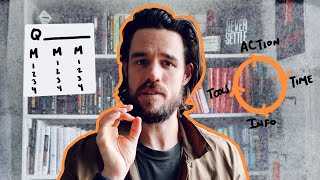
This content was created by Matt Ragland. This content was uploaded by Matt Ragland. This is a YouTube video titled "3 Systems to Achieve Any Goal in 2023" (created 2022-01-04) featuring Matt Ragland presenting three productivity frameworks—QMWD (Quarter, Month, Week, Day), the GAP method (Goal, Actions, Protect time), and the Productivity Flywheel. The video is an instructional, over-the-shoulder Bullet Journal–style walkthrough in which Matt explains how to break quarterly goals into monthly milestones, weekly deliverables, and daily actions, demonstrates examples (starting/growing a YouTube channel, a pantry/home-improvement project, and an individual video workflow), and names tool options (Notion, Roam, Things, Evernote, Descript, Final Cut, Bullet Journal, etc.). He also promotes a free webinar on January 5 and a downloadable planner worksheet. Metadata: YouTube content created on 2022-01-04 (last edited 2026-03-03).
Chapters
Everyone, it's Matt Ragland. Welcome to a new year. Happy 2022 to all of you. What I'm going to be showing you in this video is a very simple, straightforward approach for planning and executing on your goals in the new year. There are 3 concepts that we're going to go over. I've talked about them before on my channel, but I'm going to tie everything together in this video so it's really easy to see how everything connects. Those 3 concepts are QMWD, GAP, and the Productivity Flywheel. In this video, I'm going to give you an over-the-shoulder type of look, like I do in most of my Bullet Journal videos, to show you how I would set this up and explain it from an analog perspective. But the principles remain the same, and you can use this to implement a strategy in Notion or Roam or Things or Evernote or whatever you want to use for your productivity and your planning. First, I want to tell you about a free webinar that I'm hosting to help you have your most productive year ever. It's going to be live on Wednesday, January 5th at 3:00 PM Eastern, 12:00 PM Pacific. Going to be going over this productivity flywheel, going to be showing you each section in detail, different examples for it, how you can apply it to your own work and life. We'll be going over case studies, we'll take questions, it'll be super valuable for you and it's totally free. You'll also get a bonus of the Most Productive Year Ever planner worksheet that I've been using for the past several months to have really productive, uh, weeks, just stack them on one right on top of each other, like we've been talking about on the channel. So if you'd like to work with me kind of live in a webinar setting, go ahead and sign up in the description below or go to ProductivityPowerUp.com to save your spot. Now that we've got the explanations out of the way, let's go ahead and jump into the first element of your annual goal planning, which is the QMWD framework. QMWD stands for quarter, month, week, and day. And what it helps you do is take a bigger goal that you have that might take 10 to 12 weeks to do and break it down into monthly milestones, weekly deliverables, and then daily actions. The idea is that something that is pretty big from the beginning of a quarter, you can then break it down and see what do I need to do every day and every week in order to move forward and get closer to accomplishing my goal at the end of the quarter. So let's start with a simple analog explanation of QMWD and how you could do it. So I just like to lay out QMWD like this to keep it really simple anytime I'm starting something new. And what we're doing up here is that Q, that big goal up at the top, and then I have my 3 monthly milestones. We're just going to put those in, in the middle, give a little space to write them in. There we go. And then the next one, of course, is the W. So these are my weekly deliverables. We're gonna go 1, 2, 3, 4. And then the daily— the D is just the daily actions that you would do through the GAP method, which, you know, we were talking about. So Q, M, W, and then D is the day-to-day. So let's just say I'm gonna use two examples. The first one is going to be a creative output, a creative publishing example of— let's just say you wanted to start or improve a YouTube channel, I'm gonna say that my first month milestone is going to be ideas, idea setup. So it's going to make sure that I have enough ideas in the tank to make 10 to 12 YouTube videos. Okay, so we've got ideas and then we've got, let's just say film, and then start to publish. Okay, now I do have something called Your First 10 YouTube Videos that will help you with this as well. But if we're breaking this down QMWD, then our first month milestone is just going to be let's generate the ideas and the setup to make sure that we're confident going into making the best use of our time. Okay, like we're talking about with the flywheel. First week, our deliverable is going to be to brainstorm. Now let's just say we're going to brainstorm 50 ideas. Okay, the second one is second week, we're going to start to write scripts. And let's just say it's going to take 2 weeks. Okay, so the script or the outline for our first 3 or 4 YouTube videos. Okay, and then we're going to— if you need to learn anything about editing, let's just say editing as a goal right there. There's obviously a lot that goes into everything that I'm talking about, so don't get stuck on that. I'm talking about YouTube channel growth or starting a YouTube channel as like the details right here, but just notice that this is the quarterly goal. I now have 3 milestones that will bring me closer to my goal, and to grow and be to be more aligned with each month's milestone, I need to deliver on something each week that will help me reach that milestone. And so the first month milestone is to have, say, 20 good ideas, or just don't put the disclaimer of good because as a, as a creative, as a professional, it will— your perfectionism will get you. So just 20 ideas, let's just say 20 ideas that we're going to brainstorm for YouTube videos. That is my first week's gap. And when we look at weekly deliverables in the QMWD framework, that's when we start to implement another one of our concepts, and that is the GAP method that you've heard me talk about a lot on this channel. What the GAP method does is it takes what the weekly deliverable is in the QMWD framework, and it makes that weekly deliverable your primary goal for the week, so that G in GAP, and then breaks down what are the actions that I need to accomplish in order to achieve that goal. And then making sure, of course, the P, that I protect time in my week to get it done. So when you're looking at how can I achieve my big quarterly goal, really what I'm looking to do is deliver 12 weeks in a row so that naturally, naturally, naturally, that's how you say it, inevitably you achieve, you reach the summit of your success because you have been doing the work week after week for 12 weeks. So you see how this works. I have my quarterly goal, I have my monthly milestones, and then each monthly milestone should have 4 weekly deliverables that once you achieve them, once you complete them, will naturally bring you to complete and achieve the monthly milestone. Don't get caught up in the details of what I'm writing down, just the system for how I'm thinking through it. Big quarterly goal, monthly milestones, weekly deliverables that align with the monthly milestone. So as you complete the deliverables, you naturally achieve the monthly milestone. You do this 3 months in a row, you achieve the quarterly goal. The longest amount of time that I schedule any actionable goals are a quarter at a time. So I take something that I believe will take me 10 to 12 weeks, and I break it down using the QMWD framework. Now, if there is a bigger goal that I want to try and accomplish over the course of the year, I won't make like one mega giant goal out of it. I'll break it down into thinking, okay, what would I have to do each quarter to move me closer to achieving that goal at the end of the year? So in effect, I'd just be planning 4 quarterly goals instead of one annual goal. Hope that makes sense. So now we've connected the dots, pun intended, on the QMWD framework and the GAP method. The GAP method exists to fulfill the weekly deliverable, the W, in that QMWD framework. Hey, I'm editing the video right now. Proof, desk is a little messy. And I hated the intro that I gave to the Productivity Flywheel the first time. Plus, like, my hair changes volume, like, mid-cut. It's very strange how it worked out. But what I'm about to show you is the Productivity Flywheel, which is my favorite filtering device and focusing device for understanding what type of action do I need to take, how much time is it going to take, which, like, how am I going to do it with the ideas, and then what tools do I need to use, which tools do I need to use to make sure that I'm being effective, that I'm doing the right thing. So I'm showing this to you overhead now to give you like a better idea of the virtuous cycle that it has. But just wanted to give you a little bit better, like, intro to it. Maybe you like this kind of thing. The light is very nice right now, I gotta say. I look very cinematic, and, you know, the beard is just super fluffy. All right, back to the video. The Productivity Flywheel is this virtuous cycle of getting things done that helps you answer 4 core questions about your project or goal, and that is very simply, you know, what is it? When are you going to do it, or for how long? How are you going to use your ideas and information to do that? And then with what tools? So let's say I had a home improvement project like putting a pantry into our kitchen. Then the action, or what it is, would just be simply pantry. And there are lots of subtasks obviously that would go into that. But still, those are still based in the action step. And then the next one is when, and we're going to say on the weekends. So, that's what I'm going to get that done. How is I'm going to use plans from web YouTube. Okay, and obviously I'll organize those in Notion and maybe Dropbox, some other things. I'll print some things out I'm sure as well. And then with like, this is kind of on the nose, but actual, actual tools. So let's just say drill, because I know I use like digital, digital examples and business examples all the time. So maybe this will kind of bring them in, see how flexible this idea set is. Because once I decide what the action is— putting a pantry into the kitchen— when I'm going to work on it— weekends for probably times a month— I need to find the plans on the, on the internet or YouTube, or maybe even hire somebody to consult with me on it, and then, you know, drill in other tools. Then once I go through this, and I may have to go through this every day, so like what does Putting in shelving look like? When do I need to do that specifically? Okay, that's going to be on Friday night. What kind of, you know, all these things. So it can be something as big as the top layer of the project. It can also shrink itself down to the day-to-day of what specific task I have to do. Now let's use the Productivity Flywheel to look at our very specific YouTube channel example. So let's just say from the big picture of QMWD with the start and sustain a YouTube channel, we're also now going to look at how can we use the flywheel for an individual video. So if we know that the individual video action is obviously to, let's just say, publish, publish video. Okay, that's the action. The time, I just need to say when am I going to protect time to do this. So it's a little similar to the gap. The gap is like a version of of this, but you say, okay, remember, let's just stick with our Tuesday 2 to 4. The ideas, we're going to use the scripts that we wrote, right? And then the tools are going to be like, obviously camera, that could even be your iPhone, you know, edit with Descript or something like that if you're new. Final Cut or Adobe Premiere is also going to be really popular. So you can see that with this loop, I've been able to use this for an individual video as well. So if the action is to publish the video, the time that I'm going to protect is Tuesday from 2 to 4. The way that I'm organizing my ideas is through the scripts, and then the tools that I'm using are that camera to film and then Descript to edit. Now, I also want to make one, one little point about the time aspect as well. This could be the time that you're going to, you know, block for it. It could also be tracking to say, all right, this actually takes me 60 minutes just to film, let's just say. Okay, so I need to block an hour just to film at this point. So this is both time blocking and time tracking, but they all fall into this like time bucket right here. So anything that I need to do about time management goes and goes filtering through this time step right here. Same thing with like maybe personal knowledge management, note-taking, just personal standard operating procedures. Those all go into the ideas and information. Tools are things like Notion. Bullet Journal is a tool. And then action, those are things like obviously the goals, the to-dos, the habits, the routines, anything that helps you take action and stay focused. What I love about the productivity flywheel is it really becomes a virtuous cycle of success.. And so when I get in the habit and I have the understanding of knowing I can define my action, protect my time, organize my ideas, and select the right tool or tools for the job, it builds confidence because then the next time it's time to define my action and set my goals, I know that, okay, I've gone through this before. I know the loop that I can put myself through. It also helps me identify areas that I might be weak, like For me, sometimes I just get so caught up with ideas in my head that I don't always put them down on paper or on screen. And then sometimes I talk off the top of my head a little bit, like I kind of am doing right now. And so that ideas and information piece, I can see when I have those notes available to me, then my, again, my time is very efficient and my actions are very effective. I know these 3 concepts will be really helpful to you as you go to to plan and achieve your goals in the new year. Hair's all over the place today. Thanks so much for watching this video. If you have any questions about either of the 3 concepts, just ask in the comments below, and I hope to see you in the Productivity Flywheel webinar that I'm hosting on January 5th at 3 PM Eastern time. You can sign up for that in the description below or go to productivitypowerup.com where you can join for free, and I will see you there. Thanks so much. See ya. Bye.
More from Matt









Journal reading 📖 Reflectjons on how I’m living & how it aligns with the vision I have for my life.

You don’t have to listen to me. But you do have to be intentional about the systems in your life.
