4 Simple Productivity Ideas to Start the New Year
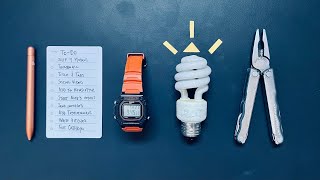
Matt Ragland breaks down productivity into four connected steps: define your actions, protect time for them, organize your information, then pick tools that support the first three. Most people skip ahead to new apps, which wastes money and time.
Chapters
As the new year approaches, people feel really excited to get started on New Year's goals, resolutions, intentions, themes for the year. There are so many different pieces of advice that come with productivity and focus and how to get things done, how to manage time and tasks. I've given you so many tools and ideas for that as well. You'll hear it from a ton of other people. I want to simplify things for you and give you 4 simple models of productivity advice so that when you hear something that kind of piques your interest or seems like it'll be really useful for crushing your goals in the new year, I want you to run it through this filter of productivity and just ask yourself, Am I already doing something that makes me effective at this particular model of productivity? If you're interested in going through this virtuous cycle with me at the beginning of 2021, I'm hosting the third round of my cohort course, the Productivity Power-Up, where I show you these four models of productivity. We have multiple lessons about each one and many other things that will help you be more focused and productive going into the new year. This really can help set you up for sustained success going into the new year. Instead of feeling overworked, hectic, overwhelmed, the Productivity Power-Up will give you a system for success that you can apply over and over again through your life. So if you're interested in it, all you have to do is just sign up for my email list in the description below, and I'll make sure you get all the information about how you can join. As I've studied, experimented, and implemented countless different types of productivity advice and strategies in the past several years, I've realized that there are really four main models of productivity that you can filter any type of new idea, tip, tactic, or strategy through. Once you understand these four models, it makes it a lot easier to understand, is this something new that I really need to implement in my current productivity stack, or is it something that I'm already really strong in and I can keep doing what I know already works? It's really easy with all the new productivity tactics and strategies and acronyms that come out seemingly every single day to think, oh, well, maybe this is something new that will help make me better. Maybe it will make me more effective, more efficient. This is a common temptation for productivity because just by virtue of the pursuit, we want to be looking for things. We have an inclination to look for things that will make us better, that will make us more productive. But if we're not careful and we're not applying these productivity models to new ideas that come out, then we end up wasting a lot of time and attention on things that we're already really good at and already have sound techniques and tactics for. The four main models of productivity are action, Time, information, and tools. When you understand how each of these work and the different tactics and strategies that go into each one, it makes it a lot easier to understand how you can assemble a productivity kit for any type of challenge, issue, or problem that you may be facing in your work or in your life. An important piece of this concept that I want to share with you is that these principles or models do tend to follow a very linear progression. So when you understand what you need to do to take action, then it's best to continue on to figure out what kind of time do I need to protect and understand in order to be effective with my action. You see how that works together? For example, the action model are tips and tactics about how to get things done and goal frameworks and even habits and routines. These are the ways you take action, the way that you do the things that need to be done. The second model of productivity is time. Once you have a set of tactics or strategies for the way that you take action in your work and in your life, then think about how much time do you need to protect in order to be effective in those actions and get them all done. This can be accomplished by things like time tracking, time blocking, attention allocation, the Google 70/20/10 rule, the Jim Collins 50/30/20 rule. These are all things that I have videos about on YouTube if you want to look for them. I'll try and link in the description below. Once you understand action, then you can protect the time needed to be effective in pursuing those actions. Now, once you do all that, then you need to have a model for organizing your ideas. And this could be things like note-taking, Zettelkasten, Sparkfile as Steven Johnson calls it. Could also be things like the PARA model that Tiago Forte talks about. Once I understand the actions that I need to take, I've protected time to do them. Now I need to organize my ideas and information to be effective and efficient in the time that I've protected so that I can do the things. You see how this is a linear progression going from action, time, to ideas. And once I have my ideas, then I will be effective in my time. To accomplish my actions. So it goes back and forth, but in kind of that progression. The fourth and final model of productivity is the one that we tend to get really excited about. And those are the tools. Now, tools can be as simple as note cards and the Bullet Journal and any other kind of analog tool. Post-it notes are a productivity tool, pens and pencils. But I also want you to think about where we normally get stuck and where we tend to spend a lot of time. And those are things like trying to figure out the newest app, the newest service or software that we can use, something like Notion, like Roam, Toggl for time tracking, Taskade or Evernote, Supernote. There are so many different tools. One of the things that I've noticed through people that have been through my course, Productivity Power-Up, and clients that I've worked with one-on-one is the temptation to hope that by finding the right tool, you'll be more effective and productive. Sometimes that is the case, and it is that sometimes that keeps a lot of our curiosity going. But what I have found is you can be effective with any of these tools as long as you understand the three models that precede it. So as long as you're clear about the actions that you need to take, as long as you've protected time, to do that work. And as long as you've organized your ideas, thinking about how you're going to bring that project or bring that goal to life. I'm not saying that it doesn't matter what tool you use, but there is not a tool that is going to make all of those other models that much more effective that you need to spend the amount of time that most of us do trying to find miracle app that's going to solve all of our problems. I'm telling you right now, it doesn't exist. A critical point that I want to make about productivity tools is that whatever tool you're using or selecting should align with one of the other three models. When you're thinking about, should I use this tool? You have to be thinking about, is this going to help me take action? Is this going to help me manage or track my time? Or is this going to help me organize my ideas? And if the tool doesn't do any of those things, or you can't think of a specific use case, then you don't need to be worrying about that tool right now. What I find really encouraging and exciting about understanding these 4 models of productivity is they form a virtuous cycle of productivity and getting things done. When I understand the actions that I need to take and I protect time to do them, and I've organized my ideas and I've selected the right tools for the job, then I naturally will build confidence for the work that I'm doing. I will build expertise for the kind of life that I want to be creating. I know that next time I go to organize a project, to understand the actions that I need to take, I will be able to look back and say, hey, I've gone through this loop before. There was a time before where I clearly defined my actions, I protected my time, I organized my ideas, I selected my tools, and by doing all of that, I was able to build my confidence for this work that I'm doing. The 3 takeaways that I want you to have from this video are: Number 1, action, time, and information are a very linear progression. You need to clearly define the actions that you need to take. You need to protect time to work on them. And then you need to organize your information and ideas. In order to make your time productive that you're protecting so that you can start to check off and actually do the work so that you can accomplish your goals. The second point that I want to make is don't go looking for new tools just for the sake of new tools. All right. It's too easy to think that there's a magic app out there, 007 GoldenEye fans, the golden gun, that's just going to solve all of your problems and make you more productive. No app will make you more productive if you don't understand and you don't have the confidence to define your actions, protect your time, and organize your ideas. So when you're selecting those tools, ask yourself, will this tool help me? How will this tool help me clearly define my actions? How will it help me protect my time? How will it help me organize my ideas? When you filter your tool selection through those other 3 models, then you'll understand in a much clearer way how this tool is going to help you and if you should pick it up or just kind of metaphorically put it back down. The 3rd takeaway of this virtuous cycle of productivity is as you go through it and you're aware of the things that you're doing and how you're filtering your decisions through this cycle, you will build confidence in the kind of person that you are. You will develop expertise in your choice of work, in your field of study. And as you do that, and as you are aware of it, now the next time you go to define your task, next time you set a goal, you'll understand, you'll remember these 4 models of productivity that you can go through this virtuous cycle, come out on the other side and say, I've done this before. And so I know that I can do it again. Thank you so much for watching this video. Let me know in the comments what model of productivity you feel most confident in and which you need the most help with going forward into the new year. I appreciate you watching and I'll see you in the next video and maybe in the Power-Up coming up soon. Thanks everybody. Bye.
More from Matt









Journal reading 📖 Reflectjons on how I’m living & how it aligns with the vision I have for my life.

You don’t have to listen to me. But you do have to be intentional about the systems in your life.
