5 Simple Bullet Journal Strategies I Use To Be More Productive
Matt Ragland breaks down five productivity pillars—Action, Time Management, Ideas & Information Management, Tools, and Frameworks/Mindset—and shows how to apply each one in a Bullet Journal. He walks through specific tactics like daily logs, QMWD goal-setting, time blocking, and SMART notes to build repeatable loops that boost confidence and output.
Chapters
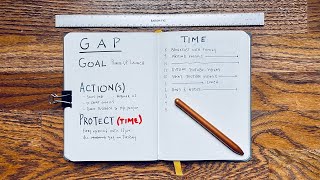
Hi everyone, my name is Matt, and welcome to a new Bullet Journal productivity video. Today, I'm going to be showing you how you can use these 5 different pillars of productivity in your Bullet Journal to be incredibly effective and efficient with your time, with your goals, and the things that you want to get done in a given day or week. Because one of the most overwhelming things about productivity practices is that it seems every single day, there is a new type of productivity tip or tool or a way that you can save time, and a lot of those are going to be valid, but I'm gonna show you how you can quickly categorize and filter the different types of productivity power-ups that you have and new ones that you might be learning to understand how you can best implement them in your life and in your work. One big thing that I wanna tell you about before we jump into the main part of the video is as you're watching this and you're thinking, okay, how do all of these productivity pillars fit together? How can I combine these power-ups that I'm developing as a productive person? How do I assemble my productivity kit so that no matter what happens, or no matter what challenge I face, or no matter what goal I want to achieve, I know that I can assemble my productivity kit and set a roadmap for myself to be successful in the thing that I want to do? Well, there are a couple of ways that I can help you with that directly, and the biggest one is with my upcoming Productivity Power-Up Masterclass. It's a 4 to 6 week program that you can be a part of where we gather as a group twice a week live for about 90 minutes. We go through these different productivity pillars. We talk about the different power-ups of productivity that you can use. We talk about Bullet Journal and Notion and Roam. We get really in-depth and also talk a lot about how you can apply this to specific goals, to outcomes, to habits that you want to build. It's a powerful practice and community for everyone who's been a part of it. And I'm starting a new cohort in April 2021, so coming up really soon. And the best way that you can know more about it and learn if it's a good fit for you at this time in your life is just to go to mattrogland.com/powerup to get on the email list. Now, if you're already on my email list, maybe you've been getting my daily emails at mattrogland.com/daily, but I know it's been a transformational thing, not just for me, but for tons of people who have been a part of the program so far. And of course, true to this channel, we will be diving into these different concepts and pillars of productivity using a bullet journal. I'll show you how to apply each of these concepts and pillars using the tips and tactics that we are very familiar with in the bullet journal community. So let's go ahead and jump into the video. I want to give a big shout out to the sponsor of this video, AppSumo. AppSumo is an online marketplace made for entrepreneurs by entrepreneurs. I've been an AppSumo customer since 2012 and have gotten some huge deals there. And you know what, that's pretty normal because all you get at AppSumo are huge deals. Like I'm talking 70% up off to 95% off. In fact, the two that I got that have made like some of the biggest impacts on me over the years are like, if you're a YouTuber, you've probably used TubeBuddy. I got a lifetime deal to TubeBuddy through AppSumo. One of the first like productivity apps that I got was through AppSumo, it was called Workflowy. These are And this is a community, this is a marketplace that is here to help entrepreneurs, to help creative people do more of the work that they love, to do more of the things that they care about, to build the business that matters to them. Best of all, signing up for AppSumo is totally free and only takes about 20 seconds. And I really love that because you'll see a lot of deal sites now where you have to like be a member of their deal site to then still spend money somewhere else. Not at AppSumo. Not only is it totally free to sign up and super fast, but my viewers can use the code MATT_RAGLAND10 at checkout or just click the link in the description below, and you will be able to save 10% off of your first purchase at AppSumo. Like I said, these deals are huge, and a lot of them are lifetime deals. So even if you see that they start charging monthly, you know, at any other time, you're going to have lifetime access to that product because of the deal that AppSumo gave you. So, thanks again to AppSumo for sponsoring my channel, for sponsoring this video. And once you pick out your AppSumo deal, please let us know in the comments which, which product you picked and how it's going to help you lead a more productive, focused, intentional life. The first pillar of productivity is that of action. And you can categorize the different action-based tips and tactics of productivity into things like task management or goal setting. And two great ways to manage that in a Bullet Journal are with, one, your daily log, which is what I recommend everyone start their Bullet Journal with. Number two is with a master task list, and as you expand out those master tasks into things that you want to do for the week, for the month, or for the quarter, or even for the entire year, use my QMWD goal setting framework to do all of those things. The second pillar of productivity is time management. Now you can think about this a couple of different ways, but the two main ways that I've talked about time management on this channel, and I believe are really effective, are time tracking and time blocking or calendar blocking. And they work really well in tandem with each other. Like when you track time to understand how long things are going to take, it makes your time blocking going forward that much more effective because you know, like I know how long it takes to shoot a YouTube video. So I'm not just going to block out an hour, I'm probably going to block out 2 or 3 hours a couple of times a day, or not a couple of times a day, a couple of times a week, in order to make sure that I have enough time blocked out and basically budgeted to make sure that I can get a new YouTube video out. The third pillar of productivity is how you manage your ideas and information. And so if you're using a bullet journal for this, then you can use like analog versions of Tiago Forte's PARA method, or something like how I've shown you how to take analog notes, like the SMART or QUIC notes that we've done a few videos about in the past. You can also think about this as brainstorm lists in your bullet journal, collections where you store different information based on the category or collection that it might be a part of. But the way that you manage your information and your ideas, not just for, you know, finding them in the moment, but how do you, how do you manage them properly for quick retrieval later on? And this is where things like Roam and Notion that have great search functions can be, you know, really powerful for quick retrieval of information, but the way that you manage your ideas, the way that you manage and retrieve information that is valuable to you and your work, that is the third pillar of productivity, because it really is something that ties a bunch of other things together. The fourth pillar of productivity are the tools that you use. So we can see that direct line being drawn to how we use the Bullet Journal to be productive, how we use things like the Full Focus Planner or the best the self journal. These are all tools that we use to be productive. You can also definitely start to include things like Notion, like Roam, like Cascade, like Woven as a calendar. And I want you to think about this critically because often we focus too much at the beginning on the tools that we're using, or we look directly to tools to solve problems for us that we should be focusing more of our energy on how am I using my time, how am I taking action, how am I organizing my ideas and information. Tools can definitely help with that, but often, and you know, entirely, they are more a function of how we use them than being the silver bullet for solving all the problems to begin with. The fifth and final pillar of productivity that I don't see people talking about as much, because maybe you could consider it like the soft skill of productivity, frameworks. And to be honest, it's simply your mindset, your confidence that you build by doing the work, by going through these different cycles of productivity. And I believe this is so important because how often do you start a session where you're like, okay, I've blocked out time, I know, like, think about all the steps that you can still go through and then get yourself stuck. Think about it. You have planned out what your action steps are, you've blocked time, you've gathered all the information, you have like your ideas put together, you have an outline for things, you have, you know, your tools ready to go, you're ready to write, you're ready to film, you're ready to record your podcast, but then you get there like, I don't know if I can do this, I don't think I'm any good at it, people aren't gonna like it, and you get stuck because your mindset isn't there, your confidence isn't there. And I believe that this is so important and not necessarily talked about enough in the world of productivity tips and tactics. Now, here's what I would do in order to build your confidence in the productivity power-ups that you have, in the things that you can do, because I do believe that you can do these things. I hope you believe that you can do these things, but it's simply to start small. On this. So when you're getting ready to do a thing that maybe you've been stuck on in the past and you've gotten everything lined up and you're at the moment, you're like, I'm gonna let myself get distracted, I'm going to like, you know, do this other thing that's, you know, maybe more downhill work instead of like the tough uphill work that I need to do. Just start really small. Oftentimes when I like get a little stuck and, you know, you might be like, you might think this is funny to hear, But if I feel stuck or like unconfident about— unconfident about a, about a video that I'm about to record, all I will try and do is literally just like record the intro, like a couple of minutes. And once I do that, I'm like, okay, I got some ideas percolating, I'm going to do, I'm going to do the rest. So oftentimes it is just starting really small. And even if that small start is all you do in the moment, you've at least given yourself a starting point to build momentum in the next productivity session that you have blocked out for yourself. And once you do that, then you'll be more confident next time you go into the cycle of, okay, what are my action steps for the things that I need to do for this, you know, this goal that I have, this habit that I want to build, this project that I want to complete? What you're doing with these 5 productivity pillars is you're building a virtuous cycle of productivity and confidence that allows you to do more over and over and over again and feel really good about the work that you're able to do. Going through this cycle, even in really short increments and loops, is a huge indicator of the confidence that you build, the productivity that you're able to, like, create and output and do more things that matter to you. Because you're building that confidence, you're going uphill, even if it is like step by step, you know, little step by little step. It doesn't have to be leaps and bounds. I want you to think about these productivity pillars as a virtuous cycle that you can complete every single day to build your skills, to clarify what needs to get done, and build confidence in those skills that you're building. So I'll show you how it all kind of works together using each of the pillars. So let's say, of course, we start with the action, deciding what we want to do. And, you know, how we're going to do it. And so that could be things like the gap plan that we have talked about, or could be like just something as simple as the tasks that we want to be doing. Great. So that is Productivity Pillar 1. Let's continue to go down to the time. What time do we— can we give to this? We would need to kind of track to understand. We may want to block some time. To understand like when we can do it or just define some time that we have available. So, once we decide on the actions, we're going to decide on the time, and then once that is done, let's think about what ideas or info we need to gather or have prepared. So, these are things like, you know, note-taking and could also be something that you could use like para from Tiago Forte, or my variation on that, which is wild. Now we've gone through these first few pillars. And so if, say, I want to start a YouTube channel, then I'm going to, like, make a plan for that. Like, what are the actions that I need to take to, let's just say, start recording videos? Well, what time do I want to block into my week to make sure that I'm taking the time to complete my actions? And then once I know that, well, what kind of ideas or information do I need to gather to make sure that I have content ready for that? So let's, let's keep going now. So let's go into this first, this next one and say, what are the tools I need to use to make these actions easier to do? Now, if we're talking about something like video, of course there are video-specific tools like a camera, but let's say if we're just talking about some things like maybe idea information management, it might be something like Notion or Roam. Another example, like I talked about, was, you know, of course, using a BuJo for this, that can help like clarify your tasks every single day. So now I'm using like specific tools, but I didn't start with the tool necessarily. It went from here is an action that I want to take, time that I need to protect for it, ideas that I have to do the action, And then what are the tools that best serve these needs that I have based on the first 3 pillars? Now once I do all that, and of course I take the action, what I'm doing is I'm solidifying my mindset and I'm boosting my confidence. So let's just go ahead and put confidence in here too, because I'm doing the work. So I of course have to do all these things, but once I have like improved my mindset and boosted my confidence, because I'm following like all these pillars, I'm creating a cycle, then next time I go to take action, or I make a plan or a task list, I know because I've completed this loop before, that I can be more confident in my ability to take action, to track and protect time, to gather the right notes for the right time, to use the most effective tool for the project or the goal, which in turn continues to improve my mindset, build my confidence, so the next time I take action, and so on and so forth, good things are going to happen. I want you to think about how many times each week you can get through this cycle, even in small ways. And if you can get through this cycle, say, 5 to 10 times per week, then that is going to be something that will continue to boost your confidence and make you feel like you're ready to take on the next day, the next week, the next set of actions of whatever goal or challenge you have in front of you. Every day, I want you to have a little micro goal of getting through this virtuous cycle of productivity, these 5 productivity pillars, every single day, even in some small way. Think about these small starts, because when you are intentional and aware of the good work that you're doing, and you can, you know, like celebrate yourself a little bit for that, then you are going to literally build confidence. You are going to build that experience and expertise. And so next time, tomorrow, next week, when it's time to start that virtuous cycle of productivity through these, like, through these 5 pillars, you're going to feel better about it each time. I want you to keep these 5 pillars of productivity in mind As you continue to learn, as you continue to grow, as you continue to pick up more power-ups, tips, tactics, strategies for being more focused and productive, and realize that even if you feel overwhelmed by the amount of new information that's coming in, look at which productivity pillar does this particular, like, piece of advice sit on top of. Is it, you know, about managing my time? Is it about managing my actions, my tasks, my goals? Is it about the ideas and information that I'm having and I need to organize and retrieve at any time? Is this just a new tool? And if it is a new tool, which of like those previous 3 pillars, you know, time, action, and information, does it fit best into? And ultimately, how fast am I getting through all of these loops so that I'm building on my confidence, I'm improving and upgrading my mindset, for believing that I can do the work that matters to me. Now, I want you to keep in mind that you can do many of these things, especially the first 3 pillars, with a Bullet Journal. A Bullet Journal is excellent for time tracking and for action tracking, especially in a day-to-day basis. The Bullet Journal is also excellent for brainstorming, for outlining, for getting ideas out of your head and onto the page, clarifying, mind mapping, You can do all those really well with a Bullet Journal, but, you know, even if you want to expand it even further, tools like Roam and Notion work really well for, like, large-scale ideas and information management. I want this video to be a really big encouragement for you and something that gives you a clarifying filter for how you can think about the different tips, tactics, strategies, and power-ups that you use for your productivity. Don't think that every every new thing that you come across has to exist in like this whole new category in your mind. Think definitively, intentionally about, is this helping me with my time, with my action, with my information? If this is a tool, how does it help support my time, my action, my information? And am I going through these loops fast enough so that I'm improving my mindset, I'm boosting my confidence to do more of the work that matters, so that when it's time to look at and say, like, here's a new goal, here's a new project, what are the action steps, what kind of time do I have? You can see how all of this fits together to create a virtuous cycle. Think of this video as the primer for this, you know, really big concept. And if you would like my help directly and personally with this, then make sure you go to mattreigland.com/powerup or mattreigland.com/daily to get on my email list so you can learn about the Productivity Power-Up Master class. It is a live course that I run for 4 to 6 weeks, 2 calls a week. There's also a community where, you know, we interact every single day. There are assignments, but it's not the kind of assignments where it's going to take you a lot of extra time to do. It's the kind of assignments that apply to the life and to the work that you're already living, the things that you're already doing. It will help improve and boost those while we are going through it. It's not going to take a ton of extra time. From your life, which I think is something that I, you know, I want to be really intentional about because I know we all live busy lives. This will help you clarify and be more effective in the work that you have to do and in the life that you want to live. If you have any questions about the 5 Pillars of Productivity, the Productivity Power-Up Masterclass that I'm running, just let me know in the comments below and I'll make sure to like respond to those really quickly. I also want to say thanks to AppSumo for sponsoring this video. Make sure you check them out and use the code MATTRAGLAND10 at checkout or click the link in the description below, and they will hook you up. Thanks so much for watching this bullet journal productivity video. I can't wait to share the next one with you. I'll see you then. Bye!
More from Matt









Journal reading 📖 Reflectjons on how I’m living & how it aligns with the vision I have for my life.

You don’t have to listen to me. But you do have to be intentional about the systems in your life.
