A Minimalist Bullet Journal for Increasing Productivity & Focus
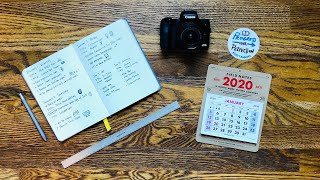
Matt Ragland walks through his 6-month Clear Habit Journal setup, showing how he uses index pages, habit trackers, weekly and daily spreads, and one-line-per-day journaling. He explains why a semi-structured approach works better for him than rigid planners.
Chapters
Hi everyone, my name is Matt, and welcome to another Bullet Journal productivity video. In this episode, I'm getting into what is always a very popular topic here on the channel and across YouTube, and it's getting ready for the new year. Now, this is going to be a little bit different than my past, like, annual planning videos.
You can check out them in the past 2 years in the description below.
But in this one, I'm showing you how I'm doing a 6-month layout in my Bullet Journal and how I am planning out all of the events, how I'm doing a future log in context with the daily, weekly, monthly spread, how I'm using the index. All of those things I'm going to get into in this video. Now, what you're not going to see as much of in this video, I'm going to have a separate video for it, is how to plan out your goals. Now, that may sound a little odd to you for, like, an annual planning video, but since I have a system that I've been consistent with a layout and a spread that I'm comfortable with and have been able to work on for several months now. What I'm going to do for really the first time is do an expanded, like I said, 6-month layout so I can use the future log in context with the actual planning that I'm going to do on a daily, weekly, monthly basis for the first 6 months. I think that's all that I really need to cover in the intro for this. I know that what you like seeing is the actual, like, Bullet Journal layout from the overhead shot, So go ahead, grab some coffee, get your bullet journal ready, and let's go ahead and dive in.
I'm starting 2020 with the Clear Habit Journal, and while I do have a complete review of this journal on my channel that you can check out up here, I still want to go over, like, really quickly some of the reasons that I chose this particular journal to start the new year rather than a completely blank one like the Baron Fig Confidant, or a kind of structured one like the Self Journal or the Full Focus Planner. What I like about the Clear Habit Journal is that it has a few things in it that I would use anyway that save me the time of kind of recreating it on a daily basis, weekly, monthly, whatever it is. To start out, it has an index. Again, the Baron Fig Confidant is probably my go-to blank bullet journal, but it is totally blank. Does have an index. It has the one-line-per-day journaling that I've liked doing, which also frees up some more space on my monthly layout, which I'll show you in a few minutes. Also has page numbers, which you can't really see, but just trust me, it does, and that's nice. It also has— even though I, I'll talk about the habit trackers in this, but it also has pages upon pages of more habits than you could possibly track. Again, that is something that I cover in more detail in the Clear journal review. The other thing that I really like are the page signifiers for where the page is halved and third— thirded? Halved and thirded? That's not how you say it, but you get what I'm saying. I would normally mark this out myself, and the only reason I put these here is so you can see the indicators themselves a little more specifically and directly., but they're just these light, like, plus or hash mark indicators to show you where the page is sectioned off and split up. So those are the main reasons that I chose this, what I call a semi-structured planner, like Clear Habit Journal. I did a little bit of doodling on it, just 2020 right here, one of my favorite quotes right here. So I used these metallic Sharpies to make, to make this on the dark paper. Looks real nice. I also have the year right here on the spine of the journal. I haven't named this one yet. One last thing before I get too deep into explaining the journal is that I do have a Bullet Journal Basics series that walks you through every piece of setting up your BuJo. So whether that's the index, the monthly layout, the daily, the weekly, preview, review, all of this, I'm going to give you a big picture overview of it in this video, but then there is a specific Bullet Journal Basics series that will be linked on the end screen of this video, and I go through everything. So if you have specific questions, make sure that you watch those videos as well. We'll start with the index, and the reason for that is something that I've struggled with in the past is proper indexing. Like, here's last year's Loysterm, and you can see that I did a pretty good job of it through May, but then completely fell off the wagon and didn't do apparently anything in the rest of the year. One of the reasons I believe that I struggle with that and indexing in general is because the future log doesn't feel like it's in context with anything else that I'm doing for my spreads for the rest of the year. So what I'm doing to keep myself accountable for both the index consistent planning and a contextual future log is that I laid out the first 6 months of my year pre-planned, kind of pre-laid out in the Bullet Journal. Now, I haven't filled out every single month yet. I need to do that over the next couple of days. But what each month looks like, just as a big picture view here, is that I have the monthly layout here, and then in this column is the day of the month and the corresponding day of the week. So January 1st, New Year's Day, W for Wednesday. Come across, and I'm still using the simple habit tracker, again keeping everything in context of movement, journaling, reading, just an X to signify that I have done those. And then tracking my mood right here, AM and PM mood. And then where I used to have the— where I used to have a one-line Journal with my monthly layout. See where I didn't do it very well here, where I used to have One Line Journal in my monthly layout. Now again, with Clear, I already have that back here on the one line per day section, and I can reference this page 8. What I would do is say P8 One Line Journal. Again, that gives me more on the referencing. I can also say this is page 24, come back right here to the appropriate page, and I can see January month page 24. So this is how I'll be like referencing and threading, just an example of it right here. Same thing for February month page 42. I'm also referencing this here in the index month by month. So here's my monthly layout. There are, as I've already mentioned, habit trackers, but it's kind of the same thing. I want to keep everything in context right here. So these are the 3 core habits that I track every day that I know correlate very highly to happiness and lack of stress. If I'm doing additional habit trackers, then I would do that just in the habit tracker section of Clear. So what I'm doing with this extra section of the monthly layout is putting my primary projects and objectives. So, product tours and onboarding, launch challenge and community, and then a Bullet Journal Basics series, which is already in progress, but just some additional notes right here. I'll talk about this in a minute. So, going into a week ahead, I would put the days of the week right up here. I reference the previous week and the past year's Bullet Journal that I just migrated away from. And then I would put my goals and objectives for the week on this page. Each day then is split into half a page, and again, I can reference this really easily and clear because they have a little plus sign right here to section off that half of the page. And I'll be putting in, like, say 11:00 AM is when we have our Podia team meeting. So, what I do is at the top, I put in all of my events, agenda items, meetings, and then a few lines down I'll start to put in my task for the day. So data review is always something that I do on Monday. Now, again, just to reference it, I do have a daily Bullet Journal layout video in the BuJo Basics series, so I'm not going to get too deep into it right here. But half a page for each day and then a quarter page for the weekends. That is everything that I have. So I went through every week for the first 6 months and laid all of this out. So you can see for January, then I go into the 13th, 19th, those days, 20th through 26th, those days, and then all the way through February 2nd. So then I go through those days. I will get into February a little bit right here, but then that next page, page 42, is where I start to build in that monthly layout.
What's important about this layout and this structure for me going into 2020 is that it allows me to kind of easily work on the things that I've struggled with in the Bullet Journal, and that is indexing, that's the future log, that is keeping notes. Because I have everything already structured, laid out, so if I have an event in March, I don't have to put it in a future log that I haven't been very good at looking at. I don't have to try and index it where, again, I haven't been very good at doing that. It allows me to just go to that day ahead and say, this is what I'm doing at the beginning of March.
So I went through again and did this for every month for the first 6 months. Now, why would I do it for the first 6 months, not for the entire 12 months, or see how many I could fit? I think if I did like, say, one bullet journal for like every 6 months, I think that would be a really good use of everything. The other thing that I didn't want to smash everything, like, as many days as I could into this is because after 6 months, other than it being a nice splitting point for the year, is here I'm at page 138, and now I can use the rest of the pages in this journal for notes, collections, and brainstorms. So what I'll do, this is where I'll use a lot more, like, unstructured note-taking, collections, brainstorms in order to reference back to the pages, to the events, to the tasks that I have. Because something that I've struggled with for also for a couple of years with normal bullet journaling is where to put my collections and notes. I might do things like, say, here on page 82, just notes and random tasks. But like, it feels a little— it feels— it really messes with the flow of the entire bullet journal, and it it left a lot of unused pages. Like, here is the books collection right here, and it was not even half a page, because then I started using— just, I had to get to the next page to do, like, the next bit of layout. And so I wasn't really sure. I never felt great. I never found a good way to have a collection or, like, a series of notes that didn't get in the way of my normal flow. So now I have this entire 6-month section. Yeah, it's not all filled out yet, but I have this entire 6-month section right here. So this is the first 6 months of the year, and then I get into everything that I can do for notes. And so what I would probably do right here, again for January— January is on page 138. So now and say these are January notes and brainstorms. What I can do to reference them is And say Begin Other, page 138. I can also come to January itself, the first one, the monthly layout, and write down here page 138 notes. So page 138 for notes, collections, whatever. If I end up with a specific page for a collection, I can still add that into the index easily.. But here I'm referencing page 138 for notes and collections, and I know when I'm looking at it, like, okay, where I've been making notes for January things is page 138. The other thing that I can do is, as I'm making these notes, say like, add videos to ACE 2020 course, page 25, for goal-specific objectives. That brings me back here where it's cross-referenced, page 138, notes for ACE. The other thing that I can do like let's say on Saturday the 11th, is I want to film Ace videos. Okay. So I want to do this and I could say, little arrow right there, that's just my own indicator. I could say notes list on Page 138. So then I'm coming back here over to page 138, videos to make. So then I have my list of videos for Ace that I'm going to shoot, and I can list them here. And I also know I can put like a parenthesis right there, page 29 task. I could also, if I wanted to, rather than page 29, I could also say, uh, January 11th, or I could do both. Because now basically what I have— and let's talk about the future log a little bit— is basically now I have a contextual future log. I already know that I have a day laid out for it, which does give it that kind of structured feel that a self-journal or a full focus planner might have. But coming in to say like the March layout I know on March 5th, which is a Thursday, I am speaking at a conference. So now I already have this planned out. If I want to know what I'm doing in March, I can just go ahead and turn to the March layout instead of having a March layout in addition to a March Future Log. Now, what Ryder would say in the Bullet Journal Method is that the future log informs the monthly layout when you're ready to get there. But I have just always struggled with that, and I wanted to try, and I've really been excited about doing this kind of pre-planned monthly layout so that I can use it as a contextual future log.
Now you may think to yourself, and it's a very reasonable thought, of, well, Matt, why don't you just go ahead and get a structured, like, daily planner like you would the Self Journal or the Full Focus Planner, which are both very good, like, structured goal-centric, habit-centric planners. The reason that I didn't want to do that personally is that even though those are structured like from a daily, weekly, monthly standpoint, I have my own, as you've seen, upgraded rapid logging system that I use that I feel really comfortable with that allows me to get a lot of information in a relatively condensed section of pages.
So now we can see how all of this ties together. I go to the index right here and see that January starts on page 24. I could go to April, which starts on page 80, and I can look at and say like, okay, what do I have during this month? What are my projects and objectives, habits, the way that I'm tracking those? And then I can also use the different days to say like, okay, I have something on, you know, like say February 17th. Oh wow, I really didn't mean to do that, but how nice is that? So, on the week of February 17th, I already have that here and I can put in a specific event. So, if I have, like say for example, I'm speaking on Thursday the 5th, the 2nd, this is the week of the 2nd, and so the Thursday would be right down here even though I haven't filled it out just yet. I'd say, you know, March 5th, and I could put down all the speaking details that I need right here. I could also cross-reference back here into my notes to add any additional like flight, hotel, or like speaking arrangement information. So you can see how I'm referencing everything back and forth. The full 6-month layout gives me a contextual future log that I can reference, index, put events on, and be ready for. The one line per day journal works really well for me, and I can see everything again kind of together in context for the different months, see how things are going. And then I'm using the final basically 50 pages of the journal for my notes, collections, and brainstorms. So that's how I am planning to use the Clear Habit Journal for the first 6 months of 2020 to keep myself on task, to better plan for future events, and stay in context of with them and for them as I plan and keep myself accountable for the things that I need to do, for the people that I need to take care of, the projects that I want to accomplish, and the way that I want to live my life.
I hope this video gave you some really good ideas about how you could structure your bullet journal, how you could lay things out, whether it is just day at a time, which is great for getting started, or for like, say, a week, a month, or a quarter.
At a time.
What's important to remember is that you should find a Bullet Journal system and process that works for you, that works for your life, that works for where you are right now in terms of being a consistent Bullet Journalist. And if that's the case, then I would say keep it simple, keep it small, maybe just a couple of bullets, tasks, notes, meetings, whatever it is, every single day, just so that you can be consistent with it, and then that will help you build motivation and build momentum towards doing it over a long period of time, which coincidentally is a great way to build any habit in the new year. Now, you may have been watching this and thought, well, can you give me a little bit more specifics about this part of the Bullet Journal? And that's a really good question. So what you'll see in the end screen, and again in the description for this video, is that I have a Bullet Journal Basics series that's going on right now. I'm kind of interrupting it for this 2020 planning video. That talks all about the index, the opening pages, the daily layout, the monthly layout, weekly spreads, reviews, previews, all of that. So everything that you would want to know in very specific detail about the Bullet Journal is going to be covered in this basic series that's linked in the end card and in the description below.
So check that out if you're new to Bullet Journaling or you just want some more context on what the thing is.
Thanks again for watching, everyone, and thanks for the support over the past however long you've been watching, whether this is your first video or your 100th video watching on this channel. I'm extremely grateful as we go into 2020.
The channel turns 3 in February and probably going to pass 40,000 subscribers before then.
So just incredible. Thank you so much. And yeah, again, from the bottom of my heart, I can't wait for 2020 and seeing all the cool things that are going to happen from for all of us and how we can plan and execute and focus on the things that matter to us using a Bullet Journal, using other analog methods to just, yeah, have the best, have the best year ever. So thank you so much for watching. I'll see you in the next video.
Bye.
More from Matt









Journal reading 📖 Reflectjons on how I’m living & how it aligns with the vision I have for my life.

You don’t have to listen to me. But you do have to be intentional about the systems in your life.
