A Simple Time Management Principle for Building Habits
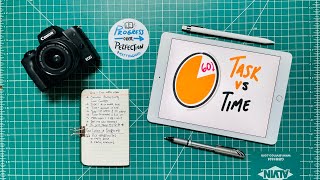
Matt Ragland shows how to choose between task-based and time-based commitments to build habits faster. He scripts, shoots, and edits a YouTube video in one hour, revealing how time limits force you to do less and finish faster instead of getting stuck in perfectionism and over-editing.
Chapters
One of the first productivity frameworks I give to new creators is distinguishing between the task commitment or the time commitment that you're going to focus your energy in. A really simple way of thinking about this from a creative output scenario is by thinking, am I going to complete the task of producing one new YouTube video no matter how long it takes, or am I going to calendar block the amount of hours I'm going to give myself to actually get the work done. Hi, my name is Matt Ragland, and I forgot to record a proper intro during the main shoot of this video. But I make videos that help creators, makers, entrepreneurs be more focused, productive, and profitable using simple systems. So what we're going to talk about today is this task versus time management. Had a little Nashville, little Tennessee come into that right now. We're going to watch this task versus time video, but I've distracted you already too much. Let's get back to the video.
Let's go.
This video, I'm going to be doing two things at once. And the first one is the big picture lesson, which is giving you the principles of task versus time scenarios. The other one that's happening kind of meta in the background is I've given myself a time constraint for actually creating this video. So right now it is 9:27 AM. And so I'm giving myself an hour till about 10:30 this morning to completely do this video. I'm giving myself a little bit of wiggle room because I'm doing like a video within a video, like video inception, and there's a dream within a dream. But what I'm going to be telling you is about the task and time principles kind of framework, and then also practicing that by giving myself a time constraint to actually work on this video. Video. All right, here we go. When you give yourself that hour of time that you can work on the output, what you can do beforehand to give you a head start on the creative process is to do a quick outline before you actually get into your hour or two of creating. Now this, you know, is your way, our way of cheating a little bit because I can grab, I can steal 15 minutes of time to do a little bit of a brain dump outline for what I want to cover in a video, in an essay, in a podcast, whatever it is, so that when I get into that hour of blocked protected time, I'm not spending 20 minutes of it getting set up and outlining. And even if I skip all of that, I'm not outlining, then my thoughts are just way too scattered. And I feel like I'm wasting time during the hour because I'm not saying as clearly what I want to. I'm not Am I going to be able to finish the thing that I started in the amount of time that I've given myself? Another thing that can make a really big difference in the times that you choose to block and protect for your creativity or for your habits is by identifying positive opportunities for that actual work to get done quickly. So right now I'm shooting this video and no one's at the house. My youngest son is at daycare and my oldest son is at swim lessons, so I have the house to myself for about an hour. I've identified at the beginning of the week an opportune time. Another opportune time, especially for people that have kids, are either early in the morning before they wake up or later at night after they go to bed. Identifying those natural opportunities in your day, in your week, in your calendar that you can protect that time, give yourself a little head start with an outline and be able to sit down, you know, stand up, however you are in the creative mode and actually begin to do the work when you have given yourself time to do it. Okay, so right now I just wanna give you an update. We are at 20 minutes into my dedicated time-blocked hour to do this video. Asking myself the question of what would a video look like if I only had an hour to do it is a challenge that I gave to not just myself, but the other members of the YouTube 10 Challenge because it was a common refrain the first couple of weeks This was taking more time than I thought. I was trying to do too much. I was using too much B-roll. I was being too perfectionist with my editing. These are all really common things for video creators, especially really trying to practice this myself, challenging other people in the group to do the same thing of what would a video be like if you only had an hour to do it?
What I would challenge all of us, if you just had one thing to say in the video, get in, get out, say the thing, publish the video. If you had to do a video in an hour, how little would you have to say in order to make it interesting? And maybe that means minimal editing, maybe that means no B-roll, still make it valuable.
And the biggest takeaway, the biggest lesson that I'm pulling out of this in the moment and that I'm sharing with other people in the community is you often have to do way less than you hope you would initially. So if you think to yourself like, oh, I've got an hour, I can shoot for 10 minutes, I can kind of get set up, I can work on the thumbnail, I can do some editing, I'll be able to do it all in an hour. It's way more likely that probably you can only do a 5-minute video. You need to realize that what you hope you're able to do in the moment is probably not what you're going to actually be able to do when the creative act is actually in effect. Let me set this down.
All right, much better.
Almost fell off my chair. Right now I'm at an hour and a half, so I've already missed my hour cutoff. And it just goes to show you, don't try and do more than literally one thing. And that's a really valuable, even if it is a really tough lesson to learn. It's the same thing when you're starting to exercise. You can use task-first time and exercise as well. This is actually where I first learned about it through athletic training, because you can say to yourself, let's just use something as simple as running. You can say to yourself, I am going to go run 1 mile. That's an example of a task constraint. You can also say I'm going to go run for 15 or 20 minutes. That's an example of a time constraint. It's the same thing with video creation. I don't have an hour. I have like maybe 20 minutes to shoot footage because then I have to edit and I have to do thumbnails and I have to upload it. I have to do all those things. But if we're just talking about, hey, I need to get the majority of this done within an hour, then focusing on that time constraint and actually doing less than I would expect is the only way that I'm going to be able to actually hit the goal of completing a video within the hour time constraint. Let me give you a quick recap of this because I'm going to go into editing real quick and, you know, knock this thing out. One of the most useful productivity frameworks you can use as a new creator is deciding if your creative output is going to be focused on a task constraint or a time constraint. A quick example that I really like of a task constraint is like Ship 30 for 30, which I've talked about a few times on this channel. They have a constraint of you're not going to write more than 250 words. A time constraint is like what I'm doing for this video right here. I'm giving myself 1 hour to go from time to start the video to have it ready to go and have it like on YouTube. Now that, that is a tight turnaround for YouTube, but even if I get it like 80 to 90% of the way there and all I have to do is upload, work on the thumbnail a little bit, write like in the description and everything, that will be good enough because I can do those in like smaller chunks of time. The last thing that I really want to emphasize is when you're doing this for the first time, always try and do less than you expect, less than you hope. Because I'm pro— I already know this is going to be really tight for me to actually do within an hour because I've given you maybe 3 or 4 different things to think about. If I was really, really focused on and had a really like hard stop at an hour, just get in, get out, give your viewer, give your reader one promise, one takeaway, one outcome that they can apply, and then start your editing process so that you can go ahead and publish. Because the more that you publish and the more at-bats that you take, to use another sports term, the, the more three-pointers you take, the better that you will get at the thing. You will close the gap, as Ira Glass talks about it. And this is even more important in the internet age. You will start to see what types of topics you're talking about that people really resonate with and that you're also interested in talking about., and you can double down on those topics as you go forward. Okay. Thank you so much for watching this video. I have, let's see, 35 minutes to do some editing in Descript. Very little B-roll on this. I'll also put in the description how long this actually took me. I might come back if you want me to come back and revisit this topic because there are like layers in it. There's a lot of, there's a lot of meta pieces and be happy to talk through those. Maybe we'll do a webinar about it, but thanks so much for watching, and I'll see you in the next video. Bye.
More from Matt









Journal reading 📖 Reflectjons on how I’m living & how it aligns with the vision I have for my life.

You don’t have to listen to me. But you do have to be intentional about the systems in your life.
