A Simple Time Tracker for the Minimalist Bullet Journal
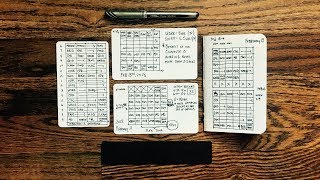
Matt Ragland shows how to track your day in 15-minute blocks using a simple grid layout. He walks through his actual week, demonstrates two different formats, and offers a free 5-day challenge with printables to help you find pockets of time for work or habits that matter.
Chapters
Hey everyone, my name is Matt, and welcome back to another Bullet Journal productivity episode on the vlog. In today's episode, what I'm going to be going over is how and why I tracked my time in 15-minute increments over the past week, what I was hoping to learn, the things that I wanted to gain out of it, and also the reason that I think you should spend 5 days tracking your time in these 15-minute increments. I'm going to show you exactly how I went through it, the little grid system that I used to check everything out, why I would do something this silly. My wife called it the nerdiest thing that you've ever done. Check out this episode. You're going to learn where you can find those 15- to 30-minute spans of time throughout your day that will help you make progress on the habits, the things that matter to you, the things that you want to start doing, whether it's something creatively, with a side hustle, or maybe it's an exercise habit, or journaling, or reading more, anything like that. The other thing that I want to go ahead and encourage you on is I'm going to be leading a 5-day time tracking challenge that is going to take you through all this. I'm going to give you the downloads, the printables, the daily prompts, just to check all this out. Because what I'm going to help you do with this 5-day challenge is to find the 15 to 30 minute increments in your day that will allow you to do something new So, go ahead and subscribe to these videos. You're going to learn a lot about productivity, and Bullet Journal, and like analog systems, and habits. If you want to go ahead and sign up for the emails as well, there's a link right below in the description. There's also going to be a card right up there that will allow you to join the 5-Day Time Tracking Challenge. I'm really going to enjoy sharing this with you, so let's go ahead and dive right in. So, where did this whole thing start? Well, it started by reading one of my favorite blogs on the internet, which is Wait But Why. And Wait But Why is run by Tim Urban, and fantastic guy, really good thinker. The article that I read from Tim was this idea of 100 blocks. And if you have 100 blocks in the day, let me show you how the math works out. So 24 times 60 equals 1,440 minutes in the day. And if you assume that everyone sleeps between 7 and 8 hours, or should, Then that leaves you with 100 10-minute blocks. So the basic premise of the article is that it really matters like who and what you spend your 100 blocks on. Exercise or going out with friends, like all these things matter. And how you spend your 100 10-minute blocks throughout the week is really like a reflection of how you're going to spend your life. So I didn't really want to get into the 10-minute block for whatever reason that just wasn't connecting with me. So what I did instead was I thought about like, okay, what if there are 15-minute blocks? So there are, let's see, 24 times 15. That means there are 96 15-minute blocks. So this is where I'm taking it. There are 96 15-minute blocks. And if you're saying like, okay, I'm going to use 32 of these on work. And let's just say I'm using— so that equals 60 blocks just on those two things. I can look at my time as 36 open blocks. So the big question I need to be asking myself is, what do I spend my 36 blocks on? Now let's just say right away that there are some things that you need to spend your 36 blocks on. If you have a family, you need to spend some time with your family. Hope that goes without saying. So we've got family. We've got food. You're gonna spend some time eating, I'd hope. So that's a couple that take up a lot of time right away. Family, food, just say spouse. Maybe commute is another. Did I misspell commute? I might have. Not sure if there's a second T. There's another one for exercise. Then everything else is kind of just what you want to make of it. So I have one that I want to commit to journaling, say side hustle, and time with friends. So these are all, these are just some of the possible things that you could spend your 36 blocks on. Okay, this looks like a mess now, but I hope you get the point. So let me tell you how I put all of this together. So here's an example. This is, let me find, this is the very first one that I did. Let me go ahead and zoom in here for you. This is the very first one that I did, and there's a couple of different ways of looking at this, and I'll compare and contrast them for you right here. So here are two different ways that I, you know, gridded out the day. Now, this I did during a workday, and the reason that I did like a solid grid during a workday is that if it's like this, this is more of a timed-out grid. So 6 AM, hour, 7 AM, hour, 8 AM, hour, 9 AM, hour, and all the way down. To the 10 PM time right here. Now, my wife really liked this one. For example, she likes seeing like, okay, this is what I spent my time on for all these hours. The reason that, and I really like this one too, this is one that I did on Saturday because I wanted to see like hour by hour. The reason that I have a solid grid right here without any like super specific times is that I know like if this is a workday, for me, then from 9 to 5, this, all of these are just going to say work anyway. To me, I'm not going to have like a big chunk of the day just taken up by one, by one set of blocks. Let's say I get up, I go to the gym, and I spend an hour at the gym. So this is getting to the gym, and then 1, 2, 3, 4, that's an hour. So 4 15-minute blocks going to the gym. I come back, I plan the day, I journal a little bit, and then I spend half hour breakfast and then an hour getting to family for family time. Okay? And so that is pretty much the— this I know is just the time. You can see I made a little notation right here, the time leading up to 9:00 AM. At 9:00 AM I start to work, and then I worked pretty long, a little bit longer than normal that day. I'll come back to that in a second. And then I just made a little notation here that now I'm starting this one at 6:30. So now I have these blocks going from 6:30 until about 10 PM. Let's just say down here. That's about when I go to bed. And so 30 minutes, 30 minutes on dinner, that's 2 15-minute blocks. And then 1, 2, 3, 4, 4 blocks. So 1 hour on family time, playing with my son, getting him to bed, reading. And then I spent an hour working on the vlog, 2 blocks, so 30 minutes just talking with my wife. I mobilized, you know, just stretched for 15 minutes, spent another 15 minutes just talking, kind of talked with her during the mobilize time here as well, worked on the vlog a little bit more, and then we watched 30 minutes of Billions and then just had a little wind-down time going into 10 PM. So this is what I spent all my extra blocks on. Now you'll notice that, you remember I said I worked till 6:30, you'll notice that I X'd out these 4 up here because I basically spent an extra hour working. So instead of these, instead of 36 open blocks, I pretty much ended up giving myself 32. So that is what you could do for like a single grid. Basically think about the Coming back over here, if you divide the day, 1,440 minutes, into 15-minute increments, that gives you 96 15-minute blocks. And I spent 28 of them sleeping. Okay, so I have 68 waking blocks, 32 of them working. So 36 available open blocks, just to come back to that. This is why I said like, okay, I'm just going to make a 6x6 grid. Of 36 blocks and then I'll break them out as needed. So that way I don't have this huge chunk in the middle of the day where it would have been like 9 AM to 5 PM, that's just working. So here I am at February 17th. This is Saturday, so I didn't work this day. So I was able to really look at from 6 AM to 10 PM, here's what I spent my time on. So talked with my wife a little bit. She worked, she worked on Saturday. So just a little bit time with her, and then I journaled for 30 minutes. I read, worked on this grid for 15 minutes. Then my son got up. I can see this happened around like 7:15, 7:30. Hung out with him for a little bit. We had breakfast, we played some more, and then he watched a few cartoons. And so I was able to plan, gonna recap, work on the grid a little bit more, and then we read. So this is just how— this is just how I went through the day from 6 AM 10 PM. It's very fair to be asking yourself, Matt, when do you find the time— like, when do you do this throughout the day? And that's a really, that's a really fair question. It's a good one. So what I do— you'll check this out. Let me find another— I find another one here for you. So here's a couple more that I did from last week, and this is just in a Field Notes notebook, a grid, which was really nice, just a regular grid, not a dot grid. So here's another like block of 6. You can see down here that I'll also like spend a little chunk working on the grid later in the day. So normally what I'll do is I'll come back in and I'll write, I'll spend like 10 to 15 minutes working on the grid and just kind of thinking back like, okay, what did I do from, you know, like 8 to 9 AM before I got to work? So that's, that's really what I'll do here. So here's I just give you a look at all of— let me just zoom out here and give you a look at all of the grids from the past week that I made. This one, this one, this one, and then I threw one in, in the barren fig here, right, as well. But here's a bunch of them from the last week. So you can see here I'm taking everything from my day. I'm trying a few different layouts here. This is 5 days of the 7. I have a couple more, like one in Baron Fig Confidant, the tiny one, and then there's the other day right there. You can see I've got the 6x6 grid and then I've got like the regular daily grid. So I'm going to give you downloads and make sure you check out— not sure which direction is, but up here there's going to be a card where you can download a printable one of both types of this. So just the 6x6, and then the like 6 to 10 in a layout. Also, you can of course add in additional, additional grid areas that you need additional lines. Okay, so check this, I'm going to be leading a 5-day time tracking challenge where you go through the grid, I'm going to be giving you both types of grids, not just the 6 by 6, but also the 6 AM to 10 PM kind of hour-by-hour grid. So you can track it based on which one feels right to you. Because I believe, again, I said this at the beginning, using this system and kind of going through it and just at first reflectively at the end of the day, looking back and saying like, okay, what did I do during this time? Maybe a check-in during the day as well might help, just depending on what kind of day you have. But I believe you can find a 15 or a 30-minute chunk each day, or at least like multiple times throughout the week, where you can spend working on something new that matters to you, or just putting a little bit more time into something that you've already decided like, this is something that I need to do more of, this is something that matters to me. I believe that following on this, like, Time Track Challenge for 5 days, you're gonna be able to find those chunks, and then instead of being reflective-reactive on your day, you can start to be more proactive about the things that you want to spend your time doing. So go ahead and subscribe with the card above to make sure you get in on the Time Track Challenge, and of course, subscribe to these videos below. I know this system may be a little confusing. I spent a lot of time, like, explaining it to my wife, so I don't necessarily expect you to get it right away. And but I wanted to go ahead and share this video with you. I wanted to share my process and what I'm thinking through on this. So please comment below on the things that were confusing to you. If you're just like, this is ridiculous, I wish you would go back to doing a different type of video. I want to hear that too. So please leave a comment, subscribe so you're making sure that you're staying because I'm going to, I'm going to keep doing the videos that I know are resonating with you and that I'm enjoying as well. And I know that there's a sweet spot there. I wanted to try something a little bit different for this one. So really curious to hear your feedback. Let me know, and I look forward to seeing you in the next video. We're going to be talking maybe a little bit more about this. I do want to update this based on your feedback. So sign up for the Time Track Challenge, subscribe to these videos below, and let me know what you think in the comments. Thanks so much for watching these. Thank you so much for subscribing, and I'll see you next time. Thanks. Bye.
More from Matt









Journal reading 📖 Reflectjons on how I’m living & how it aligns with the vision I have for my life.

You don’t have to listen to me. But you do have to be intentional about the systems in your life.
